
Unetlanvhi: The Creator in Cherokee Cosmology
Unetlanvhi is the supreme Creator at the heart of Cherokee spiritual life. Learn how this Great Spirit shaped the world, how prayers reach it, and why its presence endures today.
Contents
Before the mountains had names, before the first river cut its channel through red clay, there was Unetlanvhi. Not a thundering tyrant on a throne, not a sculptor shaping clay. A presence. A living intelligence woven into the fabric of everything that breathes, grows, or flows. The Cherokee did not set this Creator apart from the world it made. It was the world, humming beneath each leaf, each stone, each prayer spoken at dawn.
The word Unetlanvhi (sometimes written Unelanuhi in older transcriptions) comes from the Cherokee language, one of the Iroquoian family, and carries the meaning "the one who lives above" or, more poetically, "the Provider." It is not a name shouted in myth so much as a name whispered in reverence. Unlike many supreme deities of other traditions, Unetlanvhi does not swagger through vivid adventure stories. Its power shows in structure, in the ordered cosmos, in the very fact that the Cherokee world holds together.
That subtlety is precisely what makes studying this deity so rewarding. Where Greek myth gives us Zeus hurling bolts and Norse myth gives us Odin hanging from Yggdrasil, Cherokee cosmology gives us a Creator who is more principle than protagonist, more sustaining breath than dramatic actor. And yet the stories that gather around it are anything but empty.
The Name and Its Meanings in Cherokee Thought
The Cherokee language is polysynthetic, meaning a single word compresses what English needs a whole sentence to say. Unetlanvhi packs into its syllables a worldview: the Creator is not a remote clockmaker but an active presence living above and through the created order. The suffix -lanvhi suggests an ongoing state, something continuous rather than completed. The creation was not a past event that ended. It is a present fact that keeps happening.
Scholars of Cherokee oral tradition, including ethnographer James Mooney, whose fieldwork in the 1880s and 1890s among the Eastern Band produced the landmark collection "Myths of the Cherokee" (published in 1900 by the Bureau of American Ethnology), recorded the term with care. Mooney noted that Cherokee religious vocabulary drew sharp distinctions between the supreme being and the many spirits, helpers, and powers that populate the cosmos. Unetlanvhi sat at the apex, but it was an apex that touched everything below it.
In daily Cherokee life, references to the Creator were not casual. Prayer formulas, many of them written down in the Gadugi tradition and in the syllabary invented by Sequoyah around 1820, address Unetlanvhi with specific epithets. Galvladi Gigagei (the Red Man of the East) is sometimes invoked alongside the Creator in healing rituals, but they are distinct figures. The Creator stands alone, uncreated, without origin story. This is theologically significant: Unetlanvhi is the unmoved mover of Cherokee thought, without genealogy, without birth, without the vulnerability that birth implies.
How the Cherokee Cosmos Was Shaped
The Cherokee world-picture, reconstructed from Mooney's field notes and from the oral testimonies of Cherokee spiritual leaders across two centuries, describes a three-tiered universe. The Upper World is a realm of perfect order. The Lower World is a realm of creative chaos, of water and possibility. Between them lies This World, the island earth, balanced on a web of four cords hanging from the sky vault.
Unetlanvhi presides over the Upper World. Its order cascades downward. The sun, a powerful female spirit called Nvda by the Cherokee, travels daily across the underside of the sky dome as a visible sign of that order. The seasons turn because the Creator wills continuity. Rain falls because the balance of the three realms is maintained.
The actual physical shaping of the earth is often attributed to intermediate figures. The Water Beetle, called Dayunisi, dove into the primordial waters to bring up mud from the bottom, and from that mud the island world grew. The Great Buzzard, Tla'nuwa in some versions, flapped its enormous wings over the soft earth and carved the mountains and valleys of what would become the southern Appalachians, the homeland the Cherokee called Shaconage, "place of blue smoke." But behind all of these actors, sustaining the whole operation, stands Unetlanvhi. It is the silent authority that makes the act of creation coherent rather than merely chaotic.
This is a subtle but important point. The Cherokee creation does not describe a single divine act of will producing a finished product. It describes a layered, cooperative process in which many spiritual agents participate, each contributing, all of them operating within a frame that Unetlanvhi provides and maintains.

Unetlanvhi and the Sacred Number Seven
No element of Cherokee cosmology is more pervasive than the number seven. Seven clans. Seven directions (the four cardinal points plus above, below, and center). Seven plant medicines for seven categories of disease. The universe organized into seven layers. And Unetlanvhi, sitting at the seventh and highest level, as reported in multiple sacred formulas recorded by Mooney and later by anthropologist Frans Olbrechts in the 1932 study "The Swimmer Manuscript."
The Swimmer Manuscript deserves its own moment here. It was a collection of ritual formulas and medical knowledge written down in the Cherokee syllabary by a conjurer named Ayunini (his English name was Swimmer) and later acquired, translated, and published by Olbrechts. These formulas repeatedly invoke the Creator's authority, situating human healers as agents acting on behalf of, and empowered by, the supreme being. A healer did not cure through personal power. He or she channeled the ordered energy that Unetlanvhi had built into the structure of the world.
Seven in Cherokee thought is not merely a lucky number. It is the number of completion, of full spiritual maturity, of reaching the level where the divine and the human come into contact. Prayers were ideally repeated four times (the four directions) or seven times (the full cosmic count). The relationship between the number and the Creator is not decorative; it maps the structure of reality onto the structure of worship.
Prayer, Ritual, and Reaching the Creator
Unlike traditions where the supreme god receives sacrificial worship at monumental temples, Unetlanvhi was approached through spoken prayer, through clean living, and through the maintenance of right relationships with other beings. The Cherokee religious system was less about appeasement and more about alignment, aligning human behavior with the order the Creator had established.
The Green Corn Ceremony, held each summer and still practiced today by Cherokee communities, is the most important annual ritual. It combines thanksgiving, purification, forgiveness of wrongs, and renewal. At its core is gratitude directed toward Unetlanvhi for sustaining the crop that sustains the people. Corn was not merely food. It was a gift that carried spiritual obligation. The ceremony honored that obligation directly.
Tobacco smoke was the primary vehicle of prayer. Tsola, the Cherokee word for tobacco, carried prayers upward. When a conjurer or a chief smoked a pipe, the rising smoke was understood as communication ascending toward the Upper World, toward the Creator's domain. Mooney recorded numerous instances where tobacco offerings preceded major decisions, healing rituals, and diplomatic councils. The smoke was not symbolic in a modern, metaphorical sense. It was functionally real: a medium that carried words into sacred space.
Individual prayers to Unetlanvhi asked for protection, for health, for clear vision, for the welfare of the community. They were personal and direct. The Cherokee did not require a priestly intermediary to reach the Creator. Any person who spoke from a clean heart could address Unetlanvhi. This directness is a defining feature of Cherokee religious life, one that persisted even as Christian missions attempted to overlay it with hierarchical church structures from the early nineteenth century onward.
Unetlanvhi Compared to Other Great Spirit Concepts
The phrase "Great Spirit" became a catch-all term in Euro-American writing on Indigenous religion, often flattening enormous theological differences between distinct nations. Unetlanvhi shares the label of "Great Spirit" with Wakan Tanka of the Lakota, Gitche Manitou of the Algonquian peoples, and Io of the Maori, but the resemblances are structural, not identical.
Unetlanvhi (Cherokee)
Unetlanvhi is conceived as a singular supreme being presiding over a hierarchical, seven-layered cosmos. It is approached through spoken prayer, tobacco smoke, and alignment with cosmic order. It does not appear as a character in mythological narratives but is understood as the sustaining intelligence behind all creation. Its presence is immanent, continuous, and structural.
Wakan Tanka (Lakota)
Wakan Tanka, often translated as "the Great Mystery," is more of an encompassing field of sacred power than a personal deity. Lakota theology describes Wakan Tanka as containing many constituent spirits and beings. It is present in ceremonies, particularly the sweat lodge and Sun Dance, and is addressed through the pipe. Its nature is more pantheistic, less hierarchical than Unetlanvhi's position in Cherokee cosmology.
A third point of comparison deepens the picture. Gitche Manitou, the supreme being of the Algonquian-speaking peoples, shares with both Unetlanvhi and Wakan Tanka the quality of being prior to all other spiritual beings and the source from which the world's sacred power flows. Yet Gitche Manitou is notably more narrative than Unetlanvhi: Algonquian oral tradition places Gitche Manitou in direct conversation with culture heroes and transformers in ways that Cherokee tradition reserves for intermediate figures like Kanati and Selu. Where Unetlanvhi is the silent ground of being, Gitche Manitou occasionally speaks into the story. Where Wakan Tanka dissolves into a field of sacred power, Gitche Manitou retains a personal voice. Each tradition has calibrated the distance between Creator and creation differently, and those calibrations reveal entire worldviews.
The comparison matters because it corrects a common misconception: that all Native American supreme beings are the same concept repeated under different names. They are not. Each carries the specific weight of its own tradition, its own language, its own land.
Closer to home for Cherokee scholars is the comparison with Gitchi Manitou of the Algonquian-speaking peoples to the north, who share a Creator figure that is similarly non-narrative, more sustaining presence than mythological actor. The structural parallel is real. But the Cherokee system's emphasis on seven, on specific sacred geography (the Appalachian mountains, the rivers of the Southeast), and on the three-tiered cosmological order gives Unetlanvhi a distinct personality within the wider conversation about Indigenous American theology.
The Role of Intermediary Spirits
Unetlanvhi does not act alone in the Cherokee cosmos. A rich population of spirits, powers, and beings inhabit the world between the supreme Creator and ordinary human life. Understanding who these intermediaries are clarifies why Unetlanvhi's role is so specifically positioned at the apex rather than in the middle of every story.
The Nunnehi are immortal spirit people who live inside the mountains and under the rivers of the Cherokee homeland. They help lost travelers, carry the wounded to safety after battles, and protect Cherokee communities in times of danger. The Nunnehi are not divine in the sense that Unetlanvhi is divine. They are more like powerful neighbors, beings who share the world with humans and choose to assist them. Their authority derives from Unetlanvhi's order, but they act with their own agency.
The Little People of Cherokee tradition, the Yunwi Tsunsdi, are trickster-adjacent figures, small, magical, sometimes mischievous, capable of teaching humans or playing tricks on them depending on how they are treated. They represent the unpredictable creativity of the Lower World filtering up into This World.
And then there is Kanati, the great hunter, and his wife Selu, the Corn Mother, whose stories form the spine of Cherokee myth about the origin of game animals and cultivated food. Their adventures, including the escape of the game animals from Kanati's storage cave and Selu's sacrifice to create corn for her sons, are the most dramatically narrative of all Cherokee sacred stories. Yet even Kanati and Selu operate within a world whose underlying order Unetlanvhi guarantees. They are not supreme beings. They are sacred ancestors, closer to the human scale.
This layering, Creator at the top, powerful spirits in the middle, sacred ancestors bridging myth and human memory, is what gives Unetlanvhi its particular dignity. It is the ground beneath every other story.
The Impact of Colonization on Cherokee Religious Life
To tell the story of Unetlanvhi honestly requires confronting what happened to Cherokee religious practice after European contact. Beginning in the sixteenth century and accelerating through the eighteenth and nineteenth centuries, Cherokee communities faced enormous pressure to abandon traditional religion and adopt Christianity.
The forced removal of the Cherokee nation from their Appalachian homeland, known in Cherokee as Nunna daul Tsuny (the Trail Where They Cried) and in English as the Trail of Tears, completed in 1838-1839, killed an estimated four thousand of the approximately seventeen thousand Cherokee who were marched to Indian Territory in present-day Oklahoma. The cultural trauma was immense. Many oral traditions, sacred formulas, and ceremonial practices were disrupted or lost.
And yet Unetlanvhi survived. The Eastern Band of Cherokee Indians, those who escaped removal by hiding in the mountains of North Carolina, preserved significant portions of the old religious knowledge. Ayunini, the conjurer whose notebook became the Swimmer Manuscript, was writing in the 1880s, decades after removal. The tradition had not died. It had gone quieter, more internal, more carefully guarded. But it continued.
A particularly important figure in that continuity is Swimmer himself. As one of the last fluent keepers of the written sacred formulas in the nineteenth century, he understood that the syllabary was not merely a literacy tool but an ark: a vessel for preserving the precise language in which Unetlanvhi was addressed. His decision to entrust those texts to Mooney, controversial among some community members even then, ensured that the formulas survived the losses of the following decades in at least one documented form.
In the twentieth century, Redbird Smith, a principal chief of the Keetoowah Cherokee and a central figure in the Four Mothers Society, led one of the most significant religious revival movements in Cherokee history. Redbird Smith resisted both forced allotment of Cherokee lands and the erosion of traditional ceremonial life. He revived the stomp dance tradition and articulated a vision of Keetoowah spiritual identity grounded explicitly in the older relationship with Unetlanvhi. His leadership in the early 1900s demonstrated that the tradition was not merely being preserved but actively lived and renewed.
The United Keetoowah Band of Cherokee Indians, established in the nineteenth century, made the preservation of traditional Cherokee spiritual practice central to its identity. The Keetoowah Society maintained ceremonies and teachings connected directly to Unetlanvhi and the older cosmological framework. Their persistence is one of the reasons scholars and communities today can speak of Unetlanvhi with confidence and specificity rather than in the vague, reconstructed terms that haunt the study of many other Indigenous traditions.
Frequently Asked Questions about Unetlanvhi in Cherokee Religion
Frequently asked questions
Is Unetlanvhi the same as the Christian God?
The two concepts share surface features: both are supreme, both are creators, both are sources of moral order. But the theological differences are significant. Unetlanvhi is not a personal deity with a biography, not a god who intervenes in history through prophets, and not understood as existing in a Trinity. Cherokee religious thinkers, both historically and today, have sometimes drawn parallels between the two as a bridge for conversation, but the traditions developed independently and have distinct cosmological structures, ritual practices, and understandings of the divine-human relationship.
What primary sources record information about Unetlanvhi?
The most important primary documents are James Mooney's "Myths of the Cherokee" (1900) and "Sacred Formulas of the Cherokees" (1891), both published by the Bureau of American Ethnology. Frans Olbrechts' "The Swimmer Manuscript" (1932) provides detailed ritual formulas that invoke the Creator. These are supplemented by oral testimonies recorded by Cherokee scholars and community members in the twentieth and twenty-first centuries. The Cherokee language syllabary texts, some of which remain in community hands rather than academic archives, are another layer of primary documentation.
How is Unetlanvhi worshipped or honored today?
Contemporary Cherokee communities, particularly the Eastern Band in North Carolina and the Cherokee Nation in Oklahoma, maintain ceremonial practices that honor Unetlanvhi. The Green Corn Ceremony remains central. Tobacco prayers, sweat lodge purification, and specific healing protocols connected to the Swimmer Manuscript tradition continue among those trained in their use. Many Cherokee Christians have also found ways to integrate traditional reverence for Unetlanvhi with Christian practice, understanding the two as compatible rather than contradictory.
What is the difference between Unetlanvhi and the Nunnehi?
Unetlanvhi is the supreme Creator, the singular source of cosmic order, with no origin story and no peers at its level. The Nunnehi are immortal spirit people who inhabit the mountains and rivers of the Cherokee homeland. They are powerful helpers, capable of aiding or sheltering humans, but they are created beings within the cosmos that Unetlanvhi sustains. The distinction is roughly analogous to the difference between God and angels in Christian theology, though the Cherokee framework is not hierarchical in exactly the same way.
Why does Unetlanvhi appear in so few dramatic myths compared to gods in other traditions?
This reflects a deliberate theological position rather than a gap in the record. Cherokee religious thought places the supreme being above the drama of the narrative cosmos. Figures like Kanati, Selu, and the Nunnehi are the actors in stories. Unetlanvhi is the ground of being that makes all those stories possible. This is not unusual in world religion: the Brahman of Hindu philosophy, the Ein Sof of Kabbalistic Judaism, and the Tao of Chinese thought all operate as supreme principles that are more present in mystical experience and structural theology than in vivid mythological narrative.
Who was Redbird Smith, and why does he matter for understanding Unetlanvhi?
Redbird Smith (1850-1918) was a principal chief of the Keetoowah Cherokee and one of the most consequential religious leaders in modern Cherokee history. He led a revival of the stomp dance ceremonies and articulated a theology of Keetoowah identity rooted in the traditional relationship with Unetlanvhi. At a moment when allotment policies and missionary activity threatened to dissolve Cherokee spiritual life entirely, Redbird Smith insisted that the Creator's order had never been revoked and that the ceremonies were not relics but living obligations. His movement is one of the clearest demonstrations that Cherokee theology is not a historical artifact but a continuing practice.
Unetlanvhi in the Twenty-First Century: Living Theology
The story of Unetlanvhi does not end in the ethnographic record. It continues in courtrooms, in classrooms, and in ceremonies held under the same Appalachian sky that Cherokee people have looked up at for thousands of years.
The Cherokee Nation, headquartered in Tahlequah, Oklahoma, and the Eastern Band of Cherokee Indians, based in Cherokee, North Carolina, both support cultural programs that teach Cherokee language, traditional knowledge, and spiritual concepts to younger generations. The survival of the syllabary, one of the only writing systems ever independently created by an Indigenous person for their own language, means that sacred texts can be read, taught, and passed on without relying entirely on non-Cherokee translators or academic intermediaries.
Academic Cherokee Studies has also matured considerably. Scholars like Rennard Strickland, Jace Weaver, and Circe Sturm have contributed to a richer understanding of Cherokee religious life that goes beyond Mooney's nineteenth-century framework, correcting its colonial blind spots while preserving its genuine ethnographic value. The field is increasingly shaped by Cherokee voices speaking for their own tradition rather than by outside observers alone.
The theological concept of Unetlanvhi as sustaining presence rather than distant authority speaks with particular force to contemporary ecological thinking. Cherokee environmental philosophy, rooted in the understanding that the Creator's order is embedded in the land itself, has found new resonance in conversations about sustainability, land rights, and the protection of sacred sites. The Appalachian mountains, the rivers of the Southeast, the corn fields of Oklahoma: all of them carry the same spiritual freight they always did. Unetlanvhi did not step back when the Cherokee were forcibly moved. The presence simply moved with them, as presence tends to do, because it was never confined to a single geography in the first place.
Read the full book
Want the whole story?
The complete edition is an instant PDF download here, with a paperback on Amazon for selected titles.
Cherokee
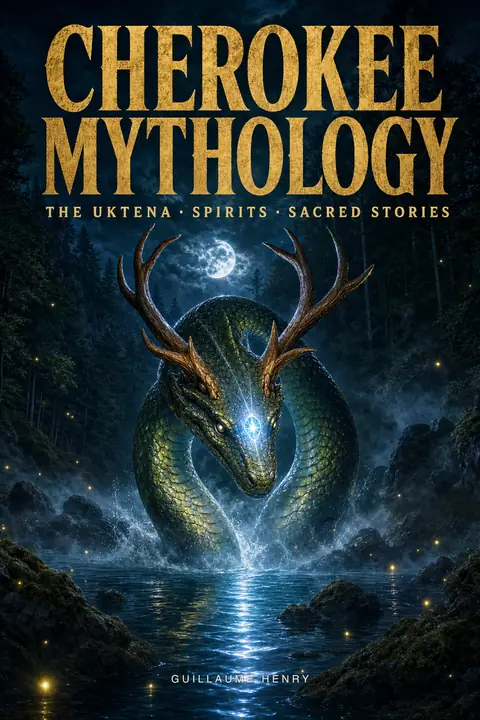
The Cherokee Mythology Book: The Uktena, the Spirits, and the Sacred Stories
The Uktena, the Spirits, and the Sacred Stories
The sacred stories of the Cherokee: how the world was made on the back of a water beetle, the horned serpent Uktena and its blazing crystal, the Little People who live inside the mountains, and the medicine that holds it all together. Recorded from the elders before it could be lost.
More from Cherokee
All articles
Cherokee
The Trail Where They Cried: Mythology and Memory of Removal
The Trail of Tears reshaped Cherokee mythology itself. Discover how forced removal in 1838-1839 became a sacred narrative of survival, covenant, and the land's eternal connection to a people who refused to disappear.

Cherokee
The Seven Clans: Cherokee Social and Spiritual Structure
The Cherokee nation organized itself through seven matrilineal clans, each with its own spiritual role, animal symbol, and responsibility to the people. Discover how this ancient system shaped Cherokee law, kinship, identity, and survival for centuries.
Cherokee
Sequoyah: Creator of the Cherokee Syllabary
Sequoyah invented a written system for the Cherokee language in just 12 years, transforming a spoken-only tradition into a literate nation. His genius was practical, not mystical: he saw that other peoples had captured their words on paper, and he figured out how.
Cherokee
The Green Corn Ceremony: Cherokee Harvest Renewal Ritual
The Green Corn Ceremony, or Iisgano'asdi in Cherokee, is the nation's most sacred annual gathering: a four-day harvest festival where the people renew their covenant with the Creator, cleanse themselves of past wrongs, and begin the year anew. Discover how a single ear of corn became the axis of Cherokee identity and spiritual restoration.