
Kanati and Selu: The First Man and Corn Mother
Kanati the hunter and Selu the Corn Mother are the founding couple of Cherokee mythology. Their story explains hunger, death, and the sacred bond between humans and the living world.
Contents
The forest was quiet before the boy appeared at the edge of the village. Nobody had sent for him. Nobody knew where he had come from. He called himself Inage Utasunhi, "the Wild Boy," and he told the sons of Kanati and Selu that he had been born from the blood that ran down to the river when Selu washed the game. That single detail, a child formed from the earth itself, tells you almost everything you need to know about how the Cherokee understood life: it rises from ordinary acts, from blood and soil and running water, whether we intend it or not.
Kanati and Selu: The First Man and Corn Mother sit at the center of Cherokee cosmological thought the way Adam and Eve sit inside the Abrahamic traditions, yet the comparison only goes so far. Where that story pivots on transgression and exile, the Cherokee myth pivots on discovery and consequence. Kanati does not fall from grace because he disobeys a god. He loses his easy mastery over game because his sons disobey him. Selu does not fall because of forbidden fruit. She prepares her children for her own death and tells them exactly how to use it. The difference in moral texture between those two structures is enormous.
The myth survives today because the ethnologist James Mooney spent years among the Eastern Band of the Cherokee in the late nineteenth century, recording oral traditions before they could be scattered further by dispossession. His 1900 collection, "Myths of the Cherokee," published by the Bureau of American Ethnology, remains the indispensable primary source for any serious reader. The stories he transcribed carry the cadence of voices that had been telling them for generations around fires in the southern Appalachians.
Kanati, the Lucky Hunter, and His Mastery Over Game
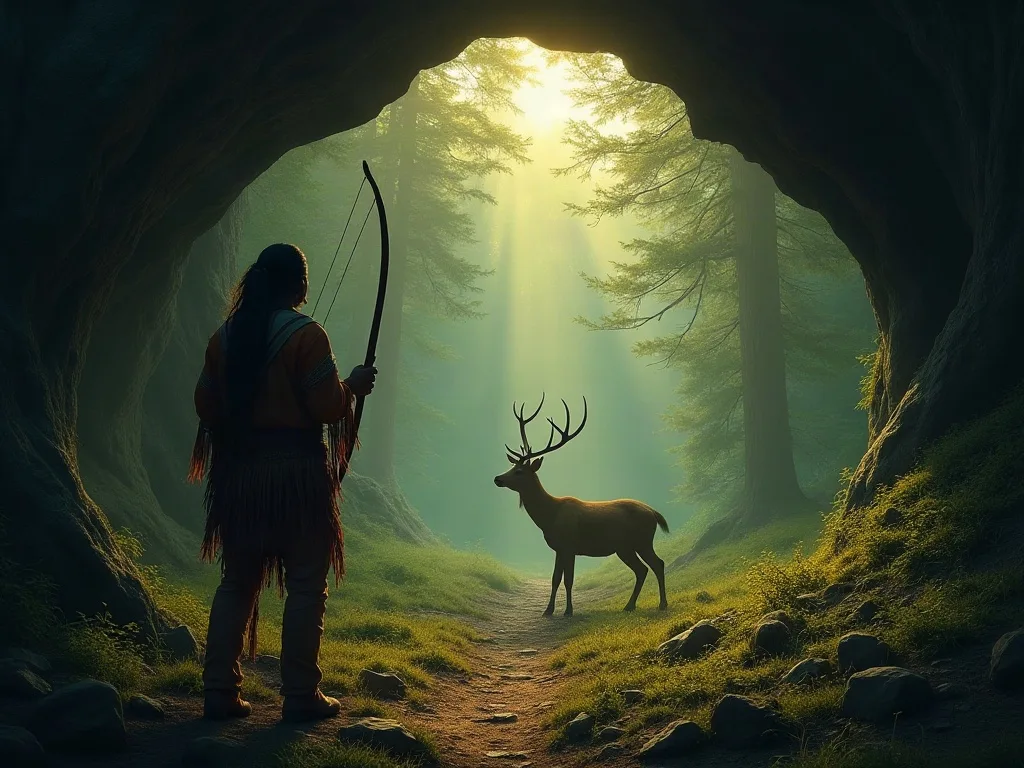
Kanati was not a god in the distant, untouchable sense. He lived in a house. He had a wife and a son. Every day he walked into the hills with his bow and came back with enough meat to feed his family. He never struggled, never came home empty-handed. His son watched and grew curious: how did his father always find the game?
One day the boy followed Kanati into the forest. He watched his father climb to a large rock on the side of a mountain, lever it aside, and wait. A deer walked out of the cave beneath. Kanati shot it, pushed the rock back, and turned for home. The cave, the boy realized, held all the animals of the world, penned there like livestock. Kanati had simply been choosing one each day.
The boy told his new companion, the Wild Boy, what he had seen. The two of them ran back to the mountain, found the rock, and pushed it away. Animals poured out in a torrent: deer, bear, turkey, every creature that had ever lived in that cave. They kept running until the last of them had vanished into the forest. When Kanati returned, the rock lay open and the cave was empty. From that day forward, according to Mooney's record of the tradition, hunters would have to track and work for their prey. The easy abundance was gone.
This moment functions the way many origin myths function: it explains a gap between an idealized past and a harder present. The cave is not imaginary geography. It is a narrative device that holds the question every hunter must have asked: why is this so difficult? The answer the myth gives is concrete and unsentimental. Abundance was squandered by curiosity and impatience. The penalty is permanent.
Kanati's response is interesting. He does not destroy his sons or curse the land. He is angry, but he punishes them by leading them into a series of ordeals, sending them against the Anida'wehi, the Little People, and other spirit beings. The boys survive and prove themselves. The myth is as much about initiation as it is about loss.
Selu, Corn Mother: How She Fed Her Family in Secret
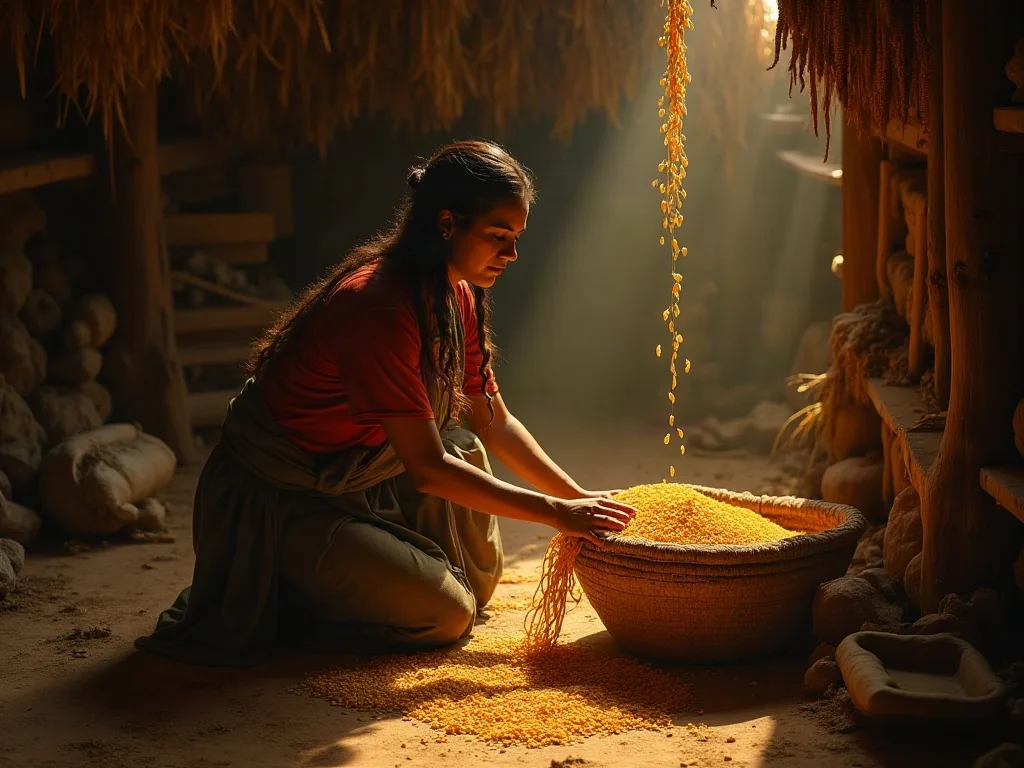
Selu fed her household in a way that was, to her son's eyes, inexplicable. When the family needed corn or beans, she went alone to the storehouse. She came back with a basket full of grain. The boy told the Wild Boy, and together they crept to the storehouse and looked through a gap in the wall.
What they saw frightened them. Selu stood over the basket and rubbed her stomach and her sides, and grain poured from her body into the basket. She was not harvesting. She was producing. Her body was the field.
The boys decided she was a witch. They told each other they would kill her. Selu heard them planning, because she had the knowledge that comes to mothers and to sacred figures who are older than ordinary time. She called her son to her and spoke without anger. She told him: yes, she would die because he had seen her secret. But she gave him instructions. After her death, he should clear a large piece of ground, drag her body over it seven times, and watch through the night. In the morning, corn would grow where her blood had fallen.
The boys killed her. They cleared only two small patches of ground, not the full field she had described. They dragged her body. And in the morning, corn grew, but only in those two small patches, not across the whole earth as Selu had intended. Mooney's text notes this plainly: that is why corn grows only in certain places, why cultivation requires effort and careful ground, why the gift is partial rather than complete.
The act of killing Selu is the hardest part of the myth for modern readers to process. It can look like a story of violence against a woman and against nature. Read more carefully, it is something stranger and more precise. Selu orchestrates her own death. She is not a victim. She is a transformer. Her body becomes the first planted field. The violence is not incidental cruelty; it is the mechanism by which her generative power passes into the earth and becomes available to every future generation. She is closer to the grain goddess Demeter of Greek tradition or to the Mesoamerican corn deity Centeotl than to any passive figure. She chooses the form her gift will take.
The Wild Boy and the Problem of Unintended Consequences
The Wild Boy, Inage Utasunhi, is one of the most quietly unsettling characters in North American mythology. He is not evil. He is not stupid. He is simply without the socialization that keeps curiosity inside safe limits. He is the part of human nature that acts before it thinks about what it will break.
His origin is instructive. He formed from the blood Selu washed into the river when she cleaned the game Kanati brought home. He is a byproduct. Nobody planned him. He arrived at the edge of the village one day and attached himself to the family because he recognized something of himself in the legitimate son.
Together, the two boys form a single psychological unit: the son who knows the rules and the son who does not. When they act together, they consistently undo the structures Kanati and Selu built. They open the cave. They spy on the storehouse. They make the decision to kill Selu. In most of Mooney's recorded variants, neither boy is presented as the sole culprit. They are co-conspirators, and the guilt is shared. This is not a myth that believes in easy scapegoats.
After Selu's death, the Wild Boy takes the boys on a journey toward the setting sun, following the path of the spirits westward. This westward direction carries weight in Cherokee geography. The direction of the dead, in many Southeastern traditions, is west. The boys are, in some sense, following their mother into the place she has gone. They do not reach her. But the journey changes them.
Animals, Plants, and the Sacred Contract That Was Broken
The liberation of the animals from Kanati's cave and the death of Selu are not isolated events in the Cherokee mythic structure. They belong to a larger account of the relationship between human beings and the rest of the living world, one in which that relationship was once intimate and balanced and has since been damaged.
James Mooney also recorded the associated story of how animals gained the right to send diseases to humans. After human hunters began killing animals carelessly (partly because the animals were now free and harder to kill, and partly because the old respect had eroded), the animals held a council. Each species chose a disease to inflict on the people who disrespected them. The plants, hearing about this, took pity on humans and chose to provide remedies for each disease. That is the mythological explanation for Cherokee botanical medicine: every illness sent by an animal has a plant cure, because the plants made a separate covenant with humanity.
This is where the Kanati and Selu cycle opens into something much broader than a family story. It is a complete ecological theology. Kanati's cave represents the original covenant in which humans were given meat without earning it. Selu's body represents the original covenant in which humans were given grain without planting it. Both covenants are broken by human action. The world that results is the world we actually inhabit: one where food requires work, where illness is real, where the living world is in complicated negotiation with humanity rather than simply providing for it.
The Cherokee word for this balance is sometimes glossed as duyuktv, a concept of right living or natural order. Kanati and Selu embody its original form. Their story traces exactly how it was disrupted and what that disruption costs.
Selu's Descendants: Corn in Cherokee Ceremonial Life
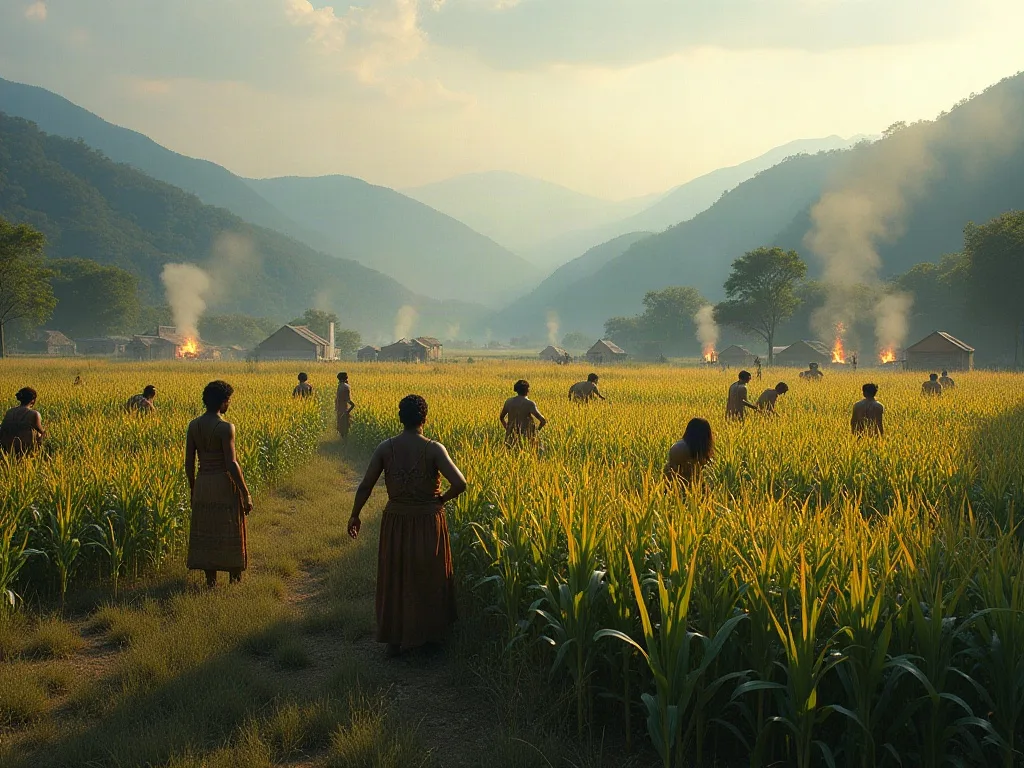
Corn occupied the center of Cherokee ceremonial life in ways that only make full sense against the backdrop of the Selu myth. The Green Corn Ceremony, practiced across much of the Southeastern Woodlands and recorded among the Cherokee by multiple observers in the eighteenth and nineteenth centuries, marked the ripening of the first corn as a sacred moment of communal renewal. Debts were forgiven. Old conflicts were set aside. Fires were extinguished and relit. The physical corn being celebrated was understood, at some level, as Selu's ongoing gift, renewed each year.
The seven varieties of corn that Cherokee tradition preserved carried names and histories. Each planting season renewed the contract Selu had written with her body. The woman who tended the corn was, in this symbolic frame, participating in the same act of transformation that Selu herself performed.
Scholars of Southeastern Indigenous religion, including Charles Hudson in his 1976 study "The Southeastern Indians," have noted how deeply agricultural mythology shaped the ceremonial calendar of Cherokee and neighboring peoples. Hudson's work situates the Cherokee Green Corn Ceremony within a regional complex that stretches from the Muscogee (Creek) to the Seminole, each variation preserving a version of the sacred relationship between women, corn, and communal life.
The myth also informed gender roles in a specific way. Among the Cherokee, agriculture was traditionally women's domain. The fields belonged to the clan matrilineages. Men hunted. Women farmed. Kanati and Selu encode this division not as arbitrary custom but as cosmic structure: the man goes out for meat, the woman's body produces grain. The complementary roles are written into the founding story.
Cross-Cultural Echoes: Corn Mothers Across the Americas
Selu is not unique in world mythology, but she is unusually clear in her logic. Corn mother figures appear across the Americas with striking regularity, each encoding a similar truth: that agricultural abundance comes from a kind of death, a sacrifice of the body into the soil.
The Penobscot tradition of the northeastern woodlands tells of Corn Mother, who similarly instructs her husband to kill her and drag her body over the ground before corn appears. The Arikara of the Great Plains have their own Corn Mother, Mother Corn, who leads the people upward from beneath the earth and teaches them planting. Further south, among the Maya, the Popol Vuh tells how the first human beings were literally shaped from maize dough by the creator gods Tepeu and Gucumatz. Human flesh and corn are the same substance.
The Aztec deity Chicomecoatl, goddess of mature corn, and the maize god Centeotl form a complex that echoes Selu's double nature: the corn is both food and sacred being, both plant and person. The pattern across these traditions suggests something about how early agricultural societies processed the psychological weight of farming, the killing of seed in the earth to produce food, the dependence of life on a form of death.
What separates Selu from many analogues is her voice. She speaks. She instructs. She accepts her fate without resentment and makes sure her gift survives her. She is not a passive symbol. She is an agent who arranges her own transformation.
Kanati and Selu in the Living Cherokee Tradition
The story of Kanati and Selu is not an artifact. The Eastern Band of Cherokee Indians, whose territory sits in the Qualla Boundary in western North Carolina, has maintained continuous connection to these traditions through language revitalization programs, the Cherokee cultural programs at the Museum of the Cherokee Indian in Cherokee, North Carolina, and through the oral tradition itself.
Storytelling remains a living practice. The versions James Mooney recorded in the 1890s are not the only versions. Cherokee storytellers have continued to shape and interpret the cycle through the twentieth and into the twenty-first century. Marilou Awiakta, a Cherokee writer and poet, reinterprets the Selu mythology in her 1993 book "Selu: Seeking the Corn-Mother's Wisdom," connecting it to contemporary ecological thinking and the question of how modern societies might recover a respectful relationship with the living world.
This continuity matters. The myth is not a museum piece. It is one end of a conversation that Cherokee people are still having. Any account of Kanati and Selu that treats it purely as ancient folklore is missing the point. It is also a living argument about how human beings should relate to the land, to animals, to the cycles of growth and death that make food possible.
For readers who want to trace how Cherokee mythological traditions fit into the broader landscape of Native American mythology, the range is vast: from the creation accounts of the Iroquois Sky Woman to the trickster cycles of the Pacific Northwest. The Kanati and Selu cycle is among the most philosophically complete of all North American foundational myths, and it rewards repeated reading.
Frequently Asked Questions About Kanati and Selu
Frequently asked questions
Who are Kanati and Selu in Cherokee mythology?
Kanati, whose name means "Lucky Hunter," and Selu, whose name means "corn," are the original couple in Cherokee foundational myth. They represent the two pillars of traditional Cherokee life: hunting and agriculture. Their story, recorded primarily by James Mooney in his 1900 collection "Myths of the Cherokee," explains why food requires human effort and how the world moved from a state of easy abundance to one where both meat and grain must be worked for.
Why does Selu ask her sons to kill her?
Selu does not simply ask to be killed. She accepts that her sons have discovered her secret and that, by the logic of sacred knowledge, her death is now inevitable. Rather than resisting it, she turns it into a gift. She instructs her son to drag her body over cleared ground so that corn will grow where her blood falls. Her death is not a punishment; it is a transformation. She converts her own body into the first planted field, passing her generative power into the earth so that future generations can benefit from it.
What is the significance of the Wild Boy in the Kanati and Selu myth?
The Wild Boy, called Inage Utasunhi in Cherokee, formed spontaneously from the blood Selu washed into the river. He is not malicious but is entirely unsocialized, with no understanding of boundaries or consequences. Together with Kanati's legitimate son, he opens the cave that held all the game animals and spies on Selu's secret method of producing corn. He functions in the myth as the personification of unregulated curiosity, the human tendency to investigate and act before considering what will be lost. His presence in the story means that blame for the disruption of the original order is always shared rather than placed on one individual.
How does the Kanati and Selu myth relate to Cherokee ceremonies?
The Green Corn Ceremony, practiced among the Cherokee and other Southeastern peoples, directly reflects the Selu mythology. When the first corn ripened each year, communities would extinguish old fires and light new ones, forgive debts, and celebrate the return of Selu's gift. The physical corn was understood as the ongoing form of Selu's sacrifice, renewed each planting season. Charles Hudson's 1976 study "The Southeastern Indians" documents the ceremonial complex in detail and situates it within the broader regional tradition.
Where can I read the original Kanati and Selu stories?
The most comprehensive primary collection is James Mooney's "Myths of the Cherokee," published in 1900 as part of the 19th Annual Report of the Bureau of American Ethnology. It is available in the public domain and contains multiple variants of the Kanati and Selu cycle alongside hundreds of other Cherokee oral traditions. Marilou Awiakta's "Selu: Seeking the Corn-Mother's Wisdom" (1993) offers a Cherokee writer's own engagement with the myth and its contemporary relevance.
Is the Selu myth connected to other Corn Mother traditions in the Americas?
Yes, and the connections are striking. The Penobscot tradition includes a Corn Mother who instructs her husband to kill her so corn can grow. The Arikara have Mother Corn, who leads the people upward from the earth and teaches planting. Maya tradition in the Popol Vuh holds that the first humans were made from maize dough. These parallels suggest a widespread understanding across early agricultural cultures that grain cultivation is inseparable from sacrifice: that food grows from a form of death, and that the earth itself is a transformed being.
What the Corn Mother Still Teaches
Selu's logic holds up in ways that have nothing to do with the supernatural. She understood that the way you receive a gift determines whether it lasts. Her sons received corn effortlessly, then spied on the source, then destroyed it, and got something smaller and harder in return. That sequence is not ancient history. It describes a pattern in the relationship between industrial civilization and the living systems it depends on.
Marilou Awiakta made this argument directly in "Selu: Seeking the Corn-Mother's Wisdom," connecting the Cherokee myth to questions about genetic modification of corn, soil health, and the kind of reciprocal awareness that sustains agriculture over centuries rather than decades. She did not need to strain the metaphor. Selu's instructions were already ecological: clear the ground with care, treat the body of the earth with respect, and the gift will return. Skip those steps, as the boys did, and the harvest will always be smaller than it could have been.
The myth also holds open a question about knowledge and its costs. Kanati knew where the animals were. Selu knew how grain was made. That knowledge allowed them to provide for their family. When their sons forced that knowledge into the open, the easy version of it was gone forever. What replaced it was not ignorance, but the harder kind of knowing: the knowledge that requires patience, skill, and an ongoing relationship with the world rather than a one-time extraction from it.
That is the enduring argument of the Kanati and Selu cycle. The original abundance is gone. But its logic, the logic of reciprocity and care, is still available to anyone willing to work within it.
Read the full book
Want the whole story?
The complete edition is an instant PDF download here, with a paperback on Amazon for selected titles.
Cherokee
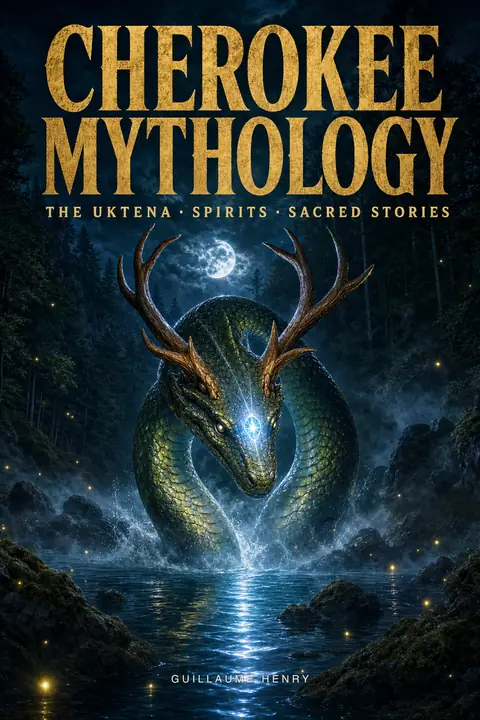
The Cherokee Mythology Book: The Uktena, the Spirits, and the Sacred Stories
The Uktena, the Spirits, and the Sacred Stories
The sacred stories of the Cherokee: how the world was made on the back of a water beetle, the horned serpent Uktena and its blazing crystal, the Little People who live inside the mountains, and the medicine that holds it all together. Recorded from the elders before it could be lost.
More from Cherokee
All articles
Cherokee
The Trail Where They Cried: Mythology and Memory of Removal
The Trail of Tears reshaped Cherokee mythology itself. Discover how forced removal in 1838-1839 became a sacred narrative of survival, covenant, and the land's eternal connection to a people who refused to disappear.

Cherokee
The Seven Clans: Cherokee Social and Spiritual Structure
The Cherokee nation organized itself through seven matrilineal clans, each with its own spiritual role, animal symbol, and responsibility to the people. Discover how this ancient system shaped Cherokee law, kinship, identity, and survival for centuries.
Cherokee
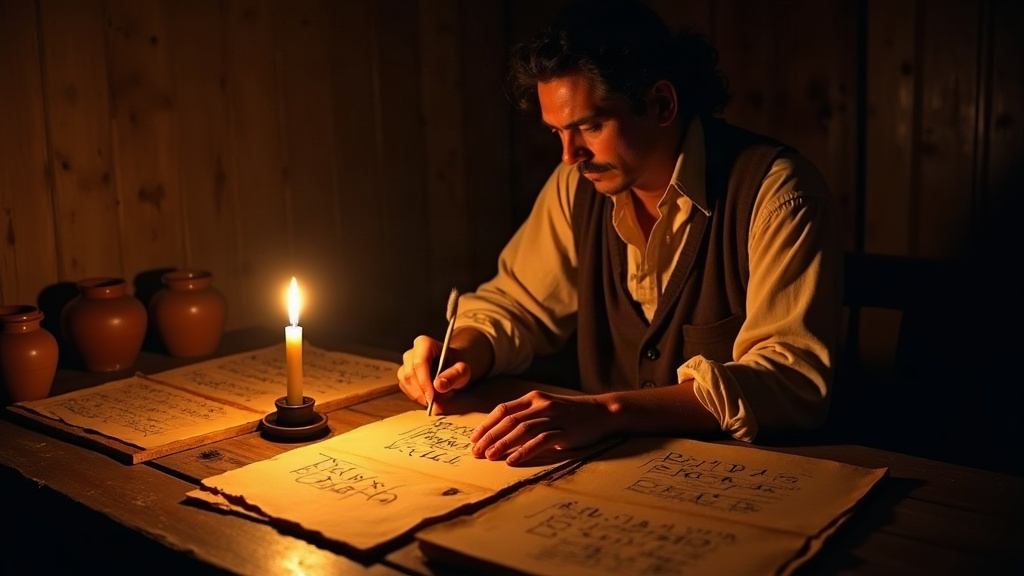
Sequoyah: Creator of the Cherokee Syllabary
Sequoyah invented a written system for the Cherokee language in just 12 years, transforming a spoken-only tradition into a literate nation. His genius was practical, not mystical: he saw that other peoples had captured their words on paper, and he figured out how.
Cherokee
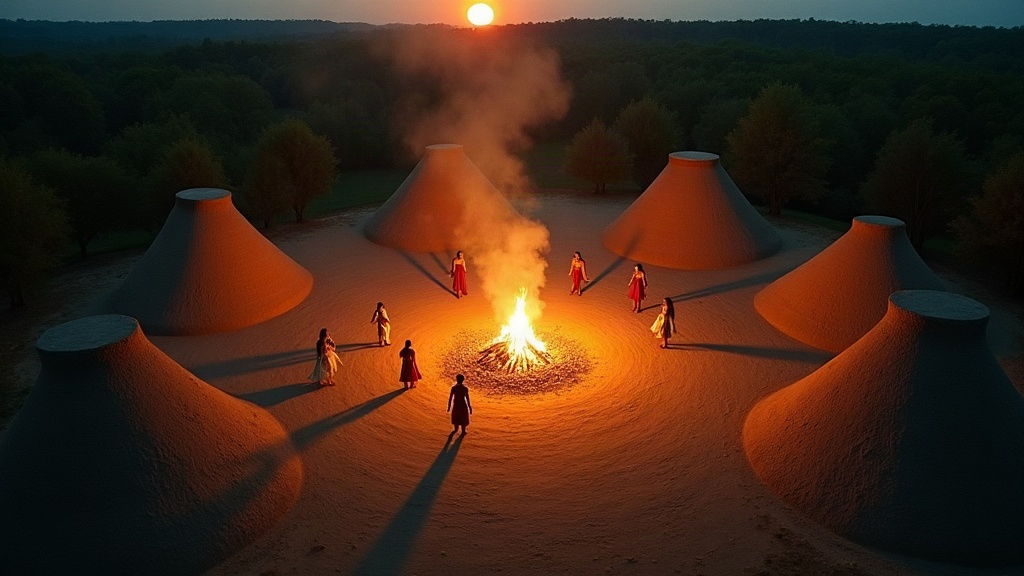
The Green Corn Ceremony: Cherokee Harvest Renewal Ritual
The Green Corn Ceremony, or Iisgano'asdi in Cherokee, is the nation's most sacred annual gathering: a four-day harvest festival where the people renew their covenant with the Creator, cleanse themselves of past wrongs, and begin the year anew. Discover how a single ear of corn became the axis of Cherokee identity and spiritual restoration.