

Qallupilluit: Child-Snatching Water Spirits of Inuit Mythology
The Qallupilluit lurk beneath Arctic sea ice, pulling disobedient children into the deep. Discover the Inuit mythology, symbolism, and survival wisdom behind these terrifying water spirits.
Contents
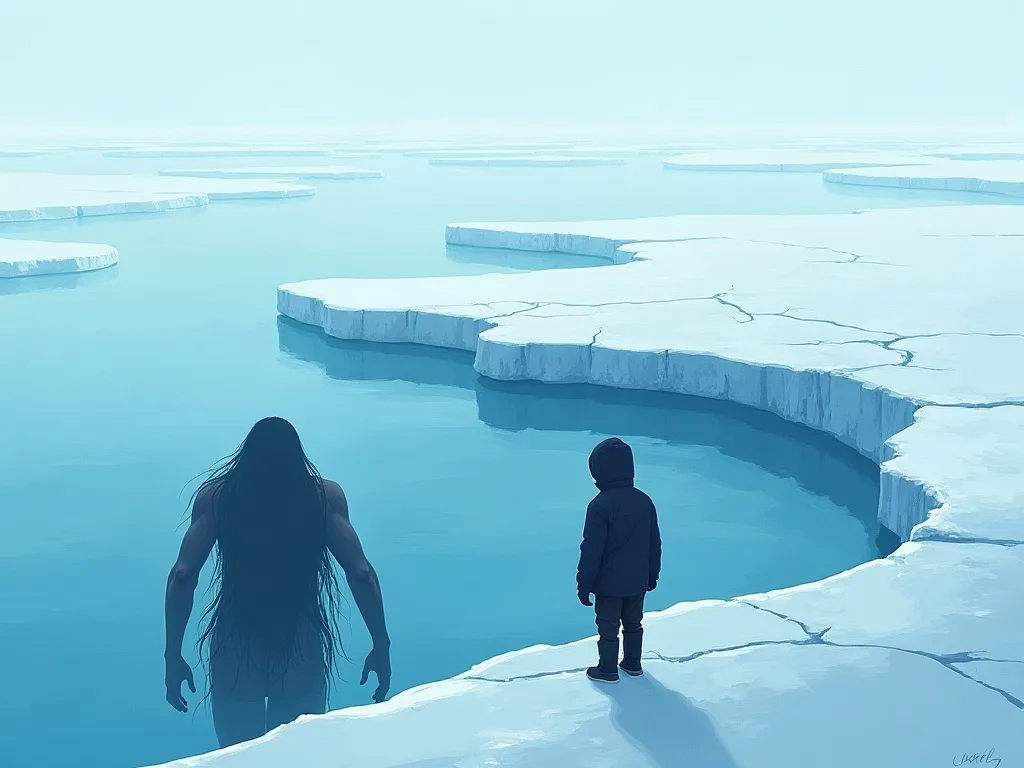
The ice groans. A child stops walking and looks down. Beneath the frozen skin of the sea, something looks back.
That is the moment the Qallupilluq wants. It has been waiting in the cold dark, listening for the sound of small feet on unstable ice, patient as the Arctic winter itself. Inuit parents across the circumpolar north have warned children about this creature for generations, and the warning was never just a story told to scare. It was knowledge passed down because the Arctic is genuinely lethal, and a moment of carelessness near cracking sea ice can kill a child in seconds. The story was the safety lesson.
Qallupilluit: child-snatching water spirits occupy one of the most vivid corners of Inuit oral tradition. They are not background monsters. They are active, purposeful, and deeply tied to the values, fears, and practical wisdom of the peoples who created them.
What the Qallupilluq Looks Like
Descriptions of the Qallupilluq differ slightly from community to community, but the outline is always unsettling. She is described as a woman-like figure with long, wet hair that spreads across the ice like dark water. Her hands are webbed. Her skin carries the greenish-grey pallor of something that has lived too long beneath freezing water. Some accounts give her a amauti, the traditional Inuit woman's parka with an oversized pouch at the back used to carry infants. The Qallupilluq uses that pouch as a snare: she carries stolen children against her back, submerged beneath the ice, the way a real mother carries a beloved baby.
That detail matters. The creature does not simply grab and devour. She takes children away to raise them, to keep them. In some versions of the story, the children are never harmed in an obvious physical sense. They are simply gone. Taken into another world that exists just below the surface of the one we can see.
Accounts collected by researchers working with Inuit communities, including material in Kenn Harper's writings on Arctic oral tradition, describe the Qallupilluq as making a strange sound beneath the ice: a humming, a tapping, or a keening wail. Children who press their ears to the ice, drawn by curiosity, can hear it. This auditory detail has the ring of lived observation. Arctic sea ice does produce eerie groans and tones as it contracts and expands. The story transforms that real, strange sound into a warning sign.
The Creature's Origins in Inuit Oral Tradition
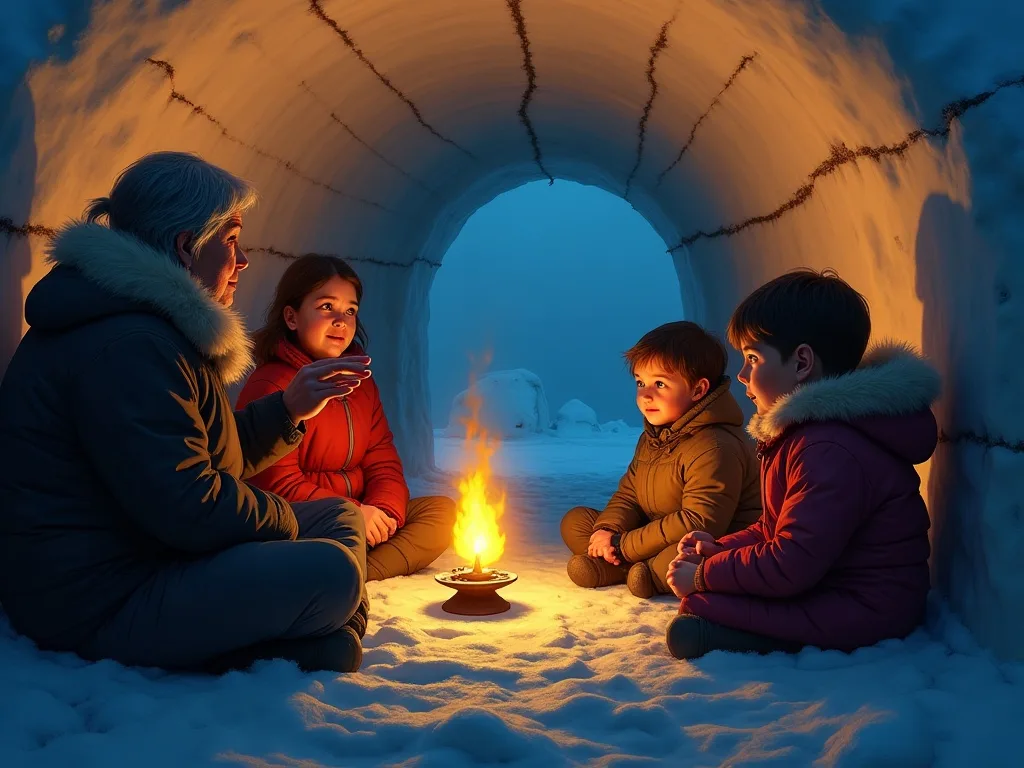
Inuit oral tradition does not come from a single written text the way Greek mythology comes partly from Hesiod's Theogony (a Greek poem from around 700 BC). Inuit stories existed, and still exist, as living spoken narratives, told and retold across the qaggiit (communal gatherings, often held in large snow houses built for that purpose during winter). They were not transcribed until the nineteenth and twentieth centuries, when missionaries, anthropologists, and later Inuit scholars began setting them down.
The Qallupilluq appears in records from Nunavut (the vast Canadian territory that became officially recognized in 1999), from northern Quebec (Nunavik), from Alaska, and from Greenland, where related figures carry different names but share the same structural role. This geographic spread suggests the creature belongs to a very old stratum of Arctic storytelling, older than any surviving written account.
Anthropologist Kira Van Deusen, in her work on circumpolar oral traditions, notes that spirits associated with water and with the theft or protection of children appear across the entire polar belt from Siberia to Greenland. The Qallupilluq sits inside this pan-Arctic imaginative world, where water is the boundary between the living and the dead, the known and the unknown.
In Inuit cosmology, the sea is not background. It is a living world with its own rules and powers. The great sea spirit Sedna (also called Nunavut's Nunavut's Sanna or Arnaqquassaaq depending on dialect) rules the ocean depths and governs the availability of marine animals. The Qallupilluq operates in the same conceptual space: the water world beneath the ice, where human rules no longer hold.
Why She Takes Children: The Logic Behind the Abduction
Stories rarely explain the Qallupilluq's motivation in the way a modern novel would. The tradition does not offer her a backstory or a trauma that justifies her behavior. She takes children because that is what she does. That is her nature, the way the Arctic fox takes lemmings.
But scholars reading these stories carefully have identified several layers of meaning. The most immediate is practical: Inuit communities depended on children staying close and obeying adults, especially near water. Sea ice in the Arctic can look stable and feel solid underfoot while hiding thin patches that open without warning. A child who ran onto uncertain ice could vanish in moments. The Qallupilluq is, on one level, a story that encodes this danger so memorably that no child who heard it would forget it.
There is a second layer. In the context of Inuit society, children who were disobedient or who wandered outside the community's protective circle created real social risk. Communities were small, resources were tight, and the loss of a child was a catastrophe. Stories about what happens to children who don't listen function in many cultures as a kind of communal parenting tool. The Qallupilluq does what parents alone cannot: she makes disobedience feel cosmically dangerous.
A third layer, harder to pin down, involves the relationship between the living world and the spirit world in Inuit thought. Inuit religious practice, particularly the tradition called Angakkuuniq (the practice of the angakkuq, the shaman or spiritual specialist), holds that spirits of various kinds inhabit the landscape and that human behavior affects the balance between the human and spirit worlds. A child taken by the Qallupilluq has crossed a boundary she was never supposed to cross. The story is about limits, about the membrane between worlds, and about what happens when that membrane is breached.
Regional Variations: From Nunavut to Alaska
The Qallupilluq is not one fixed figure. She shifts depending on where the story is told.
In Nunavut, the creature is most often described as female and as dwelling specifically under sea ice. She targets children near frozen ocean shores or river mouths. The amauti motif, the child carried in the back pouch, appears frequently here.
In Nunavik (northern Quebec), accounts recorded by researchers at the Avataq Cultural Institute describe a slightly different emphasis: the creature is drawn specifically by the sound of children playing on ice, and she is said to have long fingernails she uses to scratch the ice from below, testing its thickness, looking for a thin place she can break through.
In Greenlandic tradition, the equivalent figure sometimes called Qalupalik takes on slightly different physical characteristics, with some descriptions emphasizing a fish-like lower body. This version feels closer to a mermaid archetype, though scholars are careful to note that the cultural logic remains distinctly Inuit rather than European.
In parts of Alaska, related water spirits with different names perform similar roles. The Yup'ik tradition (the Yup'ik are a distinct people from the Inuit but share broad cultural and geographic territory across western Alaska) includes figures that guard water edges and warn against careless behavior near rivers and ocean shores. The structural parallel is strong even where the name differs.
This variation is not inconsistency. It reflects the living nature of oral tradition, where stories adapt to local geography, seasonal conditions, and community needs. A story told near the ocean will emphasize sea ice differently from one told near a river delta.
The Qallupilluq in Modern Inuit Culture
The creature has had a striking afterlife in contemporary Inuit art and storytelling. Michael Kusugak, the celebrated Inuit children's author from Rankin Inlet, Nunavut, wrote A Promise is a Promise (1988), co-authored with Robert Munsch, which brought the Qallupilluq to a wide audience. Kusugak had heard the stories as a child and understood them as both a safety tool and a piece of genuine cultural heritage worth preserving. The book describes a girl named Allashua who ignores the warning, encounters the Qallupilluit, and must be rescued by her mother's quick thinking and a bargain struck with the spirits.
The story is notable because it does not defang the creature. The Qallupilluq are genuinely frightening in the book, and the mother's solution is a genuine negotiation with something that has real power. Kusugak's version holds to the tradition's core principle: the spirits are not eliminated or destroyed. They are managed, appeased, bargained with. That reflects Inuit spiritual logic far more honestly than a story where the monster is simply defeated.
Zacharias Kunuk, the Inuit filmmaker famous for Atanarjuat: The Fast Runner (2001, the first feature film written, directed, and acted entirely in Inuktitut), has spoken about the Qallupilluq in the context of Inuit stories that deserve cinematic treatment. The creature appears in animated form in a National Film Board of Canada short, keeping its traditional visual language alive for new generations.
Comparing the Qallupilluq to Water Spirits in Other Traditions
Water spirits that take children are not unique to Inuit tradition. The comparison is worth making carefully, because it illuminates what makes the Qallupilluq distinctly Inuit even while she belongs to a broader human pattern.
Qallupilluq (Inuit)
A cold-water spirit dwelling under Arctic sea ice. Primarily targets children near thin ice. Often depicted with an amauti pouch for carrying her taken victims. Her danger is tied to physical survival in a genuinely lethal landscape. Bargaining or negotiation is possible, as in Kusugak's story. Reflects Inuit values around community obedience and the boundary between human and spirit worlds.
Rusalka (Slavic)
A Slavic water spirit, typically the ghost of a young woman who died violently or before marriage. She inhabits rivers and lakes. She lures men and occasionally children to drown. Her motivation is grief, longing, and revenge rather than the enforcement of communal rules. Exorcism or religious ritual, rather than negotiation, is typically offered as the solution. Reflects Slavic concerns about unquiet dead and improper burial.
The Rusalka of Slavic tradition and the Qallupilluq share the basic grammar of dangerous female water spirits who pull humans under. But their cultural logic is almost opposite. The Rusalka is a ghost acting from unresolved personal tragedy. The Qallupilluq is a spirit acting from a kind of territorial or custodial instinct. She is not grieving. She is claiming.
The Irish each-uisce (say "ach-ISH-keh"), the water horse that lures riders into lakes, works by seduction and speed rather than by listening for children. Japan's kappa, a river creature from Japanese folklore, grabs children and adults from water's edge, sharing the Qallupilluq's habitat logic while being distinctly different in appearance and cultural meaning. The Kappa of Japanese mythology is sometimes comic, sometimes deadly, and always tied to specific river geography in ways that echo how the Qallupilluq is tied to sea ice conditions.
What these figures share is the use of water as a threshold, a place where human control ends and something older begins.
The Qallupilluq and the Practice of Inuit Shamanism
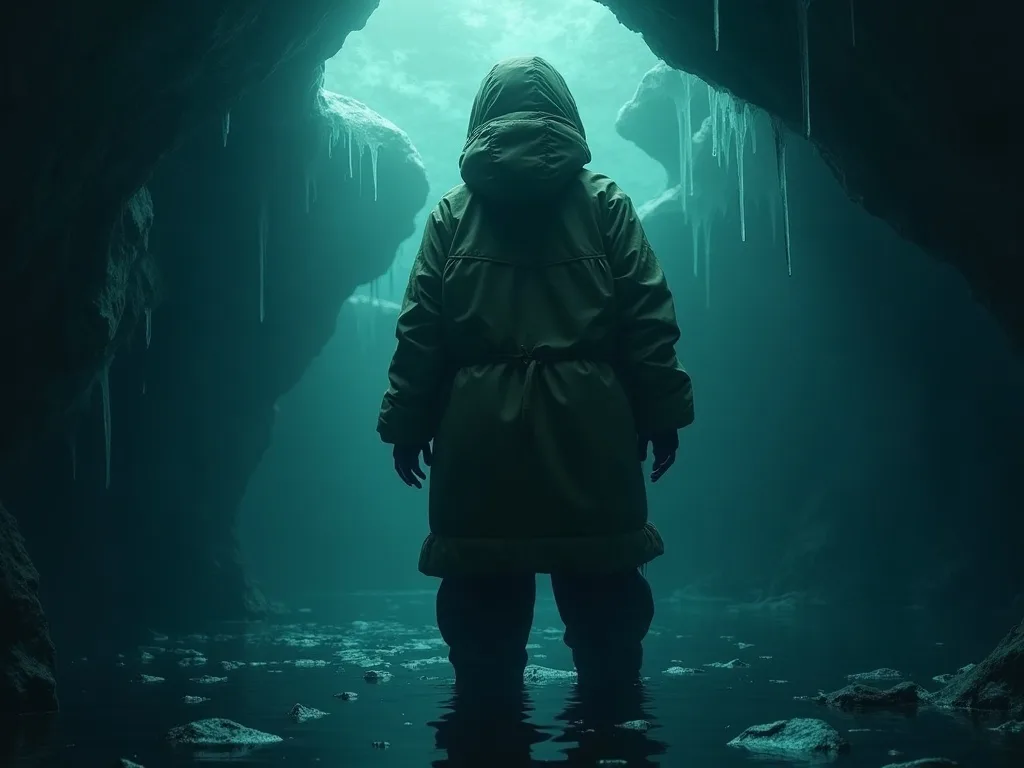
The Qallupilluq does not exist in isolation from the broader Inuit spirit world. She is part of a landscape populated by inuat, meaning "the inhabitants" in Inuktitut: the spirits that inhabit specific places, animals, and natural forces. Every seal, every polar bear, every particular stretch of ice has, in traditional Inuit thought, an animating spirit that must be respected.
The angakkuq (shaman) was the specialist who navigated this world. During trance states induced through drumming and isolation, the angakkuq could send his or her soul out to negotiate with spirits, retrieve lost souls, and restore the balance that human wrongdoing had disrupted. A child taken by the Qallupilluq, in this framework, represents a rupture in the community's relationship with the spirit world, one that might require the angakkuq's intervention.
Ethnographer Knut Rasmussen, who traveled across the Arctic between 1921 and 1924 on the Fifth Thule Expedition (one of the most thorough early studies of Inuit culture ever conducted), recorded extensive testimony from angakkuit (plural of angakkuq) about the spirit landscape they navigated. His transcriptions, published in multiple volumes, describe a world where spirits of water, ice, and wind are active forces that respond to human behavior. The Qallupilluq fits perfectly inside this recorded cosmology.
The creature also carries a faint echo of a major Inuit theological idea: that the spirit world does not punish randomly. It responds. If children are on the ice in unsafe conditions, they are, in a sense, making an invitation. The Qallupilluq accepts it. This is not cruelty. It is the working-out of a system where actions have consequences that extend beyond the visible world.
Frequently Asked Questions About the Qallupilluq
Frequently asked questions
Is the Qallupilluq always depicted as female?
In the vast majority of recorded accounts from Nunavut, Nunavik, and Greenland, the Qallupilluq is female. This makes intuitive sense given the amauti (the Inuit woman's back-pouch parka) motif: she carries stolen children the way an Inuit mother carries an infant. Some scholars suggest this also connects the figure to broader anxieties about mothers, belonging, and the danger of being claimed by a nurturing force that is not human. A small number of regional variants describe a male counterpart, but these are minority accounts.
How is the name pronounced, and why are there so many spellings?
The standard Nunavut spelling is Qallupilluq (singular) and Qallupilluit (plural), pronounced roughly "ka-LOO-pil-look" and "ka-LOO-pil-LOO-eet". The variations (Qalupalik, Kallupilluk, Qalupaliq) reflect the genuine diversity of Inuktitut dialects across a territory spanning thousands of kilometers. Inuktitut is not one uniform language; it is a dialect continuum, and the syllabic writing system used in Nunavut differs from the Roman orthography used elsewhere. All spellings point to the same creature.
What primary sources document the Qallupilluq?
The most systematic early documentation comes from Knut Rasmussen's Fifth Thule Expedition reports (published 1929-1932), which recorded oral traditions across Arctic Canada. More recent documentation comes from the Avataq Cultural Institute in Nunavik and from Inuit Tapiriit Kanatami cultural preservation initiatives. Michael Kusugak's 1988 children's book A Promise is a Promise is the most widely read modern retelling. Oral versions continue to circulate actively in Inuit communities and are considered living tradition rather than archived folklore.
Does the Qallupilluq ever return the children she takes?
In most traditional versions, no. Children taken under the ice are simply gone. This finality reinforces the story's warning function: there is no rescue, no second chance. However, in Michael Kusugak's literary retelling, the mother negotiates with the Qallupilluit and secures her daughter's return by promising to send the spirits other children (a darker bargain than it first sounds). This negotiated return reflects traditional Inuit shamanic logic, where spirits can be appealed to, rather than the European fairy-tale logic of defeating the monster outright.
Is the Qallupilluq still believed in today?
Belief exists on a spectrum. In some communities, the Qallupilluq functions primarily as a cultural reference point and a child-safety metaphor that parents use consciously. In others, particularly among elders with strong ties to traditional Inuit Qaujimajatuqangit (Inuit traditional knowledge), the spirit world including figures like the Qallupilluq is treated with genuine respect as a living reality. Inuit scholars have argued that framing these stories purely as folklore or superstition misrepresents their epistemological status within communities that never abandoned the tradition entirely.
The Ice Remembers: What the Qallupilluq Tells Us About Arctic Knowledge
The Qallupilluq is, among other things, a technology of memory. At its most basic, the story encodes knowledge about sea ice: where it is dangerous, how to read its surface, what sounds mean instability, why children should never approach the edge alone. This is Inuit Qaujimajatuqangit, the body of Inuit traditional knowledge, working through narrative.
Climate scientists studying Arctic sea ice have noted that Inuit communities have observed and described ice behavior with precision that modern instruments are only beginning to match. The Qallupilluq story exists within this observational tradition. When elders say she scratches the ice from below, testing for thin spots, they are also describing something real: ice that looks solid can have water moving beneath it that undermines its structure from the underside. The story gives that physical fact a face.
As the Arctic warms and sea ice becomes less predictable, the Qallupilluq's warning becomes, in a strange way, more urgent rather than less. Ice that communities once knew well, that had predictable seasonal patterns, is now shifting. Qallupilluit: child-snatching water spirits are a reminder that the Arctic has always demanded respect, attention, and the willingness to listen when the ice speaks.
Inuit writers and activists have pointed out that the survival of these stories is part of the survival of Inuit identity and autonomy. The Qallupilluq is not a fossil from a vanished world. She is a living part of a living culture, still doing what she always did: keeping children safe by making danger unforgettable.
The ice groans. The smart child steps back.
Read the full book
Want the whole story?
The complete edition is an instant PDF download here, with a paperback on Amazon for selected titles.
Inuit
The Inuit Mythology Book: Sedna, Sila, and the Sacred Stories of Ice, Hunger, and the Sea-Goddess at the Bottom of the World
Shamans, Spirits, and Survival in the Arctic
The mythology of the Arctic peoples: Sedna at the ocean floor, Sila in the wind, and the angakkuq shamans who flew between worlds. Drawn from primary sources.
More from Inuit
All articles
Inuit
Inuksuk: Stone Markers of the Arctic Landscape
The Inuksuk stands as a silent guardian across the Arctic: stacked stones shaped by Inuit hands to guide hunts, mark sacred places, and embody the spirit of community. Learn how these markers bridge the visible and spiritual worlds.

Inuit
The Moon Man and Sun Sister: Cosmic Pursuit Myth
In Inuit cosmology, the Moon Man chases his sister, the Sun, across the sky in an endless celestial pursuit born from darkness and shame. Discover how this myth explains the rhythm of day and night, and why it still echoes in Arctic cultures today.

Inuit
Sila: The Breath of Life and Weather Spirit
Sila is the Inuit spirit of weather, breath, and life force itself, a boundless presence that moves through air and water, sustaining hunters and demanding respect. Discover how Arctic peoples understood this invisible power that controlled their survival.

Inuit
Angakkuit: Inuit Shamans and Spirit Mediators
Angakkuit are the shamans and spirit mediators of Inuit cultures, channeling power from the animal and spirit worlds to heal, guide, and maintain balance between the human and sacred realms. Discover how these intermediaries shaped Arctic survival and cosmology.