
Bladder Festival: Honoring Animal Souls in Inuit Tradition
The Bladder Festival is the most sacred ceremony in Yup'ik tradition, returning animal souls to the sea to ensure the hunt never fails. Learn the ritual, the myth, and the living practice.
Contents
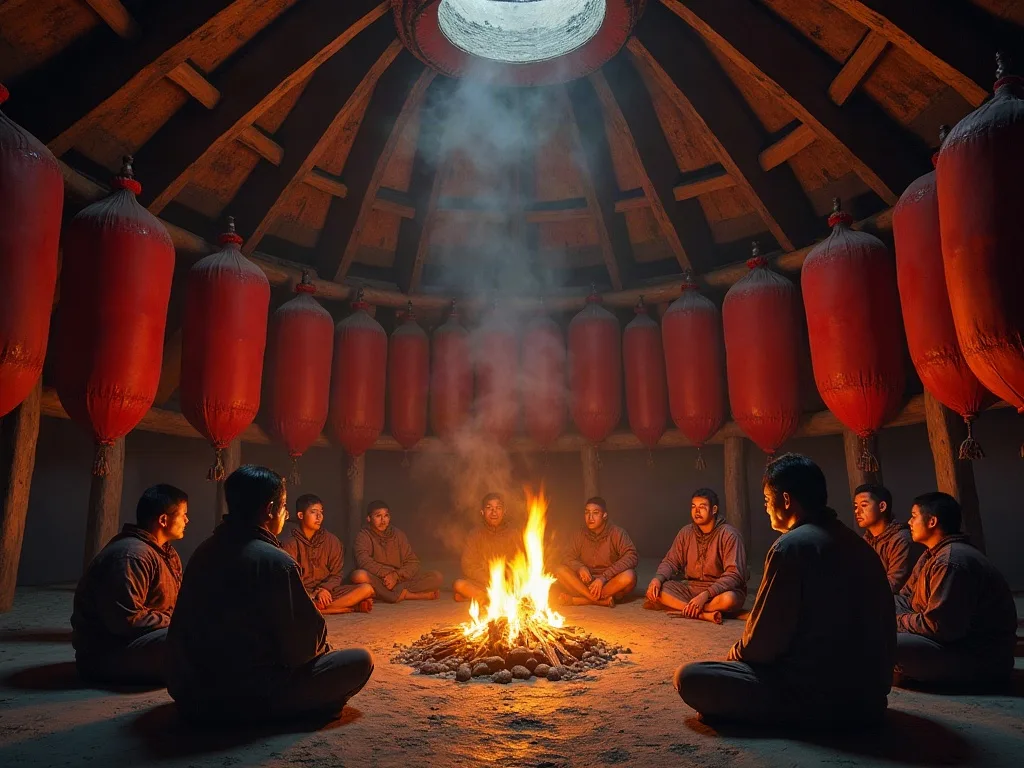
The drums begin before dawn. Inside a community qasgiq (the Yup'ik ceremonial men's house, a semi-subterranean hall of split timber and packed sod), the bladders hang from the ceiling like pale lanterns. Dozens of them. Inflated, painted in red ochre and soot, they sway in the heat of a central fire. Each one belonged, until recently, to a seal. Or a walrus. Or a beluga. Each one, the Yup'ik believe, carries a living soul.
The Bladder Festival: Honoring Animal Souls is one of the most intricate, theologically dense ceremonial cycles in the circumpolar world. Yup'ik communities along the Bering Sea coast and the Yukon-Kuskokwim Delta in Alaska observe it in the depths of winter, typically in late November or December, when the Arctic night is longest and the ice is thick enough to walk on. For five days, the community feeds those souls, dances for them, apologizes for any carelessness in the hunt, and finally returns them to the sea beneath the ice, so they can be reborn in new bodies and come back to be hunted again.
It is not a celebration of human power over animals. It is almost the opposite: a formal acknowledgment that animals choose to give themselves to hunters, and that hunters owe those animals every courtesy, every ritual debt, in return.
The Yup'ik Cosmos: Animals as Persons
To understand the Bladder Festival, you need to understand how the Yup'ik see the animal world.
The Yup'ik are one of the major Inuit and Inuit-related peoples of Alaska. Their territory stretches from Bristol Bay in the south to Norton Sound in the north, a landscape of tundra, delta, open ocean, and sea ice. Subsistence hunting, particularly the hunting of marine mammals, has sustained this world for at least four thousand years.
Yup'ik cosmology holds that the boundary between humans and animals is thin and permeable. In the distant past described in oral traditions, humans and animals could speak to each other and change forms freely. That capacity has largely faded, but the kinship remains. Every seal, every walrus, every salmon carries a yua, a word that translates roughly as "its person" or "its spirit." The yua is not a ghost or a metaphor. It is a real, conscious being that experiences the hunt from inside the animal's body.
Anthropologist Ann Fienup-Riordan, who spent decades working with Yup'ik communities and is the foremost non-Yup'ik authority on this tradition, records elders explaining that seals watch hunters from underwater. A seal will approach a hunter who is respectful, who keeps a clean boat, who treats the carcass properly. A seal will avoid a hunter who is careless or arrogant. The animal is always the active agent in whether it is caught.
This is not unique to the Yup'ik. Similar ideas appear across the circumpolar world, from the Inupiat of northern Alaska to the Inuit of the Canadian Arctic to the peoples of Siberia. But the Yup'ik have developed the ceremonial architecture around this belief more elaborately than perhaps any other group, and the Bladder Festival is the peak of that architecture.
What Is Kept, and Why: The Bladder as Soul-Vessel
After a successful hunt at sea, a Yup'ik hunter does not simply bring the animal home. He observes a sequence of protocols that begin the moment the animal surfaces dead in the water.
The carcass is brought ashore facing upstream or toward the land, depending on local tradition. Fresh water is offered to the animal's mouth, because marine mammals are believed to crave fresh water after a life at sea. The meat is butchered with care. And then the bladder, which Yup'ik hunters identified as the seat of the animal's yua, is removed whole, dried, and saved.
Through the spring, summer, and autumn, these bladders accumulate. Hunters bring them to the qasgiq at the start of the festival period. The bladders are inflated (they had been deflated for storage), decorated, and hung on a wooden rack called a agayutem kangia, which spans the interior of the hall. For the five days of the festival, those bladders are treated as honored guests.
The logic is precise: the yua of the animal is present in the bladder. If you treat it well, feed it, sing to it, dance for it, and ultimately release it with ceremony, it will return to its home in the sea and take on a new body. It will then be available to be hunted again, this time choosing to come to the same hunters who honored its previous life. The festival is therefore not just a religious obligation. It is also, in practical terms, what makes next year's hunt possible.
Elders recorded by Fienup-Riordan in her 1994 study Boundaries and Passages: Rule and Ritual in Yup'ik Eskimo Oral Tradition emphasize that the animals know when they are treated well and when they are not. They communicate this to other animals. A community that is careless with its bladders will find the seals turning away.
The Five-Day Ceremony: Songs, Food, and the Steam Bath
The Bladder Festival follows a structured sequence that varies somewhat by village but holds a recognizable core shape across the Yup'ik world.
On the first day, the bladders are brought into the qasgiq and inflated. Men sweep the hall clean. The smell of woodsmoke and seal oil fills the space. The bladders are hung in rows, each one tagged in some way to identify which hunter caught which animal. This is important: at the end of the festival, each hunter will personally escort his bladders to the ice hole through which they will be returned.
During the festival days, the community enacts several key ritual sequences:
- Feeding the yuat: Food is placed near the bladders at each meal. The souls of the animals eat the yua of the food (its spiritual essence), while the physical food is later consumed by the people. This mirrors the Yup'ik understanding that every material thing has both a physical and a spiritual dimension.
- Dancing and drumming: Men drum inside the qasgiq while women dance in the entryway or in a separate space. The songs performed are specific to the festival, many of them very old, passed down from grandparents. Some songs address the animals directly, apologizing for any disrespect during the year.
- The steam bath: Midway through the festival, the qasgiq fire is built to an intense heat and the men sweat together with the bladders present. Steam baths in Yup'ik culture are both hygienic and deeply ritual. Sweating with the animal souls is a form of shared bodily experience, a statement of kinship.
- Gift exchanges: During the festival, men give gifts, food, and goods to one another and to the community. Generosity during the Bladder Festival is understood to please the animal souls, who value humans who do not hoard.
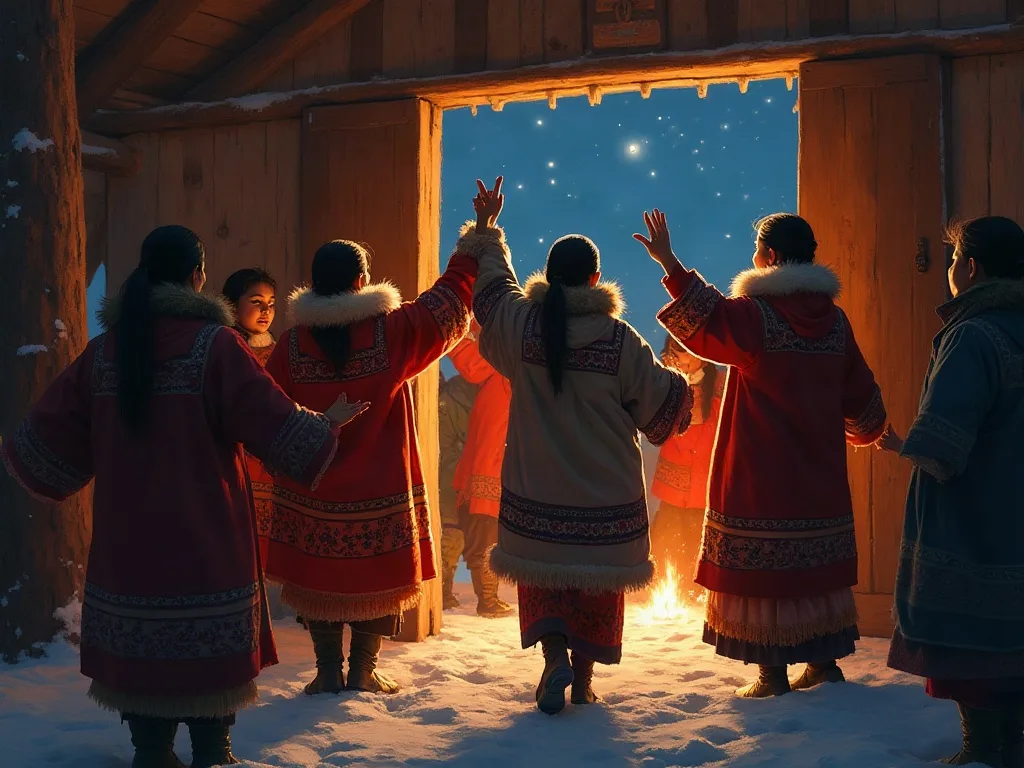
On the final night, the community stays awake until dawn. This is the most solemn period. Songs shift tone. The atmosphere in the qasgiq becomes quiet and concentrated.
Returning the Souls: The Ice-Hole Ceremony
The last act of the Bladder Festival is the one that makes everything else meaningful.
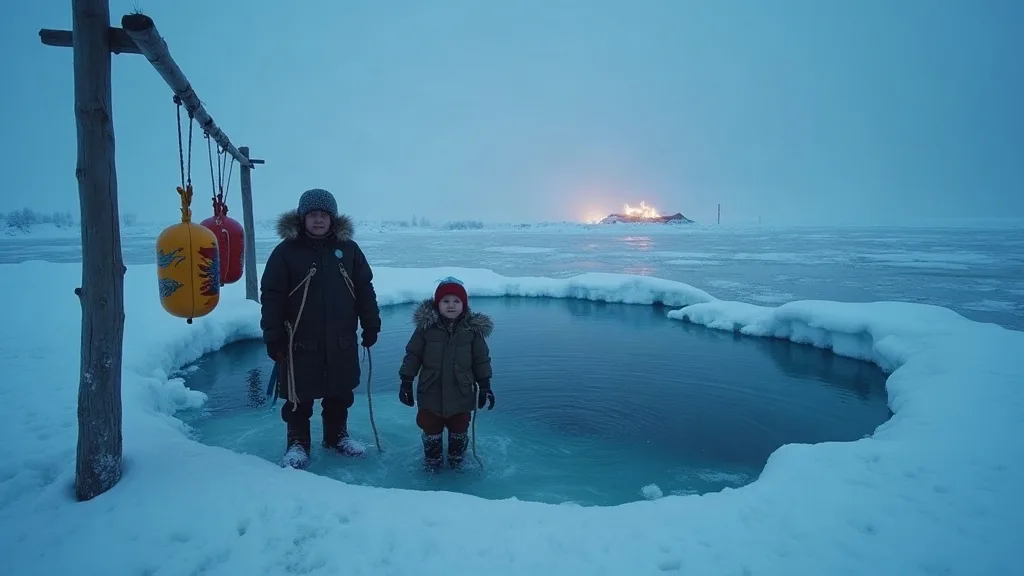
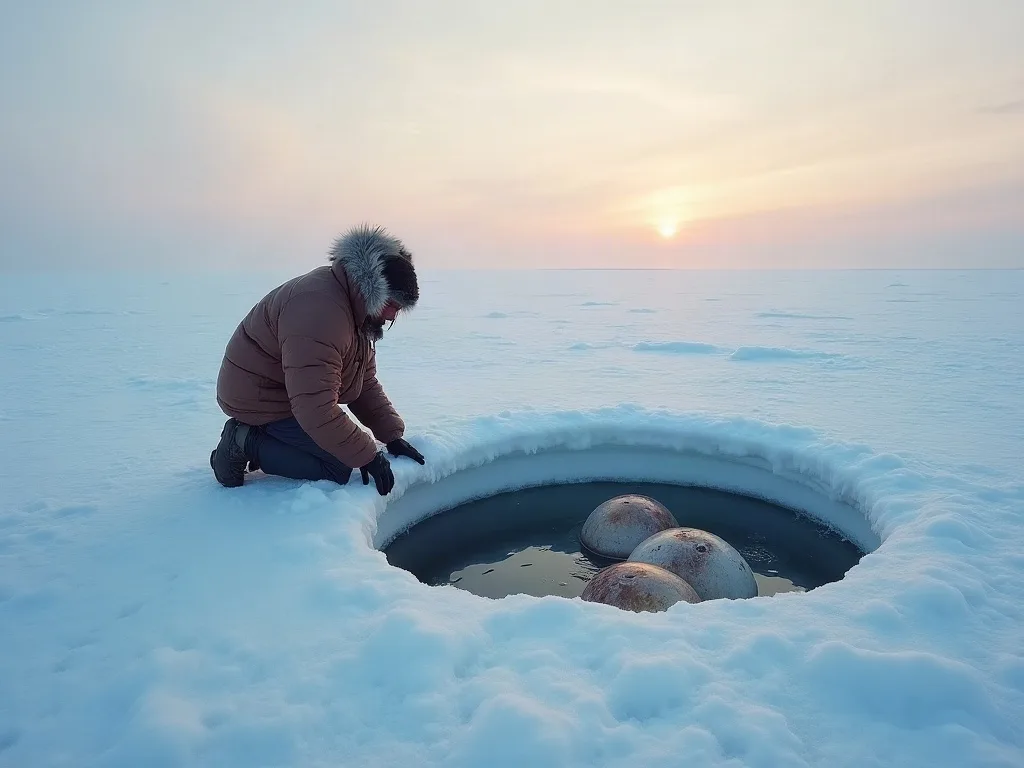
At first light on the final morning, the men carry the bladders out of the qasgiq and across the ice to a hole cut specifically for this purpose. The hole is called an aciiq. Sometimes it was cut directly in front of the village. Sometimes it was cut at a spot considered particularly important for the local seal population.
Each hunter takes his own bladders and pushes them down through the hole into the dark water beneath the ice. As he does so, he speaks to the souls inside. He thanks them. He invites them to return. He may also name a specific elder or skilled hunter in the community, requesting that the yua be reborn near that person so the relationship between hunter and animal can continue.
The bladders sink. The yuat inside them swim free, back into the body of the ocean.
Among Yup'ik communities, elders have described this moment as genuinely emotional, comparable to a farewell to a person you hope to see again. The hunter knows, if he has done everything correctly, that the soul will return. But there is always a sense of responsibility: did we perform every part well enough? Did we sing every song? Did we offer enough fresh water, enough food?
The fear that the ceremony was not performed correctly is not superstition. It is a form of moral seriousness. The animals, in Yup'ik belief, notice. And they respond.
Connected Ceremonies: The Bladder Festival in a Ritual Year
The Bladder Festival did not stand alone. It was part of a ceremonial cycle that organized the entire Yup'ik year, each festival calibrated to a particular relationship between humans, animals, and spiritual forces.
The Nakaciuryaraq (also called the Feast for the Dead) preceded the Bladder Festival by only a few weeks in some communities. In it, the living hosted the dead, fed them, and gave them gifts through the medium of children, who were understood to carry the names and partial identities of ancestors. The dead, like the animal souls, needed to be acknowledged and properly released.
The Kevgiq (the Messenger Feast), held in midwinter, was a massive inter-village exchange event where host communities fed and gifted visiting communities in elaborately choreographed sequences. It reinforced alliances between villages and modeled the same principle of generous circulation that the Bladder Festival applied to the human-animal relationship.
The Agayuyaraq (the Great Feast for the Dead), held every few years, was an even larger-scale ceremony of the same type as the Feast for the Dead, with months of preparation.
What ties all of these together is a single cosmological principle: in the Yup'ik world, nothing should accumulate without being given back. Food, gifts, souls, names, all of them move in cycles, and it is the ceremonies that keep the cycles turning. Stop the ceremonies, and the world stagnates. The animals stop coming. The dead grow restless. The community weakens.
This is not metaphor. It is an operating description of how the universe actually works, as understood by the people who have lived in one of Earth's most demanding environments for millennia.
Suppression and Revival: The Festival After Contact
The arrival of Christian missionaries in the Yup'ik region accelerated dramatically after the 1880s, when American influence consolidated across Alaska. Moravian missionaries settled in the Yukon-Kuskokwim Delta in 1885. Roman Catholic missionaries established presence in other regions. Both groups identified the ceremonial life of Yup'ik communities as incompatible with Christian practice.
The qasgiq itself became a target. Missionaries often encouraged or pressured communities to dismantle their ceremonial houses, which were the physical infrastructure of the entire ceremonial calendar. Without the qasgiq, the Bladder Festival and the other great ceremonies could not be performed in their traditional form. By the early twentieth century, many communities had reduced or stopped the ceremonies entirely.
The consequences were real and documented. The collapse of ceremonial life coincided with the collapse of traditional social structures, with epidemic disease (which killed enormous proportions of the Yup'ik population in the 1900 influenza and measles outbreaks), and with the economic displacement that came from the shift to cash economies and commercial fishing. Whether or not one accepts the theological framing, the ceremonies had organized the community's relationship to its food supply, its social bonds, and its sense of collective meaning. Losing them was not a minor cultural adjustment.
From the 1970s onward, Yup'ik communities began reviving ceremonial practices as part of broader cultural reclamation movements. The Bladder Festival revival has been one of the most significant of these efforts. Villages including Toksook Bay, Nightmute, and Chefornak on Nelson Island became important centers for reviving not just the festival itself but the knowledge needed to perform it correctly: the specific songs, the protocol for handling the bladders, the proper sequence of the ice-hole ceremony.
Ann Fienup-Riordan's collaborative work with Yup'ik elders through the 1980s and 1990s documented many of the practices in detail, creating a resource that communities could use in revival efforts. The Calista Elders Council, a Yup'ik organization based in Bethel, Alaska, has been central to this documentation and revival work.
Today, the Bladder Festival is performed in multiple communities each winter. It is not performed as a historical reenactment. It is performed because the belief that underlies it, that animals are persons with souls who must be properly acknowledged, has never gone away.
Cross-Cultural Echoes: When Animals Must Be Released
The logic of the Bladder Festival has parallels in other cultures, though none identical.
Among the Ainu of northern Japan, the iyomante (bear-sending ceremony) follows a similar structure. A bear, raised in the village and treated as a guest, is ritually killed and its spirit sent back to the divine realm, where it will speak well of the humans who honored it and encourage other bears to come down. The soul must be released properly, or the relationship breaks.
In ancient Mesopotamia, certain temple rituals involved returning the divine energy of a sacrificed animal to its divine patron through specific prayers and offerings. The animal was a vehicle for divine presence, and that presence had to be returned correctly.
The Siberian Evenk and Khanty peoples have bear ceremonies with comparable structures: the killed bear is treated as an honored guest, fed and thanked, then sent home through ritual so it can return.
What all of these share is a cosmological premise: the world is not a storehouse of resources that humans can draw from without consequence. It is a web of relationships, and relationships require maintenance. Ceremony is that maintenance. It is work, in the most fundamental sense.
This understanding stands in sharp contrast to modern industrial hunting and fishing, which treats marine life as a resource to be extracted. The Bladder Festival offers a different framework, one in which the hunters are the ones who owe a debt.
Frequently Asked Questions About the Bladder Festival
Frequently asked questions
Why specifically the bladder? Why not another organ?
Yup'ik elders consistently explain that the yua of a marine mammal resides in the bladder. This may connect to the observation that the bladder is one of the few organs that retains its shape after the animal is processed, making it a natural physical container for something intended to be preserved and returned. The bladder also floats, which fits the idea of a spirit returning to the water. Different Yup'ik communities have slightly different explanations, but the identification of the bladder as the soul-vessel is consistent across the tradition.
Did only hunters participate, or the whole community?
The entire community participated, though in different roles. Men performed most of the drumming and the ice-hole ceremony itself. Women danced in specific spaces and prepared food. Children were present and played important roles as gifts were given out, because children, especially those named after ancestors, were understood to carry spiritual significance. The elders held authority over the correct sequence of rituals. It was a community-wide event, not a male-exclusive one, though the roles were clearly differentiated.
What happened if the ceremony was not performed correctly?
The consequences described in oral tradition were specific: animals would simply stop coming. Seals would avoid the village's hunting grounds. Walrus would not surface near the boats. This was not understood as supernatural punishment but as a natural result of a broken relationship. If you treated a guest badly, that guest would not return and would tell others not to come either. The animals, being persons, would do the same. Elders also described illness and bad luck in the community as signs that ceremonial obligations had been neglected.
Is the Bladder Festival still practiced today?
Yes. After significant suppression during the late nineteenth and early twentieth centuries, when Christian missionaries discouraged or actively banned traditional ceremonies, Yup'ik communities began reviving the festival from the 1970s onward. Today, communities including Toksook Bay and Chefornak hold the ceremony each winter. Organizations like the Calista Elders Council in Bethel, Alaska, have documented the protocols in detail, and the festival is performed as a living ceremony, not a historical demonstration.
How does the Bladder Festival relate to other Inuit traditions?
The concept of animal souls that must be properly released appears across the broader Inuit world. The Inupiat of northern Alaska have related practices around the return of whale souls, particularly in the whaling ceremonies of communities like Barrow (now Utqiagvik). Canadian Inuit communities have their own protocols for returning seal skulls and bones to the water. The Yup'ik Bladder Festival is the most elaborate and best-documented version of this pan-Arctic concern, but it is part of a family of related practices that reflect a shared cosmological foundation across the circumpolar world.
What primary sources document the festival?
The most detailed documentation comes from twentieth-century ethnographic work, particularly Ann Fienup-Riordan's Boundaries and Passages (1994) and Hunting Tradition in a Changing World (2000), both built on collaborative research with Yup'ik elders. Earlier accounts appear in the writings of Edward William Nelson, a U.S. Signal Corps observer who spent time in the Yukon-Kuskokwim region in the 1870s and 1880s and recorded ceremonial practices in his 1899 report The Eskimo About Bering Strait. Nelson's account is valuable precisely because he observed ceremonies before the major missionary suppression campaigns.
The Bladder Festival and What It Asks of the Living
The yua does not disappear when a seal is killed. It moves. It waits. It evaluates whether the people who took its previous body did so with enough respect to deserve another encounter.
This is a demanding belief system. It places the burden of ecological and spiritual responsibility squarely on the hunter, on the community, on every person who eats the meat. You are not simply consuming a resource. You are in a relationship with a person who can choose to withdraw from you.
That framework did not prevent the Yup'ik from hunting. They hunted extensively and skillfully. But it shaped how they hunted, what they kept, what they said, how they butchered, and how they remembered each animal through the long winter until they could return it to the sea. The ceremony was the practical expression of a complete worldview.
The revival of the Bladder Festival in the late twentieth and early twenty-first centuries is not nostalgia. It is also not mere cultural preservation in the museum sense of that term. Yup'ik practitioners describe it as functionally necessary: the animals need to be acknowledged. The ceremonies need to happen. The yuat need to be released. The relationship needs to be maintained.
In a broader world where the collapse of marine mammal populations is well documented, where Indigenous subsistence rights are contested, and where the question of how humans should relate to the animals they kill is more urgent than ever, the Yup'ik answer, built across four thousand years of practice and refined into the extraordinary architecture of the Bladder Festival, is worth understanding in full.
The bladders go back into the water. And next year, if everything was done right, the seals come back.
Read the full book
Want the whole story?
The complete edition is an instant PDF download here, with a paperback on Amazon for selected titles.
Inuit
The Inuit Mythology Book: Sedna, Sila, and the Sacred Stories of Ice, Hunger, and the Sea-Goddess at the Bottom of the World
Shamans, Spirits, and Survival in the Arctic
The mythology of the Arctic peoples: Sedna at the ocean floor, Sila in the wind, and the angakkuq shamans who flew between worlds. Drawn from primary sources.
More from Inuit
All articles
Inuit
Inuksuk: Stone Markers of the Arctic Landscape
The Inuksuk stands as a silent guardian across the Arctic: stacked stones shaped by Inuit hands to guide hunts, mark sacred places, and embody the spirit of community. Learn how these markers bridge the visible and spiritual worlds.

Inuit
The Moon Man and Sun Sister: Cosmic Pursuit Myth
In Inuit cosmology, the Moon Man chases his sister, the Sun, across the sky in an endless celestial pursuit born from darkness and shame. Discover how this myth explains the rhythm of day and night, and why it still echoes in Arctic cultures today.

Inuit
Sila: The Breath of Life and Weather Spirit
Sila is the Inuit spirit of weather, breath, and life force itself, a boundless presence that moves through air and water, sustaining hunters and demanding respect. Discover how Arctic peoples understood this invisible power that controlled their survival.

Inuit
Angakkuit: Inuit Shamans and Spirit Mediators
Angakkuit are the shamans and spirit mediators of Inuit cultures, channeling power from the animal and spirit worlds to heal, guide, and maintain balance between the human and sacred realms. Discover how these intermediaries shaped Arctic survival and cosmology.