

Sedna: Goddess of the Sea and Marine Animals
Sedna rules the ocean and all its creatures in Inuit belief. A goddess born from tragedy, she demands respect from hunters and can grant abundance or withhold bounty. Her story reveals how the Arctic peoples saw power, punishment, and the sacred bargain between humans and the sea.
Contents
A young woman stands at the bow of a kayak, her hands gripping the sides. Her father sits behind her. They are far from shore, and he is angry. She had married a bird-man, a stranger in feathers, and her father could not bear the shame. Now, as she clings to the kayak's edge during a violent storm, he brings his paddle down hard. Again. Her fingers slip into the black water. She sinks. She does not drown. Instead, she descends into a palace of stone and bone beneath the waves, where she will reign for all time as Sedna, the Inuit goddess of the sea and all creatures that live within it.
This is not a gentle creation myth. It is a story of violation, survival, and transformation. And it echoes through the hunting cultures of the Arctic from Greenland to Alaska, explaining why the ocean gives and takes, why seals appear in hunters' nets or vanish entirely, and why the people must treat the sea with fear and reverence.
The Origin of Sedna: From Betrayal to Sovereignty
The tale of Sedna's birth as a goddess begins with a deeply human tragedy. Before the ocean, before her throne, she was a mortal woman with a face and a name, though oral traditions preserve her story rather than a fixed biography. Different Inuit groups (the Kalaallit of Greenland, the Yupik and Inupiat of Alaska, the Inuit of northern Canada) tell versions that shift in detail but never in the core: a young woman marries against her father's wishes, or is tricked into marriage, or accepts a suitor who reveals himself as something other than human.
The husband, in most tellings, is a bird-man or a seal-man. Some accounts say he is Fulmar, a seabird with human form. Others describe him as a deceptive being who wore the shape of a handsome stranger but belonged to the creatures of the sea. He lures the woman away from her community, and she soon realizes her mistake. The marriage is a trap. He does not provide. He keeps her in squalor. She is hungry, isolated, desperate.
Her father, unable to bear his daughter's misery, sets out to rescue her. He finds her living in a bird's nest, perched on a cliff above the waves. He loads her into his kayak and begins paddling away from the coastal settlement where her husband hunts. But the bird-man's family will not allow her departure. They conjure a terrible storm. The waves rise. The kayak pitches wildly.
In his panic, the father makes a choice that condemns him to legend and his daughter to godhood. He throws her overboard.
As the woman falls toward the water, she grabs the kayak's edge. Her father, desperate to save himself, strikes her fingers with his paddle. Again he strikes. Her grip loosens. Her fingers fall away and transform into seals as she sinks into the dark water. Her body descends deeper and deeper, sinking past the shallow fishing grounds, past the place where whales dive, into an underwater realm of stone halls and bone furnishings, where she comes to rest.
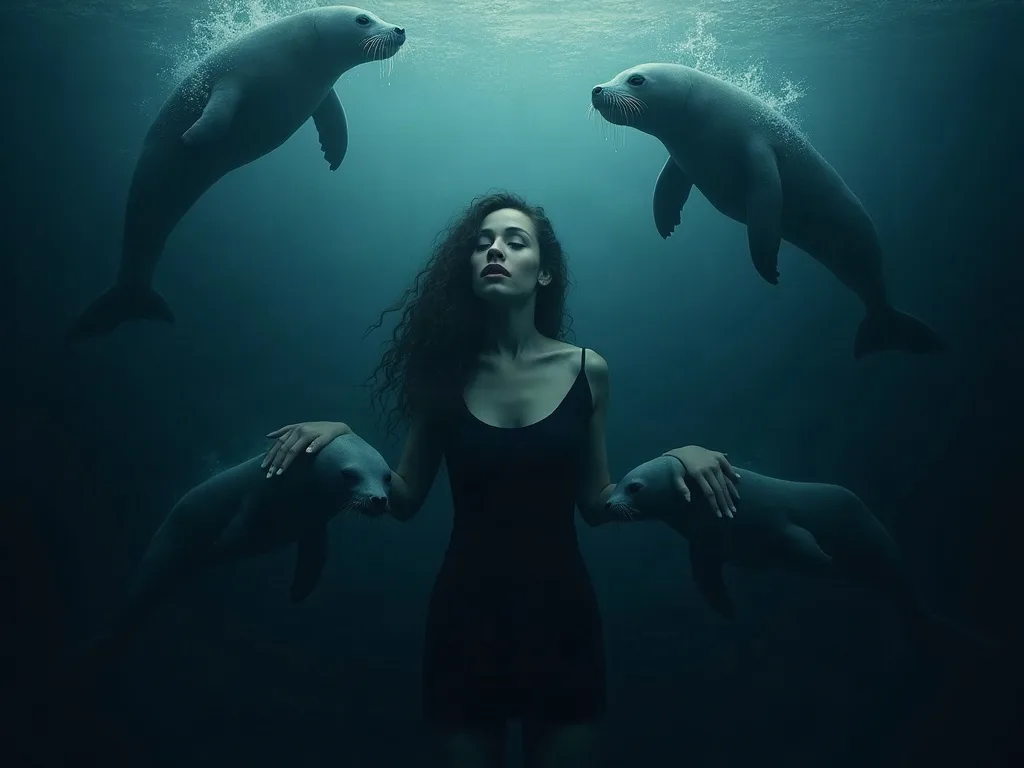
She does not die. She becomes something far more powerful.
Sedna's Realm: The Ocean's Dark Throne
Sedna's underwater palace, called Adlivun or Avilun (the under-world, literally "down there"), lies at the bottom of the sea. Some Inuit cosmologies place it directly beneath the hunting grounds; others describe it as a separate realm accessible only to the soul or to shamans in trance. The descriptions from Greenlandic, Alaskan, and Canadian Inuit traditions are remarkably consistent: stone walls, whale bones as furnishings, dark water pressing in from all sides.
She dwells there alone, or sometimes accompanied by her father, who was condemned to live with her as punishment for his betrayal. Some versions say he tends her fire. Others say he is imprisoned in a corner, forever atoning. Her mother is sometimes mentioned as a servant or attendant, but Sedna herself is sovereign. She rules the vast animal kingdom of the sea.
Every seal, every walrus, every whale, every fish that swims in Inuit waters belongs to her. They are not her property as humans understand ownership. They are closer to her children, or her subjects, or aspects of herself. When a hunter successfully captures a seal, it is because Sedna has permitted it. The animal descends willingly to the hunter's harpoon. When the sea yields nothing, it is because Sedna withholds. She has closed the gates of her palace. The animals do not come.
This is the foundation of Inuit marine theology: the hunt is never assured. It is always a negotiation with a powerful being who can accept or reject the hunter's plea.

The Rules of Respect: How Hunters Please Sedna
Sedna's power over marine animals meant that Inuit hunters developed elaborate rituals and prohibitions to keep her satisfied. These were not casual customs. They were survival strategies. A broken taboo could mean starvation for an entire community through the long Arctic winter.
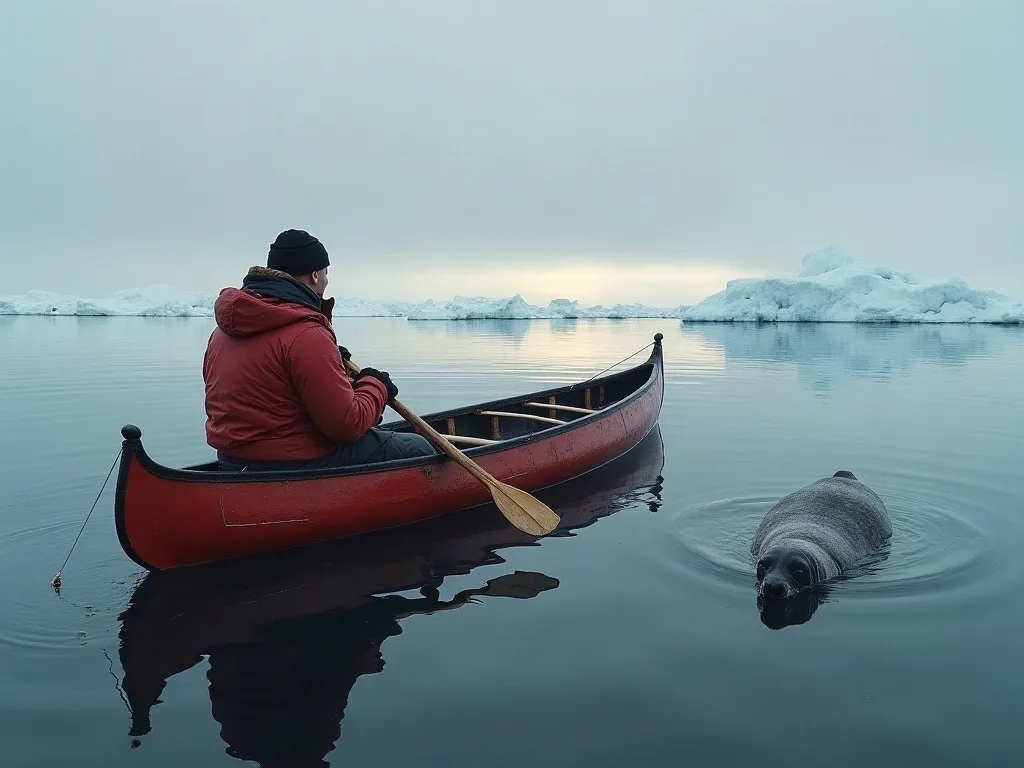
The primary rule was cleanliness and respect toward the hunted animal. When a seal was killed, its blood and fat could not be mixed carelessly. Hunters were forbidden from working with seal and land-animal materials on the same day. The distinction between sea and land was sacred; crossing it without proper ritual angered Sedna. Some groups burned seal bones in a specific direction to honor her. Others sang prayers to her as they worked.
Water was also central to Sedna's worship. Hunters would pour fresh water into the seal's mouth after killing it, a gesture that some scholars interpret as returning the animal's soul to Sedna with gratitude, or as a last drink for the creature's journey. In Greenlandic traditions, strict rules governed menstruation and childbirth: women were kept separate during these times, and special care was taken to prevent their contact with hunting gear or marine animals, because Sedna's purity requirements were exacting.
Violation of these rules brought sickness, bad hunting, or misfortune. The community would confess breaking taboos aloud in a gathering, often led by a shaman, believing that public acknowledgment and apology could restore Sedna's favor.
Shamanic Journeys to Sedna's Palace
In Inuit spiritual life, the shaman (called an angakkuq or anggakok) held a unique role: he could travel to Sedna's realm while in trance, descending through the ocean to her palace to intercede on behalf of the community. When the hunt failed, or when illness and misfortune multiplied, the angakkuq would enter a trance, his soul leaving his body, and journey down to meet the goddess.
Accounts of these journeys, recorded by anthropologists in the 19th and 20th centuries from Inuit elders, describe the shaman passing through the ocean, encountering guardians, and finally arriving at Sedna's hall. There he would find her sitting, combing her long black hair, which flowed endlessly and was filled with the filth and sin accumulated from the people's taboo violations. Her hair clogged with debris symbolized her displeasure.
The shaman's task was to comb her hair, to show respect, and to confess the community's breaches. As he combed, Sedna's anger would ease. She would nod, satisfied. The animals would be released. The shaman's soul would return to his body, and he would awaken to report that the hunt could now proceed.
This imagery appears across Inuit traditions from Greenland to Alaska, though the specific details and ritual protocols varied. The consistency suggests a shared cosmology shaped by the shared environment: the vast Arctic Ocean, the dependence on marine hunting, and the perceived intelligence and power of the animals that fed the people.
The Transformation: Why Sedna Lost Her Hands
The loss of Sedna's fingers as she sinks into the sea is more than a dramatic detail. It is theological. Her severed fingers are said to transform into the seals and walruses that constitute the foundation of Inuit survival. Some traditions describe them becoming the first seals; others say they continue to fall as marine creatures are born.
This means that Sedna's own body is the source of the animals the hunters pursue. To hunt is to consume Sedna herself, a sacred act that demands the highest respect. The hunter is not simply taking food; he is partaking in a cycle of sacrifice and renewal that has Sedna at its center.
Her amputation also mirrors the punishments inflicted by fathers and community in Inuit culture. A woman could be "killed" socially for violations, cast out or abandoned. Sedna's story, told by a culture where women held significant economic and spiritual authority (they owned the kayak, controlled the household, sometimes became shamans), carries ambivalence: it explains female power through a female deity, while also encoding a trauma of betrayal and powerlessness. Modern Inuit and Kalaallit scholars have read this duality in Sedna for generations.
Sedna Across the Arctic: Regional Variations
Sedna's worship and mythology were not uniform. The Kalaallit (Greenlandic Inuit) called her Arnakuagsak, meaning "the woman with a taboo," emphasizing her role as enforcer of ritual law. In some Alaskan Yupik traditions, she appears as Arnakuagasak or Avilayoq. Among Canadian Inuit groups, she is Silna or Taleleo. The names vary, but the essential figure remains: a female deity of the ocean, born from violence, governing marine abundance.
The rituals also shifted by region and season. Greenlandic practices emphasized the confession of taboo violations. Among some Alaskan groups, the shaman's journey to Sedna's realm was central to spring seal-hunting season. In Canada, different groups placed Sedna within broader cosmologies that included other deities and spirits. Yet across these variations, one truth held: the sea was personified as a female power, and respect toward her was the condition of survival.
Sedna and Other Inuit Deities
Sedna does not stand alone in Inuit cosmology. She is one figure within a complex spiritual landscape that includes Sila (a supreme creative force sometimes described as a universal consciousness or intelligence), Tuurngait (spirits that shamans allied with or controlled), and various local spirits tied to land, weather, and animals.
Sila is often described in more abstract terms: a power that governs weather, fate, and the order of things. Sedna is personal, embodied, demanding. While Sila might represent the vast impersonal laws of existence, Sedna represents the specific, felt relationship between humans and the animals of the sea. You do not negotiate with Sila in the same way. You negotiate, always, with Sedna.
The relationship between these deities and the colonial Christian missionaries who arrived in Greenland and Alaska from the 18th century onward shaped how Sedna has been remembered and represented. Some communities integrated Sedna into Christian frameworks (Mary as a goddess of the sea, for instance). Others suppressed the traditions altogether. The oral records we have of Sedna's myths come largely from the efforts of anthropologists like Knud Rasmussen, who documented Inuit knowledge in the early 20th century, and from Inuit communities themselves, who have maintained and revitalized these traditions in recent decades.
Sedna's Legacy in Modern Inuit Culture and Art
In contemporary Inuit and Kalaallit communities, Sedna has experienced a revival. Artists, writers, and knowledge keepers have returned to her story as a means of asserting cultural continuity and reclaiming narratives that colonialism attempted to erase. Greenlandic artist and author Niviaq Qilersuaq has woven Sedna into her work. Inuit filmmakers have explored her mythology. The goddess appears in contemporary Inuit literature as a symbol of resilience, female power, and the unbreakable connection between the people and the sea.
Sedna also resonates in modern conversations about environmental ethics and the human relationship with nature. Her mythology encodes a principle that Western industrial culture has only recently begun to articulate: that the taking of life from the natural world is not a right, but a permission that can be revoked. It demands respect, restraint, and reciprocity. In an era of overfishing and marine collapse, Sedna's insistence that the sea has a will and can withhold seems less a superstition and more a profound truth.
Sedna and Cross-Cultural Ocean Goddesses
Sedna is not the only goddess who rules the sea and demands respect from those who hunt or fish her waters. The parallels are striking and instructive. Sedna and Yemaya from Yoruba tradition (brought to the Americas through diaspora) share sovereignty over saltwater, maternal authority, and the power to grant or withhold abundance. Amphitrite, Poseidon's consort in Greek mythology, represents a more muted version of female oceanic power, overshadowed by her husband.
What distinguishes Sedna is the centrality of her origin story. She is not born of the sea; she becomes its queen through violation and transformation. Her authority emerges from suffering and survival. For Inuit hunters, this meant something essential: the sea's power over life and death was not distant or impersonal. It had a face, a history, a grievance. And that proximity made all the difference in how one approached her realm.
Frequently asked questions about Sedna, Inuit goddess of the sea
Frequently asked questions
Did Inuit hunters actually perform rituals to honor Sedna before hunting seals?
Yes. Anthropological records from the 19th and 20th centuries, particularly the work of Knud Rasmussen with Greenlandic and Alaskan Inuit groups, document elaborate taboos and prayers directed at Sedna. Hunters purified themselves, avoided mixing sea and land animal materials, and made offerings. These practices were not optional; they were understood as essential conditions for Sedna's blessing.
Is Sedna worshipped by Inuit communities today?
She is remembered and revitalized, particularly in Greenland, Arctic Canada, and Alaska, as part of broader cultural reclamation efforts. While colonial suppression and Christianity reduced explicit worship in many communities, contemporary Inuit artists, writers, and knowledge keepers are returning to Sedna's mythology as a central expression of cultural identity and values.
Why does Sedna's hair become filthy if she is a goddess?
In shamanic accounts, Sedna's hair fills with the accumulated transgressions and taboo violations of the community. Her filthiness represents the weight of human sin and disrespect toward marine animals. By combing her hair, the shaman acknowledges these breaches and seeks her forgiveness, allowing her to restore the flow of marine abundance.
Are Sedna's severed fingers actually transformed into seals?
In Inuit theology, yes. The transformation of her fingers (or her entire body) into marine animals is central to understanding the relationship between Sedna and the hunt. It means that to hunt seals is to participate in a cycle of sacrifice rooted in Sedna's own broken body. This frames hunting as a sacred, reciprocal act, not merely an extraction of resources.
How did Christian missionaries affect the worship of Sedna?
Colonial contact, particularly from the 18th century onward, led to the suppression of Sedna veneration in many communities through deliberate missionary efforts and the imposition of Christianity. Some communities integrated Sedna into Christian frameworks; others lost the traditions almost entirely. In recent decades, Inuit-led cultural revitalization has restored and re-centered Sedna in many Arctic communities.
What is the difference between Sedna and Sila in Inuit cosmology?
Sila is often described as a vast, impersonal creative or controlling force (sometimes translated as weather, fate, or universal consciousness). Sedna is a specific, personal deity with a body, a history, and direct relationships with humans. Hunters negotiate with Sedna in concrete ways; they respond to Sila as an encompassing power they cannot fully comprehend or control.
The Unfinished Negotiation: Sedna in the Contemporary Arctic
The story of Sedna: Goddess of the Sea and Marine Animals does not end with shamanic journeys or anthropological records. It continues in contemporary Arctic communities facing unprecedented challenges: climate change, melting sea ice, collapsing fish stocks, and the transformation of marine ecosystems that have sustained the Inuit for millennia.
Modern Inuit environmental activists and scholars have invoked Sedna's mythology as a framework for understanding these crises. If the sea has a will, and if that will can be angered or appeased, then current practices of industrial fishing, whaling by colonial nations, and climate-driven marine collapse represent a catastrophic violation of the taboos that once governed human-ocean relations. Sedna's story, in this reading, becomes urgent prophecy. The animals are withdrawing. The sea is withholding. The negotiation, interrupted by colonialism, must be resumed.
This is not a return to a pre-contact past. Rather, it is an insistence that Inuit knowledge, including the theological principle embedded in Sedna's mythology, offers crucial wisdom for how humans should relate to the living world. To approach the sea with respect, to understand abundance as a gift rather than a right, to build restraint into the hunt itself, these are not superstitions. They are survival strategies that kept Arctic communities fed, stable, and in balance with their environment for thousands of years.
Sedna, the woman who was thrown from a kayak and rose as a goddess, reminds us that power can emerge from violation, that boundaries matter, and that the living world has its own sovereignty. In an era when that sovereignty is under unprecedented strain, her story carries weight.
Read the full book
Want the whole story?
The complete edition is an instant PDF download here, with a paperback on Amazon for selected titles.
Inuit
The Inuit Mythology Book: Sedna, Sila, and the Sacred Stories of Ice, Hunger, and the Sea-Goddess at the Bottom of the World
Shamans, Spirits, and Survival in the Arctic
The mythology of the Arctic peoples: Sedna at the ocean floor, Sila in the wind, and the angakkuq shamans who flew between worlds. Drawn from primary sources.
More from Inuit
All articles
Inuit
Inuksuk: Stone Markers of the Arctic Landscape
The Inuksuk stands as a silent guardian across the Arctic: stacked stones shaped by Inuit hands to guide hunts, mark sacred places, and embody the spirit of community. Learn how these markers bridge the visible and spiritual worlds.

Inuit
The Moon Man and Sun Sister: Cosmic Pursuit Myth
In Inuit cosmology, the Moon Man chases his sister, the Sun, across the sky in an endless celestial pursuit born from darkness and shame. Discover how this myth explains the rhythm of day and night, and why it still echoes in Arctic cultures today.

Inuit
Sila: The Breath of Life and Weather Spirit
Sila is the Inuit spirit of weather, breath, and life force itself, a boundless presence that moves through air and water, sustaining hunters and demanding respect. Discover how Arctic peoples understood this invisible power that controlled their survival.

Inuit
Angakkuit: Inuit Shamans and Spirit Mediators
Angakkuit are the shamans and spirit mediators of Inuit cultures, channeling power from the animal and spirit worlds to heal, guide, and maintain balance between the human and sacred realms. Discover how these intermediaries shaped Arctic survival and cosmology.