
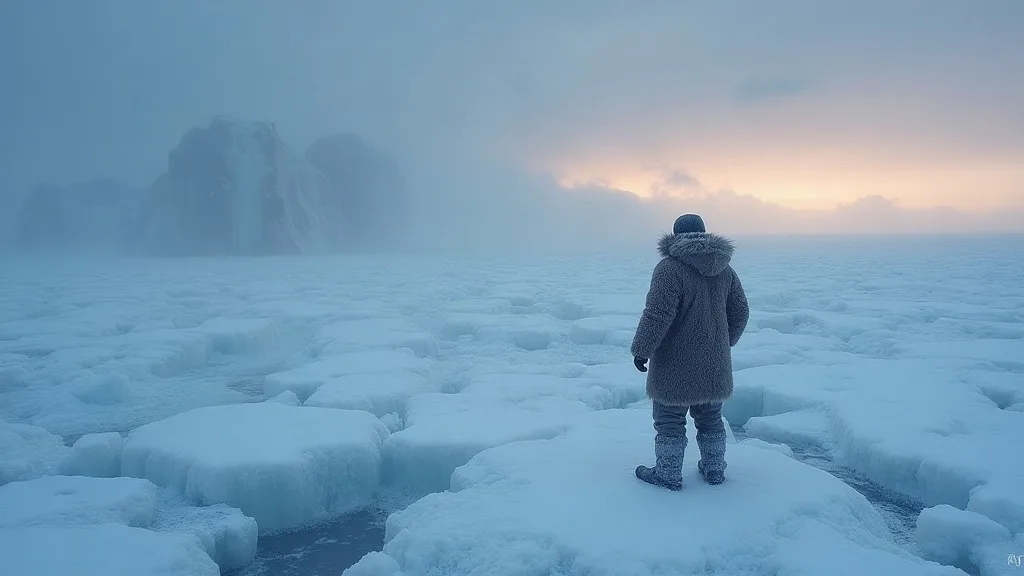
Kiviuq: The Eternal Wanderer Hero of Inuit Mythology
Kiviuq walks the Arctic ice as the hero who cannot die, hunted by monsters and shaped by starvation, yet never settling. Discover how this Inuit legend embodies survival, transformation, and the relentless human journey across the frozen world.
Contents
A man walks across the Arctic ice with no destination, no home to return to, no rest that lasts. Behind him stalks a widow with invisible arms. Before him stretch horizons of emptiness and danger. This is Kiviuq: the eternal wanderer hero of Inuit mythology, a figure so central to the Arctic imagination that his story ripples through dozens of distinct Inuit peoples, from the Copper Inuit to the Yupik, each telling adding a new scar to his legend.
Kiviuq is not a god in the Olympian sense. He is a hero like Odysseus, but stranger. He ages and hungers, gets wounded and learns. He is also something beyond mortal: he cannot truly die, and his transformations hint at powers that blur the line between human and spirit. For thousands of years, Inuit storytellers have passed his adventures across the ice, updating details, shifting his enemies, sometimes renaming him (the Copper Inuit call him Kiviok, the Yupik know variants), but always returning to the core: a man alone, forever moving, forever tested.
What makes Kiviuq compelling is not that he wins. It is that he survives, learns, and keeps walking. In a world where the Arctic gives no quarter, that is heroism enough.
The Man Who Will Not Stay Still
The origins of Kiviuq vanish into the deep past. No single written source recorded him; instead, he lived in the oral tradition of Inuit peoples across a vast geography spanning modern Canada, Greenland, and Alaska. Anthropologists and folklorists who collected these tales in the 19th and 20th centuries, from Knud Rasmussen to the work of Charles Bourke later, found Kiviuq's story remarkably stable across regions, yet fluid enough to accommodate local monsters, local ice formations, local hungers.
What scholars agree on: Kiviuq was born, grew to manhood, and then something broke him loose from ordinary life. Some versions say he was orphaned early. Others claim he offended a powerful spirit. One widespread tradition holds that his mother died, and he wandered into the Arctic as a consequence of grief and restlessness. The Greenlandic Inuit tell of a young man whose house burned, killing his family; he alone escaped and never returned.
Whatever the trigger, Kiviuq becomes a wanderer not by choice but by compulsion. He cannot settle. When he tries to stay with a woman, he is driven away. When he finds food, circumstances force him onward. The Arctic becomes both his prison and his school.
Hunted by the Invisible Widow
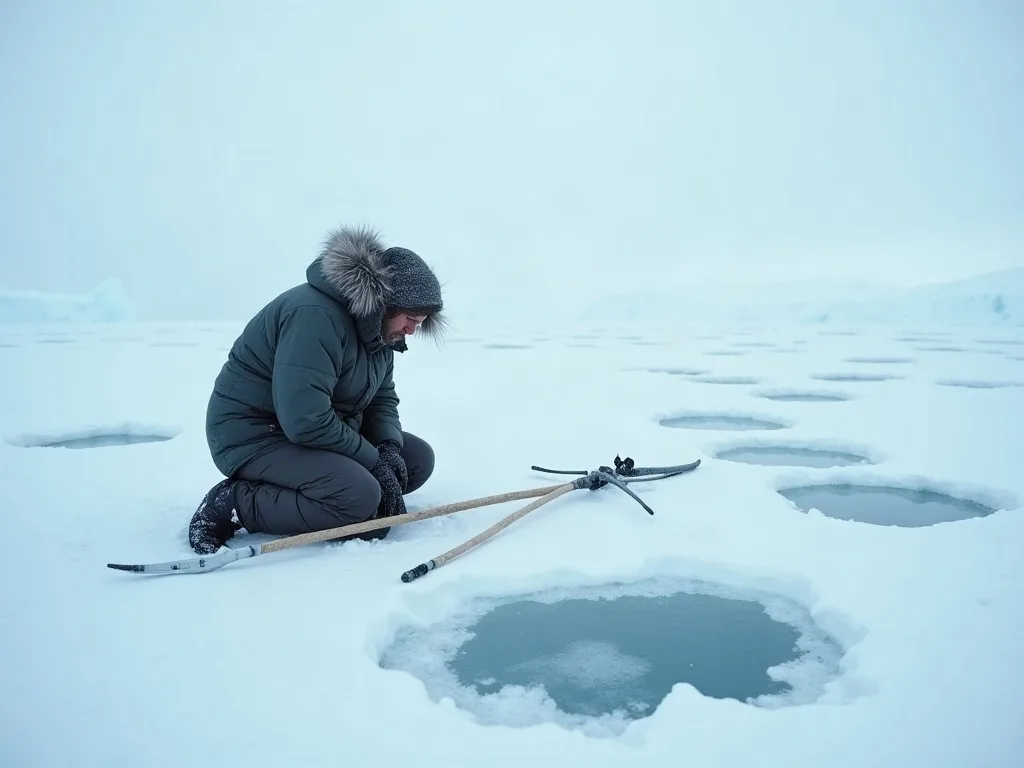
One of the most persistent figures in Kiviuq's saga is the widow, often called the old woman or the invisible woman. She hunts him across the ice, her arms stretching impossibly long to grab him, yet he cannot see her clearly. She is the embodiment of relentless pursuit, of a threat that does not tire, does not forgive, does not explain itself.
In some tellings, she is a spirit wronged. In others, she is a supernatural being with her own laws. What matters narratively is that she represents one of Kiviuq's core antagonists: the unseen danger, the enemy that logic cannot defeat. To escape her, he must flee, hide, use intelligence and knowledge of the land. He cannot fight her directly; the Arctic has taught him that some battles are won by endurance, not combat.
This widow haunts multiple versions of the cycle. She is almost a psychological figure, an obsession given form, the consequence of Kiviuq's own restlessness following him. Yet she is also real within the myth: other characters see her effects, warn Kiviuq of her coming, sometimes help him hide.
Monsters of the Frozen World
As Kiviuq wanders, the land throws creatures at him that seem designed to test specific virtues. The Inuit storytelling tradition encoded practical survival lessons into monster encounters, and Kiviuq's saga is no exception.
He faces giants who live in the ice, some friendly until he offends them, others inherently hostile. He meets cannibals and creatures of pure hunger. He encounters a one-eyed woman who tries to seduce or trap him. In one version, a creature made of stone pursues him. In another, a giant bird carries him across the ocean, then drops him into cold waters.
Each encounter teaches something. Against hunger, he learns to hunt seals in new ways. Against loneliness, he learns to read signs of other humans and sometimes accept help. Against despair, he keeps moving, because in the Arctic, stasis is death.
What stands out in the Kiviuq cycle is the absence of a singular climactic battle. Unlike many hero myths, where a final confrontation resolves everything, Kiviuq simply continues. The monsters do not disappear; they are simply outlasted. He grows older but does not age normally. He learns but does not accumulate status or treasure. He survives because he accepts survival as its own end.
Starvation as Teacher
One of the most vivid recurring episodes in Kiviuq tales involves starvation. The Arctic cannot be tricked. There are seasons when no game moves, when the ice is too thick to fish through, when a man's stomach eats itself. Kiviuq faces this repeatedly, and it strips him down to something essential.
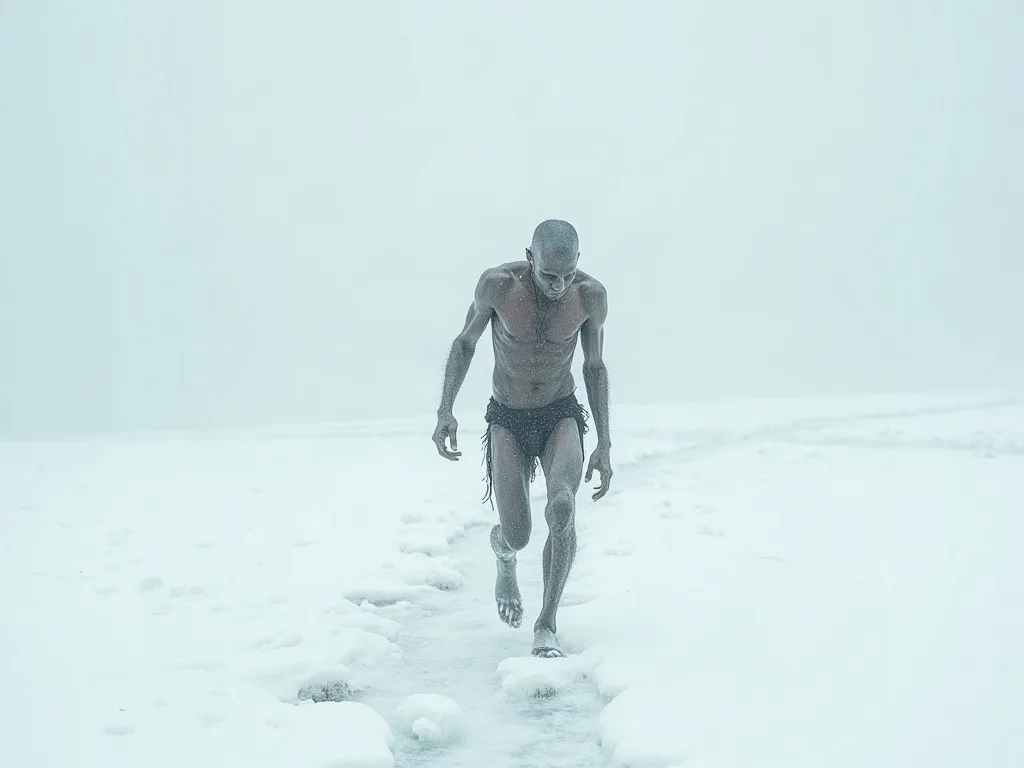
Some tellings describe him eating his own leather clothing. Others say he boils bones for marrow, catches fish through the ice using only his ingenuity, or follows animal tracks for days knowing they might lead nowhere. In one haunting version, he is reduced to such weakness that he can barely move, yet something drives him on anyway.
This is not the starvation of pathetic failure but the starvation of initiation. Each time Kiviuq survives without food, he is reborn smaller and lighter. He sheds what cannot survive in the true Arctic. What remains is the core: awareness, will, the ability to see patterns in ice and snow that ordinary sight cannot find.
Inuit teachers used these episodes to train younger hunters mentally. The story said: this is what the land will ask of you. This is what the mind must become.
The Shaman's Path and Transformation
Some versions of the Kiviuq cycle hint that his wandering has made him something more than human. He does not age normally. He can survive conditions that should kill anyone. In a few tellings, he gains the ability to see spirits or to move between the human world and the land of the dead.
This suggests that Kiviuq may have been understood by some storytellers as having undergone a shamanic initiation. In Inuit belief, shamans were often those who survived extraordinary ordeals and returned changed, able to perceive and negotiate with the spirit world. Kiviuq's endless trials might be read as the breaking and remaking that turns an ordinary person into a shaman.
Whether or not Kiviuq "becomes" a shaman varies by version and region. What is consistent is that his ordeal transforms him into something more durable, more attuned to the Arctic's rhythms, more able to survive in a way that ordinary humans cannot. He is not immortal like a god but unkillable, worn smooth by suffering, shaped by ice and hunger into a figure who belongs to the Arctic itself.
Women, Desire, and the Impossibility of Home
A recurring motif in Kiviuq tales involves encounters with women. Sometimes they offer shelter. Sometimes they try to hold him. Often, both.
He may meet a woman living alone, and she offers him food, warmth, companionship. For a moment, it seems the wandering might end. But something always breaks the spell. He may become restless. She may reveal herself as something other than human. The ice may demand he move on. Or he simply cannot stay, as if his nature forbids settlement.
These episodes are not tragic in a romantic sense. They are tragic in the way of the human condition: connection is possible but costly. Every woman Kiviuq might love is left behind. Every home he might build becomes a prison he must escape. The Arctic has claimed him in a way that allows no permanence.
Some storytellers have suggested that Kiviuq's inability to settle is itself a curse or a gift from the spirit world, the price of his survival or the mark of his unique nature. Others see it as the inevitable consequence of his early loss and displacement. The myth does not resolve this ambiguity; it holds it.
What emerges is a portrait of heroic isolation that feels more psychologically acute than much later European literature: a man who is capable of love and connection but fundamentally unable to rest within them. His heroism is not in conquering this but in acknowledging it and moving forward anyway.
The Cyclical Arctic and Kiviuq's Eternal Return
One of the most striking aspects of Kiviuq mythology is its structure. Unlike many hero cycles with a clear beginning, middle, and end (birth, adventure, death or ascension), Kiviuq's stories often feel cyclical. He wanders, encounters tests, survives, and wanders again. The landscape repeats. The enemies shift but the pattern holds.
This mirrors the Arctic environment itself, where cycles dominate: the tilt of the sun, the freeze and thaw, the movement of animal migrations, the seasons that return relentlessly. Kiviuq does not break the cycle; he is part of it. His restlessness is the Arctic's restlessness. His survival is the Arctic's survival through him.
Some researchers have suggested that Kiviuq functions almost like a culture hero or a semi-divine figure whose existence guarantees that the Arctic itself remains traversable. As long as Kiviuq walks, the land is not utterly empty or utterly hostile. As long as he survives, humans can survive. He is not so much one individual as an archetype: the wanderer, the tested one, the survivor, reborn in every listener who internalizes the story and carries it forward.
Why Kiviuq Endures in Modern Retellings
In recent decades, Kiviuq has found new audiences beyond the Arctic communities where he originated. Writers, artists, and creators have recognized in him a figure that speaks to contemporary anxieties: displacement, rootlessness, the struggle against overwhelming odds with no guaranteed reward.
Climate change, which is reshaping the Arctic faster than anywhere on Earth, has also renewed interest in Kiviuq. His story becomes a way of thinking about human adaptation and persistence in a landscape that permits no entitlement. He is not a figure of conquest but of humble, stubborn survival.
In contemporary Inuit communities, Kiviuq remains a touchstone, referenced in conversations about resilience, identity, and the continuity of tradition. Storytellers continue to tell his adventures, sometimes with modern elements woven in (a snowmobile instead of a kayak, a radio instead of a traveler's intuition), but the core remains: a man walking the ice, pursued and tested, refusing to surrender.
Kiviuq and Other Wanderer Heroes
Comparing Kiviuq to wanderer-heroes from other traditions illuminates what is specific about his mythology. The Irish hero Oisin, for instance, also travels across magical landscapes and returns to find centuries have passed. But Oisin's wandering is enchantment, a curse or blessing granted by the fairy world; Kiviuq's is built into his nature, self-perpetuating, without external magical compulsion.
Odysseus, the Greek hero, also endures years of wandering, facing monsters and tests. Yet Odysseus is always trying to return home. Kiviuq has no home to return to. The wandering is not a detour but the destination itself. This represents a fundamentally different understanding of what heroism means and what a human life is "for."
In Hindu mythology, the wandering ascetic is also a valued figure, someone who has renounced attachment and roams seeking wisdom. Kiviuq, however, is not pursuing wisdom as a spiritual goal. He is surviving. The two may produce similar stories, but the interior meaning shifts. Kiviuq is not an ascetic rejecting the world; he is a man whom the world has rejected, or whom he has chosen to reject, and he persists in that rejection with a kind of heroic acceptance.
The Scholarly Debate: History, Diffusion, and Regional Variants
When anthropologists first collected Kiviuq tales in the early 20th century, they were struck by two things: the wide geographic spread of the story and the consistency of its core elements across radically different regions and storytellers who had no direct contact.
One theory proposed that Kiviuq tales represented a very ancient cultural stratum, originating among early Paleo-Inuit or Thule peoples and spreading across the Arctic as populations migrated. The widespread motifs (the wanderer, the widow, the monster encounters, the theme of starvation and survival) might represent archaic patterns of Arctic survival encoded into story.
Another school of thought, influenced by 20th-century diffusionist models, suggested that tales spread through trade networks and intersettlement visits, with regional storytellers adapting and elaborating. This would explain both the consistency and the local variation.
More recently, scholars have been cautious about over-systematizing. They note that the Kiviuq cycle is genuinely alive, performed orally, and therefore inherently fluid. The "same" story told in different communities, or by different storytellers in the same community, can vary significantly in details while maintaining the same narrative arc and thematic concerns.
What remains clear is that Kiviuq belongs to an older layer of Inuit culture, one whose roots lie deep in the Arctic past. Whether he originated as a single figure who spread widely or as an archetypal pattern that emerged independently in multiple communities remains an open question that oral tradition alone may never definitively answer.
Frequently asked questions about Kiviuq: The Eternal Wanderer Hero
Frequently asked questions
Is Kiviuq a god or a human hero?
Kiviuq is primarily a hero, not a deity in the traditional sense. He is mortal, hungers, ages, and can be wounded. However, some tellings suggest he has been transformed by his ordeals in ways that make him more than human: he cannot truly die, heals unnaturally fast, and may perceive spirits. He might be best understood as a semi-divine or shamanic figure, someone whose suffering and survival have set him apart from ordinary humanity without making him a god who demands worship.
Why does Kiviuq never stay in one place?
Different versions offer different explanations. Some say he is cursed or marked by the spirit world. Others suggest that his early loss and displacement made him fundamentally unable to settle. The most compelling reading is that restlessness is not a flaw in Kiviuq's character but its defining feature; the Arctic demands constant movement, and Kiviuq embodies that demand. His inability to stay is his wisdom, not his weakness.
Who is the widow that pursues Kiviuq?
The widow is a recurring figure in the Kiviuq cycle, though she is not always clearly identified. Some versions hint that she is a spirit wronged by Kiviuq or his family in the distant past. Others treat her as a supernatural being with her own laws and hungers. Her exact nature varies by region and storyteller. What remains consistent is her role: she represents relentless, invisible threat, an enemy that cannot be fought directly and can only be escaped through speed, cunning, and an intimate knowledge of the land.
Are there different versions of Kiviuq's story across Inuit cultures?
Yes. The Copper Inuit, the Greenlandic Inuit, the Yupik, and other Arctic peoples each have their own tellings, sometimes with different names (Kiviok, Kivioq) and locally specific monsters and places. The core elements remain: a wanderer pursued, encounters with supernatural beings, starvation, tests of survival. But local storytellers add details reflecting their own environment, values, and enemies. This is not corruption of an original but the natural life of an oral tradition.
What can modern readers learn from Kiviuq's story?
Kiviuq teaches that heroism is not always about winning or acquiring status. It can be about surviving, persisting, continuing to move forward when stopping seems easier. His story also models a form of intelligence shaped by environment: not abstract knowledge but the ability to read ice, track animals, recognize danger, and endure hunger. For contemporary readers, especially those thinking about climate change and human resilience, Kiviuq offers a portrait of adaptation without illusion, of a human figure scaled to the true size of his world.
The Eternal Wanderer's Legacy in Arctic Consciousness
Kiviuq endures not because he conquered anything or left a kingdom behind him. He endures because he walked. Because he hunted. Because he did not surrender to the widow or the ice or the hunger or the loneliness. Because every storyteller who retells his adventures participates in his survival, keeping him alive across centuries and distances that might have erased any other hero.
The Arctic has shaped Inuit peoples for thousands of years, and the land asks the same question of everyone it touches: can you persist? Can you find food when nothing grows? Can you keep moving when rest seems like an mercy? Kiviuq's answer, told and retold across the ice, is yes. Not always comfortable. Not always happy. But yes.
In a world where modern heroes often accumulate, conquer, and claim, Kiviuq teaches a different arithmetic. Survival is enough. Movement is enough. The ability to endure, to learn, to keep walking into the next day: this is the true measure of a man.
Read the full book
Want the whole story?
The complete edition is an instant PDF download here, with a paperback on Amazon for selected titles.
Inuit
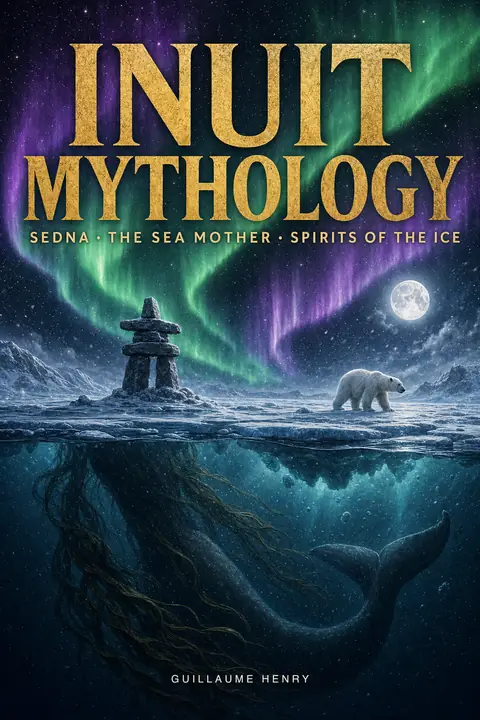
The Inuit Mythology Book: Sedna, Sila, and the Sacred Stories of Ice, Hunger, and the Sea-Goddess at the Bottom of the World
Shamans, Spirits, and Survival in the Arctic
The mythology of the Arctic peoples: Sedna at the ocean floor, Sila in the wind, and the angakkuq shamans who flew between worlds. Drawn from primary sources.
More from Inuit
All articles
Inuit
Inuksuk: Stone Markers of the Arctic Landscape
The Inuksuk stands as a silent guardian across the Arctic: stacked stones shaped by Inuit hands to guide hunts, mark sacred places, and embody the spirit of community. Learn how these markers bridge the visible and spiritual worlds.
Inuit
The Moon Man and Sun Sister: Cosmic Pursuit Myth
In Inuit cosmology, the Moon Man chases his sister, the Sun, across the sky in an endless celestial pursuit born from darkness and shame. Discover how this myth explains the rhythm of day and night, and why it still echoes in Arctic cultures today.

Inuit
Sila: The Breath of Life and Weather Spirit
Sila is the Inuit spirit of weather, breath, and life force itself, a boundless presence that moves through air and water, sustaining hunters and demanding respect. Discover how Arctic peoples understood this invisible power that controlled their survival.

Inuit
Angakkuit: Inuit Shamans and Spirit Mediators
Angakkuit are the shamans and spirit mediators of Inuit cultures, channeling power from the animal and spirit worlds to heal, guide, and maintain balance between the human and sacred realms. Discover how these intermediaries shaped Arctic survival and cosmology.