
Kukulkan: the Maya Feathered Serpent God Who Commanded Wind, Water, and Time
Kukulkan ruled the sky and the sea, the wind and the calendar. The Maya feathered serpent god shaped cities, calendars, and creation myths across a thousand years of Mesoamerican history.
Contents
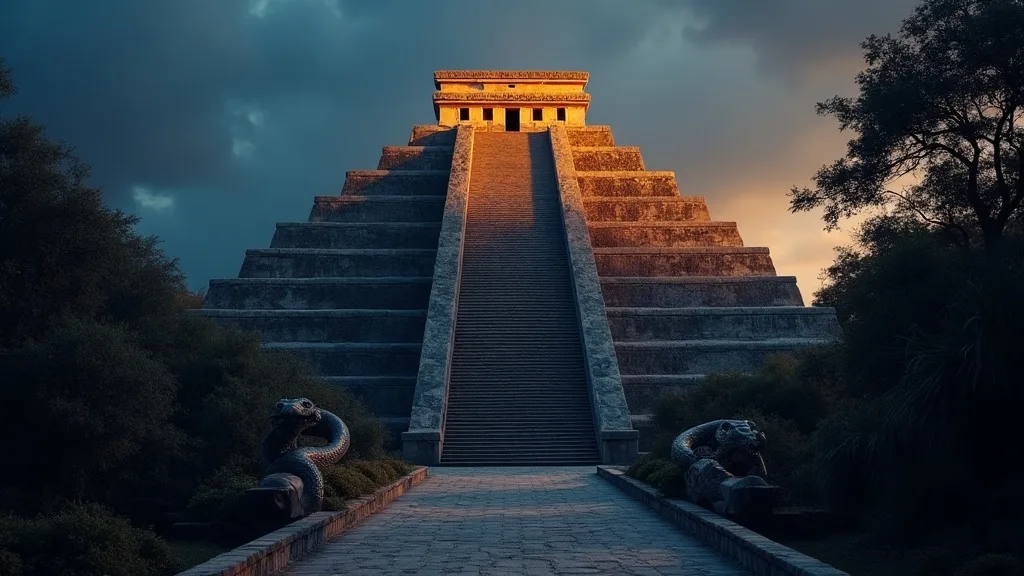
A shadow moves down the staircase at Chichen Itza every spring equinox. It starts at the top, flows across seven triangles of light and stone, and ends at the carved serpent head at the base. The crowd watching today numbers in the thousands. Those who watched a thousand years ago probably felt the same chill. The pyramid was built to do exactly this.
The god who demanded that precision was Kukulkan, the Maya feathered serpent. He was not merely a symbol. In the religious and political life of the ancient Maya, Kukulkan governed wind and rain, the movement of the sky, and the great turning of calendar cycles. He was also a culture hero, a figure who arrived, taught, and departed, leaving a civilization reshaped behind him. Few deities in world mythology managed to be that much, to that many people, for that long.
The Name and What It Carries
Kukulkan is a Yucatec Maya word. Break it down and you get something precise: kuk references the iridescent tail feathers of the resplendent quetzal, and kan means serpent. The combination is an image before it is a name: a snake that can fly, a creature of the earth that carries the sky.
That visual tension is the theological core of the figure. Snakes in Maya thought belonged to the earth, the underworld, water, and renewal (they shed skin; they are endlessly reborn). Birds belonged to the sky, wind, and the transmission of divine messages. A creature that fused both was something extraordinary: a being that moved between realms, that could descend to the underworld and rise to the heavens without becoming one or the other. Kukulkan the Maya feathered serpent was, structurally, a mediator of cosmic zones.
The equivalent name in Nahuatl, the language of the Aztec, is Quetzalcoatl (quetzal-feathered serpent), and in the language of the Quiche Maya of highland Guatemala, the figure appears in the Popol Vuh, the sixteenth-century Maya creation epic, in the form of Gucumatz, a name with the same etymological roots. All three names point to one ancient idea that was already circulating in central Mexico and the Maya lowlands before any of those cultures rose to dominance.
Before Chichen Itza: The Feathered Serpent at Teotihuacan
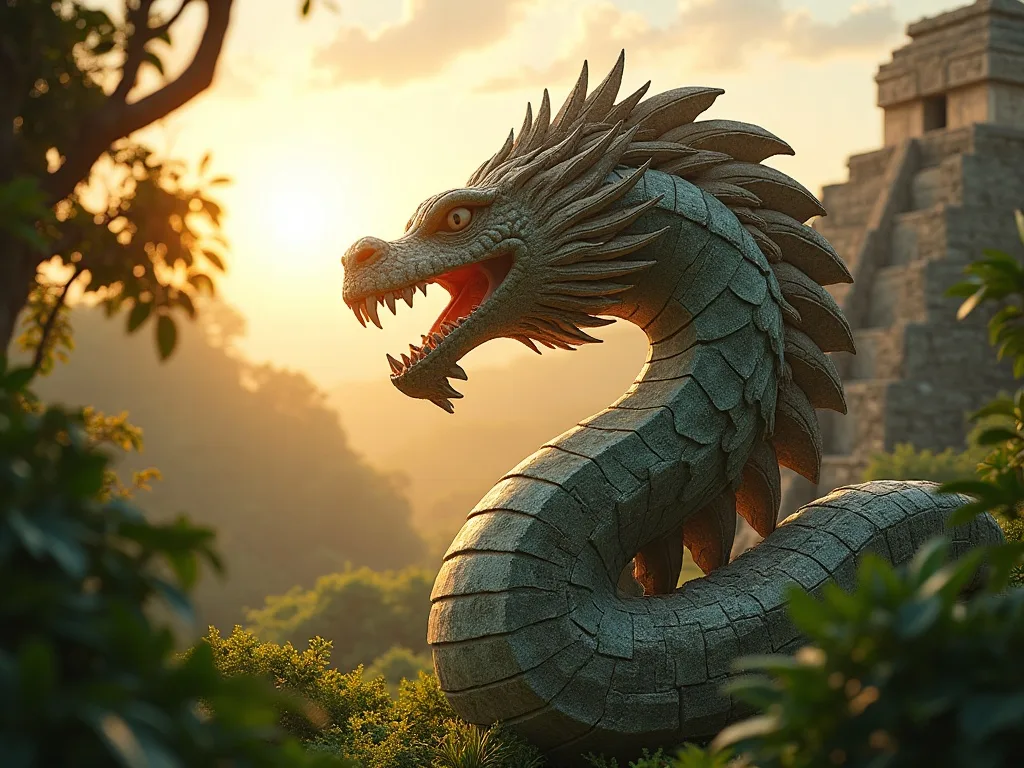
Any account of Kukulkan that begins at Chichen Itza is starting in the middle of the story. The feathered serpent image appears centuries earlier at Teotihuacan, the enormous city in the Valley of Mexico that flourished from roughly 100 CE to 550 CE. The Temple of the Feathered Serpent at Teotihuacan (sometimes called the Temple of Quetzalcoatl) is covered in stone carvings of serpent heads alternating with what scholars now interpret as a rain deity or storm deity. The figures are not identical to later Maya or Aztec versions, but the lineage is clear.
Teotihuacan fell around 550 CE, and some of its populations almost certainly dispersed across Mesoamerica. The feathered serpent cult traveled with them. By the time the Toltec civilization rose at Tula (in modern Hidalgo, Mexico) between roughly 900 and 1150 CE, the feathered serpent had become fully associated with rulership, wisdom, the priesthood, and cosmic order. At Tula, the figure carried the name Ce Acatl Topiltzin Quetzalcoatl, a ruler-priest who was either historical, legendary, or both, depending on who you asked and when.
The Maya of the Yucatan Peninsula were in close contact with the Toltec world. When Chichen Itza rose to regional dominance in the ninth and tenth centuries CE, Toltec architectural forms arrived alongside it: the chacmool reclining figure, the tzompantli skull rack, warrior columns in the form of feathered serpents. The figure at the center of this was Kukulkan.
Scholars still debate exactly what happened. Some read the evidence as a military conquest, Toltec forces arriving and imposing their cult. Others argue for slower cultural transmission through trade and elite exchange. Bishop Diego de Landa, the sixteenth-century Spanish cleric whose account Relacion de las Cosas de Yucatan remains a key (if complicated) source for Maya religion, described Kukulkan as a great lord who came from the west, governed wisely, and then departed by sea toward the east, promising to return.
Kukulkan at Chichen Itza: Architecture as Scripture
The city of Chichen Itza, in what is now the Mexican state of Yucatan, is the most visible monument to Kukulkan's power. The pyramid known today as El Castillo (a Spanish name; its original Maya name was Kukulkan's Pyramid) was built to encode astronomical knowledge in stone.
The pyramid has four staircases, each with 91 steps. Add the shared top platform and the total is 365, one for each day of the solar year. Each face of the pyramid contains 52 panels, matching the 52-year cycle of the Maya sacred calendar round, the tzolkin-haab combination. The serpent heads at the base of the northern staircase align precisely with the sun at the spring and autumn equinoxes to create the shadow-serpent effect seen today.
This is not coincidence. Maya architects and astronomers worked together. The pyramid was a calendar, a temple, and a political statement all at once. Controlling the movements of Kukulkan, demonstrating that your city could predict the god's appearance on the staircase, was a direct claim to sacred authority.
Inside El Castillo, archaeologists found an earlier pyramid structure containing a chacmool and a red jaguar throne encrusted with jade. These inner chambers were not public. They were for priests and rulers alone.
The Temple of the Warriors nearby shows Kukulkan again: feathered serpent columns flank the entrance, their tails forming the base and their open mouths facing skyward, as if the roof rested on the god's breath. The Great Ball Court at Chichen Itza, the largest in Mesoamerica at 168 meters long, has serpent imagery running along its walls, and the game played there carried cosmic meaning. The Maya ballgame reenacted the journey of the Hero Twins through the underworld, a story preserved in the Popol Vuh.
Kukulkan in Maya Cosmology: Wind, Rain, and the Ordering of Time
Kukulkan's domains were not decorative. They were operational. The god governed:
- Wind: the ik glyph in Maya script means both wind and breath, the animating force of life. Kukulkan moved the air.
- Rain and water: feathered serpents appear near cenotes (the sacred limestone sinkholes of Yucatan) and waterways. Rain was survival in a landscape without rivers.
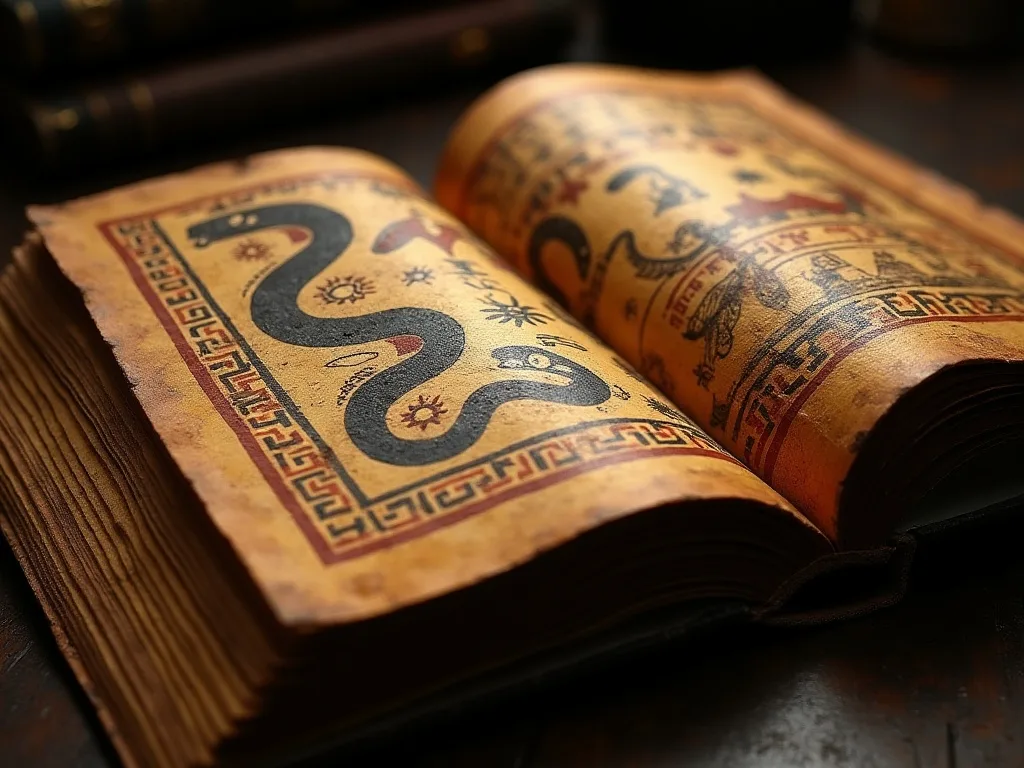
- The sky and celestial movement: the planet Venus held special importance for Kukulkan. Venus moves in a cycle of roughly 584 days, which the Maya tracked with extraordinary accuracy. The Dresden Codex, one of only four surviving pre-Columbian Maya books, contains detailed Venus tables that link the planet's appearance as morning star and evening star to ritual obligations and dangerous periods.
- Knowledge and the calendar: Kukulkan was associated with wisdom, the priestly arts, and the ordering of time itself. In this function he was patron of scribes, diviners, and the ah kin, the Maya calendar priests.
The Popol Vuh calls Gucumatz (the Quiche equivalent) one of the original creator gods who participated in the formation of the world. The creation happened in darkness, over water. Gucumatz and the sky god Tepeu spoke together, and what they named came into being. This is not so different from the Hebrew Genesis or the Egyptian concept of Hu, the word of creative power. The feathered serpent was, in several traditions simultaneously, the voice that shaped the world.
The Culture Hero Myth: Arrival, Teaching, and Departure
Perhaps the most affecting strand of Kukulkan's mythology is the one Diego de Landa recorded and that the Chilam Balam books (a series of colonial-era Maya manuscripts in Yucatec Maya) preserve in fragments: the story of the great teacher who came from elsewhere.
In this tradition, Kukulkan (or his human incarnation) arrived on the Yucatan coast from the west with a band of followers. He wore no ornaments. He ate little. He preached against human sacrifice and taught the arts of civilization: agriculture, medicine, calendar reckoning, writing, the layout of cities. After a period of governance, he gathered his followers and departed by sea to the east. He said he would return.
This narrative structure is deeply similar to the Aztec account of Quetzalcoatl of Tula, who ruled the legendary city of Tollan, was driven out by the trickster god Tezcatlipoca, and sailed east on a raft of serpents, also promising to return. The overlap is not coincidence. The two traditions are reflecting the same older Toltec legend, filtered through different cultures and languages.
For the Spanish, arriving in 1519, that return prophecy seemed almost too convenient. The year of Hernan Cortes's arrival coincided with a cycle in which Quetzalcoatl was expected to return. Whether Moctezuma II genuinely believed Cortes was the returning god, or whether that story was shaped in retrospect, remains one of the most contested questions in Mesoamerican history.
The Dresden Codex and Kukulkan's Astronomical Life
The Dresden Codex, painted on bark paper probably in the twelfth or thirteenth century CE (though it copies material from much earlier), is one of the most scientifically precise documents from the ancient world. Its Venus tables track the synodic cycle of Venus with an error of only about two minutes per year. That accuracy required centuries of observation.
Venus mattered because the Maya identified Kukulkan directly with the planet's morning star phase, called Noh Ek ("Great Star") or Xux Ek ("Wasp Star"). When Venus rose as morning star after its disappearance in the underworld (inferior conjunction), it represented Kukulkan's resurrection. The planet's disappearance was a death; its reappearance, a return. This cosmological drama played out every 584 days, giving ritual life a regular heartbeat tied to the sky.
The Dresden Codex also contains eclipse prediction tables and a flood myth. The flood scene shows a great sky serpent pouring water from its jaws, a direct image of Kukulkan in his capacity as rain-bringer and world-ender. The Maya cosmos was not stable. It had been destroyed and rebuilt multiple times. Kukulkan was both the one who ordered it and, when the time came, the one who dissolved it.
Cross-Cultural Echoes: The Feathered Serpent Beyond the Maya
Kukulkan is not an isolated phenomenon. The feathered or winged serpent appears across cultures with striking consistency:
- In Aztec tradition, Quetzalcoatl was one of the four creator gods, specifically the god of wind (Ehecatl) and the creator of the current humanity.
- In the Inca tradition, the amaru was a two-headed serpent associated with underground water and sky storms.
- The horned serpent appears in the mythology of dozens of North American Indigenous nations, from the Ojibwe to the Cherokee.
- The Naga of Hindu and Buddhist tradition is a divine serpent associated with water, fertility, and cosmic order. Shesha, the cosmic serpent on whom Vishnu rests, echoes the same structural role: a serpent that holds the world.
- Egyptian Wadjet, the cobra goddess of Lower Egypt, was a divine protector who wore the sky on her head.
None of these are the same deity. But the convergence of serpent plus sky (feathers, wings, horns) plus water, fertility, and cosmic order is remarkably consistent. Some scholars argue this reflects a shared archetype rooted in the actual behavior of large snakes near water sources. Others point to the visual drama of lightning, which moves like a snake across the sky. Whatever the deep root, the Maya feathered serpent god stands as one of the clearest expressions of that global pattern.
Kukulkan After the Conquest: Survival and Transformation
The Spanish arrived in Yucatan in the early sixteenth century. By 1697, the last independent Maya kingdom, Tayasal (in modern Guatemala), had fallen. Missionaries burned Maya books; Diego de Landa himself ordered the burning of manuscripts at Mani in 1562, later regretting it enough to write his Relacion as a partial compensation.
But Kukulkan did not simply vanish. Maya communities continued to practice forms of traditional religion beneath the surface of Catholic observance. The Chilam Balam books were written down in the colonial period using the Spanish alphabet, preserving prophetic texts, calendar knowledge, and fragments of the old myths. The name Kukulkan appears in them. The association between the feathered serpent and the cycle of time continued.
Today Kukulkan is explicitly present in contemporary Maya cultural revival movements across Mexico, Guatemala, Belize, and Honduras. The spring equinox at Chichen Itza is attended by thousands of people who come not only as tourists but as participants. Some are practitioners of renewed or reconstructed Maya spiritual traditions. The shadow-serpent on the staircase still draws crowds because it still works.
In popular culture, the name has traveled further: Kukulkan appears in Marvel Comics (as the villain in early Black Panther stories), in video games, and in films. The Black Panther sequel Wakanda Forever (2022) drew directly on Kukulkan for the design of the underwater kingdom's ruler. For many viewers, that film was the first time they encountered the name. For others, it was a recognition of something they already carried.
Frequently Asked Questions About Kukulkan, the Maya Feathered Serpent
Frequently asked questions
Is Kukulkan the same god as the Aztec Quetzalcoatl?
They share the same root concept: a feathered serpent who governs wind, water, knowledge, and cosmic order. Both names translate to "feathered serpent" in their respective languages (Yucatec Maya and Nahuatl). The traditions likely drew from a common Toltec source, particularly the legends surrounding the ruler-deity of Tula. However, the Maya Kukulkan and the Aztec Quetzalcoatl developed distinct mythological biographies, ritual calendars, and iconographic details in their own traditions. Treating them as identical collapses important cultural differences.
What does the equinox shadow at Chichen Itza actually show?
At the spring and autumn equinoxes, the setting sun casts a series of triangular shadow segments along the northern staircase of El Castillo pyramid, creating the optical illusion of a serpent body connecting the sky to the carved stone serpent head at the base. The effect lasts roughly 45 minutes. It was engineered by Maya architects using precise solar alignment. Modern archaeologists confirm the effect is intentional, though some debate how consistently it would have been visible before the pyramid's twentieth-century restoration work.
What are the primary ancient sources for Kukulkan's mythology?
Key sources include: the Dresden Codex (a pre-Columbian Maya bark-paper book with astronomical and mythological content); the Chilam Balam books (colonial-period Yucatec Maya manuscripts that preserve older prophetic and historical texts); Diego de Landa's Relacion de las Cosas de Yucatan (1566, a Spanish cleric's account of Maya religion); and the Popol Vuh (a Quiche Maya creation epic recorded in the sixteenth century, where the equivalent figure is Gucumatz). The architecture of Chichen Itza itself is also treated as a primary source.
Was Kukulkan ever associated with human sacrifice?
The culture hero myth, as recorded by Diego de Landa, specifically describes a Kukulkan who preached against human sacrifice. However, Chichen Itza shows clear archaeological evidence of sacrifice, including the Sacred Cenote, into which offerings including human remains were cast. The feathered serpent imagery appears throughout the site. Scholars interpret this as a distinction between the idealised mythological figure and actual ritual practice, or as reflecting different political periods and factions at the city.
How did Kukulkan's Venus connection work in practice?
The Dresden Codex Venus tables allowed Maya priests to predict when Venus would appear as the morning star after its inferior conjunction (when it passes between Earth and the Sun and disappears from view). That reappearance represented Kukulkan's resurrection and was considered both powerful and dangerous: a period when the god's energy was raw and required careful ritual management. Priests would conduct ceremonies, and some activities were considered inauspicious during certain Venus phases. The tables track this cycle across 104 years, matching 65 Venus cycles to 146 sacred 260-day calendar cycles.
What Kukulkan's Return Still Means
The promise of return is the thread that runs through every version of the story. Quetzalcoatl sails east. Kukulkan departs by sea. The shadow-serpent descends the pyramid twice a year and then disappears. The Venus star sets and rises again.
In the Chilam Balam of Chumayel, one of the most studied colonial Maya manuscripts, the prophets speak in cycles: each katun (a Maya time period of roughly 20 years) carries the memory of the last time it occurred. History is not linear; it spirals. What happened before will come back in a different form. The return of the feathered serpent is not a one-time event. It is a structure of time itself.
Contemporary Maya scholars and community members have pushed back strongly against interpretations that reduce Kukulkan to an archaeological curiosity or a tourist attraction. For many, the feathered serpent god remains a living theological concept tied to wind, water, agricultural cycles, and the obligations that humans owe to the natural world. That argument is not abstract. The Yucatan Peninsula depends on its cenotes and seasonal rains. A god who governs both is not metaphorical.
There is also an ongoing academic conversation about what Kukulkan reveals about Maya political theology. The ruler who controlled Kukulkan's imagery controlled legitimacy itself. At Chichen Itza, the pyramid is the most visible building in the city not because it is the largest (the Great Ball Court is longer) but because it is the most precisely calibrated. Precision was the point. Demonstrating that you understood, and could predict, the movements of a god was the clearest possible argument for why you should govern.
That argument still holds. Kukulkan's pyramid still aligns. The serpent still descends. And the question the ancient Maya built into the stone, who understands the sky well enough to make the god appear on demand, still does not have a simple answer.
Read the full book
Want the whole story?
The complete edition is an instant PDF download here, with a paperback on Amazon for selected titles.
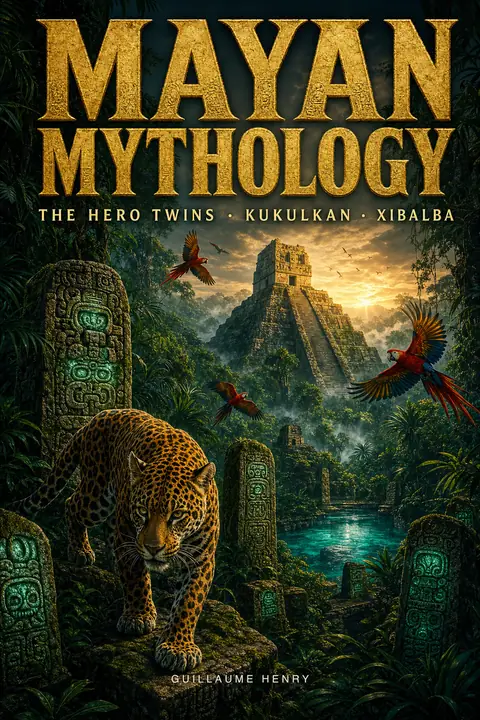
Mayan
The Mayan Mythology Book: Hunahpu, Xbalanque, Kukulkan and the Sacred Stories of the Rainforest Mathematicians
The Popol Vuh, Xibalba, and the Cosmos Calculated in 13s and 20s
The Hero Twins descend to Xibalba. Kukulkan returns at equinox. Itzamna writes the first books. The complete mythology of the Maya who calculated the cosmos and left us the Popol Vuh.
More from Mayan
All articles
Mayan
Ixchel: Goddess of the Moon and Childbirth in Maya Mythology
Ixchel ruled the night sky and the sacred threshold where life enters the world. As the aged moon goddess and divine midwife of the Yucatan, she embodied both the gentleness of birth and the ferocity of storms.

Mayan
The Mayan Calendar System: Tzolk'in and Haab' Explained
The Mayan calendar tracks time across multiple overlapping cycles: the 260-day Tzolk'in and the 365-day Haab' align every 52 years in a sacred pattern. Discover how the Maya read the cosmos in numbers.
Mayan
Bloodletting Rituals: Sacred Sacrifice in Mayan Religion
Mayan bloodletting rituals were not acts of violence but profound spiritual transactions. Kings pierced their own bodies to feed the gods, sustain the cosmos, and commune with ancestors in ceremonies that shaped civilizations for over two thousand years.

Mayan
The Maize God: Symbol of Life and Resurrection in Mayan Mythology
The Maize God embodies the Mayan cycle of death and rebirth through corn, the lifeblood of Mayan civilization. Discover how this deity shaped creation myths, ritual, and the Mayan understanding of existence itself.