
Popol Vuh: The Maya Creation Myth That Built a World from Words
The Popol Vuh is the Maya creation myth that tells how gods shaped humanity from maize after two failed attempts. Read the full story, its sources, and why it still matters.
Contents
Before light existed, there was only sky and sea. No land, no sound, no creature moving through the dark. Then the gods spoke, and the word itself became the act of making. The feathered serpent Gucumatz rose from the water to meet Tepeu in the sky, and together they said "earth," and earth appeared. Mountains broke the surface like breathing.
That opening is not a metaphor. For the K'iche' Maya people of highland Guatemala, it is a literal account of how everything began. The Popol Vuh, the Maya creation myth, is the fullest surviving record of their cosmology, their heroes, their gods, and the long, failed experiment of making a being capable of truly remembering its creators. Written down in the mid-sixteenth century but rooted in beliefs that predate the Spanish conquest by centuries, the text is equal parts origin story, epic adventure, and philosophical treatise on what it means to be human.
It rewards close reading. Every episode connects to the next with the logic of a dream: gods who fail and try again, heroes who die and resurrect, a ballgame played against the lords of death. Nothing in the Popol Vuh is accidental.
How the Popol Vuh Survived
The original K'iche' document from the sixteenth century has vanished. What scholars work with today is Ximénez's manuscript, which preserves the K'iche' text on the left-hand pages and a Spanish translation on the right. That manuscript now lives in the Newberry Library in Chicago, where it has been held since the mid-twentieth century.
Before Ximénez, the text circulated quietly among the K'iche' nobility of Santa Cruz del Quiché, read in private. The K'iche' authors who wrote it down said plainly that they were recording what had been kept hidden, "the original book and ancient writing," to use Allen J. Christenson's translation of their own words. Christenson's 2007 annotated translation, published by the University of Oklahoma Press, remains the scholarly standard in English and draws on decades of fieldwork in highland Maya communities.
The title Popol Vuh translates roughly as "Book of the Council" or "Book of the Community" in K'iche'. Popol means something like "gathered together," and Vuh means book or paper. It was never a secret text in the modern thriller sense. It was a civic document, a record of who the K'iche' were and where they came from.
The Three Failed Creations Before Humanity
The gods did not get humanity right on the first attempt. The Popol Vuh is unusual among world creation myths for its frankness about divine trial and error. Three attempts fail before the fourth, and each failure teaches the gods something.
The first beings the gods made were animals: deer, birds, jaguars. These creatures could not speak. They could not name their creators, could not pray, could not remember. The gods told them plainly: "You will be replaced." Animals became food for those who came later.
The second attempt used mud. The mud person crumbled, dissolved in water, spoke without sense. It could not turn its head. It had no mind. The gods called the diviners Xpiyacoc and Xmucane, the grandmother and grandfather figures who serve as the great matchmakers and calendar-keepers of the Maya cosmos, and those two agreed: the mud person had to go.
The third attempt produced wooden people, manikins carved from pito wood. These beings looked like humans and multiplied across the earth. But they had no memory, no heart, no recognition of the gods who made them. They treated their animals cruelly, ignored their grinding stones, left their cooking pots cold. In one of the most vivid passages in the entire text, those very objects took revenge. The dogs said, "You beat us; now we bite you." The grinding stones said, "You ground us until we bled; now we grind you." The wooden people fled into the trees, where their descendants became the monkeys you still see in the forest today.
This pattern, creation, failure, destruction, new creation, runs through Mesoamerican cosmology broadly. The Aztec Legend of the Five Suns (recorded in the Codex Chimalpopoca) describes a similar sequence of failed cosmic ages. Both traditions share roots older than any surviving text, traceable to the ancient cultural networks of Mesoamerica that also gave rise to Quetzalcoatl, the feathered serpent whose worship stretched from central Mexico down through Guatemala.
Hunahpu and Xbalanque: Heroes Who Cheated Death
The creation of humans is not the only story in the Popol Vuh. Roughly half the text concerns the Hero Twins, Hunahpu and Xbalanque, and their journey into Xibalba, the Maya underworld. This section functions as an embedded epic, and it is where the Popol Vuh reaches its most thrilling pitch.
The twins' story begins with their father and uncle, Hun Hunahpu and Vucub Hunahpu, who played the ballgame so loudly on the surface of the earth that the lords of Xibalba, Hun Came and Vucub Came, summoned them underground. The two older heroes were tricked, humiliated, and killed. Hun Hunahpu's severed head was hung in a calabash tree as a warning.
That head, still alive, spat into the hand of a young woman of Xibalba named Xquic, and she conceived the Hero Twins. Xquic escaped to the surface world, was accepted by the twins' grandmother Xmucane, and gave birth to Hunahpu and Xbalanque, who grew up to become the greatest ballplayers the world had ever seen.
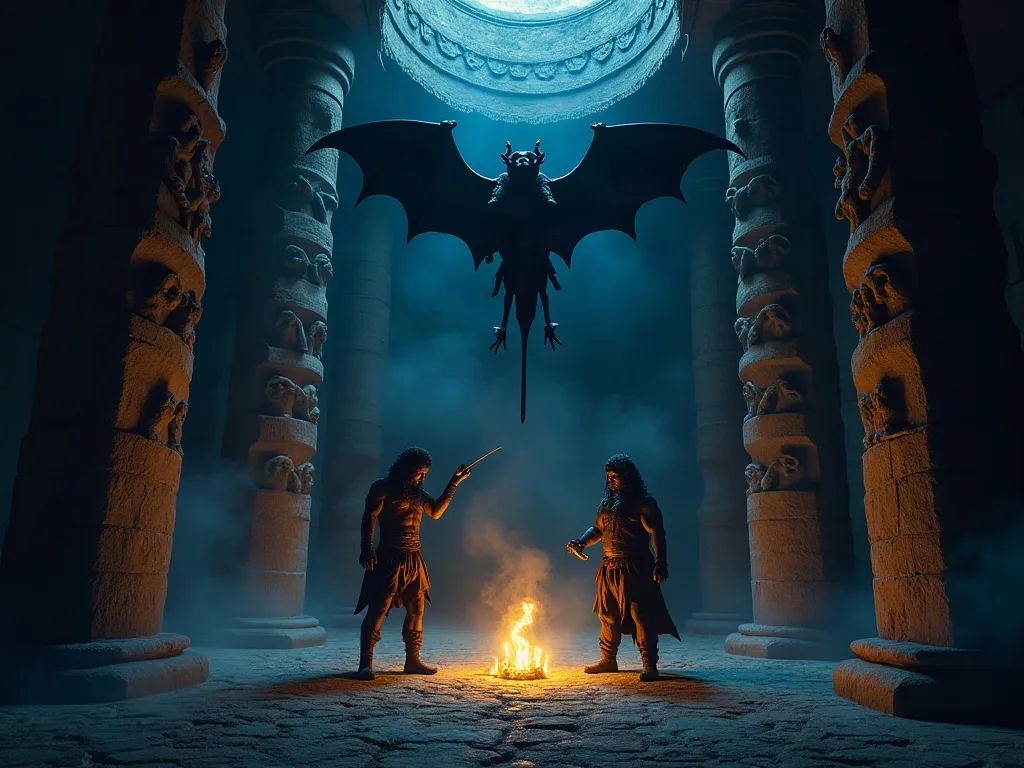
The lords of Xibalba summoned them too, and this time the twins were ready. They passed through the six houses of Xibalba: Dark House, Cold House, Fire House, Jaguars' House, Rattling House, Bat House. Each was designed to kill them. Each time they survived. In the Bat House, Hunahpu lost his head to the bat demon Camazotz, a moment that reads like a true shock. Xbalanque replaced his brother's head with a carved squash until they could retrieve the real one.
The climax is extraordinary. The twins died on purpose, let the lords of Xibalba grind their bones and scatter the ashes into a river, then regenerated in the water as catfish, then as two wandering performers, then revealed themselves to the astonished death lords. They performed a miracle: they killed and revived a dog, then cut a human and brought him back to life. The delighted lords begged to experience the trick themselves. Hunahpu and Xbalanque killed them and did not bring them back.
Death, in the Popol Vuh, is not a final state. It is a transformation, a passage through darkness that leads to a new form. Hun Hunahpu's own resurrection is tied to this: after the twins defeated Xibalba, their father rose again as the Maize God, the central deity of Maya agricultural religion, whose death and rebirth mirrors the planting cycle with exact precision. Maya scholars including David Freidel and Karl Taube have traced the Maize God's iconography back to Classic period ceramics (roughly 250-900 CE), confirming that the Popol Vuh's narrative rests on centuries of visual and religious tradition.
The Fourth Creation: Humanity Made from Maize
After Xibalba is broken, the gods return to the problem of making proper humans. This time Xmucane grinds white and yellow maize, mixes the dough with water, and from that dough the gods shape four men: Balam Quitze, Balam Acab, Mahucutah, and Iqui Balam. The first four humans.
These beings were extraordinary. They could see everything, the four corners of the sky, the full arc of the horizon. They gave thanks. They named their creators. The gods were satisfied, then worried: these humans were too perfect, too much like gods themselves. So the gods breathed a cloud over their vision, like fogging a mirror, limiting human sight to what is nearby, to the mortal scale.
This limitation is itself a form of theology. Humanity made from maize carries a specific message: people are not dust or clay, not an afterthought or a mistake. They are made from the same sacred substance that the gods themselves planted and tended. Maize is not merely food in the Maya worldview. It is the material of human identity. The K'iche' phrase ixim winaq, "maize person," runs through the Popol Vuh and through living K'iche' Maya speech today.
The four women who become the wives of the first men are created next, while the men sleep. Families form. The K'iche' Maya and several neighboring peoples trace their ancestry directly to these first four couples, which gives the Popol Vuh the status not only of cosmological scripture but of dynastic charter.
The Ballgame and Its Cosmic Stakes
The ballgame woven through the Popol Vuh was a real sport with real courts, real rubber balls (made from the Castilla elastica tree), and real ritual stakes. Hundreds of ballcourts survive across Mesoamerica, from Chichén Itzá in the Yucatán to Copán in Honduras. The sport's imagery appears on Classic Maya ceramics, painted with scenes that echo the Popol Vuh almost panel by panel.
The game in the text is not entertainment. It is a contest between the living and the dead, between the surface world and the underworld, between the forces that want crops to grow and those that want them to rot. When Hunahpu and Xbalanque play, every rally is a cosmological argument.
This connection between the mythological and the archaeological is what gives the Popol Vuh its authority as a primary source. It is not simply a literary document. It is a key that helps decode the visual and architectural programs of the Classic Maya, a civilization that reached its height roughly five centuries before the K'iche' authors picked up their quill.
The ancient Maya city of Chichén Itzá preserves one of the most complete ballcourt complexes anywhere in Mesoamerica, with carved panels along its walls showing ballplayers in the posture of Xibalba's defeated lords.
Xibalba: What the Maya Underworld Actually Looked Like
Xibalba (pronounced roughly "shee-bal-BA") means "place of fright" in K'iche'. It is not Hell in the Christian sense. There is no permanent punishment, no lake of fire for sinners. Xibalba is a kingdom, structured like a court, with twelve lords divided into pairs, each pair controlling a specific kind of suffering.
The Lords of Xibalba named in the Popol Vuh include:
- Hun Came and Vucub Came ("One Death" and "Seven Death"), the supreme lords
- Xiquiripat and Cuchumaquic, who cause illness in the blood
- Ahalpuh and Ahalcana, who cause swelling and pus
- Chamiaholom and Chamiabac, lords of the skeleton, who reduce people to bone
- Ahalmes and Ahaltocob, who cause poverty and misery
This is an underworld of specific afflictions, not of moral judgment. Death in Xibalba is a process with distinct stages, much like the Egyptian Duat (the Egyptian realm of the dead described in texts like the Book of the Dead), where the deceased moves through a sequence of trials before transformation.
The twelve lords of Xibalba are often depicted in Maya ceramics as skeletal or partially decomposed figures, seated on thrones, wearing jaguar-pelt clothing. Archaeologist Michael Coe's 1973 study of Maya funerary ceramics, "The Maya Scribe and His World," identified the Xibalba narrative on painted pots decades before a full Popol Vuh translation was widely available, demonstrating how deeply the myth had penetrated Classic Maya visual culture.
Cross-Cultural Echoes: A Myth Among Myths
The Popol Vuh sits comfortably alongside the great cosmological texts of other traditions without being reduced to any of them. A few comparisons clarify what makes it distinct.
Popol Vuh (K'iche' Maya)
Creation begins with speech and cooperation between sky and sea gods. Humanity is the result of multiple attempts, each more refined. The primary material of the final human is maize, a cultivated plant. Heroes must descend to the underworld and defeat it by wit, not strength. Death and rebirth are cyclical, tied to agriculture.
Theogony (Ancient Greek)
Creation begins with Chaos, a void, from which the first gods emerge alone. Humanity is created by Prometheus from clay, as an afterthought relative to the gods' own drama. The primary challenge of heroes is physical combat with monsters. The underworld (Hades) is a place of diminishment, not transformation. Death is largely final for mortals.
The contrast is not about which tradition is superior. It shows how differently two sophisticated cultures framed the same questions: where did we come from, and why does death happen? The Maya answer places agriculture, community, and cyclical time at the center. The Greek answer places individual heroism and cosmic genealogy at the center.
The Popol Vuh also echoes certain Hindu cosmological texts in its theme of divine experimentation. The Rigveda's famous Nasadiya Sukta (the "Hymn of Creation," roughly 1200 BCE) describes a creator who is not certain whether creation even worked. That same uncertainty hums through the Popol Vuh's three failed attempts. Brahma, the Hindu creator god, is similarly not omnipotent in early texts. Creation, across cultures, turns out to be hard work.
The Popol Vuh's Living Legacy in Maya Communities
The Popol Vuh is not a museum piece. K'iche' Maya communities in highland Guatemala maintain oral traditions, ceremonies, and calendrical practices that connect directly to the text. The 260-day Tzolk'in calendar, still used by Maya Ajq'ij (day-keepers or calendar priests), corresponds precisely to the divinatory system invoked by Xpiyacoc and Xmucane in the Popol Vuh when they consult the days to determine whether each creation will succeed.
The Guatemala government officially recognized the Popol Vuh's cultural status in 2012, declaring July 22 the "Day of the Popol Vuh." Several Guatemalan universities teach it in K'iche' as a primary text, not a translated curiosity.
In contemporary Maya literature, writers like Humberto Ak'abal (1952-2019), whose K'iche' poetry circulated internationally, drew directly on the imagery of the Popol Vuh without treating it as archaic. The Hero Twins appear in murals in Guatemala City. The Maize God's resurrection posture, one knee raised, arms open, has been identified in modern Maya textile patterns woven by communities that have kept the design alive for generations without ever calling it by a scholar's name.
Frequently Asked Questions About the Popol Vuh and the Maya Creation Myth
Frequently asked questions
Who actually wrote the Popol Vuh?
The text was written down by anonymous K'iche' Maya authors in the town of Santa Cruz del Quiché, Guatemala, sometime between 1554 and 1558. They wrote in the K'iche' Maya language using the Latin alphabet, which Franciscan missionaries had recently introduced. The authors say they were recording an older tradition that had previously been kept in "the original book," suggesting a pre-conquest pictorial or hieroglyphic source now lost. The Spanish friar Francisco Ximénez discovered the manuscript around 1701 and made the only surviving copy.
Is the Popol Vuh the only Maya creation text?
No, but it is the most complete. Other Maya traditions preserved their own cosmologies: the Books of Chilam Balam, written in Yucatec Maya after the conquest, contain creation passages. The Dresden Codex, a pre-conquest Maya screenfold book now in Dresden, Germany, encodes astronomical and calendrical knowledge tied to the same mythological figures. Classic Maya monumental inscriptions, particularly at Palenque and Quiriguá, record creation dates and divine genealogies. The Popol Vuh is uniquely valuable because it presents a continuous narrative rather than ritual fragments.
What role does the ballgame play in Maya religion beyond the Popol Vuh?
The rubber ballgame, called pitz in Classic Maya inscriptions, was played across Mesoamerica for at least 3,500 years, with the oldest rubber balls found at the Olmec site of El Manatí in Veracruz, Mexico, dated to around 1600 BCE. Courts have been excavated at hundreds of sites. The game carried different meanings in different contexts: political alliance, war-captive sacrifice, ritual re-enactment of the Hero Twins' descent. Not every game ended in death; many were competitions between polities with diplomatic stakes. The Popol Vuh gives the game its deepest theological explanation: it is a contest between life and death, played on the boundary between worlds.
Why are humans made from maize specifically, and not from clay or breath?
Maize (Zea mays) was domesticated in Mesoamerica roughly 9,000 years ago and became the caloric and cultural foundation of every major civilization in the region. For the K'iche' Maya, the choice of maize as the stuff of humanity encodes a deep truth: people are not separate from the land they cultivate. They are that land, transformed. The Popol Vuh makes the point explicitly when the gods say the maize-humans are exactly right because they can nourish the gods through offerings, meaning the same crop that builds human bodies also feeds divine attention. This reciprocity, human to god, god to human, through maize, is the theological center of Maya agricultural religion.
How do scholars know the Popol Vuh reflects pre-conquest beliefs and not Spanish influence?
Several lines of evidence converge. First, the mythology in the Popol Vuh matches Classic Maya iconography (250-900 CE) with remarkable precision: the Hero Twins, the Maize God, the ballgame, and the underworld lords all appear on ceramics and stone monuments centuries before the Spanish arrived. Second, the 260-day calendar system embedded in the text predates contact and is independently attested in pre-Columbian inscriptions. Third, linguists have identified K'iche' phrases and poetic structures in the text that show no trace of Spanish theological vocabulary. Allen J. Christenson's 2007 translation addresses these questions in detail, concluding that the narrative core is genuinely pre-Columbian.
Can I read the Popol Vuh in English, and which translation is best?
Several English translations exist. Allen J. Christenson's 2007 translation (University of Oklahoma Press) is the most scholarly, with extensive footnotes, K'iche' text alongside the English, and notes on every major term. Dennis Tedlock's 1985 translation (Simon and Schuster) is older but remains widely read, and Tedlock worked directly with K'iche' day-keepers, incorporating their oral interpretations. For readers who want a literary rather than annotated experience, Michael Bazzett's 2018 verse translation (Milkweed Editions) renders the text as poetry and preserves its narrative rhythm beautifully.
The Unfinished Argument: What the Popol Vuh Asks of Its Readers
The Popol Vuh does not close with a solved universe. The four original men ask the gods to show themselves fully, to let humans see them clearly. The gods refuse. They veil themselves in sky and cloud. The limitation placed on human vision becomes a permanent feature of existence: we are made from the same substance as sacred things, but we cannot quite see the sacred directly. We look for it, remember it, name it, tend it through ceremony, and wait.
That tension has kept the text alive for five centuries of extraordinary pressure. The Spanish tried to erase it. The K'iche' authors hid it, literally, by writing it in secret. Ximénez preserved it out of a scholar's instinct he might not even have been able to justify to his superiors. Modern Maya communities have reclaimed it as a living charter, not a relic.
What the Popol Vuh asks of its reader is exactly what it asked of the wooden people who failed: remember. Remember who made the world, remember the substance you are made of, remember the names. A text that knows precisely why it might be forgotten, and chooses to speak anyway, is a text that has already beaten death at the ballgame.
For readers who want to follow the Hero Twins deeper into the Maya mythological landscape, the traditions of the ancient Maya civilization offer a world of connected stories, from the astronomical cycles of Itzamna to the war mythology of the Classic period inscriptions.
Read the full book
Want the whole story?
The complete edition is an instant PDF download here, with a paperback on Amazon for selected titles.
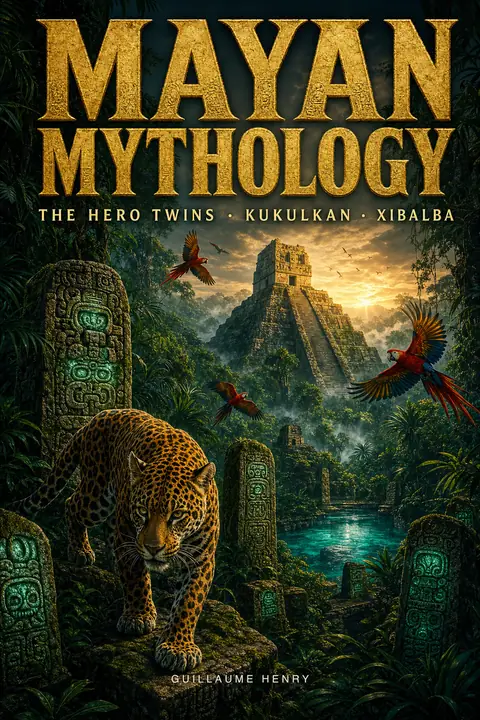
Mayan
The Mayan Mythology Book: Hunahpu, Xbalanque, Kukulkan and the Sacred Stories of the Rainforest Mathematicians
The Popol Vuh, Xibalba, and the Cosmos Calculated in 13s and 20s
The Hero Twins descend to Xibalba. Kukulkan returns at equinox. Itzamna writes the first books. The complete mythology of the Maya who calculated the cosmos and left us the Popol Vuh.
More from Mayan
All articles
Mayan
Ixchel: Goddess of the Moon and Childbirth in Maya Mythology
Ixchel ruled the night sky and the sacred threshold where life enters the world. As the aged moon goddess and divine midwife of the Yucatan, she embodied both the gentleness of birth and the ferocity of storms.

Mayan
The Mayan Calendar System: Tzolk'in and Haab' Explained
The Mayan calendar tracks time across multiple overlapping cycles: the 260-day Tzolk'in and the 365-day Haab' align every 52 years in a sacred pattern. Discover how the Maya read the cosmos in numbers.
Mayan
Bloodletting Rituals: Sacred Sacrifice in Mayan Religion
Mayan bloodletting rituals were not acts of violence but profound spiritual transactions. Kings pierced their own bodies to feed the gods, sustain the cosmos, and commune with ancestors in ceremonies that shaped civilizations for over two thousand years.

Mayan
The Maize God: Symbol of Life and Resurrection in Mayan Mythology
The Maize God embodies the Mayan cycle of death and rebirth through corn, the lifeblood of Mayan civilization. Discover how this deity shaped creation myths, ritual, and the Mayan understanding of existence itself.