
The Thunderbird: Storm Spirit of the Great Plains
The Thunderbird rules the skies of Native American myth, bringing rain, lightning, and sacred order. Learn where this storm spirit came from and why it still matters.
Contents
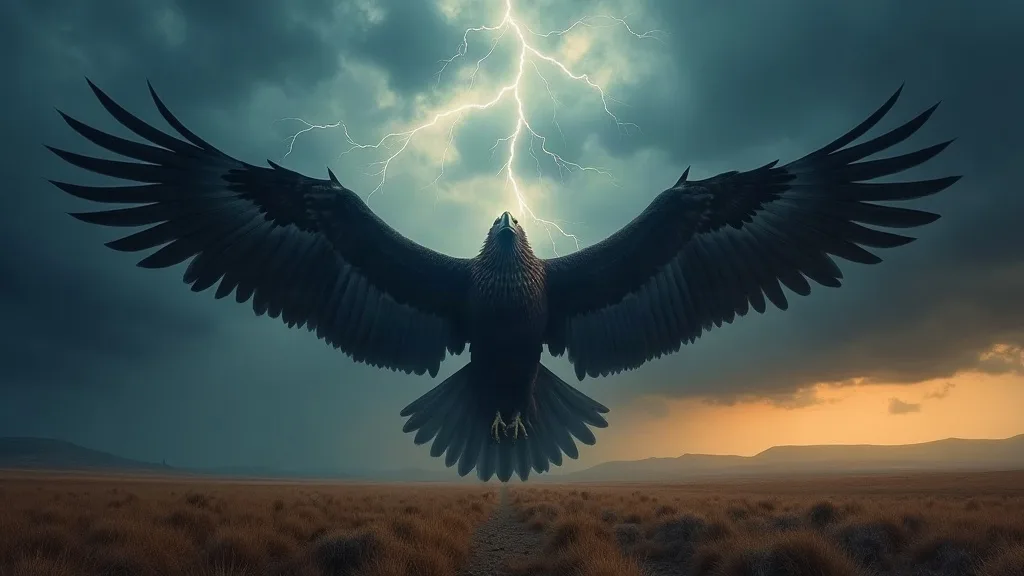
The sky turns green just before the storm arrives. The air goes still, the grassland holds its breath, and then, from somewhere above the clouds, a sound rolls across the plains that no human voice could make. Old stories say that is not thunder. That is wings.
The Thunderbird is one of the most powerful supernatural beings in Native American tradition. Enormous enough to blot out the sun, it rides the storm fronts that sweep across the continent. Its wings beat the thunder into existence. Its eyes flash lightning. Rain falls where its feathers shed moisture. Across dozens of distinct nations, from the Ojibwe of the Great Lakes to the Lakota of the high plains, from the Kwakwaka'wakw of the Pacific Northwest coast to the Algonquin of the eastern woodlands, this creature holds a central place in the cosmos. Not as a monster. As a force that keeps the world alive.
Where the Thunderbird Lives: Sky Nations Above the Clouds
Every tradition places the Thunderbird above the ordinary sky. Not in the sky we see when we look up, but in a higher tier, a world above clouds where beings of enormous power make their home.
The Ojibwe, whose territory spans the Great Lakes region, call this being Animikiig (sometimes spelled Animiki), a word rooted in the Anishinaabe verb for thunder. They describe a community of Thunderbirds, not a single creature, living in the sky realm and sending storms downward whenever Horned Serpents, called Mishi-ginebig, rise from the water to threaten humanity. The storm is not random violence. It is a battle being fought on behalf of the living world.
Among the Lakota, the Thunderbird is Wakinyan, "the Winged One" or "the Thunderer." The Lakota cosmology, recorded extensively in the early 20th century by scholar James R. Walker through interviews with Oglala Lakota holy men, places Wakinyan at the west, one of the four directions that shape sacred space. Wakinyan lives in a tipi of clouds at the edge of the world. He has no eyes, yet he sees everything. He has no ears, yet nothing escapes him. He speaks in thunder and writes his will in lightning across the sky.
The number of Thunderbirds varies by nation. The Menominee of the Great Lakes region describe four Thunderbirds, one for each cardinal direction, with the greatest among them controlling the west. The Passamaquoddy of the northeastern coast speak of a single, colossal Thunderbird that hatches from an enormous egg and grows until it fills the whole horizon. These are not contradictions. They are different angles on the same sacred reality, filtered through different landscapes and different histories.
The War Beneath the Storm: Thunderbird Against the Underwater Serpent
The single most widespread narrative pattern attached to the Thunderbird across North American traditions is its conflict with a great serpent or serpent-like being that lives beneath the water. This opposition, sky versus water, lightning versus flood, shows up from the Pacific Northwest to the Atlantic coast, and scholars of comparative mythology have noted its persistence for over a century.
The Ojibwe version is the clearest. Animikiig and Mishi-ginebig, the Horned Serpent, are ancient enemies. The Horned Serpent pulls humans and animals beneath the surface to drown them. The Thunderbirds strike the water with lightning to kill the serpents and protect the people living along the shoreline. Storms over water are therefore battles. A close lightning strike on a lake is a Thunderbird scoring a hit.
The Algonquian-speaking peoples of the Great Lakes and Northeast hold similar accounts. The cosmic serpent goes by different names, Mishibizhiw among the Ojibwe, or simply "the Great Horned Serpent" in English translations, but the dynamic stays the same. Two powers, one above and one below, hold the world in tension. Neither destroys the other permanently, because if either won completely, the world would collapse. Too much sky-fire and the earth burns dry. Too much water and everything drowns. The storm is the mechanism that keeps the balance.
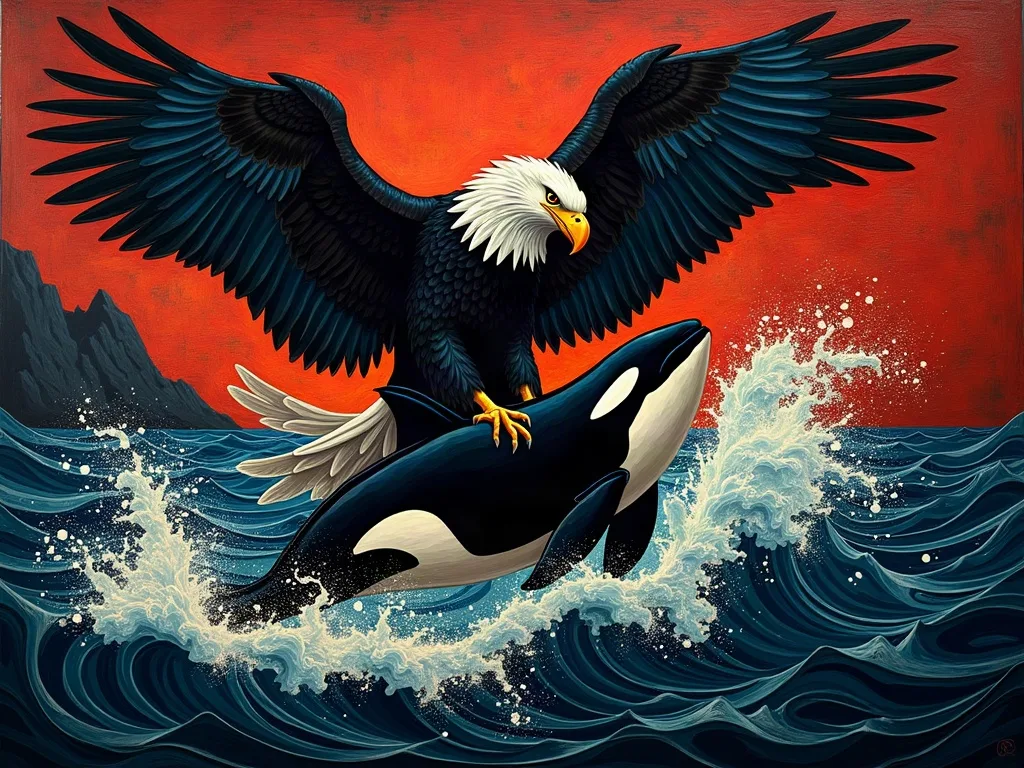
Among the Haida and Kwakwaka'wakw of the Pacific Northwest coast, this battle takes visual form in the famous "Thunderbird and Whale" motif carved on totem poles. Here the serpent transforms into a great whale or sea monster, and the Thunderbird clutches it in its talons. The image is not a moment of triumph; it is an eternal struggle rendered in red cedar, meant to remind those who see it that the tension between sky and sea never ends.
What the Thunderbird Looks Like: Feathers, Eyes, and Impossible Scale
The physical form of the Thunderbird shifts between traditions, but certain features return again and again.
Size is the first and most consistent attribute. The Thunderbird is always enormous, described as large enough to carry a killer whale in its talons, or to spread wings that cast a shadow over an entire village. The Lakota accounts recorded by Walker describe Wakinyan as so vast that its full form cannot be seen at once, only glimpsed in parts through cloud-breaks.
The second consistent feature is light from the eyes. Almost every tradition locates the source of lightning in the Thunderbird's gaze. Some accounts, particularly from the Plains nations, specify that the Thunderbird keeps its eyes closed most of the time because an open gaze would destroy whatever it fell upon. Lightning is not aggression; it is a blink.
Feathers function as both weapon and weather tool. The Ojibwe accounts describe the wingbeat of Animikiig creating the sound of thunder directly, each downstroke pushing air hard enough to shake the earth below. The feathers can carry rain; in some stories, a single feather, touched by the right ceremony, can bring needed rainfall to drought-parched land.
The beak curves sharply downward. The talons are sometimes described as made of stone, or as actual flint, which explains why flint arrowheads hold sacred power in many Great Plains traditions. To find a piece of flint was to hold a fragment of the Thunderbird's body, dropped from the sky during battle.
Some Northwest Coast traditions, notably those of the Nuu-chah-nulth people, add a second head on the back of the Thunderbird, facing rearward, representing the being's ability to see in all directions simultaneously, past and future as well as present.
The Thunderbird in Lakota Ceremony: Wakinyan and the Sacred Heyoka
Among the Lakota, the Thunderbird Wakinyan holds a specific and demanding relationship with certain human beings. Those who dream of Wakinyan are compelled to become heyoka, sacred contrarians who act opposite to social norms: laughing at funerals, walking backward, saying the opposite of what they mean.
This is not a joke. The heyoka role, documented by ethnographer Frances Densmore in her 1918 work "Teton Sioux Music," is one of the most powerful and most demanding spiritual callings in Lakota society. The heyoka bears the energy of the storm directly in their body. Their reversal behaviour is a way of managing that power, of channeling it outward safely. To dream of Wakinyan and ignore the call is to invite destruction.
Black Elk, the Oglala Lakota holy man whose visionary experiences were recorded by John G. Neihardt in "Black Elk Speaks" (1932), described his great vision as beginning with the Thunderbeings, the six Grandfathers who shape reality. The Thunderbird presides over the west in this vision, the direction of storms and of transformative power. Black Elk's own heyoka ceremony was one of the central events of his early spiritual life. He performed it publicly, acting out the storm in costume, giving the community a way to laugh at and therefore absorb the fear that thunder genuinely produced.
Pacific Northwest Thunderbirds: Totem Poles, Cedar, and the Whale
On the Pacific Northwest coast, the Thunderbird operates in a visual culture of extraordinary richness. The peoples of this region, including the Kwakwaka'wakw, Haida, Tlingit, and Nuu-chah-nulth, expressed sacred knowledge through carved and painted objects: totem poles, house posts, ceremonial screens, and masks.
The Thunderbird appears near the top of many totem poles, which is significant. Totem poles read from the ground upward, with the sky beings occupying the highest position. The Thunderbird at the apex represents the highest tier of the cosmos, the power that stands above the human, animal, and spirit levels arranged below.
Kwakwaka'wakw ceremonial regalia includes Thunderbird masks, some of the most technically ambitious objects in the tradition. The outer mask opens during ceremony to reveal a second, inner face, a transformation sequence that mirrors the being's nature: the storm concealing something older and more permanent beneath. These masks were used in the Tseyka winter dances, ceremonies conducted during the season when the boundary between the human world and the spirit world grows thin.
A particular story from the Quileute people of the Olympic Peninsula of present-day Washington State describes a time of famine, when the sea held no whales and the people were starving. A Thunderbird arrived, flew out over the ocean, seized a whale in its talons, and carried it back to the shore. The people ate, and the famine ended. Here the Thunderbird acts not as a battle-being but as a provider, a being that corrects the imbalance between sky and sea in a way that directly sustains human life.
The Thunderbird in Plains Material Culture: Shields, Ledger Art, and the Sacred West
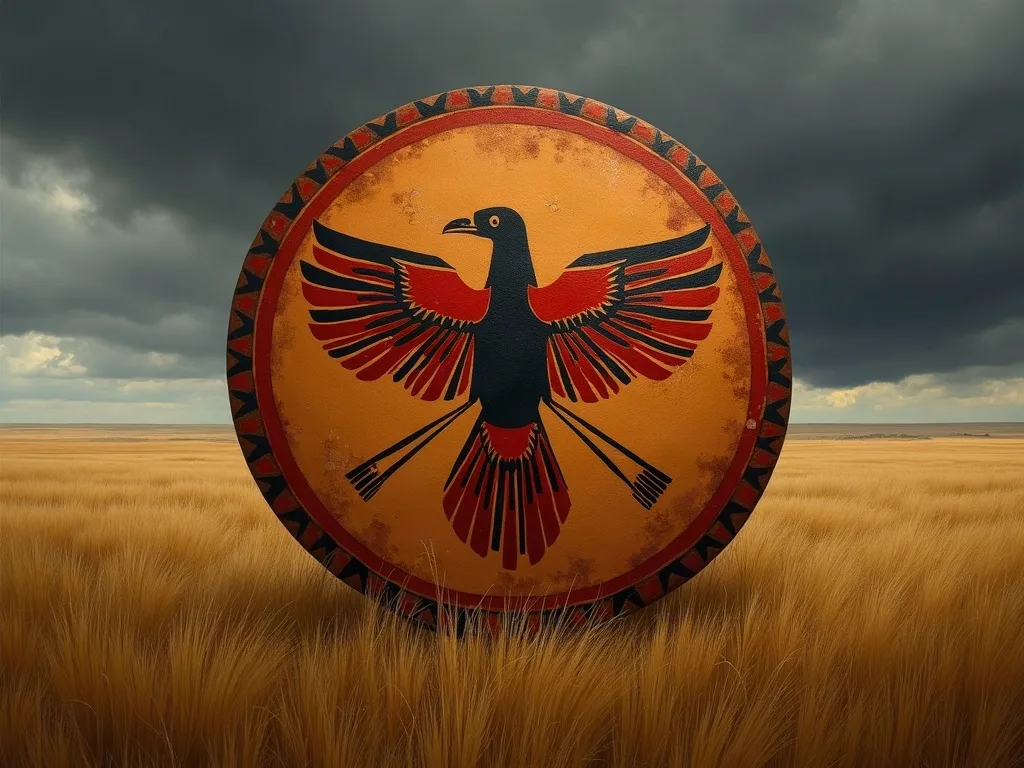
On the Great Plains, where the horizon is wide and storms sweep in with almost cinematic drama, the Thunderbird became embedded in visual and material culture. Warriors painted Thunderbird imagery on their shields, tipis, and horses. The image was understood as protective, calling the power of the storm into a defensive context.
Lakota and Cheyenne shield covers from the 19th century, held in collections at the Smithsonian National Museum of the American Indian, show stylised Thunderbird figures rendered in strong geometric lines. These were not decorative choices. A shield carrying a Thunderbird image carried actual storm-power, the belief being that an arrow or bullet would no more strike the bearer than it would strike a bolt of lightning in midair.
Ledger art, the drawings made by Plains warriors on paper and accounting ledgers obtained through trade after the mid-19th century, frequently shows Thunderbirds in dynamic motion, wings fully spread, lightning streaming from the wingtips. These drawings were personal records, spiritual autobiographies as much as historical accounts. A warrior who had experienced a vision of the Thunderbird would record that vision in ledger form, making the private revelation visible.
The cardinal direction of the west holds special weight across Plains cosmologies precisely because most major storm systems approach from the west. The Thunderbird's home at the western edge of the world is not abstract geography. It is where every person on the plains can look when the sky begins to change colour and the air goes electric.
Cross-Cultural Echoes: Thunderbirds Beyond North America
The Thunderbird pattern, a winged sky-being associated with storms, lightning, and cosmic battle, appears in traditions far beyond North America. This does not mean those traditions borrowed from each other. It suggests that humans watching the same natural phenomena, massive birds of prey, violent electrical storms, and the way lightning strikes water, arrive at similar symbolic conclusions.
The Mesopotamian Anzu, a lion-headed storm eagle from Sumerian and Akkadian mythology dating back to at least 2500 BC, battles divine figures and steals sacred objects, linking storms to transgression and cosmic conflict in ways that parallel Thunderbird narratives. The Vedic Garuda, the great eagle of Hindu tradition and mount of Vishnu, is an enemy of serpents and a carrier of the thunderbolt-adjacent sacred fire. The Aztec Quetzalcoatl, the Feathered Serpent, interestingly combines both poles of the Thunderbird-Serpent opposition into a single figure, a flying serpent that bridges sky and earth.
What distinguishes the North American Thunderbird from these parallels is its specificity to landscape. The being is not a borrowed concept or a theological abstraction. It grows directly from the observable reality of Great Plains and Great Lakes weather, where thunderstorms are among the most powerful natural events a person can witness and where the connection between lightning and water is dramatically visible. The mythology does not explain the storm; it recognises the storm as a being that already understands itself.
Frequently Asked Questions About the Thunderbird
Frequently asked questions
Is the Thunderbird a single creature from one specific mythology?
No. The Thunderbird appears across dozens of distinct Native American nations, each with its own name, its own specific lore, and its own ceremonial context. The Ojibwe call it Animikiig, the Lakota call it Wakinyan, the Algonquin and many Northeast peoples have their own variants. Treating these as one unified myth flattens real cultural differences. The shared thread is the identification of storms with a giant bird, but the stories around that thread differ significantly.
What is the significance of the Thunderbird's battle with the Underwater Serpent?
The conflict represents a fundamental cosmic balance. The Thunderbird governs the sky and brings rain and lightning. The Horned Serpent or great water creature governs the depths and brings floods and drowning. Their eternal battle keeps neither force dominant, which is what allows the living world to exist. Scholars of Native American religion, including Åke Hultkrantz in his survey "The Religions of the American Indians" (1979), have identified this sky-water opposition as one of the most stable structural patterns across North American sacred traditions.
Why do some researchers connect the Thunderbird myth to real prehistoric animals?
Several researchers have noted that the physical description of the Thunderbird, its enormous size, its predation on large sea creatures, and its bone-like talons, resembles the profile of large extinct birds such as Teratornis merriami, a vulture-like bird with a wingspan of up to 3.5 metres that lived in North America until roughly 10,000 years ago. Palaeontologist Paul S. Martin and others have explored whether oral traditions preserved memory of encounters with megafauna. Most scholars treat this as an interesting possibility rather than a confirmed explanation, since the symbolism of the Thunderbird clearly transcends any purely zoological reading.
What does it mean to have a Thunderbird vision in Lakota tradition?
In Lakota belief, dreaming of Wakinyan is not simply an unusual dream. It is a call, one that the dreamer is obligated to answer. Those who receive this vision are expected to become heyoka, sacred contrarians who perform opposite behaviour in social contexts. The ceremony that publicly enacts this transformation, sometimes involving re-enactment of the vision with costumes and comedy, serves a social function: it gives the community a way to process fear of the storm through laughter and shared ritual. Ignoring a Wakinyan vision was understood to carry serious spiritual consequences.
How is the Thunderbird depicted in Pacific Northwest art?
Pacific Northwest Coast artists render the Thunderbird in a distinctive formal visual language characterised by ovoid shapes, split-U forms, and precisely controlled line weights. The Thunderbird typically appears with its wings spread, a curved beak, and often a secondary face on its chest or back. On totem poles, it occupies the topmost position. In ceremonial masks, it is made to transform during performance, with an outer shell opening to reveal an inner form, expressing the belief that the Thunderbird exists in multiple simultaneous states.
Is the Thunderbird symbol still used today?
Yes, extensively. The Thunderbird appears in the flags and seals of several Indigenous nations. It is a widely used image in contemporary Indigenous art, sometimes in traditional formal styles and sometimes in new artistic idioms. It also entered mainstream North American culture through sports team names, car models (the Ford Thunderbird, produced from 1955 to 2005), and popular culture generally. Indigenous scholars and artists have noted the tension between this broad cultural presence and the specific sacred meaning the being holds in living ceremonial traditions.
The Thunderbird After Colonisation: Survival, Reclamation, and Living Ceremony
The story of the Thunderbird did not end with the arrival of European settlers on the plains and coasts. It changed, went underground in some places, survived openly in others, and is actively being reclaimed today.
The 19th and early 20th centuries brought deliberate suppression of Indigenous ceremonial life across the United States and Canada. The Potlatch, the major ceremony of Pacific Northwest nations in which Thunderbird regalia played a significant role, was banned in Canada from 1885 to 1951. Sacred objects, including Thunderbird masks and painted shields, were confiscated and placed in museum collections in North America and Europe, where many remain today.
The result was not the death of the tradition. Knowledge was kept in family memory, in private ceremony, in the details passed between elders and children in ways that colonial administrators could not monitor. When the legal suppressions lifted, the traditions were still there, sometimes wounded, never gone.
Today, Thunderbird imagery holds a dual presence. In living Indigenous ceremony, among the Ojibwe, Lakota, Kwakwaka'wakw, and many other nations, Wakinyan and Animikiig and their many counterparts remain active sacred beings, not historical curiosities. Ceremonial regalia is being made. Songs are being sung. Young people are learning the protocols around Thunderbird visions and what they require.
At the same time, the image has circulated so widely in mainstream culture that a significant effort of reclamation is underway: Indigenous artists, scholars, and community leaders insisting on the difference between the Thunderbird as a living sacred being and the Thunderbird as a logo or a brand. That tension is not resolved. It is part of the ongoing story of how these traditions survive, adapt, and assert their own meaning against every force that has tried to flatten them into decoration.
The storm still comes from the west. The plains still go electric and green before the rain. Whatever name you carry for the being in the clouds, the feeling it produces, the mix of awe and fear and gratitude, is exactly what the oldest stories said it should be.
Free 25-page sample
Want the whole story?
Take the first 25 pages free. If it pulls you in, the full edition is yours as an instant PDF download, with a paperback on Amazon for selected titles.
Native American
The Native American Mythology Book: Raven, Coyote, Spider Woman, and the Sacred Stories of Turtle Island
From Pacific Raven to Atlantic Glooscap
The unbroken pre-contact mythology of North America: Raven stealing light, Coyote's tricks, Spider Woman weaving creation, Sedna beneath the ice, and the kachina spirits of the mesa.
More from Native American
All articles
Native American
The Vision Quest: Rite of Passage and Spiritual Revelation
The vision quest stands at the heart of many Native American spiritual traditions: a solitary journey into wilderness where seekers fast, pray, and await contact with the sacred. Discover how this ancient ceremony marks the threshold between boyhood and manhood, illness and healing, confusion and purpose.

Native American
The Sun Dance: Plains Ceremony of Renewal and Sacrifice
The Sun Dance stands as the most sacred communal ceremony of the Great Plains nations, a multi-day ritual of piercing, fasting, and prayer where participants offer their bodies to restore balance and healing to their people. We trace its origins, structure, and enduring power across Lakota, Cheyenne, Arapaho, and Shoshone traditions.
Native American
The Medicine Wheel: Sacred Symbol and Ceremonial Structure
The Medicine Wheel represents the interconnected nature of existence across countless Native American traditions. Discover how this ancient symbol functions as both spiritual map and healing practice, grounded in real ceremonies that still guide communities today.

Native American
Sedna: Inuit Goddess of the Sea and Marine Animals
Sedna rules the Arctic depths as the Inuit goddess of the sea and marine animals. Her story begins with betrayal and transformation: a fallen maiden becomes the sovereign of the ocean, controlling the seal, whale, and fish that sustained Arctic peoples for millennia. Discover how her myth shaped survival, hunting ritual, and the spiritual bond between humans and the sea.