
Coyote: The Trickster of Native American Mythology
Coyote is the shape-shifting trickster at the heart of dozens of Native American traditions, at once creator, fool, and cosmic disruptor. His stories reveal something real about how humans survive a world that refuses to behave.
Contents
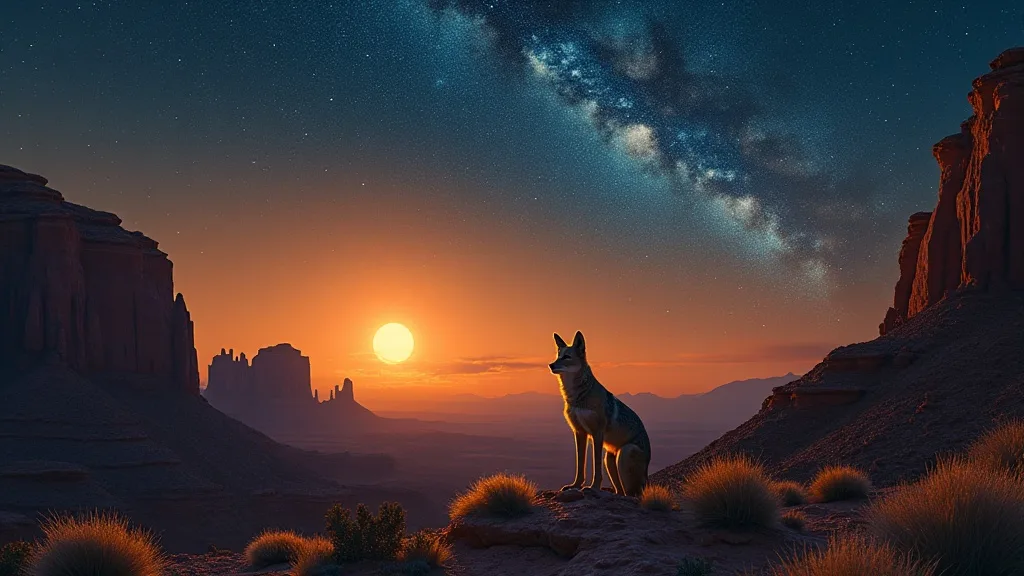
He steals fire. He bungles the creation of rivers. He talks the stars into the wrong places and then brags about it. Across more than a hundred distinct Indigenous traditions stretching from the Plateau region of the Pacific Northwest to the desert Southwest, from the Great Basin to the Great Plains, one figure keeps appearing at the exact moment the cosmos needs either saving or humiliating: Coyote, the trickster of Native American mythology.
He is not a devil, though he causes damage. He is not a saint, though he sometimes gives humanity its most vital gifts. He is the figure who exists precisely in the gap between those categories, and it is that gap where life actually happens.
What makes Coyote enduring across so many distinct peoples and languages is not a single canonical text. There is no Coyote Iliad. His stories live in oral recitation, in winter ceremony, in the patient voice of an elder, and they shift with every telling. Understanding him means sitting with that multiplicity rather than flattening it.
Coyote's Origins Across Regional Traditions
No single tribe invented Coyote. He arrived in the mythological record with the peopling of the continent itself, and his earliest attested forms appear in the traditions of the Plateau peoples: the Nez Perce, the Flathead (Salish), the Yakama, and the Spokane. In these traditions, Coyote often functions as the transformer figure who reshapes a pre-human world into one habitable for people.
The Nez Perce version is instructive. Before people existed, animal people walked the earth. Coyote was among them, clever and restless. He fought and killed a monster called Kamiah (or, in some tellings, Wishpoosh, a giant beaver of terrifying proportions) and from the creature's dismembered body created the different human tribes. Heart, intestines, blood: each piece scattered to a direction and became a people. Then, when his companion Fox pointed out that he had forgotten the land where the battle took place, Coyote fashioned the Nez Perce from the creature's blood mixed with the earth. Small people, he said, but strong and clever.
Among the Crow and Blackfoot of the northern Plains, Coyote shades more toward a pure trickster with fewer creator attributes. Among the Zuni, Navajo (Diné), and Hopi of the Southwest, he appears as a chaos-bringer who disrupts the careful sacred order the Holy People maintain. The Navajo call him Ma'ii, a word that carries connotations of both animal and itinerant wanderer, someone who goes around and returns. He is present at the moment the stars are being set in the sky and, impatient with the precise work of the Holy People, tosses the remaining stars in random handfuls, scattering them into the Milky Way.
The Trickster Pattern: What Coyote Actually Does
Scholarship on the trickster type began in earnest with the folklorist Paul Radin's 1956 study The Trickster: A Study in American Indian Mythology, which analyzed the Winnebago (Ho-Chunk) Trickster cycle and placed it in conversation with Hermes and other cross-cultural figures. Radin, Carl Kerényi, and Carl Jung each contributed a layer to the interpretation, but their framework had limits: it treated trickster as a universal archetype, smoothing over the very specific cultural work different Coyote stories do in different communities.
A more useful framework comes from the stories themselves. Coyote is defined by four recurring behaviors:
- Transgression: He crosses boundaries that should not be crossed, often to comic and catastrophic effect.
- Transformation: He changes shape, impersonates others, disguises his intent.
- Failure as instruction: His schemes collapse in ways that teach the listener what not to do, and why the rules exist.
- Unexpected gift: Even his disasters sometimes leave something useful behind. He steals fire. He breaks open the fish trap. He blunders into the right answer.
That fourth point is the one that separates Coyote the trickster from a simple cautionary tale. He is not merely a warning. He is proof that chaos occasionally creates.
Among the Maidu of California, Coyote and Earthmaker together shape the world from primordial water. Coyote argues for everything to be easy: rivers that flow both ways, so people never have to paddle upstream; no death, so no one ever grieves. Earthmaker refuses. Each of Coyote's proposed shortcuts gets denied, and the world gains its difficulty, its current, its mortality. When Coyote's own son is the first to die, he goes to Earthmaker weeping and asks him to revoke the rule about death. Earthmaker says no. Coyote, who invented the problem, now lives inside it. His grief is not ironic. It is real, and that is the point.
Coyote and the Theft of Fire
The fire-theft story travels across an enormous range of traditions and is one of the clearest examples of Coyote functioning as a culture hero rather than a pure trickster. The Kalapuya of Oregon, the Shoshone, and several Plateau peoples all carry versions.
In one widely told Shoshone variant, fire was held by two old women who refused to share it. Coyote organized a relay race of animals: squirrel, chipmunk, frog, each waiting at intervals across the mountains. He stole a coal from the old women's fire (sometimes by getting them to chase him, sometimes by a more elaborate deception), and then ran. The animals passed the fire down the relay line, each handing it off before the old women could catch them. The cedar tree received it last and has held fire inside its wood ever since. When humans need fire, they rub cedar sticks together and coax it out again.
The structural parallel with Prometheus is genuine and frequently noted. Both figures steal fire from those who hoard it and give it to humans who need it. But where Prometheus suffers an eternal punishment, Coyote's consequence is characteristically sideways: in many versions, he is burned, or he runs so hard he collapses, or he simply walks away having done something useful by accident. The cosmos does not punish him the way it punishes the Greek Titan. It absorbs him and moves on.
Coyote as World-Maker in Plateau and Basin Traditions
The traditions of the Plateau peoples, particularly the Nez Perce, Yakama, Umatilla, and Okanagan, give Coyote his most elaborate cosmological role. Here he is a deliberate transformer: a figure who travels the pre-human landscape and reshapes it for the benefit of the people who will come.
He clears rivers of monsters that block the salmon runs. He teaches people how to catch and prepare fish. He steals wapato root from the people who hoard it. In Yakama tradition, he places the Cascades in their current configuration. These are not the blunders of a foolish animal; they are purposeful acts of world-formation carried out by a being who knows people are coming and wants to have things ready.
The Thompson (Nlaka'pamux) and Okanagan traditions describe Coyote traveling with a companion, sometimes Fox, sometimes a pair of hairs from his own body that he can animate as advisors. When he is about to do something catastrophically stupid, his companions warn him. He ignores them. The disaster unfolds. He reassembles himself (in many stories, Coyote can be killed and resurrected, often by Fox breathing life back into his scattered bones), and then he does something right almost by accident.
This cycle of failure, death, resurrection, and accidental success is not random narrative messiness. It maps onto the rhythms of seasons, of salmon runs that fail and return, of drought and rain. Coyote dies and comes back because the world does too.
Coyote Among the Navajo (Diné): Ma'ii the Wanderer
The Navajo tradition gives Coyote a distinctive role in the creation narrative preserved in texts like the Diné Bahane' (the Navajo creation story, recorded in detail by Paul Zolbrod in his 1984 translation). In this account, Ma'ii (Coyote) accompanies the Holy People through the emergence from lower worlds into the present world.
His most consequential act in the Diné Bahane' involves the sacred bundle of the water monster. The Holy People notice the waters rising behind them as they climb upward through the worlds. Ma'ii is accused of having stolen something. After much insistence, he produces a baby he had hidden inside his blanket, a child belonging to Tó Neinilí, the Water Monster. The floods were pursuit, not disaster; they were the Water Monster reclaiming his own. The Holy People return the child and the waters recede.
This episode is not merely plot. In Navajo ceremonial thought, Ma'ii carries the capacity to both cause harm and undo it. He appears in the Coyoteway ceremonial, a healing chant performed to address illnesses caused by Coyote's influence. In this framework, Coyote is not simply a character in a story but a living presence in the world, an agent whose anger or interference has real physical consequences and whose appeasement requires ritual knowledge.
The Navajo also credit Ma'ii with teaching humans about death. In one account, he throws a stone into a lake; if it floats, humans will not die. It sinks. Later, when Ma'ii's own child dies, he regrets the decision, but there is no reversing it. Death entered the world through an act of casual carelessness that nobody understood would matter.
Coyote and the Stars: Chaos Written in the Sky
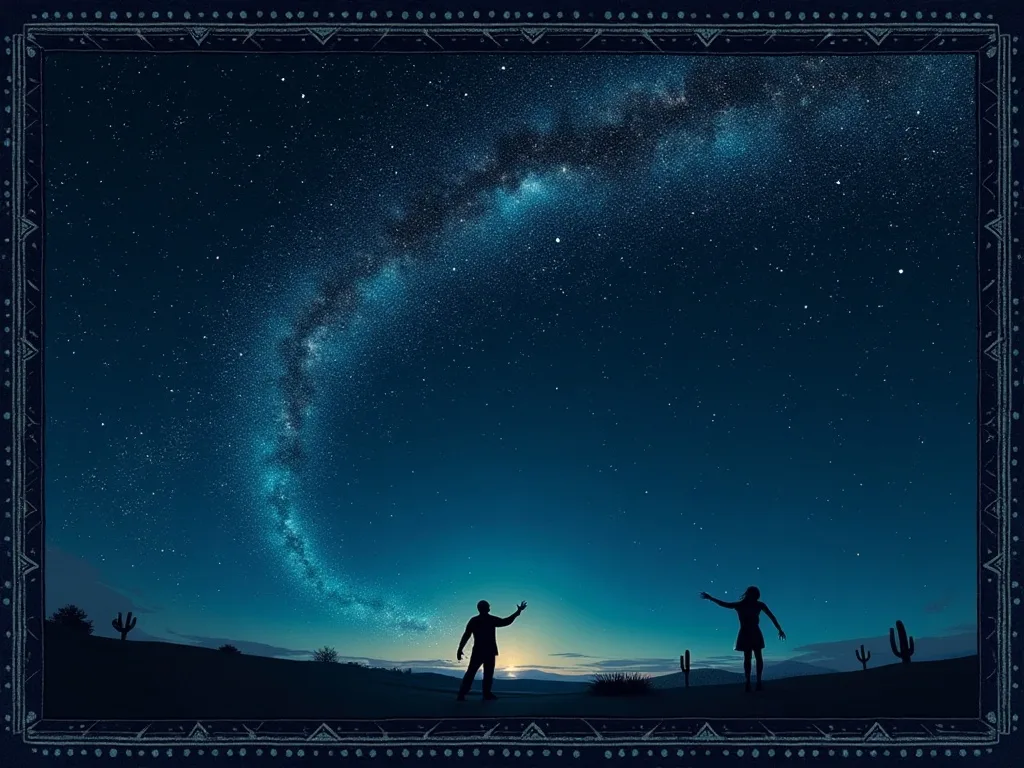
The star-scattering story appears in Navajo, Paiute, and several Plateau traditions, and it is one of the most visually arresting in the Coyote corpus. The Holy People (or, in some versions, the chief gods of the sky) are painstakingly placing stars in ordered patterns to serve as a calendar, a guide for agriculture and ceremony. Coyote, bored with the slowness of the work, grabs the remaining star-material and flings it across the sky in one impatient sweep.
The result is the Milky Way.
This is not presented as a catastrophe. It is presented as Coyote. The Milky Way is the trace of his impatience, written permanently into the night sky as a reminder that not everything in the cosmos was planned, that some of it is the residue of someone who simply could not wait.
The Milky Way's mythological role across Indigenous traditions is far broader than this single story, but the Coyote version captures something precise about how these traditions hold disorder: not as the absence of order but as its necessary companion.
Coyote's Body: Shapeshifting, Disguise, and Desire
Coyote does not stay in one shape. This is axiomatic. He becomes a woman to trick a chief into marriage. He disguises himself as an old man to steal food. He pretends to be dead to see how people will react. He impersonates shamans, enemies, relatives.
This shapeshifting capacity reflects something deeper than plot convenience. In many Plains traditions, the winkté (Lakota) and nadleeh (Navajo) roles as two-spirit persons are associated with Coyote's boundary-crossing nature. Coyote moves between genders, between species, between the living and the dead, not because rules do not apply to him, but because the stories use him to test where rules come from and what they protect.
His sexual appetite is equally boundary-crossing, and many traditional Coyote stories are explicitly ribald. He is cuckolded, seduced, humiliated. He seduces women who later discover what he is. His genitals occasionally detach and cause mischief on their own. These are adult stories, often told with laughter, and the laughter is not nervous: it is the laughter of recognition. Coyote's body is an exaggerated map of human appetite and its consequences.
The Lakota figure Iktomi, the spider trickster, operates in a similar register and occasionally appears in stories alongside or in contrast to Coyote, each representing a slightly different flavor of cunning. Where Iktomi plots, Coyote improvises. Where Iktomi weaves traps, Coyote runs headfirst into them.
Oral Tradition, Ceremony, and the Ethics of Telling
One of the most important things to understand about Coyote stories in Native American oral tradition is that they are not equally available to all listeners at all times. In many communities, Coyote stories are winter stories: told only when the ground is frozen, when snakes are sleeping, when the world itself is in a dormant state that makes it safer to speak of dangerous things.
The Yakama, the Nez Perce, the Flathead all observe this protocol. A story told out of season is not just socially inappropriate; in traditional belief, it risks calling the wrong kind of attention from the beings the story describes. This is not superstition in the dismissive sense. It is a sophisticated understanding that stories are not inert containers for information. They are active, relational, and potentially consequential.
This is also why many traditional storytellers are cautious about fixed written versions of Coyote mythology. A written text freezes what is meant to move. The humor that lands differently for a child than for an elder, the pause before a punchline that signals something coming, the choice to change a detail for a particular audience: all of this disappears on the page. Ethnographers from the 19th and early 20th centuries, including Franz Boas, Edward Sapir, and Archie Phinney (a Nez Perce scholar who recorded stories in his own language), worked to capture these narratives, but all acknowledged the limits of transcription.
Phinney's 1934 bilingual collection Nez Perce Texts remains one of the most valuable primary sources, precisely because it preserves the Nez Perce originals alongside translations.
Coyote in Contemporary Indigenous Literature and Art
The transition from oral to written, from ceremony to art, did not extinguish Coyote. It transformed him, as he always transforms.
N. Scott Momaday, Leslie Marmon Silko, and Gerald Vizenor all engage Coyote's energy in their fiction and essays, using his shape-shifting irreverence to navigate the complexities of contemporary Native identity, colonialism, and survival. Vizenor, Anishinaabe, coined the term "trickster hermeneutics" to describe the interpretive mode Coyote embodies: a refusal of fixed meaning, a commitment to irony as a survival tool.
Visual artists including Harry Fonseca (Nisenan Maidu) spent decades painting Coyote in contemporary urban settings, leather jacket and sunglasses, street-smart and ancient at once. Fonseca's Coyote series (begun in the late 1970s) treats the figure not as a relic of pre-contact life but as a living presence navigating modernity with the same combination of recklessness and resilience he always carried.
Coyote, in these works, is not a symbol of the past. He is a strategy for the present. That is perhaps the most traditional thing about him.
Frequently Asked Questions About Coyote in Native American Mythology
Frequently asked questions
Is Coyote a god, a spirit, or an animal in Native American traditions?
Coyote resists clean categorization, and that resistance is the point. In most traditions he is a primordial being who existed before humans, capable of creation and transformation, but he is also subject to hunger, lust, grief, and death in ways that gods typically are not. The Nez Perce term "animal people" is more accurate than "god": Coyote belongs to a class of beings who preceded humans and whose natures shaped the world, but who are not distant or transcendent. He is intimate, fallible, and present.
Why are Coyote stories traditionally told only in winter?
Many Plateau and Basin peoples restrict Coyote stories to the winter months, roughly when snakes and insects are dormant. The protocols vary by nation, but the underlying logic is consistent: stories that involve powerful beings or dangerous knowledge require conditions where those beings are less likely to hear themselves invoked and respond. The Yakama say telling Coyote stories in summer risks bringing snakes. More broadly, the seasonal restriction signals that oral tradition is not entertainment but ceremony, with its own relational ethics.
What is the difference between Coyote and Iktomi?
Both are trickster figures within Native American traditions, but they come from different cultural contexts. Coyote is most strongly associated with Plateau, Great Basin, and Southwest peoples. Iktomi is the Lakota spider-trickster of the Great Plains. Both transgress, deceive, and expose human folly, but their methods differ: Iktomi tends toward premeditated webs of deception, while Coyote tends toward impulsive action and spectacular failure. They are distinct figures who occasionally appear in the same region's stories as complementary archetypes.
Is Coyote the same as the trickster figures in other world mythologies?
Scholars have drawn comparisons between Coyote and Loki of Norse mythology, Hermes of the Greek tradition, and Anansi of West African and Afro-Caribbean tradition. All are liminal, boundary-crossing figures who challenge established order and occasionally benefit humanity through their chaos. Paul Radin's 1956 study The Trickster was the first major comparative treatment. But reducing Coyote to a "universal trickster archetype" obscures the specific cultural, ceremonial, and linguistic contexts each tradition brings. The parallels illuminate; they should not flatten.
Which Native American nations have Coyote stories?
More than 80 distinct nations have named Coyote trickster-creator traditions, including the Nez Perce, Yakama, Flathead, Shoshone, Paiute, Navajo (Diné), Zuni, Maidu, Kalapuya, Crow, Blackfoot, Okanagan, Umatilla, and Thompson (Nlaka'pamux) peoples. The geographic range covers the Pacific Northwest, Great Basin, Southwest, and portions of the Plains. East of the Mississippi, the trickster role tends to fall to other animals, particularly Rabbit (in the Southeast) and Raven (in the far Northwest and Arctic). Coyote's range tracks closely with the actual habitat of the physical coyote.
What primary sources exist for studying Coyote mythology?
Key primary sources include Archie Phinney's bilingual Nez Perce Texts (1934), Paul Zolbrod's translation of the Diné Bahane' (1984), Franz Boas and Edward Sapir's extensive ethnographic collections from Plateau and Basin peoples in the early 20th century, and the recorded oral narratives held in archives at the Smithsonian Institution. Barry Lopez's Giving the Stick to Coyote gathers literary retellings with careful cultural attribution. For academic analysis, Paul Radin's The Trickster (1956) and Jarold Ramsey's Coyote Was Going There (1977) remain foundational.
Coyote and the Unresolved Question of Sacred Chaos
Contemporary scholars of religion and mythology continue to debate what, precisely, Coyote the trickster does for the communities that tell his stories. The functionalist reading, common in mid-20th century anthropology, treated him as a safety valve: a figure through whom transgressive desires get expressed and defused, leaving the social order intact. But this reading underestimates him.
A more rigorous position, advanced by scholars like Jarold Ramsey and William Bright, is that Coyote stories perform a kind of epistemological work. They teach attention to consequence. They model what happens when appetite overrides wisdom, and they do it through comedy because comedy reaches places that solemn instruction cannot. Laughter is the fastest route to a lesson absorbed.
But there is a third reading, emerging more clearly in Indigenous scholarship, that does not reduce Coyote to a pedagogical tool. In this view, Coyote is not explained by his function. He is a real presence, a relational being whose stories are an ongoing conversation between humans and the non-human world. The Navajo Coyoteway ceremony is not a metaphor for social regulation; it is a literal response to a literal disruption caused by a literal Ma'ii.
These three readings do not cancel each other. Coyote holds them all simultaneously, which is, when you think about it, exactly what you would expect from a figure who has been outrunning definitions for ten thousand years.
The stars he scattered are still up there, disorganized and brilliant. That, too, is his.
Free 25-page sample
Want the whole story?
Take the first 25 pages free. If it pulls you in, the full edition is yours as an instant PDF download, with a paperback on Amazon for selected titles.
Native American
The Native American Mythology Book: Raven, Coyote, Spider Woman, and the Sacred Stories of Turtle Island
From Pacific Raven to Atlantic Glooscap
The unbroken pre-contact mythology of North America: Raven stealing light, Coyote's tricks, Spider Woman weaving creation, Sedna beneath the ice, and the kachina spirits of the mesa.
More from Native American
All articles
Native American
The Vision Quest: Rite of Passage and Spiritual Revelation
The vision quest stands at the heart of many Native American spiritual traditions: a solitary journey into wilderness where seekers fast, pray, and await contact with the sacred. Discover how this ancient ceremony marks the threshold between boyhood and manhood, illness and healing, confusion and purpose.

Native American
The Sun Dance: Plains Ceremony of Renewal and Sacrifice
The Sun Dance stands as the most sacred communal ceremony of the Great Plains nations, a multi-day ritual of piercing, fasting, and prayer where participants offer their bodies to restore balance and healing to their people. We trace its origins, structure, and enduring power across Lakota, Cheyenne, Arapaho, and Shoshone traditions.
Native American
The Medicine Wheel: Sacred Symbol and Ceremonial Structure
The Medicine Wheel represents the interconnected nature of existence across countless Native American traditions. Discover how this ancient symbol functions as both spiritual map and healing practice, grounded in real ceremonies that still guide communities today.

Native American
Sedna: Inuit Goddess of the Sea and Marine Animals
Sedna rules the Arctic depths as the Inuit goddess of the sea and marine animals. Her story begins with betrayal and transformation: a fallen maiden becomes the sovereign of the ocean, controlling the seal, whale, and fish that sustained Arctic peoples for millennia. Discover how her myth shaped survival, hunting ritual, and the spiritual bond between humans and the sea.