
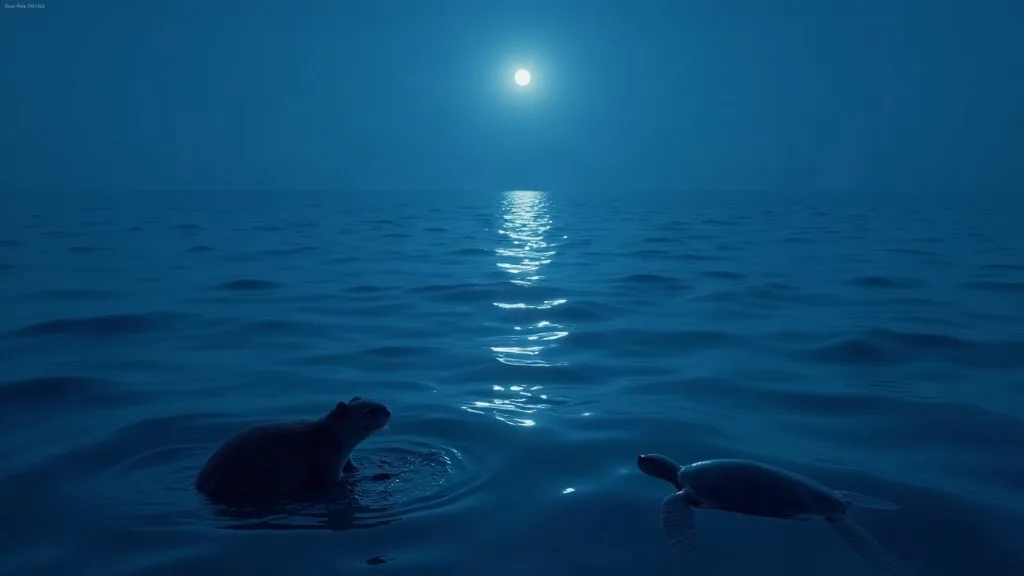
The Earth Diver Creation Myth: How the World Rose from the Deep
Before land existed, a small animal dove into primordial waters and brought up a handful of mud. The Earth Diver creation myth spans dozens of Native American nations and reveals how the world began.
Contents
The water stretched in every direction, flat and featureless, and there was nothing else. No shore, no tree, no stone. Only sky above and water below, and in that water, something small moving downward into the dark.
That image sits at the center of one of the most widespread creation stories on earth. The Earth Diver creation myth describes a moment before land existed, when a creature or a being plunged into primordial waters and returned with a grain of mud. From that grain, the world was made. The story appears across dozens of Native American nations, from the Ojibwe of the Great Lakes to the Muscogee of the Southeast, from the Iroquois of the Northeast to several Plains and California traditions. It also surfaces in Siberian, Finnish, and Hindu accounts, which tells us something striking: this is a very old idea, or a very human one, or both.
The version that reaches most readers first is Haudenosaunee (Iroquois), and it is worth starting there. But the story has many shapes, and each reveals something the others do not.
Sky Woman and the Turtle's Back: the Haudenosaunee Account
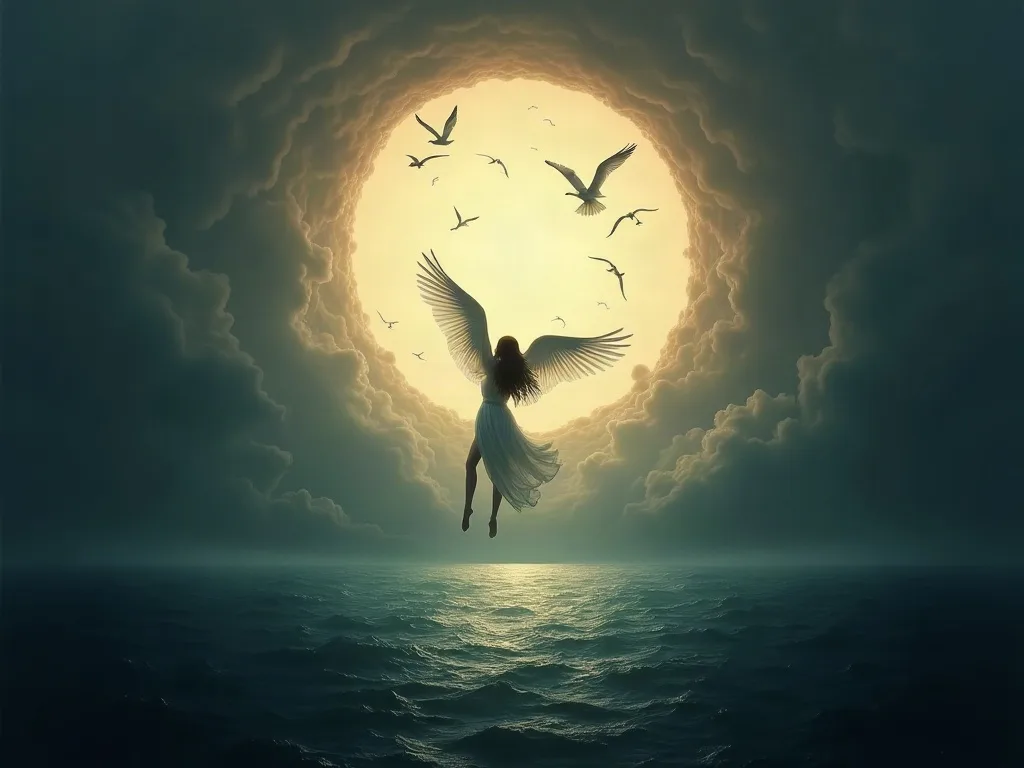
The Haudenosaunee story begins not underwater but in the sky. A pregnant woman, often called Sky Woman or Ataensic (a name meaning, roughly, "ancient sky woman" in Mohawk), falls through a hole that opens in the sky world. Below her, nothing but ocean. Water birds, geese and ducks, see her falling and fly up to catch her on their wings. They lower her gently toward the water, and the animals council together: what can they do? She needs solid ground.
One by one, animals dive. The beaver goes down. The otter goes down. Neither returns with anything. Finally, a small creature, often the muskrat, slips beneath the surface. It is gone a long time. When it floats back up, it is nearly dead from the depth. But between its small paws, there is a smear of mud.
The great turtle surfaces and offers its back. The mud is placed on the shell. Sky Woman steps onto it and begins to walk in a circle. As she walks, the mud spreads. It grows into an island, and the island grows into a continent. The Haudenosaunee call it Turtle Island, a name that today is used across many Indigenous communities to refer to North America as a whole.
Sky Woman gives birth on this new land. Her daughter later gives birth to twin boys, one good, one hostile. These twins shape the details of the world: mountains, rivers, plants, animals. The Earth Diver moment is only the beginning, but without it, nothing follows.
Primary sources for this account include oral tradition recorded in multiple forms, notably by J.N.B. Hewitt in his 1903 Bureau of American Ethnology reports and, more recently, in versions told by Haudenosaunee scholars such as John Mohawk and Oren Lyons.
The Ojibwe Version: Nanabozho and the Four Divers
Among the Ojibwe (also written as Anishinaabe, the broader cultural-linguistic group), the Earth Diver creation myth takes a form centred on Nanabozho, the trickster-transformer figure who sits at the heart of Anishinaabe cosmology.
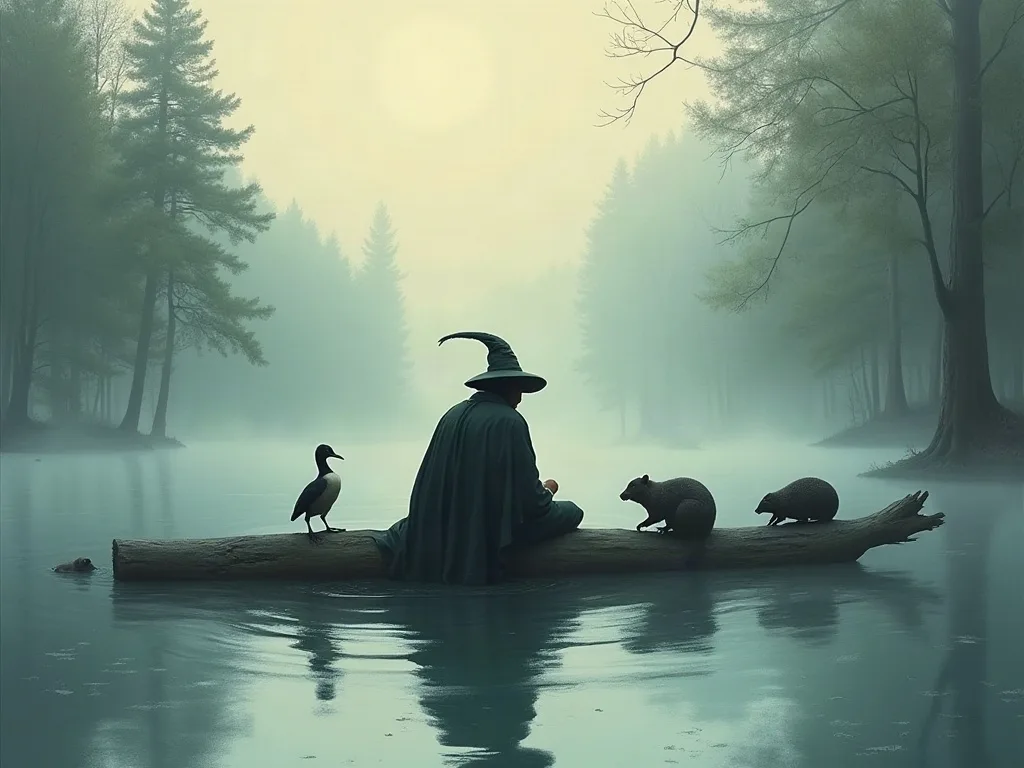
In one widely recorded version, a great flood covers the world rather than a primordial void. Nanabozho floats on a log, surrounded by animals who have survived the waters. He asks them to dive. The loon tries and fails. The mink tries and fails. The beaver dives deep but comes back empty. Then the muskrat, small and apparently the least capable swimmer, goes down. It is underwater far longer than any of the others. It surfaces, unconscious or dead, but clutched in its paws is a tiny bit of earth.
Nanabozho takes the earth, breathes on it, sings over it, and sets it floating. It grows. He runs around it to test its size. The first time it is too small. He runs again. It is bigger. He continues until the land is large enough for all creatures.
The Ojibwe scholar and author Basil Johnston recorded and discussed versions of this story in his 1976 work Ojibway Heritage, treating the myth not as folklore but as active theology: a living description of how the Anishinaabe universe works and what responsibility humans hold within it.
Muscogee and Yuchi: Fire, Water, and the Crawfish's Claws
In the Southeast, the Muscogee (Creek) and Yuchi traditions offer their own Earth Diver accounts, and they differ in a notable way: the mud-bringer is sometimes a crawfish (crayfish), not a mammal.
In several Yuchi versions recorded by ethnologist Frank Speck in the early twentieth century, the world is water at the beginning. The crawfish descends to the muddy bottom, gathers what it can in its claws, and surfaces. The mud is spread, and the earth forms. In some Muscogee accounts, the diver brings back sand, not mud, and the land that grows is specifically the territory the Muscogee knew as home in present-day Alabama and Georgia.
This grounding of the creation story in recognizable landscape is common across Earth Diver traditions. The mud that forms the world is often the same mud beneath the specific river or lake where the storyteller's community lives. Creation is never abstract. It is local, rooted, tied to the exact geography of the people telling it.
The Arikara and Pawnee: First Woman and the Primordial Ocean
On the Great Plains, the Arikara and Pawnee nations carry creation accounts that fold the Earth Diver structure into a larger cosmological frame. Among the Arikara, the creator figure Nesaru watches over humans trapped below the surface of a great sea. He sends Mother Corn, a divine woman, to lead them upward. Before the world of land exists, an otter or duck-like creature brings up earth.
The Pawnee traditions, documented in detail by ethnographer George Dorsey in the early 1900s, describe a layered cosmos in which creation involves not a single dive but a long negotiation between sky powers and water powers. The physical act of an animal bringing mud from below is embedded in a ritual logic: the earth is not simply made, it is earned, retrieved, coaxed from the deep.
This sets the Earth Diver apart from other creation types. In the Genesis account, for instance, a creator speaks the world into being from above. In the Earth Diver story, the world is retrieved from below, and often by the smallest or most unlikely creature. The muskrat, not the bear. The crawfish, not the eagle. That inversion carries meaning.
Why the Smallest Animal Always Wins
The pattern is consistent enough to be worth pausing on. Across dozens of versions, the creature that succeeds is not the strongest or the fastest. The otter fails. The beaver fails. The muskrat, the crawfish, the toad, the small turtle: these are the ones who return with mud.
Scholars have offered several readings. Åke Hultkrantz, the Swedish historian of religions who spent decades studying Native American traditions, argued in The Religions of the American Indians (1967) that the motif reflects a genuine theological preference for humility and persistence over brute power. The world is built on the effort of the overlooked.
Anna Birgitta Rooth mapped the distribution of the Earth Diver myth across North America and Eurasia in her 1957 study and identified it as one of the oldest traceable narrative structures in oral tradition, possibly predating the separation of Siberian and North American peoples across the Bering land bridge. If she is right, the muskrat's dive is a story at least 12,000 to 15,000 years old.
There is also a pragmatic ecological reading: muskrats, otters, and crawfish are precisely the animals that do dig and carry mud from the bottom of ponds and rivers. The myth picks its hero not at random but from careful observation of the actual world. The storytellers knew their landscape.
Turtle Island: The Land Beneath Your Feet
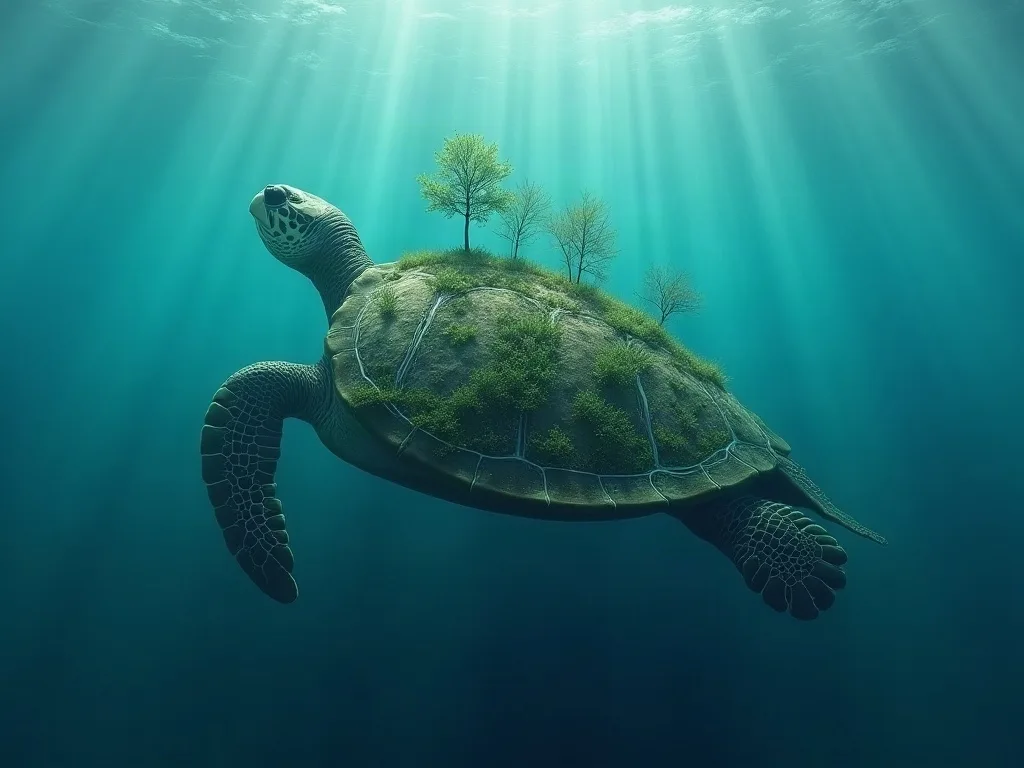
The image of the turtle bearing the world on its shell is one of the most durable in North American mythology. It appears in Haudenosaunee, Ojibwe, Delaware (Lenape), Algonquin, and several other traditions. The turtle is chosen for specific reasons: it lives between water and land, it carries its own shelter, it is ancient-looking, and it can dive.
In the Lenape tradition, the world rests on a great turtle's back and is periodically shaken when the turtle moves, which accounts for earthquakes. This is not so different from the Greek myth in which Poseidon, the earth-shaker, causes the ground to tremble, or the Norse world tree Yggdrasil whose roots are gnawed by forces from below. Every tradition needs an explanation for why solid ground is not entirely stable.
Robin Wall Kimmerer, a Potawatomi botanist and author of Braiding Sweetgrass (2013), writes about Turtle Island not as a dead metaphor but as a living framework for understanding human relationship to land. In her reading, the story instructs: the land was a gift, retrieved at great cost, and it must be tended. The turtle still bears weight. The mud is still new.
Cross-Cultural Echoes: Siberia, Finland, and the Vedic Deep
The Eurasian parallels deserve attention, because they deepen rather than diminish the Native American accounts.
In several Siberian traditions, particularly among the Buryat and the Vogul, a creator figure asks a water bird or an animal to dive for earth, and the world grows from the mud brought back. In the Finnish Kalevala (compiled by Elias Lönnrot from oral tradition in 1835), the world begins when a duck lays an egg on the knee of the water mother Ilmatar; the egg breaks and forms the earth, sky, and stars. The water as primary element, the small creature as agent, the gradual growth of land: these are consistent.
In the Hindu Shatapatha Brahmana, a very ancient Sanskrit text, the god Vishnu takes the form of a boar (Varaha) and dives to the bottom of the cosmic ocean to retrieve the earth goddess, lifting her on his tusks. This is not identical to the Earth Diver pattern but it rhymes clearly: divinity descends into water and brings earth upward.
These parallels do not mean that one tradition borrowed from another. They may point to something more interesting: a shared prehistoric logic about creation. Water first. Depth next. Earth brought from below. The world is not placed here from above; it is pulled from underneath.
The Vishnu avatar Varaha represents one of the most striking points of comparison for anyone tracing these stories across continents.
What Creation From Below Means
Creation myths are never simply stories about the past. They carry instructions for the present. The Earth Diver story, specifically, encodes several ideas that run through Native American thought more broadly.
First: the world required effort and sacrifice. The muskrat nearly dies. The crawfish struggles. Nothing arrives without cost. The land beneath your feet was won by the labor of a small creature that most humans overlook.
Second: the world is shared. The turtle offers its back. The birds catch the falling woman. The animals council together. Creation is collective, not the act of a single all-powerful being working alone.
Third: the earth is alive and has been alive since before humans arrived. It was not made for humans. Sky Woman or Nanabozho needed somewhere to stand, but the animals were already there, already diving, already deliberating. Humans are latecomers to a world that other creatures shaped.
These are not incidental details. They are, as Ojibwe scholar Gerald Vizenor has argued, the grammar of Indigenous ecological thought: a set of relationships, not a hierarchy.
Frequently Asked Questions About the Earth Diver Creation Myth
Frequently asked questions
Which Native American nations tell the Earth Diver creation myth?
More than 60 recorded traditions include some form of the Earth Diver story. The best-documented versions come from the Haudenosaunee (Iroquois Confederacy), Ojibwe (Anishinaabe), Muscogee (Creek), Yuchi, Arikara, Pawnee, and Lenape nations, among others. The story's geographic spread covers the Great Lakes, the Northeast, the Southeast, and the Great Plains, with related accounts found in California and the Subarctic as well.
Is the Earth Diver myth found outside North America?
Yes. Closely related accounts appear in several Siberian traditions (among the Buryat and Vogul peoples), in the Finnish oral tradition that contributed to the Kalevala, and in looser parallel forms in Hindu mythology, particularly the Varaha avatar of Vishnu who retrieves the earth from the cosmic ocean. Folklorist Anna Birgitta Rooth mapped these distributions in her 1957 comparative study and argued the motif is at least as old as the migration of peoples from Siberia into North America.
Why is it usually a small animal that succeeds in the dive?
Across most versions, larger or stronger animals fail and the smallest or most unassuming creature succeeds. Scholars including Åke Hultkrantz have read this as a theological statement about humility and persistence. There is also an ecological realism at work: muskrats, crawfish, and small turtles genuinely do retrieve mud and material from the bottoms of ponds and rivers. The storytellers were precise observers of the natural world, and the myth reflects that observation.
What does 'Turtle Island' mean and where does it come from?
Turtle Island is the name used in several Native American traditions, most prominently Haudenosaunee and Ojibwe, for the North American continent. It refers to the Earth Diver story in which Sky Woman or a similar figure lands on the back of a great turtle, and the world grows from mud placed on its shell. Today many Indigenous people and allies use "Turtle Island" in place of "North America" as a way of acknowledging the continent's Indigenous history and the living presence of these creation traditions.
How is the Earth Diver myth different from Genesis or other Near Eastern creation stories?
In Genesis and similar Near Eastern accounts, creation flows downward from an all-powerful deity who speaks or shapes the world from above. The Earth Diver inverts that direction: the raw material of creation (mud, sand, earth) comes from below, retrieved through physical effort, often at cost. Creation is collaborative rather than unilateral, and the creator often needs help from animals. This reflects a broader pattern in many Native American cosmologies in which humans and animals share responsibility for the world rather than living under a strict divine hierarchy.
Where can I find primary sources for these stories?
Key documented sources include J.N.B. Hewitt's 1903 Bureau of American Ethnology reports on Haudenosaunee mythology, Basil Johnston's Ojibway Heritage (1976), Frank Speck's early-twentieth-century ethnological fieldwork among the Yuchi, and George Dorsey's Pawnee and Arikara studies. For scholarly analysis, Åke Hultkrantz's The Religions of the American Indians (1967) and Anna Birgitta Rooth's 1957 paper on the creation myth typology remain foundational references.
The Myth That Is Still Being Told
The Earth Diver story is not a relic. It is being retold right now, in classrooms on reservations, in ceremonies that do not require outside observers, in children's books authored by Haudenosaunee and Ojibwe writers, and in the work of scholars who treat it as living cosmology rather than archived folklore.
Leanne Betasamosake Simpson, an Anishinaabe scholar and author, writes in Dancing on Our Turtle's Back (2011) that the Earth Diver story is not simply an account of origins. It is a theory of resurgence: the idea that renewal comes from going deep, from returning to what has been submerged, and bringing it back up. In the context of Indigenous communities rebuilding language, land relationships, and governance after centuries of colonization, the muskrat diving through dark water becomes something more than a creation image. It becomes a model for survival.
That is what the best creation myths do. They answer a question about the past and leave you with a question about the present. The water is still out there. The mud is still below. Something has to dive.
The broad Native American mythological tradition that contains the Earth Diver story also includes emergence myths, transformer cycles, and trickster narratives that are equally worth tracing, each one a thread in the same vast fabric of thought about where the world came from and what humans owe it.
Free 25-page sample
Want the whole story?
Take the first 25 pages free. If it pulls you in, the full edition is yours as an instant PDF download, with a paperback on Amazon for selected titles.
Native American
The Native American Mythology Book: Raven, Coyote, Spider Woman, and the Sacred Stories of Turtle Island
From Pacific Raven to Atlantic Glooscap
The unbroken pre-contact mythology of North America: Raven stealing light, Coyote's tricks, Spider Woman weaving creation, Sedna beneath the ice, and the kachina spirits of the mesa.
More from Native American
All articles
Native American
The Vision Quest: Rite of Passage and Spiritual Revelation
The vision quest stands at the heart of many Native American spiritual traditions: a solitary journey into wilderness where seekers fast, pray, and await contact with the sacred. Discover how this ancient ceremony marks the threshold between boyhood and manhood, illness and healing, confusion and purpose.

Native American
The Sun Dance: Plains Ceremony of Renewal and Sacrifice
The Sun Dance stands as the most sacred communal ceremony of the Great Plains nations, a multi-day ritual of piercing, fasting, and prayer where participants offer their bodies to restore balance and healing to their people. We trace its origins, structure, and enduring power across Lakota, Cheyenne, Arapaho, and Shoshone traditions.
Native American
The Medicine Wheel: Sacred Symbol and Ceremonial Structure
The Medicine Wheel represents the interconnected nature of existence across countless Native American traditions. Discover how this ancient symbol functions as both spiritual map and healing practice, grounded in real ceremonies that still guide communities today.

Native American
Sedna: Inuit Goddess of the Sea and Marine Animals
Sedna rules the Arctic depths as the Inuit goddess of the sea and marine animals. Her story begins with betrayal and transformation: a fallen maiden becomes the sovereign of the ocean, controlling the seal, whale, and fish that sustained Arctic peoples for millennia. Discover how her myth shaped survival, hunting ritual, and the spiritual bond between humans and the sea.