

Curupira: The Backward-Footed Guardian of the Jungle
Curupira is a red-haired forest spirit from Tupi-Guarani mythology whose feet point backward to confuse hunters and loggers. This creature embodies the jungle's fierce protection of its own, punishing those who kill animals without respect or destroy trees needlessly. Learn how a figure born from indigenous ritual belief became a living warning about the price of ecological excess.
Contents
In the deep forests of Brazil and the wider Amazon basin, hunters and loggers have long told stories to explain sudden disappearances, bizarre animal behavior, and the eerie feeling of being watched in the jungle. At the heart of these tales stands a solitary guardian: a creature with fiery red hair, a human upper body, hooves or stumped feet, and one feature that makes tracking him impossible. His feet point backward.
This is Curupira, one of the most vivid and enduring spirits of Tupi-Guarani mythology. For centuries, indigenous peoples and later generations of Brazilians have invoked his name not as abstract folklore but as a real force in the forest. Hurt the animals without permission, cut down the forest without purpose, and Curupira will find you. He will confuse you. He will turn you around until you walk in circles, lost and helpless, until the jungle itself reclaims you.
Curupira is not a god in the classical sense. He is a guardian, a boundary-keeper, a spirit so embedded in the Amazonian landscape that he remains alive in oral tradition today, even in urban Brazil, where children still hear warnings about the backward-footed creature who protects what civilizations are eager to destroy.
The Origin of Curupira in Tupi-Guarani Belief
The Tupi people, whose language and culture spread across much of Brazil before Portuguese colonization, saw the forest not as a resource to conquer but as a living entity with its own rules and inhabitants. Within this worldview, spirits were not distant deities but neighbors. Some were helpful. Some were dangerous. All demanded respect.
Curupira emerges from this animistic framework. His name itself carries meaning in Tupi: curu means "body" and pira means "fish" or, in broader contexts, "living being." Some scholars trace the etymology to Curupira as "the being of the forest floor," though indigenous sources vary. What matters is not the linguistic precision but the function: Curupira was understood as the spirit-owner of the jungle and its creatures.
Unlike many mythological guardians who appear as terrible monsters, Curupira's threat is subtler. He is small (often described as child-sized or adolescent), with a human face and form from the waist up. His hair is the color of flame. His lower body, however, is profoundly wrong. Some tellings describe feet that point entirely backward; others speak of hooves, cloven feet, or legs twisted in impossible ways. This anatomical impossibility serves a purpose: when a hunter tracks Curupira, following his footprints deeper into the forest, he is always walking the wrong way. Curupira's backward feet mean that every step you follow takes you further from safety, not closer to the creature.
The spirit appears most often at dusk, in the thickest parts of the forest where sunlight barely reaches. He is solitary, territorial, and uninterested in human concerns except when humans violate the forest's laws.
Curupira's Role as Protector of Animals and Trees
Curupira serves as the enforcer of reciprocity between humans and the forest. In Tupi-Guarani cosmology, hunting was necessary and permitted, but only if conducted with respect. An animal could be killed for food, but not for sport. A tree could be felled for shelter, but not for greed. Curupira ensured these boundaries held.
Hunters who killed animals carelessly, who wasted meat, or who hunted beyond need would find themselves in Curupira's attention. The spirit would scatter the game, make animals disappear, or cause hunting dogs to lose the scent. In some accounts, Curupira would appear and terrify the hunter, driving him mad or causing him to forget his own name and identity. More dramatically, he would lead the hunter deeper and deeper into the forest until the man was hopelessly lost, starving, and abandoned to the jungle itself.
The backward feet served as both warning and trap. A hunter who thought he had glimpsed Curupira and began to track the footprints was, in fact, being led away from the village, away from safety, into the wilderness. By the time the hunter realized his mistake, the forest was his prison.
Trees, too, fell under Curupira's protection. The forest was understood as a single organism, and Curupira was its immune system. To fell a tree wastefully was to wound the body. Loggers and farmers who cleared land indiscriminately reported encountering the red-haired spirit, who would cause their tools to break, their animals to flee, or their plans to collapse into chaos.

The Trickster and the Enforcer: Curupira's Dual Nature
While Curupira's primary role is protective, indigenous narratives also portray him as a trickster. He delights in misleading people, in practical jokes that blur the line between funny and sinister. A hunter might discover his shelter rearranged, his weapons hidden, or his path home reversed so completely that he walks out of the forest not at his village but miles away, disoriented and humbled.
This trickster aspect does not undermine his authority. Rather, it deepens it. Curupira's mischief is not random. It is always a response to transgression. He plays tricks on those who deserve them. For the respectful hunter, the careful farmer, and the person who lives in balance with the forest, Curupira remains invisible. Only those who overstep encounter his tricks, and the tricks are teaching tools.
In some oral traditions recorded by anthropologists and colonial-era chroniclers, Curupira is portrayed as nearly invisible to the innocent but unavoidably present to the greedy. A person who takes only what is needed will walk past the spirit without incident. A person driven by greed or cruelty will encounter him repeatedly, each encounter more disorienting than the last.
The Backward Feet: Symbol and Practical Effect
The backward feet are the defining feature of Curupira, and they carry multiple layers of meaning. On the practical level, they are a tracking prevention device. An indigenous hunter skilled in reading sign would see the prints and be confused. Which way is the creature going? Is he moving deeper into the forest or coming toward the village? The answer is always disorienting: he is moving in whatever direction you are not expecting.
On a symbolic level, the backward feet represent inversion, reversal, and the disruption of normal human understanding. The forest is not a place where normal rules apply. Curupira's backward feet are a constant reminder that once you enter his domain, your assumptions are wrong. North is not where you think it is. Distance becomes meaningless. Time behaves strangely.
Some ethnographers have suggested that the backward feet reflect a deeper indigenous philosophy: the forest is not mapped or understood in human terms. Its logic is other. Curupira's anatomy is the forest made flesh. To encounter him is to encounter a being who sees and moves according to rules that humans cannot fully grasp.
In practical folklore usage, stories of Curupira's backward feet served as an effective tool for teaching respect. A child who heard repeatedly that hunters who chased the spirit would end up lost would learn caution. A logger who heard that Curupira's footprints led only deeper into confusion would think twice about clearing indiscriminately. The mythology was a technology of restraint, encoded into narrative.
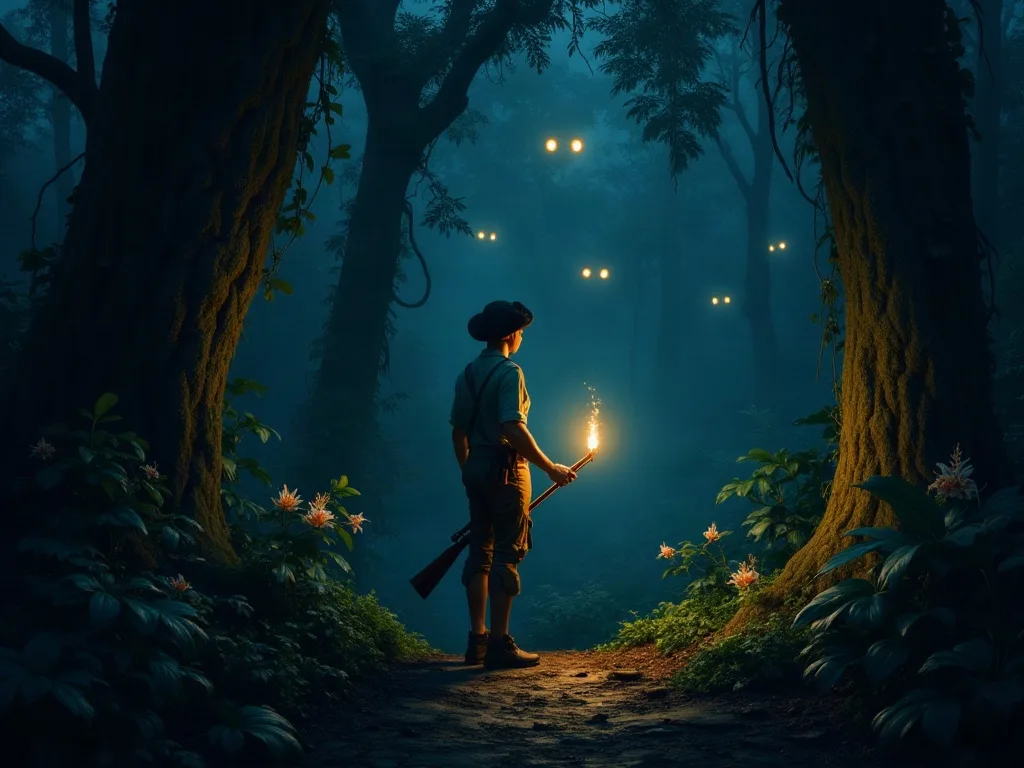
Curupira in Colonial and Modern Brazilian Culture
When Portuguese colonizers arrived in Brazil in the 16th century, they encountered the Tupi people and their stories. The missionaries who came to convert indigenous peoples documented Curupira in their reports. Some Christian clergy explicitly tied Curupira to the Devil, reframing the forest spirit as a demon to be feared and the forest itself as a place of pagan darkness to be tamed.
This reframing did not erase Curupira from the cultural imagination. Rather, it transformed him. Over the centuries, through a blending of indigenous belief, African oral traditions (brought by enslaved peoples), and Brazilian folk Christianity, Curupira became part of a broader Brazilian mythology that remained distinct from European folklore. Unlike the fairies of Celtic tradition or the dwarves of Germanic myth, Curupira remained rooted in the specific landscape of the Amazon and the Brazilian interior.
By the 19th and 20th centuries, Curupira appeared in Brazilian literature, folk songs, and regional folklore. Writers like Mário de Andrade and other modernist authors incorporated him into their work as a symbol of a specifically Brazilian magic, neither fully indigenous nor fully European but something new born from the encounter and mixing of cultures.
In contemporary Brazil, Curupira remains widely known. He appears in children's stories, environmental education materials, and regional festivals. More significantly, as awareness of deforestation and environmental destruction has grown, Curupira has experienced a cultural resurgence. Environmental activists and indigenous advocates have invoked his image and story as a symbol of the forest's own resistance to exploitation. The guardian who once punished hunters now stands as a symbol of nature's capacity to push back against industrial civilization.
Curupira Across Tupi-Guarani and Neighboring Traditions
While Curupira is most strongly associated with Tupi-Guarani cultures, similar spirits appear across the broader indigenous South American landscape. The Guarani people, who shared language roots and cultural similarities with the Tupi, had their own forest guardians and shape-shifting spirits. The concept of a spirit-owner of the forest who protects animals and punishes hunters appears in cultures across the Amazon and beyond.
The Mapuche peoples of southern Chile had similar guardian figures. Indigenous groups across the Amazon basin, from the upper Orinoco to the interior of Brazil, spoke of spirits who inhabited the forest and guarded its bounty. What varies is the specific form, name, and narrative detail, but the underlying function remains consistent: the forest is alive, conscious, and capable of defending itself through supernatural means.
The concept also echoes across indigenous Americas. In North American traditions, entities like Deer Woman or various forest spirits similarly embody the principle that animals and wild places have guardians and that humans who violate the relationship between hunter and hunted will face consequences. These are not cautionary tales invented by elders to control behavior, though they serve that purpose. They are expressions of a worldview in which the forest is not a backdrop but an active participant in human life.
The Mythology's Reflection of Forest Ecology and Sustainability
Modern ecological science has validated something that indigenous peoples understood intuitively: forests are complex, interconnected systems, and removing one element causes cascading consequences. Curupira mythology, while not scientific, expresses this understanding through narrative. When a hunter wastes meat or kills excessively, he is not simply committing an individual transgression. He is disrupting the balance that sustains the forest and, by extension, human survival within it.
The spirit's punishment of those who "take without giving back" or who destroy without purpose aligns with indigenous practices of reciprocal resource management. Anthropological research on indigenous fire management, game rotation, and forest gardening has shown that these practices maintained forest productivity for centuries without degradation. Curupira mythology provided both the religious justification and the narrative reinforcement for these sustainable practices.
In this light, Curupira is not simply a monster or a trickster. He is a mythological embodiment of ecological consequence. The hunter who wastes game is punished not by an arbitrary supernatural entity but by the forest's own feedback mechanisms: game disappears, animals migrate, the ecosystem fails to provide. Curupira is the anthropomorphized version of this natural principle made visible and personal.

Curupira and the Question of Cultural Continuity
One of the most interesting aspects of Curupira is his persistence. Unlike many indigenous deities and spirits who faded as colonization progressed and indigenous populations were decimated by disease, forced conversion, and displacement, Curupira remains alive in Brazilian culture. He appears in modern fiction, television, environmental campaigns, and the imagination of Brazilians who have no direct indigenous ancestry.
This survival raises questions about how indigenous belief systems remain potent even when institutional power has shifted away from indigenous peoples. Part of Curupira's endurance may lie in his specificity. He is tied to a particular landscape (the forest), a particular activity (hunting and logging), and a particular moment of encounter (when transgression occurs). As long as people interact with the forest, Curupira remains relevant.
Another factor is that Curupira, more than many mythological figures, serves a function that persists across cultural change. Whether you understand him as a literal spirit, a psychological archetype, or a narrative tool for teaching respect, the message remains clear: the forest has limits. Those who ignore those limits face consequences. In an era of accelerating deforestation, that message feels urgent and alive.
Indigenous scholars and cultural workers have begun to reclaim Curupira narratives as part of a broader project of indigenous sovereignty and knowledge validation. Rather than treating him as a historical artifact or a quaint folk belief, they present him as part of a legitimate, sophisticated system of understanding ecology and human responsibility. From this perspective, Curupira is not a creature of superstition but an expression of genuine ecological wisdom.
How Curupira Appears to Humans: Physical Encounters and Signs
Indigenous narratives and colonial-era accounts describe several ways that Curupira makes his presence known. The most direct is a visual encounter. Those who claim to have seen him describe a small humanoid figure, often described as adolescent in appearance, with vivid red or flame-colored hair. The upper body is human, though unusually proportioned. The lower body is where wrongness becomes apparent: twisted legs, backward-pointing feet, or hooves that click against the forest floor.
More commonly, Curupira announces himself through indirect signs. A hunter's dogs will refuse to follow a trail and whine or yelp in distress. Animals that were abundant will suddenly vanish from an area. A hunter will discover that the path he has been following has looped back on itself repeatedly, returning him to where he started, though he walked in what seemed like a straight line. These signs indicate that Curupira has closed off an area to hunting, either as punishment or as a teaching.
Some accounts describe Curupira's voice as high-pitched and child-like, calling from the depths of the forest. Others describe a whistling sound, a clicking of hooves, or a rustling of leaves that seems to move toward you and then away in patterns that defy normal animal behavior. The effect is always disorienting: a sense of presence that is aware and intentional, but not quite present.
One recurring detail in folklore is that Curupira will sometimes leave gifts or move objects to communicate. A hunter's machete is found sharpened and laid across his path as a warning. Baskets of food are arranged in curious patterns. Tools are systematically broken or hidden. These actions communicate that the forest spirit is aware of human activities and is responding deliberately.
Variants and Regional Differences in Curupira Stories
Like most living folklore, Curupira stories vary across regions and time periods. In some tellings, he is more benign, a mischievous spirit who plays tricks but does not bring serious harm. In others, he is genuinely dangerous, capable of killing through starvation, madness, or leading hunters into territories of jaguars or snakes.
The degree of Curupira's hostility often correlates with how the story is being used. A story told to discourage children from wandering into dangerous forest may portray him as relatively mild; a story told to a hunter who has killed excessively may describe him as terrifyingly vengeful. The narrative is flexible, shaped by the context of its telling.
Regional variants also differ in Curupira's appearance. In some accounts from the interior of São Paulo and Mato Grosso, he is described as completely human-sized. In stories from the deeper Amazon, he is sometimes portrayed as barely more than a meter tall. Some versions describe him as having a single eye; others give him normal vision. The backward feet are nearly universal, but the exact nature of the deformation varies: some say the feet are reversed at the ankle joint; others describe the entire leg as facing backward.
These variations do not represent confusion or contamination of a "pure" original. Rather, they reflect the way living oral traditions evolve. Each storyteller adapted Curupira to the specifics of their landscape, their community's recent history, and the particular lesson or warning they wanted to communicate. This flexibility is a sign of vitality, not weakness.
Frequently Asked Questions About Curupira
Frequently asked questions
Is Curupira a god or a demon?
Curupira is neither in the Christian sense. He is a spirit or guardian in Tupi-Guarani cosmology, a being with agency and power who inhabits a specific place and enforces rules within it. Colonial Europeans often labeled him a demon because they encountered him in a non-Christian religious system and were unfamiliar with indigenous animism. Indigenous peoples understood him as a force of nature given personhood, not as evil or good in absolute terms, but as a being who must be respected and whose rules must be followed.
Did indigenous peoples actually believe Curupira was real?
Yes, and many still do. The Tupi and other indigenous groups understood Curupira as an actual inhabitant of the forest, not as a metaphor or purely fictional creature. When a hunter returned with a story of being lost in circles or encountering the backward-footed spirit, the community took it seriously as a genuine event. Modern indigenous peoples maintain this belief system alongside other ways of understanding the world. The question of whether Curupira is "real" depends on how you define reality; from an anthropological perspective, his reality in the cultural and psychological world of indigenous peoples is unquestionable.
What is the deeper meaning of Curupira's backward feet?
The backward feet are a symbol of the forest's otherness and its resistance to human comprehension and navigation. They teach that the forest does not operate according to human logic or human maps. Practically, they explain how a hunter can be lost despite his skills: he is in a realm where his abilities are inverted. Philosophically, they represent the boundary between human society (where feet point forward, toward future progress and goals) and the forest (where direction and progress become meaningless). Curupira's backward feet are the forest's way of saying "you are not in control here."
How has Curupira been used in environmental advocacy today?
In recent decades, indigenous activists and environmental organizations have invoked Curupira as a symbol of nature's resistance to exploitation and deforestation. Rather than treating him as a superstition of the past, they present him as a living principle: the forest itself, through Curupira, punishes those who destroy it thoughtlessly. Some environmental groups have used Curupira imagery in campaigns against logging and land-clearing in the Amazon. This represents a reclamation of indigenous knowledge as sophisticated and relevant, not archaic. The figure of Curupira has been modernized to address contemporary crises while remaining rooted in traditional belief systems.
What is the primary source for Curupira mythology?
Curupira stories come primarily from oral tradition maintained by Tupi and other indigenous groups. No single ancient text defines him the way the Eddas define Norse deities or the Vedas define Hindu gods. Our knowledge of Curupira comes from colonial-era chronicles (such as writings by Portuguese missionaries and chroniclers from the 16th and 17th centuries), ethnographic fieldwork by anthropologists in the 19th and 20th centuries, and living oral narratives still told in indigenous communities and Brazilian folk culture. This makes Curupira's mythology "living" in a way that many other traditions are not, continuously evolving through retelling.
Curupira's Place in a Globalized World
As the world becomes more interconnected and indigenous knowledge systems receive greater attention and validation, Curupira has begun to appear in spaces far removed from the Amazon. He shows up in fantasy literature, in video games, in academic discussions about indigenous epistemology and environmental ethics. A figure who was dismissed as superstition a century ago is now invoked in conversations about what indigenous peoples have always known: that unlimited extraction from nature carries a price, and that respect and reciprocity are not moral luxuries but practical necessities.
This global circulation of Curupira raises important questions about cultural appropriation and authenticity. When a writer in New York or Tokyo includes Curupira in a story, is this respectful engagement or exploitation? There is no simple answer. What matters is whether the figure is treated with genuine respect, whether indigenous peoples are credited and compensated if commercial use is involved, and whether the underlying wisdom about ecological balance is honored rather than flattened into exotic decoration.
For indigenous peoples themselves, the global visibility of figures like Curupira represents a form of validation and power. A figure once condemned as evidence of indigenous ignorance is now recognized as evidence of indigenous wisdom. Curupira embodies ecological knowledge that industrial civilization is only beginning to understand. In this reversal, mythology becomes a form of resistance and a blueprint for a different way of living in the world.
The backward-footed guardian still walks the forest. Whether one understands him as a literal being, a cultural principle, a psychological archetype, or a metaphor for nature's capacity to disrupt human plans, his message remains clear and urgent: the forest has rules, and they are not ours to write.
Free 25-page sample
Want the whole story?
Take the first 25 pages free. If it pulls you in, the full edition is yours as an instant PDF download, with a paperback on Amazon for selected titles.

Tupi-Guarani
The Tupi-Guarani Mythology Book: The Land Without Evil, the Twin Heroes, and the Spirits of the Rainforest
Namandu, the Twin Heroes, and the Land Without Evil
The mythology of the Tupi and Guarani peoples of the Amazon and the Atlantic forest: Namandu the creator who unfolded the world out of darkness, the twin heroes raised by jaguars, Tupa of the thunder, the fire-serpent Boitata, and the long search for the Land Without Evil.
More from Tupi-Guarani
All articles
Tupi-Guarani
Tupã: The Thunder God and Supreme Creator of Tupi-Guarani Myth
Tupã commands the sky as both destroyer and creator: the Tupi-Guarani supreme god who speaks through thunder, shapes the cosmos, and rules over all lesser powers. Discover how this ancient deity shaped the worldview of millions across the Amazon and beyond.

Tupi-Guarani
The Origin of Manioc: Mani and the Gift of Cassava
In Tupi-Guarani lore, a girl named Mani died of a broken heart and transformed into the cassava root, becoming the foundation of survival for generations. Discover how a myth of grief became the story of a continent's staple crop.
Tupi-Guarani
Anhangá: The Forest Protector and Trickster Spirit
Anhangá is the shape-shifting guardian of Tupi-Guarani forests, a spirit who punishes hunters who show disrespect to animals and plants. Part protector, part deceiver, this creature embodies the deep ecology of Amazonian belief.

Tupi-Guarani
Sumé: The Culture Hero and Civilizing Prophet of the Tupi-Guarani
Sumé taught agriculture, language, and moral law to the Tupi-Guarani peoples before vanishing into the sea. This foundational culture hero bridges the sacred and the everyday in South American oral tradition.