Tupi-Guarani
From the search for the Land Without Evil to the jaguar gods of the Amazon, Tupi-Guarani mythology is one of South America's richest living traditions. Here is everything you need to know.
Browse Tupi-Guarani
The forest shakes. Something vast moves through the canopy before dawn, pressing the leaves flat. A Guarani elder says it is Kuarahy, the Sun, still learning how to rise. His twin brother Jasy, the Moon, trails behind, pale and uncertain. Between them, they are holding the world together, and today, as every day, they are at risk of failing.
Tupi-Guarani mythology is not a quiet tradition. It belongs to a language family that once stretched from the mouth of the Amazon to the Río de la Plata, spoken by hundreds of distinct peoples across what is now Brazil, Paraguay, Bolivia, Argentina, and Uruguay. The myths these peoples carried were not identical from village to village, but certain figures, certain fears, and one great dream ran through all of them: the dream of a perfect land, Yvy Marã Ey, the Land Without Evil, waiting somewhere beyond the horizon.
This guide covers the cosmos they imagined, the gods and monsters they named, the sacred texts their descendants preserved, and the living ritual traditions that connect the twenty-first century to a world thousands of years old.
How the Tupi-Guarani Cosmos Was Built

Before there was anything solid, there was only darkness and water. The supreme deity, Ñamandú, also called Tupã in many Tupi traditions, existed alone inside that void. He was not born. He simply was. Paraguayan ethnographer León Cadogan, who lived among the Mbyá Guarani in the twentieth century and published his landmark 1959 collection Ayvu Rapyta ("The Foundation of Human Speech"), recorded the most detailed surviving cosmogony. It is a text of extraordinary beauty.
Ñamandú first created language. Not earth, not sky, not light, but words. From his own heart, he drew the ayvu, the sacred speech that would become the soul of every human being. Before the body, there was the word. It is a creation story that sounds almost startlingly close to the opening of the Gospel of John, arrived at from a completely different direction on a completely different continent.
Once language existed, Ñamandú created the divine flowers that would support the future earth, then the cosmic palm tree Pindó Yvy Tenonde (the First Palm of the Earth). Light came next, not from a sun but from Ñamandú's own heart, which shone outward. Darkness retreated but was never fully conquered. The Tupi-Guarani cosmos was not a stable, finished product. It was always provisional, always in need of care, always at risk of collapse.
This instability is the theological engine of the entire tradition. The earth had been destroyed before. The Guarani called the previous world Yvy Tenonde, the First Earth. It was flooded and ended. The present world, Yvy Pa'ũ, rests on four cosmic poles held up by four divine beings. If those beings tire, or if humanity fails its ritual obligations, the poles collapse and everything ends. The great mythological scholar Hélène Clastres, in her 1975 study La Terre sans Mal ("The Land Without Evil"), identified this cosmological anxiety as the driving force behind the great Tupi migrations recorded by Portuguese colonists in the sixteenth century: entire villages walking into the sea or into the jungle, singing, convinced that the Land Without Evil lay just beyond reach.
Tupã, Ñamandú, and the Question of the Supreme Being
Portuguese missionaries arriving in Brazil after 1500 heard Tupi speakers use the word Tupã to describe a loud, sky-shaking force, and they immediately adopted it as the Tupi word for "God." Jesuit priests then built their entire evangelical vocabulary around it, printing catechisms that called the Christian God Tupã. The problem is that the original meaning was almost certainly "the sound of thunder" or "thunder-force," not an omniscient personal deity.
Ñamandú is the figure that better matches a supreme creator in Mbyá Guarani theology. He exists before creation and is not subject to the cosmic crises that threaten lesser beings. His full name in the Cadogan texts is Ñamandú Ru Ete, "the True Father Ñamandú," and he is sometimes described as having no beginning, which is rare in South American mythologies where even the highest powers tend to have origins.
Below Ñamandú, the Mbyá tradition recognizes three other divine fathers who together form a kind of cosmic quartet: Karaí, the god of fire and sacred speech; Jakairá, the god of the gentle mist and the middle realm; and Tupã himself, repositioned as the god of rain, water, and eastern thunder. Each of these four fathers has a divine mother as his companion, and each rules over one of the four cosmic directions. It is a theological architecture of considerable sophistication, and it survived intact because the Mbyá kept it largely away from missionary interference.
Read about how other South American traditions structured their divine hierarchies
The Twin Heroes: Kuarahy and Jasy
No figures in Tupi-Guarani mythology capture the imagination quite like the divine twins. Their story is structurally related to the Mayan Hunahpu and Xbalanque (the Hero Twins of the Popol Vuh), the Aztec dual sun-and-moon mythology, and the Andean twin traditions, which suggests either very ancient shared roots across pre-Columbian South and Central America, or parallel responses to the same natural phenomena.
Kuarahy (the Sun) and Jasy (the Moon) were born from a mortal woman whose husband, the creator god, had gone on a journey. She was killed by the monstrous Jaguaretê (the great jaguar) before she could give birth. The twins emerged from her body anyway, raised themselves with supernatural knowledge, and eventually avenged their mother. This narrative pattern, the orphaned hero children who grow up to defeat the force that destroyed their parent, appears in dozens of Tupi and Guarani variants collected by researchers from the nineteenth century onward.
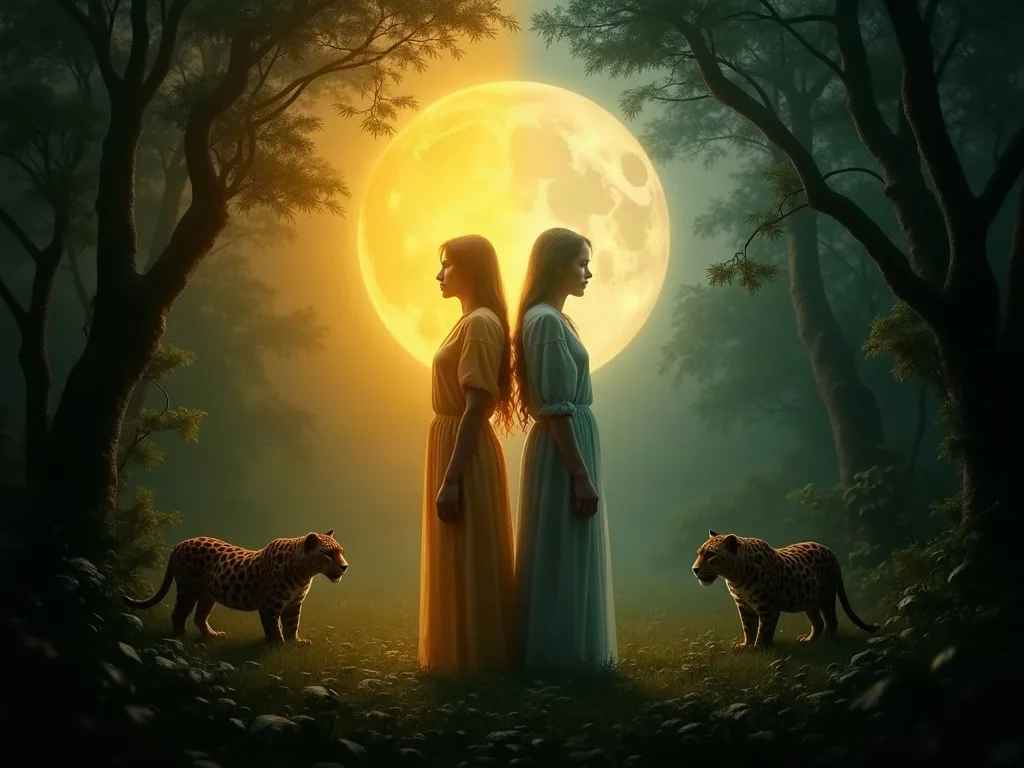
What makes the twins theologically interesting is not just the revenge plot. Kuarahy is associated with male power, agriculture, clarity, and the east. Jasy carries female energy, the night, planting cycles, and the west. Together they represent a complete cosmological polarity. Their quarrels, reconciliations, and occasional failures to show up on time (the moon does not always rise when expected) explain natural irregularities in ways that are both scientifically specific and emotionally resonant.
The Apapocuva Guarani, studied by ethnographer Curt Nimuendajú in his 1914 dissertation Die Sagen von der Erschaffung und Vernichtung der Welt ("The Myths of the Creation and Destruction of the World"), preserved a version in which Jasy is regularly swallowed by a great darkness and must be rescued by Kuarahy. This is almost certainly a mythological account of lunar eclipses.
The Land Without Evil: Yvy Marã Ey
Of all the ideas that Tupi-Guarani religion produced, Yvy Marã Ey is the one that changed history most visibly. Yvy Marã Ey means, literally, "the land that has no evil" or "the imperishable earth." It was not a metaphor or an afterlife. The Guarani believed it was a real place, reachable by living human beings, located somewhere to the east, or sometimes to the west, or deep underground, depending on the tradition.
To reach it required transformation. A person had to become light enough, spiritually perfected enough, to walk into a divine space without dying. The ritual technology for achieving this lightness was fasting, dance, sacred chant, and the consumption of cauim, a fermented drink made from manioc that opened the senses to divine contact. The shaman-prophets called karaí (not to be confused with the divine Karaí of the cosmic quartet) led their communities in these practices for weeks or months at a time.
When Portuguese colonists arrived and began enslaving the Tupi, the prophecies of the karaí intensified. Entire populations began walking. The colonial chronicler Pero de Magalhães Gândavo recorded in the 1570s that large groups of Tupi speakers on the Brazilian coast simply abandoned their villages and walked toward the sea, convinced the Land Without Evil lay beyond it. Some walked for years. The migrations continued in various forms through the eighteenth and nineteenth centuries.
Hélène Clastres argued that this was not irrationality but a coherent theological response to catastrophe: if the present earth is corrupt and doomed, and if the Land Without Evil genuinely exists, then the rational choice is to find it. The Guarani karaí were not deluded. They were applying a consistent eschatological logic that their entire metaphysical system supported.
Gods, Monsters, and Sacred Animals
The Tupi-Guarani tradition is rich with beings that do not fit neatly into the category of "god" or "monster." Many are yvyra'ija, forest spirits with moral ambiguity; they protect certain animals or trees but punish hunters who take more than they need. Others are specifically dangerous to children or pregnant women. Still others are divine helpers that appear only to shamans.
Anhangá is among the most feared. His name means roughly "the bad spirit" or "the errant soul," and he appears as a white deer with burning eyes, a form chosen to approach hunters without suspicion. Anyone who sees Anhangá and does not know the correct counterspell risks madness. He is not simply evil in the Christian sense; he is a force of disorder, attached to places where the boundary between the living and the dead has worn thin.
Mbói Tu'ĩ ("the parrot snake") is a great serpent with a parrot's head, guardian of waterways. He controls floods and the fish runs and must be propitiated before any major river crossing or fishing expedition. His image appears in Paraguayan folk art today, often rendered in bright ceramic.
Kurupira (also written Curupira) is one of the most widespread figures in all of Brazilian folklore, a small being with red hair and feet turned backward so that trackers following his footprints always go in the wrong direction. He protects the forest and punishes hunters who kill for sport. His origin is almost certainly Tupi, though the figure has been adopted into the broader Brazilian popular imagination and appears in children's books, carnival floats, and national literature.
Moñái is a great serpent of the fields and open grasslands, guardian of birds. He demands respect for bird species the way Mbói Tu'ĩ demands respect for fish. Together with Bo'y (a serpent of the underground) and Teju Jagua (a seven-headed lizard with a dog's faces, guardian of fruit and caverns), these serpentine beings form a group that Guarani theology considers the lords of specific ecological zones.
Explore how serpent deities appear across world mythology
Shamanism, the Karaí, and the Sacred Word
No understanding of Tupi-Guarani mythology is complete without the shaman. In most Tupi and Guarani communities, the religious specialist was called pajé (in Tupi-Portuguese) or karaí (in Guarani). This person was not simply a healer or a ritual technician. He or she was a speaker, in the most cosmic sense: someone who could use ayvu, sacred speech, to move between worlds.
The Mbyá Guarani liturgical texts recorded by Cadogan show that the karaí chanted for hours, sometimes days, in a specialized register of Guarani that ordinary speakers could not fully understand. The words were said to carry their own power independently of their meaning, which is a concept common across many oral traditions but particularly well developed here. Cadogan translated the Ayvu Rapyta cycle as "the foundations of human speech," and the texts describe the soul's divine origin, its journey into a human body, and its eventual return to the sacred realm.
The karaí also functioned as prophets. Their visions drove the great migrations toward Yvy Marã Ey. In the nineteenth century, a karaí named Ñanderu Marangatu led a major westward migration from the Brazilian coast, documented by Nimuendajú, walking hundreds of kilometers in pursuit of the imperishable earth. He did not find a physical paradise, but the pilgrimage itself produced new sacred songs and new ritual forms that survived into the twentieth century.
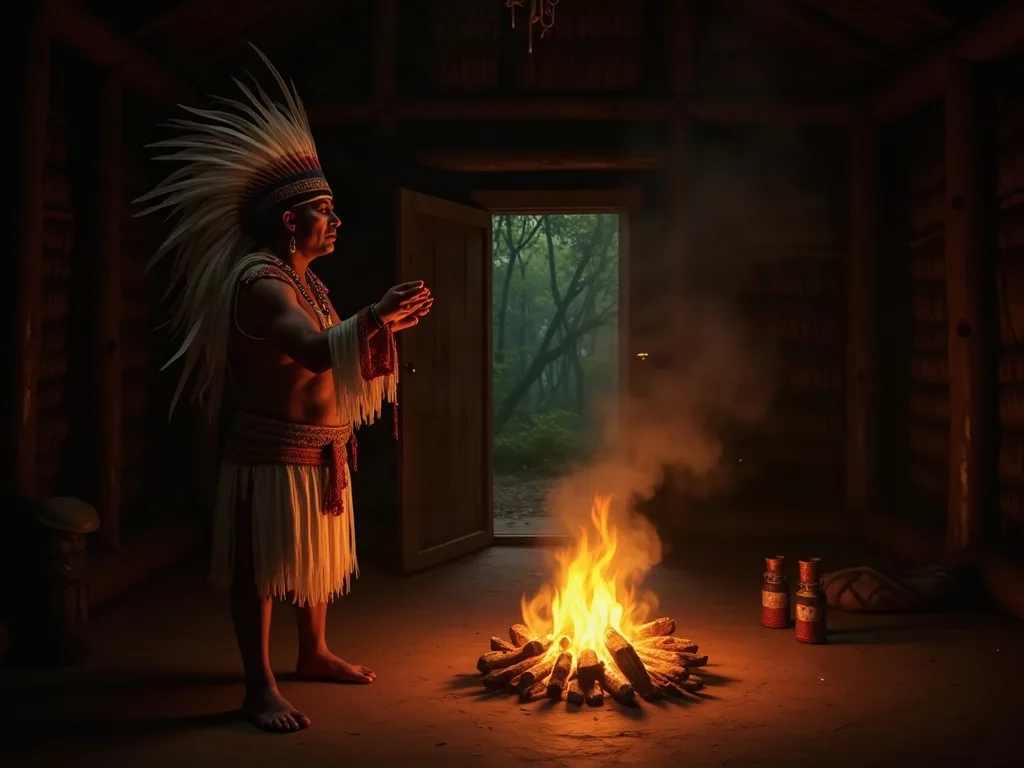
This capacity for prophecy and renewal is one reason Tupi-Guarani religion has been so durable. It is not a fixed scripture but a living conversation between the sacred and the human, updated continuously by the karaí who have direct access to divine speech.
The Flood, the Fire, and the End of the First Earth
Most Tupi and Guarani traditions remember a great catastrophe that ended the First Earth, Yvy Tenonde. The details vary considerably between groups. In some versions, the world was flooded. In others, it was burned. In a few, both happened in sequence.
The Apapocuva Guarani version collected by Nimuendajú is structurally close to flood myths found worldwide: a pair of siblings survived by climbing a palm tree while the waters rose. The hero twins Kuarahy and Jasy are sometimes said to have created the present earth after this catastrophe, building it again from sacred materials that survived the flood.
What distinguishes the Tupi-Guarani flood myth from, say, the Mesopotamian or biblical accounts is the explicit cyclical framework. The destruction of Yvy Tenonde was not a punishment for human wickedness alone. It was the natural consequence of a world that had grown too heavy with imperfection. The present earth will end the same way. This is not pessimism; it is accuracy. The ritual obligations of living people, the chants, the fasts, the pilgrimages, are the mechanisms that delay the collapse.
The fire variant has its own theological logic. Tataendy ("sacred fire" or "eternal fire") appears in several Guarani traditions as a divine element that both creates and destroys. Fire separates cooked from raw, human from animal, civilized from wild. The cosmic fire that ended one world is the same fire that powers the sun, and the same fire that lives in the hearth of every Guarani household. Tataendy is terrifying and sacred in equal measure.
Colonial Contact and the Survival of Tupi-Guarani Belief
The Portuguese arrived on the Brazilian coast in 1500. Within fifty years, epidemic disease, slavery, and warfare had reduced the coastal Tupi population catastrophically. What survived did so in two ways: through the aldeamentos, the mission villages run by Jesuit priests, and through the populations that fled inland, beyond colonial reach.
The Jesuits recorded Tupi and Guarani languages and myths because they needed to understand them to convert their speakers. Figures like José de Anchieta, who wrote the first Tupi grammar in 1595, and António Ruiz de Montoya, who published a Guarani dictionary in 1640, preserved enormous amounts of linguistic and cultural data as a byproduct of missionary work. Their documents are now primary sources for researchers.
The mission experience also transformed the myths. The karaí prophets became partly assimilated to Christian messianism, and Tupã became permanently attached to the Christian God in colonial-era texts. Disentangling the original Tupi-Guarani theology from its colonial overlay is one of the central challenges of the field, and scholars like Bartomeu Melià and Eduardo Viveiros de Castro have spent careers on exactly this question.
Viveiros de Castro's concept of "Amerindian perspectivism," developed from fieldwork with Amazonian peoples including Tupi speakers, offers a framework for understanding how Tupi-Guarani ontology differs fundamentally from European assumptions. In this view, all beings, jaguars, fish, spirits, humans, share the same basic interiority and differ only in their bodies. What a jaguar sees when it looks at the forest is not what a human sees. The jaguar sees culture; the jaguar sees a village. This idea of a world where subjectivity is universal and perspective is biological runs through Tupi-Guarani myth at every level.
Discover how Amazonian cosmologies connect to other indigenous American traditions
The Guarani in the Twenty-First Century
The Guarani are not an archaeological record. They are living peoples facing real crises: land dispossession in Paraguay, Brazil, and Bolivia; cultural suppression; poverty. The Mbyá Guarani of the Atlantic Forest region continue ritual life under enormous pressure. The Ava Guarani and the Pai Tavytera maintain their own distinct ceremonial traditions.
The opy, the Guarani prayer house, is still built in many communities. The sacred chants are still taught from elder to young. The karaí still receive visions. And the desire for Yvy Marã Ey has not diminished: Guarani activists today explicitly use the language of the Land Without Evil to describe their political demands for territory and autonomy, arguing that only a land free from exploitation can be a land without evil.
This continuity matters for anyone reading Tupi-Guarani myths. These are not stories from a vanished civilization. They are the active cosmology of a people who are still here, still arguing with the sacred, and still walking.
Frequently Asked Questions About Tupi-Guarani Mythology
Frequently asked questions
Who is the supreme god in Tupi-Guarani mythology?
In Mbyá Guarani theology, as documented by León Cadogan in his 1959 Ayvu Rapyta, the supreme being is Ñamandú, sometimes called Ñamandú Ru Ete ("the True Father Ñamandú"). He precedes creation and is the source of ayvu, sacred speech, which he used to create the cosmos. The word Tupã, often cited as the supreme Tupi deity, originally referred more specifically to thunder and was later heavily shaped by Portuguese Jesuit missionaries who adopted it as the Tupi equivalent of "God."
What is the Land Without Evil in Guarani belief?
Yvy Marã Ey ("the Land Without Evil" or "the imperishable earth") is a real place in Guarani cosmology, not an afterlife. It is a paradise reachable by living human beings who have achieved sufficient spiritual lightness through fasting, sacred chant, and ritual dance. The belief drove several large-scale migrations recorded by colonial historians in the sixteenth century and continues to carry political and spiritual meaning for Guarani communities today.
What are the primary written sources for Tupi-Guarani mythology?
The most important modern source is León Cadogan's Ayvu Rapyta (1959), which records Mbyá Guarani creation texts in the original language with translation. Curt Nimuendajú's 1914 study of the Apapocuva Guarani is another key reference. Colonial-era Jesuit records by António Ruiz de Montoya (especially his 1640 Tesoro de la Lengua Guaraní) and José de Anchieta preserve early Tupi data. Hélène Clastres's La Terre sans Mal (1975) remains the best analytical overview of the Land Without Evil concept.
Is Kurupira a Tupi-Guarani figure?
Yes. Kurupira (or Caapora in some Tupi variants) originates in Tupi mythology as a forest protector with feet turned backward and vivid red hair. He punishes hunters who take more than necessary from the forest. The figure spread across Brazilian popular culture through colonial contact and appears today in literature, cinema, and folklore far beyond his indigenous origins, though his core attributes remain recognizably Tupi.
How did Jesuit missionaries affect Tupi-Guarani mythology?
Jesuit missionaries, especially in the reduções (mission settlements) of Paraguay and southern Brazil during the seventeenth and eighteenth centuries, systematically recorded Tupi and Guarani languages to enable conversion. In doing so, they preserved linguistic data that would otherwise be lost, but they also reshaped the myths: Tupã was redefined as "God," Anhangá became "the Devil," and elements of Christian cosmology were grafted onto indigenous frameworks. Scholars like Bartomeu Melià have devoted decades to separating the original layers from the colonial overlays.
Are Tupi-Guarani myths still practiced today?
Yes. The Guarani, who number over 300,000 people across Brazil, Paraguay, Bolivia, and Argentina, maintain active ritual life. The Mbyá Guarani of the Atlantic Forest perform sacred chants (ñembo'e), build prayer houses (opy), and transmit cosmological knowledge through oral tradition. The search for Yvy Marã Ey continues to structure both spiritual practice and political advocacy for land rights.
The Unresolved Question: How Old Is This Mythology?
Linguists place the separation of the proto-Tupi-Guarani language family at somewhere between 2,000 and 5,000 years ago, which means the shared mythological core could be at least that old. But the honest answer is that no one knows exactly how far back the stories go, and this uncertainty is itself part of the tradition's power.
Archaeological work in the Amazon basin, particularly following the identification of terra preta (the dark, human-made soils found across Amazonia) as evidence of large, sophisticated pre-Columbian settlements, has radically changed scholarly views of Amazonian civilizations. These were not sparse, nomadic populations living unchanged since the Pleistocene. They were complex societies capable of large-scale landscape management. The mythology that survived colonial destruction is therefore the mythology of a civilization, not a tribe in the dismissive sense that older anthropology sometimes implied.
Eduardo Viveiros de Castro's later work, particularly The Relative Native (2015), positions Tupi-Guarani cosmology not as a curiosity of anthropological study but as a philosophical system with genuine challenges to offer Western thought. The idea that perspective is biological, that what counts as "culture" depends on the body you inhabit, is not an exotic belief to be catalogued. It is a different answer to questions that Western philosophy has not fully resolved.
The forest is still shaking. Something vast is still moving through the canopy before dawn. Whether you read that as Kuarahy completing another circuit of the sky, or as the irreplaceable sound of a living civilization asserting its presence, the result is the same. Tupi-Guarani mythology is not finished. It is still being made.
Major gods of Tupi-Guarani
View all →
Tupi-Guarani
Jacy: The Moon Goddess and Guardian of Night
Jacy lights the Tupi-Guarani sky as moon goddess, guardian of night, mother of growth. Learn how this celestial being shapes seasons, protects travelers, and guards the sacred boundary between day and darkness in South American myth.
Tupi-Guarani
Tupã: The Thunder God and Supreme Creator of Tupi-Guarani Myth
Tupã commands the sky as both destroyer and creator: the Tupi-Guarani supreme god who speaks through thunder, shapes the cosmos, and rules over all lesser powers. Discover how this ancient deity shaped the worldview of millions across the Amazon and beyond.
Famous Tupi-Guarani myths
View all →Tupi-Guarani
The Land Without Evil: Yvy Marã Ey and the Sacred Quest
Yvy Marã Ey, the Tupi-Guarani "Land Without Evil," is more than a paradise myth. It is a living theology of escape, renewal, and sacred motion that drove entire nations to walk toward the horizon.

Tupi-Guarani
The Flood Myth: Destruction and Renewal in Tupi Tradition
The Tupi and Guarani peoples preserved a flood myth of striking depth: a world drowned, a remnant saved, and a new earth shaped from the ruins of the old. Here is what that story actually says.

Tupi-Guarani
The Origin of Manioc: Mani and the Gift of Cassava
In Tupi-Guarani lore, a girl named Mani died of a broken heart and transformed into the cassava root, becoming the foundation of survival for generations. Discover how a myth of grief became the story of a continent's staple crop.
Recent in Tupi-Guarani
6 entries
Tupi-Guarani
Anhangá: The Forest Protector and Trickster Spirit
Anhangá is the shape-shifting guardian of Tupi-Guarani forests, a spirit who punishes hunters who show disrespect to animals and plants. Part protector, part deceiver, this creature embodies the deep ecology of Amazonian belief.
Tupi-Guarani
Caipora: The One-Legged Dwarf of the Forest
Deep in the Brazilian rainforest, a one-legged figure rides a peccary through the dark, smoking a pipe and guarding every animal that runs beneath the canopy. Meet the Caipora.

Tupi-Guarani
Curupira: The Backward-Footed Guardian of the Jungle
Curupira is a red-haired forest spirit from Tupi-Guarani mythology whose feet point backward to confuse hunters and loggers. This creature embodies the jungle's fierce protection of its own, punishing those who kill animals without respect or destroy trees needlessly. Learn how a figure born from indigenous ritual belief became a living warning about the price of ecological excess.

Tupi-Guarani
Iara: The Enchanting Water Spirit of Rivers and Lakes
Iara emerges from the rivers of Tupi-Guarani myth as a siren of the tropics: a water spirit whose song draws men to their doom. Learn the origins, powers, and lasting cultural grip of this South American enchantress.
Tupi-Guarani
Jacy: The Moon Goddess and Guardian of Night
Jacy lights the Tupi-Guarani sky as moon goddess, guardian of night, mother of growth. Learn how this celestial being shapes seasons, protects travelers, and guards the sacred boundary between day and darkness in South American myth.
Tupi-Guarani
Jurupari: Initiation Rites and the Sacred Flutes
Jurupari is the lawgiver-spirit at the heart of Amazonian initiation ritual, where sacred flutes carry divine law, transform boys into men, and are forbidden to women on pain of death.