

The Origin of Manioc: Mani and the Gift of Cassava
In Tupi-Guarani lore, a girl named Mani died of a broken heart and transformed into the cassava root, becoming the foundation of survival for generations. Discover how a myth of grief became the story of a continent's staple crop.
Contents
A young woman lies dead in the garden, her body untouched by decay. Where her grave stands, a strange plant emerges from the dark earth, pale and tuberous. The Tupi people gather around it, uncertain. Her mother weeps. Then they understand: the girl has returned, not as she was, but transformed into something that will feed her people forever. This is the origin of manioc, the myth that explains where cassava came from, how it became the root of Tupi-Guarani civilization, and why a girl named Mani chose to become nourishment.
Mani is not merely a deity in the Tupi-Guarani cosmos. She is intimacy, sacrifice, and the boundary between death and life redrawn as abundance. Her story moves from sorrow into transformation; it answers why a plant with no equivalent in Old World agriculture became essential to the survival of millions. This myth endures because it speaks to something deeper than botany: it tells how a people made sense of loss, how they saw their own futures in the ground beneath them, and how a single act of love reshaped their relationship with the earth.
The Girl Who Died of Longing
Before Mani became a plant, she was a human girl, born in the earliest times when the boundaries between human and spirit, soil and sky, were less certain than they are now. Different versions of the myth exist across Tupi-Guarani territories, but the core narrative is remarkably consistent: Mani lived with her family, beloved by everyone who knew her. She was beautiful, thoughtful, perhaps a little sad.
What precipitated her death varies. In some versions, she fell in love with a young man from a distant village and could not be with him. In others, she simply grieved for reasons the earth itself seemed to understand. Some tellings say she died of heartbreak; others say she faded like morning mist, her sorrow so profound that her body could no longer hold her spirit. The Tupian peoples, who passed this story orally for centuries before European contact, understood death not as an ending but as a transition. Mani did not vanish. She only changed.
Her family found her unmoving in the garden one dawn. There was no wound, no sign of struggle. She looked as though she were sleeping, her chest still, her face serene. They wept. They sang the mourning songs. They prepared to bury her in the earth, as was their custom, wrapping her carefully and laying her to rest beneath the soil of the village.
The Transformation in the Soil
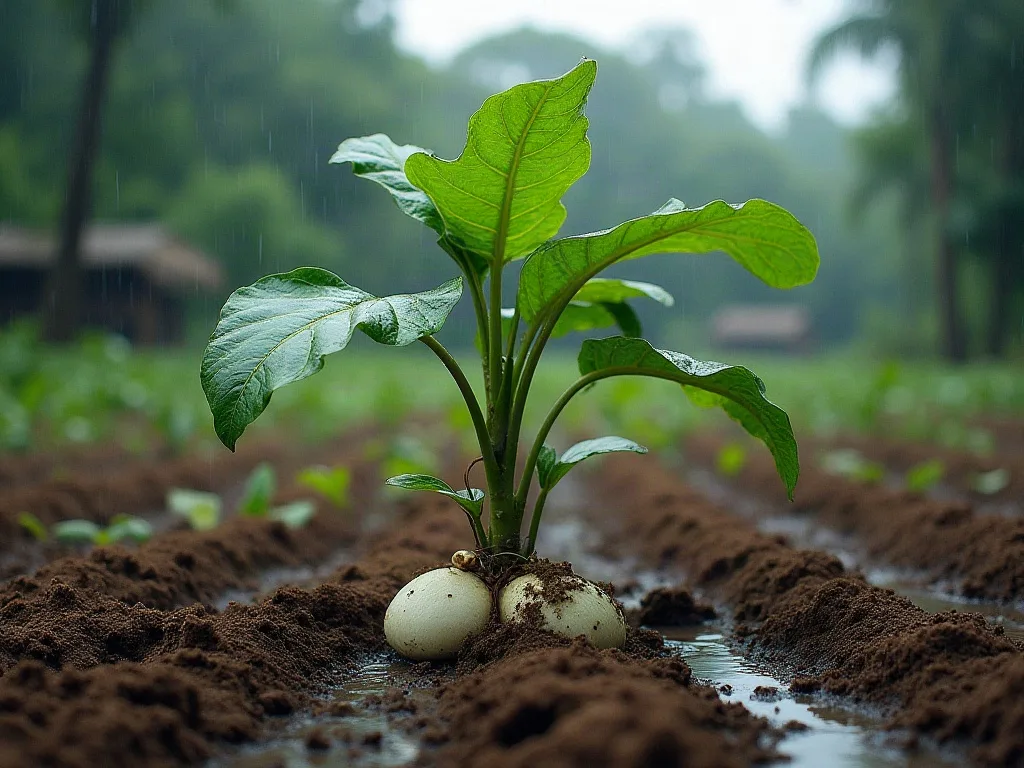
Days passed. Weeks passed. The family returned to the garden where Mani lay, as people do, drawn by memory and the need to be near the dead. But something extraordinary had occurred beneath the earth. Where her body had rested, a plant unlike any other had begun to grow. Its leaves were broad and green. Its roots sank deep. Most striking were the tubers that formed below the soil: white, starchy, dense with nourishment.
The mother of Mani recognized what had happened. This was not mere growth. This was her daughter, transformed. Mani had become something new, something that would sustain life rather than be consumed by death. The plant that emerged from her burial ground was cassava (called manioca in Guarani, or maniva in older Tupi dialects), and its name carried within it the memory of the girl she had been.
The family dug the tubers carefully. They learned, through what some versions say was instruction from Mani herself in dreams, how to process the root. Raw cassava contains cyanogenic compounds that make it toxic. The Tupi-Guarani people developed methods to grate, press, and prepare the root into safe food. From Mani's body came mandioca flour, a fine white powder that could be stored, mixed with other foods, baked into bread, and distributed. From her transformation came survival.
This is not a myth of resurrection in the sense of Christian theology. Mani does not return to human form. Instead, she undergoes metamorphosis, a total becoming-other that remains present and nourishing. She is both gone and everywhere at once. Each time a family eats cassava bread, they consume the body of the girl who loved them, transformed into the staple that built civilizations.

The Plant That Reshaped a Continent
Cassava was indigenous to the Amazon basin and the territories of the Tupi-Guarani peoples. It was one of the few domesticated crops that the pre-Columbian Americas had developed, alongside maize and potatoes. But cassava was unique. It required less labor than maize, tolerated poor soils, and stored well when processed into flour. It could be cultivated in abundance and sustained large populations through seasons of scarcity.
By the time of European contact in the 16th century, the Tupi-Guarani had built their food security partly on cassava. The myth of Mani encoded something essential: this plant was not merely a crop. It was a gift, a sacrifice, a covenant between the human and the plant world. Every harvest was an act of remembrance. Every meal was communion with a girl who had chosen to feed her people forever.
The Spanish and Portuguese colonizers recognized cassava's value. They enslaved indigenous people to cultivate it, transported it across the Atlantic, and introduced it to Africa, Asia, and Europe. Today, cassava is a staple for over 800 million people worldwide. It is the third-largest source of food carbohydrates in the developing world. The myth of Mani never spread beyond the Tupi-Guarani territories, but the plant she became fed the world.
This creates a strange historical irony. The myth remained localized, known primarily to indigenous communities and scholars of Amazonian religion. Yet the plant born from Mani's sacrifice became global, feeding people who would never hear her name. The story stayed in the Amazon. The body went everywhere.
Variations Across Tupi-Guarani Peoples
The Tupi-Guarani were not a single nation but a vast linguistic and cultural family spanning the Amazon basin, Paraguay, parts of Brazil, and beyond. The myth of Mani was told by Tupi speakers, Guarani speakers, Tupinambá groups, and others. Each community held its own version, and these versions reveal much about how different peoples understood the same core story.
In some Tupinambá tellings, Mani was the daughter of a paramount chief, and her death was connected to tribal conflict or a violation of sacred protocol. In Guarani versions, she was simply a beloved daughter, and the focus was on her mother's grief and wisdom. Some versions name her father; others emphasize a relationship with the natural world, suggesting that Mani had already begun to sense her transformation before death came.
A few variations introduce a companion figure: a young man who loved Mani and continued to tend her grave with devotion. In these tellings, his faithfulness aided her transformation, or his sorrow was so pure that it drew the earth's compassion. The myth remained flexible, adapted to local history, family structures, and theological concerns.
What remained constant across all versions was the core meaning: death is not the end of relationship. Transformation binds the dead to the living through nourishment. Sacrifice becomes abundance. The girl becomes the staple. Love persists through eating.
Mani and the Broader Tupi-Guarani Cosmos
Mani exists within a larger universe of Tupi-Guarani spiritual thought. The Tupi-Guarani peoples understood the world as inhabited by multiple layers of being: the visible human world, the realm of spirits and shamans, the domain of powerful plant beings, and the territories of dangerous entities that lived in water and forest.
Death was not a barrier between these realms. A shaman could travel between worlds. A spirit could inhabit a plant. A human could become something else. Mani's transformation fits within this cosmology. She moved from the human realm into the plant world, where she continues to exist as a living entity with agency and intention. When an elderly Tupi-Guarani person dies, people say they "go to the other place." When Mani dies, she goes into the earth and becomes cassava.
The myth also reflects the Tupi-Guarani understanding of women's power. Mani's mother is crucial in recognizing and protecting the transformation. She is not passive. She understands immediately what has happened and acts to preserve it, teaching others how to harvest and process the plant. In Tupi-Guarani societies, women held significant roles in agriculture, gathering, and spiritual knowledge. Mani's story honored that authority.
From Oral Tradition to Written Record
The myth of Mani survived European contact, enslavement, disease, and cultural suppression because it was woven into daily practice. Every time a woman grated cassava, the story was retold. Every time a family ate cassava bread, the myth was enacted. Oral traditions that are embedded in survival practices prove remarkably durable.
The myth entered written records only in the 17th and 18th centuries, when European observers and missionaries documented indigenous practices. Jesuit missionaries in particular recorded myths and spiritual beliefs, sometimes sympathetically, sometimes in order to understand what they needed to suppress or convert. Early accounts by travelers and ethnographers preserved versions of the Mani story, though often filtered through European expectations and theological categories.
In the 19th and 20th centuries, anthropologists and folklorists collected the myth more systematically. Scholars like Alfred Métraux and other researchers working on Amazonian religions documented Tupi-Guarani oral traditions before more of them were lost to assimilation and cultural disruption. These written accounts, gathered from elders and communities, form the primary sources available today for understanding the myth in detail.
The challenge is that oral myths never existed in a single "correct" version. They were alive, changing slightly with each telling. Written records freeze them at a moment, creating the illusion of fixity. The myth of Mani recorded in 1620 was both the same as and different from the myth told in 1920 or 2024. Each generation of Tupi-Guarani people adapted it to their circumstances while keeping its essential shape intact.
The Sacred Substance: Cassava Bread and Ritual
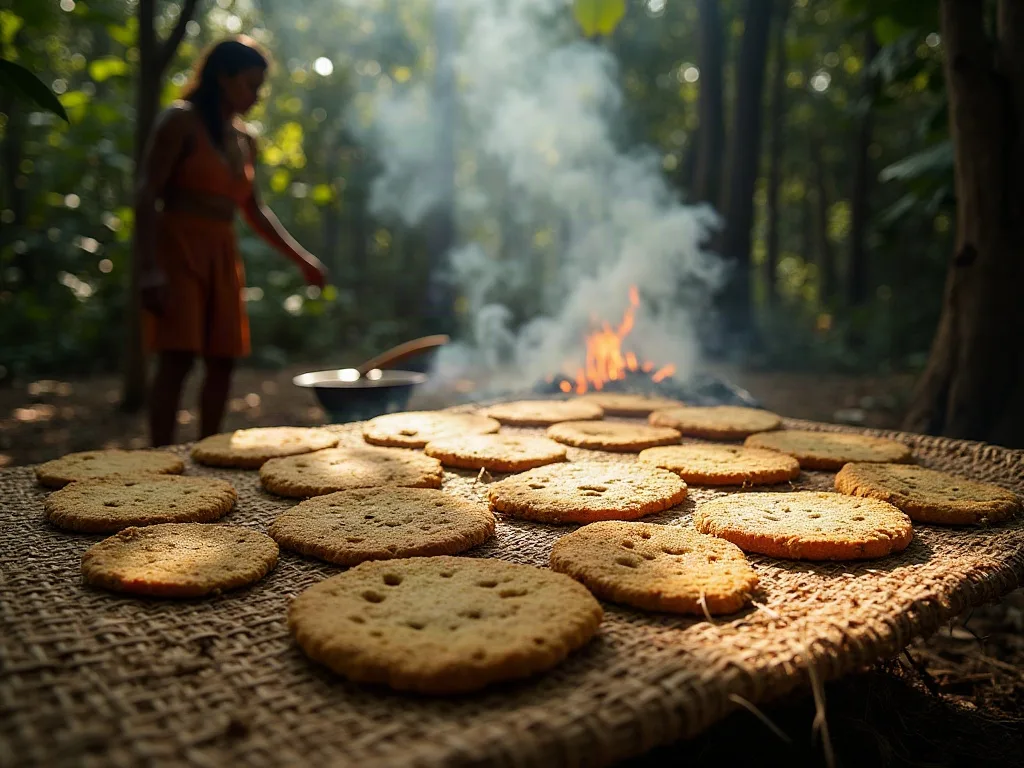
Cassava was not simply food in Tupi-Guarani life. It was a sacred substance tied to cosmology, kinship, and spiritual practice. The preparation of cassava into bread was a ritualized process that took time and skill. Women grated the root on rough surfaces, pressed the pulp in woven cylinders to remove liquid, dried the flour in the sun or over fires, and sometimes mixed it with other ingredients.
In some communities, the consumption of cassava bread was associated with sharing, social bonds, and the maintenance of order. To share food meant to share in a kind of kinship. To refuse cassava bread offered by a host was a serious insult. To give it generously was an act of leadership and care.
The myth of Mani made this practice sacred. When a family prepared cassava, they were not merely performing a technical process. They were maintaining a relationship with the girl who had become their staple. The work of processing cassava was a form of respect and remembrance, a way of continuing the compact that Mani had made with her people.
Some Tupi-Guarani communities also developed complex myths around the origin of agriculture itself. Mani is one figure in a broader mythology of cultivation, transformation, and the gifts that plants offer. Other origin myths explained tobacco, maize, and other crops. But Mani held a special place because cassava was the foundation. She was the first transformation, the first gift, the primary sacrifice.
Mani and Cassava
Mani becomes cassava through her death and transformation. The plant carries her name and sustains her people. The sacrifice is voluntary, rooted in love. The myth encodes practical knowledge about processing a toxic root into safe food. The story remained localized to Tupi-Guarani territories and was embedded in daily practice.
Other Plant Myths
Many world mythologies explain crops through violation, theft, or divine gift. Persephone's association with grain in Greek tradition comes through abduction. Demeter's grief creates scarcity. In Mesoamerican mythology, maize is formed from divine body or created through a trial. Mani's origin differs: she chooses sacrifice; no one forces her. Her gift is made through love, not obligation or punishment.
The Myth in Historical Context
When Portuguese colonizers arrived in Brazil in 1500, they encountered Tupi-Guarani peoples who had already cultivated cassava for centuries. The myth of Mani was unknown to Europeans, but the plant itself was immediately recognized as valuable. The Portuguese enslaved indigenous people to grow cassava, process it, and export it.
Cassava flour became a staple food for enslaved Africans on Brazilian plantations. It was cheap to produce, could sustain a laboring population, and required less skilled labor than other crops. In one of history's darkest ironies, the plant that Mani had given to her people as an act of love became a tool of enslavement and exploitation. The myth that surrounded cassava emphasized care, kinship, and sacred obligation. The colonial system that seized the plant stripped it of its spiritual meaning and turned it into a commodity.
As indigenous peoples were decimated by disease, warfare, and slavery, the knowledge systems that sustained the myth of Mani were fragmented. Communities were scattered. Languages were suppressed. Children were forbidden to speak Tupi or Guarani. The myth survived in fragments, preserved by communities that maintained their cultural identity despite centuries of pressure to assimilate.
In the 20th and 21st centuries, indigenous peoples across Brazil, Paraguay, and other Tupi-Guarani territories have worked to recover and preserve their languages, myths, and practices. The story of Mani has become part of a broader indigenous resurgence, a way of asserting continuity with pre-Columbian knowledge and resisting erasure. Cultural organizations and indigenous scholars document the myth, teach it in schools, and integrate it into contemporary indigenous identity.
Mani in Modern Indigenous Practice
Today, the myth of Mani is actively maintained in Tupi-Guarani communities and taught in indigenous education programs. It appears in books, documentaries, and artwork created by indigenous artists and scholars. The myth has become a symbol of indigenous identity, resilience, and connection to the land.
Some contemporary Tupi-Guarani people have reclaimed cassava production as an assertion of cultural sovereignty. Community gardens in Brazil, Paraguay, and other territories cultivate cassava using traditional methods and honor the myth through practice. The crop that colonizers seized and commodified has become, again, a way of asserting indigenous knowledge and values.
The myth also appears in environmental and political contexts. Indigenous activists invoke the story of Mani when discussing Amazon conservation, food sovereignty, and the rights of indigenous peoples to their lands and resources. The myth is not ancient history. It is a living framework for understanding relationships between humans, plants, and the earth.
Academic study of the myth has also grown. Scholars of Amazonian religion, indigenous cosmology, and folklore examine how Mani's story encodes ecological knowledge, gender relations, and the spiritual dimensions of agriculture. The myth is recognized as a sophisticated expression of indigenous thought, worthy of serious scholarly engagement.
Frequently Asked Questions About the Origin of Manioc
Frequently asked questions
Who first told the story of Mani and cassava?
The myth originated among Tupi-Guarani peoples in the Amazon basin and surrounding territories. It was passed orally for centuries before European contact. The earliest written records come from 17th and 18th century missionaries and travelers. No single origin point exists; the myth was told across multiple Tupi-Guarani communities, with variations. Scholars like Alfred Métraux documented the myth in the 20th century through interviews with indigenous elders.
Is the myth of Mani still told today?
Yes. The myth remains part of active Tupi-Guarani cultural practice, especially in Brazil and Paraguay. Indigenous communities teach it to children, incorporate it into educational programs, and invoke it in discussions of cultural identity and sovereignty. The story has also entered broader Brazilian and Latin American consciousness through literature, art, and film.
Why does cassava need to be processed before eating?
Raw cassava contains cyanogenic compounds that are toxic if consumed in quantity. The Tupi-Guarani peoples developed processing techniques such as grating, pressing, drying, and sometimes fermenting the root to break down these compounds and make the cassava safe. This practical knowledge is encoded in the myth itself: the processing of cassava honors Mani and ensures that her gift sustains rather than harms. The myth encodes survival knowledge.
How does the Mani myth compare to plant origin myths in other cultures?
Many cultures explain crops through myths of violence, theft, or divine command. In Greek mythology, grain is associated with Persephone's abduction. In Mesoamerican traditions, maize is created through divine labor or sacrifice. The Mani myth stands apart because the transformation is chosen, rooted in love rather than punishment or duty. Mani volunteers to become cassava to feed her people. This reflects Tupi-Guarani theological emphasis on relationship, kinship, and reciprocal obligation rather than hierarchy or coercion.
What happened to the Mani myth during colonization?
When Portuguese and Spanish colonizers arrived, they seized cassava as a commodity crop and enslaved indigenous peoples to cultivate it. The spiritual context of the myth was lost to most colonizers, who saw cassava only as a source of profit and a tool for feeding enslaved populations. Indigenous communities maintained the myth despite suppression and cultural disruption. In recent decades, indigenous peoples have reclaimed the myth as part of cultural resurgence and assert its importance to indigenous identity and sovereignty.
The Myth That Feeds Millions
The myth of Mani operates at multiple scales simultaneously. It is intimate: a mother's grief, a girl's sacrifice, a family's memory. It is ecological: a story that explains cassava cultivation and encodes knowledge about how to process a toxic plant into nourishment. It is political: a myth that indigenous peoples have used to assert cultural identity and resist colonialism. It is global: the plant that emerged from Mani's grave now feeds hundreds of millions of people who have never heard her name.
This peculiar fact distinguishes Mani's story from most mythological narratives. Usually, myths remain localized even as their spiritual or literary influence spreads. The Tupi-Guarani peoples told the story of Mani to explain their own world, their own survival. They did not anticipate that the plant she became would circle the earth, feeding people in Africa, Asia, Europe, and beyond. They could not have known that five centuries later, their myth would describe one of the world's most essential crops.
Yet this is precisely what makes the myth endure. Mani is not a distant deity described in ancient texts. She is present every time cassava is cultivated, processed, and eaten. Her story connects the intimate act of eating to a broader history of transformation, loss, and love. It transforms food into ceremony. It makes survival into remembrance.
For the Tupi-Guarani peoples, and for anyone who understands the myth, cassava is never just a starch. It is the body of a girl who chose to become abundance. It is a gift given five hundred years ago that continues to nourish the living. It is proof that love, once transformed, becomes eternal.
Free 25-page sample
Want the whole story?
Take the first 25 pages free. If it pulls you in, the full edition is yours as an instant PDF download, with a paperback on Amazon for selected titles.

Tupi-Guarani
The Tupi-Guarani Mythology Book: The Land Without Evil, the Twin Heroes, and the Spirits of the Rainforest
Namandu, the Twin Heroes, and the Land Without Evil
The mythology of the Tupi and Guarani peoples of the Amazon and the Atlantic forest: Namandu the creator who unfolded the world out of darkness, the twin heroes raised by jaguars, Tupa of the thunder, the fire-serpent Boitata, and the long search for the Land Without Evil.
More from Tupi-Guarani
All articles
Tupi-Guarani
Tupã: The Thunder God and Supreme Creator of Tupi-Guarani Myth
Tupã commands the sky as both destroyer and creator: the Tupi-Guarani supreme god who speaks through thunder, shapes the cosmos, and rules over all lesser powers. Discover how this ancient deity shaped the worldview of millions across the Amazon and beyond.

Tupi-Guarani
Anhangá: The Forest Protector and Trickster Spirit
Anhangá is the shape-shifting guardian of Tupi-Guarani forests, a spirit who punishes hunters who show disrespect to animals and plants. Part protector, part deceiver, this creature embodies the deep ecology of Amazonian belief.

Tupi-Guarani
Sumé: The Culture Hero and Civilizing Prophet of the Tupi-Guarani
Sumé taught agriculture, language, and moral law to the Tupi-Guarani peoples before vanishing into the sea. This foundational culture hero bridges the sacred and the everyday in South American oral tradition.

Tupi-Guarani
Curupira: The Backward-Footed Guardian of the Jungle
Curupira is a red-haired forest spirit from Tupi-Guarani mythology whose feet point backward to confuse hunters and loggers. This creature embodies the jungle's fierce protection of its own, punishing those who kill animals without respect or destroy trees needlessly. Learn how a figure born from indigenous ritual belief became a living warning about the price of ecological excess.