

Sumé: The Culture Hero and Civilizing Prophet of the Tupi-Guarani
Sumé taught agriculture, language, and moral law to the Tupi-Guarani peoples before vanishing into the sea. This foundational culture hero bridges the sacred and the everyday in South American oral tradition.
Contents
In the earliest days, the Tupi-Guarani peoples walked the lands of what is now Brazil without the knowledge to survive it. No crops grew where they planted. No animals fell to their arrows with certainty. No laws governed the quarrels between villages. Then a man arrived, moving upriver or walking from the forest depending on which elder told the story. He had power that was not quite human. He taught them everything they needed, and when his work was done, he walked into the Atlantic and did not return.
This figure is Sumé, a culture hero of profound importance to the Tupi-Guarani traditions. He appears in the oral histories preserved by seventeenth-century Spanish and Portuguese missionaries, in the testimonies of indigenous peoples who encountered European contact, and in the fragmentary but vivid accounts recorded in texts like the Informaciones and the Nóbrega correspondence. Sumé is not a god in the sense of the creator deities of the Tupi-Guarani cosmos. He is something equally compelling: a teacher, a civilizer, a being who walked among mortals and left them transformed.
The name itself carries weight. In the Tupi language, Sumé may derive from words meaning "to show" or "to teach", though scholars remain divided on the etymology. What matters is what the name signified to those who spoke it: a presence that revealed order where chaos had been, that showed the path forward when the way was hidden.
Origins and Arrival
The Tupi-Guarani mythologies do not record Sumé as born. He arrives. In some accounts collected by the Jesuits, particularly in the writings of José de Anchieta and Fernão Cardim in the mid-1500s, Sumé descends from the sky realm or emerges from the sacred forest, already bearing knowledge. In others, he walks from beyond the sea. The point of his appearance is less important than the fact of it: he comes into the world already complete, already purposeful, already laden with wisdom that the people do not yet possess.
This pattern of sudden arrival distinguishes culture heroes from creation deities. The creator gods of the Tupi-Guarani, particularly Tupã (the master of breath and storm), stood outside time and made the world itself. Sumé enters an already-formed world and remakes the human condition within it. He is interventionist, immediate, engaged with the concrete problems of survival and society.
Some traditions suggest Sumé was sent by the higher powers. Others imply he came of his own intention. The ambiguity itself is instructive: it reflects the liminal status Sumé occupies. He is more than human but not a deity in the full sense. He commands respect bordering on reverence without the formal priesthood that surrounds the worship of Tupã or Iara, the water spirit. He is the ancestor-teacher, the civilizer who walks among people and shapes their capacity to be people.
The Gift of Agriculture
The most consistent narrative thread across Tupi-Guarani sources concerns Sumé's gift of agriculture. Before his teaching, the accounts suggest that hunting and gathering alone sustained the peoples. Crops either did not grow, or grew without human understanding of how to cultivate them. Sumé's revelation of agriculture is thus not merely technical instruction. It is the threshold between one mode of being and another.
In the versions recorded by missionaries, Sumé taught the planting of manioc, the cassava root that became foundational to Tupi-Guarani diet and culture. Manioc is not a crop that yields easily to careless planting. It demands specific knowledge: when to plant, how deep, how long to allow growth before harvest, how to process the toxic raw root into edible flour. Sumé's instruction was precise. He showed the people these steps, often described as patient demonstration rather than abstract teaching. He worked alongside them. He showed them by doing.
The significance of manioc cannot be overstated in South American indigenous contexts. It allowed population density to increase. It made settlement possible. It shifted the Tupi-Guarani from a purely nomadic pattern toward the semisedentary village model that characterized them by the time of European contact. In effect, Sumé's teaching of manioc cultivation was the teaching of social organization itself. You cannot grow manioc on the scale the Tupi-Guarani grew it without division of labor, without storage systems, without the coordination of multiple families.
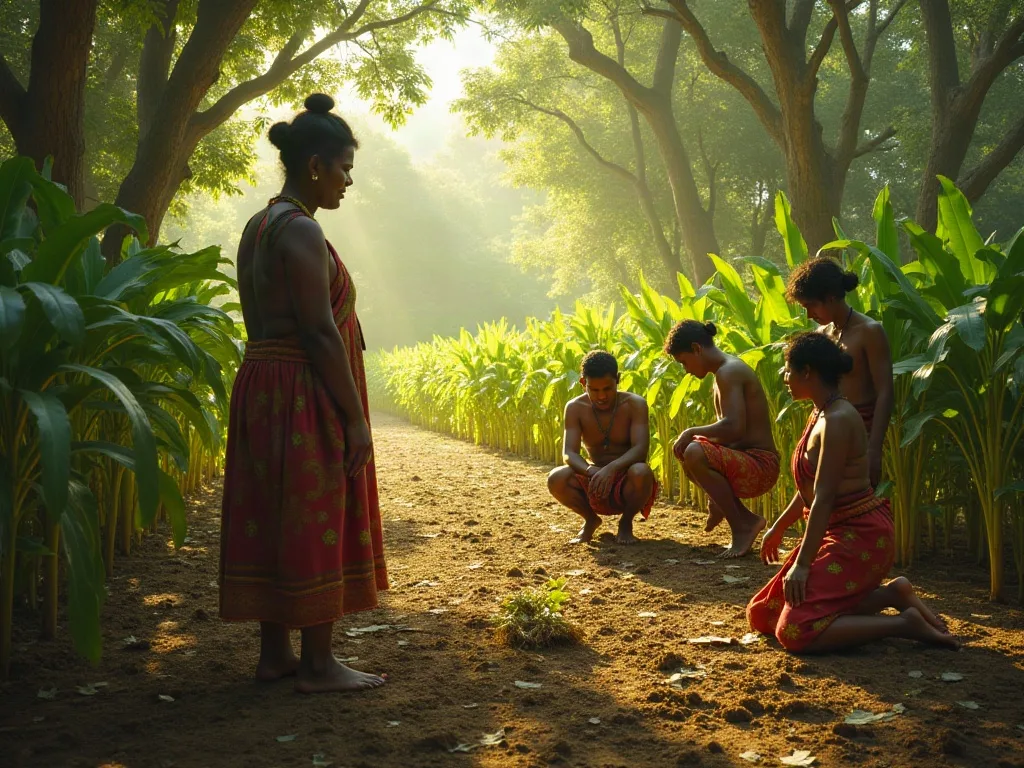
The oral traditions also credit Sumé with teaching other crops. Corn, beans, and squash appear in some accounts, though manioc is always primary. He taught not only what to plant but why: he imbued agricultural knowledge with an ethical dimension. The crops are gifts. The earth is generous but requires respect. Waste is shameful. This fusion of practical instruction with moral teaching is characteristic of Sumé's role. He does not simply hand over a technique. He transmits a way of relating to the world.
The Transmission of Language and Law
Beyond agriculture, Sumé's role as a civilizing prophet extended to language itself. Several missionary accounts suggest that Sumé clarified or refined the Tupi language, teaching the people how to speak with precision and power. In some traditions, he is credited with establishing naming practices, the ceremonial speech that binds people to the land and to each other, and the formal oratory that would later distinguish Tupi councils and diplomatic exchanges.
This is not as odd as it might first appear. In many indigenous traditions worldwide, the culture hero does not separate technical knowledge from linguistic and spiritual knowledge. To teach someone how to plant is also to teach them the words that make planting a communal act, that give it meaning. The Tupi-Guarani peoples had language before Sumé, certainly. His gift was the refinement of it, the elevation of speech from mere sound to a vehicle of law and covenant.
Law is the third pillar of Sumé's teaching. The Tupi-Guarani, like many societies, faced the eternal problem of internal conflict. How do you govern the disputes that arise between individuals and families? What authority enforces restraint? Sumé is remembered as the teacher of social law: the prohibition against certain forms of violence, the protocols for resolving quarrels, the obligations of kinship, the rights and duties of leadership.
These laws were not arbitrary. They emerged, in the traditions, from Sumé's understanding of human nature and human flourishing. He taught that communities could only endure if certain bonds held: the obligation to feed the hungry, to shelter the orphan, to speak truth in council, to honor the elders. He taught that revenge might be natural but was corrosive, that cycles of killing had to be broken by something stronger than the impulse to retaliate.

It is important to note that these teachings, as preserved in missionary accounts, reflect the perspectives of those missionaries. The Spanish and Portuguese friars who recorded Sumé traditions were not neutral observers. They often shaped the narrative to make Sumé's laws resonate with Christian morality, seeing in him a pagan precursor to gospel teaching. Yet the testimony of indigenous peoples themselves, captured in the Informaciones del Perú and in the works of colonial-era indigenous authors like Felipe Guaman Poma, suggests that the ethical dimensions of Sumé's teaching were genuine to Tupi-Guarani values: hospitality, courage tempered by wisdom, the bonds of reciprocal obligation.
The Mystery of His Departure
All the major accounts of Sumé share a common ending: he departs. The specific form of departure varies. In some versions, he walks westward into the interior, promising to return in an age when the world is transformed. In others, he walks into the sea and vanishes beneath the waves. Still others describe him ascending into the sky, becoming a star or a companion to the celestial powers.
This departure is not presented as abandonment. Instead, it has the quality of completion. Sumé's work among the Tupi-Guarani is finished. He has given them what they needed. To remain longer would be to rob them of their own agency, their own capacity to develop and govern themselves. His absence is thus a final gift: the space in which the people can truly become themselves.
The promise of return, implicit in many accounts, gives the departure a different coloration. Sumé does not disappear absolutely. He withdraws into a hidden dimension, a sacred realm accessible only in certain circumstances or times. If the world falls into complete disorder, if the people utterly abandon the laws and the knowledge he taught, he might return to restore what was lost. This belief persists in some contemporary Tupi-Guarani communities and in the millenarian movements that emerged in response to European contact.
The departure into the sea is particularly rich in symbolic possibility. The Atlantic, from the perspective of the Tupi-Guarani territories, was the direction of the rising sun, associated with rebirth and renewal. To walk into the sea was not necessarily to die but to pass into another mode of existence. Some scholars have speculated that oral traditions of Sumé's ocean departure may have been reinforced or reinterpreted after European contact, when ships arrived from across the sea bringing beings of ambiguous status. Yet the accounts preserved in early missionary sources already contain this motif, suggesting it was deeply embedded in pre-Columbian traditions.
Scholarly Interpretation and Historical Context
The figure of Sumé has attracted significant scholarly attention, particularly from scholars of South American indigenous religions and from anthropologists studying culture heroes across traditions. The most thorough early academic treatment comes from Alfred Métraux's The Religion of the Tupi-Guarani (1949), which synthesizes missionary accounts and subsequent ethnographic work to construct a coherent picture of Sumé's role in the Tupi-Guarani cosmos.
One scholarly debate concerns the degree to which Sumé traditions were shaped by contact with Christianity. Some researchers argue that the Tupi-Guarani, encountering Jesuits and their narratives of a divine teacher who came to instruct humanity, reinterpreted or reshaped Sumé legends to align with Christian theology. The missionary records, they argue, present a Sumé who is suspiciously Christlike: born of mysterious parentage, a teacher of moral law, a figure who departs with a promise of return.
Other scholars, including some contemporary indigenous researchers, argue that the parallels reflect genuine similarities in how human societies imagine culture heroes, not necessarily Christian influence on the traditions themselves. A figure who arrives with knowledge, teaches survival skills and social law, and departs leaving the people transformed is not inherently Christian. It is archetypal. The Tupi-Guarani had such figures before 1500, and the consistency of the accounts across independent sources suggests deep cultural roots.
What seems most plausible is a third position: that Sumé was indeed a figure in pre-Columbian Tupi-Guarani tradition, that his role was genuinely that of culture hero and civilizing prophet, and that the missionary accounts, while filtered through Christian perspectives, preserve authentic memory of this role even as they reshape certain details to fit European theological frameworks.
Sumé and the Landscape of American Culture Heroes
When Sumé is placed in the broader context of American mythology, a pattern emerges. From Quetzalcoatl in Mesoamerica to Viracocha in Andean tradition to Manitou in Algonquian cosmology, the Americas generated a remarkable gallery of culture heroes: beings who walked among humans, taught them the arts of civilization, and often depart with the promise of return or the threat of judgment.
These figures are not identical. Quetzalcoatl is a god who becomes human, with a far richer mythology built around his return and vengeance. Viracocha creates the world and humanity in an act of cosmogonic power, then sets off on a journey of inspection and teaching. Manitou is more abstract, a principle of power rather than a specific biographical figure. Yet they share with Sumé a fundamental role: they stand at the threshold between the human and the divine, teaching humanity how to live in a structured, moral, productive way.
This pattern suggests something profound about how American peoples understood civilization itself. Civilization is not something that emerges gradually through undirected historical change. It is something given, something revealed, something transmitted by a being of superior knowledge acting deliberately to raise humanity from chaos or ignorance. The culture hero is the embodiment of this belief: a teacher who brings order.
Sumé in the Age of Contact and Beyond
The arrival of Europeans in South America created a profound crisis for Tupi-Guarani traditions, including the Sumé narratives. Here was a new civilizing presence, bringing new technologies, new knowledge, and an entirely foreign spiritual system. How did the Tupi-Guarani interpret this rupture?
Some responses incorporated Sumé. In certain millenarian movements that emerged in the sixteenth and seventeenth centuries, Portuguese and Spanish colonizers or Jesuits were sometimes interpreted as manifestations of Sumé returning or as his messengers sent to test the people. More commonly, indigenous leaders drew on Sumé traditions to articulate resistance. They claimed to be followers of Sumé's law against the law of the colonizers. They spoke of a return to the pure teaching Sumé had given before it was corrupted by European influence.
The Jesuits themselves, particularly in Paraguay where they established their famous reductions (organized mission communities), sometimes invoked Sumé traditions as a bridge to Christian teaching. They presented Jesus as a kind of Sumé: a teacher come from beyond, bringing knowledge and law. Whether this was respectful adaptation or colonial co-optation is a question that continues to animate scholarly and indigenous discussion.

In contemporary times, Sumé remains a figure of cultural identity and pride among Tupi-Guarani peoples and their descendants. In Brazil, where Tupi-Guarani languages and traditions persist in various forms, references to Sumé appear in indigenous activism, in literature, and in efforts to recover and revitalize traditional knowledge. He is no longer primarily a figure of pre-Columbian mythology but an emblem of indigenous presence and historical dignity.
The Timeless Power of the Civilizing Teacher
What makes Sumé enduring is his fundamental role: he is the one who shows that transformation is possible. Every human society faces the same challenge that confronted the mythical Tupi-Guarani in the age before Sumé: the gap between what we know and what we need to know, between chaos and order, between isolation and community. The culture hero comes to close that gap.
Sumé did not come bearing weapons or demanding submission. He came with teaching. He showed by doing. He elevated technical knowledge into moral practice. He then withdrew, leaving the people capable and responsible for what they had learned. This pattern resonates across cultures and centuries because it speaks to something true about human growth: that we learn best from those who teach us not through domination but through revelation, who empower us rather than keep us dependent.
The Tupi-Guarani oral traditions preserved Sumé's memory through centuries of disruption, colonization, and cultural transformation. That memory endures today not as antiquarian curiosity but as living connection to a vision of what teaching and civilization can mean: not the imposition of external order but the awakening of capacity that already dwells within a people, waiting to be called forth.
Frequently asked questions about Sumé and Tupi-Guarani civilization
Frequently asked questions
Who recorded the earliest accounts of Sumé?
Spanish and Portuguese missionaries, particularly Jesuits, recorded the most detailed early accounts in the sixteenth and seventeenth centuries. José de Anchieta and Fernão Cardim are among the most important sources. Their writings were shaped by Christian perspectives, but they preserve testimony from indigenous peoples themselves about Sumé's role as a culture hero and teacher.
Is Sumé the same as any god in Tupi-Guarani religion?
No. Sumé is distinct from creator deities like Tupã and from spirits like Iara. He occupies a unique position: more than human, but not a god in the sense of being a creator or an object of formal worship. He is a culture hero and civilizing prophet, a teacher who walked among the people and then departed.
What evidence suggests Sumé was a pre-Columbian figure rather than a Christian invention?
The consistency of Sumé traditions across multiple independent indigenous accounts, the details preserved in early missionary records before significant Christian influence could be exerted, and the role he plays in Tupi-Guarani cosmology all suggest authentic pre-Columbian origins. While Christian contact certainly shaped how Sumé traditions were recorded and understood, the figure itself appears to have deep roots in Tupi-Guarani memory.
Why is manioc cultivation so important to Sumé's role?
Manioc is not merely a crop; it enabled the Tupi-Guarani to transition from purely nomadic life to more stable village settlement, to support larger populations, and to develop more complex social organization. Teaching manioc cultivation was thus teaching the foundation of civilization itself, which is why it appears as Sumé's primary gift across nearly all accounts.
What happened to Sumé after he departed?
Accounts vary. Some say he walked into the sea, others that he traveled westward into the interior, and still others that he ascended to the sky. Most traditions suggest he remains in a hidden realm and may return under certain conditions, particularly if the world has fallen into complete disorder or if his teachings are utterly abandoned.
How do contemporary Tupi-Guarani communities regard Sumé today?
Sumé remains an important symbol of cultural identity and indigenous heritage, particularly in Brazil where Tupi-Guarani languages and traditions persist. He appears in indigenous activism, literature, and efforts to recover traditional knowledge and values, representing both historical connection to pre-Columbian civilization and ongoing indigenous presence.
The Sumé Pattern in Indigenous Futures
The figure of Sumé points toward a question that extends beyond mythology into contemporary life: what does it mean for a people to hold a vision of civilization as something taught, revealed, and grounded in ethical responsibility rather than imposed through force?
The Tupi-Guarani maintained this vision through centuries of disruption. When European powers sought to impose their own model of civilization, indigenous peoples drew on Sumé traditions to articulate alternatives, to claim authority rooted in their own sacred history. That act of resistance through mythological memory suggests something about how culture heroes function in indigenous societies: they are not merely explanations of the past. They are blueprints for the future, templates for what right relationship and right teaching can be.
Sumé teaches that civilization is not about domination. It is about awakening what lies dormant in a people. It is about the patient transmission of knowledge grounded in respect for the world and for human dignity. In a time when multiple models of civilization clash and compete, when indigenous peoples worldwide are reasserting their own visions of how to live and flourish, Sumé's memory remains vital: not as a quaint relic but as a profound statement about what teaching can be when it is rooted in genuine care for human flourishing.
Free 25-page sample
Want the whole story?
Take the first 25 pages free. If it pulls you in, the full edition is yours as an instant PDF download, with a paperback on Amazon for selected titles.
Tupi-Guarani
The Tupi-Guarani Mythology Book: The Land Without Evil, the Twin Heroes, and the Spirits of the Rainforest
Namandu, the Twin Heroes, and the Land Without Evil
The mythology of the Tupi and Guarani peoples of the Amazon and the Atlantic forest: Namandu the creator who unfolded the world out of darkness, the twin heroes raised by jaguars, Tupa of the thunder, the fire-serpent Boitata, and the long search for the Land Without Evil.
More from Tupi-Guarani
All articles
Tupi-Guarani
Tupã: The Thunder God and Supreme Creator of Tupi-Guarani Myth
Tupã commands the sky as both destroyer and creator: the Tupi-Guarani supreme god who speaks through thunder, shapes the cosmos, and rules over all lesser powers. Discover how this ancient deity shaped the worldview of millions across the Amazon and beyond.

Tupi-Guarani
The Origin of Manioc: Mani and the Gift of Cassava
In Tupi-Guarani lore, a girl named Mani died of a broken heart and transformed into the cassava root, becoming the foundation of survival for generations. Discover how a myth of grief became the story of a continent's staple crop.

Tupi-Guarani
Anhangá: The Forest Protector and Trickster Spirit
Anhangá is the shape-shifting guardian of Tupi-Guarani forests, a spirit who punishes hunters who show disrespect to animals and plants. Part protector, part deceiver, this creature embodies the deep ecology of Amazonian belief.

Tupi-Guarani
Curupira: The Backward-Footed Guardian of the Jungle
Curupira is a red-haired forest spirit from Tupi-Guarani mythology whose feet point backward to confuse hunters and loggers. This creature embodies the jungle's fierce protection of its own, punishing those who kill animals without respect or destroy trees needlessly. Learn how a figure born from indigenous ritual belief became a living warning about the price of ecological excess.