

Iara: The Enchanting Water Spirit of Rivers and Lakes
Iara emerges from the rivers of Tupi-Guarani myth as a siren of the tropics: a water spirit whose song draws men to their doom. Learn the origins, powers, and lasting cultural grip of this South American enchantress.
Contents
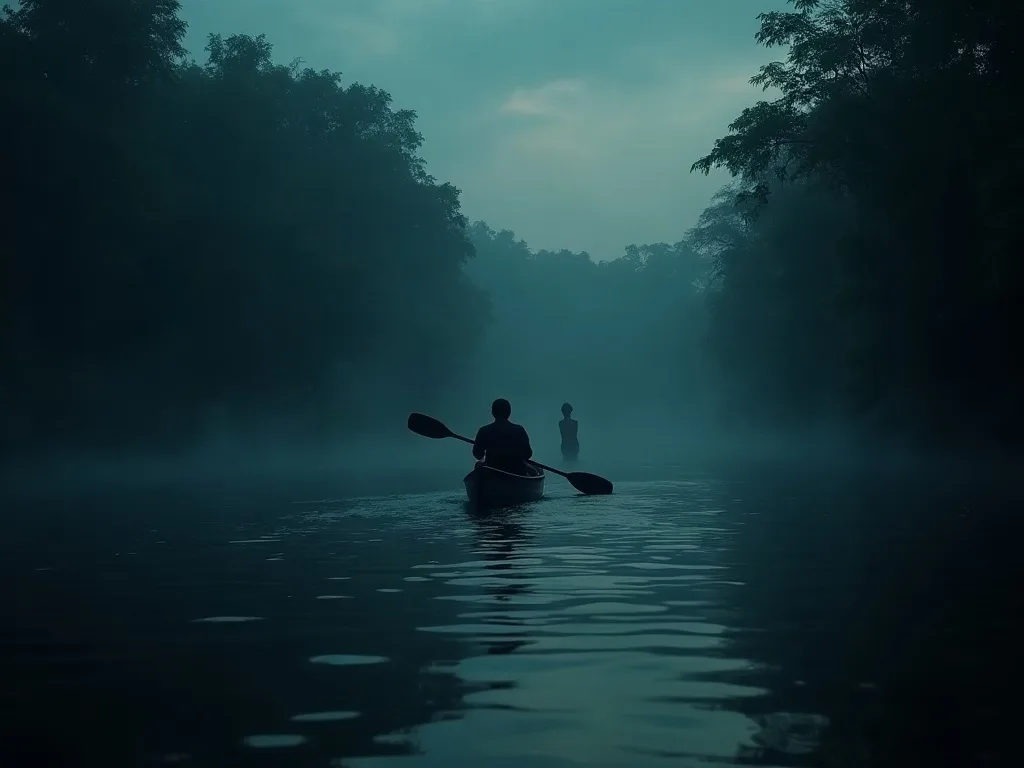
A canoe cuts through the black water of the Amazon at dusk. The paddler hears it first: a woman's voice, impossibly clear above the river sound, singing in a melody that makes his chest ache. He sees her then, perched on a rock, combing her long dark hair. She turns to look at him. When he meets her eyes, he no longer remembers why he wanted to reach the far shore.
This is how Iara enters the stories told by the Tupi and Guarani peoples of South America. She is not a ghost. She is not quite a demon. She is the river itself, given form and hunger, and for five centuries her legend has refused to fade.
The Origin of Iara: From Forest Daughter to Water Mother
The oldest versions of Iara's story, preserved in oral traditions and recorded by early colonial observers, tell a darker beginning than most modern retellings allow.
In the deep past, before the rivers knew their final shape, a young woman lived in the forest. Some accounts call her the daughter of a powerful shamanic family. Others say she was simply born of the Tupi peoples, beloved by her people for her grace and her voice. One thing never changes: a man came to her with hunger that had nothing to do with love.
Whether the man was her father, a rival suitor, or an enemy warrior varies by region and narrator. The violence itself is the constant. In most versions, she was killed and thrown into the river. But the waters did not let her fade. Instead, she sank deeper, transforming.
The river claimed her. It gave her a second form, more beautiful and more terrible than her first. Her long black hair became green in the shadows of the water. Her skin took on the pale glow of moonlight on rapids. Her eyes opened again, but now they saw everything that moved beneath the surface and everything that moved above it, desperate to cross.
Iara was no longer a victim. She had become the river's daughter, the river's voice, the river's hunger.
This transformation from innocent to supernatural predator mirrors patterns found across indigenous Amazonian traditions. The water spirits of the Tupi-Guarani peoples exist at a threshold: between world and underworld, between the living and the ancestor realm, between protection and punishment. Iara straddles all these territories at once.
Iara's Form and Powers: Beauty as Weapon
When hunters or fishermen see Iara, what they describe is always precise, always magnetic. She appears as a woman of impossible loveliness: dusky skin, long dark hair falling past her waist, and eyes that reflect light like water under the moon. Her upper body is human and entirely female. Below the waist, accounts split. Some say she has the tail of a pink river dolphin, the boto, an animal sacred and feared in Tupi-Guarani cosmology. Others describe a scaled fish body, or simply a form that shifts between states, never fixed.

What makes Iara distinct from mermaids of European tradition is not her tail but her voice and her song. She does not speak in riddles or curses. She sings, and the song itself is the weapon.
Fishermen and hunters report that her voice carries across water with impossible clarity, cutting through the sound of rapids and rain. The song has no words in any human language, yet it speaks directly to something deep in the listener's mind: longing, memory, the ache of things lost. Men who hear it are said to forget their own names. They forget their families waiting on shore. They forget the difference between breathing air and drowning in water.
The anthropologist Alfred Métraux, who collected Tupi-Guarani oral traditions in the mid-20th century, documented accounts from Amazonian communities describing Iara's power in strikingly consistent terms across different regions. The song, he noted, was never described as coercive or violent. Instead, it was irresistible, like gravity or hunger or thirst. Those who heard it did not fight the pull. They simply accepted it as inevitable.
Once a man enters the water at Iara's call, the accounts become less consistent. Some say she drowns him immediately, pulling him down to the river bottom to join her collection of lovers and victims. Others claim she keeps them alive in an underwater palace, submerged but still breathing, still conscious, still singing in response to her song. A few accounts suggest she releases them, transformed: men who return to shore speaking only in riddles, their minds broken or expanded, unable to fully re-enter human society.
River Spirits in Tupi-Guarani Cosmology: Iara's Place
To understand Iara, one must first understand that the Tupi and Guarani peoples do not divide the world cleanly into natural and supernatural. The rivers are alive. They have mothers, guardians, and moods.
The Yara or Iara belongs to a family of aquatic spirits known across the Amazon as encantados (Portuguese for "enchanted ones") in colonial terminology, though the indigenous concept is far older than any European label. These are not spirits who possess the water; they are the water in conscious form.
The pink river dolphin, the boto, is perhaps the most famous. In some accounts, Iara and the boto are one being. In others, they are siblings or rivals. The boto is often described as male, trickster, shape-shifting, capable of seduction but also wisdom. Iara, by contrast, is singular in her hunger and singular in her domain: she draws, she calls, she keeps.
The Tupi-Guarani did not see these beings as good or evil in the European moral sense. They were more like the river itself: necessary, powerful, indifferent to human intention. To respect them was to survive. To ignore their warnings was to drown.
Shamans in Tupi-Guarani societies maintained relationships with these spirit beings, negotiating on behalf of their communities. A skilled pajé (shaman) could ask Iara for safe passage, could placate her, could even learn from her the songs and knowledge of the water world. But this required respect, restraint, and ritual. The cost of ignorance was steep.
The Historical Spread of Iara's Myth: Syncretism and Slavery
When Portuguese colonizers arrived in Brazil in the sixteenth century, they encountered Iara already woven deep into Tupi and Guarani oral tradition. They recorded her in their missionary accounts, often with incomprehension or moral disapproval. A creature who seduced men into the water? This was the Devil's work, they concluded, and set about suppressing the tale.
Yet the myth did not vanish. Instead, it merged.
African slaves, brought to Brazil in vast numbers from the sixteenth century onward, brought their own water spirits: Yemaya and Oshun from Yoruba tradition, water mothers and enchantresses of their own. In the forced mixing of cultures, in the slave quarters and the hidden shrines of Candombl religious practice, Iara and the African water spirits began to interweave.
By the nineteenth century, Iara had become something new: a syncretic figure, still unmistakably Tupi-Guarani in her river origin and in her hunger, but now wearing clothing stitched from multiple traditions. She appeared in Brazilian folklore, in literary accounts, in the stories told by poor communities living along the Amazon. She had become a Brazilian figure, which meant she belonged to no single tradition and to all of them at once.
In the nineteenth and twentieth centuries, naturalists and folklorists, many of them Brazilian themselves, began collecting Iara stories with genuine curiosity. Couto de Magalhães, a Brazilian explorer and writer, documented extensive Tupi-Guarani myths in the 1870s, including versions of the Iara narrative. These collections, though filtered through Portuguese-language recording and European scholarly frameworks, preserved something of the original Tupi-Guarani understanding: that Iara was not a cautionary tale invented to keep men from deserting. She was a fact of the river world, as real as piranhas or anacondas or the current itself.
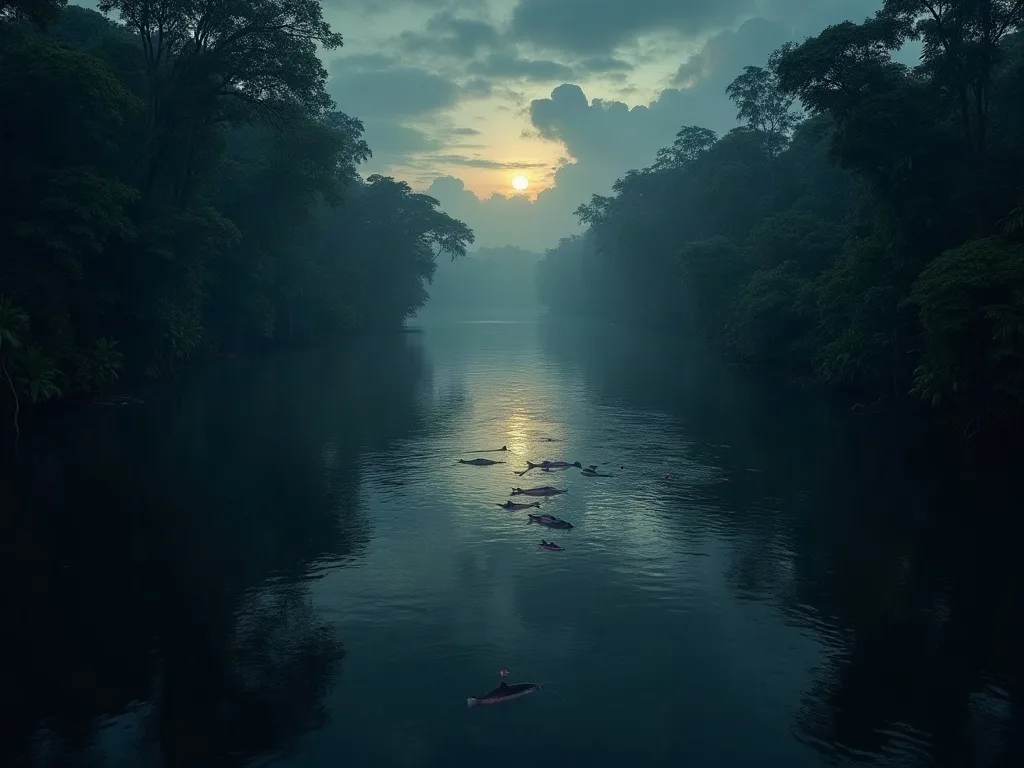
Iara and the Mythology of Predation: Who Hunts Whom
Here the myth deepens in complexity. In Tupi-Guarani tradition, predation is not moral. It is seasonal, ecological, necessary. The jaguar hunts. The anaconda hunts. The river hunts. This is not evil. It is how the world holds itself together.
Iara hunts men, but she does so in the same way the river hunts canoes: by being what she is, by flowing in her nature. The men who fall to her are not innocent victims in a moral sense. Many accounts describe them as men who violated the river's rules: hunters who took too much game, fishermen who cast nets during forbidden seasons, men who visited the water with disrespect or greed.
Some stories suggest that Iara herself is partly innocent, partly trapped. She was a woman once. She loved once, perhaps. She was murdered, drowned, violated. What rose from the river was not her revenge but her transformation, and in that new form she enacts the only hunger she knows: the hunger to draw others down into the state she occupies, neither living nor dead, neither fully herself nor fully the river.
This ambiguity is crucial to understanding Iara. She is not a demon in the Christian sense. She does not tempt for the sake of temptation. She draws because she must, because the water must eat, because to be a river spirit is to exist at a boundary that requires constant feeding.
The scholar of Brazilian folklore and mythology, Haroldo Maranhao, has argued that Iara represents one of the few mythological figures in Brazilian tradition who refuses the role of moral lesson. She does not teach. She simply is, and those who encounter her must reckon with her reality, not her meaning.
Encounters and Evidence: The Stories That Persist
Across centuries and across the Amazon basin, reports of Iara sightings and encounters persist with remarkable consistency. These are not universally believed, but they are universally known.
Fishermen speak of nights on the water when all sound ceased, and in that silence they heard singing. Hunters describe finding their brothers standing waist-deep in dark river, eyes unfocused, humming tunes no one had taught them. Whole canoe expeditions have supposedly vanished without trace, and the only evidence recovered was a woman's comb washed up on the bank, made of bone or wood, ornate with patterns no human hand could have carved.
In the twentieth century, as anthropological and folkloric study of the Amazon intensified, researchers documented accounts from indigenous communities with careful attention to consistency across regions. The details shifted based on local river systems and seasonal patterns. But the structure remained: the beautiful woman, the irresistible song, the transformation that follows entry into the water, the absolute certainty that some men did not return.
Scientific skepticism has offered alternative explanations: the pink river dolphin (boto) making calls that echo eerily off canyon walls. Manatees or caimans mistaken for human form in the darkness. Untreated malaria or river blindness causing hallucinations. Drowning deaths rationalized as supernatural abduction to preserve dignity.
Yet these explanations sidestep the cultural fact: that across centuries and among multiple indigenous populations, Iara has remained the framework through which certain river experiences are understood and transmitted. Whether or not a literal water woman exists, the myth of Iara exists, and it shapes how the river is negotiated, feared, respected, and remembered.
Iara in Modern Brazilian Culture: River Spirit to Global Icon
In contemporary Brazil, Iara has moved from oral tradition into visual art, literature, music, and popular culture. She appears in novels by Jorge Amado and other canonical Brazilian authors, always recognized immediately by Brazilian readers as a living mythic presence, not a historical curiosity.
In the 1990s and 2000s, Iara became a symbol in environmental activism, particularly regarding river protection and indigenous land rights. Conservationists invoked her as a warning about the consequences of damning, polluting, or poisoning the rivers. The message was implicit: if you kill the rivers, the river spirits will come for you. If you disrespect the water's old agreements, the water will refuse to forgive.
This appropriation is complicated. It uses indigenous mythology to serve contemporary environmental politics, which can flatten or distort the original cosmology. Yet it also keeps the myth alive and tied to real stakes: the actual survival of specific river systems and the communities dependent on them.
In Brazilian popular music, especially in the styles of forrá and sertanejo (regional country music), Iara appears as a romantic figure, a seductress, a warning against desire itself. These songs often shift her meaning: she becomes less a guardian of the river's boundaries and more a temptress figure, closer to the European siren than to the original Tupi-Guarani encantada.
Visual artists have given Iara increasingly prominent representation, particularly women artists from indigenous or Amazonian communities. In their work, she is reclaimed: not as a seductress or a demon or a symbol for environmental causes, but as a being in her own right, with her own agency, her own grief, her own truth independent of how the river or men or history has used her.
Iara and Global Mythology: The Siren Question
The comparison between Iara and the mermaids and sirens of European mythology is almost unavoidable, and almost entirely misleading.
The European siren originates in Greek mythology as a creature whose song lures sailors to shipwreck (though the earliest Greek sirens were bird-women, not fish-tailed). This image was adopted and Christianized in medieval tradition, where the siren became a symbol of temptation, lust, the dangers of desire. The siren in European tradition is almost always a figure of warning for men: she represents the feminine as inherently dangerous, as a trap to be avoided.
Iara carries none of this moral scaffolding. She is not a warning about feminine seduction. She is a being with her own history, her own suffering, her own agency as a river guardian. If anything, European accounts that label her a "siren" or a "mermaid" are committing a form of cultural theft: translating her into terms that fit European anxieties, rather than understanding her in her own context.
The comparison reveals more about European mythology than about Iara. European myths often construct danger as external, as something that must be resisted or avoided. Tupi-Guarani myths, including that of Iara, construct danger as relational: it arises from incorrect behavior toward the spirits, from disrespect toward the river's boundaries, from not acknowledging the water's otherness and power.
A man who ignores Iara's warnings and enters the water anyway is not tempted by a siren-demon. He is a man who refused to negotiate with the river on the river's terms. The cost is his own.
The River's Memory: What Iara Remembers
One of the most haunting aspects of Iara's myth, particularly in oral versions collected from indigenous communities, is the suggestion that she retains human memory.
She remembers being a woman. She remembers a name, though few accounts venture to speak it. She remembers the violence done to her. She remembers, perhaps, the man who murdered her, and she remembers every descendant of that man who ventures onto her river, thinking himself safe.
This memory makes her not a monster but a tragedy made conscious. She is not malevolent in the way demons are supposed to be malevolent. She is a wronged being who was given immense power and no way to use that power except through the only language left to her: the song, the call, the irresistible pull downward.
Some anthropologists and cultural scholars have read Iara's myth as a narrative processing of historical violence. The Tupi and Guarani experienced devastating violence from colonization, slavery, and warfare. Iara, born from drowning and transformed into something other, encodes survival after catastrophe. She does not disappear. She does not forgive. She remains, dangerous and powerful, in the place of her death.
This reading does not make Iara less real in the context of the myth. It makes her more complex: both a spiritual being in her own right and a cultural memory of what it means to endure trauma and remain, forever changed, in the landscape where the trauma occurred.
Frequently asked questions about Iara, the water spirit
Frequently asked questions
Is Iara based on a real historical person?
No definitive historical record identifies a specific woman who became Iara. However, the myth likely encodes real patterns of violence and death: the drowning of indigenous women during colonization, violence in warfare, and murder by conquest. The myth transforms historical trauma into supernatural narrative, which is how indigenous traditions often process loss.
What is the connection between Iara and the pink river dolphin?
In some Tupi-Guarani traditions, Iara and the boto (pink river dolphin) are separate beings with overlapping domains. In others, they are aspects of the same spirit or closely related spirits. The boto is also a shape-shifter capable of seduction, but typically described as male and less focused on drowning prey than on trickery. Both share the role of river guardians and both demand respect.
Do indigenous Amazonian communities today still believe in Iara?
Belief varies significantly by community, generation, and region. Many indigenous people, particularly elders and those living close to the river, maintain that Iara is real in a spiritual or mythological sense that is not diminished by skepticism. Younger, urban Brazilians of mixed heritage often encounter Iara as a cultural figure or folklore rather than a literal being. The myth remains alive regardless of literal belief, shaping how the river is understood and respected.
Why is Iara female while most river guardians in world mythology are male?
This reflects the gender and sexual politics embedded in mythology itself. Female spirits tied to water, beauty, and seduction often encode cultural anxieties about feminine power and desire in societies where women's autonomy is restricted. In Tupi-Guarani tradition, Iara's femininity is not incidental; it is central to her power as a guardian and her tragic history. She was a woman who was violated, and she remains a woman, now invested with the river's own agency and hunger.
How has Iara's myth changed since colonization?
Original Tupi-Guarani traditions understood Iara as a river guardian and a being with her own agency. Colonial and later Brazilian interpretations increasingly framed her as a dangerous seductress, drawing on European siren imagery. Recent indigenous and feminist scholarship has worked to reclaim Iara from these overlay interpretations, returning focus to her as a being with her own story, trauma, and power independent of how she serves cultural anxieties about desire or danger.
The Eternal River, The Eternal Song
The Amazon does not end. It flows, turning, returning, wearing away stone and reshaping continents on a scale that human time cannot quite grasp. And somewhere in that flow, in the dark water under the canopy, in the moments between dusk and night when the forest goes silent and only the current sounds, the story says she is still there.
Iara persists because the rivers persist, and the rivers of South America still carry the memory of every act of violence, every drowning, every life taken by water or by the men who control the water's edge. She is the river's consciousness, the water's refusal to forget or forgive. She is also a woman, still, in some fundamental way. Still beautiful. Still powerful. Still singing a song no one fully understands until they are already in the water and it is too late to climb back out.
The myth of Iara does not offer comfort or resolution. It offers instead a radical acknowledgment: that the world is older than human law, that the rivers remember, that power moves in many directions, and that some borders, once crossed, can never be recrossed. To encounter Iara in the old stories is to be reminded that we do not own the water. We pass through it, briefly, on her sufferance. Everything else follows from that truth.
Free 25-page sample
Want the whole story?
Take the first 25 pages free. If it pulls you in, the full edition is yours as an instant PDF download, with a paperback on Amazon for selected titles.
Tupi-Guarani
The Tupi-Guarani Mythology Book: The Land Without Evil, the Twin Heroes, and the Spirits of the Rainforest
Namandu, the Twin Heroes, and the Land Without Evil
The mythology of the Tupi and Guarani peoples of the Amazon and the Atlantic forest: Namandu the creator who unfolded the world out of darkness, the twin heroes raised by jaguars, Tupa of the thunder, the fire-serpent Boitata, and the long search for the Land Without Evil.
More from Tupi-Guarani
All articles
Tupi-Guarani
Tupã: The Thunder God and Supreme Creator of Tupi-Guarani Myth
Tupã commands the sky as both destroyer and creator: the Tupi-Guarani supreme god who speaks through thunder, shapes the cosmos, and rules over all lesser powers. Discover how this ancient deity shaped the worldview of millions across the Amazon and beyond.

Tupi-Guarani
The Origin of Manioc: Mani and the Gift of Cassava
In Tupi-Guarani lore, a girl named Mani died of a broken heart and transformed into the cassava root, becoming the foundation of survival for generations. Discover how a myth of grief became the story of a continent's staple crop.
Tupi-Guarani
Anhangá: The Forest Protector and Trickster Spirit
Anhangá is the shape-shifting guardian of Tupi-Guarani forests, a spirit who punishes hunters who show disrespect to animals and plants. Part protector, part deceiver, this creature embodies the deep ecology of Amazonian belief.

Tupi-Guarani
Sumé: The Culture Hero and Civilizing Prophet of the Tupi-Guarani
Sumé taught agriculture, language, and moral law to the Tupi-Guarani peoples before vanishing into the sea. This foundational culture hero bridges the sacred and the everyday in South American oral tradition.