

Jacy: The Moon Goddess and Guardian of Night
Jacy lights the Tupi-Guarani sky as moon goddess, guardian of night, mother of growth. Learn how this celestial being shapes seasons, protects travelers, and guards the sacred boundary between day and darkness in South American myth.
Contents
The Tupi-Guarani peoples of South America knew the night sky not as a void but as alive with presence. Above them, Jacy moved across the darkness, a luminous guardian whose silver light brought safety, fertility, and the promise of renewal. She was not a distant ornament in the heavens. She walked beside humans, shaped the rhythms of planting and harvest, watched over women in labor, and guided lost travelers through the forest.
Jacy: The Moon Goddess and Guardian of Night holds a place of central importance in Tupi-Guarani cosmology. She is not merely a celestial body but a divine mother, a keeper of natural cycles, a protector against the chaos of darkness. In the myths of the Tupi peoples (who inhabited what is now Brazil) and the Guarani (who lived across Paraguay, Argentina, and southern Brazil), Jacy's presence is woven through creation itself.
The Origins of Jacy in Tupi-Guarani Creation
The Tupi-Guarani creation accounts begin not with a single creator but with a process of unfolding. In the beginning, according to Guarani sources recorded by the Jesuit Bartolomé de Las Casas and later ethnographers, there existed Ñanderygueyú, the supreme deity, and his dual-natured companion. From these primordial forces emerged the sky, the earth, and the beings who would populate them.
Jacy appeared as part of this cosmic differentiation. She was not created as an afterthought but emerged as a necessary balance to the sun god, Guaracy (also called Tupã in some accounts). Where Guaracy brought the heat of the day, the clarity of masculine action, Jacy brought the cool reflection of night, the feminine principle of receptivity and inner wisdom. The two were not rivals but complementary forces, like the warp and weft of a single cloth.
The earliest Tupi traditions, passed through oral narratives and later documented by missionaries and ethnographers in the 16th and 17th centuries, describe Jacy as having been present at the moment when chaos was first ordered into seasons and cycles. She inherited dominion over the night hours, over dreams, over the tides that moved with her phases, and over the fertile dampness that night brings to plants and soil.
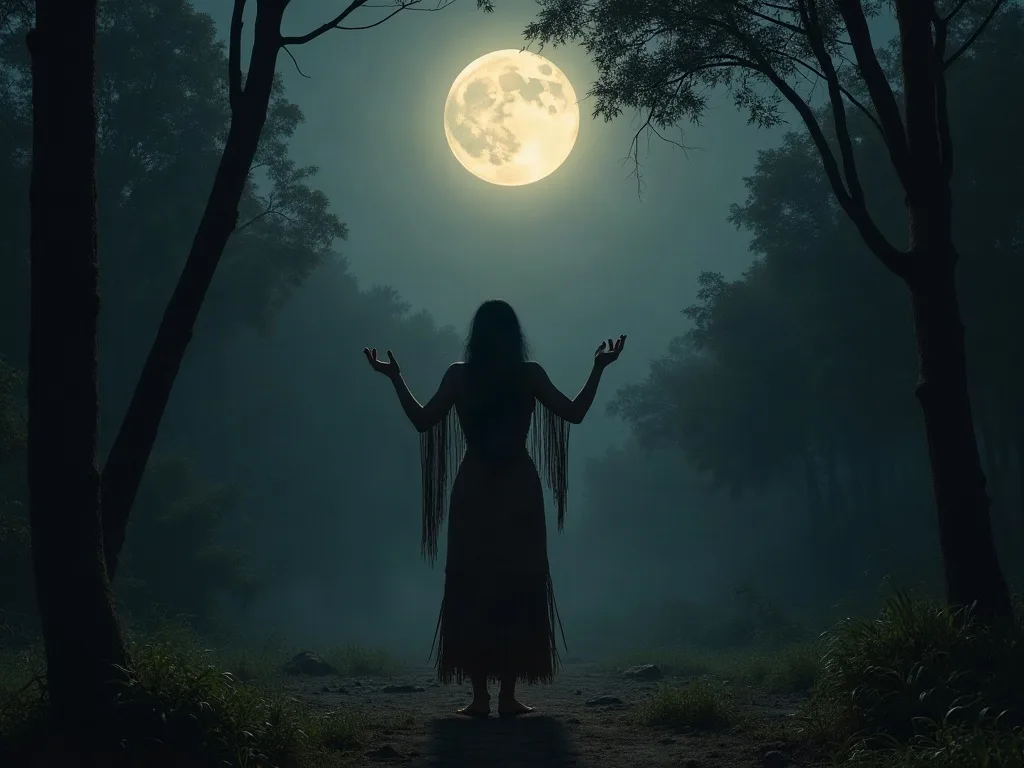
In some Guarani accounts, Jacy gave birth to herself in the first age of creation. She wove her own light from the tears of a primordial woman or from the dust of creation itself. This act of self-origin, common in many South American mythologies, marks her as a being of power independent and complete. She did not need a father or partner to bring her into being. She simply was.
The Lunar Cycles and Jacy's Transformation
For the Tupi-Guarani peoples, Jacy's most visible activity was her movement through the sky in cycles. The phases of the moon were not astronomical abstractions but Jacy herself, changing, breathing, and communicating her will to the world below.
The new moon, when Jacy disappeared from the night sky, was not a time of her absence but of her renewal. The Tupi called this time a period of sacred rest, a moment when she withdrew from the world to gather her strength. During this dark phase, certain rituals and hunts were forbidden. Women would rest, plants were thought to draw inward, and the forest held its breath.
The waxing moon was Jacy growing, her light returning and strengthening. This phase corresponded with growth itself. When farmers planted seeds, they would often choose times of the waxing moon, trusting that Jacy's increasing light would pull their crops from the soil with equal force. Pregnant women felt her presence most keenly in these nights. The gentle but steady illumination matched the slow building of new life within the womb.
The full moon was Jacy at her most powerful and most dangerous. Her light flooded the world, and in this brightness, she was said to be most active in the affairs of humans. Hunters tracked by her light. Lovers met in her glow. But the full moon also brought madness, passionate excess, and the breaking of boundaries. The Tupi word for lunacy and for the full moon shared a common root, suggesting that too much of Jacy's influence could overwhelm human reason.
The waning moon was Jacy releasing, her light slowly retreating. In these nights, the harvest was gathered, strength was drawn inward, and the body was understood to be in a natural state of release and rest. This phase was favored for death rituals and for separating one season from the next.
Jacy as Protector and Mother
Beyond her role as keeper of cycles, Jacy was understood by the Tupi-Guarani as a direct protector of specific people and places. She was the guardian of women, particularly in the vulnerability of pregnancy and childbirth. When a Guarani woman felt the pain of labor begin, her family would call on Jacy to guide the child safely into the world. The moon's phases were read as omens for the birth: a full moon was considered a time of strength, while a new moon was thought to bring difficulty.
Jacy also protected travelers lost in the forest. The Amazon and its surrounding regions are dense with darkness, dense with dangers seen and unseen. A person without a path, without fire, without landmarks, was entirely at the mercy of the forest's many threats. But if the moon was visible, if Jacy was watching, a traveler had a guide. Her light was steady, her movement was predictable, her presence was a promise that the night would not last forever.
The goddess held special protection over animals born at night. Jaguars, night-hunting birds, nocturnal forest creatures were sometimes understood to be Jacy's children or her charges. To harm them recklessly was to invite her wrath. Many Tupi-Guarani hunting rituals required prayers to Jacy asking permission before taking a nocturnal creature's life.
Jacy's Relationship with Guaracy and the Balance of Light
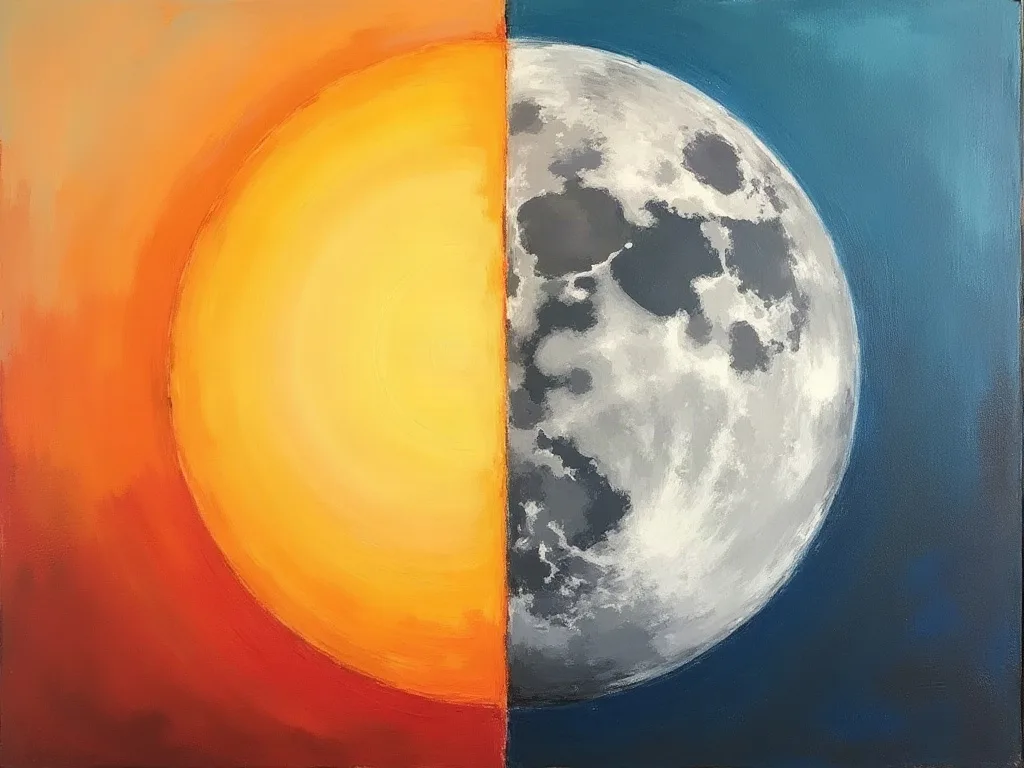
Where Guaracy, the sun god, represented clarity, activity, and masculine force, Jacy embodied mystery, rest, and feminine wisdom. This was not a relationship of conflict but of necessary complementarity. The cosmos required both light and dark, action and reflection, growth and consolidation.
In some Guarani myths, Jacy and Guaracy were not merely siblings or partners but lovers who briefly inhabited the same sky at dawn and dusk. In these liminal hours, when the sun was setting and the moon was rising, their energies were thought to interact. The colors of sunrise and sunset reflected this meeting: neither fully day nor night, but a temporary merge of their two powers.
The balance between them was understood as critical to the world's survival. If Guaracy dominated entirely, the world would burn, water would evaporate, and plants would wither. If Jacy reigned unopposed, eternal darkness and cold would freeze all growth. Only in alternation, in rhythm, in the daily exchange of authority from one to the other, could life continue.
This balance reflected how the Tupi-Guarani understood gender and power. Neither the masculine nor the feminine principle was superior. Neither could function alone. A successful society, like a successful cosmos, required both in proper proportion and mutual respect.
Jacy and the Water World
The Tupi-Guarani peoples, many of whom lived near rivers, understood Jacy as intimately connected to water. The moon pulls the tides; the Guarani knew this, and they wove it into their mythology. Jacy was believed to influence the flow of rivers, the gathering of rains, and the movement of fish in streams.
In creation myths, Jacy was sometimes said to have walked along the rivers at the world's beginning, leaving blessing and establishing channels for life to flow. Water bodies, rivers, lakes, streams, were sometimes understood to be her domain, especially at night when her reflection shimmered on their surface.
The anaconda, a great serpent revered in Tupi-Guarani mythology and deeply associated with water and fertility, was sometimes understood to be Jacy's guardian or companion. The serpent's ability to move between water and land, between visible and hidden realms, mirrored Jacy's own crossing between night and day, between the seen world and the invisible world of dreams and spirit.
Jacy in Dreams and the Spirit World
For the Tupi-Guarani, Jacy's domain extended beyond the physical night sky into the realm of dreams and spiritual experience. When a person slept under her light, they entered a space that was partly hers. The dreams that came in her moonlight were thought to carry special weight and truthfulness.
Shamans, the spiritual leaders of Tupi-Guarani communities, were often understood to work particularly closely with Jacy's power. They would perform rituals and meditations during specific moon phases to enhance their vision, to journey into spirit worlds, and to bring back healing knowledge for their people.
The boundary between the waking world and the world of dreams, between the living and the ancestors, was Jacy's threshold. She stood at both places simultaneously, making her a guide for those journeys where the living needed to speak with the dead, where a healer needed to see beyond physical illness into spiritual imbalance.
Jacy in Tupi-Guarani Calendar and Agriculture
The agricultural year of the Tupi-Guarani peoples was structured around Jacy's cycles. The word for month in Guarani, mes, derives from the same root as mesi, the moon. A year was measured not by an abstract solar calendar but by the passage of thirteen lunar cycles.
Different moons had different names and different associations. The corn moon, the planting moon, the hunting moon. Each name was tied to the agricultural and subsistence activities that took place during that lunar month, and each activity was conducted in harmony with Jacy's supposed influence on growth, animal migration, and soil fertility.
Priests and elders, the keepers of knowledge, would read the moon's position to determine when to plant, when to harvest, when to hold ceremonies, and when to hunt. To ignore Jacy's instruction was to work against the order of the cosmos itself. A crop planted against the moon's phase would be weak. An animal hunted at the wrong lunar moment would become scarce. The universe had a rhythm, and Jacy marked it.
Jacy's Echoes in Historical and Contemporary Practice
When Spanish and Portuguese missionaries arrived in South America in the 16th century, they encountered Jacy as a living, revered deity in Tupi-Guarani worship. Some missionaries attempted to suppress her veneration or to reframe her as a Christian symbol. But Jacy's connection to women's fertility, to the cycles of nature, and to the deep emotional rhythms of daily life proved resilient.
In many communities that blended Christianity with Tupi-Guarani traditions, Jacy's qualities were absorbed into the figure of the Virgin Mary, who in Iberian Catholic theology is closely associated with the moon and with motherhood. This syncretism was not a complete replacement of Jacy but a translation. The moon goddess did not vanish; she changed her name and surface attributes while maintaining her essential function as guardian of night, fertility, and female power.
In contemporary Guarani communities across Paraguay, Argentina, and southern Brazil, Jacy remains a part of cultural memory and spiritual practice. She appears in songs, in agricultural wisdom passed from elder to young, and in the emotional and intuitive understanding of the night sky. Young Guarani poets and artists have reclaimed her figure as a symbol of indigenous identity and of the feminine principle that colonization attempted to erase.
Frequently Asked Questions About Jacy the Moon Goddess
Frequently asked questions
Was Jacy worshipped as a single unified goddess, or did different Tupi-Guarani groups have variations of her?
The Tupi-Guarani peoples were not a monolithic empire but a network of related but distinct communities spread across vast territories. While Jacy appears consistently as a moon goddess across these groups, the details of her mythology, her relationships with other deities, and her specific roles did vary by region and community. Some groups emphasized her protective role over women; others stressed her agricultural function. Guarani sources and Tupi sources, while closely related, are not identical. The core of Jacy as moon, as protector, as keeper of cycles remained constant.
How did Jacy's mythology survive the colonial period if indigenous spiritual practices were suppressed?
Oral tradition proved remarkably resilient. While organized public worship was indeed suppressed by colonizers, knowledge was passed privately within families and communities. Additionally, the blending of Jacy's attributes with Mary in Christian practice allowed her symbolic power to persist under a new name. Ethnographers and anthropologists who documented Guarani and Tupi cultures from the 18th century onward recorded Jacy's myths before they could be entirely lost. This documented material, combined with living Guarani and Tupi communities who have maintained their traditions, ensures her stories survive.
Did the Tupi-Guarani understand the moon's phases scientifically, or was it purely mythological?
The two were not separate. The Tupi-Guarani had centuries of precise observational knowledge about the moon's movement and phases. They understood the mechanics of the cycles with accuracy. But they framed this knowledge within a sacred and meaningful narrative. Jacy was both a physical celestial body and a conscious deity. The moon rises at predictable times and follows a pattern, but that pattern was understood as Jacy's intentional action. Myth and observation worked together, not in opposition.
What primary sources preserve Jacy's mythology today?
The earliest written sources come from Spanish and Portuguese missionaries and chroniclers in the 16th and 17th centuries, including Bartolomé de Las Casas, Nóbrega, and Juan de Castellanos, who documented indigenous beliefs they encountered. Ethnographic work by scholars like Curt Nimuendajú in the early 20th century preserved detailed accounts of Guarani cosmology. Contemporary Guarani and Tupi community elders remain the living repositories of these traditions. Modern anthologies of South American mythology, such as those compiled by John Bierhorst, gather these sources together for broader access.
How does Jacy compare to moon goddesses in other cultures?
Moon goddesses appear across human cultures, from Selene in ancient Greece to Chang'e in China to Hecate in Mediterranean traditions. These figures often share common threads: association with fertility, with the cycles of time, with feminine wisdom, with protection during darkness, and with liminality between worlds. Jacy's specific role emphasizes agricultural and maternal protection, and her relationship with a coequal sun deity (rather than a subordinate role) reflects the Tupi-Guarani cosmology of balanced opposing forces. She is both universal in her archetype and distinct in her cultural particulars.
Jacy's Unfinished Story in the Modern World
The mythology of the Tupi-Guarani peoples continues to evolve. Jacy is not a figure locked in the past. In recent decades, indigenous artists, writers, and scholars from Guarani and Tupi communities have begun reclaiming and reinterpreting their own mythologies on their own terms, free from the filtering lens of colonial missionaries or 20th-century anthropologists.
Young Guarani filmmakers, musicians, and poets have invoked Jacy as a symbol of resistance, of indigenous feminine power, and of the alternative ways of knowing that colonialism sought to destroy. In doing so, they participate in an ancient tradition: each generation of Tupi-Guarani peoples reimagined their myths to speak to their own moment while maintaining fidelity to the core truths the myths embodied.
The moon itself remains what it has always been: a constant presence, a marker of time, a guardian of the night. For anyone who looks up at the full moon above a South American forest, or anywhere on Earth, they are seeing what the Tupi and Guarani saw. In that moment, whether they know her name or not, they are under the gaze of Jacy.
Free 25-page sample
Want the whole story?
Take the first 25 pages free. If it pulls you in, the full edition is yours as an instant PDF download, with a paperback on Amazon for selected titles.
Tupi-Guarani
The Tupi-Guarani Mythology Book: The Land Without Evil, the Twin Heroes, and the Spirits of the Rainforest
Namandu, the Twin Heroes, and the Land Without Evil
The mythology of the Tupi and Guarani peoples of the Amazon and the Atlantic forest: Namandu the creator who unfolded the world out of darkness, the twin heroes raised by jaguars, Tupa of the thunder, the fire-serpent Boitata, and the long search for the Land Without Evil.
More from Tupi-Guarani
All articles
Tupi-Guarani
Tupã: The Thunder God and Supreme Creator of Tupi-Guarani Myth
Tupã commands the sky as both destroyer and creator: the Tupi-Guarani supreme god who speaks through thunder, shapes the cosmos, and rules over all lesser powers. Discover how this ancient deity shaped the worldview of millions across the Amazon and beyond.

Tupi-Guarani
The Origin of Manioc: Mani and the Gift of Cassava
In Tupi-Guarani lore, a girl named Mani died of a broken heart and transformed into the cassava root, becoming the foundation of survival for generations. Discover how a myth of grief became the story of a continent's staple crop.

Tupi-Guarani
Anhangá: The Forest Protector and Trickster Spirit
Anhangá is the shape-shifting guardian of Tupi-Guarani forests, a spirit who punishes hunters who show disrespect to animals and plants. Part protector, part deceiver, this creature embodies the deep ecology of Amazonian belief.

Tupi-Guarani
Sumé: The Culture Hero and Civilizing Prophet of the Tupi-Guarani
Sumé taught agriculture, language, and moral law to the Tupi-Guarani peoples before vanishing into the sea. This foundational culture hero bridges the sacred and the everyday in South American oral tradition.