
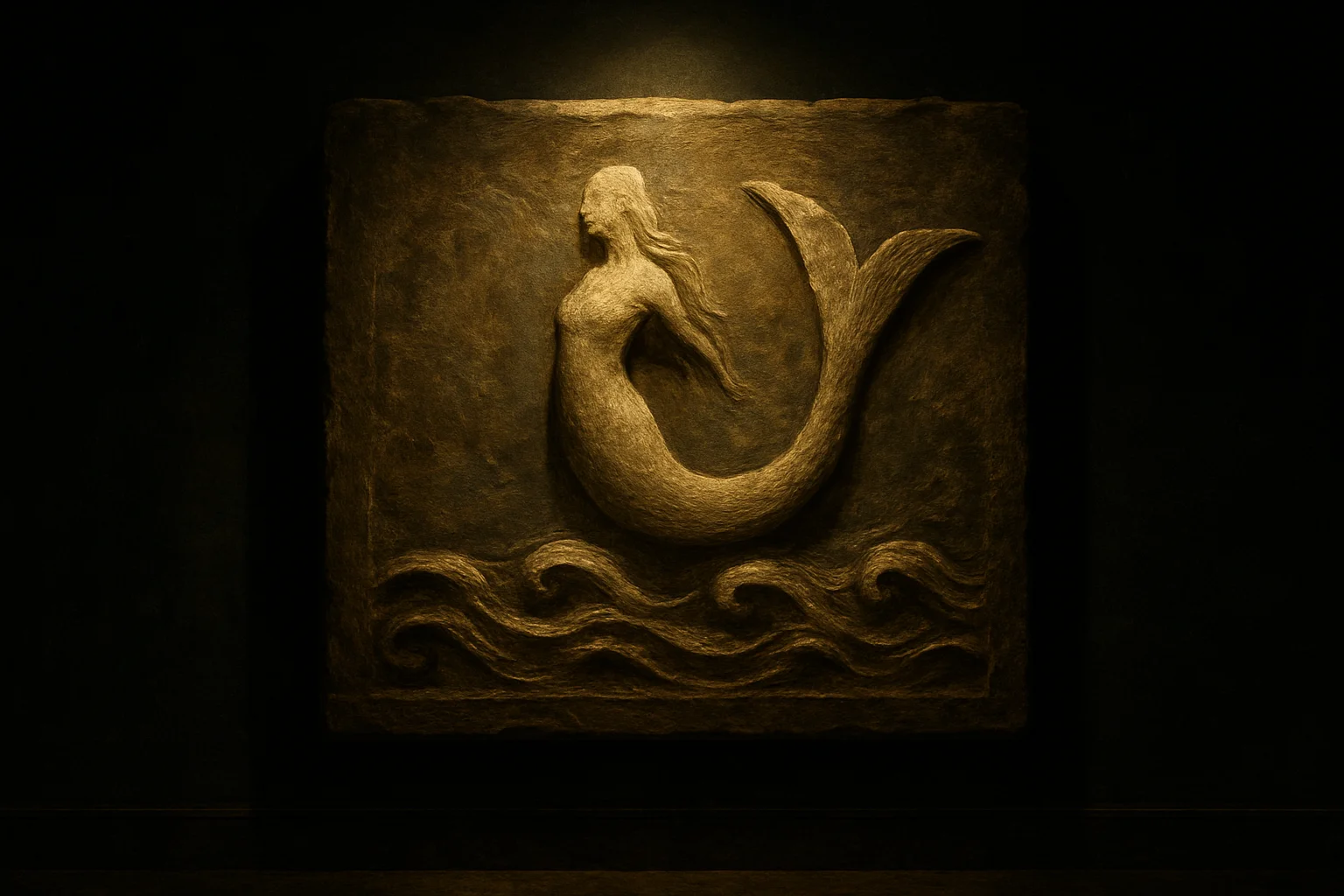
Mermaid in Mythology: Their History and Their Songs
Mermaids, sirens, and fish-tailed spirits across cultures. From Greek bird-women to European ballads, West African Mami Wata, and Japanese ningyo.
Contents
Mermaids in mythology are not a single creature but a family of half-human, half-aquatic beings whose forms and meanings shift across cultures and centuries. The Greek sirens of Homer's Odyssey were bird-women, not fish-tailed singers; the conflation with mermaids happened in medieval Europe, where new legends of water-dwelling women with fishtails emerged independently from older siren traditions. Mermaid-like figures appear in West African cosmology, Japanese folklore, and ancient Near Eastern religion, each with distinct origins and symbolic weight.
The confusion between sirens and mermaids is not a modern mistake. It began in the Middle Ages, when scribes and artists reimagined the classical siren as a creature of the sea rather than the sky. What follows is a separation of these traditions, a survey of mermaid lore across continents, and an account of why the song remains central to nearly all of them.
What is a mermaid?
A mermaid is a female figure, human from the waist up and fish from the waist down, dwelling in seas, rivers, or lakes. The male counterpart is a merman. The word itself is Middle English: mere meaning sea, maid meaning woman. The form is consistent, but the nature varies. Some mermaids lure sailors to death. Others marry mortal men, bear children, and vanish when a taboo is broken. Still others are deities or spirits tied to water's fertility and danger.
The mermaid is not a universal archetype. It is a convergence of separate traditions, some ancient, some medieval, some colonial. To treat all fish-tailed women as variations on a single theme is to miss the specificity of their origins.
The Greek siren: bird-woman, not fish-tail
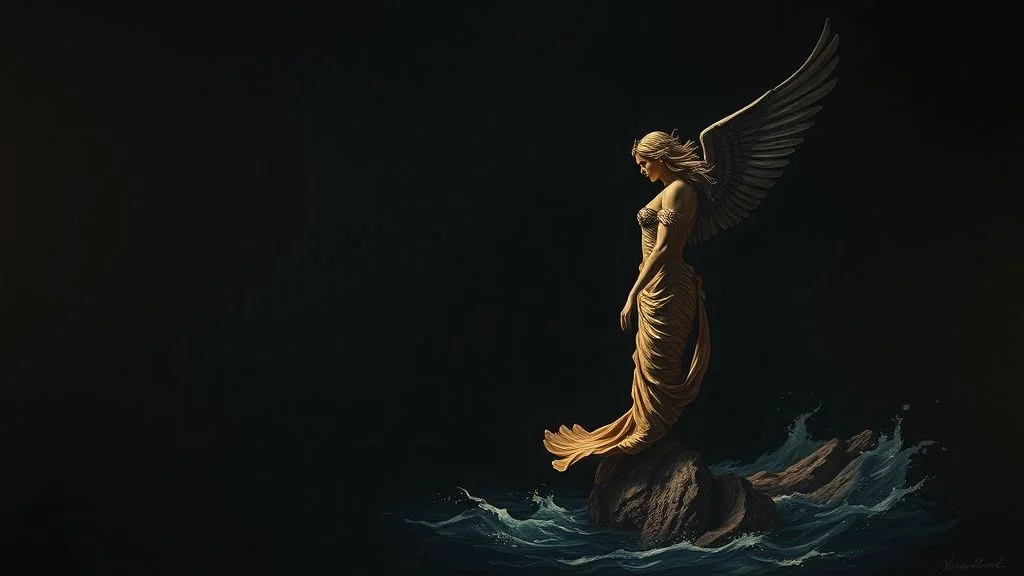
The sirens of Greek myth are not mermaids. Homer's Odyssey places them on a flowery meadow surrounded by the bones of men, singing a song so irresistible that sailors steer toward it and die. Homer does not describe their bodies. Later sources do. Apollodorus in his Library calls them part woman, part bird. Ovid in Metamorphoses 5.551-563 recounts their transformation: they were companions of Persephone, given wings by the gods to search for her after Hades took her below.
Pausanias, writing in the second century CE, saw images of sirens in Greece and described them as birds with women's faces. The association with the sea comes from their role in the Odyssey, where Odysseus sails past them, but the creatures themselves are aerial, not aquatic. They belong to the same family as the sphinx and the harpy: hybrid beings whose danger is tied to knowledge, prophecy, or forbidden speech.
"Come hither, renowned Odysseus, great glory of the Achaeans, and stay your ship so that you may listen to our voice. No one has ever sailed past this place in his black ship without listening to the honey-sweet voice from our mouths." Homer, Odyssey 12.184-187
The song is the weapon. The body is secondary.
When sirens became mermaids
The shift from bird to fish happens in the early medieval period, though no single text records the change. By the eighth century, the Physiologus, a Greek bestiary translated widely across Europe, still describes sirens as part woman, part bird. But by the twelfth century, manuscript illuminations begin to show sirens with fishtails. The reasons are unclear. Some scholars suggest confusion with older water spirits from Celtic and Germanic tradition. Others point to the influence of Near Eastern iconography, where fish-tailed deities were already ancient.
Pliny the Elder, writing in the first century CE, mentions sea-women in his Natural History 9.4-5, though he treats them as natural curiosities rather than mythic beings. He describes them as having rough, scaly skin and dying with a mournful cry. This is not the Greek siren, but it shows that fish-tailed humanoids were part of Roman natural philosophy.
By the time of the medieval bestiaries, the siren had become a symbol of temptation and deceit, often depicted with a mirror and comb, luring men to sin. The fishtail was a visual marker of her duplicity: beautiful above, monstrous below. The song remained, but the theology had changed.
European mermaid traditions
Medieval and early modern Europe produced a rich body of mermaid lore, distinct from the classical siren. These stories are less about temptation and more about boundary-crossing: between human and animal, land and water, marriage and abandonment.
The Melusine legend
Melusine is a water spirit who marries a mortal nobleman on the condition that he never see her on Saturdays. He agrees. They have children. The marriage prospers. Then, driven by suspicion, he spies on her and discovers that on Saturdays her lower body becomes a serpent's tail, or in some versions, a fishtail. She discovers his betrayal, transforms fully, and flies away, leaving him and their sons behind.
The tale appears in French romance literature in the fourteenth century, most famously in Jean d'Arras's Roman de Mélusine. It is not a moral fable about lust. It is a story about trust, secrecy, and the cost of transgression. Melusine is not evil. She is a wife and mother who cannot remain in the human world once the taboo is broken.
British and Scandinavian ballads
British and Scandinavian ballads preserve dozens of mermaid encounters. Child Ballad 289, "The Mermaid," tells of a ship that sights a mermaid with a comb and glass, an omen of disaster. The crew drowns. The mermaid is not an agent but a herald, a sign that the sea has claimed them.
Other ballads describe mermaids who fall in love with fishermen, bear their children, and return to the sea when the man breaks a promise or speaks a forbidden word. The pattern mirrors selkie stories but with a key difference: the mermaid's tail is permanent, not a skin she can remove.
Selkies and seal-folk
Selkies are not mermaids. They are seal-people, common in Scottish and Irish tradition, who shed their sealskins on land and take human form. A man who steals a selkie woman's skin can compel her to marry him. She will live as his wife, bear his children, but if she finds the hidden skin, she returns to the sea and does not come back.
The selkie is a shapeshifter. The mermaid is a hybrid. The distinction matters. Selkie stories are about captivity and longing. Mermaid stories are about the impossibility of crossing the boundary between worlds.
Mermaid
Permanent hybrid form, human torso and fish tail. Cannot fully become human or fully become fish. Lives in the water, visits land rarely. The tail is her nature, not a garment.
Selkie
Shapeshifter who wears a sealskin. Fully seal in the water, fully human on land. The skin can be stolen, hidden, or returned. The transformation is reversible.
Mermaid-like beings beyond Europe
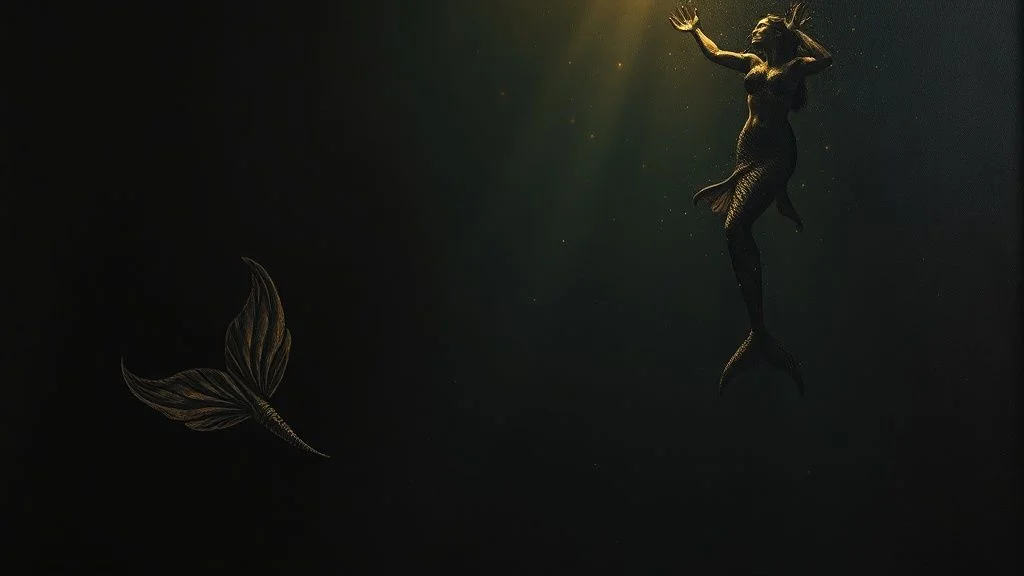
Fish-tailed or water-dwelling humanoid figures appear in mythologies far removed from the Mediterranean. Some predate European contact. Others emerge in the colonial period, shaped by encounter and exchange. The label "mermaid" is a convenience, not a claim of common origin.
Mami Wata in West Africa and the diaspora
Mami Wata is a water spirit venerated across West and Central Africa and throughout the African diaspora in the Caribbean and Americas. Her name is pidgin: "Mother Water." She appears as a beautiful woman, sometimes with a fishtail, sometimes with legs, often holding a snake. She is associated with wealth, fertility, healing, and danger. She can grant prosperity or drown those who offend her.
Mami Wata is not a single deity but a category of water spirits, each with local names and attributes. In some traditions, she is a trickster, in others a mother goddess. Her iconography shows influence from European mermaid imagery, Hindu prints of river goddesses, and indigenous African water spirits. She is a syncretic figure, shaped by centuries of trade, migration, and adaptation.
Oral tradition preserves her stories. There is no ancient written text. Ethnographers working in the twentieth century recorded accounts from devotees, but the tradition itself is older, though how much older is contested.
The ningyo of Japan
The ningyo of Japanese folklore is a fish-person, sometimes beautiful, sometimes monstrous. Early accounts describe it as having a human face and a fish's body, with scales and fins. Eating its flesh grants immortality or long life, but catching one brings storms and disaster.
The ningyo appears in medieval Japanese texts and artwork, often as a creature of omen. It is not a seducer or a singer. It is a boundary creature, a sign that the natural order has been disturbed. Some ningyo are male, some female. The gender is less important than the liminality.
The ningyo is not a borrowing from European mermaid lore. The traditions developed independently, though later Meiji-era Japan encountered Western mermaid imagery and the two began to merge in popular culture.
Oannes and Atargatis in the ancient Near East
Oannes is a fish-man described by the Babylonian priest Berossus in the third century BCE. He emerges from the sea each day to teach humanity writing, law, and agriculture, then returns to the water at night. He is a culture hero, not a seducer. His form is human above, fish below, the inverse of the later mermaid.
Atargatis is a Syrian goddess, sometimes called Derketo by the Greeks, who is depicted with a fishtail in later Hellenistic and Roman art. Her cult centers were in Hierapolis and Ashkelon. She is a fertility goddess, associated with water, fish, and doves. Lucian of Samosata describes her temple and rites in the second century CE, noting the sacred fish pools and the prohibition against eating fish.
Atargatis is not a mermaid in the folklore sense. She is a deity. But her iconography, a woman with a fishtail, influenced later Mediterranean and Near Eastern depictions of water spirits. The line between goddess and creature is porous in the ancient world.
The song and the danger
The song is the thread that ties these traditions together. Whether bird-woman or fish-tailed spirit, the mermaid's voice is her power. It lures, it enchants, it drowns. The song is knowledge, or prophecy, or simply beauty so overwhelming that reason fails.
In the Odyssey, the sirens promise Odysseus knowledge of all that happens on earth. In medieval bestiaries, the mermaid's song is the voice of temptation, leading men to spiritual ruin. In West African tradition, Mami Wata's call can bring wealth or madness. In British ballads, the mermaid's appearance is a death omen, her song unheard but implied.
The danger is not always malice. Sometimes it is simply the incompatibility of two worlds. The mermaid belongs to the water. The sailor belongs to the land. The song is the moment of contact, and contact is fatal.
- The siren's song in the Odyssey offers forbidden knowledge, not seduction.
- Medieval mermaids sing to lure men to sin, a symbol of worldly temptation.
- Mami Wata's call can grant prosperity or drown the listener, depending on respect and offering.
- In Japanese ningyo lore, the creature itself is silent; the danger is in the act of capture.
- Selkie songs, when they appear in ballads, are songs of mourning, not enchantment.
The song is not decoration. It is the mechanism of the myth.
The mermaid as boundary figure
The mermaid, in all her forms, is a creature of the threshold. She lives between water and air, human and animal, life and death. She cannot be fully one thing. This is her power and her tragedy. She marries mortal men but cannot stay. She grants wishes but exacts a price. She sings, and the song is irresistible, and the listener is lost.
She appears in the same mythic space as the dragon, the vampire, and the werewolf: creatures that test the boundaries of the human. She is less a monster than a reminder that the world is not made for crossing. Some borders cannot be undone.
The mermaid endures because the question endures: what happens when two worlds touch? The answer, in nearly every tradition, is loss.
Frequently asked questions
Are mermaids and sirens the same creature?
Mermaids and sirens are not the same creature, though they have been conflated since the medieval period. Greek sirens, as described in Homer's Odyssey and later classical sources, were part woman and part bird, not fish-tailed beings. The shift from bird-women to fish-tailed figures occurred in medieval Europe, when scribes and artists began depicting sirens with fishtails, possibly influenced by separate mermaid traditions or Near Eastern iconography. By the twelfth century, the two had merged in popular imagination, but their origins are distinct.
Where do mermaids appear in ancient mythology?
Fish-tailed or water-dwelling humanoid figures appear in several ancient mythologies, though not always under the name "mermaid." Atargatis, a Syrian goddess depicted with a fishtail in Hellenistic and Roman art, was worshipped in temples at Hierapolis and Ashkelon. Oannes, a Babylonian fish-man described by Berossus, emerged from the sea to teach humanity. Greek sirens, though bird-women in classical sources, were associated with the sea in Homer's Odyssey. The fish-tailed mermaid as a distinct folklore figure is primarily a medieval European development.
Why are mermaids associated with dangerous songs?
Mermaids are associated with dangerous songs because the song represents the moment of fatal contact between human and otherworldly realms. In the Odyssey, the sirens' song offers knowledge that no mortal should hear, luring sailors to their deaths. Medieval Christian tradition reinterpreted the mermaid's song as a symbol of worldly temptation and spiritual ruin. In West African Mami Wata traditions, the spirit's call can bring wealth or madness, depending on the listener's respect and offerings. The song is not mere decoration; it is the mechanism by which the boundary between worlds is crossed, and crossing is rarely safe.
What is the difference between a mermaid and a selkie?
A mermaid is a permanent hybrid, human from the waist up and fish from the waist down, unable to fully become human or fully become fish. A selkie, by contrast, is a shapeshifter who wears a sealskin and can move between fully seal and fully human forms. Selkie stories, common in Scottish and Irish tradition, often involve a man stealing a selkie woman's skin to compel her to marry him; if she recovers the skin, she returns to the sea. Mermaid stories focus on the impossibility of crossing the boundary between worlds, while selkie stories focus on captivity, longing, and the reversibility of transformation.
Do mermaid legends exist outside Europe?
Yes, mermaid-like beings appear in mythologies across the world, though they are not always called mermaids and their origins are independent of European tradition. Mami Wata, a water spirit venerated across West and Central Africa and the African diaspora, is depicted with a fishtail and associated with wealth, fertility, and danger. The ningyo of Japanese folklore is a fish-person whose flesh grants immortality but whose capture brings disaster. Atargatis, a Syrian goddess, and Oannes, a Babylonian fish-man, predate European mermaid lore by centuries. These traditions developed separately, though some later syncretism occurred through trade and colonialism.
When did sirens change from bird-women to fish-tailed beings?
Sirens began to be depicted with fishtails rather than bird bodies sometime between the eighth and twelfth centuries CE, though no single text records the transition. The Physiologus, an early medieval Greek bestiary, still describes sirens as part woman, part bird, but by the twelfth century, manuscript illuminations increasingly show them with fishtails. The reasons for the shift are unclear, but scholars suggest confusion with older Celtic and Germanic water spirits, influence from Near Eastern fish-tailed deities, or the symbolic needs of Christian allegory, which used the mermaid's dual form to represent deceit and temptation. The change was gradual and inconsistent across regions.
Further reading on Mythologis
Read the full book
Want the whole story?
The complete edition is an instant PDF download here, with a paperback on Amazon for selected titles.
Mythology
The World Mythology Book: The Gods, Heroes and Myths of Every Culture
The Gods, Heroes and Myths of Every Culture, in One Volume
The whole of world mythology in a single volume: Greek, Norse, Egyptian, Japanese, Hindu, Celtic, Slavic, Mesoamerican and African myths gathered side by side, each drawn from the primary sources.