
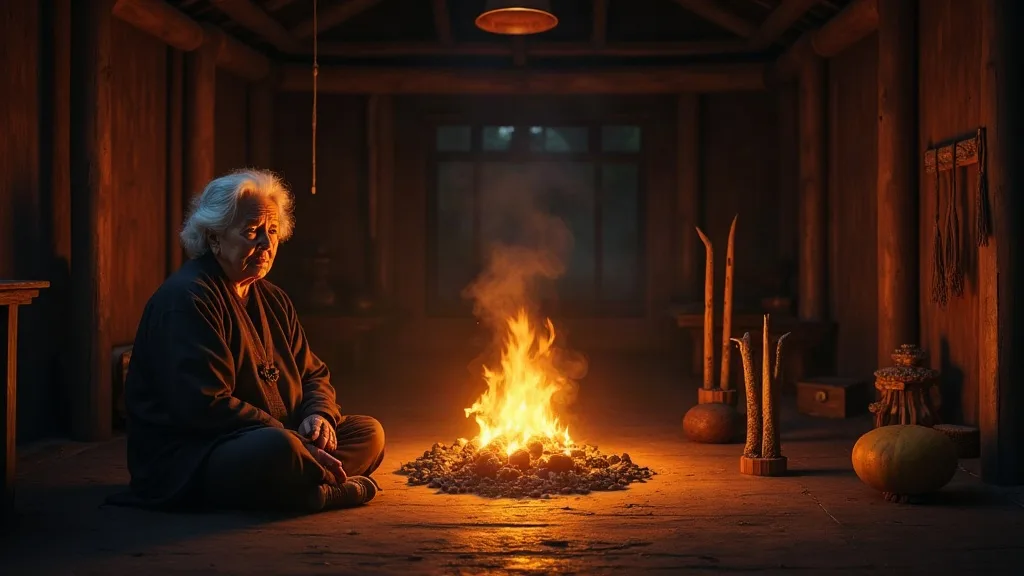
Kamuy Fuchi: Goddess of the Hearth in Ainu Mythology
Kamuy Fuchi guards every Ainu fireplace as the oldest and most sacred of all kamuy. Learn how she connects the living to the gods, and why her flame was never left to die.
Contents
The fire never went out. Not through the long Hokkaido winters, not through the nights when wolves circled the village edges, not through illness or mourning. The Ainu people kept it burning because Kamuy Fuchi: Goddess of the Hearth lived inside that flame, and letting her fire die was not carelessness, it was an insult to the most ancient deity in their cosmos.
She sat at the center of every home. Not metaphorically, but literally: the hearth occupied the heart of the traditional Ainu dwelling, the cise, and Kamuy Fuchi occupied the hearth. Prayers passed through her before they reached any other god. Disputes were settled before her. Children were named in her presence. She was the first voice in every ritual and the last warmth at every death.
Her name contains two Ainu words. Kamuy means "deity" or "spirit," the living force inside all things. Fuchi means "old woman" or "grandmother." So Kamuy Fuchi is, at her most literal, the divine grandmother. But the Ainu did not think of her as old in the sense of frail. She was old in the sense of being the most ancient, the most permanent, the one who was there before the others. She predates creation arguments. She simply burns.
Who Kamuy Fuchi Is: The Oldest of the Kamuy
The Ainu spiritual system recognizes kamuy in almost everything: bears, owls, salmon, the sea, thunder, disease, and wind. But Kamuy Fuchi holds a position no other spirit shares. She is Ape Huchi Kamuy, "the grandmother deity of fire," and she is sometimes called Iresu Kamuy, "the nurturing deity." These titles are not ceremonial flattery. They reflect a theological reality: in Ainu cosmology, the hearth fire is the axis of human life.
Ainu scholar Bronisław Piłsudski, who spent years among the Ainu people of Sakhalin around the turn of the twentieth century, documented prayers in which Kamuy Fuchi is addressed before any request is made to other gods. The sequence mattered. She was the gatekeeper, the translator between mortal speech and divine attention.
She is described in oral tradition as a grandmother, white-haired and luminous, seated cross-legged beside her flames. Some accounts collected by the Japanese folklorist Kyosuke Kindaichi describe her as wearing garments that shimmer at the edges, the way heated air shimmers above a wood fire. She was never given a young woman's form. Age, in her case, meant authority.
Her relationship to the household was total. She watched over births, because a child born near the hearth was born in her presence. She witnessed marriages, because vows spoken at the fire had a witness that could not lie. She accompanied the dead, because the rituals of mourning centered on the fire she inhabited. The Ainu did not separate the sacred from the domestic. For them, the most sacred place in any cosmos was the home.
The Hearth as Cosmic Axis: How the Ainu Organized Sacred Space
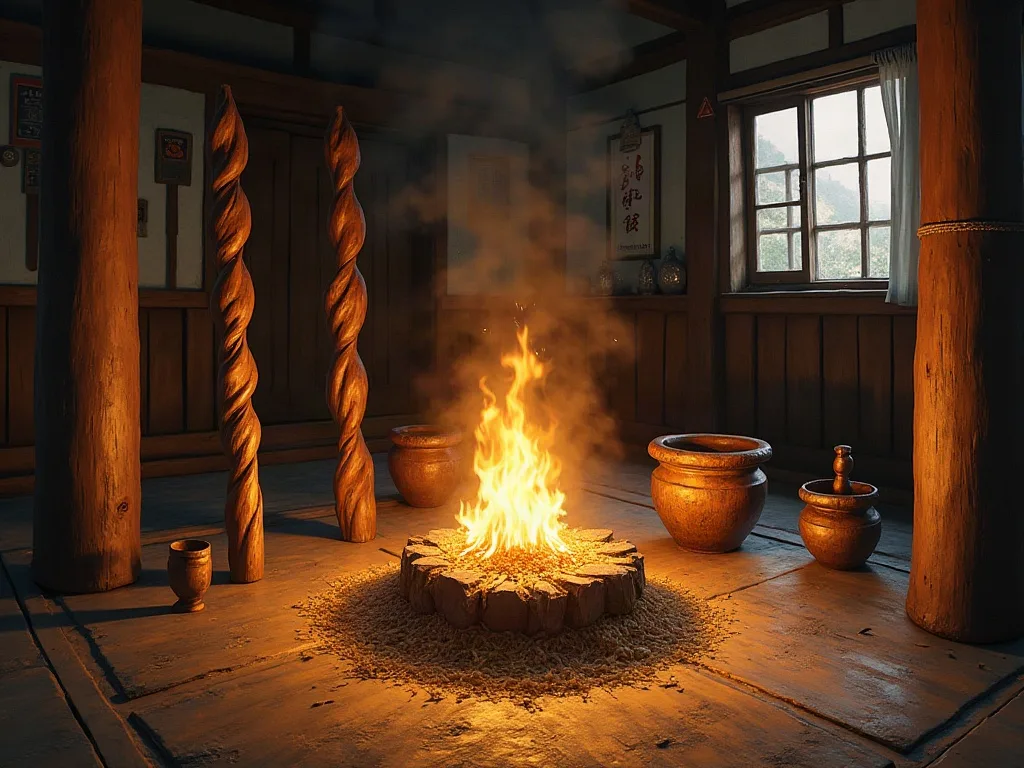
To understand Kamuy Fuchi's power, you need to picture an Ainu cise. The traditional house was built on a clear spatial logic. The eastern wall held the rorun puyar, the "sacred window," through which kamuy entered and left. The nusa, a ritual altar of carved wooden stakes, stood outside on the east side. The fire burned in the center of the floor, between the humans and the sacred window.
This arrangement made the hearth the literal midpoint between the human world and the divine world. Smoke from the fire carried prayers upward and outward through the sacred window. Kamuy Fuchi sat at that crossing point. Every ritual object passed near her before it went anywhere sacred. Every offering was acknowledged by her first.
The Ainu concept of direction reinforced this. The upstream direction (kamuy poro pet, "the river of the gods") was sacred and was associated with the divine realm. The downstream direction was the human world. The hearth, inside the house, stood between both. Kamuy Fuchi did not belong to either world exclusively. She existed precisely at the seam.
This cosmological geography was not abstract philosophy. It governed daily behavior. You did not step over the hearth fire. You did not throw garbage into it. You did not speak disrespectfully near it. Children learned these rules before they learned anything else, because Kamuy Fuchi heard everything said in a home, and what she heard, the other kamuy eventually learned.
The Ainu bear ceremony, the Iyomante, is one of the most documented Ainu rituals. Even there, Kamuy Fuchi's role was central: the fire burned throughout, and prayers to the bear spirit were routed through her. She functioned as the spiritual infrastructure of every ceremony the Ainu conducted.
Prayers, Ritual Offerings, and the Art of Speaking to Fire
The Ainu did not pray in silence. They spoke directly to Kamuy Fuchi, often in long, elaborate speeches full of respectful repetition and formulaic praise. These prayers were called upaskuma, and they were a form of storytelling as much as petition. A man asking Kamuy Fuchi to carry a request to the god of the sea would first recount who he was, what his household had done to honor the kamuy, what they had offered, and only then make the request.
The offerings made at the hearth were precise. Inau, carved wooden prayer sticks with shaved wooden curls spiraling from their tops, were placed near the fire. The shavings represented breath, speech, the living quality of the offering. Millet wine, called sake in Japanese accounts but kamuy un sake ("divine rice wine") in Ainu ceremony, was poured near the flames. Kamuy Fuchi received the first drop of any food or drink before the household ate.
Researcher Neil Gordon Munro, a Scottish physician who lived among the Ainu in Hokkaido in the early twentieth century and wrote one of the most comprehensive accounts of Ainu ceremony, described watching Ainu women speak to the fire as naturally as they would speak to another person in the room. There was no theatrical performance. Kamuy Fuchi was a present reality, not a distant abstraction requiring elaborate ceremony to contact. She was already there. The prayer was a conversation.
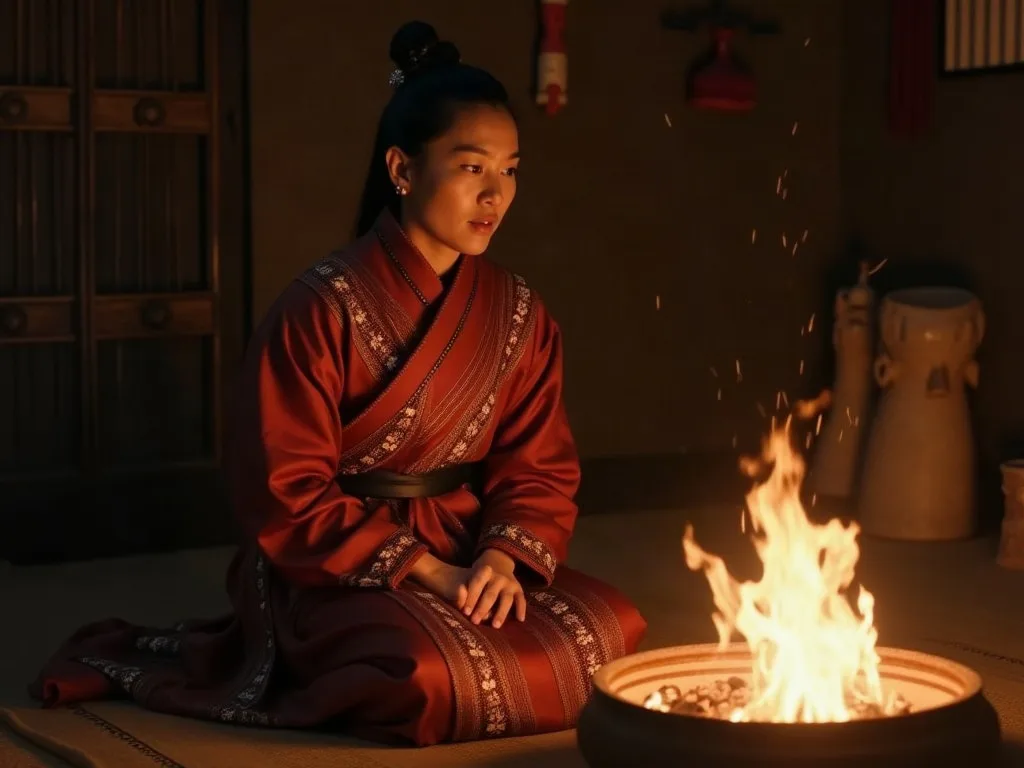
Women held a special relationship with Kamuy Fuchi. The maintenance of the hearth fire was the responsibility of the women of the household. This was not servitude but stewardship of a sacred post. The woman who tended the fire was effectively the ritual specialist of everyday life, maintaining the conditions under which all spiritual communication could occur. Extinguishing the fire accidentally was a bad omen; doing it deliberately without ritual cause was a genuine transgression that required ceremonial correction.
Kamuy Fuchi and the Bear: Mediation at the Highest Level
The Iyomante, the ceremony in which the Ainu sent a bear's spirit back to the divine realm, is the ritual that has drawn the most scholarly attention to Ainu religion since the nineteenth century. Bears were understood to be powerful kamuy who had chosen to visit the human world wearing a bear's body. When a young bear was raised in the village and then ceremonially killed and sent home, Kamuy Fuchi played an indispensable role.
The prayers that accompanied the bear's departure addressed her first. She was asked to guide the bear's spirit through the transition from the human world back to the kamuy realm. The fire burned without interruption during the multi-day ceremony. Some accounts, including those recorded by Piłsudski in the early 1900s, describe the moments when the bear's spirit was believed to have arrived safely as marked by changes in the fire, a sudden brightness or a particular quality of the smoke.
This is not peripheral detail. It establishes that Kamuy Fuchi was not merely a domestic goddess in the diminished sense that phrase sometimes carries. She was the mediating power at the most solemn moment in Ainu religious life. Without her, the bear could not go home. Without her, the cycle that sustained the relationship between humans and the animal spirits of the mountains could not turn.
How Kamuy Fuchi Differs from Other Fire Deities Worldwide
Fire goddesses and fire gods appear in dozens of traditions. Hestia, the Greek goddess of the hearth, shares striking parallels with Kamuy Fuchi: both dwell in the domestic fire, both receive the first offering at any meal, both are understood as permanently present rather than summoned by ritual. Hestia's fire in Athens was kept burning in the Prytaneion, the civic hearth, mirroring the way the Ainu hearth was simultaneously domestic and communal.
The Roman Vesta carried the same logic further, with the Vestal Virgins maintaining the sacred flame as a civic and religious duty whose failure meant catastrophe for Rome itself. The parallel to the Ainu woman who tended Kamuy Fuchi's fire is close enough to be instructive, though the two traditions developed entirely independently.
What makes Kamuy Fuchi distinct is her role as mediator rather than symbol. Hestia and Vesta represent the hearth: they are identified with the idea of the home, with stability, with domestic order. Kamuy Fuchi does not merely represent the hearth. She acts through it. She is a channel, a function, a living presence who works on behalf of the humans in her house every single day. The distinction matters. Hestia receives honor. Kamuy Fuchi does work.
Inari, the Japanese kami of rice and foxes, offers another comparison point. Like Kamuy Fuchi, Inari is approached through everyday household ritual and is understood to directly affect the practical outcomes of domestic life: harvests, prosperity, protection. But Inari's sphere is external: the field, the marketplace, the hunt. Kamuy Fuchi's sphere is the interior of the home itself.
The Ainu Creation Context: Where Kamuy Fuchi Sits in the Larger Cosmos
Ainu oral literature does not have a single canonical creation text in the way the Babylonian Enuma Elish or the Mayan Popol Vuh do. Instead, the cosmological picture emerges across hundreds of yukar, the long epic poems that Ainu storytellers memorized and performed, sometimes over multiple days. Within these accounts, Kamuy Fuchi appears as one of the original presences.
The highest deity in the Ainu cosmos is Kamuy Kotan, sometimes glossed as the divine realm or as the chief deity who inhabits it. Below this supreme level exist multiple tiers of kamuy, organized roughly by their domain and power. Kamuy Fuchi's position in this hierarchy is unusual: she is not the most powerful kamuy in the cosmic sense, but she is the most essential from the human perspective, because no human can access the hierarchy at all without going through her.
Some yukar accounts describe her as having been assigned her post at the hearth by the creator deity as the first act of organizing the relationship between the divine world and the human world. This narrative logic makes her older than most of the other kamuy humans deal with: she existed before the specialized spirits of salmon or deer or thunderstorms were assigned their roles. She was the infrastructure laid down first.

The kamuy of illness, the kamuy of good hunting, the kamuy of the sea all had to be approached through her. This centrality shaped Ainu ritual life completely. There was no separate priesthood managing access to these spirits. Every family had direct access, because every family had a fire, and every fire held Kamuy Fuchi.
Kamuy Fuchi in Ainu Society: Gender, Authority, and Household Ritual
The gendered dimension of Kamuy Fuchi's worship deserves careful attention. The Ainu traditionally organized ritual authority along gender lines. Men performed certain outdoor ceremonies, particularly those involving the hunt and the Iyomante. Women held ritual authority within the home, and the hearth was their domain.
This was not a lesser domain. In a spiritual system where the hearth was the cosmic center, the people who maintained the hearth held genuine religious power. Ainu women who spoke prayers to Kamuy Fuchi at dawn, who ensured the fire never went cold, who poured the first portion of every meal into the flames, were performing the most foundational religious acts in the culture. There was nothing incidental about this role.
Researcher Emiko Ohnuki-Tierney's work on Ainu symbolic systems, particularly her 1974 analysis of Ainu spatial classifications, emphasizes that the inside of the house was not a subordinate space but the primary ritual space. Kamuy Fuchi was its presiding deity, and her custodians carried real spiritual authority, even if that authority operated in a register that outside observers sometimes failed to recognize.
The nusa altar outside the home, carved with inau and facing the sacred direction, was the more visible and formally documented ritual space. But Ainu religious practice made clear that the inner fire and the woman tending it were the living center of household spiritual life.
Frequently Asked Questions About Kamuy Fuchi
Frequently asked questions
What does the name Kamuy Fuchi mean in the Ainu language?
In Ainu, kamuy means "deity" or "spirit," referring to the sacred quality that inhabits all living and many non-living things. Fuchi means "old woman" or "grandmother." Together the name translates as "divine grandmother" or "grandmother deity." She is also called Ape Huchi Kamuy, meaning "grandmother deity of fire," where ape is the Ainu word for fire. The title reflects her status as the most ancient and venerable of the household spirits.
How did the Ainu pray to Kamuy Fuchi in daily life?
Prayers were spoken aloud directly at the hearth, often in the form of long, respectful speeches called upaskuma. These were addressed to Kamuy Fuchi first, before any request was made to other kamuy. Carved wooden prayer sticks called inau were placed near the fire, and the first portion of every meal and drink was offered to the flames before the household ate. The fire was never intentionally extinguished without ritual justification. Researchers including Neil Gordon Munro documented Ainu women speaking to the fire in the early twentieth century as a routine, unhurried practice.
Is Kamuy Fuchi similar to Hestia or other hearth deities from other cultures?
There are clear structural parallels. Hestia in Greek myth and Vesta in Roman religion both preside over the domestic fire and receive the first offering at meals, just as Kamuy Fuchi does. But the Ainu deity has a distinctive function: she is an active mediator between humans and the wider spirit world, not only a symbol of home and stability. No prayer to any other kamuy could be made without first going through her. That active, channel-like role makes her function different from Hestia's symbolic presence, even though the two traditions developed entirely independently of each other.
What primary sources document belief in Kamuy Fuchi?
Because the Ainu transmitted their sacred knowledge orally through yukar (epic poems) and spoken prayer, there is no single ancient text. The most important documentary sources are the fieldwork accounts of researchers from the late nineteenth and early twentieth centuries: Bronisław Piłsudski collected Ainu prayers and songs from Sakhalin communities; Neil Gordon Munro documented ceremony and household ritual in Hokkaido; Kyosuke Kindaichi studied Ainu oral literature and recorded descriptions of deity appearances. Emiko Ohnuki-Tierney's scholarly analysis of Ainu spatial symbolism provides a rigorous academic framework for understanding Kamuy Fuchi's role within the broader system.
What happened to Kamuy Fuchi beliefs after the Meiji-era assimilation policies?
The Meiji government's assimilation campaign from the late nineteenth century onward disrupted much of traditional Ainu life, including religious practice. The policy of kaitakushi land development displaced Ainu communities and suppressed indigenous ceremony. Kamuy Fuchi worship, tied to the traditional cise and its central hearth, was affected as Ainu families were moved into Japanese-style housing that lacked the sacred spatial layout. However, Ainu cultural revitalization efforts since the late twentieth century, accelerated after Japan officially recognized the Ainu as an indigenous people in 2019, have worked to recover and transmit traditional practices, including hearth-centered ritual and prayer.
Did Kamuy Fuchi have any connection to the afterlife in Ainu belief?
Yes. The moment of death in an Ainu household was a moment of intense ritual activity centered on the hearth fire. Prayers were addressed to Kamuy Fuchi asking her to receive the departing soul and to communicate with the kamuy of the afterlife realm on the dead person's behalf. Mourning rituals included maintaining the fire and placing offerings of food and inau near the flames. Some accounts describe prayers in which the deceased is "introduced" to Kamuy Fuchi by name so that she can guide the soul through the threshold between the human and spirit worlds.
Kamuy Fuchi in the Modern Ainu Cultural Revival
The Ainu people's relationship with their own spiritual heritage has had to survive centuries of pressure. The Meiji-era assimilation policies that began in earnest in the 1870s dismantled many of the conditions under which Kamuy Fuchi's worship naturally occurred. Traditional cise were replaced with Japanese-style houses. Ainu children were sent to schools where their language was forbidden. The yukar traditions that carried cosmological knowledge about hearth deities and their roles were interrupted across multiple generations.
But the fire did not go entirely out. Ainu cultural organizations, particularly the Hokkaido Utari Association (now the Hokkaido Ainu Association), worked through the twentieth century to document, preserve, and teach traditional practices. The yukar recordings made by scholars like Piłsudski and Kindaichi, and the growing body of Ainu-language scholarship, have allowed communities to reconnect with oral traditions that were nearly severed.
Japan's passage of the Ainu People's Support Act in 2019, which granted formal recognition of the Ainu as an indigenous people, created new institutional support for cultural preservation. The Upopoy National Ainu Museum, opened in Shiraoi, Hokkaido, in 2020, includes exhibits on Ainu spiritual life and the centrality of the hearth to Ainu cosmology. Kamuy Fuchi is not an artifact. For Ainu people engaged in cultural renewal, she is a living presence whose role in daily spiritual life is being actively reclaimed.
The scholarly conversation around Ainu religion has also matured. Early Western accounts often read Ainu belief through a lens of "primitive animism," flattening the sophisticated theological logic that makes Kamuy Fuchi the mediating axis of an entire spiritual system. More recent work, including research by Ainu scholars themselves, presents the hearth goddess not as a charming folk belief but as a precisely articulated position within a coherent cosmology. The grandmother of fire held, and holds, genuine intellectual and spiritual depth. The flame in the center of the house was never just a source of warmth. It was a door, and she kept the key.
Free 25-page sample
Want the whole story?
Take the first 25 pages free. If it pulls you in, the full edition is yours as an instant PDF download, with a paperback on Amazon for selected titles.

Ainu
The Ainu Mythology Book: The Kamuy, the Bear Spirit, and the Sacred World of Hokkaido
The Kamuy, the Bear Spirit, and Hokkaido
The beliefs of the indigenous people of northern Japan: a world where everything (fire, water, owl, and bear) is a kamuy, a god wearing a disguise, who visits the human world as a guest and must be sent home with honor. Preserved in the great epic songs, the yukar.
More from Ainu
All articles
Ainu
The Ainu Creation Story: How the World Rose from the Primordial Sea
Before Japan existed, before humans walked the earth, the Ainu tell of a time when only water and sky collided. Discover how divine beings created the islands, brought forth life, and shaped a world where nature itself is sacred.

Ainu
Repun Kamuy: The Orca God of the Sea
The Ainu revered Repun Kamuy, the orca deity who commands the sea and guides fishers through treacherous waters. Discover how this killer whale god shaped maritime survival, ritual, and the spiritual relationship between the Ainu and the ocean.

Ainu
Inaw: Sacred Wooden Offerings in Ainu Ritual and Spirit Communication
Inaw are carved wooden sticks that carry prayers between the human and spirit worlds in Ainu religion. Learn how these humble offerings bridge the sacred and everyday, and why they remain central to Ainu cultural identity today.

Ainu
Kotan Kor Kamuy: The Village Guardian Owl
Meet Kotan Kor Kamuy, the watchful owl spirit who guards Ainu villages from harm. In Ainu belief, this kamuy oversees human settlements and stands as protector of community bonds. Discover how a vigilant nocturnal hunter became one of the Ainu peoples' most trusted spiritual guardians.