
Kotan Kor Kamuy: The Village Guardian Owl
Meet Kotan Kor Kamuy, the watchful owl spirit who guards Ainu villages from harm. In Ainu belief, this kamuy oversees human settlements and stands as protector of community bonds. Discover how a vigilant nocturnal hunter became one of the Ainu peoples' most trusted spiritual guardians.
Contents
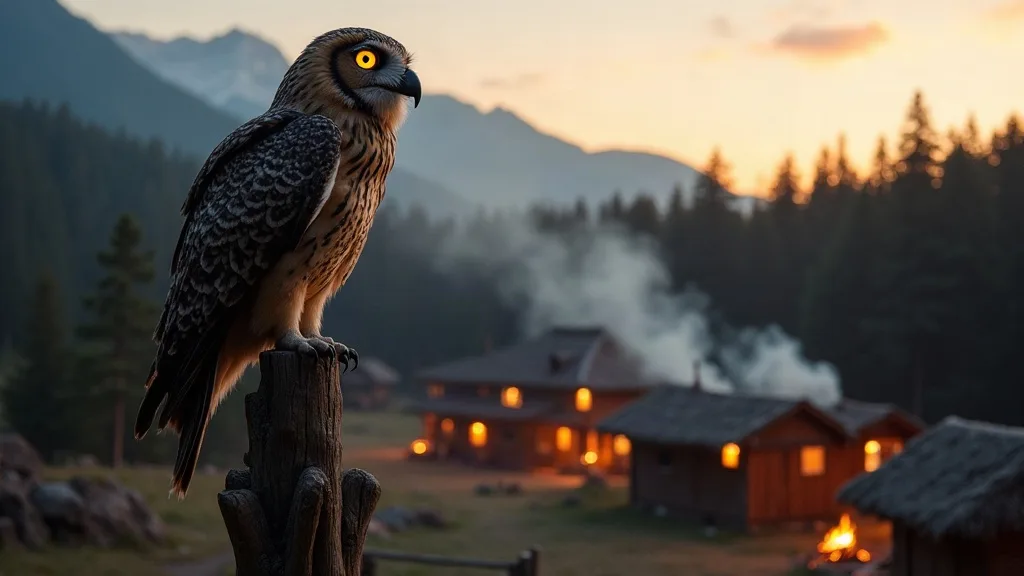
An owl lands on a roofpole in the darkness. Its head swivels. Eyes fixed on the village below. In Ainu cosmology, this is no ordinary bird; it is Kotan Kor Kamuy, the guardian spirit of the settlement itself. While outsiders might see an eagle or a wolf as a natural protector, the Ainu recognized something different: a creature whose very nature suited it for the role of vigilant watcher. The owl's stillness. Its night vision. Its ability to see what humans cannot. These became the signature traits of a kamuy (divine spirit) whose influence shaped how Ainu communities understood safety, order, and the thin boundary between the human village and the wild.
Kotan Kor Kamuy inhabits the space between worlds. Not quite of the human settlement, not fully of the forest, the village guardian owl mediated between these realms in Ainu spiritual practice. To understand this deity is to glimpse how the Ainu imagined their relationship with the natural and supernatural forces that surrounded them.
The Name and Its Meaning
"Kotan" means village or settlement in the Ainu language (Aynu itak). "Kor" refers to a guardian or protector. "Kamuy" is the Ainu term for a spirit, deity, or sacred force. So Kotan Kor Kamuy translates directly as "the guardian spirit of the village." The name itself encodes the deity's function: not a vague supernatural presence, but a specific, protective intelligence tied to human community.
The owl species most associated with this role in Ainu tradition is the shima, the Blakiston's eagle-owl or similar large owl native to Hokkaido and the northern Japanese archipelago. These birds are formidable hunters, active at night, silent in flight. For the Ainu, who lived in close proximity to forest and river, such a creature's prowess was tangible proof of a non-human intelligence worthy of respect. The owl did not need to roar or display vivid plumage; its stealth and effectiveness were authority enough.
Role and Spiritual Function
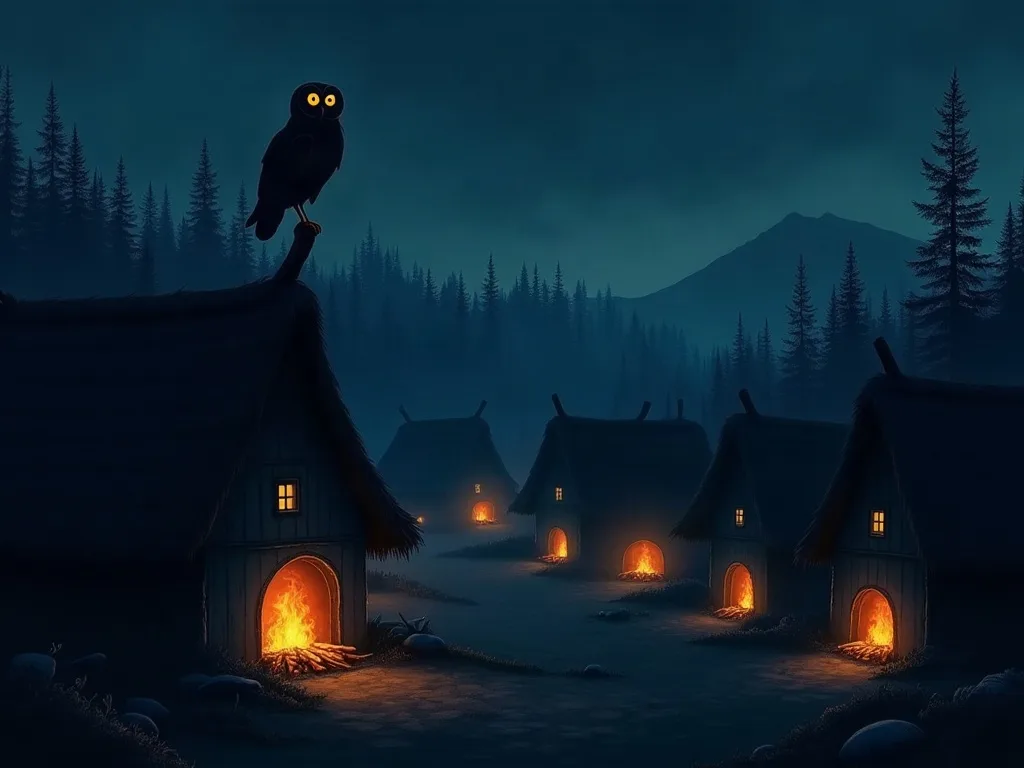
In Ainu religion, kamuy were not distant abstractions. They inhabited specific places and performed specific duties. Kotan Kor Kamuy was understood as resident in the settlement itself, often pictured as perched on the sacred pole (inau) that marked the village boundary or on the central post of a chief's dwelling.
This guardian served several overlapping functions. First, it protected the village from spiritual harm. The Ainu believed that malevolent spirits (wenpe kamuy, or evil spirits) could harm humans, spoil crops, or bring sickness. An alert, watchful presence like the owl was believed to ward off such threats. Second, Kotan Kor Kamuy ensured social order within the settlement. The owl's wisdom and night vision symbolized the ability to see hidden transgressions, to detect discord or wrongdoing that might fester if left undetected. Third, the guardian owl maintained the boundary between the village (a space of order and human culture) and the surrounding wilderness (a space of raw spiritual power and natural forces).
This boundary maintenance was crucial to Ainu survival and cosmology. Villages were not seen as separate from nature but rather as carefully maintained spaces within it. Kotan Kor Kamuy kept that delicate balance.
Relationship to Other Ainu Spirits
Kotan Kor Kamuy did not stand alone in the Ainu spirit pantheon. The Ainu recognized kamuy for different aspects of existence: mountain spirits (nupuri kamuy), sea spirits (unchi kamuy), fire spirits (hi no kamuy), animal spirits for every hunted species, and ancestral spirits (upas).
Compared to these, Kotan Kor Kamuy held a distinctive middle position. Unlike the mountain or sea spirits, which commanded awe and caution, the village guardian was seen as actively invested in human welfare. Unlike animal spirits such as the bear spirit (kimun kamuy), whose interests might conflict with human needs, the owl's protection was aligned with human survival. The Ainu made offerings to Kotan Kor Kamuy alongside other guardians, but the relationship felt less formal, more intimate. This was a spirit that lived at the threshold of the village, not in a distant wilderness.
The guardian owl also connected to shamanic practice. Ainu spiritual practitioners (often women called machi, or shamans) were believed to have special communication with Kotan Kor Kamuy. The owl's nocturnal nature, active when humans slept, seeing in the dark, made it a natural symbol of shamanic knowledge and perception beyond ordinary sight. For a wider view of how Ainu spirituality shaped relationships with powerful animal spirits, see the traditions surrounding Kimun Kamuy, the great mountain bear whose rituals mirror the reciprocal logic governing Kotan Kor Kamuy.
Symbolism and Sacred Imagery
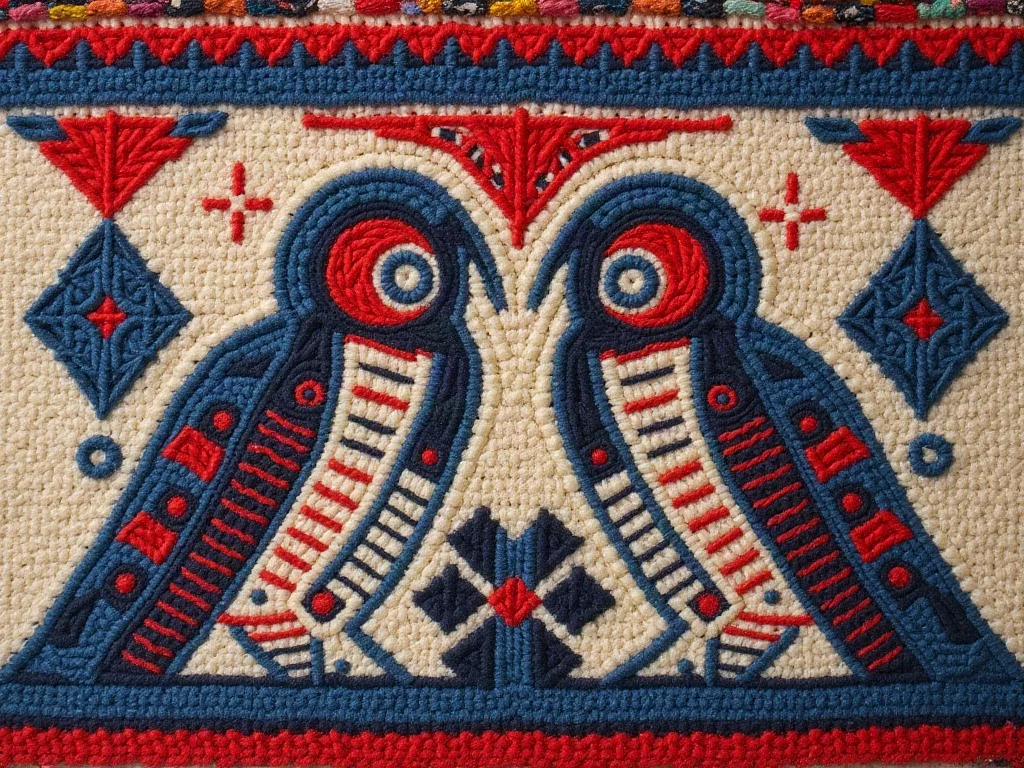
The owl itself carried dense symbolic weight in Ainu culture. Its large round eyes suggested awareness and watchfulness. Its silent flight evoked invisible protective presence. Its ability to turn its head nearly all the way around made it seem to survey everything. In Ainu visual culture, the owl appeared in traditional embroidered patterns (ainu mosir, the sacred land) and in decorative motifs on sacred objects.
The owl was also associated with foreknowledge. In some Ainu tales, an owl's appearance or call preceded significant events: a hunter's lucky day, a visitor's arrival, or danger approaching. This reputation for premonition elevated Kotan Kor Kamuy beyond mere sentry; the spirit was believed to possess insight into coming circumstances.
Rituals and Veneration
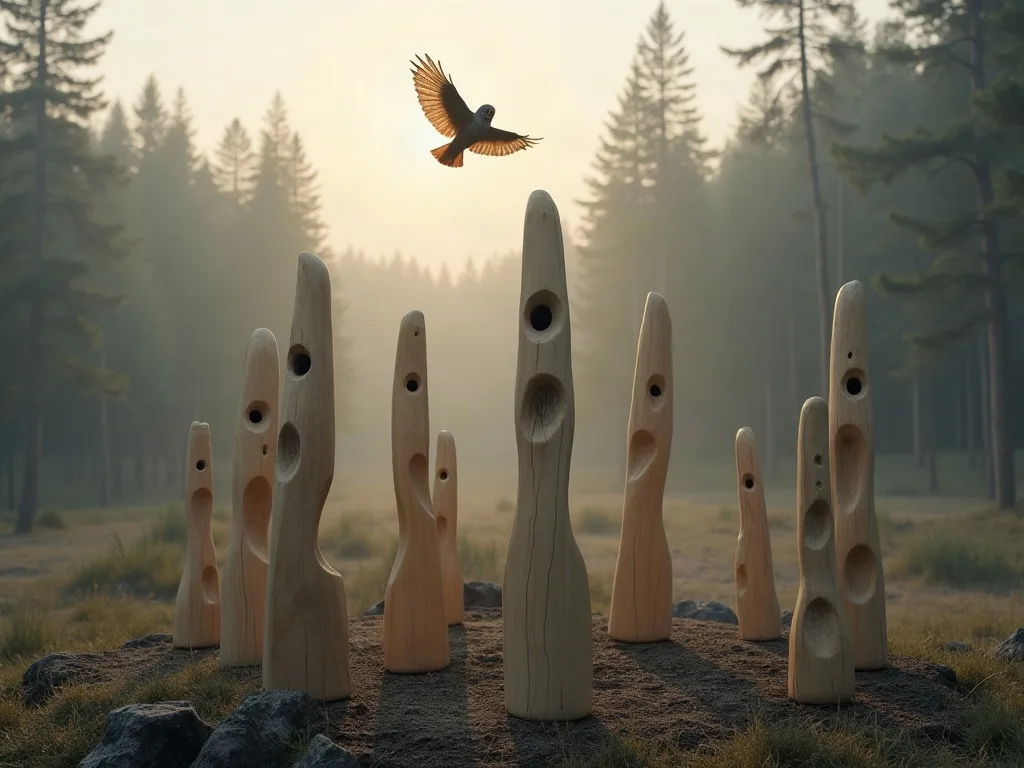
The Ainu did not construct temples to Kotan Kor Kamuy as one might build a shrine to a human ancestor. Instead, veneration took place through daily recognition and seasonal rituals. When a household or settlement needed protection, or simply to acknowledge the guardian's presence, the Ainu would make offerings of inau (wooden prayer sticks carved with spirit vessels), wine, or food, directed toward the space where Kotan Kor Kamuy was believed to reside.
Some villages maintained a yomonte, a sacred ritual ground, where the village's protective spirits were collectively honored. Kotan Kor Kamuy featured in these annual ceremonies. The rhythms of village life (hunts, harvests, births) were framed as undertaken with the guardian's blessing and protection.
When an Ainu family moved to a new settlement or cleared a new village site, one of the first acts was to invite Kotan Kor Kamuy to the new location. This was not conquest of empty space but negotiation with the spirit world: humans would establish their order here, but only with the permission and oversight of the guardian. Failure to show such respect was believed to result in the village's misfortune.
Comparative Echoes Across Indigenous Traditions
Kotan Kor Kamuy represents a widespread pattern in indigenous religions: the village guardian animal. Many cultures developed similar figures. The Germanic peoples honored haus-alb (house spirits), often associated with nocturnal animals. Among the Sámi, spiritual guardians of settlements took animal forms. Quetzalcoatl, the great feathered serpent of Mesoamerican tradition, served a protective function in the founding of cities. Across the Pacific, Japanese religious traditions developed their own protective spirits for settlements, a pattern discussed further in the myths surrounding Inari Okami, the fox deity whose guardianship of communities shares striking structural similarities with Ainu owl veneration.
What distinguished Kotan Kor Kamuy was the specific match between the owl's nature and the role it performed. The owl's actual hunting prowess, intelligence, and nocturnal alertness made it more than a symbolic choice; it was a spirit whose real-world behavior backed up its spiritual function.
The Ainu World and Its Divine Structure
To fully grasp Kotan Kor Kamuy, one must understand how the Ainu imagined the cosmos. The Ainu recognized a layered world. Above existed kamuy mosir, the land of the gods. Humans inhabited the middle realm. Below lay another realm of spirits. Humans were never truly separate from these layers; every object, animal, and natural phenomenon could be inhabited by a kamuy. What mattered was maintaining right relationships with these spirits through respect, offering, and restraint.
The Ainu developed sophisticated oral traditions preserved in yukar (traditional narrative poems) and uwepeker (prose stories). These narratives were not told for entertainment alone; they transmitted ethical and practical knowledge about how to live rightly in a world saturated with spiritual presences. A striking example survives in the ethnographic collections assembled by Bronislaw Pilsudski in the early twentieth century: a yukar recited by the Sakhalin Ainu elder Husko, in which an owl-spirit addresses a village directly, announcing its nightly rounds and warning that any household showing disrespect to the kamuy will find its hearth-fire cold by morning. The poem is short but precise. The owl names the roofpole it stands on, the smell of the offering wine left below, the sound of sleeping children. It is less a hymn than a report from a sentry. Kotan Kor Kamuy, though less prominent in surviving texts than the bear or the sea spirit, appeared in stories like this that reinforced the importance of village cohesion and orderly community life.
Spiritual Continuity and Modern Understanding
The Ainu people faced centuries of pressure from Japanese expansion, cultural suppression, and economic transformation. Many traditional practices declined. Yet Ainu cultural revival in the 20th and 21st centuries has brought renewed interest in figures like Kotan Kor Kamuy. Contemporary Ainu scholars and spiritual practitioners have worked to document and preserve knowledge about village guardians and other aspects of traditional cosmology.
Today, Kotan Kor Kamuy appears in academic studies of Ainu religion, in community gatherings devoted to reviving Ainu traditions, and in creative works (literature, visual art) that draw on Ainu mythology. The figure speaks to something universal: the human desire for invisible protection, for a witness to our deeds, for a spiritual companion that watches over us while we sleep.
The owl itself remains present in Hokkaido and northern regions. Birdwatchers and naturalists encounter the great owls that the Ainu knew. In this sense, Kotan Kor Kamuy is not purely mythological; it is a spirit whose basis in nature remains visible, audible, and real. For a broader look at how indigenous Japanese island cultures blended observation of living nature with spiritual meaning, the traditions of Ryukyuan mythology offer illuminating parallels, particularly in how local animal spirits were assigned protective roles over specific geographic communities.
Distinctive Features of Ainu Spiritual Guardianship
Kotan Kor Kamuy embodies features distinctive to Ainu thought. First, the Ainu did not sharply divide the natural and supernatural; spirits inhabited both realms fluidly. Second, the Ainu focused on relationship and reciprocity rather than hierarchy; gods were partners to be honored, not masters to be feared. Third, Ainu spirituality was deeply ecological; every guardian, including the owl, was tied to actual landscape and animal behavior.
This meant Kotan Kor Kamuy was not an invention of fancy but a spiritual recognition of a real presence: the owl that hunted at night in the forest surrounding the Ainu village, whose piercing eyes and silent flight seemed to manifest an intelligence aligned with human welfare. The Ainu converted observation into reverence.
The Guardian's Gaze
In the deepest sense, Kotan Kor Kamuy represents the Ainu understanding that safety and order are not achieved through isolation but through relationship. A settlement prospered not by building walls against the spirit world but by inviting the most trustworthy spirits, the guardians like the owl, to take residence within its bounds. The guardian's gaze, sweeping the darkness, was the gaze of a community watching over itself with non-human aid. Every owl call in the night was a reminder: you are seen. You are protected. The boundary holds.
Frequently asked questions about Kotan Kor Kamuy
Frequently asked questions
Why did the Ainu choose an owl as the primary village guardian?
The owl's nocturnal hunting prowess, silent flight, and keen vision made it a natural embodiment of vigilance and protective intelligence. For the Ainu, the owl's real-world behavior, its ability to see in darkness and hunt unseen, translated directly into spiritual authority. The match between the creature's actual nature and the protective function created a spirit that felt credible and present.
How did the Ainu honor Kotan Kor Kamuy in daily life?
Veneration was practical and ongoing rather than confined to temples. Families made offerings of inau (carved wooden prayer sticks), food, and wine directed toward the space where the guardian was believed to reside, often the village boundary or a chief's dwelling. Communities incorporated Kotan Kor Kamuy into annual ritual cycles and invited the spirit's presence when establishing new settlements, seeking its blessing and protection.
Did Kotan Kor Kamuy appear in Ainu myths and stories?
While Kotan Kor Kamuy is less prominent in surviving recorded narrative than some other Ainu spirits such as the bear, the guardian owl does appear in traditional stories and oral poetry that emphasize village cohesion and the consequences of spiritual neglect. Bronislaw Pilsudski's early-twentieth-century recordings of Sakhalin Ainu yukar include at least one owl-guardian poem in which the spirit narrates its own nightly watch. The owl's role was woven into the fabric of Ainu life rather than spotlighted in a single founding narrative.
How does Ainu spirituality compare to other indigenous traditions' guardian spirits?
Many cultures developed village or household guardian animals, from Germanic haus-alb to Sámi settlement spirits. Kotan Kor Kamuy is distinctive in how thoroughly it was integrated into daily Ainu life and how closely its spiritual function mirrored the owl's actual ecological role. Ainu religion generally emphasized reciprocal relationship over hierarchy, distinguishing it from traditions with more formal pantheons.
Is Kotan Kor Kamuy still venerated in Ainu communities today?
The Ainu cultural revival has brought renewed interest in traditional spirits and practices, including Kotan Kor Kamuy. Contemporary Ainu scholars and spiritual practitioners have worked to document and preserve knowledge of village guardians. The figure appears in modern Ainu art, literature, and community gatherings devoted to reviving traditional cosmology, signaling its enduring spiritual significance.
The Owl's Vigilance in the Modern Age
The resurgence of interest in Ainu culture has shed new light on figures like Kotan Kor Kamuy. What the Ainu understood intuitively, that a vigilant, intelligent presence watching over a community brings peace, resonates across time and cultural boundaries. In an age of disconnection and anxiety, the image of the guardian owl, silent and constant, offers a different model of protection: one based not on walls or weapons but on relationship, presence, and spiritual reciprocity.
The Ainu relationship with Kotan Kor Kamuy reminds us that spirituality arises not from abstraction but from close observation of the living world. The owl is real. Its vigilance is real. Its alignment with human welfare, as the Ainu understood it, transformed a nocturnal hunter into a guardian that inhabited the border between the seen and unseen, protecting the settlement in both realms simultaneously.
Scholars of indigenous religion now use the Ainu model of the village guardian to ask broader questions: when does a culture's ecological knowledge cross into theological recognition? At what point does a community, living closely enough with an animal to know its habits, begin to perceive in it something beyond instinct, something closer to intention? Kotan Kor Kamuy sits precisely at that threshold. It invites us to take seriously the idea that sustained, respectful attention to the living world can produce genuine spiritual insight, knowledge that is not merely poetic but practically real, tested over generations by people whose survival depended on reading the forest correctly. That is the challenge the owl still sets before us.
Free 25-page sample
Want the whole story?
Take the first 25 pages free. If it pulls you in, the full edition is yours as an instant PDF download, with a paperback on Amazon for selected titles.

Ainu
The Ainu Mythology Book: The Kamuy, the Bear Spirit, and the Sacred World of Hokkaido
The Kamuy, the Bear Spirit, and Hokkaido
The beliefs of the indigenous people of northern Japan: a world where everything (fire, water, owl, and bear) is a kamuy, a god wearing a disguise, who visits the human world as a guest and must be sent home with honor. Preserved in the great epic songs, the yukar.
More from Ainu
All articles
Ainu
The Ainu Creation Story: How the World Rose from the Primordial Sea
Before Japan existed, before humans walked the earth, the Ainu tell of a time when only water and sky collided. Discover how divine beings created the islands, brought forth life, and shaped a world where nature itself is sacred.

Ainu
Repun Kamuy: The Orca God of the Sea
The Ainu revered Repun Kamuy, the orca deity who commands the sea and guides fishers through treacherous waters. Discover how this killer whale god shaped maritime survival, ritual, and the spiritual relationship between the Ainu and the ocean.

Ainu
Inaw: Sacred Wooden Offerings in Ainu Ritual and Spirit Communication
Inaw are carved wooden sticks that carry prayers between the human and spirit worlds in Ainu religion. Learn how these humble offerings bridge the sacred and everyday, and why they remain central to Ainu cultural identity today.

Ainu
Ainu Mosir: The Quiet Land of the Humans
Ainu Mosir is the sacred homeland where humans live in balance with nature and the kami spirits. Discover how the Ainu people understood their island world, its spiritual geography, and the delicate relationship between the seen and unseen realms.