
Ainu Mosir: The Quiet Land of the Humans
Ainu Mosir is the sacred homeland where humans live in balance with nature and the kami spirits. Discover how the Ainu people understood their island world, its spiritual geography, and the delicate relationship between the seen and unseen realms.
Contents
On the northern island of Hokkaido, where rivers wind through ancient forests and mountains rise mist-wrapped from the earth, the Ainu people have lived for thousands of years. They call their homeland Ainu Mosir: the Quiet Land of the Humans. Not a place of human dominion, but a place where humans belong, as one thread in a vast web of living things. The land itself breathes. The mountains, rivers, and forests are alive with kami, the spirits that inhabit every natural thing. To live in Ainu Mosir is not to rule nature but to move through it with respect, asking permission, leaving offerings, understanding that every fish caught, every tree felled, every animal hunted comes with obligation.
This is a geography unlike the imperial landscapes of other mythologies. There are no grand temples built by gods, no cosmic battles carved into mountainsides. Instead, Ainu Mosir is intimate, quiet, layered with meaning that only reveals itself to those who watch. A river is both a place to fish and the home of a water spirit. A mountain is both an obstacle and a sacred presence. An old tree is both shelter and ancestor. This is how the Ainu have always read their world.
Geography of the Spirit World
Ainu Mosir encompasses not just the visible island of Hokkaido, but the entire spiritual landscape that underlies human experience. In Ainu cosmology, the world is divided into several realms, each visible to those who know how to look. The ordinary human world, where people build houses and hunt and farm, is only one layer. Beneath it and above it are other worlds, equally real, equally inhabited.
The sky realm, rapo (the upper world), is the domain of celestial kami. The sun, moon, and stars are all kami in this tradition, not distant objects but presences that watch over the land. [Chup], the sun goddess, moves across the sky each day, and her journey is one of the great rhythms that orders Ainu time and ritual. The underworld, pokna mosir (the lower world), is the realm of darkness and death, a place humans do not enter while living but where the ancestors dwell and where certain kami maintain their own order.
Between these realms runs Ainu Mosir itself, the middle land where rivers, mountains, forests, and human settlements coexist. The geography is not arbitrary. Certain mountains are especially sacred: their peaks pierce the boundary between worlds, making them thin places where spirits and humans can more easily meet. Certain rivers are highways for kami; to fish them required permission and gift-giving. Certain forests held the bones of ancestors and the homes of older powers that predated human settlement.
The physical landscape of Hokkaido, with its rivers, coastlines, and volcanic peaks, is thus the stage for a spiritual drama that the Ainu have always understood. When they settled regions, they did not simply occupy land; they negotiated with the kami already dwelling there. Every new settlement required ritual introduction, acknowledgment of the spirits already present. To live in Ainu Mosir was to live in constant dialogue.
The Rivers: Highways Between Worlds
In Ainu understanding, rivers are far more than sources of water and food. They are the arteries through which kami travel between the upper and lower worlds. The largest rivers of Hokkaido, especially the Ishikari and Tokoro, were understood as sacred pathways, places where the boundaries between realms grew thin.
The river spirits, wakka-ushim-un-kur (spirits of the waters), governed the salmon and trout that were central to Ainu survival. To fish a river was not simply to take food. It was a transaction. The Ainu fisherman would make offerings before casting his net or hook. He would speak to the spirit of the river, ask permission, explain his need. When he caught a fish, he would thank its spirit for the gift of its body. These practices were not quaint customs but the practical theology of a people who understood that they lived in a territory owned by other powers.
This spiritual geography shaped Ainu settlement patterns and trade routes. Certain rivers were known as the domains of particularly generous or temperamental kami. Fishing grounds were passed down through families not as property but as relationships maintained across generations. An ancestor's skill at placating a river spirit could make that river's waters abundant for his descendants. A family that grew careless, that took without giving, might find the river's bounty withdraw.
The most sacred rivers were those that descended from volcanic mountains, carrying water that had passed through the peaks where sky and earth touched. These waters were thought to carry especially potent blessing and danger. The most important rituals of the Ainu year, the Iyomainte (the sending-off of spirits), often involved offerings made at river mouths, where the water returned to the sea and its sacred cycle completed.
Mountains as Anchors Between Worlds
The mountains of Hokkaido are the visible roots of Ainu Mosir. They anchor the land and connect it to the realms above. Certain peaks were understood as the homes of particularly powerful kami. Mount Asahi, Mount Akan, and Mount Daisetsu were not merely geographical features but presences with personality, history, and spiritual authority.
Ainu elders taught that mountains were the oldest inhabitants of the land, present before humans arrived. The kami of the mountains had seen seasons turn, had watched forests grow and burn and grow again. They deserved particular reverence. Climbing a mountain required ritual preparation. A hunter ascending a peak would leave offerings at the base, would speak prayers at key points along the path, would listen for signs of the mountain's mood. A mountain could be kind or dangerous; its kindness could not be taken for granted.
In Ainu narrative tradition, mountains sometimes speak. The yukar (traditional songs and stories) contain accounts of humans meeting mountain spirits at high elevations, moments when the ordinary rules of the world grew loose and conversation between realms became possible. These were not random fairy tales but teachings about how to read the landscape, how to understand the signs that indicated the mountain's presence and will.
The volcanic mountains held particular significance. The fire that emerged from them was understood as a manifestation of deep earth powers, kami that dwelt below the human realm. Volcanic activity was not a natural disaster to be explained by geological force but a message from below, a sign that something was shifting in the deep powers that held the land. After eruptions, special rituals of purification and propitiation were necessary to restore balance.
Forests: The Old Owners
The forests of Hokkaido, before industrial logging transformed them, were ancient and dense. The Ainu understood forests not as resources to be harvested but as kingdoms with their own order. Trees had spirits. Particularly old trees, those that had stood for centuries, were homes to powerful kami. To fell a great tree required ritual. You did not simply cut and burn. You asked the tree's spirit for permission, explained your need, made offerings of gratitude and apology.
Forests were also the domain of the [Okuri-inu-like] creatures and other beings that belonged to no human settlement. The deep forest, the untouched heart far from villages, was a place where the boundary between worlds grew permeable. Hunters who ventured too far into the forest without proper ritual preparation could find themselves lost in time, emerging days later to discover that years had passed, or worse, not emerging at all. The forest could open or close its paths depending on the mood of its masters.
Specific trees held particular significance in Ainu ritual and daily life. The inaw (carved wooden stick), the central object of Ainu ceremony, was made from willow wood. The willow tree was understood as a bridge between worlds, its slender branches reaching toward the sky while its roots gripped the earth. When an inaw was carved, the tree's spirit was invoked to carry prayers and offerings upward toward the kami realm.
Forest burning was used in Ainu land management, but not as destruction. Controlled burns cleared underbrush, promoted the growth of new plants that deer and other game animals fed upon, and maintained open groves where hunting was easier. This too was a form of dialogue with the forest, a way of shaping the landscape while respecting its essential nature.
The Sea: Border and Highway
To the east and west of Hokkaido stretch the waters of the Pacific and the Japan Sea. For the Ainu, these were not distant phenomena but intimate parts of their world. Coastal Ainu communities fished the waters, hunted sea mammals, and understood the ocean as both provider and danger. The sea had its own kami, its own moods and powers.
The currents and tides were read as signs of the sea's will. Certain times were safe for boats; others were forbidden. Shipwreck was not mere accident but a sign that an offering or protocol had been overlooked, that the sea spirit required acknowledgment. Stories of sea spirits, particularly the suiko (water demon), taught caution and respect. These beings were not evil but powerful and easily provoked by human carelessness.
Ainu trade networks extended by sea. Routes to the [Ryukyu Islands] and to the Ainu settlements on Sakhalin were understood through this spiritual geography as well as practical geography. A successful trading voyage was one in which the sea kami allowed safe passage. Merchants and hunters made offerings at coastal shrines before embarking, and again upon safe return.
Settlements and the Order of Human Space
When the Ainu built settlements, they did so with conscious ritual purpose. A village was not merely a collection of houses but a structured space that reflected Ainu understanding of how humans should live within Ainu Mosir.
Villages were typically built near rivers or coasts, where food was abundant, but never too close to wild space. There was a carefully maintained boundary between human settlement and the wild territories where kami held primary authority. The boundary was often marked by inaw and other sacred objects, visible reminders that beyond this line, humans were guests in another's territory.
Within the village, the chise (house) was the basic unit. Each house had its own kami, its own spiritual presence. The hearth at the center of the house was a sacred space where offerings were made and prayers spoken. The northeast corner of the house held particular spiritual significance; the kamuy-huci (goddess of the hearth), the most important kami of the household, dwelt there in smoke that rose toward the sky realm.
The architecture of the village itself reflected cosmological principles. The tusmore (a structure for drying meat and fish) might be positioned to align with sacred directions. The layout of houses followed principles of harmony with natural features; builders would read the land, looking for places already blessed by kami, already balanced in their spiritual charge.
Sacred Sites and Thin Places
Certain locations within Ainu Mosir held particular spiritual intensity. These were places where humans most readily encountered kami, where the boundary between realms was most permeable.
Hot springs were understood as direct communication with earth kami, places where the deep heat rose from below. To bathe in a hot spring was not merely to cleanse the body but to be touched by the power dwelling beneath the surface. Some hot springs had reputations for healing; others were thought to be the homes of dangerous spirits. Elders would instruct youth about which springs could be approached and which should be avoided.
Waterfalls, particularly large ones where the water fell with great force and created mist, were also thin places. The power and noise of falling water was understood as the voice of the water kami, a visible manifestation of spiritual presence. Hunters and healers would sometimes make pilgrimage to waterfalls to receive visions or to seek the blessing of particularly powerful spirits.
Caves held their own significance, particularly caves near the sea or at the base of mountains. They were understood as gateways to the lower world, places where the dead might still dwell, places where powerful kami might be encountered. Cave shrines, with offerings left in the darkness, represented human respect for mysteries that did not fully belong to the visible world.
The Seasonal Cycle and Ritual Geography
The year in Ainu Mosir was marked not by arbitrary calendar divisions but by the movements of kami and the cycles of nature. Spring brought the return of salmon to the rivers; summer was the season of hunting sea mammals and gathering plants; autumn meant preparing for winter by fishing and hunting intensively; winter was a time of indoor work, storytelling, and spiritual practice.
Each season brought appropriate rituals. The Iyomainte, the grand sending-off of spirits, was performed in spring and autumn to honor the salmon and bear respectively. These were not casual hunts but sacred transactions in which the animal's spirit was honored, thanked, and sent back to report to its parent kami in the spirit realm. Only through proper ritual could hunting continue to be fruitful.
The geography shifted with season as well. In summer, certain mountain passes became traversable; in winter, they closed. Rivers that were highways in spring became dangerous torrents. The Ainu calendar was a geography of seasonal opportunity and restriction, a way of reading the land that reflected the movement of kami through different realms.
The Relationship Between Seen and Unseen
Ainu Mosir is ultimately a place where the visible and invisible are understood as equally real, equally present. What separates them is not a rigid wall but a permeable boundary that skilled and respectful humans could learn to perceive and navigate.
The yukar, the traditional songs that preserved Ainu knowledge, were understood as accounts of these crossings. In a yukar, a hunter might encounter an old woman who is revealed to be a bear spirit; a beautiful woman in the forest might be a spirit test of a man's faithfulness to his wife. These were not fantasies but real possibilities, descriptions of how the world actually worked for those with eyes to see.
Shamanic specialists, called tusker or wise elders, were people who had developed particular skill in perceiving and communicating with kami. They could diagnose illness caused by spiritual imbalance, could perform rituals to restore harmony, could speak with the spirits of the dead. Their power was not magical coercion but earned through study, vision quests, and demonstrated respect for the spirits they worked with.
The Modern Echo and Spiritual Geography Today
For centuries after Japanese settlement intensified in the 19th and 20th centuries, Ainu Mosir as a spiritual geography was actively suppressed. Sacred mountains were renamed in Japanese. Rivers were damned. Forests were logged. The rituals and knowledge systems that maintained the relationship between humans and kami were discouraged or forbidden.
Yet the concept has endured. In recent decades, as Ainu cultural recognition has grown, the idea of Ainu Mosir has returned as both a historical memory and an active spiritual practice. Contemporary Ainu activists, artists, and spiritual leaders speak of reclaiming Ainu Mosir not as a nostalgic return to a lost past but as a living geography that can be honored and inhabited today, even within modern Japan.
The sacred sites of Hokkaido, the mountains and rivers and waterfalls, continue to hold their spiritual charge for those who approach them with the old respect. The kami have not left. Ainu Mosir remains, quiet and patient, awaiting those who remember how to listen.
Frequently asked questions about Ainu Mosir?
Frequently asked questions
What does Ainu Mosir literally mean?
Ainu Mosir translates directly as "the land of the Ainu" or "the Quiet Land of the Humans." Mosir is the Ainu word for earth or land. In Ainu belief, it referred specifically to Hokkaido and the territories where Ainu people lived, but understood as a sacred, spirit-inhabited geography rather than merely a physical location.
How did the Ainu understand the spirits living in Ainu Mosir?
The Ainu believed every natural thing possessed a spirit, or kami: mountains, rivers, trees, animals, even the hearth fire. These spirits were not personifications but actual presences with agency and will. Humans existed in a relationship of mutual obligation with these kami, taking only with permission and gratitude, offering gifts and ritual acknowledgment in return.
What role did ritual play in living within Ainu Mosir?
Ritual was the language of relationship between humans and kami. The inaw (carved stick), offerings of food and wine, and the great seasonal ceremonies like the Iyomainte (bear-sending festival) were not separate from daily life but woven through it. Without these rituals, the Ainu believed the kami would withdraw their blessing and the land would become barren or dangerous.
Are there specific mountains or rivers considered especially sacred in Ainu tradition?
Yes. Mount Daisetsu, Mount Akan, and Mount Asahi were particularly revered as homes of powerful kami. The Ishikari and Tokoro rivers were understood as major pathways for spirits. The Shiretoko Peninsula, with its waterfalls and caves, was a major sacred site. These locations were pilgrimage destinations for hunters and those seeking spiritual blessing or healing.
How did Ainu Mosir cosmology differ from other mythological systems?
Unlike empires of the Greek gods or the hierarchies of Hindu mythology, Ainu cosmology emphasized balance and coexistence rather than dominion. There was no creation myth of humans ruling nature, no temples built to glorify gods. Instead, humans were woven into a landscape of other powers, living as respectful guests in a kingdom of spirits. The sacred was intimate and local, not distant and cosmic.
Has the concept of Ainu Mosir survived into the modern era?
Despite centuries of suppression, Ainu Mosir has endured as both historical memory and living spiritual practice. Contemporary Ainu communities, particularly in Hokkaido, have begun reclaiming and revitalizing the concept as a way of honoring ancestral knowledge and maintaining a spiritual relationship with the land even within modern Japan.
The Enduring Presence of Sacred Geography
Ainu Mosir invites a radically different way of reading land. It asks us to see rivers as relatives, mountains as elders, forests as neighbors with their own authority. In a time when many people live disconnected from the geography they inhabit, the Ainu model offers an alternative: not ownership, but relationship; not extraction, but reciprocal exchange; not dominion, but hospitality in a land that was never ours to begin with.
The mountains of Hokkaido still rise. The rivers still flow. The old forests, though diminished, still stand. For those who remember how to look, Ainu Mosir is still there, quiet and patient, a living geography waiting for those who approach with the old respect.
Free 25-page sample
Want the whole story?
Take the first 25 pages free. If it pulls you in, the full edition is yours as an instant PDF download, with a paperback on Amazon for selected titles.
Ainu
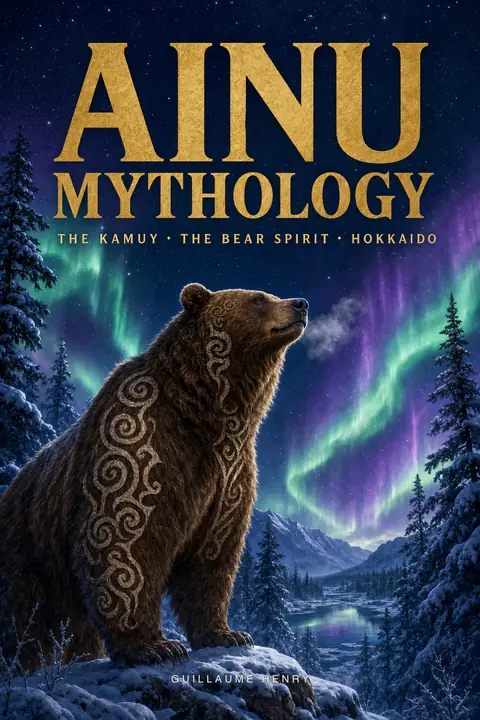
The Ainu Mythology Book: The Kamuy, the Bear Spirit, and the Sacred World of Hokkaido
The Kamuy, the Bear Spirit, and Hokkaido
The beliefs of the indigenous people of northern Japan: a world where everything (fire, water, owl, and bear) is a kamuy, a god wearing a disguise, who visits the human world as a guest and must be sent home with honor. Preserved in the great epic songs, the yukar.
More from Ainu
All articles
Ainu
The Ainu Creation Story: How the World Rose from the Primordial Sea
Before Japan existed, before humans walked the earth, the Ainu tell of a time when only water and sky collided. Discover how divine beings created the islands, brought forth life, and shaped a world where nature itself is sacred.

Ainu
Repun Kamuy: The Orca God of the Sea
The Ainu revered Repun Kamuy, the orca deity who commands the sea and guides fishers through treacherous waters. Discover how this killer whale god shaped maritime survival, ritual, and the spiritual relationship between the Ainu and the ocean.

Ainu
Inaw: Sacred Wooden Offerings in Ainu Ritual and Spirit Communication
Inaw are carved wooden sticks that carry prayers between the human and spirit worlds in Ainu religion. Learn how these humble offerings bridge the sacred and everyday, and why they remain central to Ainu cultural identity today.
Ainu
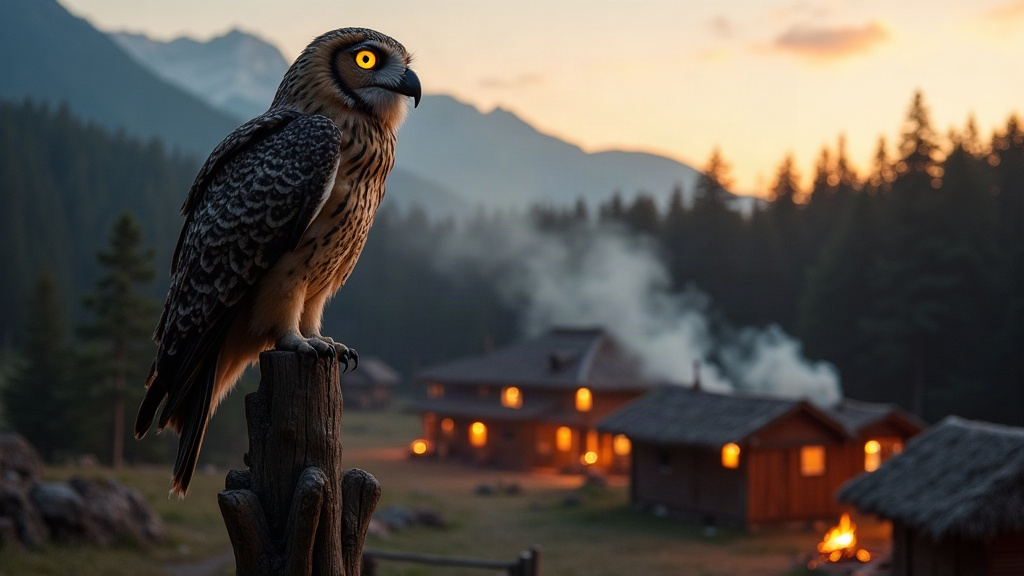
Kotan Kor Kamuy: The Village Guardian Owl
Meet Kotan Kor Kamuy, the watchful owl spirit who guards Ainu villages from harm. In Ainu belief, this kamuy oversees human settlements and stands as protector of community bonds. Discover how a vigilant nocturnal hunter became one of the Ainu peoples' most trusted spiritual guardians.