
Yukar: The Ainu Epic Tradition
Yukar are the great sung epics of the Ainu people of northern Japan, carrying the voices of gods, heroes, and bears across centuries of oral tradition. Here is what they say, and why they still matter.
Contents
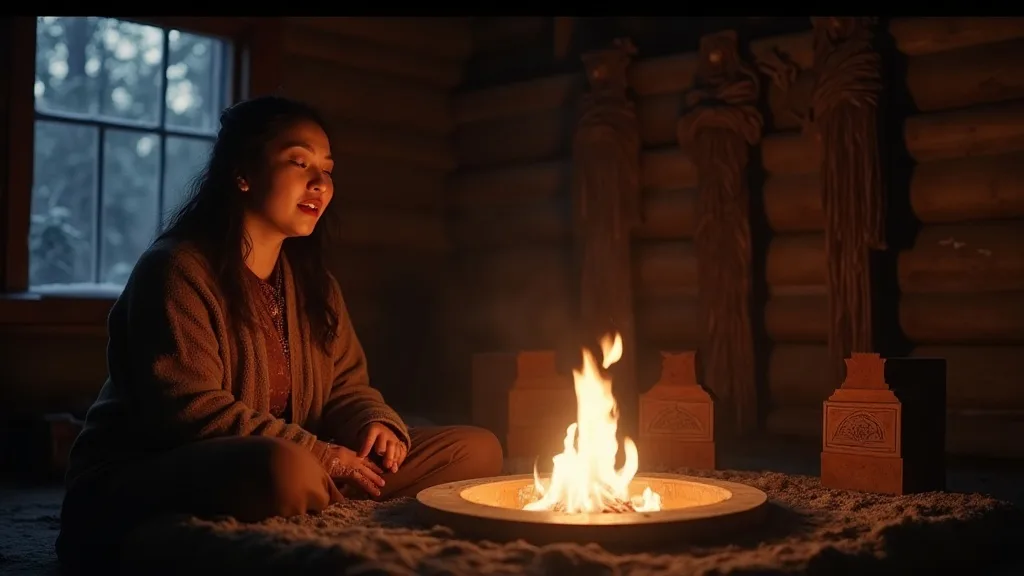
A fire burns low in a pit-house on Hokkaido. Outside, snow presses against the walls. Inside, a woman begins to sing, her voice rising and falling in a pattern that is neither speech nor ordinary song. She is performing yukar, and the story she carries has been memorized word for word from her grandmother, who learned it from hers. The deity speaking through her voice has not been silent for a long time.
Yukar: The Ainu Epic Tradition sits at the center of one of the richest oral literatures ever produced in East Asia. These are long, metrical sung narratives composed and transmitted by the Ainu people, the indigenous inhabitants of Hokkaido, the Kuril Islands, and Sakhalin. They are not casual folktales. Each yukar can run for hours, sometimes for a full night, performed from memory by a trained singer who rocks gently back and forth, eyes half-closed, keeping time with a rhythm stick against a wooden plank.
What makes yukar extraordinary is not just their age. It is the architecture of a whole cosmology built inside them: a world where gods called kamuy (divine spirits) descend to earth disguised as animals, where human heroes negotiate with the spirit realm through ritual and courage, and where the act of singing is itself a sacred transaction between the living and the unseen.
What Yukar Are: Form, Structure, and Performance
The word yukar comes from an Ainu verb meaning "to recite" or "to imitate." Scholars of Ainu literature, including Bronisław Piłsudski, the Polish ethnographer who recorded Ainu oral texts in the early 1900s, and Neil Gordon Munro, a Scottish physician who lived among the Ainu for decades, noted that the genre encompasses several sub-categories. The broadest division separates kamuy yukar (divine epics, narrated in the first person by a deity) from yukar proper (hero epics, narrated by a human or semi-divine warrior).
In kamuy yukar, the singer effectively becomes the voice of a god. An owl deity, a salmon deity, or a bear deity speaks directly: "I am the owl, guardian of the village." This first-person divine speech is unusual in world epic traditions, where gods typically appear as characters observed from outside. The Ainu convention collapses the distance between narrator and divine subject entirely.
Hero yukar follow a different pattern. A warrior figure, often called Poiyaumpe or Ainu Rakkur, journeys across a geography of named places, confronts enemies, rescues kidnapped women or sacred objects, and returns changed. The narrative echoes the structure of epic traditions elsewhere: the Sumerian Epic of Gilgamesh, the Finnish Kalevala, the Greek Odyssey. But the Ainu hero always operates within a web of obligation to the kamuy. He succeeds not through raw strength alone but through correct ritual behavior: offering prayers, handling killed animals with care, returning bones to the water.
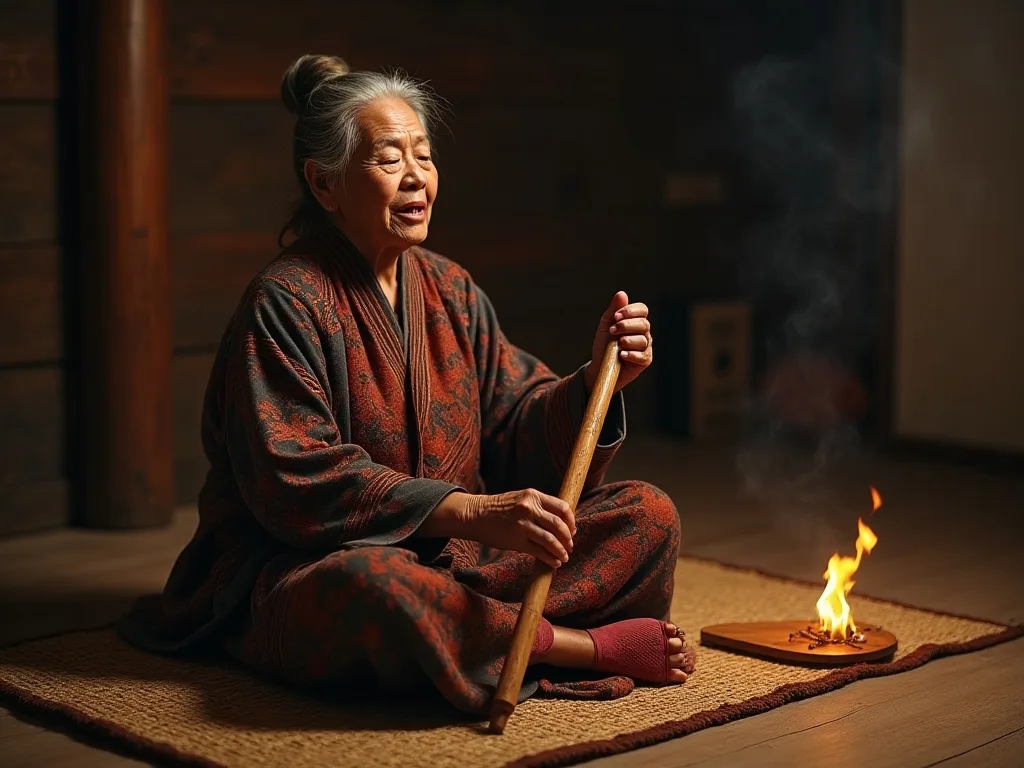
Every performance is structured around a repeated refrain, a short musical phrase called sakorpe or sakor, which punctuates the narrative at regular intervals, much as a chorus punctuates a Greek tragedy. This refrain does two things at once: it gives the singer a moment to breathe and recall the next passage, and it signals to the audience that the story is still unfolding within its sacred frame.
Performances traditionally happened at night, near the sacred window (rorun puyar) that faces east and through which offerings are passed to the kamuy. The singer sat close to the hearth deity, Kamuy Fuchi, the goddess of fire who mediates between the human and spirit worlds. Her presence was not symbolic. She was understood to be listening.
The Kamuy: Gods Wearing Animal Skins
To read yukar without understanding the kamuy is to read without the grammar. The word kamuy describes beings of power who normally live in a realm above or beyond the human world, but who visit earth by wearing bodies: the body of a brown bear, a killer whale, a salmon, a thunder cloud, an epidemic. These disguises are temporary. When a bear is hunted and killed correctly, its spirit removes its animal costume, takes the gifts the hunters have prepared, and returns home wealthy. The hunt is not violence. It is a formal visit.
This logic shapes every yukar that features animals. The bear does not simply appear as an animal character. It appears as a great lord (kamuy translated in many yukar as "god-person") who chose to disguise himself to bring meat and fur to a beloved Ainu community. His death, performed with the right prayers and the right treatment of his bones and skin, is his journey home. The wrong treatment, the breaking of a bone, the failure to say the right words, is an insult that the kamuy will remember and punish.
Kamuy in yukar are not remote, untouchable figures like the Olympian gods of Greece seated far above human affairs. They are intensely interested in humans, capable of love and fury in equal measure, and they communicate not through oracles or prophets but directly through the mouths of yukar singers.
The relationship between the Ainu and their bear god is perhaps the most studied aspect of Ainu religion, partly because of the iyomante, the bear-sending ceremony described in several kamuy yukar, in which a bear cub raised in the village is ceremonially killed and its spirit sent home with gifts. Scholars including Hitoshi Watanabe and Emiko Ohnuki-Tierney have written extensively on how yukar texts illuminate the theological logic of iyomante: the bear kamuy volunteers to die because he wants the gifts, and his willing death is an act of generosity.

The Hero Cycle: Ainu Warriors Between Worlds
The longest and most complex yukar are the hero epics. These center on warriors who exist at the boundary of the human and divine, often because they were born of unusual parentage or were raised by a kamuy in the upper world before being sent down to earth.
One of the most celebrated hero figures is Otasam Unkur, whose adventures span battles with demons called oni (borrowed into Ainu from Japanese contact but transformed into indigenous spiritual enemies), sea crossings, rescues of divine women, and negotiations with kamuy who test his worthiness. The narrative geography of these epics is specific and real: named rivers, named capes, named mountains of Hokkaido and Sakhalin appear constantly, grounding the supernatural in a physical landscape the audience knew from daily life.
The hero's code in yukar is precise. He must:
- Always pray before action, especially before battle or the taking of life.
- Return captured women and sacred objects to their rightful place.
- Never boast. Victory is credited to the kamuy, not the self.
- Treat enemies with the respect due to their spiritual nature, even when killing them.
This code distinguishes Ainu heroism from many warrior traditions. There is no kleos (glory, in the sense Homer uses it), no permanent fame sought for its own sake. The hero acts because the kamuy require it, and his virtue is measured by how carefully he maintains right relationship with the spirit world, not by how many enemies he defeats.
Women play a crucial role in the yukar hero cycle. Female characters, sometimes called Menoko yukar (women's epics), form a parallel sub-genre in which a woman narrates her own journey, her marriage negotiations with a divine figure, her defense of a village, or her punishment and eventual redemption. Bronisław Piłsudski's 1912 transcriptions include several of these, and they show a complexity of female agency that challenges any easy reduction of Ainu oral literature to a male-warrior tradition.
Primary Sources: Who Recorded the Yukar
Oral traditions are always at risk of vanishing without deliberate preservation. For yukar, the rescue came from an unlikely combination of sources.
Piłsudski recorded phonographic cylinders of Ainu songs and narrations on Sakhalin between 1902 and 1905. These recordings, damaged but partially surviving, are among the earliest audio documents of any indigenous oral tradition anywhere in the world. His written transcriptions, translated into Japanese, German, and eventually English, gave scholars the first reliable textual access to the kamuy yukar genre.
Yukie Chiri, an Ainu woman born in 1903, transcribed yukar from memory and from oral recitation by her aunt and other community members before dying of illness at age nineteen. Her 1923 collection, published posthumously as Ainu Shin'yoshu (Collection of Ainu Myths), remains a landmark. Chiri wrote in Japanese but preserved the Ainu-language texts alongside, insisting that the words themselves, not just the content, had to survive.
Kyosuke Kindaichi, a Japanese linguist, spent decades working alongside Ainu performers and produced the most extensive textual archive of hero yukar in the twentieth century. His analysis of the formulaic structure of yukar, the repeated phrases, the set epithets for heroes and kamuy, placed Ainu epic firmly within the comparative study of oral-formulaic composition developed by Milman Parry and Albert Lord for Homeric and South Slavic epic.
The comparison to Homer is not just structural. Both traditions use repeated epithets for major figures. Both use formulaic "type-scenes" (the arming of a warrior, the preparation of a feast, the return home) that recur across different narratives. Both were performed by specialists who could expand or compress passages depending on the audience and occasion. The differences are equally instructive: where Homer's epics were eventually written down by a literate culture that valued fixed text, yukar survived into the twentieth century primarily through living performance by women singers.
The Sacred Geography of Yukar Narratives
One of the least-discussed but most striking features of yukar is their relationship to physical place. The epics are not set in a vague mythological never-land. They unfold across Hokkaido's real capes, rivers, and forests, and across Sakhalin and the Kuril chain. When a hero travels from the Saru River region to the Sea of Okhotsk coast, the audience knew exactly what that journey looked like, how long it took, what weather it brought.
This anchoring has two effects. First, it makes the stories feel immediate and local, owned by the specific communities whose landscapes appear in them. A yukar sung in the Hidaka region might describe the Hidaka mountains in terms that a Sapporo-region version of the same hero cycle would change to reflect its own terrain. The core narrative travels; the geography adapts.
Second, it means that yukar encode geographical and ecological knowledge. Which rivers run with the most salmon. Which mountain passes are dangerous in winter. Which offshore headlands attract killer whales. This knowledge was not incidental. The Ainu economy depended on it, and embedding it in sacred narrative was a way of making sure it was memorized faithfully and passed on correctly.
The Ainu relationship to the natural world runs through every layer of yukar, from the kamuy disguised as animals to the hero who knows the names of specific river mouths. Ecology and theology are not separate categories in this tradition.

Yukar Compared: Echoes Across World Epic Traditions
Placing yukar in comparative perspective is not about ranking traditions. It is about understanding what human oral epic does, and what makes each tradition distinct within that shared form.
Yukar (Ainu)
- First-person narration by kamuy (gods speak as "I")
- Heroes succeed through ritual correctness, not brute strength
- Women's epics (Menoko yukar) form a recognized parallel genre
- Geography is specific: named rivers, capes, mountains of Hokkaido
- Performance by specialist singers, traditionally female
- Preserved largely through 20th-century ethnographic recording
Kalevala (Finnish)
- Third-person omniscient narration predominates
- Heroes succeed through magical knowledge (runo-singing as power)
- Female characters central but not narrators in their own right
- Geography anchored to Finnish Karelia and a mythical "Northland"
- Performed by laulaja (singers), often in pairs in a call-response style
- Compiled into written form by Elias Lönnrot in 1835 and 1849
The Finnish Kalevala comparison is instructive because both traditions belong to circumpolar cultural zones where shamanic cosmology, animal-spirit relationships, and an intensely local geography shape the epic imagination. Both use formulaic repetition as a structural spine. Both survived into modernity through a combination of dedicated individual collectors and community memory.
The yukar tradition also echoes aspects of the Japanese Kojiki, the eighth-century chronicle of Japanese mythology, in its treatment of descent narratives: divine beings who come down to earth, take on mortal form, and then return. But where the Kojiki was written by an imperial court to consolidate political authority, yukar remained stubbornly oral and communal, shaped by and for the people who lived with the Hokkaido landscape, not by state power.
In the wider Pacific, yukar shares structural features with the oral traditions of indigenous Siberian peoples, particularly the Yakut olonkho epic cycle, which also uses a three-tiered cosmology (upper world, middle earth, lower world) and first-person divine speech. The circumpolar cultural sphere that stretches from Siberia through Sakhalin into Hokkaido is visible in the shared formal choices of these traditions, even when the specific content diverges sharply.
The Near-Extinction and Revival of Yukar
By the mid-twentieth century, yukar was in severe danger. The Meiji-era Japanese government (1868 onward) had suppressed Ainu language and culture as part of a broader assimilation policy. Ainu children were forbidden to speak their language in schools. Ritual practices associated with yukar performance were disrupted. The specialist singers, many of them elderly women, died without passing on their full repertoires.
What survived did so through the work of individual collectors and the stubborn memory of a small number of performers. Nabesawa Kan, one of the last great yukar specialists of the Hidaka region, performed and transmitted texts into the 1970s. Her performances were recorded and transcribed by Japanese and Ainu scholars working in the new cultural-preservation movement that gathered force after World War II.
The legal and political situation changed slowly. Japan officially recognized the Ainu as indigenous people only in 2019, a shift that opened new possibilities for cultural support and language education. The Upopoy National Ainu Museum, opened in Hokkaido in 2020, places yukar at the center of its permanent collection, with recordings, transcriptions, and live performance events that bring the tradition to new audiences.
Young Ainu performers are now learning to sing kamuy yukar from transcriptions and recordings as well as from living elders. The transmission chain was broken in places, but it was not entirely severed. The reconstruction is imperfect and honest about its imperfections. Performers acknowledge when a passage comes from a written source rather than direct oral transmission. That honesty is itself part of the Ainu ethical tradition that runs through yukar: say what is true, give credit where it is due, do not claim more than you know.
Frequently Asked Questions About Yukar: The Ainu Epic Tradition
Frequently asked questions
What language are yukar performed in, and can non-Ainu speakers access them?
Yukar are performed in the Ainu language, an isolate with no proven relatives among any other language family. Ainu is classified as critically endangered, with very few fully fluent native speakers remaining. Translations exist in Japanese (most extensively), and a smaller number of English translations and analyses are available in academic publications. Bronisław Piłsudski's early transcriptions have been partially translated into English. Donald Philippi's 1979 book "Songs of Gods, Songs of Humans" remains one of the most accessible English-language introductions, presenting translated kamuy yukar with scholarly commentary.
How long can a single yukar performance last?
The shortest kamuy yukar last around twenty minutes. The longest hero yukar can continue for an entire night, sometimes over multiple nights for especially complex cycles. Kyosuke Kindaichi documented performances lasting six to eight hours. The singer performs from memory, aided by the rhythmic refrain that structures each episode, but there is no written script. Length varied depending on the singer's repertoire, the occasion, and the audience.
Were yukar always performed by women, or could men perform them too?
Historically, both men and women performed yukar, but there was a strong association between women and the kamuy yukar (divine epics), while men more often performed hero yukar. By the twentieth century, the most celebrated and prolific performers on record were women, partly because women maintained the tradition more tenaciously through the period of cultural suppression. Yukie Chiri's aunt, from whom she transcribed many texts, was a woman of exceptional memory. The female-singing association is real but not absolute, and recent revival efforts involve performers of all genders.
What is the relationship between yukar and shamanism?
Yukar performance shares several features with shamanic practice in the broader circumpolar sense: the singer enters a focused, semi-trance state; the first-person voice of a deity speaks through the human performer; the performance takes place in ritually structured space near the sacred hearth. However, Ainu religious specialists called tusukur (shamans who practice spirit-mediumship) are distinct from yukar singers. Not every yukar singer was a tusukur. The performances are related to shamanic cosmology without being shamanic ritual in the strict sense, a distinction that Ainu scholars including Emiko Ohnuki-Tierney have been careful to maintain.
Are there written versions of the original Ainu-language yukar texts?
Yes, though the written record is incomplete. Yukie Chiri's 1923 Ainu Shin'yoshu preserves both Ainu-language texts and Japanese translations. Kindaichi's multi-volume transcription project, produced across the mid-twentieth century, is the largest single archive. The National Ainu Museum in Hokkaido now maintains a digital archive that makes recordings and transcriptions accessible to researchers and Ainu community members. The challenge is that written transcription can only partially capture the melodic and rhythmic dimensions that are inseparable from yukar as a living form.
Yukar in the Twenty-First Century: A Living Tradition Under Reconstruction
The word "revival" can be misleading when applied to yukar. It implies something dead being brought back. What is happening is more complicated and more interesting. The tradition never fully stopped. It went quiet in some communities, survived at reduced intensity in others, and is now being actively rebuilt using the recordings and transcriptions that the early ethnographers, often working against the wishes of assimilationist governments, had the foresight to make.
The tension in this rebuilding is real and productive. When a young Ainu singer learns a kamuy yukar from a recording made in 1965, she is learning something genuine. She is also doing something different from what her great-grandmother did when she learned the same passage from the woman who slept beside her. Neither version is false. Both are part of what oral tradition actually is: a process of continuous transmission that adapts to the conditions of each generation.
Yukar are also finding new audiences through digital platforms. Recordings hosted by the Upopoy National Ainu Museum and by Hokkaido University's Ainu-language archive are now accessible online. Academic projects in Japan, the United States, and Europe are producing new translations and comparative analyses. Ainu-language education programs are teaching children the formulaic phrases that form the building blocks of yukar performance, starting the transmission chain again at the beginning.
What these epics carry cannot be replaced by any summary. The voice of an owl kamuy speaking in first person, the precise name of the river where a hero's sword was forged, the refrain that marks each turn of the story: these are not decorations around a core meaning. They are the meaning. The kamuy speak through the words themselves, and the words have been kept, against considerable odds, alive.
Free 25-page sample
Want the whole story?
Take the first 25 pages free. If it pulls you in, the full edition is yours as an instant PDF download, with a paperback on Amazon for selected titles.

Ainu
The Ainu Mythology Book: The Kamuy, the Bear Spirit, and the Sacred World of Hokkaido
The Kamuy, the Bear Spirit, and Hokkaido
The beliefs of the indigenous people of northern Japan: a world where everything (fire, water, owl, and bear) is a kamuy, a god wearing a disguise, who visits the human world as a guest and must be sent home with honor. Preserved in the great epic songs, the yukar.
More from Ainu
All articles
Ainu
The Ainu Creation Story: How the World Rose from the Primordial Sea
Before Japan existed, before humans walked the earth, the Ainu tell of a time when only water and sky collided. Discover how divine beings created the islands, brought forth life, and shaped a world where nature itself is sacred.

Ainu
Repun Kamuy: The Orca God of the Sea
The Ainu revered Repun Kamuy, the orca deity who commands the sea and guides fishers through treacherous waters. Discover how this killer whale god shaped maritime survival, ritual, and the spiritual relationship between the Ainu and the ocean.

Ainu
Inaw: Sacred Wooden Offerings in Ainu Ritual and Spirit Communication
Inaw are carved wooden sticks that carry prayers between the human and spirit worlds in Ainu religion. Learn how these humble offerings bridge the sacred and everyday, and why they remain central to Ainu cultural identity today.

Ainu
Kotan Kor Kamuy: The Village Guardian Owl
Meet Kotan Kor Kamuy, the watchful owl spirit who guards Ainu villages from harm. In Ainu belief, this kamuy oversees human settlements and stands as protector of community bonds. Discover how a vigilant nocturnal hunter became one of the Ainu peoples' most trusted spiritual guardians.