
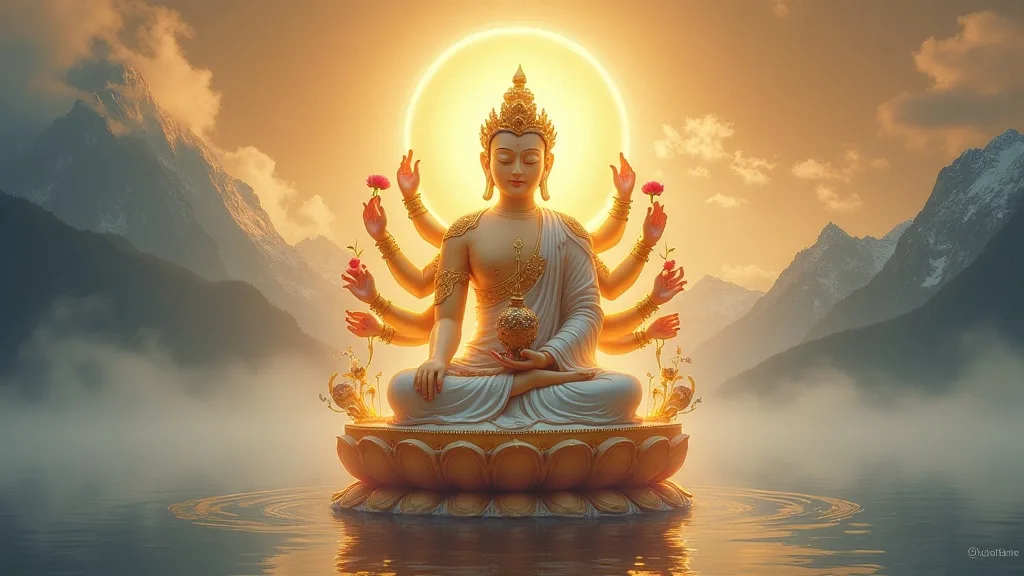
Avalokiteshvara: The Bodhisattva of Infinite Compassion
Avalokiteshvara hears every cry of suffering in the universe and answers. Across Buddhism's vast geography, this bodhisattva takes a thousand forms to bring beings to the shore of liberation.
Contents
The sound began as a whisper from the farthest edge of the cosmos. A child lost in fire, a sailor swallowed by a storm, a prisoner whose chains had no key. Each cry, no matter how small, reached the same pair of ears. A figure turned. And the world, even at its worst, was not entirely alone.
That figure is Avalokiteshvara: the Bodhisattva of Infinite Compassion, the being who looks down upon the world with perfect, inexhaustible care. No other figure in Buddhist tradition has spread as widely, transformed as dramatically, or been loved as personally. From a Sanskrit teaching text written around the second century CE, Avalokiteshvara grew into one of the most recognisable spiritual presences in Asia, taking root in India, China, Japan, Korea, Tibet, Sri Lanka, and Southeast Asia, each region shaping the deity anew without ever breaking the original promise: no cry goes unheard.
Before the first heading, that promise is worth holding for a moment. Avalokiteshvara is not a god who rewards the virtuous and ignores the rest. The compassion here is structural, built into the name. Avalokita means "one who looks" or "one who looks down upon," and ishvara means "lord" or "sovereign." Put together: the Lord Who Looks Down Upon the World. Some scholars, following the Tibetan translation Chenrezig, read the name slightly differently as "one who sees with unobstructed vision." Either reading points to the same reality: a being whose gaze never flinches from suffering.
Origins in the Mahayana Tradition
The earliest clear reference to Avalokiteshvara appears in the Lotus Sutra (Sanskrit: Saddharma Pundarika Sutra), a foundational Mahayana Buddhist scripture that scholars date to somewhere between 100 BCE and 200 CE. The twenty-fifth chapter, known separately as the Guanyin Sutra or the "Universal Gateway" chapter, is dedicated entirely to Avalokiteshvara's power to respond to suffering. The text lists thirty-three forms the bodhisattva can take to reach those in need: a monk, a king, a woman, a child, a dragon, a god. The form does not matter. What matters is matching the appearance that each being can actually receive.
This chapter circulated independently throughout Asia almost immediately, which tells you something about how urgently people needed what it offered. The Lotus Sutra as a whole is a vast, ambitious text, but chapter twenty-five found its own life, translated and copied thousands of times before printing existed.
The Mahayana school of Buddhism, in contrast to earlier traditions, placed great emphasis on the bodhisattva ideal. A bodhisattva is a being who has reached the threshold of full Buddhahood but chooses to remain accessible to all suffering beings until every last one reaches liberation. This is not postponement. It is the highest act of compassion available to an enlightened mind. Avalokiteshvara, according to the Mahayana texts, made this vow so vast that even Amitabha Buddha (the Buddha of Infinite Light, who presides over the Pure Land) wept at hearing it.
The Thousand-Armed Form and Its Meaning
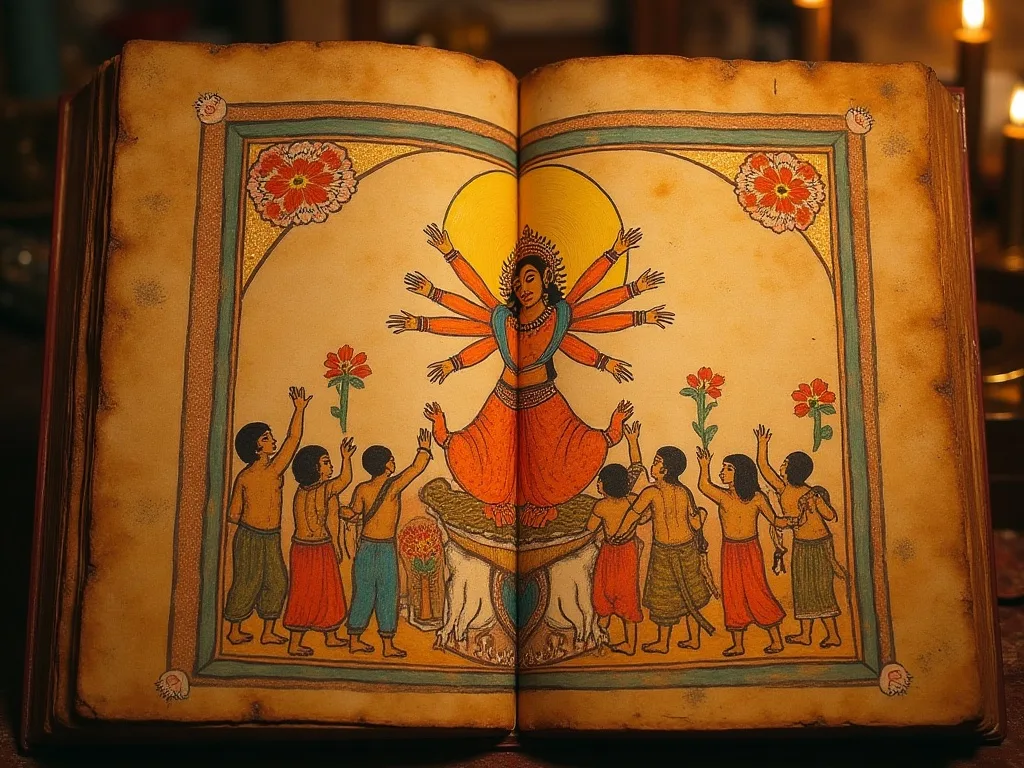
The most iconographically striking form of Avalokiteshvara is the Sahasrabhuja, "the Thousand-Armed One." Each arm holds a different attribute: a lotus, a vase of nectar, a rope to pull beings from danger, a book of wisdom, a jewel that grants wishes, a bow to shoot away delusion. In the palm of each hand is an eye, so that the being sees in every direction simultaneously and the thousand hands can reach wherever the eye falls.
This image is not decorative exaggeration. The Nilakantha Dharani, a Sanskrit liturgical text that spread widely between the seventh and ninth centuries CE, explains the theology precisely: suffering comes from all directions, at all times, from every corner of the six realms of existence. A single pair of arms is mathematically insufficient. A thousand arms, each equipped with a different tool, means that no specific form of suffering lacks its specific remedy. The image is a diagram of unconditional response.
The blue throat that appears in many depictions of this form connects Avalokiteshvara to one of Indian mythology's most recognisable moments: the churning of the cosmic ocean (the Samudra Manthan), during which a poison capable of destroying the universe rose to the surface. Avalokiteshvara swallowed it to protect all beings. The poison stopped at the throat, staining it blue, and the universe survived. The story echoes Shiva swallowing the same poison in Hindu tradition, and scholars like Robert Beer note that the two iconographies influenced each other directly as Buddhism and Shaivism overlapped in early medieval India.
Guanyin: The Transformation in East Asia
When the Lotus Sutra moved into China, something unexpected happened. The translator Kumarajiva (who completed his monumental version of the text around 406 CE) rendered Avalokiteshvara as Guanshiyin, "one who perceives the sounds of the world." Later shortened to Guanyin, the name captured the same listening quality as the Sanskrit original. But something else shifted alongside the name.
In Chinese Buddhist art from roughly the tenth century onward, Guanyin began to appear more and more often as female, a transformation that had no direct parallel in South Asian tradition, where Avalokiteshvara remained male. Scholars disagree about the exact reasons. Some point to the influence of indigenous Chinese goddesses of mercy. Others note that certain Lotus Sutra translations described Guanyin taking female form, and that the idea gradually crystallised. Susan Murcott and others have argued that Chinese devotees, many of them women who had little access to formal monastic structures, found in Guanyin a compassionate presence who looked like them.
By the Song dynasty (960-1279 CE), white-robed Guanyin images were everywhere: on temple altars, on household shrines, on the shelves of merchants and fishermen. The figure held a willow branch and a vase of pure water, used to heal and purify. The thousand-armed Tibetan form and the white-robed Chinese form express the same vow through entirely different aesthetic vocabularies.
Chenrezig: The Tibetan Heart of the Matter
In Tibet, Avalokiteshvara became Chenrezig (Tibetan: sPyan ras gzigs), "the one who sees with clear eyes," and the entire history of the Tibetan people wound itself around this figure. The first Tibetan kings were said to be manifestations of Chenrezig. The Dalai Lama, in every generation, is understood to be Chenrezig incarnated: not symbolically, but literally, the bodhisattva choosing to take human form to guide Tibetan Buddhism through its historical crises.
The six-syllable mantra Om Mani Padme Hum, the most recited string of syllables in Tibetan Buddhism, belongs to Chenrezig. It is carved into stone, painted on prayer flags, spun in hand-held wheels, murmured by pilgrims walking for months to reach Lhasa. The Tibetan teacher Dilgo Khyentse Rinpoche explained each syllable as a key that opens one of the six realms of existence: Om purifies pride, Ma purifies jealousy, Ni purifies desire, Pad purifies ignorance, Me purifies greed, Hum purifies hatred. Six syllables, six realms, one being big enough to hold them all.
The Mani Kabum, a Tibetan treasure text (terma) attributed to the eleventh century and associated with the king Songtsen Gampo, claims that the mantra was the first thing Chenrezig spoke into existence, before the mountains or the sky. It is, in other words, older than the world.
Amitabha Buddha presides over the Pure Land into which Avalokiteshvara guides beings, and in Tibetan iconography Chenrezig often wears a small image of Amitabha in his crown, marking their inseparable relationship. The bodhisattva and the Buddha are not rivals. They are, in a sense, two expressions of the same light.
Kannon in Japan and the Spread Across Southeast Asia
The Japanese received Avalokiteshvara through the Chinese tradition and called the figure Kannon (sometimes Kwannon), a further compression of the Chinese Guanyin. Japanese Buddhism, particularly the Tendai and Shingon schools that flourished from the ninth century CE onward, developed elaborate ritual around Kannon's thirty-three forms, building thirty-three-temple pilgrimage circuits that still attract hundreds of thousands of walkers each year.
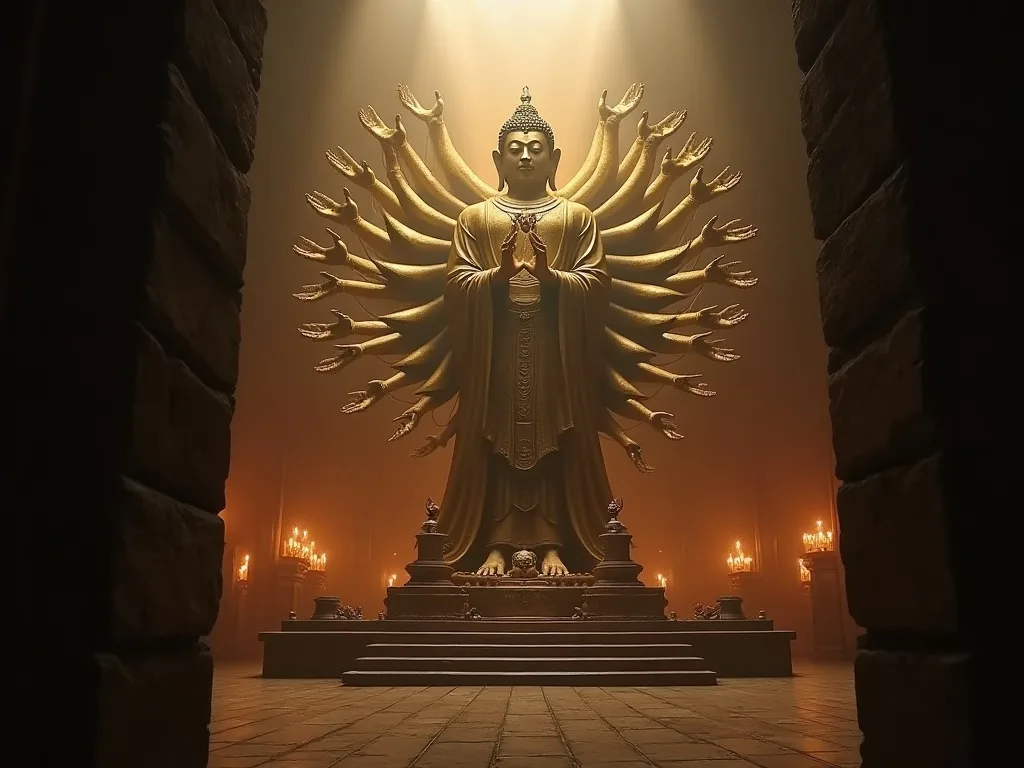
The Sanjusangen-do temple in Kyoto, built in 1164 CE, houses 1,001 statues of the thousand-armed Kannon: a central figure over eleven feet tall, flanked by a thousand smaller standing forms. Walking among them, you understand immediately why Mahayana texts describe Avalokiteshvara as filling space itself. The room does not feel like a room. It feels like a decision made by the universe to keep watching.
In Sri Lanka, the figure known as Natha Deviyo is considered by many scholars to be a localised form of Avalokiteshvara, predating the arrival of other protective deities. In Cambodia, the Bayon temple at Angkor (built in the late twelfth and early thirteenth centuries CE under the reign of Jayavarman VII) displays enormous stone faces on its towers. Scholars including George Coedes and Jean Boisselier have identified these faces as Avalokiteshvara, a king who chose to embody compassion in stone on a scale that could be seen from miles away.
Symbols, Attributes, and How to Read an Image
Encountering an Avalokiteshvara image for the first time, a few visual keys unlock the meaning.
- The lotus (padma): the flower that rises unstained through muddy water. It signals that Avalokiteshvara operates in the world of suffering without being consumed by it.
- The water vase (kundika): holds the water of compassion that cools the heat of delusion and pain.
- The crystal rosary (mala): represents the continuous counting of prayers on behalf of all beings, the recitation that never stops.
- The willow branch: appears especially in East Asian iconography; used to sprinkle the healing water.
- The deerskin: worn over the left shoulder in some Tibetan forms, it signals the bodhisattva's connection to the wilderness of suffering beyond human institutions.
- Eleven heads: in the Ekadasha-mukha form, Avalokiteshvara wears ten additional faces above the primary one, allowing simultaneous awareness of all directions. The topmost head, in many Tibetan versions, is that of Amitabha.
The colours also carry weight. White signals purity and truth. Green (in the Tibetan Shyama Tara tradition, where Avalokiteshvara's tears became the goddess Tara) signals active protection. Red signals love. The four-armed Chaturbhuja form, the most common in Tibetan thangka painting, holds a jewel at the heart, a crystal rosary in one raised hand, and a lotus in the other raised hand, with the fourth hand open in offering.
Avalokiteshvara and the Goddess Tara
The connection between Avalokiteshvara and the goddess Tara is one of Buddhist mythology's most intimate stories. The Tara Tantra texts, composed in Sanskrit probably around the sixth or seventh century CE, explain that Tara was born from Avalokiteshvara's tears. He wept at the sheer number of beings suffering across the six realms, and from his left eye came the White Tara, from his right eye the Green Tara. Both carry his vow, expressed now through a female form that blends the bodhisattva ideal with a protective, maternal energy.
In Tibet, White Tara and Green Tara became independent objects of devotion, each with her own mantra, her own iconography, her own practices. But the genealogy remained known: they are Avalokiteshvara's compassion made visible through grief. The weeping was not weakness. It produced something.
This story also illustrates how Avalokiteshvara functions in Buddhist cosmology: not as a static deity enthroned above the world, but as a dynamic, responsive presence whose emotions actively create the beings and energies needed to meet the world's need. Compassion, in this framework, is not passive. It manufactures help.
Avalokiteshvara in Modern Practice and Scholarship
No mythological figure from the Buddhist canon has attracted more varied scholarly attention in the last century. The German scholar Heinrich Zimmer, writing in the mid-twentieth century, placed Avalokiteshvara at the center of the Mahayana transformation of Buddhism, arguing that the figure embodied the shift from an individual liberation ethic to a cosmic, relational one. The Chinese American scholar Chun-fang Yu spent decades tracing Guanyin's evolution in Chinese religion, publishing her landmark study in 2001, "Kuan-yin: The Chinese Transformation of Avalokitesvara," which remains the standard reference for the East Asian strand.
Buddhist communities worldwide continue to recite the twenty-fifth chapter of the Lotus Sutra, perform the Om Mani Padme Hum practice, and carve, paint, or 3D-print images of the bodhisattva. In Taiwan, Guanyin temples rank among the most visited religious sites in the country. The Tibetan government-in-exile regards the Dalai Lama as Chenrezig's living embodiment, which means the theological tradition has a living political dimension in the twenty-first century.
There is also an unresolved debate that continues to interest comparative religion scholars: the relationship between Avalokiteshvara and the Christian figure of the Virgin Mary, who entered East Asian Buddhist territories alongside Jesuit missionaries in the sixteenth and seventeenth centuries. Some scholars have argued that visual cross-pollination occurred, that Guanyin images influenced Madonna iconography in Japan, and vice versa. Others treat this as overreach. The debate is unresolved, but the visual resemblance between a white-robed, child-bearing Guanyin and certain Madonna images is striking enough to be worth holding as an open question.
What is not in dispute is the reach. A being whose story begins in a Sanskrit chapter about a cosmic vow has become, over two millennia, the most widely recognised figure of mercy in human religious history, expressed in hundreds of languages, in stone and paint and murmured syllable, across half the surface of the earth.
Frequently Asked Questions About Avalokiteshvara
Frequently asked questions
What is the difference between Avalokiteshvara, Guanyin, Chenrezig, and Kannon?
They are the same bodhisattva understood through different cultural and linguistic lenses. Avalokiteshvara is the Sanskrit name used in Indian and pan-Buddhist scholarly contexts. Guanyin is the Chinese form, which became predominantly female from around the tenth century CE onward. Chenrezig is the Tibetan name, central to Vajrayana practice and associated with the Dalai Lama. Kannon is the Japanese rendering, the central figure of major pilgrimage circuits. The theology is continuous across all four; the iconography and gender presentation shift by region and period.
Why does Avalokiteshvara sometimes appear female and sometimes male?
The Lotus Sutra explicitly states that Avalokiteshvara takes whatever form is most useful to reach a given being. In South Asia and in Tibetan Buddhism, the bodhisattva is typically depicted as male. In China, Japan, Korea, and Vietnam, the female form gradually became dominant from roughly the tenth century CE onward, likely through a combination of indigenous goddess traditions, specific textual passages, and the devotional needs of communities where women had limited access to formal religious roles. The bodhisattva's vow is considered gender-transcendent: the form shifts; the commitment does not.
What does the mantra Om Mani Padme Hum actually mean?
The six syllables are Sanskrit and Tibetan in their origins, and their meaning has been interpreted at multiple levels. Literally, the phrase translates roughly as "the jewel in the lotus." The Tibetan Buddhist understanding, explained at length by figures like the Dalai Lama and Dilgo Khyentse Rinpoche, links each syllable to the purification of one of six afflictions (pride, jealousy, desire, ignorance, greed, hatred) that bind beings to one of the six realms of existence. The mantra is understood as the sound of Avalokiteshvara's compassion, not merely a description of it.
Is Avalokiteshvara a god or a Buddha?
Technically, neither in the conventional sense. A bodhisattva, in Mahayana Buddhism, is a being who has attained profound wisdom and could achieve full Buddhahood but deliberately remains accessible to all beings until universal liberation is reached. Avalokiteshvara holds this status and is considered a future Buddha (Samantabhadra tradition assigns the bodhisattva the eventual title "Amoghasiddhi"). In practice, across Asia, Avalokiteshvara functions as a deity in the popular religious sense: prayed to, offered to, and trusted to respond to specific life crises.
What are the primary texts about Avalokiteshvara?
The Lotus Sutra (especially chapter 25), the Karandavyuha Sutra, the Larger Sukhavativyuha Sutra (which links the bodhisattva to Amitabha's Pure Land), the Nilakantha Dharani, and the Tibetan Mani Kabum are the core textual sources. For the East Asian tradition, Chun-fang Yu's "Kuan-yin: The Chinese Transformation of Avalokitesvara" (2001) is the scholarly landmark. For the Tibetan strand, Martin Willson's "In Praise of Tara" covers the overlap with the Tara tradition extensively.
Where is Avalokiteshvara worshipped today?
Active devotional practice around Avalokiteshvara continues in Tibet, Bhutan, Nepal, China, Taiwan, Japan, Korea, Vietnam, Sri Lanka, Cambodia, and among diaspora Buddhist communities worldwide. The Sanjusangen-do temple in Kyoto, the Guanyin temples of Taiwan, and the Potala Palace in Lhasa (named after Avalokiteshvara's mythical mountain residence, Mount Potalaka) are among the most significant living sites.
Mount Potalaka and the Geography of Compassion
Buddhist cosmology gave Avalokiteshvara a home: Potalaka, a mountain island described in the Avatamsaka Sutra (a Sanskrit scripture compiled around the third to fifth centuries CE) as rising from the southern sea, covered in forests, waterfalls, and medicinal plants, where the bodhisattva sits in permanent meditation while simultaneously responding to every cry in the universe. The name became attached to real geography. The Potala Palace in Lhasa, Tibet, built in the seventeenth century CE by the Fifth Dalai Lama, takes its name from this mountain, making the seat of Tibetan government a literal embodiment of the bodhisattva's dwelling.
In Japan, the temple Nachi Taisha in Wakayama is identified by some traditions with Potalaka. In South India, a hill near Tirunelveli in Tamil Nadu carries the same association. The mountain moves because compassion does not stay in one place. It locates itself wherever suffering is concentrated enough to require a response.
That dynamic quality is perhaps what explains Avalokiteshvara's extraordinary durability across two thousand years of human history. Empires rise and dissolve. Languages fragment. Trade routes close. But the figure of a being who turns toward suffering rather than away from it, who multiplies arms rather than retract them, who weeps and produces goddesses from the tears, remains legible in every context humans have carried it into. The vow, made once in Sanskrit, keeps being renewed in every language that needs it.
Read the full book
Want the whole story?
The complete edition is an instant PDF download here, with a paperback on Amazon for selected titles.
Buddhist
The Buddhist Mythology Book: Mara, Avalokiteshvara, Mahakala, and the Sacred Cosmology Beyond Meditation
Demons, Bodhisattvas, and the Cosmic Architecture of Buddhism
The mythological layer of Buddhism: Mara's temptation, the Bodhisattvas, Vajrayana fierce deities, the Eight Hells, Mount Meru, and the Jataka tales. Delivered within 24 hours of purchase.
More from Buddhism
All articles
Buddhism
Vesak: The Festival Celebrating Buddha's Birth, Enlightenment, and Death
Vesak marks the three most pivotal moments in Siddhartha Gautama's life, all on a single day. Discover how Buddhists across Asia transform this holy date into a festival of light, moral renewal, and collective remembrance of the Buddha's journey to awakening.

Buddhism
Tara: The Mother of Liberation in Mahayana Buddhism
Tara embodies compassion in action, the Tibetan Buddhist goddess who hears suffering and moves to end it. Known as the Mother of Liberation, she appears in multiple forms, each one a different answer to human need.

Buddhism
The Lotus Sutra: Sacred Text of Universal Buddhahood
The Lotus Sutra teaches that every being, no matter how lost, can achieve buddhahood. Discover how Buddhism's most beloved scripture rewrote enlightenment and shaped a thousand years of practice.
Buddhism
The Six Realms of Samsara: Buddhist Cosmology and Rebirth
Buddhist cosmology maps existence across six realms of rebirth, from heavens where joy becomes suffering to hells where torment teaches detachment. Discover how this ancient map of consciousness shapes Buddhist ethics and practice.