
Bodhi Tree: The Sacred Fig Under Which Buddha Attained Enlightenment
The Bodhi Tree is the sacred fig at Bodh Gaya where the Buddha sat until awakening came. Learn how one night under its branches changed the course of human history.
Contents
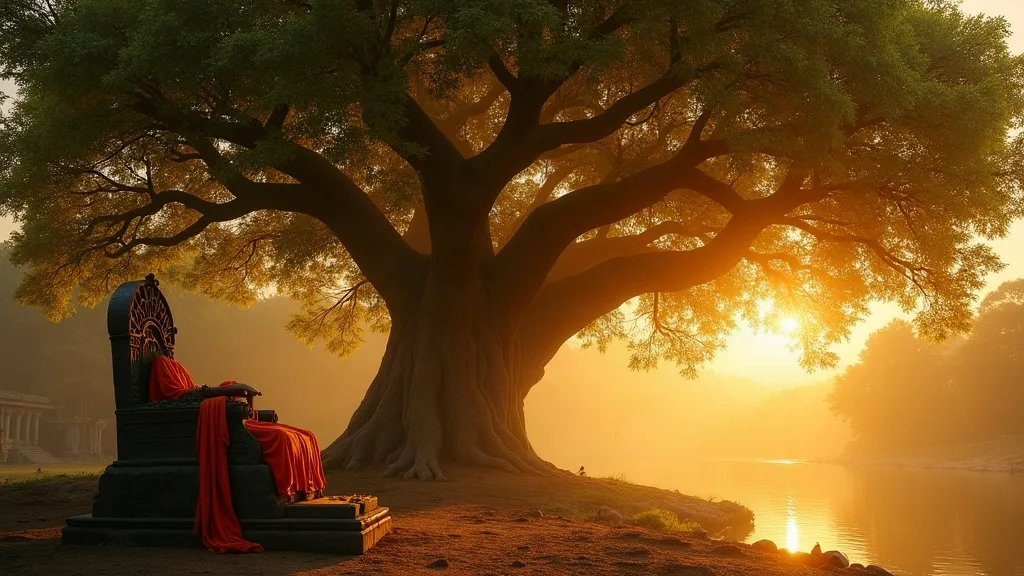
The night was warm, the ground hard beneath the mat of grass. A young man named Siddhartha Gautama had walked away from years of severe fasting, had eaten a bowl of rice milk offered by a village woman, and had made a quiet decision: he would sit beneath this particular fig tree and not rise until he understood the nature of suffering. He planted himself at its roots on the bank of the Niranjana River, near the town of Gaya in what is now the Indian state of Bihar. The tree stood perhaps fifteen meters tall, its heart-shaped leaves catching whatever breeze moved through the heavy air.
That was sometime around 528 BC, though scholars debate the exact year. By morning, according to the Pali Canon (the oldest surviving written record of the Buddha's teachings, compiled in Sri Lanka around the first century BC), Siddhartha had passed through every layer of meditative concentration, resisted every challenge the god Mara threw at him, and arrived at a state of complete, irreversible understanding. He was, from that moment, the Buddha, the "Awakened One." The tree under which it happened became something the world had never quite had before: not a temple, not an idol, but a living being worshipped as a witness to the most important moment in Buddhist history.
The Bodhi Tree: The Sacred Fig Under Which Buddha Attained Enlightenment is one of the most remarkable sacred sites on Earth, a place where botany, history, devotion, and philosophy converge in a single trunk rooted in ancient soil.
What the Bodhi Tree Actually Is
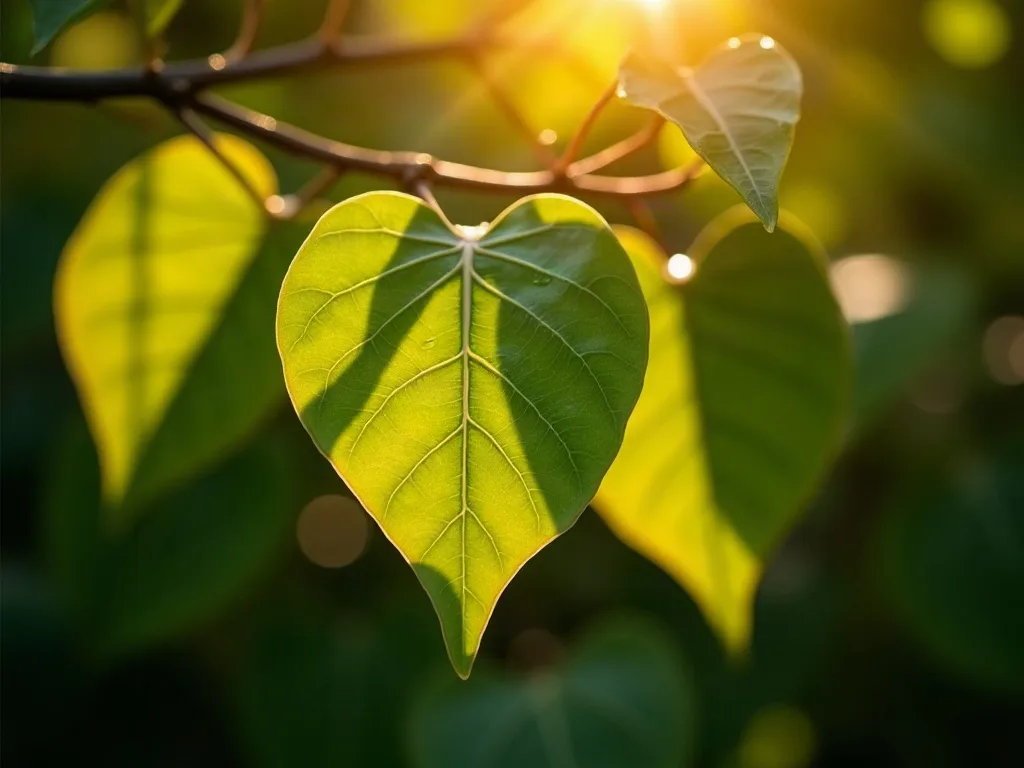
Ficus religiosa is a subtropical fig native to the Indian subcontinent and parts of mainland Southeast Asia. It can live for centuries, its aerial roots eventually merging with the main trunk to form pillar-like supports. The leaves are distinctive: wide at the base and tapering to a long, thin tip, almost like a teardrop with a tail. When the wind catches them, they flutter constantly even in light air, which gave rise to an old belief that the tree was inhabited by a spirit, or yaksha in Sanskrit.
Long before Siddhartha sat beneath one, the peepal was already considered sacred in the Indus Valley tradition. Seals found at Mohenjo-daro, dated to around 2500 BC, show figures sitting in a meditative pose beneath what appears to be a Ficus religiosa. The Vedic texts, composed roughly between 1500 and 900 BC, mention the ashvattha tree (the Sanskrit name for the species) as a cosmic axis, a connector between the earthly and divine realms. The Bhagavad Gita, a philosophical dialogue from the Mahabharata, has the god Krishna declare: "Among trees, I am the ashvattha." When Siddhartha chose to sit beneath it, he was choosing a tree already charged with centuries of sacred meaning.
The particular specimen at Bodh Gaya grew on the western bank of the Niranjana. After the awakening, the Buddha reportedly spent the first week simply sitting and gazing at the tree in gratitude. Buddhist texts call this the "week of gazing," animisalochana in Pali, and it produced one of the most unusual acts of reverence in any religious tradition: a god thanking a plant.
The Night of the Awakening: What the Texts Record
The earliest accounts of what happened under the Bodhi Tree come from the Pali Canon, specifically the Majjhima Nikaya (the "Middle-Length Discourses") and the Vinaya Pitaka (the monastic rule texts). Later Sanskrit sources, including the Buddhacharita by the poet Ashvaghosha written around 100 AD, add vivid narrative detail.
The story goes like this. As Siddhartha settled into deep meditation, Mara, the god of desire and death, understood that this man was about to escape his dominion entirely. Mara sent his daughters, personifications of craving, aversion, and delusion, to distract Siddhartha. They failed. Mara then launched an army of demons, throwing weapons that turned into flowers as they neared the seated meditator. Finally, Mara challenged Siddhartha's right to be there, demanding a witness to his spiritual merit.
Siddhartha touched the ground with his right hand. This gesture, called bhumisparsha mudra in Sanskrit (literally "earth-touching gesture"), invited the earth itself to testify. The earth, personified as the goddess Sthavara, is said to have shaken and roared in confirmation. Mara withdrew. Siddhartha moved through four stages of concentration, then spent the three watches of the night reviewing his past lives, understanding the mechanism of karma and rebirth, and finally perceiving the Four Noble Truths: that suffering exists, that it has a cause, that it can end, and that a path leads to that ending.
By dawn, according to the Majjhima Nikaya, the process was complete. He sat a while longer, not certain whether ordinary people could understand what he now knew. A divine figure, sometimes identified as Brahma Sahampati, urged him to teach. He agreed. The Bodhi Tree had watched all of it.
Ashoka and the Tree That Became a Political Symbol
The story of the Bodhi Tree takes an imperial turn in the third century BC. The Mauryan emperor Ashoka, who ruled most of the Indian subcontinent from roughly 268 to 232 BC, converted to Buddhism after witnessing the carnage of his own military campaigns. He made a pilgrimage to Bodh Gaya, the first recorded royal visit to the site, and built a shrine around the tree. This is documented in the Ashokavadana, a Sanskrit text from around the second century AD, and also referenced in Sri Lankan chronicles like the Mahavamsa, compiled around the fifth century AD.
The Mahavamsa adds a dramatic subplot. Ashoka's queen, Tissaraksha, apparently resented the time her husband devoted to the tree, treating it almost like a rival. She is said to have ordered the tree poisoned. The tree survived, or a replacement was grown from its cuttings; the sources differ. What is certain is that Ashoka's daughter, the nun Sanghamitta, carried a branch of the Bodhi Tree to Sri Lanka, where it was planted at Anuradhapura around 288 BC. That Sri Lankan tree, known as the Jaya Sri Maha Bodhi, is still alive today. At roughly 2,300 years old, it is the oldest historically documented tree in the world with a recorded planting date.
Ashoka also commissioned a diamond throne, the vajrasana in Sanskrit, to mark the exact spot where Siddhartha sat. A stone replica of this throne still exists at Bodh Gaya, beneath the current Mahabodhi Temple.
The Mahabodhi Temple and Centuries of Destruction
The current Bodhi Tree stands in a walled compound next to the Mahabodhi Temple at Bodh Gaya, a UNESCO World Heritage Site designated in 2002. The temple itself has a complex history. Ashoka built the first structure; subsequent kings of various faiths modified or demolished it. The Shaivite king Shashanka, who ruled Bengal in the early seventh century AD, reportedly cut the Bodhi Tree down to its roots and poured burning coals over the stump, according to the Chinese pilgrim Xuanzang (also written as Hsüan-tsang), who visited Bodh Gaya around 637 AD and recorded his travels in detail.
Xuanzang writes that even after this attack, the tree regrew from the roots within months, and that King Purnavarma later protected it with a high stone wall. Whether Shashanka actually succeeded in killing the tree or merely damaged it severely is disputed by historians, but the repeated pattern of destruction and regrowth became part of the tree's own mythology: an emblem of resilience that mirrored the Buddhist idea of the indestructibility of awakening itself.
During the period of Muslim rule over Bengal, from the twelfth century onward, Buddhist institutions in the region collapsed rapidly. The Bodhi Tree was neglected. When the British military officer Francis Buchanan-Hamilton surveyed Bodh Gaya in 1811, he found the site in ruins. The Mahabodhi Society, founded in 1891 by the Sri Lankan reformer Anagarika Dharmapala, launched a campaign to restore both temple and tree to Buddhist care. The effort succeeded only partially in Dharmapala's lifetime, but today the site is managed by the Bodh Gaya Temple Management Committee.
The tree currently growing at the site is considered a direct descendant of Ashoka's tree, which was itself a descendant of the original. Cuttings have been taken at several points in history and replanted when the parent tree died or was damaged. The lineage is treated in Buddhist tradition with the same reverence one might accord a royal dynasty.
What Pilgrims Do at Bodh Gaya
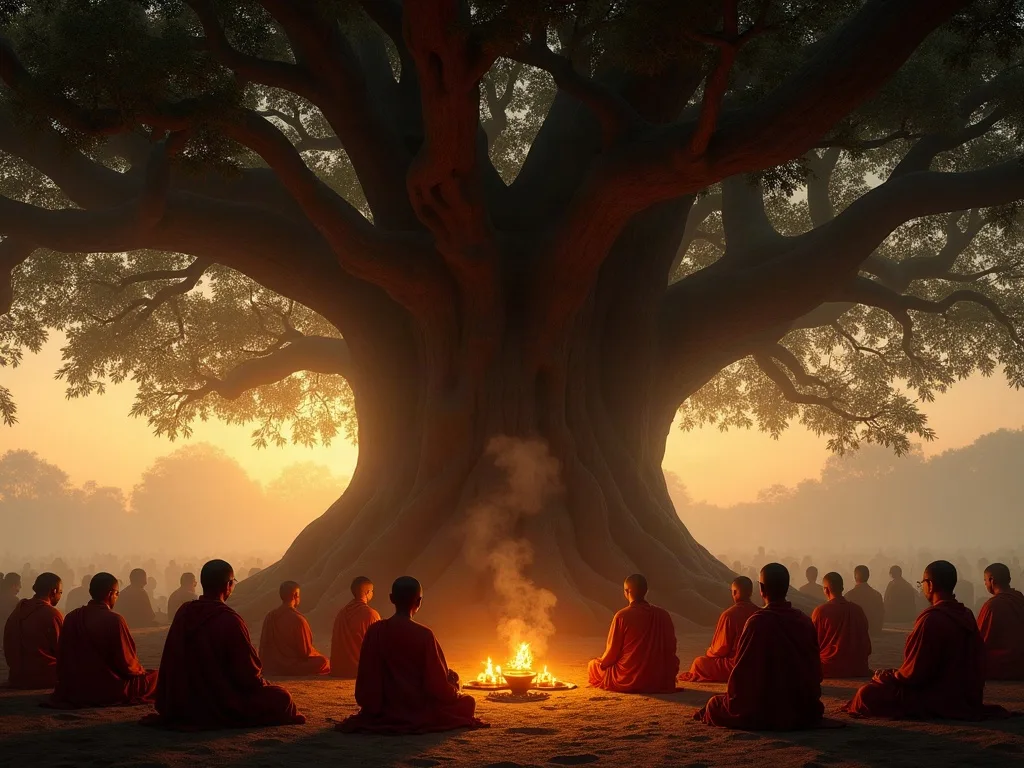
More than a million pilgrims visit Bodh Gaya each year. The ritual activities around the sacred fig tree follow patterns established by the earliest Buddhist communities and documented by pilgrims like the Chinese monk Faxian, who visited around 405 AD.
Pilgrims typically:
- Circumambulate the Mahabodhi Temple clockwise, a practice called pradakshina in Sanskrit, which in Buddhist tradition expresses reverence and accumulates merit.
- Sit in meditation beneath or near the tree, often for extended periods, in deliberate imitation of the Buddha's own posture.
- Offer incense, flowers, and butter lamps at the vajrasana stone throne.
- Collect fallen leaves from the Bodhi Tree, which are kept as relics and often pressed and distributed to temples worldwide.
- Hang gold-leaf offerings on the lower branches, a practice especially common among Burmese and Thai pilgrims.
The tree's fallen leaves carry a particular weight. Because Ficus religiosa sheds leaves constantly, pilgrims rarely have to wait long. Temples from Tokyo to Toronto keep framed Bodhi Tree leaves on their altars, physical threads connecting distant communities back to Gaya.
The Tree in Buddhist Art and Symbolism Across Asia
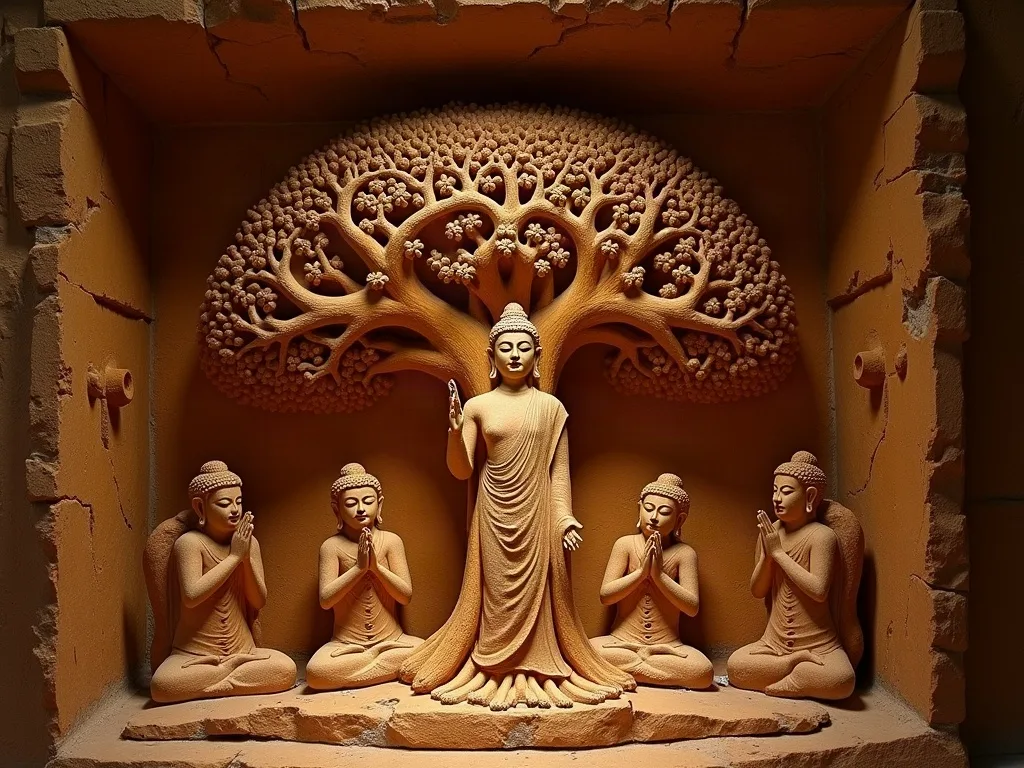
Before the Buddha's human form was depicted in art, sculptors represented him through symbols. In the earliest Buddhist art found at Sanchi (stupa reliefs dating to the second and first centuries BC) and Bharhut (similar date), the Bodhi Tree stands alone at the center of a scene, surrounded by worshipping figures. The empty throne beneath it signals the Buddha's presence without showing his body. This convention persisted for centuries before the Gandharan school, influenced by Greek artistic contact after Alexander the Great's campaigns, began carving the Buddha in human form around the first or second century AD.
The tree's significance spread with Buddhism itself. In Theravada Buddhism, practiced in Sri Lanka, Myanmar, Thailand, Laos, and Cambodia, every major temple keeps a Bodhi Tree or a Ficus religiosa grown from a cutting traced back to Bodh Gaya. The tree at the Shwedagon Pagoda in Yangon, the tree at Wat Phra Kaew in Bangkok, the trees at Kelaniya Raja Maha Vihara in Sri Lanka: all are part of this botanical lineage.
In Mahayana Buddhism, the tradition that spread through Tibet, China, Korea, and Japan, the Bodhi Tree figures prominently in texts about the Bodhisattva path, the long road of practice across many lives before full awakening. The tree is sometimes understood as a cosmic axis, an echo of the ancient ashvattha symbolism, connecting the human world to the Buddha-fields described in texts like the Avatamsaka Sutra.
The tree also appears in the most famous Chan (Zen) poem in the Chinese tradition. In the seventh century, the monk Shenxiu wrote: "The mind is like a bright mirror stand. Polish it always and let no dust alight." His rival, Huineng, responded: "There is no mirror stand. Where would the dust alight?" Both poems use the Bodhi Tree as implicit backdrop: Huineng's poem ends with the line "Originally there is not a single thing; how could dust be attracted?" The debate between gradual and sudden enlightenment, one of the most important doctrinal disputes in East Asian Buddhism, was conducted through images rooted in that night under the tree.
Bodhi Tree Descendants Around the World
The Bodhi Tree's reach is genuinely global. Here is a partial record of significant descendant trees:
| Location | Tree's Origin | Status |
|---|---|---|
| Anuradhapura, Sri Lanka | Cutting by Sanghamitta, c. 288 BC | Living, world's oldest historically dated tree |
| Bodh Gaya, India | Replanted descendant | Living, main pilgrimage site |
| Wat Pho, Bangkok | Cutting from Sri Lanka | Living |
| Mahabodhi Society, Colombo | Sri Lanka lineage | Living |
| Buddhist temples, California and New York | Various modern cuttings | Living |
| Sarnath, India | Ashoka-era planting | Uncertain lineage |
The Indian government periodically sends cuttings from the Bodh Gaya tree to Buddhist communities worldwide as diplomatic and religious gestures, especially to countries with large Buddhist populations. Japan received one such cutting in 1954 for the World Fellowship of Buddhists conference.
Cross-Cultural Echoes: Other Sacred Trees in World Religion
The idea of a tree at the center of a spiritual transformation appears across many traditions, and the comparison reveals both universal human intuitions and specific Buddhist innovations.
Yggdrasil, the great ash tree of Norse mythology, connects nine worlds and is described in the Prose Edda (compiled around 1220 AD by Snorri Sturluson) as the axis holding reality together. Odin hung on it for nine nights to gain the knowledge of the runes: a voluntary ordeal beneath a tree, aimed at wisdom. The structural parallel with Siddhartha's vigil is striking.
The Tree of Knowledge in the Garden of Eden, as described in the Book of Genesis, also stands at the hinge point of a cosmic narrative: a fruit tree whose consumption changes the nature of human consciousness forever.
What distinguishes the Bodhi Tree from these others is its particularity. The Norse and Abrahamic sacred trees are mythological objects, located in cosmic or primordial space. The Bodhi Tree can be visited. Its descendants can be touched. Botanists can test its DNA. That combination of the historically specific and the spiritually absolute is unusual in the history of sacred sites.
Frequently Asked Questions About the Bodhi Tree
Frequently asked questions
Is the Bodhi Tree at Bodh Gaya the original tree from the Buddha's time?
No. The tree currently growing at Bodh Gaya is a descendant of the original, propagated through cuttings taken at various points across more than two millennia. The earliest well-documented cutting was taken by Ashoka's daughter Sanghamitta to Sri Lanka around 288 BC. The Bodh Gaya tree today descends from a replanting of that lineage. The original tree was reportedly damaged or destroyed multiple times, including an attack attributed to the seventh-century king Shashanka, as recorded by the Chinese pilgrim Xuanzang.
What species is the Bodhi Tree, and does it have any special biological properties?
The Bodhi Tree is a Ficus religiosa, also called the sacred fig or peepal tree. It produces no edible fruit useful to humans but releases significant oxygen, which may have made dense groves of it attractive camping spots in ancient India. The species can live for several centuries under good conditions and develops elaborate aerial root systems with age. Its constantly fluttering leaves, caused by the long drip-tip shape of each leaf, gave it a reputation for housing spirits long before Buddhism adopted it as a symbol.
What exactly happened to the Buddha under the Bodhi Tree, according to Buddhist texts?
According to the Pali Canon, particularly the Majjhima Nikaya, Siddhartha Gautama spent one night in uninterrupted meditation under the tree. He passed through four stages of meditative absorption, then used his concentrated mind to review his past lives, understand the mechanism by which karma drives rebirth, and finally perceive the Four Noble Truths and the Eightfold Path. Buddhist tradition holds that this was not a mystical vision but a direct cognitive insight, a seeing of things as they actually are. By dawn, the process was irreversible. He had become the Buddha.
Can anyone visit the Bodhi Tree at Bodh Gaya?
Yes. Bodh Gaya in Bihar, India, is open to visitors of all religious backgrounds. The Mahabodhi Temple complex, a UNESCO World Heritage Site, charges a modest entry fee. The tree itself stands inside a railed enclosure adjacent to the temple. Millions of pilgrims and tourists visit each year, with peak seasons around Buddhist holidays such as Buddha Purnima (the full moon of the month Vaisakha, usually in May). Meditation is permitted and actively practiced by visitors in the grounds around the tree.
Why is the Jaya Sri Maha Bodhi tree in Sri Lanka considered especially significant?
The Jaya Sri Maha Bodhi at Anuradhapura in Sri Lanka is the oldest historically documented tree in the world with a verified planting date, circa 288 BC. It was grown from a cutting of the original Bodhi Tree, carried by the nun Sanghamitta, daughter of Emperor Ashoka, to the Sri Lankan king Devanampiya Tissa. The Mahavamsa, the Sri Lankan royal chronicle, records the event in detail. For Sri Lankan Buddhists, it carries extraordinary national and religious significance: it has had armed guards protecting it continuously since the nineteenth century.
What is the 'earth-touching gesture' associated with the Bodhi Tree?
The bhumisparsha mudra (Sanskrit: "earth-touching gesture") depicts the Buddha seated in meditation with his right hand resting on his right knee, fingertips touching the ground. According to Buddhist narrative, at the moment Mara challenged his right to seek enlightenment, Siddhartha responded by calling the earth itself as witness to his accumulated merit across countless lifetimes. This gesture became one of the most widely reproduced images in Buddhist art worldwide. Statues in this posture are found from Gandhara in modern Pakistan to the temples of Kyoto.
The Bodhi Tree in the Twenty-First Century: Science, Politics, and Living Devotion
The tree at Bodh Gaya today is not ancient, but it carries enormous institutional weight. In 2010 and again in 2018, security alerts caused by suspected bomb threats led Indian authorities to close the Mahabodhi Temple complex temporarily, a reminder that the site sits at the intersection of living devotion and contemporary geopolitics.
Botanists from Banaras Hindu University have conducted studies on the tree's health, monitoring soil pH, root spread, and fungal threats. The Ficus religiosa is resilient but not invincible: pollution from the millions of butter lamps and incense sticks burned annually affects the soil chemistry around the roots. Conservationists and temple authorities periodically debate how to balance preservation with the uninterruptible flow of pilgrimage.
The deeper question the tree poses is one that Buddhist philosophy itself would recognize as worth sitting with. What makes a living thing sacred? Is it the DNA carried forward through two and a half millennia of cuttings and replantings? Is it the unbroken human intention, the continuous act of regarding this particular tree as the site of the most consequential awakening in Buddhist memory? The Pali word bodhi means "awakening" or "understanding." The tree named for it does not meditate, does not understand anything. Yet it has been the object of more sustained human reverence than almost any other plant on Earth. Pilgrims bow to it, rulers have tried to destroy it, monks have wept beneath it, scholars have argued about it, and somewhere in the soil around its roots lies the compressed sediment of 2,500 years of human seeking. That may not be reducible to botany, but it is not reducible to fiction either.
The Sri Lankan tree at Anuradhapura is guarded around the clock. The Bodh Gaya tree is ringed with a golden railing. Cuttings from both are growing in Los Angeles, in London, in Seoul. The lineage, as Buddhists have always maintained, continues.
Read the full book
Want the whole story?
The complete edition is an instant PDF download here, with a paperback on Amazon for selected titles.
Buddhist
The Buddhist Mythology Book: Mara, Avalokiteshvara, Mahakala, and the Sacred Cosmology Beyond Meditation
Demons, Bodhisattvas, and the Cosmic Architecture of Buddhism
The mythological layer of Buddhism: Mara's temptation, the Bodhisattvas, Vajrayana fierce deities, the Eight Hells, Mount Meru, and the Jataka tales. Delivered within 24 hours of purchase.
More from Buddhism
All articles
Buddhism
Vesak: The Festival Celebrating Buddha's Birth, Enlightenment, and Death
Vesak marks the three most pivotal moments in Siddhartha Gautama's life, all on a single day. Discover how Buddhists across Asia transform this holy date into a festival of light, moral renewal, and collective remembrance of the Buddha's journey to awakening.
Buddhism
Tara: The Mother of Liberation in Mahayana Buddhism
Tara embodies compassion in action, the Tibetan Buddhist goddess who hears suffering and moves to end it. Known as the Mother of Liberation, she appears in multiple forms, each one a different answer to human need.

Buddhism
The Lotus Sutra: Sacred Text of Universal Buddhahood
The Lotus Sutra teaches that every being, no matter how lost, can achieve buddhahood. Discover how Buddhism's most beloved scripture rewrote enlightenment and shaped a thousand years of practice.
Buddhism
The Six Realms of Samsara: Buddhist Cosmology and Rebirth
Buddhist cosmology maps existence across six realms of rebirth, from heavens where joy becomes suffering to hells where torment teaches detachment. Discover how this ancient map of consciousness shapes Buddhist ethics and practice.