

Hanuman: The Monkey God of Devotion and Strength
Half-divine warrior, half-devoted servant, Hanuman stands as one of Hinduism's most beloved figures. His story is one of extraordinary power placed entirely at the feet of love.
Contents
The mountain shook when he leapt. According to the Valmiki Ramayana, the oldest telling of the story, the island of Lanka trembled under the force of Hanuman's departure from its shores, his body expanding to the size of a cloud, his orange fur blazing like a comet crossing the ocean. He had come alone, found the imprisoned Sita, burned half the city, and left. All for his lord, Rama, without hesitation, without pride, without any claim to personal glory.
That image, one divine being in complete service to another, is not a footnote in Hindu tradition. It is the tradition's center of gravity for hundreds of millions of people. Hanuman, the monkey god of devotion and strength, occupies a position in Hindu devotional life that is both cosmic and intimate. Temples to him sit at crossroads and hilltops across South Asia, always open before dawn, always occupied by someone pressing a palm to his red-painted feet. He is the patron of wrestlers, soldiers, sailors, and scholars. He is the first deity many children learn to pray to, and the last name many elders whisper before sleep.
His mythology is older than it looks and stranger than most retellings suggest.
The Birth of a Wind God's Son
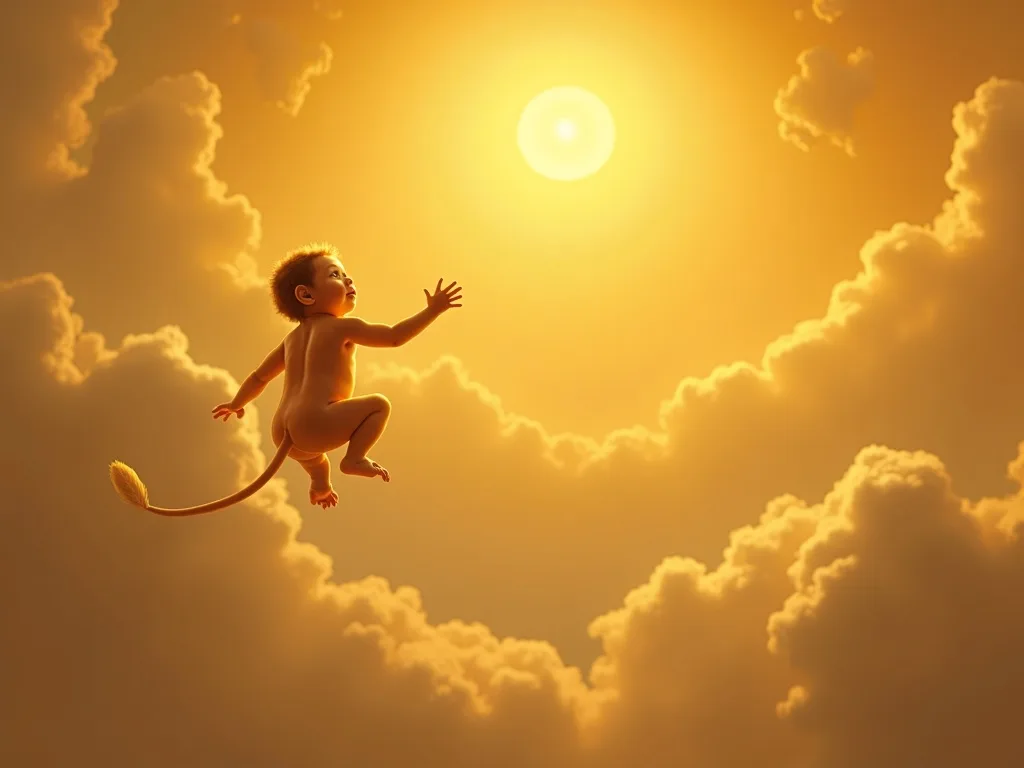
Hanuman's origin story carries the full weight of celestial politics. His mother, Anjana, was an apsara (a celestial nymph) cursed to be born as a vanara, one of the monkey-people of ancient Indian mythology. To break the curse, she needed to give birth to a partial incarnation of the god Shiva. She prayed intensely on a mountaintop, and the wind god Vayu carried the divine seed to her on a breeze, making Hanuman simultaneously the son of Vayu, a partial manifestation of Shiva's energy (amsha), and the foster son of the vanara chieftain Kesari. This triple parentage is not accidental. It gives him divine stamina, cosmic power, and tribal loyalty, all three strands running through every episode of his mythology.
The child who arrived was extraordinary from his first hours. Seeing the rising sun and mistaking it for a ripe fruit, infant Hanuman launched himself into the sky to grab it. Indra, king of the heavens, struck him with his thunderbolt to protect the sun. The blow fractured Hanuman's jaw and sent him plummeting to earth. Vayu, furious at his son's injury, withdrew all air from the world. The cosmos suffocated. The gods rushed to appease the wind god, each granting young Hanuman a boon: Indra gave him a body harder than a thunderbolt, Brahma made him immune to the brahmastra weapon, Agni granted immunity to fire, Varuna protected him from water, and Yama exempted him from death by his own rod. The child who had been struck down by the heavens rose from that moment with more gifts than any warrior in the three worlds.
His education came from the sun itself. Hanuman approached Surya and asked to be taught. Surya pointed out the practical problem: he never stopped moving, and a stationary student could not keep pace with a moving teacher. Hanuman replied by expanding his body to match Surya's path, facing the sun and walking backward through the sky as the sun traversed the heavens. Surya taught him all knowledge, the Vedas, the sciences, grammar, and statecraft, over the course of a single day. When the lesson ended, Hanuman asked what fee he owed. Surya asked only that he serve and protect his son Sugriva, the exiled vanara king. That debt, and that promise, is how Hanuman came to be at Sugriva's side when Rama arrived in the forest.
A Meeting in the Forest: Servant and Lord
The Valmiki Ramayana, composed somewhere between 500 and 100 BCE with older oral cores stretching further back, places the first meeting between Hanuman and Rama in the Kishkindha forest. Rama and his brother Lakshmana are searching for Sita, abducted by the demon king Ravana. Sugriva, suspicious of these two armed strangers in his territory, sends Hanuman to investigate.
Hanuman approaches the brothers disguised as a brahmin scholar. He speaks with such precise grammar and such measured intelligence that Rama whispers to Lakshmana: "No one who does not know the Vedas thoroughly can speak so perfectly. His language is flawless, his voice melodious, his bearing noble. There is nothing in him that is displeasing." The disguise falls away. What Rama recognized was not superhuman strength but cultivated wisdom, a detail that speaks to the Hindu understanding of shakti (divine power) as inseparable from vidya (knowledge).
From that moment forward, the relationship is sealed. Hanuman becomes Rama's messenger, scout, general, and most intimate companion. The bond they form is one of the most studied relationships in Sanskrit literature: not the love of equals, not the awe of a subject before a king, but bhakti, devotional love, in which the devotee's greatness is measured precisely by the depth of selfless surrender. The Ramayana scholar A. K. Ramanujan observed that Hanuman is the ideal devotee precisely because he never forgets he is also the most capable being in the story. His humility is therefore a choice, not a limitation.
The Leap to Lanka and the Tests of Power
The search for Sita eventually arrives at an impassable obstacle: the ocean separating mainland India from Lanka. The vanara army stares at the water. One by one, the heroes declare the maximum distance they could jump: a hundred leagues, eighty leagues, fifty. None can reach Lanka. Then the elder bear-king Jambavan turns to Hanuman and reminds him of something: Hanuman had forgotten his own power. As a young god too strong and too playful, his power had been sealed by a sage's curse to keep him from disrupting the world. Jambavan's reminder breaks the seal.
Hanuman grows. The Sundara Kanda, the fifth and most lyrical book of the Ramayana, describes the expansion: his body swells to fill the mountain, his eyes burn like suns, his tail coils behind him like a dragon. He compresses the mountain beneath his feet until it cracks, launches himself across a hundred leagues of ocean, fights a sea-demoness who tries to swallow him, shrinks himself to the size of a fly to slip past her, and lands on Lanka's shore in the shadow of Ravana's fortress.
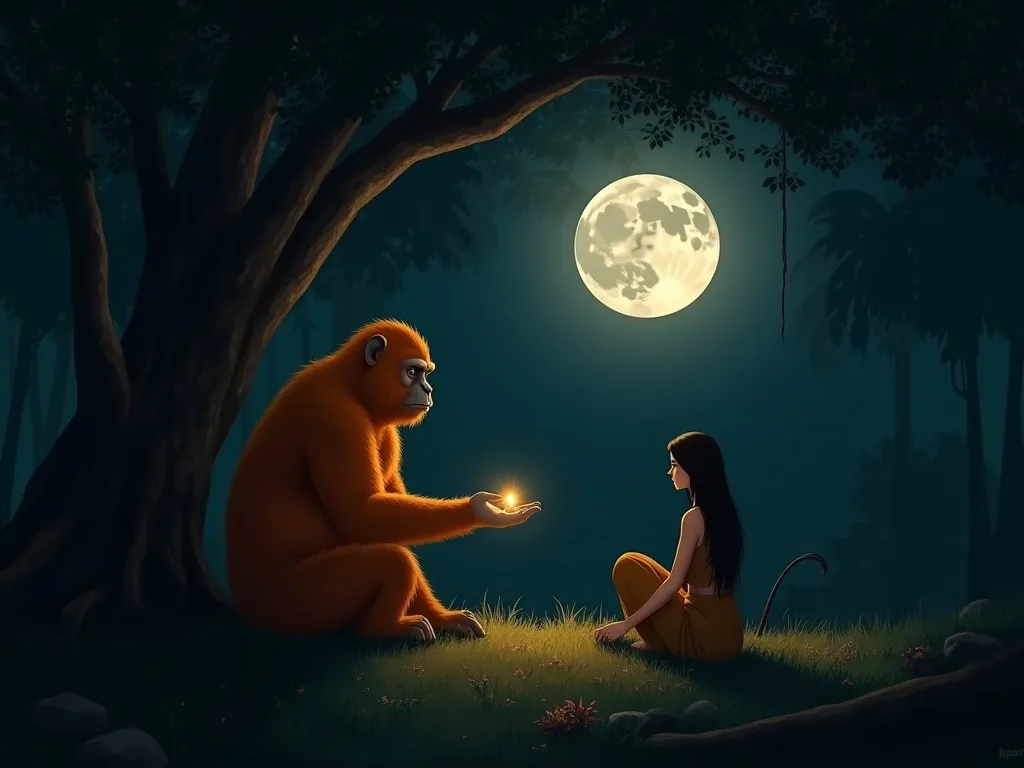
What follows is one of the most intricate spy-sequences in ancient literature. Hanuman searches the city at night in his miniature form, moving through palaces, prisons, and pleasure gardens. He finds Sita beneath an ashoka tree, grief-worn but unbowed. He reveals himself, offers Rama's ring as proof of his identity, and suggests she climb on his back and let him carry her home. Sita refuses. Her rescue must be Rama's act, she says, or it will be meaningless. A woman's deliverance from dishonor must come through her husband's valor, not a servant's cleverness, no matter how devoted. Hanuman accepts this with quiet grace.
He does not leave quietly, though. Captured by Ravana's forces, dragged before the demon king, his tail set on fire as punishment, Hanuman uses the burning tail to leap from rooftop to rooftop and burn much of Lanka's golden city before extinguishing the flame in the sea and returning to Rama with his report. The episode is celebrated annually across South Asia during Diwali-adjacent festivals and has generated thousands of paintings, sculptures, and theatrical renditions.
The Herb Mountain and the Question of Heart
One moment from the war at Lanka is cited more often than any other when Hindus want to explain what Hanuman means to them. Late in the battle, Lakshmana is struck down by a weapon that can only be cured by a specific medicinal herb, the Sanjivani, that grows on a Himalayan peak. The herb must be found before sunrise or Lakshmana will die. Hanuman flies to the Himalayas, but once there, he cannot identify which of the many herbs is the Sanjivani. Rather than returning empty-handed, he tears up the entire mountain and carries it back to Lanka.
The image of a monkey carrying a mountain is one of the most recognizable in South Asian iconography. But the story's second half is less often depicted. After the war, as Rama prepares to return to Ayodhya, a debate breaks out over which heroes deserve the finest jewels from Lanka's treasury. Sita gives Hanuman a pearl necklace. He immediately begins biting each pearl open. The assembled court watches in bewilderment. Hanuman explains: he is checking whether Rama lives inside each pearl, because anything that does not contain Rama is worthless to him. When courtiers laugh, he tears open his own chest. Inside, carved into his heart, are the figures of Rama and Sita.
This scene, the chest opened to reveal the deity within, is the theological core of Hanuman's cult. It appears in almost every major temple as a sculptural motif, and it articulates the Hindu bhakti doctrine more vividly than any theological treatise: the devotee is not merely a servant. The devotee is the dwelling place of the divine.
Tulsidas and the Living Hanuman
The Hanuman most contemporary Hindus know is not strictly the creation of Valmiki. In 1574 CE (traditional date), the poet-saint Tulsidas completed the Ramcharitmanas, a retelling of the Ramayana in Awadhi (a vernacular dialect of Hindi), and followed it with the Hanuman Chalisa, a forty-verse hymn that has become one of the most recited texts in the world. Estimates of daily recitations across South Asia alone run into the tens of millions.
The Chalisa is forty verses because forty (chalis) in northern Indian folk numerology represents completion, the same principle behind forty-day mourning periods and forty-day fasting cycles. Tulsidas wrote it, according to tradition, while imprisoned by the Mughal emperor's officials who had questioned his devotion to Rama. He composed the Chalisa in prison, Hanuman appeared, and the emperor released him. Whether historical or legendary, the story establishes the Chalisa as a text with protective power, which is exactly how most of its practitioners use it: as a shield against fear, illness, evil spirits, and misfortune.
Tulsidas's Hanuman differs subtly from Valmiki's. He is warmer, more immediately accessible, tinged with the emotional directness of north Indian bhakti movements. His relationship to Rama feels less formal, more like the love between a mother and child than between a general and his commander. This shift reflects the broader devotional revolution of medieval India, in which texts like the Bhagavata Purana democratized access to the divine by insisting that love, not ritual expertise, was the highest qualification.
Hanuman Across Traditions: Tantric, Tribal, and Regional Forms
The Hanuman of the standard Ramayana tradition is only one face. Across South Asia, regional and tribal traditions have constructed quite different Hanuman figures.
In Tamil Nadu, the Kamba Ramayanam (12th century CE) presents a Hanuman whose devotion is tinged with a kind of aesthetic passion, the beauty of his feats treated as acts of artistic creation. Kampan's Hanuman weeps more openly, argues more fiercely, and is given more interiority than his Sanskrit counterpart.
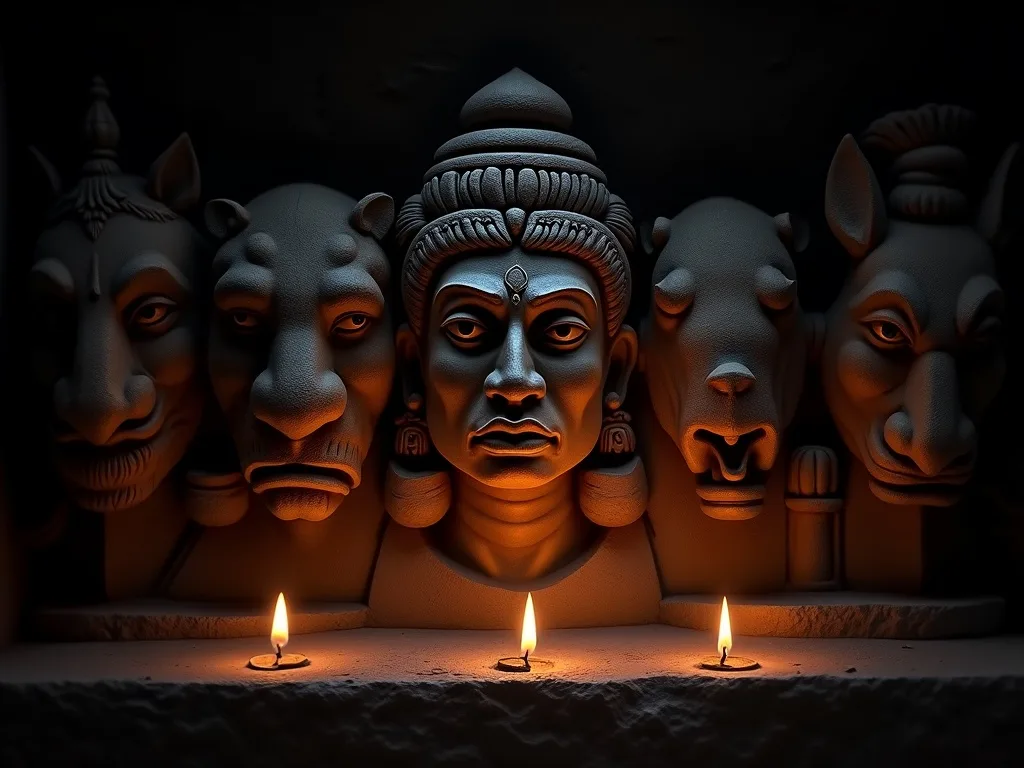
In some Tantric lineages, particularly in parts of Rajasthan and Madhya Pradesh, Hanuman is worshipped as Panchamukhi Hanuman, the five-faced form. Each face corresponds to one of his five divine ancestors or aspects: the vanara face to the south, the Narasimha (lion) face to the north, the Garuda (eagle) face to the west, the Varaha (boar) face to the east, and the Hayagriva (horse) face to the sky. This form is explicitly Tantric, connected to the protection of the five directions and the neutralization of black magic. It appears frequently on amulets and protective talismans.
In tribal communities across Jharkhand and Chhattisgarh, Hanuman merges with local forest deities, his monkey form connecting him to the animist reverence for monkeys as forest ancestors. The boundary between his Sanskrit mythology and these older substrate traditions is genuinely porous, and scholars like Wendy Doniger have noted that the vanara (monkey-people) of the Ramayana may encode older indigenous tribal confederacies into the epic's political geography.
In the diaspora, particularly in the Caribbean Hindu communities of Trinidad and Guyana descended from 19th-century indentured laborers, Hanuman temples became the earliest centers of religious life precisely because he requires no complex ritual apparatus, only devotion and the Chalisa. His accessibility across caste lines has made him the most genuinely pan-Hindu deity of the modern period.
The Wrestler's God and the Body as Devotion
For centuries, Hanuman has been the patron deity of akharas, the traditional Indian wrestling schools and gymnasiums. This is not symbolic. Wrestlers perform puja to Hanuman before and after every training session. The body, in this tradition, is not an object of vanity but an instrument of service, a vessel that must be disciplined and strengthened so that it can protect the weak and honor the lord. Strength without devotion is brute force; devotion without strength is sentiment. Hanuman unites them.
The body theology embedded in his myth is worth pausing on. He can shrink to a fly's size or expand to fill the sky. He can be struck by Indra's thunderbolt and walk away. He carries a mountain. He tears open his own chest. His body is simultaneously the most powerful and the most surrendered body in Hindu mythology, always at Rama's disposal, never deployed for personal gain. This is precisely the model offered to practitioners of Hatha Yoga, martial arts, and physical austerities in the Hanuman tradition: build the body not for yourself but as an act of devotion.
The connection between Hanuman and physical practice extends into the contemporary period. His image appears in gyms across India, on wrestling belts, on the bumpers of trucks carrying impossibly heavy loads. The 20th-century wrestler Dara Singh, who played Hanuman in the television Ramayan series (1987-1988, Doordarshan), became so identified with the role that millions of viewers genuinely mourned him when he died in 2012, as if a divine representative had left the earth.
Frequently Asked Questions about Hanuman
Frequently asked questions
Is Hanuman immortal, and does he still walk the earth?
Yes, according to Hindu tradition, Hanuman is one of the seven chiranjivis, beings granted immortality who are said to still exist in the world in physical form. The Ananda Ramayana and several Puranas state that he will remain alive until the end of the current age (Kali Yuga), reciting Rama's name wherever it is spoken. Many devotees report feeling his presence during intense prayer, and certain remote shrines in the Himalayas are associated with locations where he meditates.
What is the Hanuman Chalisa and why is it recited so widely?
The Hanuman Chalisa is a forty-verse hymn composed by the poet-saint Tulsidas, most likely in the late 16th century, in the Awadhi dialect of Hindi. Each verse praises one quality or deed of Hanuman. It is recited for protection against fear, illness, evil forces, and misfortune. The text is considered both a devotional act and a protective ritual (a kavach, or spiritual armor). Its accessibility, requiring no caste qualification, no priestly mediation, and no complex ritual knowledge, has made it ubiquitous across Hindu communities worldwide.
What is the relationship between Hanuman and Shiva?
Hanuman is widely understood as an amsha avatara of Shiva, meaning a partial incarnation carrying a portion of Shiva's divine energy. The Shiva Purana and Skanda Purana both describe Shiva agreeing to be born as a vanara to serve Vishnu's incarnation as Rama, since Vishnu's lila (divine play) required a perfect devotee of equal cosmic stature. This dual identity, Shiva's power wrapped in Vaishnavite devotion, is part of what makes Hanuman uniquely capable of bridging sectarian divisions within Hinduism.
Why is Hanuman painted red or orange in temple iconography?
The red or orange coloring has two traditional explanations. The more common holds that Sita anointed her own forehead with the red sindoor powder marking of a married woman, and Hanuman, learning that the sindoor honored Rama's long life, covered his entire body with it to multiply that blessing. The second explanation connects the orange to ochre, the color of sannyasa (renunciation), marking Hanuman as the supreme celibate devotee (brahmachari). Temple priests apply red vermillion powder (sindoor) to Hanuman's image as a core act of daily worship.
Does Hanuman appear in any tradition outside Hinduism?
Hanuman's influence extends throughout Southeast Asia, particularly in Theravada Buddhist countries. In Thailand's Ramakien, the national Thai version of the Ramayana (codified under King Rama I around 1800 CE), Hanuman is a major hero, though he is more amorous and more comedic than his Sanskrit counterpart. In Bali, Indonesia, where a Hindu tradition survives, the Kecak fire-dance, developed in the 1930s partly with input from the German artist Walter Spies, centers on Hanuman's story, performed by choirs of men producing a percussive chant rather than musical instruments.
What primary texts are the main sources for Hanuman's mythology?
The foundational source is the Valmiki Ramayana, particularly the Sundara Kanda (Book Five), which is entirely devoted to Hanuman's journey to Lanka. The Kishkindha Kanda (Book Four) describes his first meeting with Rama. Later elaborations appear in the Ananda Ramayana, the Adhyatma Ramayana, and several Puranas including the Skanda Purana and Shiva Purana. Tulsidas's Ramcharitmanas and Hanuman Chalisa are the dominant vernacular sources for north Indian devotion. The Tamil Kamba Ramayanam provides the major southern literary tradition.
Hanuman in the Age of New Devotion
Something unexpected has happened to Hanuman's image across the last thirty years. Alongside the ancient red-painted temple form, a new visual idiom has emerged: hyper-muscled, cinematic, occasionally armored, the body rendered with the anatomical precision of a comic-book superhero. Graphic novel publishers, mobile-game studios, and Bollywood poster artists have produced a Hanuman whose biceps could belong to a Marvel character, whose leap across the ocean looks like a superhero flight sequence.
Scholars of religion like Philip Lutgendorf, whose monograph Hanuman's Tale (Oxford University Press, 2007) remains the single most thorough scholarly study of the deity, have traced this visual shift to anxieties about Hindu masculinity in postcolonial India, the felt need to reclaim the warrior-devotee as a figure of contemporary power rather than premodern piety. The muscular Hanuman appears prominently in Hindu nationalist visual culture, a fact that troubles many devotees who see the shift as reducing a god of selfless love to a symbol of aggressive identity politics.
The tension is real, and it is not new. Even in the medieval period, different communities projected different things onto Hanuman. What remains constant across every version, from Valmiki to Tulsidas to the Kecak dancers of Bali to the akharas of Varanasi, is the fundamental paradox at his core: the most powerful being in the story is also the most completely surrendered. He can carry a mountain and does not want a crown. He can burn a city and weeps for his lord's suffering. Every tradition that touches him finds in that paradox something it needs, whether the assurance that love is stronger than power, or the proof that power without love is nothing at all.
That paradox, held open across three millennia, is why the temples are still open before dawn.
Free 25-page sample
Want the whole story?
Take the first 25 pages free. If it pulls you in, the full edition is yours as an instant PDF download, with a paperback on Amazon for selected titles.
Hindu
The Hindu Mythology Book: Vishnu, Shiva, Brahma, the Mahabharata, and the Sacred Stories of India
Vishnu, Shiva, Brahma, the Mahabharata, and the Sacred Stories of India
The Rigveda, the Mahabharata, the Ramayana, and the major Puranas. Every god, every avatar, every sacred epic.
More from Hindu
All articles
Hindu
The Bhagavad Gita: Krishna's Discourse on Duty and Devotion
On the eve of the Kurukshetra war, Krishna reveals the nature of the soul, duty, and liberation to a trembling Arjuna. The Bhagavad Gita's 700 verses have shaped Hindu thought for over two millennia.
Hindu
Lakshmi: Goddess of Wealth and Prosperity
Lakshmi stands at the center of Hindu cosmic order as the goddess who grants wealth, fortune, and abundance. Her eight forms, her lotus throne, and her ancient origins reveal a deity far richer than any single attribute.
Hindu
Krishna: The Divine Cowherd and Supreme God
Dark-skinned, flute in hand, Krishna stands at the center of Hindu devotion: trickster, warrior, philosopher, and the universe itself wearing a peacock feather.
Hindu
Durga and Kali: The Fierce Goddesses of Power
Durga rides a lion into battle; Kali stands on Shiva's chest, tongue red with demon blood. Two faces of the same cosmic fire, they reveal what Hindu theology understands about divine wrath, liberation, and the nature of time itself.