
The Bhagavad Gita: Krishna's Discourse on Duty and Devotion
On the eve of the Kurukshetra war, Krishna reveals the nature of the soul, duty, and liberation to a trembling Arjuna. The Bhagavad Gita's 700 verses have shaped Hindu thought for over two millennia.
Contents
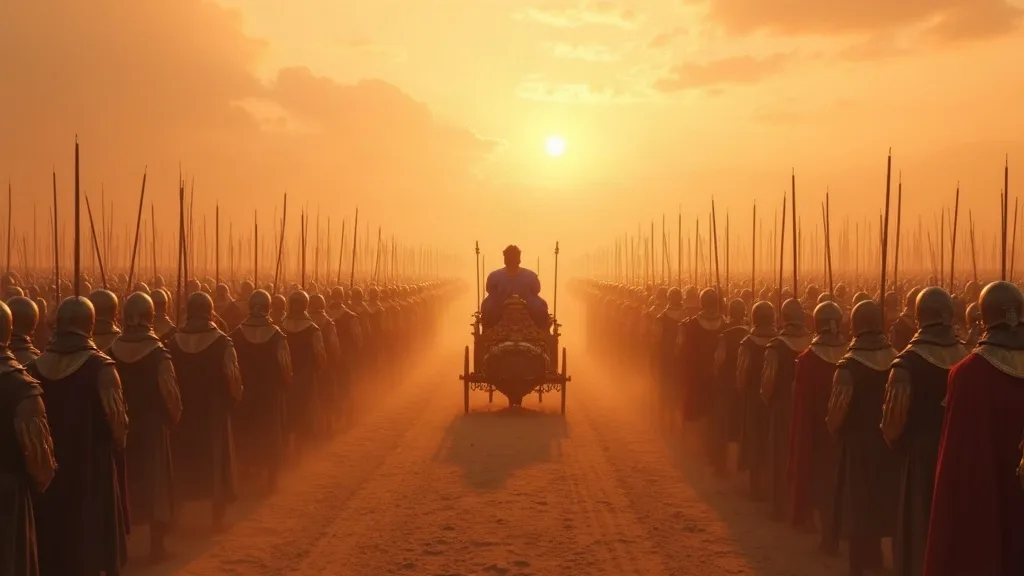
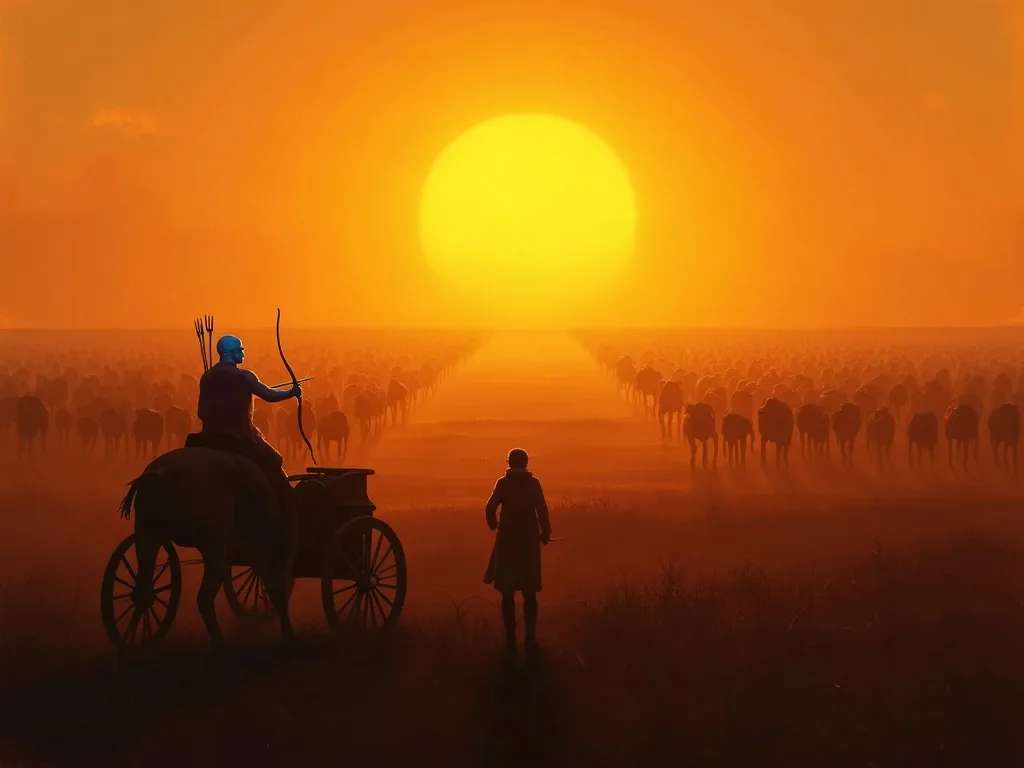
The conch shells sound. Two armies face each other across the plain of Kurukshetra, chariots aligned, arrows notched, the air thick with dust and the low trembling of war drums. Arjuna, the greatest archer alive, stands in his chariot between the two hosts and suddenly cannot move. He sees uncles, teachers, cousins on the opposing side. His bow, Gandiva, slips from his fingers. He tells Krishna, his charioteer, that he would rather die than kill his own kin.
What follows is not a battle report. It is one of the most concentrated philosophical dialogues ever set down in any language. Over the next eighteen chapters, Krishna speaks to Arjuna about the nature of the self, the structure of reality, the meaning of action, and the path toward liberation. The conversation takes perhaps an hour of narrative time. Its reverberations have not stopped.
The Bhagavad Gita: Krishna's Discourse on Duty and Devotion sits inside the Mahabharata, the vast Sanskrit epic attributed to the sage Vyasa, embedded in the sixth book (Bhishma Parva, chapters 23 through 40). Scholars date the core text to somewhere between the fifth century BCE and the second century CE, though the debate continues. What is undeniable is that the Gita, as it is universally called, became the single most read scripture of the Hindu world, and one of the most translated texts on Earth.
The Battlefield Setting and Why It Matters
The choice of a battlefield as the site of philosophical revelation is not accidental. Vyasa places Arjuna's crisis at the exact moment when evasion is impossible. The armies will not wait. The sun is rising. And yet Arjuna freezes, articulating with painful clarity every reason why fighting is wrong: the destruction of families, the corruption of lineages, the collapse of ancestral rites.
This crisis has a name in Sanskrit: vishada, grief or despondency. The first chapter is called Arjuna Vishada Yoga, the yoga of Arjuna's despair. Modern readers often recognise it immediately. The paralysis is not cowardice; it is the paralysis of a moral person who cares too much and thinks too fast. Arjuna is not wrong to feel what he feels. Krishna does not dismiss his grief. He listens, then begins to speak.
The battlefield also functions as a cosmic stage. Kurukshetra, a real site in the modern Indian state of Haryana, was already considered sacred ground before the Mahabharata was composed. The Shatapatha Brahmana mentions it as a field of ritual fire. Placing the Gita here signals that what is about to happen is not merely personal counsel but a revelation of universal scope.
Dharma, Karma, and the Immortal Self
Krishna's first major move is to reframe Arjuna's problem entirely. Arjuna is mourning people who, from the standpoint of ultimate reality, cannot die.
"Never was there a time when I did not exist, nor you, nor all these beings; nor will there be any time when we shall cease to exist." (Bhagavad Gita 2.12, trans. A. C. Bhaktivedanta Swami Prabhupada)
The atman, the individual self or soul, is nitya (eternal), avyaya (inexhaustible), aja (unborn), and avināshi (indestructible). Swords cannot cut it. Fire cannot burn it. Water cannot wet it. This is not poetry; it is a precise philosophical claim. The body is a garment. Grief over the body's death is, from the vantage point of the atman, a category error.
This leads directly to the concept of svadharma, one's own duty arising from one's nature and station. Arjuna is a kshatriya, a warrior. His dharma is to fight a just war. To step back from that duty out of sentiment is, Krishna argues, a failure of both courage and understanding. It would not prevent the deaths Krishna foresees; it would only ensure that Arjuna abandons his proper role in the cosmic order.
The concept of dharmic duty in the Bhagavad Gita is sometimes misread as rigid social determinism. The Gita is subtler. Krishna acknowledges that dharma is difficult to determine (sadharmasya gahana gatih, "the way of duty is deep," 4.17). What he insists on is the principle of nishkama karma, action without attachment to results. Do what your nature and situation call you to do. Do it fully. But do not grasp at the fruit.
Nishkama Karma: Action Without Attachment
Chapter three introduces Karma Yoga, the path of selfless action, and it remains one of the Gita's most practically resonant teachings. Krishna addresses a potential trap: if the atman is eternal and the body ephemeral, why act at all? Why not withdraw, renounce, sit still?
His answer is direct. Not acting is itself an act. The body cannot remain even for a moment without performing some action; it breathes, digests, moves. Worse, the person who renounces action while still mentally desiring its fruits is practicing self-deception. True renunciation is internal: continue to act, but release the craving for specific outcomes.
The analogy Krishna uses is the householder who performs sacrifice: the ritual action is real, the effort is real, but the actor does not clutch the result. Yajna, sacrifice, becomes a template for all ethical action. Work done as offering, as prasad returned to the world, is purifying. Work done as private accumulation entangles.
Shiva's philosophy of detachment shares certain structural parallels here: the great ascetic who is simultaneously the most active force in the cosmos. The Gita reaches a similar paradox from a different direction.
The Three Paths: Jnana, Bhakti, and Karma
The Gita's eighteen chapters are not a single argument but a layered architecture. Scholars have long noted that the text holds three primary paths to liberation in productive tension.
Jnana Yoga (chapters 2-4, 13-15): the path of discriminative knowledge. By understanding the difference between purusha (consciousness) and prakriti (nature), between the eternal self and the changing material world, the seeker dissolves the illusion of ego-bound action. This path draws on the older Upanishadic tradition, especially the Brihadaranyaka and Chandogya Upanishads.
Karma Yoga (chapters 3, 5-6): the path of disciplined action. The practitioner acts in full accordance with duty but without clinging to results. The will is engaged; the ego is sidelined. This path made the Gita intensely practical, applicable to any life situation.
Bhakti Yoga (chapters 7-12, especially 12): the path of loving devotion. Krishna reveals himself as the personal God who sustains all creation. To fix the mind on him, to offer every act to him, to take refuge in him alone: this is the highest path, described in chapter twelve as the "most secret of all secrets." Bhakti is not subordinate to Jnana; in the Gita's own hierarchy, it is presented as the most direct route.
These three are not meant to be exclusive options. Most commentators, from Adi Shankaracharya in the eighth century CE to Swami Vivekananda in the nineteenth, treat them as complementary strands suited to different temperaments. Shankaracharya emphasised Jnana; Ramanuja in the eleventh century centred Bhakti; B. G. Tilak in 1915 argued vigorously that Karma Yoga was the Gita's true spine, in a reading explicitly connected to India's independence struggle.
The Cosmic Revelation: Vishvarupa
Chapter eleven is unlike anything else in the Gita. Arjuna has absorbed Krishna's teaching, but he asks to see the divine form directly. Krishna grants him divya chakshu, divine sight, because the human eye cannot bear what is about to be shown.
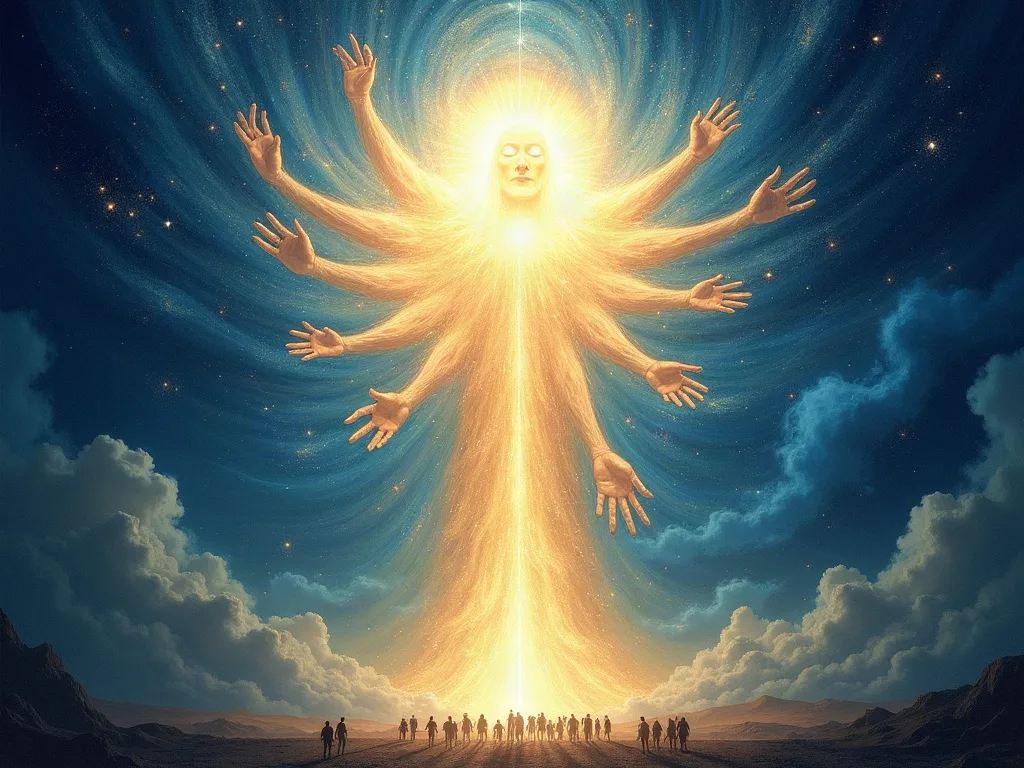
What Arjuna sees is Vishvarupa, the universal form: a being of infinite mouths, infinite eyes, infinite arms, blazing like a thousand suns simultaneously risen, swallowing all the warriors of Kurukshetra into its jaws like rivers flowing into the sea. The imagery is terrifying and magnificent in equal measure. Arjuna trembles and begs Krishna to return to his familiar, gentle form.
This chapter stands at the pivot of Krishna's divine teachings in the Bhagavad Gita. It dramatises a core theological claim: the personal god and the impersonal absolute are not two separate realities. Krishna, the charioteer with a flute, is also the ground of all being. The vision of Vishvarupa is the proof, offered not as argument but as direct experience.
The Vishvarupa passage has reverberated far beyond Hinduism. J. Robert Oppenheimer, who witnessed the first atomic bomb test at Trinity in 1945, quoted chapter eleven verse thirty-two: "Now I am become death, the destroyer of worlds." The line gains its full weight only when you know that it is not a threat but a revelation: time itself speaks, and time cannot be argued with.
Bhakti and the Personal God: Chapters 7 Through 12
The middle section of the Gita marks a shift in register. Krishna moves from philosophical analysis to personal disclosure. He is not merely a teacher explaining an impersonal system; he is a lover, a friend, the very ground of being who chose to become Arjuna's charioteer because devotion called him there.
In chapter nine, he describes how the universe perpetually emerges from him and returns to him like waves in an ocean. He holds all beings in himself "like a garland of jewels strung on a thread" (7.7). And yet he is not exhausted by this; the divine is inexhaustible precisely because it does not grasp at the maintenance of what it creates.
Chapter twelve, Bhakti Yoga, is often memorised in full by practicing Vaishnavas. Krishna catalogues the qualities of the devotee who is "dear to him": free from hatred, friendly to all creatures, not agitated by sorrow or elated by pleasure, self-sufficient, unmoved by outcomes. The portrait is not of a passive mystic but of someone deeply engaged with life while remaining unbound by it.
Vishnu's relationship with his devotees follows this same logic across the Puranas. The Bhagavata Purana, composed several centuries after the Gita, effectively extends the Bhakti theology of chapter twelve into an entire cosmos of sacred narrative.
Jnana Yoga (Path of Knowledge)
Emphasises discriminative wisdom: knowing the eternal self (atman) from the perishable body. Draws on the Upanishadic tradition. Favoured by Adi Shankaracharya. Accessible to those with strong philosophical temperament. The practitioner dissolves the ego through understanding rather than through emotional surrender.
Bhakti Yoga (Path of Devotion)
Emphasises loving surrender to Krishna as personal God. The practitioner offers every act, every thought, every breath to the divine. Favoured by Ramanuja and the Vaishnava tradition. Described in chapter twelve as the most direct path. Emotional and relational by nature, not cold or abstract.
The Gunas: Three Qualities That Shape All Reality
Chapters fourteen through eighteen extend the Gita's cosmology into an analysis of nature itself. All of material existence, prakriti, is woven from three fundamental qualities called gunas:
- Tamas: inertia, dullness, darkness, resistance to movement.
- Rajas: passion, agitation, desire, restless energy.
- Sattva: clarity, purity, balance, luminosity.
Every object, food, action, form of worship, and type of knowledge carries a mixture of the three. The aspiring practitioner works to increase sattva while reducing tamas and the binding quality of rajas. Even sattva can become a trap if one clings to it as an achievement. The ultimately liberated person, the gunatita, has transcended all three.
This framework had enormous influence on Ayurvedic medicine, classical Indian aesthetics (rasa theory), and the architecture of the Samkhya philosophical school. The Gita absorbs Samkhya's cosmological categories and reframes them within a theistic context: the three gunas are ultimately Krishna's own creative energy, maya, at play.
Transmission, Commentaries, and the Living Tradition
No text survives in isolation. The Gita reached its current cultural status through a chain of interpreters who each read it differently, sometimes contradicting one another, all claiming fidelity to the original.
Adi Shankaracharya (circa 788-820 CE) wrote the first surviving systematic commentary, arguing that the Gita ultimately teaches Advaita Vedanta: pure non-dualism, the identity of atman and Brahman. Action and devotion are preparatory stages; knowledge alone liberates.
Ramanuja (1017-1137 CE) countered with Vishishtadvaita, qualified non-dualism. The individual soul and the material world are real, but they exist as the body of Brahman. Bhakti is not a stepping stone; it is the highest reality. His commentary, the Gitabhashya, remains the foundational text of the Sri Vaishnava tradition.
Madhva (1238-1317 CE) went further, arguing for Dvaita, strict dualism: the soul and God are eternally distinct. Devotion is the only path, and the grace of Vishnu alone saves.
In the modern period, the Gita became a site of political as well as spiritual interpretation. Bal Gangadhar Tilak's Gita Rahasya (1915), written in a British prison, argued for Karma Yoga as an ethics of active resistance. Mahatma Gandhi called the Gita his "eternal mother," but read it allegorically: Kurukshetra was the battlefield of the human soul, not a historical war. Swami Vivekananda brought the text to Western audiences at the 1893 Parliament of the World's Religions in Chicago.
The Bhagavad Gita as a guide to spiritual liberation has also been taken up by figures far outside the Hindu tradition: Aldous Huxley, Henry David Thoreau, T. S. Eliot, and Carl Jung each found in its pages something that addressed their own philosophical crises.
The Mahabharata's larger narrative frames all of this: the Gita exists inside a story about what happens when a family destroys itself. That context is never entirely separable from the teaching it contains.
The Gita and the Problem of Violence
One question that honest readers raise: Krishna tells Arjuna to fight. People will die. Is the Gita a justification of violence?
The challenge is real, and serious thinkers have not avoided it. Gandhi's allegorical reading was partly motivated by the need to sidestep this difficulty. Ambedkar, the Dalit intellectual and architect of the Indian Constitution, criticized the text's use of svadharma to reinforce caste hierarchy.
The Gita's own internal logic offers several responses. First, the text is clear that this is a dharmic war, a battle already authorized by justice against a usurping power. It is not a general endorsement of violence. Second, the teaching of nishkama karma cuts against the ego-driven aggression that typically fuels war. Third, the Gita repeatedly states that the highest knowledge is ahimsa, non-injury, as one of the divine qualities listed in chapter sixteen (16.2).
But the tension remains live. The Gita does not pretend the world is free of conflict. It asks instead: how does a person of integrity act when the world forces a choice between bad outcomes? That question has not aged.
Frequently Asked Questions About the Bhagavad Gita
Frequently asked questions
Where exactly does the Bhagavad Gita appear in the Mahabharata?
The Gita is embedded in the Bhishma Parva, the sixth of the eighteen books of the Mahabharata, in chapters 23 through 40. The Mahabharata itself is traditionally attributed to the sage Vyasa, though modern scholars see it as a composite work assembled over several centuries. The Gita may have originated as an independent philosophical poem before being integrated into the epic.
How many translations of the Bhagavad Gita exist, and which are most reliable?
Over 300 translations exist in English alone. Among the most respected scholarly versions are those by Barbara Stoler Miller (1986, Columbia University Press), W. J. Johnson (1994, Oxford World's Classics), and Georg Feuerstein. For readers approaching from a Vaishnava devotional perspective, the translation by A. C. Bhaktivedanta Swami Prabhupada (1972) remains widely used, though its commentary carries a specific theological agenda. Winthrop Sargeant's interlinear Sanskrit-English edition (1979) is invaluable for students of the original text.
What is the difference between the Bhagavad Gita and the Upanishads?
The Upanishads are a collection of around 108 philosophical texts appended to the four Vedas, composed roughly between 800 and 200 BCE. They explore Brahman, atman, and liberation through dialogue and meditation. The Gita draws heavily on Upanishadic thought, especially the Chandogya and Katha Upanishads, but adds two crucial elements: a personal God (Krishna as Bhagavan) and the framework of Karma Yoga, active ethical engagement with the world. Shankaracharya's Prasthanatrayi places the Gita, the Upanishads, and the Brahma Sutras as the three foundational texts of Vedantic philosophy.
Is the Bhagavad Gita specific to Vaishnavism, or does it belong to all Hindu traditions?
The Gita is technically part of the Smriti (remembered scripture) rather than the Shruti (heard, i.e., Vedic scripture), which gives all Hindu schools freedom to interpret it. Shaiva philosophers, Shakta commentators, Advaita Vedantins, and Vaishnava schools have all claimed it. The text itself identifies Krishna as the supreme, which gives it a Vaishnava flavor, but its philosophical sections on the atman, karma, and the gunas are considered universal within Hindu discourse.
What did Oppenheimer actually mean when he quoted the Bhagavad Gita?
J. Robert Oppenheimer quoted chapter eleven, verse thirty-two: "Now I am become death, the destroyer of worlds." In the Gita, the speaker is Krishna in the Vishvarupa form, revealing to Arjuna that the warriors are already destined to die and that time (Kala) is the true agent of their deaths. Oppenheimer, witnessing the Trinity test in July 1945, appears to have seen in this verse a way to articulate the terrible vastness of what nuclear technology had unleashed: a power that exceeded human intent and moral control, much as Arjuna stood helpless before the cosmic form.
How did the Bhagavad Gita influence Western philosophy and literature?
The first English translation appeared in 1785, by Charles Wilkins, under the patronage of Warren Hastings. It immediately drew attention from European Romantics and Idealists. Wilhelm von Humboldt called it "the most beautiful, perhaps the only true philosophical song existing in any known tongue." Emerson and Thoreau read it; Thoreau kept a copy at Walden Pond. Hegel engaged with it skeptically. In the twentieth century, Huxley's The Perennial Philosophy used the Gita as a central example of the universal mystical tradition.
The Gita in the Twenty-First Century: Open Questions and New Readings
The text that began as counsel to a paralyzed warrior continues to generate new readings precisely because it refuses to resolve its own tensions neatly. Contemporary scholars including Arvind Sharma, Barbara Stoler Miller, and Wendy Doniger have examined the Gita's construction of gender, caste, and political power with tools unavailable to earlier commentators. The debate Ambedkar opened about svadharma and caste hierarchy has only deepened in post-independence India.
At the same time, the Gita's influence on psychology, ecology, and leadership studies shows no sign of slowing. The concept of nishkama karma has been applied to everything from medical ethics (act without attachment to outcome) to environmental philosophy (stewardship without ownership). Krishna's description of the self as "the field-knower" observing "the field" (chapter thirteen) has attracted interest from philosophers of consciousness working in the tradition of phenomenology.
The text is also increasingly read alongside other axial-age philosophical documents: the Analects of Confucius, the Phaedo of Plato, the Stoic meditations of Marcus Aurelius. All of them circle the same central question: how should a person act in a world they cannot control? The Gita gives one of the most architecturally sophisticated answers ever proposed, built on a cosmology that is simultaneously personal and cosmic, intimate and vast.
Krishna's discourse on duty and devotion was never simply a solution to Arjuna's problem on one morning in Kurukshetra. It was the articulation of a way of being human that remains, two thousand years later, urgently unfinished.
Free 25-page sample
Want the whole story?
Take the first 25 pages free. If it pulls you in, the full edition is yours as an instant PDF download, with a paperback on Amazon for selected titles.
Hindu
The Hindu Mythology Book: Vishnu, Shiva, Brahma, the Mahabharata, and the Sacred Stories of India
Vishnu, Shiva, Brahma, the Mahabharata, and the Sacred Stories of India
The Rigveda, the Mahabharata, the Ramayana, and the major Puranas. Every god, every avatar, every sacred epic.
More from Hindu
All articles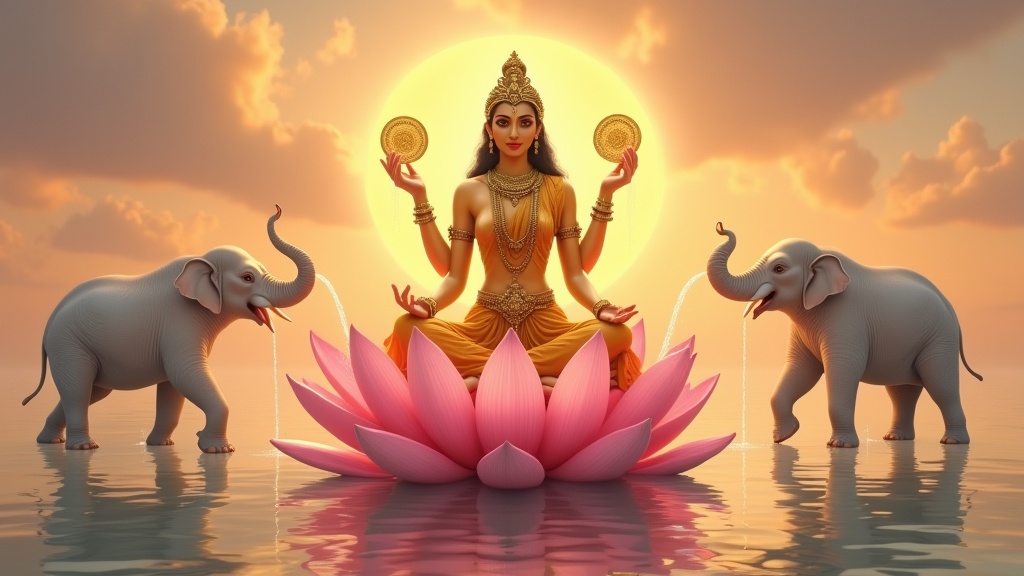
Hindu
Lakshmi: Goddess of Wealth and Prosperity
Lakshmi stands at the center of Hindu cosmic order as the goddess who grants wealth, fortune, and abundance. Her eight forms, her lotus throne, and her ancient origins reveal a deity far richer than any single attribute.

Hindu
Hanuman: The Monkey God of Devotion and Strength
Half-divine warrior, half-devoted servant, Hanuman stands as one of Hinduism's most beloved figures. His story is one of extraordinary power placed entirely at the feet of love.
Hindu
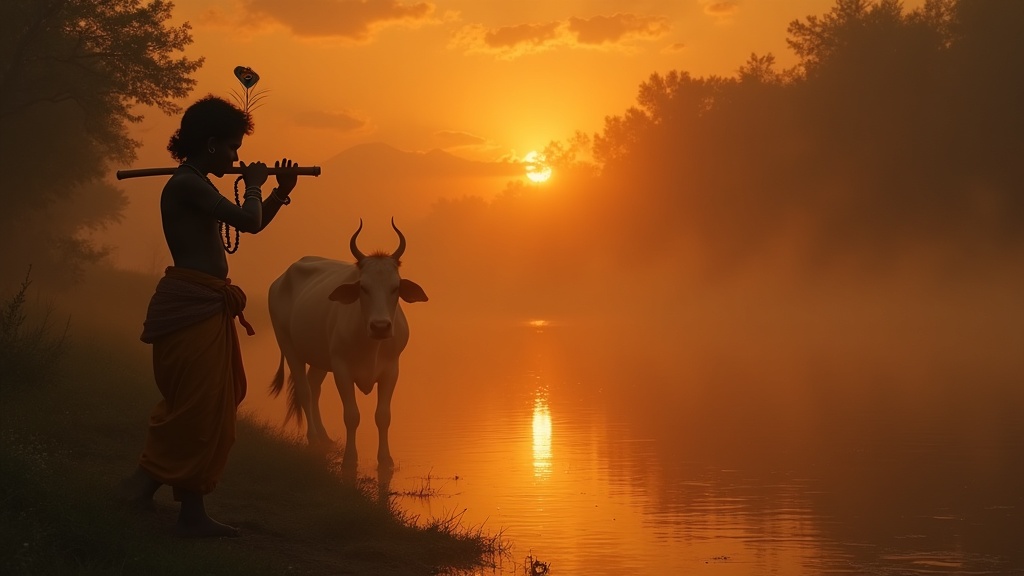
Krishna: The Divine Cowherd and Supreme God
Dark-skinned, flute in hand, Krishna stands at the center of Hindu devotion: trickster, warrior, philosopher, and the universe itself wearing a peacock feather.
Hindu
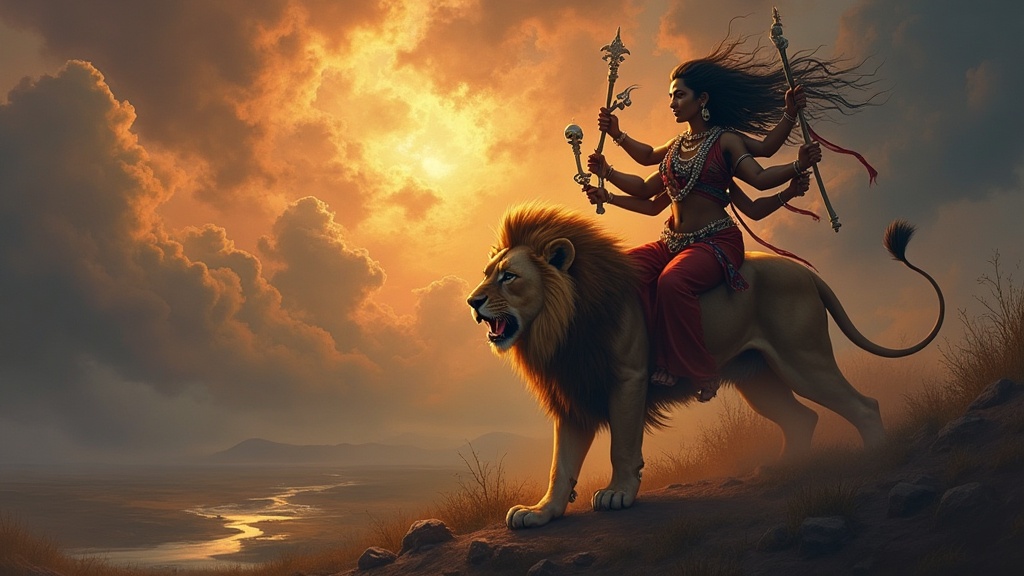
Durga and Kali: The Fierce Goddesses of Power
Durga rides a lion into battle; Kali stands on Shiva's chest, tongue red with demon blood. Two faces of the same cosmic fire, they reveal what Hindu theology understands about divine wrath, liberation, and the nature of time itself.