
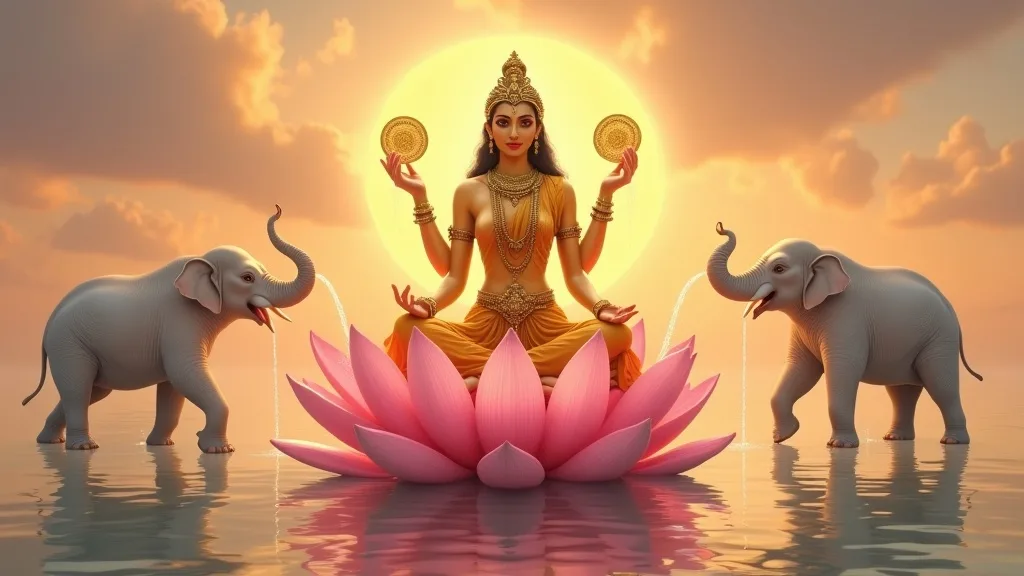
Lakshmi: Goddess of Wealth and Prosperity
Lakshmi stands at the center of Hindu cosmic order as the goddess who grants wealth, fortune, and abundance. Her eight forms, her lotus throne, and her ancient origins reveal a deity far richer than any single attribute.
Contents
The lotus rises from water before anything else moves. Then come the hands, four of them, pouring gold coins that never run out, holding a flower that never wilts. Lakshmi: Goddess of Wealth and Prosperity does not arrive with fanfare. She arrives with the particular stillness of abundance already present, already real.
She stands, or sits, at the center of one of the oldest living religious traditions on earth. Her image hangs in market stalls in Mumbai, in rice fields in Bali, in tech offices in Bengaluru, and in temple niches carved twelve centuries ago in the Deccan plateau. No other figure in the Hindu pantheon matches her simultaneity: she is at once the cosmic principle that sustains the universe and the specific grace a family asks for at Diwali, when small clay lamps line every windowsill.
Scholars trace her worship back to the Rigveda, though her full personality crystallizes across later texts, the Vishnu Purana, the Srimad Bhagavatam, the Lakshmi Tantra, and the Shri Suktam, a hymn still recited in morning rituals across South and Southeast Asia. Each source adds another layer: wealth, yes, but also sovereignty, beauty, crop fertility, spiritual liberation, and the mysterious interior quality that Sanskrit calls shri, which no single English word captures cleanly.
Origins and Vedic Roots of Shri-Lakshmi
The earliest Vedic layer offers a goddess called Shri, praised in the Shri Suktam, a hymn appended to the Rigveda and still among the most widely recited Sanskrit texts in living Hinduism. The hymn asks Shri to bring cattle, horses, grain, and sons, which were the literal currencies of wealth in an agrarian world. She is lotus-born (padmini), lotus-colored (padma-varna), and accompanied by elephants who shower her with water. That image, two elephants flanking a seated goddess and pouring water over her head, is called Gaja-Lakshmi and appears on coins minted in the Maurya period (circa 300 BCE), making it one of the oldest continuously reproduced religious images in South Asian art.
A second Vedic strand links her to the goddess Alaksmi, her shadow twin, who embodies misfortune, poverty, and inauspiciousness. Ancient ritual texts prescribe formulas to repel Alaksmi before inviting Shri. The two sisters together form a complete moral and cosmological polarity: good fortune is not a stable possession but a dynamic state, always capable of reversal. This polarity shaped the later theology of Lakshmi's characteristic "fickleness," chanchala, a quality her devotees frequently invoke not as a flaw but as a reminder that wealth must be earned, maintained, and given away in proper measure.
By the time the Vishnu Purana was composed (roughly 4th-5th century CE), the two names Shri and Lakshmi had merged entirely, and the goddess had been woven into a creation myth of staggering scope.
The Churning of the Cosmic Ocean
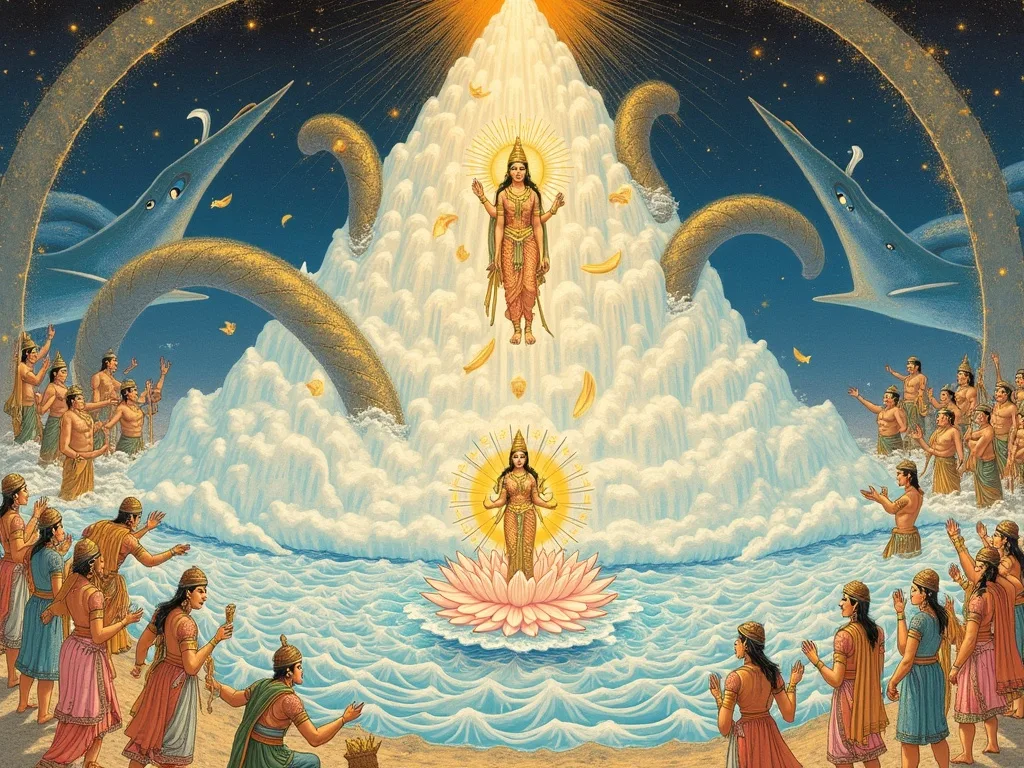
The Samudra Manthan, the churning of the cosmic ocean, is among the grandest set pieces in all of Hindu mythology, and Lakshmi emerges from it as one of its supreme prizes. The story, told most fully in the Vishnu Purana and the Srimad Bhagavatam, begins when the sage Durvasa curses Indra, king of the Aesir-equivalent Adityas, causing his sovereignty to drain away like water from a cracked pot. The gods lose their vigor. Asuras (demons) seize the three worlds.
Vishnu counsels a temporary truce: if gods and demons cooperate to churn the primordial ocean of milk, Kshirasagara, the resulting amrita, the nectar of immortality, will restore the gods. They use Mount Mandara as a churning rod, wrapped with the serpent Vasuki as a rope, with Vishnu himself stabilizing the mountain from below in his tortoise avatar Kurma.
Out of the churning come fourteen cosmic treasures, the ratnas or jewels of the universe. Fourteen is the traditional count, though the lists vary across texts. Among them: the physician Dhanvantari carrying a pot of amrita; the divine physician's gift; the wish-granting cow Kamadhenu; the horse Uchchaishravas; the elephant Airavata; the deadly poison Halahala, which Shiva drinks to save creation; and, crowning the sequence, Lakshmi herself, seated on a lotus, radiating golden light, holding another lotus.
All present, gods and demons alike, are stunned into stillness. Rishis chant the Shri Suktam. The celestial Gandharvas sing. The oceans bring her the finest garments. Brahma offers a garland of flowers that never fade. Then Lakshmi looks slowly across the assembly and places her garland around the neck of Vishnu. That gesture, a choice rather than a commandment, defines their relationship for every subsequent age of cosmic time.
The churning narrative does more than explain Lakshmi's origin. It frames her as the pivot on which cosmic order (rita, later dharma) turns. Without her presence, the gods lack the radiant authority to govern. Without that authority, the cosmos slides toward chaos. The Goddess of Wealth and Prosperity is, at this level, the energy that makes ordered existence possible.
Lakshmi and Vishnu: A Theology of Sacred Marriage
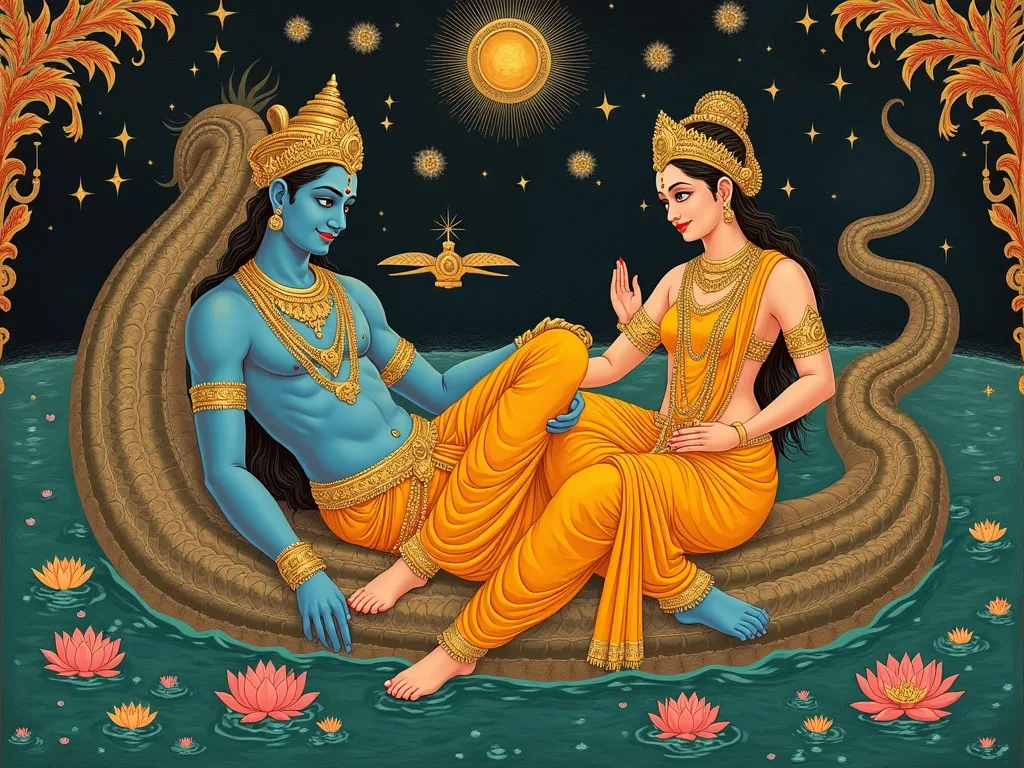
No other divine couple in Hindu theology has generated as sustained a theological literature as Lakshmi and Vishnu. The Vaishnava tradition treats their union not as a narrative convenience but as a metaphysical principle: Vishnu is the absolute ground of being, and Lakshmi is his shakti, the active power through which that being manifests as a living, nourishing cosmos.
The philosopher-theologian Ramanuja (1017-1137 CE) made Lakshmi's mediating role central to the Vishishtadvaita (qualified non-dualism) school of Vedanta. In his reading, Lakshmi intercedes between the devotee and Vishnu, her infinite compassion (karuna) softening his cosmic sovereignty (aishvarya). A worshipper cannot simply walk into the presence of the absolute. Lakshmi is the door.
This mediating function appears concretely in Vishnu's avatars. When Vishnu descends as Rama, Lakshmi descends as Sita. When he descends as Krishna, she descends as Rukmini (and, in some traditions, as Radha). Each avatar pair re-enacts the primal choice: Lakshmi, free to attach herself to any cosmic power, repeatedly chooses the one who upholds dharma. This makes her not merely a consort but a theological testimony: wherever true virtue and order exist, prosperity follows.
The Pancharatra tantric texts, some of the oldest Vaishnava canonical works, describe Lakshmi's six qualities (shadgunya): knowledge, sovereignty, energy, strength, creative power, and splendor. These are the same qualities attributed to Vishnu himself. She is not subordinate; she is constitutive.
The Ashta-Lakshmi: Eight Forms of Fortune
The tradition did not leave Lakshmi's gifts as one undifferentiated blessing. The Ashta-Lakshmi, the eight Lakshmi forms, map her abundance onto eight distinct registers of human flourishing. Temples devoted to all eight together are found across Tamil Nadu and Andhra Pradesh, and the eight are invoked collectively in the Ashta-Lakshmi Stotram, a popular devotional composition.
- Adi-Lakshmi (the primordial form): the aspect that exists before creation, the unlimited ground of the goddess.
- Dhana-Lakshmi (wealth): specifically financial and material abundance, the form most commonly visualized with gold coins pouring from her hand.
- Dhanya-Lakshmi (grain): the fertility of the earth, adequate harvests, the prosperity of farmers.
- Gaja-Lakshmi (elephants): sovereignty and royal power; the elephant-flanked form found on Mauryan coins.
- Santana-Lakshmi (progeny): the blessing of children, lineage continuity, familial prosperity.
- Veera-Lakshmi (courage): the strength to face adversity, the valor that protects earned fortune.
- Vijaya-Lakshmi (victory): success in endeavors, overcoming obstacles, the grace that turns effort into outcome.
- Vidya-Lakshmi (knowledge): the wisdom that converts raw wealth into meaningful life; she overlaps here with Saraswati, reflecting how Hindu theology refuses to separate intellectual and material flourishing.
The Ashta-Lakshmi framework is a sophisticated answer to a real question: why do people with money lack happiness, or people with knowledge lack resources? Because shri is not a single thing. Each of its eight facets must be cultivated separately, and the absence of any one leaves the structure incomplete.
Iconography: Reading the Lotus, the Gold, the Owls
Lakshmi's visual grammar is among the most codified in South Asian religious art, and every element carries precise theological weight.
The lotus (padma) recurs so persistently that Lakshmi's most common epithet is simply Padma or Kamala. The lotus grows from muddy water and emerges unstained, a physical demonstration of the theological claim that true shri dwells in the world without being corrupted by it. Lakshmi stands on a lotus, holds a lotus, and is framed by lotus borders. Some texts say she was born from the lotus; others say the lotus was born from her.
Her four arms encode a complete theology of time. Two hands hold lotuses. One hand (the lower right) points downward in varada mudra, the gesture of giving. One hand (the lower left) is raised in abhaya mudra, the gesture of protection. She is simultaneously a source and a refuge, giving with one hand and shielding with the other.
Gold coins pour from one hand in later iconographic traditions, a medieval elaboration that makes the material dimension explicit. But classical Gupta-period sculpture (4th-6th century CE) often depicts her simply seated, composed, without the coin-pour: the wealth is implicit in her presence, not demonstrated by a prop.
The owl (uluka) serves as her mount (vahana) in many North Indian traditions. This surprises people expecting something more regal. The owl sees in darkness, an emblem of the wisdom that locates wealth even where others cannot perceive it. It also hunts with patience and precision, qualities the tradition reads as necessary disciplines for the person who wishes to sustain rather than squander what Lakshmi grants.
Red and gold dominate her color palette. Red (rakta) is the color of life, energy, and auspiciousness in Hindu ritual. Gold is self-explanatory. In South Indian bronze sculpture of the Chola period (9th-13th century CE), her posture becomes increasingly refined, her ornaments more intricate, reflecting a royal aesthetic that identified divine grace with artistic perfection.
Diwali: The Annual Return of the Goddess
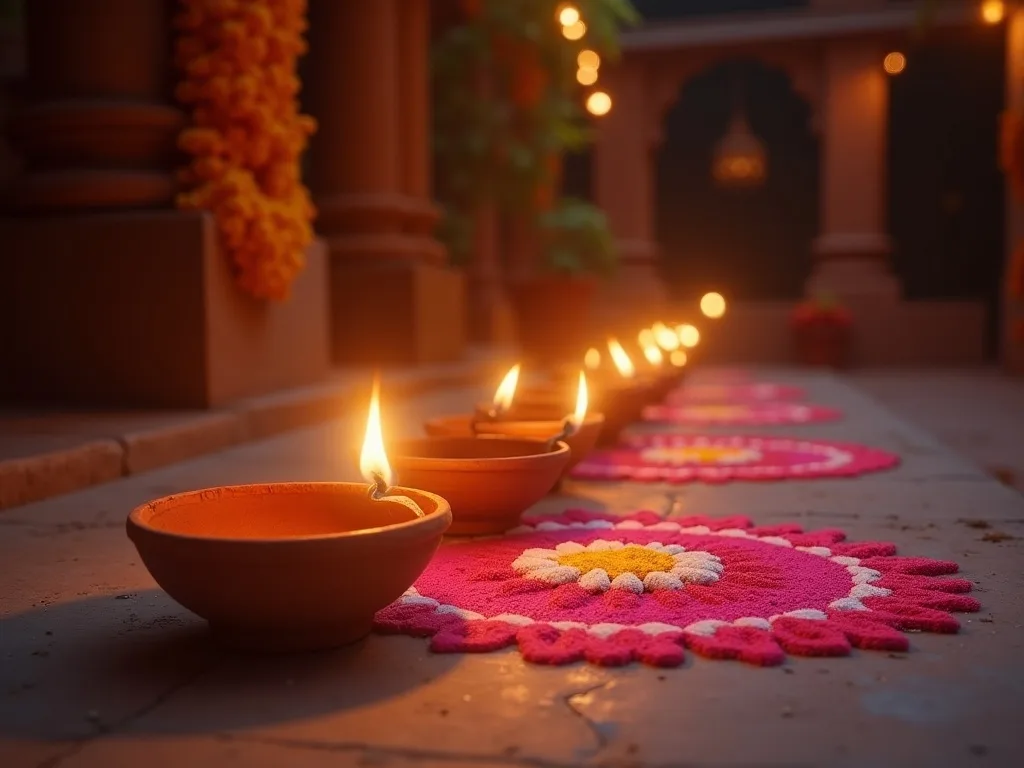
No ritual event in South Asian religious life concentrates attention on Lakshmi as completely as Diwali, the festival of lights. The timing follows the Kartik new moon (October-November), when the night is at its darkest and the goddess is said to wander, looking for clean, well-lit homes to bless for the coming year.
The ritual logic is older than the current festival form. The Rigveda's concept of shri as something that enters and departs a household like a distinguished guest already contains this idea: prosperity is not owned but hosted. Diwali rituals enact that hospitality. Homes are cleaned meticulously, because Lakshmi will not enter a dirty house. Lamps are lit, because she follows light. Rangoli patterns, geometric or floral designs made from colored powder, are drawn at thresholds to invite her. Merchant communities perform Lakshmi Puja on the main night, opening their account books to her blessing, a tradition continuous since at least the medieval period in Gujarati and Rajasthani trading communities.
The specific Diwali narrative varies by region. In North India, Diwali celebrates the return of Rama and Sita (Vishnu and Lakshmi in avatar form) to Ayodhya after fourteen years of exile, the lamps recalling the lights villagers set out to guide them home. In parts of Bengal, the festival night belongs instead to the goddess Kali, who shares the same new moon. In South India, the emphasis shifts to the defeat of the demon Narakasura by Krishna (another avatar of Vishnu). The Goddess of Wealth and Prosperity is, across all these regional variations, the underlying promise that ordered life, restored and illuminated, brings abundance in its wake.
Lakshmi Across Traditions: Jainism, Buddhism, and Southeast Asia
The reach of shri extends well beyond Hindu practice. The goddess Shri appears in the Jain canonical texts (Agamas) as one of the vidyadevis, knowledge goddesses who attend the Tirthankaras. Jain temple sculpture frequently places Gaja-Lakshmi imagery at entryways, adapted to a tradition that rejects theistic devotion but accepts auspicious imagery.
In Buddhism, the figure of Shri-Lakshmi became Kishijoten in Japan and Sri-devi in Tibetan tantric Buddhism (where she is a wrathful protectress rather than a gentle bestower). Buddhist Gandharan sculpture of the 2nd-4th centuries CE shows unmistakable Lakshmi iconography on temple facades, suggesting that her image served as a shared visual language of divine blessing across traditions in ancient South Asia.
The most sustained non-Hindu adaptation occurred in Southeast Asia. The Khmer empire (9th-15th century CE) at Angkor developed a Sanskrit-language royal theology in which the king's legitimacy depended partly on his identification with Vishnu and his queen's with Lakshmi. The bas-reliefs at Angkor Wat depict the Samudra Manthan scene across a 49-meter carved panel, with Lakshmi at its center, making her the literal pivot of Khmer cosmological art. In Bali, which preserved a distinctly Indic Hindu tradition after Islam spread through Java, Lakshmi remains a living cult presence today, invoked in rice agriculture under the name Dewi Sri, a local adaptation that fused her grain-goddess aspect with indigenous agricultural spirits.
Scholarly Debates: Chastity, Sovereignty, and the "Fickle Goddess"
The epithet chanchala, fickle or unstable, attached to Lakshmi from early in the literary tradition, and it has generated significant scholarly discussion. Some interpreters, following a straightforwardly patriarchal reading, have taken it as a projection of male anxiety onto the female principle: wealth, like women, cannot be trusted to stay. Wendy Doniger and other historians of religion have documented how this reading circulated in Sanskrit didactic literature, where a virtuous man is instructed not to boast of Lakshmi's favor, lest she hear and depart.
But a contrasting reading, developed by A.K. Ramanujan and more recently by scholars like Vasudha Narayanan, situates chanchala in the same theological register as the Buddhist concept of anicca (impermanence). Lakshmi's movement is not capricious but purposeful: she leaves where dharma is violated and arrives where it is honored. The Vishnu Purana is explicit on this point, narrating episodes in which Lakshmi abandons kings who grow arrogant, covetous, or negligent of ritual. Her mobility is her moral mechanism.
The sovereign dimension of her character, often underplayed in popular representations that reduce her to a coin-pouring icon, receives sustained attention in the Arthashastra tradition, which frames shri as a political quality: the radiant authority of the just king that causes subjects to prosper and enemies to submit without violence. Kautilya (4th century BCE) does not name Lakshmi explicitly, but the concept of shri as royal tejas (inner radiance) runs through his political theory. Centuries later, Chola queens bore the title Lakshmi as part of their formal designation, a direct claim to embody her sovereignty.
What Lakshmi Demands: The Ethics of Abundance
The devotional tradition around Lakshmi is not passive. Virtually every major text on her worship pairs the goddess's gifts with a corresponding set of obligations.
The Lakshmi Tantra (roughly 9th-10th century CE), a Pancharatra text devoted entirely to Lakshmi's theology, insists that she cannot be compelled or purchased. Ritual purity, generous giving (dana), and truthful conduct are the preconditions, not the transactional price, of her favor. The text frames her as Svayamsiddha, self-realized, and the worshipper's task is to align their own character with the conditions in which she naturally dwells.
The Mahalakshmi Ashtakam, attributed to the sage Indra in the Padma Purana, lists her as the destroyer of suffering, the remover of sins, the one who grants intelligence, beauty, and liberation (moksha). That last word matters: shri in its fullest sense includes spiritual liberation. Material wealth is its outer shell; liberation is its core. The person who gains only coins and misses moksha has grasped the outer husk and left the grain.
This ethical architecture explains why Lakshmi is invoked alongside Saraswati (goddess of knowledge) and Durga in the Navaratri festival cycle: the tradition refuses to let any single divine function stand alone. Prosperity without knowledge corrupts. Knowledge without strength cannot protect itself. The three goddesses form a system.
Frequently asked questions about Lakshmi
Frequently asked questions
What is the difference between Lakshmi and Shri?
The names are theologically identical in post-Vedic Hinduism. Shri is the older Vedic designation, found in the Shri Suktam of the Rigveda, and refers to the quality of radiant auspiciousness. Lakshmi appears more prominently in Puranic literature as the consort of Vishnu and the personified goddess of fortune. By the Gupta period (4th-6th century CE), both names were used interchangeably for the same deity, and texts frequently join them as Shri-Lakshmi. Modern usage tends to favor Lakshmi for the goddess and Shri as an honorific prefix (as in Shri Ram or Shri Devi).
Why is Lakshmi considered fickle, and is that view accurate?
The chanchala (fickle) epithet comes from Sanskrit didactic literature and the Puranas, which describe her departing from homes or kingdoms where dharma is ignored. Later Vaishnava theologians, particularly within the Sri Vaishnava school founded by Ramanuja, reframed this mobility as moral purposefulness rather than caprice: Lakshmi withdraws from arrogance and dishonesty and arrives where virtue, generosity, and order prevail. The "fickle" reading is a popular shorthand; the fuller theological picture is of a goddess whose movements encode a precise ethical logic.
What are the primary sacred texts about Lakshmi?
The foundational texts are the Shri Suktam (appended to the Rigveda), the Vishnu Purana (churning of the ocean narrative and her relationship with Vishnu), the Srimad Bhagavatam (tenth book especially), the Lakshmi Tantra (a complete Pancharatra text devoted to her theology), the Mahalakshmi Ashtakam (from the Padma Purana), and the Ashta-Lakshmi Stotram (a devotional hymn enumerating her eight forms). The Devi Mahatmyam (within the Markandeya Purana) addresses her sovereign, cosmic-power aspect under the broader figure of the Great Goddess.
How did Lakshmi's worship spread outside India?
Lakshmi's iconography traveled with Indian maritime trade from roughly the 2nd century BCE onward. Coins bearing Gaja-Lakshmi imagery circulated through Gandharan, Southeast Asian, and Roman trade routes. The Khmer empire at Angkor institutionalized Vaishnava royal theology with Lakshmi as its feminine axis, culminating in the Angkor Wat bas-reliefs (12th century CE). In Bali, she survives as Dewi Sri, the rice goddess, blended with local agricultural spirits. In Japanese Buddhism, she became Kishijoten, goddess of beauty and luck, still worshipped at temples such as Kofukuji in Nara.
Is Lakshmi only associated with money?
The reduction of Lakshmi to financial wealth alone is a modern simplification, largely driven by mercantile Diwali iconography. Classical theology treats her as the source of all eight forms of prosperity (Ashta-Lakshmi): material wealth, grain, courage, progeny, sovereignty, victory, knowledge, and primordial abundance. The Sanskrit concept of shri that she embodies covers moral radiance, political authority, and spiritual liberation alongside material fortune. Many classical texts explicitly state that the person who fixates on Lakshmi's coin-pouring aspect while neglecting her vidya (knowledge) and vijaya (victory) dimensions misunderstands her nature.
What is the significance of the lotus in Lakshmi's iconography?
The lotus (padma) is Lakshmi's defining symbol for two interlocking reasons. First, origin: several Puranas say she was born from the lotus that grew from Vishnu's navel, or that she emerged from the churning ocean seated on a lotus. Second, theology: the lotus grows from muddy water and surfaces unblemished, modeling the shri principle that true prosperity exists in the material world without being degraded by it. Her epithet Padmavati (lotus-dwelling) and Kamala (lotus) reflect this directly. In classical art, her lotus pedestal also elevates her above the mundane ground, marking her as a cosmic rather than merely earthly power.
Lakshmi in the Modern World: Between Icon and Ideal
The contemporary life of Lakshmi: Goddess of Wealth and Prosperity is a study in scale and adaptation. Her image circulates in currencies (the Indian rupee note series has featured her temple motifs), in corporate logos, in smartphone Diwali animations, and in diaspora temples from Leicester to Los Angeles. The Tirumala Tirupati Devasthanam, the wealthiest religious institution in the world by donation volume, centers its theology on the goddess Padmavathi, identified with Lakshmi, as the consort of Venkateswara (Vishnu). The annual donations, exceeding 15 billion rupees in recent years, are themselves understood as the return flow of shri: what the goddess gives, her devotees offer back.
Some contemporary Hindu scholars, including Devdutt Pattanaik, have argued that the reduction of Lakshmi to a prosperity-gospel icon strips away her harder edges. The texts make clear that Lakshmi departs from the covetous, the violent, and the ritually negligent. She is not a vending machine for wealth but a barometer of cosmic order. A community, a household, or a civilization that loses her is being told something specific about the quality of its collective dharma.
The deepest layer of her theology, the shri that is liberation, remains quietly present beneath the gold-coin imagery, recognizable to anyone who reads the Lakshmi Tantra or the Mahalakshmi Ashtakam with attention. The goddess sitting on her lotus is not simply promising material reward. She is pointing toward a state in which internal and external order align so completely that the distinction between spiritual and material abundance dissolves. That is the oldest promise she carries. It predates every coin that ever bore her image.
Free 25-page sample
Want the whole story?
Take the first 25 pages free. If it pulls you in, the full edition is yours as an instant PDF download, with a paperback on Amazon for selected titles.
Hindu
The Hindu Mythology Book: Vishnu, Shiva, Brahma, the Mahabharata, and the Sacred Stories of India
Vishnu, Shiva, Brahma, the Mahabharata, and the Sacred Stories of India
The Rigveda, the Mahabharata, the Ramayana, and the major Puranas. Every god, every avatar, every sacred epic.
More from Hindu
All articles
Hindu
The Bhagavad Gita: Krishna's Discourse on Duty and Devotion
On the eve of the Kurukshetra war, Krishna reveals the nature of the soul, duty, and liberation to a trembling Arjuna. The Bhagavad Gita's 700 verses have shaped Hindu thought for over two millennia.

Hindu
Hanuman: The Monkey God of Devotion and Strength
Half-divine warrior, half-devoted servant, Hanuman stands as one of Hinduism's most beloved figures. His story is one of extraordinary power placed entirely at the feet of love.

Hindu
Krishna: The Divine Cowherd and Supreme God
Dark-skinned, flute in hand, Krishna stands at the center of Hindu devotion: trickster, warrior, philosopher, and the universe itself wearing a peacock feather.
Hindu
Durga and Kali: The Fierce Goddesses of Power
Durga rides a lion into battle; Kali stands on Shiva's chest, tongue red with demon blood. Two faces of the same cosmic fire, they reveal what Hindu theology understands about divine wrath, liberation, and the nature of time itself.