
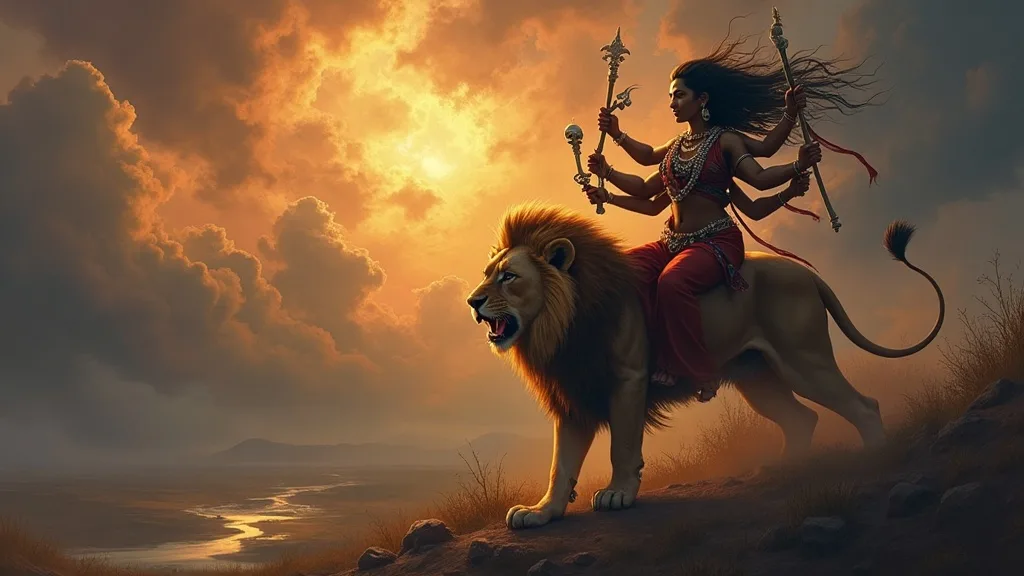
Durga and Kali: The Fierce Goddesses of Power
Durga rides a lion into battle; Kali stands on Shiva's chest, tongue red with demon blood. Two faces of the same cosmic fire, they reveal what Hindu theology understands about divine wrath, liberation, and the nature of time itself.
Contents
The demon Mahishasura had a boon that no man or god could kill him. He had earned it through austerities so severe that Brahma had no choice but to grant it, and for years he tore through the three worlds, driving the Aesir-equivalent Aesir from their celestial seats and turning heaven into a ruin. The gods pooled their rage and their light. That pooled fury, tejas in Sanskrit, condensed into a form so luminous it scorched the sky: a woman with eighteen arms, riding a lion, holding every weapon at once. She was Durga, "the one who is difficult to approach," and what followed was not a battle so much as a reckoning.
She fought for nine days. She killed the demon's generals. She killed the demon himself after he shapeshifted through buffalo, lion, elephant, and finally human form. The Devi Mahatmya, composed roughly between the 4th and 6th centuries CE and embedded in the Markandeya Purana, records the whole campaign in precise, almost military language. It is still recited at Navratri, the nine-night festival that marks her victory every autumn.
Kali came later, or perhaps she was always there underneath. When the blood of the demon Raktabija hit the ground, each drop became a new Raktabija, a cloning multiplication that made ordinary slaughter impossible. Durga's fury intensified until her face turned dark, her eyes red. From her forehead a goddess erupted: skeletal, blackened, wearing a garland of severed heads. That goddess opened her mouth and consumed every drop of blood before it could fall. She was Kali, "the black one," "the one beyond time," and she did not stop when the battle ended.
The Mythology Behind the Names
The name Durga compounds the Sanskrit root dur (difficult) with ga (to go or approach). She is the fortress that enemies cannot penetrate, and simultaneously the terrain too difficult to cross. In the Devi Mahatmya she is called Chandika (the fierce), Ambika (the mother), Amba (the primal), and Bhagavati (the blessed one), each epithet pointing at a different facet of the same blazing presence.
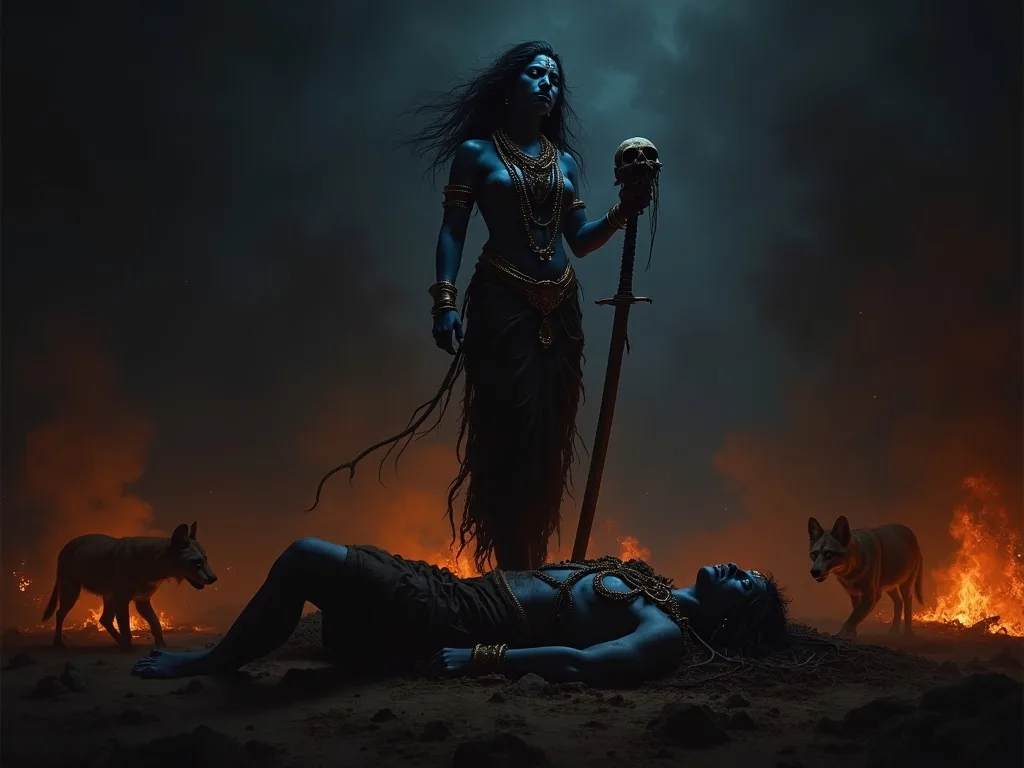
Kali derives from kala, the Sanskrit word for both "black" and "time." Both meanings are intentional. She is the darkness before creation and the darkness that swallows it at the end. She is time made visible, which is why her iconography is so deliberately unsettling: her black skin, her wild hair, the severed head she holds in one hand, the sword in another, the skull-cup catching blood. She offers abhaya mudra with a third hand, the gesture of fearlessness, and a fourth hand points downward in varada mudra, blessing. Terror and refuge in the same body.
The Kalika Purana, composed in Assam roughly between the 9th and 11th centuries CE, elaborates her mythology in the region that still hosts the Kamakhya temple, one of the 51 shakti pithas (seats of the goddess) scattered across the subcontinent. The Mahabhagavata Purana and regional Bengali tantric texts develop her further, giving her the great cremation ground of Smashan as her natural dwelling, a place where the illusion of the living body dissolves.
Two Aspects of One Shakti
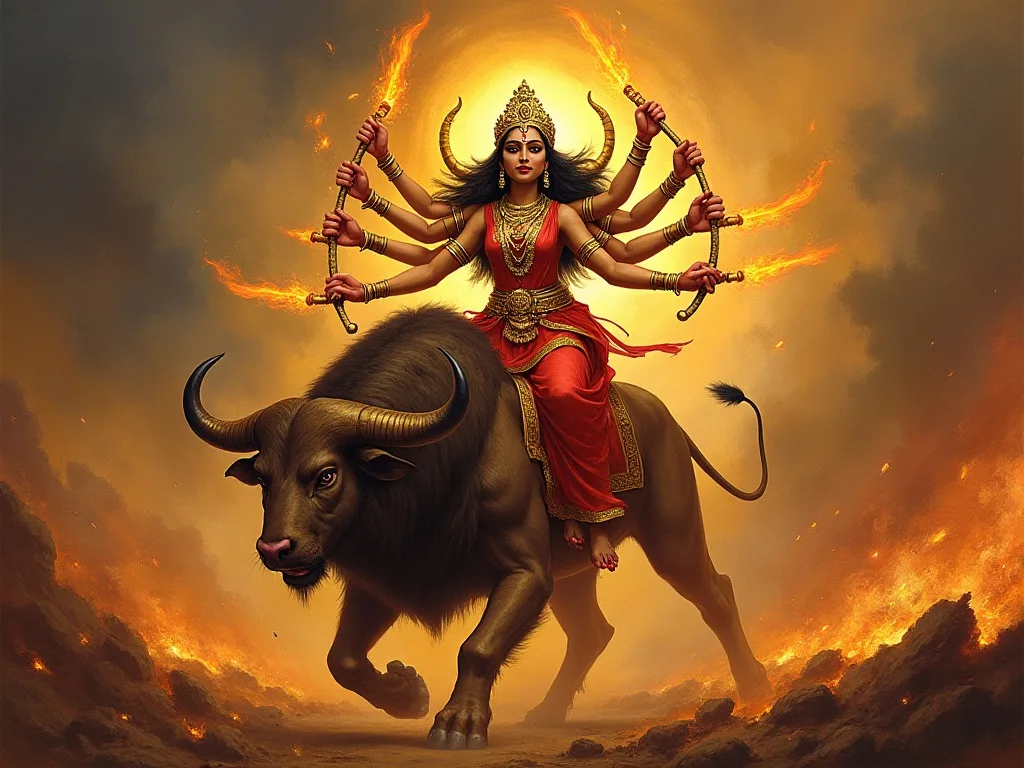
Hindu theology does not present Durga and Kali: The Fierce Goddesses of Power as rival deities or opposing principles. They are aspects of Shakti, the primordial feminine energy that animates the universe. The Shakta philosophical tradition, systematized in texts like the Devi-Bhagavata Purana (circa 6th-12th century CE), holds that the Goddess is Brahman itself, the ground of being, and that figures like Vishnu, Shiva, and Brahma are her expressions rather than her superiors.
Durga's relationship with Shiva is instructive. In one strand of mythology she is his consort Parvati, who takes the fierce form of Durga or Kali when cosmic necessity demands it. In another, older Shakta strand, she is entirely independent, self-caused, the source from which Shiva himself draws his transformative power. The Soundarya Lahari, attributed to the 8th-century philosopher Adi Shankaracharya, opens with the line: "Without your Shakti, Shiva is a corpse." The Sanskrit plays on words: Shava (corpse) and Shiva (auspicious) differ by a single vowel.
Kali's relationship with Shiva is even more charged. In the mythology surrounding her post-battle frenzy, she danced so wildly on the corpses of demons that the earth trembled. Shiva lay down in her path. When Kali's foot landed on her husband's chest, she stopped, startled back to herself, and stuck out her tongue in the gesture of lajja (modest embarrassment). That image, tongue out, foot on Shiva's chest, is the most reproduced depiction of Kali in Bengal and across the Hindu diaspora.
The two goddesses share iconographic territory but occupy different emotional registers. Durga is martial and radiant, riding her lion (vahana) with composure, her face serene even in battle. Kali is ecstatic and terrifying, moving through the night uncontrolled, embodying a power that civilization cannot contain. Together they map the full range of Shakti: ordered force and untamed force, protective wrath and annihilating wrath.
Durga
- Form: Luminous, golden or red-complexioned, eighteen armed
- Mount: Lion or tiger
- Weapons: Trident, sword, bow, discus, mace, lotus; weapons gifted by gods
- Emotional register: Fierce but composed; serene in battle
- Primary texts: Devi Mahatmya, Devi-Bhagavata Purana
- Major festival: Navratri / Durga Puja (autumn)
- Theological role: Protective cosmic warrior; guardian of dharmic order
Kali
- Form: Black-skinned, skeletal or full-bodied, four to ten armed
- Mount: None; stands on Shiva or dances on corpses
- Weapons: Sword, severed head, skull-cup; she needs no gifts
- Emotional register: Ecstatic, uncontrolled, beyond social constraint
- Primary texts: Kalika Purana, Mahanirvana Tantra, Mahabhagavata Purana
- Major festival: Kali Puja (same night as Diwali in Bengal)
- Theological role: Liberation through dissolution; destroyer of ego and illusion
The Devi Mahatmya and the Theology of Divine Wrath
The Devi Mahatmya, sometimes called the Chandi or the Durga Saptashati (700 verses on Durga), is not simply a battle poem. It is a theological argument in narrative form. Its three episodes, the battle against Madhu and Kaitabha, the battle against Mahishasura, and the final campaign against Shumbha and Nishumbha, move from cosmic prehistory through mythological time into a vision of the Goddess as the substrate of all reality.
The philosopher-narrator Medhas tells the framing story to a merchant and a deposed king, both of whom are suffering from loss and attachment. By the end of the text, both men receive darshan (the auspicious sight of the deity) and the Goddess grants them boons according to their nature. The lesson is structural: the Goddess dismembers the demons of ego and delusion the same way she dismembers Mahishasura. The mythology of war is simultaneously a psychology of liberation.
Scholars including Wendy Doniger and Thomas Coburn (whose 1991 translation Devi-Mahatmya: The Crystallization of the Goddess Tradition remains the standard academic edition) have traced how the text synthesizes multiple regional goddess cults into a single philosophical statement. The Goddess absorbs local names, Vindhyavasini (she who dwells in the Vindhya mountains), Rohini (the red one), Bhadrakali (the auspicious Kali), and makes them facets of one being.
Durga Puja: Nine Nights and a River Immersion
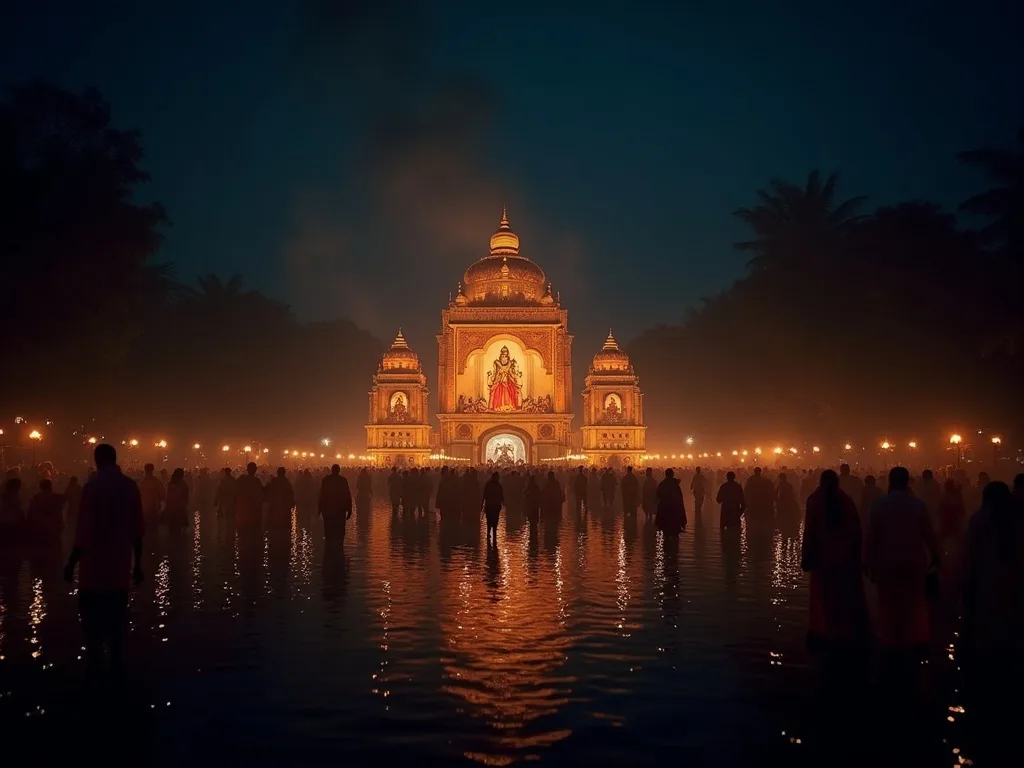
The annual cycle of Durga Puja, the world's largest goddess festival by participation, brings together everything the mythology contains. Celebrated across nine nights (Navratri) in the Hindu lunar month of Ashwin (typically September-October), the festival culminates on the tenth day, Vijayadashami (Victory Tenth), which marks Mahishasura's defeat.
In Kolkata, West Bengal, the festival transforms the city into an open-air gallery. Artisans in the Kumartuli district of north Kolkata have spent months shaping clay idols: Durga flanked by her children Lakshmi, Saraswati, Karttikeya, and Ganesha. The iconographic program is fixed by tradition but reinvented every year in the theme pandals (temporary temple structures) that neighborhoods build in competition with each other. After five days of worship, the idols are carried to the Hooghly River and immersed, the goddess returning to the water from which life rose.
The Mahalaya dawn broadcast on All India Radio, begun in 1931 and still heard by millions, plays the Mahishasuramardini, a devotional composition that blends passages from the Devi Mahatmya with songs. Hearing it is how many Bengali Hindus mark the beginning of the goddess season, alarm clocks set for 4 AM across generations.
Ganesha, Durga's son in the Bengali iconographic tradition, presides over the beginning of auspicious endeavors. His presence at the Puja installation anchors the family of the goddess in a narrative framework that draws on both Shaiva and Shakta streams.
Kali's Cremation Ground and the Tantric Tradition
If Durga's home is the battlefield and the festival pandal, Kali's home is Smashan, the cremation ground. This is not merely metaphor. Tantric practice (Tantra here meaning the systematic ritual and philosophical tradition encoded in texts called Tantras, distinct from Western pop-culture distortions) historically situated certain forms of Kali-worship at actual cremation sites, places where the social body was visibly dissolved.
The Mahanirvana Tantra, an influential text probably compiled in Bengal in the 18th century, presents Kali as Adya Shakti, the primordial power, whose worship is accessible to all regardless of caste. This democratizing impulse is theologically consistent: if Kali destroys illusion, she destroys the illusion of hierarchy along with everything else.
The philosopher and saint Ramakrishna Paramahamsa (1836-1886), whose Bengali devotional practice centered on Kali at the Dakshineswar temple near Kolkata, described his goddess not in terms of terror but intimacy. He called her Ma (Mother) and reported conversations with her as with a person. His disciple Swami Vivekananda, who took Vedanta to the West in the 1890s, grew up steeped in this devotional register, in which Kali's terrifying iconography is understood as the mother's face at the moment she removes every illusion the child clings to.
The Bengali poet Ramprasad Sen (1718-1775) composed hundreds of Shyama Sangeet (songs of the dark one) that speak to Kali in a tone oscillating between reproach and adoration, a child arguing with a mother who is both terrifying and tender. These songs are still sung at Kali Puja, the festival that falls on the new moon night of the month of Kartik (October-November), the same night much of the rest of India lights lamps for Diwali.
Cross-Cultural Parallels: Battle Goddesses Across Traditions
Durga and Kali are not isolated phenomena. Warrior goddesses who both protect and destroy appear across the ancient world, and the structural similarities are striking even when historical contact is unlikely.
The Greek Athena is born fully armed from Zeus's head, a goddess of civilized warfare who also holds wisdom. She is closer to Durga in temperament: composed, strategic, protecting the city-state of Athens the way Durga protects the cosmic order. The Celtic Morrigan, a triple goddess of battle from Irish mythology, shape-shifts through crow, wolf, and woman the way Kali moves through different forms of dissolution. She too is associated with death on the battlefield and with prophecy.
The Mesopotamian Inanna/Ishtar descends to the underworld and returns transformed, a narrative of death and regeneration that resonates with Kali's dwelling in the cremation ground. The Aztec Coatlicue, mother of Huitzilopochtli, wears a skirt of snakes and a necklace of severed hands and hearts, an iconographic program that parallels Kali's skull garland point for point.
These parallels do not flatten the goddesses into a single archetype. They indicate, rather, that human beings confronting death, destruction, and the limits of order have repeatedly reached for a female figure who embodies that confrontation without flinching. The specific theology, the specific stories, the specific ritual contexts differ profoundly. What is shared is the recognition that power at its most fundamental is neither safe nor gentle.
The Shakti Pithas and Sacred Geography
The body of the Goddess is not only a philosophical concept. It is mapped onto the Indian subcontinent through the network of 51 shakti pithas, sacred sites where, according to the Devi Bhagavata Purana and related texts, pieces of the body of Sati fell to earth.
Sati was a previous form of the Goddess, daughter of Daksha, who married Shiva against her father's wishes. When Daksha insulted Shiva at a great sacrifice, Sati immolated herself in grief. Shiva, mad with bereavement, carried her body through the three worlds. Vishnu, taking pity, used his Sudarshana Chakra (discus) to dismember the corpse, and wherever a piece landed, a shrine arose.
The Kamakhya temple in Assam, one of the most powerful of these sites, marks where the yoni (womb) of Sati fell. It has no image in the conventional sense; worship centers on a natural rock fissure in the earth. Every year during the Ambubachi Mela, when the Brahmaputra River reportedly runs red with the goddess's menstrual blood, hundreds of thousands of pilgrims gather. The site draws both orthodox Hindu pilgrims and tantric practitioners, a reminder that the boundaries between these streams have always been permeable.
The Vaishno Devi shrine in Jammu, set inside a cave in the Trikuta mountains, receives over eight million pilgrims annually, making it one of the most visited religious sites on earth. The goddess there is worshipped in the form of three natural rock formations, pindis, representing Mahakali, Mahasaraswati, and Mahalakshmi: the three primary forms of the Goddess in the Devi Mahatmya's theological scheme.
Durga and Kali in Modern Art, Literature, and Resistance
The fierce goddesses have not remained confined to temple walls. From the 19th century onward, their imagery has been recruited into political, artistic, and social argument with a frequency that reveals how much symbolic charge they carry.
The nationalist poet Bankim Chandra Chattopadhyay's 1882 novel Anandamath gave India its pre-independence anthem Vande Mataram (I bow to the Mother), which explicitly cast the Indian subcontinent as the goddess Durga. The song, later set to music by Rabindranath Tagore, mobilized the image of the armed goddess in the anticolonial struggle. It remains India's national song, though its sectarian undertones have made it politically contentious.
Contemporary Indian artists including M.F. Husain (whose depictions of Hindu goddesses provoked intense controversy in the 1990s), and feminist scholars like Rita DasGupta Sherma, have reexamined Kali as a figure who resists the domestication of the feminine. In Sherma's reading, Kali's unbound hair, her refusal of ornament, her occupation of liminal spaces (the battlefield, the cremation ground, the night) represent a theological tradition that locates sacred power specifically in what social order tries to control or suppress.
Outside India, the image of Kali appeared on the cover of Time magazine in 2017 in the context of discussions about female power in politics. The image drew both celebration and criticism, a sign that the iconography retains its capacity to unsettle, which is, theologically speaking, exactly what it is supposed to do.
The film and literary tradition in Bengal has returned to these goddesses repeatedly. Satyajit Ray's documentary The Inner Eye (1972) and his broader fascination with Bengal's spiritual geography reflect the degree to which Durga and Kali are not historical figures but living presences in the culture, goddesses whose festivals still stop cities, whose images still hang in kitchens and offices and hospital rooms across South Asia.
Frequently Asked Questions About Durga and Kali
Frequently asked questions
Are Durga and Kali the same goddess or two different deities?
Within Shakta theology, they are two aspects of the same ultimate power, Shakti or Devi. The Devi Mahatmya presents Kali as emerging from Durga's rage during the battle against Raktabija, making her a more extreme expression of the same divine energy. In temple practice and popular devotion, however, they often function as distinct personalities with separate iconographies, festivals (Durga Puja in autumn, Kali Puja on the new moon of Kartik), and ritual protocols. The distinction is real at the level of practice; the unity is real at the level of theology.
What does Kali's standing on Shiva's chest actually mean?
Several explanations circulate in both mythological and philosophical literature. The most common narrative says Kali was in a post-battle frenzy, unable to stop her dance of destruction, and Shiva lay in her path to calm her; when she stepped on him and recognized her husband, she stopped in lajja (embarrassment), sticking out her tongue. Philosophically, Shiva as Purusha (pure consciousness) is inert without Shakti (active power); Kali standing on him represents energy activating consciousness, not dominance. The image encodes a non-dualist metaphysics in visual form.
What is the primary scripture for understanding Durga's mythology?
The Devi Mahatmya, comprising 700 Sanskrit verses embedded in the Markandeya Purana and probably composed between the 4th and 6th centuries CE, is the foundational text. It is also called the Chandi or Durga Saptashati. Thomas Coburn's 1991 translation and study Devi-Mahatmya: The Crystallization of the Goddess Tradition (Motilal Banarsidass) is the standard academic reference. The Devi-Bhagavata Purana (approximately 6th-12th century CE) extends the theology and is considered canonical by many Shakta communities.
Is the worship of Kali connected to violence or blood sacrifice?
Historically, animal sacrifice (bali) was practiced at some Kali temples and is still performed at certain sites, including the Kamakhya temple in Assam and the Kalighat temple in Kolkata, though legal restrictions and reformist movements have reduced it significantly. The theological argument for sacrifice in these traditions holds that the offering to Kali represents the ego's surrender, not glorification of death. The 19th-century reform movements associated with figures like Ramakrishna and Vivekananda generally emphasized internal, devotional worship over blood sacrifice. The image of violent Kali-worship popularized in 19th-century British colonial literature (and recycled in popular films) bears very little resemblance to actual ritual practice.
How do Durga and Kali relate to other Hindu goddesses like Lakshmi and Saraswati?
The Devi Mahatmya and related texts organize the Goddess into three primary aspects: Mahalakshmi (abundance, preservation), Mahasaraswati (wisdom, creation), and Mahakali (destruction, liberation). Durga, in the Devi Mahatmya's own internal logic, encompasses all three; she is the complete form from which these specific aspects flow. The nine forms of Durga worshipped during Navratri (Navadurga) include Shailputri, Brahmacharini, Chandraghanta, Kushmanda, Skandamata, Katyayani, Kalaratri, Mahagauri, and Siddhidatri, each associated with a night of the festival and a specific power or blessing.
What is the significance of the demon Mahishasura and why is he a buffalo?
Mahishasura's buffalo form carries specific symbolic weight. The buffalo in ancient Indian iconography was associated with Yama, the god of death, whose mount (vahana) it is. A demon in buffalo form thus embodies death itself, or the death-principle that threatens the cosmic order. Durga's defeat of Mahishasura is not merely the victory of good over evil in a simple moral sense; it is the victory of divine consciousness over the intractable fact of mortality and the ego's terror of dissolution. The name Mahisha (buffalo) also evokes moha (delusion) through sonic association, a reading supported by commentarial traditions within the Devi Mahatmya scholarship.
The Living Goddesses: Tradition Under Pressure and in Motion
Neither Durga nor Kali is a figure from a finished past. The traditions surrounding them are actively contested, reinterpreted, and re-energized in the early 21st century across multiple fronts.
In Nepal, the institution of the Kumari, a living girl selected as a manifestation of the goddess Taleju (a form associated with Durga), continues in Kathmandu despite pressure from human rights advocates who argue that the practice restricts the girl's education and social development. The Royal Kumari of Kathmandu participates in the Indra Jatra festival each September, appearing at her window to give darshan to hundreds of thousands of worshippers. The debate around the Kumari tradition sits at the intersection of religious freedom, child welfare, and postcolonial critique, none of those positions simple.
In Tamil Nadu and parts of Andhra Pradesh, village goddesses (grama devata) who share many characteristics with Kali (fierce, independent, demanding, protective of specific communities) are the primary objects of local devotion, often more immediately present in daily life than the great pan-Hindu deities. Scholar Isabelle Nabokov's research on Tamil spirit possession rituals documents how these goddess traditions operate as local courts of justice and communal therapy, goddess power exercised through the bodies of mediums who speak on her behalf.
The feminist reappropriation of Kali in the global English-speaking world, advanced by scholars like Rachel McDermott (Revelry, Rivalry, and Longing for the Goddesses of Bengal, 2011) and Lina Gupta, reads her iconography as a theological counter to the domestication of women in both traditional and modern contexts. This reading has genuine roots in the Bengali devotional tradition while extending it into new argumentative territory.
What this flux confirms is what the Devi Mahatmya asserted in its opening hymn: the Goddess does not retire. She remains Nityam (eternal), called forward whenever the balance tips too far toward the demonic, which is to say, whenever delusion, greed, or cruelty threatens to swallow the world. The battle of nine days never fully ends. It recurs in every age, and the goddess rises to meet it wearing a different name, a different face, the same intractable fire.
Free 25-page sample
Want the whole story?
Take the first 25 pages free. If it pulls you in, the full edition is yours as an instant PDF download, with a paperback on Amazon for selected titles.
Hindu
The Hindu Mythology Book: Vishnu, Shiva, Brahma, the Mahabharata, and the Sacred Stories of India
Vishnu, Shiva, Brahma, the Mahabharata, and the Sacred Stories of India
The Rigveda, the Mahabharata, the Ramayana, and the major Puranas. Every god, every avatar, every sacred epic.
More from Hindu
All articles
Hindu
The Bhagavad Gita: Krishna's Discourse on Duty and Devotion
On the eve of the Kurukshetra war, Krishna reveals the nature of the soul, duty, and liberation to a trembling Arjuna. The Bhagavad Gita's 700 verses have shaped Hindu thought for over two millennia.
Hindu
Lakshmi: Goddess of Wealth and Prosperity
Lakshmi stands at the center of Hindu cosmic order as the goddess who grants wealth, fortune, and abundance. Her eight forms, her lotus throne, and her ancient origins reveal a deity far richer than any single attribute.

Hindu
Hanuman: The Monkey God of Devotion and Strength
Half-divine warrior, half-devoted servant, Hanuman stands as one of Hinduism's most beloved figures. His story is one of extraordinary power placed entirely at the feet of love.
Hindu
Krishna: The Divine Cowherd and Supreme God
Dark-skinned, flute in hand, Krishna stands at the center of Hindu devotion: trickster, warrior, philosopher, and the universe itself wearing a peacock feather.