
Samsin Halmoni: The Grandmother Goddess of Childbirth
Samsin Halmoni is the Korean grandmother goddess who presides over pregnancy, childbirth, and the health of newborns. Worshipped in homes and shrines for centuries, she remains central to Korean motherhood tradition and represents a mother's protective power.
Contents
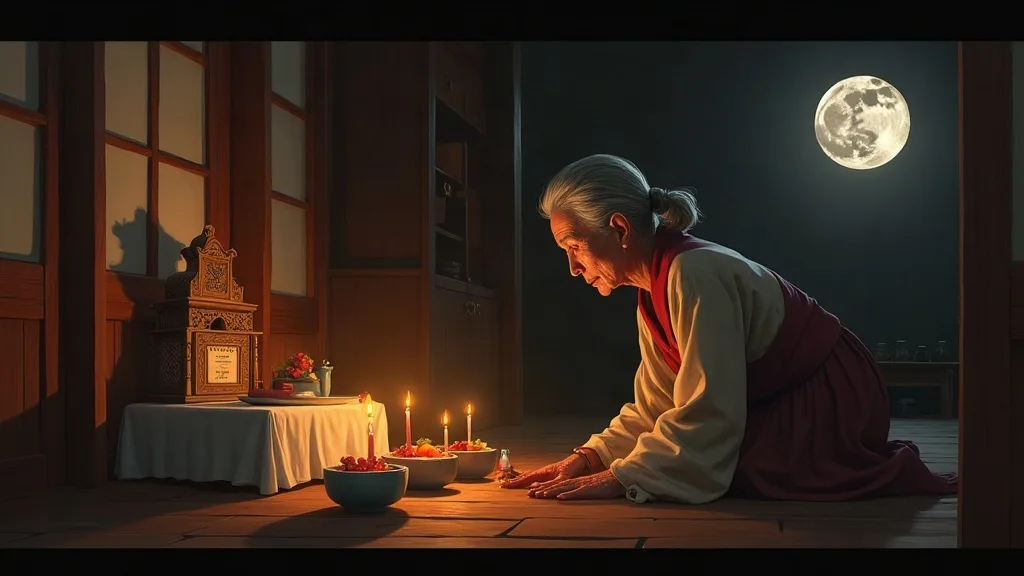
A grandmother sits by a bedside, not with medicine or words, but with presence. In Korean homes for over a thousand years, Samsin Halmoni has occupied exactly this space: the divine grandmother who watches over pregnant women, guides them through labor, and protects the vulnerable moment when a new life enters the world. Her name means "three-spirit grandmother," though she is rarely depicted with a fixed form or genealogy. Instead, she lives in the rituals that accompany birth, the shrines set up in homes, and the devotion of mothers and grandmothers who call on her when danger feels close.
Unlike the grand pantheon gods who rule from mountaintops or the underworld, Samsin Halmoni works in the intimate domestic sphere. She is not distant. She is not stern. She arrives when called and remains until the child is safely born and breathing. This is not myth as conquest or cosmology; it is myth as the everyday negotiation between the human and the sacred, between mothers and the terrifying vulnerability of bringing new life into the world.
Origins and Early Worship
The roots of Samsin Halmoni worship trace deep into Korean shamanic tradition, though pinpointing a single origin point proves difficult. Korean shamanism, known as Muism or the Shamanic Tradition, predates Buddhism and Confucianism by centuries, and Samsin Halmoni emerges from this spiritual ecosystem as one of many household and nature deities that were honored long before written documentation.
Early mentions of a childbirth goddess appear in accounts from the Three Kingdoms period (57 BCE - 668 CE), though these references are fragmentary. The Samguk Yusa, a historical record compiled by the Buddhist monk Ilyeon in the 13th century, preserves older stories and beliefs that had been transmitted orally. While Samsin Halmoni herself does not appear as a formal character in classical mythology the way that the shamanic spirits of mountains or rivers might, her conceptual role as a maternal protector has roots in ancient Korean religion that long predate organized documentation.
The Korean concept of childbirth itself carried profound spiritual weight. Pregnancy was understood not merely as a biological process but as a negotiation with unseen forces. The health of mother and child depended not only on practical midwifery but on securing blessing and protection from spiritual powers. In this framework, Samsin Halmoni gradually consolidated into a recognizable figure: the grandmother deity who inhabited the birthing chamber and the household shrine.

By the Joseon period (1392-1910), when Korean culture developed a more complex literary and ritual tradition, Samsin Halmoni worship had become formalized in a way that blended shamanic practice with folk religion. The Joseon scholars and elites, influenced by Confucianism, did not necessarily incorporate her into the official state religion, but in common households across Korea, the grandmother goddess remained absolutely central to how families prepared for and managed childbirth.
The Three-Spirit Nature of Samsin Halmoni
The name "Samsin" literally translates to "three-spirit," but this trinity does not correspond to a neat theological division the way Christian concepts of the Trinity might. Rather, Samsin Halmoni's three-fold nature reflects the complexity of the childbirth process itself and the multiple dimensions of protection required.
In some regional interpretations, the three spirits represent different aspects of the journey: the protector of pregnancy, the guide through labor, and the guardian of the postpartum recovery and the newborn's first vulnerable days. Other traditions describe three aspects of fertility, growth, and maternal strength. The exact meaning varies by region and family practice, which itself is essential to understanding Korean folk religion: there is no single authoritative text dictating what Samsin Halmoni must be. Instead, she is defined by the devotions of the people who invoke her.
What remains consistent is her role as a multiplicity of protective power. She is not one grandmother but the essence of grandmotherly care itself, the accumulated wisdom and vigilance of all the mothers and grandmothers who have guided birth before. This echoes a central principle in Korean shamanism: that spiritual power exists not in isolation but in relationship, in the web connecting the living, the ancestors, and the realm of spirits.
Worship and Household Ritual
The primary site of Samsin Halmoni worship is not a grand temple but the home itself. Traditionally, Korean households maintained a Samsin shelf or altar, typically located near the warmest part of the house or in the kitchen, spaces associated with life-giving heat and nourishment. This was not a cold object of distant prayer but a living part of household practice.
When a woman became pregnant, her family would perform rituals to honor and invoke the blessing of Samsin Halmoni. These rituals, collectively called Samsin kut or Samsin ceremonies, combined offerings of food, incense, and ritual words spoken by family members or a mudang (shaman). The offerings themselves carried meaning: rice, seaweed, rice cakes, fresh fruit, and in some cases soup or other prepared foods. These were offered not out of obligation to an abstract principle but because feeding the goddess was understood as a way of securing her care and presence.
As the pregnancy advanced and labor approached, the urgency of these rituals intensified. Some families would prepare a small shrine or decorated space specifically for the birth itself, placing offerings there and calling upon Samsin Halmoni to guide the process. The mudang, if present at a birth, would perform rituals to ensure her presence and to placate any spirits that might cause harm or difficulty.
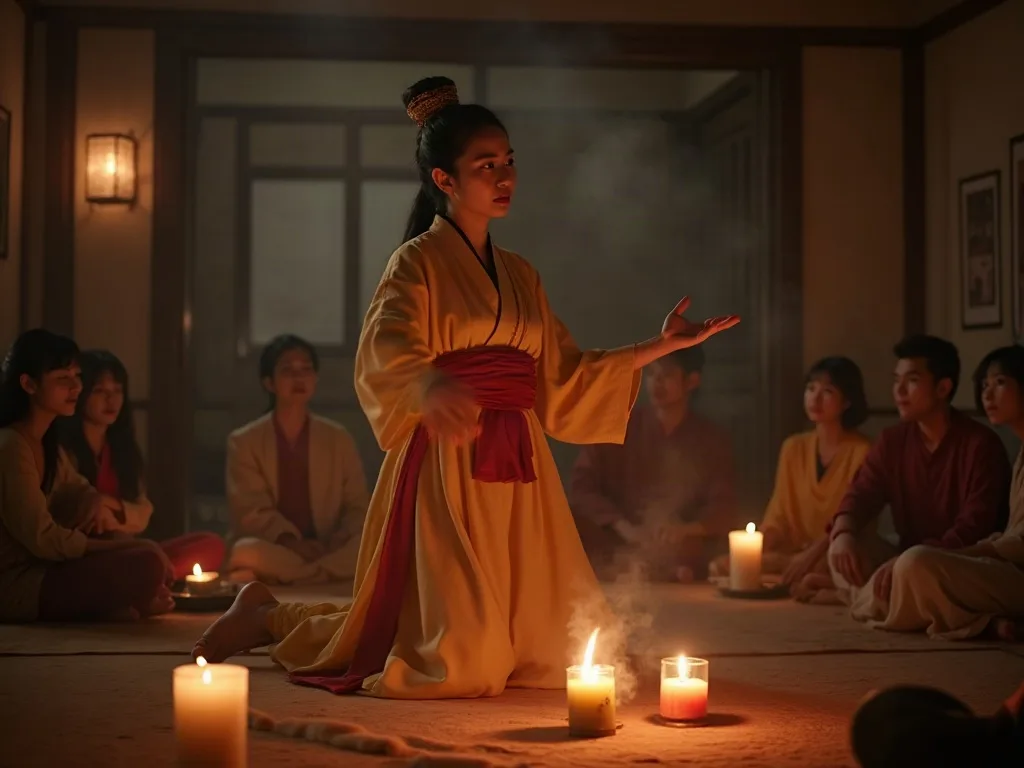
The postpartum period was also a time of intensive ritual devotion. After birth, a family would continue offerings to Samsin Halmoni to thank her for the safe delivery and to ask for her continued protection of the newborn through the most vulnerable days. In traditional Korea, infant mortality was a grave concern, and the first weeks and months of a child's life required both practical care and spiritual protection.
A unique feature of Samsin Halmoni worship is that it was often conducted without formal priestly mediation. While mudangs played important roles, particularly in larger ceremonies, households could and did offer prayers and food directly. A grandmother might light incense and make an offering with her own hands, speaking to the goddess about her concerns and hopes. This democratization of spiritual access reflects how Korean shamanism, unlike some religious traditions, kept the sacred realm accessible to ordinary people in ordinary spaces.
Samsin Halmoni and Childbirth: The Symbolic Protective Journey
Understanding Samsin Halmoni requires appreciating what childbirth meant in the context of Korean history and belief. Pregnancy and labor were dangerous. Before modern medicine, maternal mortality and infant loss were common realities, not rare tragedies. The threat was not imaginary but visceral: a woman entering labor faced a real possibility of not surviving it, of her child not being born alive, of infection or hemorrhage after delivery.
In this context, Samsin Halmoni was not a symbolic comfort but a perceived active presence. She was the one who watched the mother, knew the danger, and could intervene. Many Korean women and families understood her as literally present in the birthing chamber, guiding the child's emergence, protecting against malevolent spirits that might attack during this vulnerable threshold moment. The mudang's ritual incantations during labor were not theatrical but a direct communication with this protective power.
The ritual purification of the birthing space was another key element of Samsin Halmoni practice. Because childbirth was understood as crossing a threshold between worlds, from the realm of pregnancy to the realm of the living child, the space itself required spiritual attention. Ritual practitioners would ensure that the boundaries were properly marked, that protective spirits were present, and that harmful influences were kept at bay.
Regional Variations and Local Traditions
Like all living traditions, Samsin Halmoni worship has developed regional and local variations across Korea. In some parts of Korea, the grandmother goddess is understood as closely connected to the ancestors of a particular family, with her identity merging with the protective powers of deceased grandmothers. In other regions, she is more of a universal spirit who may take on specific local characteristics.
Jeju Island, with its distinctive Muist (shamanic) traditions and its own pantheon of local deities, honors Samsin Halmoni in ways that reflect Jeju's unique spiritual ecology. The offerings, the forms of prayer, and the relationship to other household and nature spirits vary by island. Similarly, regions that experienced more intensive Buddhist influence may have integrated Samsin Halmoni into narratives or rituals alongside Buddhist protector deities.
The practice of Samsin shrine maintenance itself varies. In some households, the shrine remained active year-round, tended carefully by the eldest woman or female relative. In others, it was activated specifically during pregnancy and early postpartum, then scaled back as the child grew beyond infancy. Some families maintained elaborate shrines; others kept a simple shelf or a small box with offerings. This flexibility itself is central to how Korean folk religion operates: there is room for different levels of formal practice, different economic circumstances, different family structures.
Syncretism and Coexistence with Buddhism
When Buddhism arrived in Korea during the Three Kingdoms period, it did not simply replace earlier spiritual traditions. Instead, a complex coexistence developed over centuries. Samsin Halmoni provides a fascinating case study in this syncretism.
Some Buddhist temples began honoring Samsin Halmoni alongside Buddhist deities, acknowledging that their female congregants would naturally invoke both Buddhist blessings and the protection of the household grandmother goddess. In some interpretations, Samsin Halmoni was understood as a manifestation or guardian spirit under Buddhist frameworks, protected by bodhisattvas or working in alignment with Buddhist compassion.
Yet Samsin Halmoni worship remained fundamentally domestic and shamanic in character. Even as Buddhist temples became central institutions in Korean life, especially among educated elites, the household cult of Samsin Halmoni continued among commoners and persisted in family practice. A Korean woman might visit a Buddhist temple to pray for a healthy pregnancy and simultaneously maintain offerings at her Samsin shrine at home. These were not experienced as contradictory but as different layers of spiritual protection.
The Confucian influence that intensified during the Joseon period created additional complexity. Official Confucianism emphasized filial piety and ancestral reverence but did not particularly emphasize household goddesses. Yet even as Confucian scholars attempted to systematize Korean thought and discourage "superstitious" practices, the lived reality of Korean families included continued devotion to Samsin Halmoni. This tension between official ideology and folk practice is a permanent feature of Korean religious history.
The Mudang and Ritual Specialists
While Samsin Halmoni could be invoked by any family member, the mudang (shaman) served as a specialized ritual practitioner who deepened and formalized the relationship. The mudang's role during pregnancy and childbirth included both practical knowledge and spiritual mediation.
A mudang might be called to the home during pregnancy if complications arose, if the labor was prolonged, or if other signs suggested spiritual disturbance. The mudang would perform rituals, songs, and dances aimed at honoring Samsin Halmoni and asking for her direct intervention. These performances were not mere theater: they were understood as creating a bridge between the earthly and spiritual realms, making space for divine presence and protection.
The mudang's knowledge of which spirits were present, which had to be appeased, and how to ensure their favorable disposition was considered essential expertise. Over generations, mudang families developed specific ritual sequences and songs dedicated to Samsin Halmoni, and these traditions were passed down through apprenticeship and family lineage.
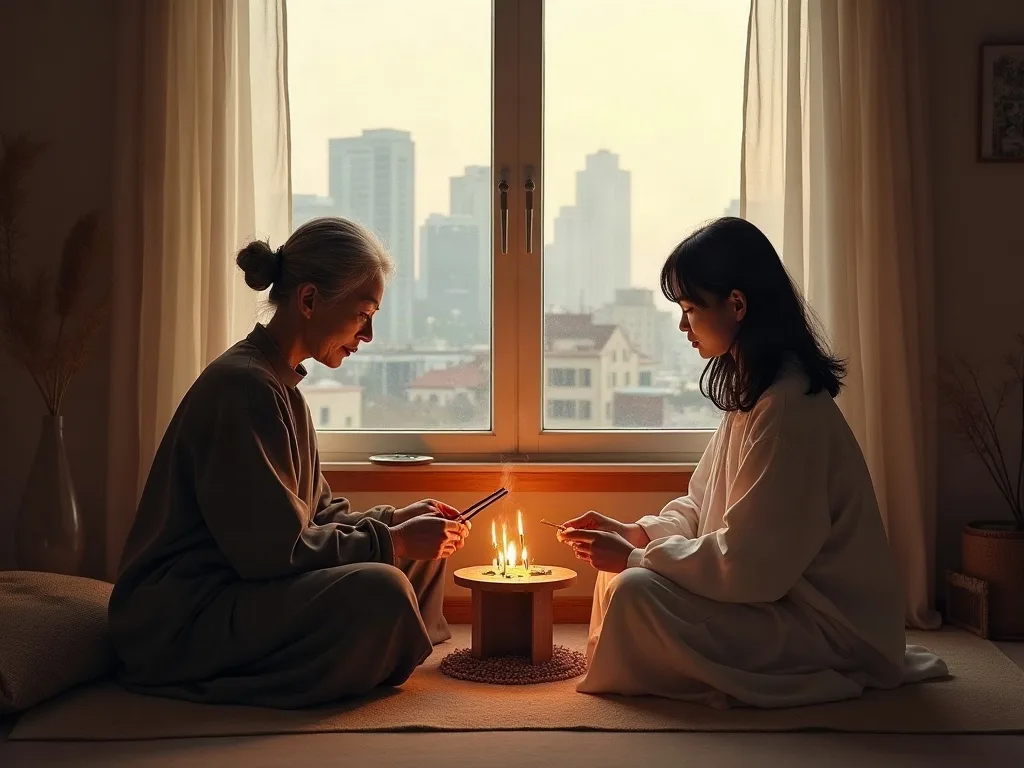
It is important to note that the mudang profession was historically feminized, with most mudangs being women. This made a certain kind of sense: women who had themselves given birth understood the reality of childbirth risk and the comfort of invoking feminine spiritual power. The mudang became an intermediary not just with the divine but with female community knowledge, combining ritual expertise with the practical wisdom of experienced mothers and midwives.
Modern Practice and Contemporary Korea
In contemporary South Korea, Samsin Halmoni worship persists, though it has shifted in character. Modern medicine has removed much of the acute danger from childbirth that once made invoking the goddess an urgent necessity. Yet the practice has not disappeared; it has transformed.
Many Korean women still maintain or create Samsin shrines during pregnancy, not from fear of physical danger but from a desire to honor the spiritual dimension of motherhood and to connect with ancestral practices and female lineage. The ritual becomes a way of marking the transition to motherhood, of slowing down and acknowledging the profound change underway, of connecting with generations of mothers who came before.
Contemporary Korean shamanism continues to offer Samsin Halmoni rituals, and families still seek out mudangs for pregnancy blessings or postpartum purification ceremonies. Cultural preservation efforts in Korea have also documented and celebrated Samsin Halmoni traditions, recognizing her as part of Korea's living heritage.
North Korea, under communist ideology that discouraged religious practice, suppressed much of the public practice of shamanism and household goddess worship. Yet family practice likely continued in more private, hidden forms, and with the gradual opening of North Korea's society, there is evidence of interest in recovering these traditions.
The goddess also appears in contemporary Korean literature, film, and art as a symbol of maternal power, female lineage, and the spiritual dimensions of childbirth and motherhood. Korean writers and artists have drawn on Samsin Halmoni imagery as a way of exploring female experience and honoring ancestral women.
Samsin Halmoni and Female Spiritual Authority
One of the most striking aspects of Samsin Halmoni worship is what it reveals about female spiritual authority in Korean culture. The goddess is explicitly female, invoked and tended primarily by women, and exists in a domain, childbirth, the household, female lineage, that gave women significant ritual and spiritual power.
While Confucian ideology increasingly restricted women's public roles during the Joseon period, the household sphere remained fundamentally female-controlled. The eldest woman of the household had authority over the Samsin shrine, over the rituals, over decisions about when and how to invoke the goddess. This was not formal institutional power, but it was real power: the power to determine what happened in the most intimate family space.
The mudang profession, dominated by women, similarly gave women a form of spiritual authority and economic independence. A mudang could support herself through her ritual knowledge, could own property, and could exercise influence in her community. This was exceptional in many male-dominated societies.
Samsin Halmoni thus stands as a figure who enabled and embodied female spiritual authority. She was not conquered by male gods, was not subordinate to male priests, and did not require male mediation. The relationship between women and Samsin Halmoni was direct, intimate, and rooted in the irreducibly female experience of pregnancy and birth.
Comparative Echoes: Birth Goddesses Across Cultures
Samsin Halmoni is not unique; virtually every culture has recognized the profound spiritual power associated with childbirth and has honored feminine divine figures who preside over it. Comparing her to other traditions illuminates what is universal about the protection of motherhood and what is distinctly Korean.
In Greek mythology, Eileithyia was the goddess of childbirth, invoked by women in labor. She was less prominent in surviving mythological texts than male Olympians, but she was invoked in the most urgent moments. Like Samsin Halmoni, she represented a direct, practical, and indispensable spiritual presence.
In Hindu tradition, Durga and other goddess forms embody protective maternal power. The concept of the Divine Mother, or Devi, encompasses protection, fertility, and fierce defense of her children, resonating with Samsin Halmoni's role.
In Japanese spirituality, kami (divine spirits) associated with specific places and functions include birth deities. The emphasis on feminine household spirits and the integration of folk practice with formal religion parallels Korean shamanic syncretism.
The universal pattern is clear: cultures that honor the dangerous reality of childbirth and recognize women's irreplaceable role tend to honor feminine divine powers associated with that realm. Samsin Halmoni emerges from this ancient human recognition that bringing new life into the world is sacred work that deserves spiritual acknowledgment.
Philosophical Significance: Presence Over Power
One of the most philosophically interesting aspects of Samsin Halmoni is that her significance lies not in grand cosmic power but in presence and attention. She does not rule the cosmos or wage mythological battles. She is not a creator deity or a figure of high theology. Instead, she represents the divine understood as intimate companionship in moments of vulnerability.
This reflects a fundamental strand in Korean spirituality: the recognition that the sacred is not removed from daily life but woven into it. The goddess who watches over childbirth is the goddess who watches over the household, who knows the names of family members, who attends to the particular needs of particular women. This is divinity as relationship, not authority.
The idea that presence itself is a form of spiritual power, that showing up, staying, witnessing, and protecting constitute divine action, is philosophically profound. It suggests a different understanding of what it means for the sacred to be real and operative in the world. Samsin Halmoni does not perform flashy miracles or punish transgressions. She attends. She watches. Her presence changes the nature of the room she enters.
This also aligns with how Korean shamanism more broadly understands spiritual practice. Ritual specialists do not command spirits or demand obedience. Instead, they create the conditions for beneficial spiritual presences to arrive and remain. They invite, they honor, they listen, and they facilitate relationships. Samsin Halmoni is at the center of this relational understanding of the sacred.
Frequently asked questions about Samsin Halmoni
Frequently asked questions
Is Samsin Halmoni still worshipped in Korea today?
Yes, though the form has changed. Modern Korean women, especially during pregnancy, still maintain Samsin shrines, make offerings, or seek rituals from shamans. Many do so as a way of honoring cultural heritage and the spiritual dimension of motherhood rather than from fear of physical danger. The practice persists in private households and in contemporary shamanic communities.
Is Samsin Halmoni found in Buddhist or Confucian texts?
Samsin Halmoni emerges from Korean shamanism and folk religion rather than from official Buddhist or Confucian doctrine. While some Buddhist temples have incorporated her as a household protector, and while Confucian scholars documented her existence, she belongs to a different religious register: the lived practice of ordinary people rather than formal theological systems.
What is the difference between Samsin Halmoni and a mudang?
Samsin Halmoni is a divine spirit or goddess; a mudang is a human ritual specialist or shaman. The mudang invokes, honors, and intermediates with Samsin Halmoni on behalf of families and communities. A household could invoke Samsin Halmoni directly, but a mudang's specialized knowledge and ritual power were considered essential for more serious or complex spiritual work.
How does Samsin Halmoni compare to other cultures' birth goddesses?
Like goddesses such as the Greek Eileithyia or Hindu Durga, Samsin Halmoni represents the spiritual protection of motherhood and the recognition that childbirth involves both physical and spiritual dimensions. What distinguishes her is her focus on intimate household presence rather than cosmic authority, and her integration into shamanic practice rather than organized temple-based religion.
Why is Samsin Halmoni called the 'three-spirit' grandmother?
The exact meaning of "three-spirit" varies by tradition and region. Some interpret it as representing three aspects of the birth journey (pregnancy, labor, postpartum recovery), while others see it as three dimensions of protective power or three stages of maternal care. The lack of a single fixed definition reflects how Korean folk religion allows for diverse local interpretations.
Samsin Halmoni in the Archive of Female Spiritual Power
Samsin Halmoni matters not only to those seeking to understand Korean culture and mythology but also to anyone interested in the history of female spirituality and how women have claimed sacred authority. She appears in scholarship on Korean shamanism, on the history of motherhood, on gender and religion, and on the persistence of folk traditions in the face of changing social conditions.
The challenge for contemporary scholars is honoring what the practice reveals about human spirituality and female authority while not romanticizing or exoticizing it. Samsin Halmoni worship emerged from real necessity and real knowledge: the acknowledgment that childbirth was dangerous and required protection, and that women possessed irreplaceable knowledge and power in this domain.
As Korea continues to modernize and as access to medical technology changes how childbirth is experienced, the spiritual practice associated with Samsin Halmoni might continue to transform or might fade. Yet her existence in Korean history and contemporary practice testifies to something enduring: the recognition that bringing new life into the world is sacred work that deserves acknowledgment, protection, and honor.
Read the full book
Want the whole story?
The complete edition is an instant PDF download here, with a paperback on Amazon for selected titles.

Korean
The Korean Mythology Book: Dangun, Bari, the Dokkaebi Tricksters, and the Shamanic Stories of the Peninsula
From Hwanin's Heaven to the Underworld and Back
The shamanic mythology of Korea: Dangun the founder, Bari the death-walker, the Yongwang Dragon Kings, the dokkaebi goblins, and the gumiho fox spirits.
More from Korean
All articles
Korean
Hwanung: The Heavenly Prince Who Descended to Earth
Hwanung, the celestial prince of Korean myth, descended from heaven to establish human civilization. His union with a bear-woman bore Tangun, founder of Gojoseon, Korea's first kingdom. Discover how this cosmic descent shaped Korean identity and continues to echo through the nation's cultural memory.

Korean
Mago Halmi: The Primordial Creatrix Goddess
Mago Halmi shaped existence itself before time began. The Korean primordial goddess stands at the root of all creation, a force older than the heavens, wiser than fate itself.

Korean
Jumong: The Archer Hero and Founder of Goguryeo
Jumong, a legendary archer and divine prince, fled a deadly throne and established Goguryeo, one of Korea's greatest kingdoms. His story of exile, resurrection, and martial mastery shaped a nation.
Korean
The Seven Star Maidens: Chilseong and Celestial Worship in Korean Tradition
The Seven Star Maidens weave Korean spirituality with the night sky itself. Chilseong worship shaped household rituals, artistic tradition, and how ordinary people imagined fortune for centuries.