
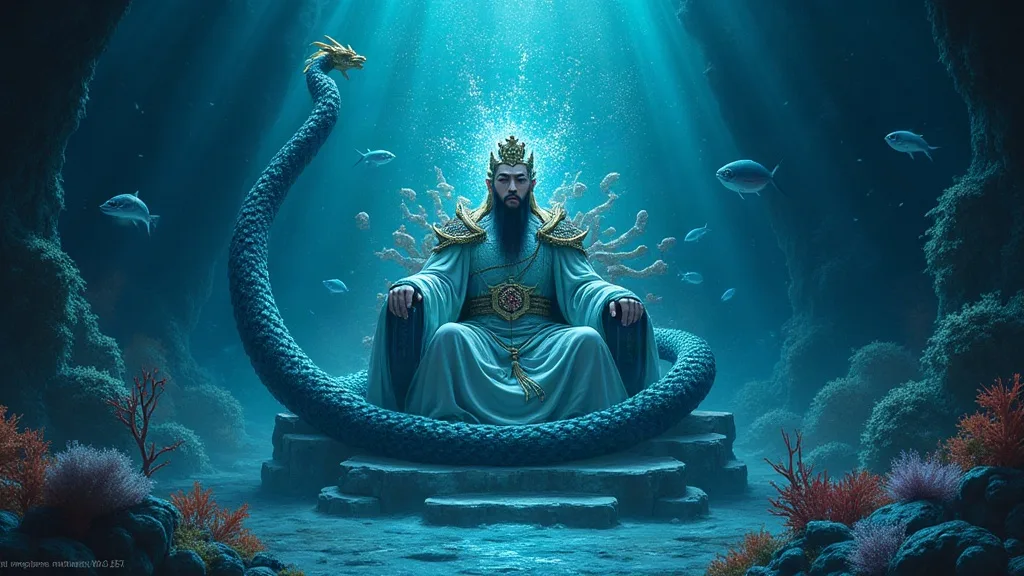
The Dragon King: Yongwang of the Underwater Palace
Yongwang, the Korean Dragon King, rules a glittering palace beneath the sea and commands rain, rivers, and fate itself. Learn who he is, why fishermen still fear his moods, and where his myth came from.
Contents
The sea changes color before a storm. Korean fishermen once read that shift as a message, not a weather pattern. Something below the surface was deciding their fate, setting the waves high or flat, releasing fish in abundance or withholding them entirely. That something had a name: Yongwang, the Dragon King, sovereign of a palace built from coral and jade at the bottom of the ocean.
He does not appear in a single founding text the way Zeus appears in Hesiod's Theogony (a Greek poem written around 700 BC). Yongwang lives across centuries of oral tradition, shamanic ritual, painted votive scrolls, and narrative folk tales. He is older than easy documentation, and precisely because of that, he has survived longer than most.
Pull back the water, and what waits beneath is one of the most structurally coherent divine figures in the Korean pantheon: a king with a court, a library of fate, a treasure hall, and an almost bureaucratic authority over everything wet. Rain, rivers, tides, and the lives of those who depend on them, all answer to him.
Who Yongwang Is: Name, Nature, and Domain
Yongwang (용왕) translates directly as "Dragon King," from yong (dragon) and wang (king or ruler). The title carries administrative weight in Korean: wang is the same word used for historical monarchs. Calling him the Dragon King is not poetry. It is a rank.
His domain covers every body of water that matters. The East Sea (the Sea of Japan), the Yellow Sea, the South Sea, each has its own Dragon King in some regional traditions, with Yongwang functioning as the supreme title that can refer to any of them or to the supreme ruler who oversees them all. The ambiguity is intentional. Water does not recognize provincial borders, and neither does he.
His physical form follows the conventions of East Asian dragon iconography: a long serpentine body, scaled like a carp scaled to the size of a whale, four legs tipped with talons, a mane of whiskers, and a pearl, a glowing jewel of power, held beneath his chin. This is not the fire-breathing dragon of medieval Europe. The yong (dragon, 용) in Korean and broader Sino-Korean tradition is a water creature, associated with life-giving rain and the movement of clouds. Fire belongs to a different register entirely.
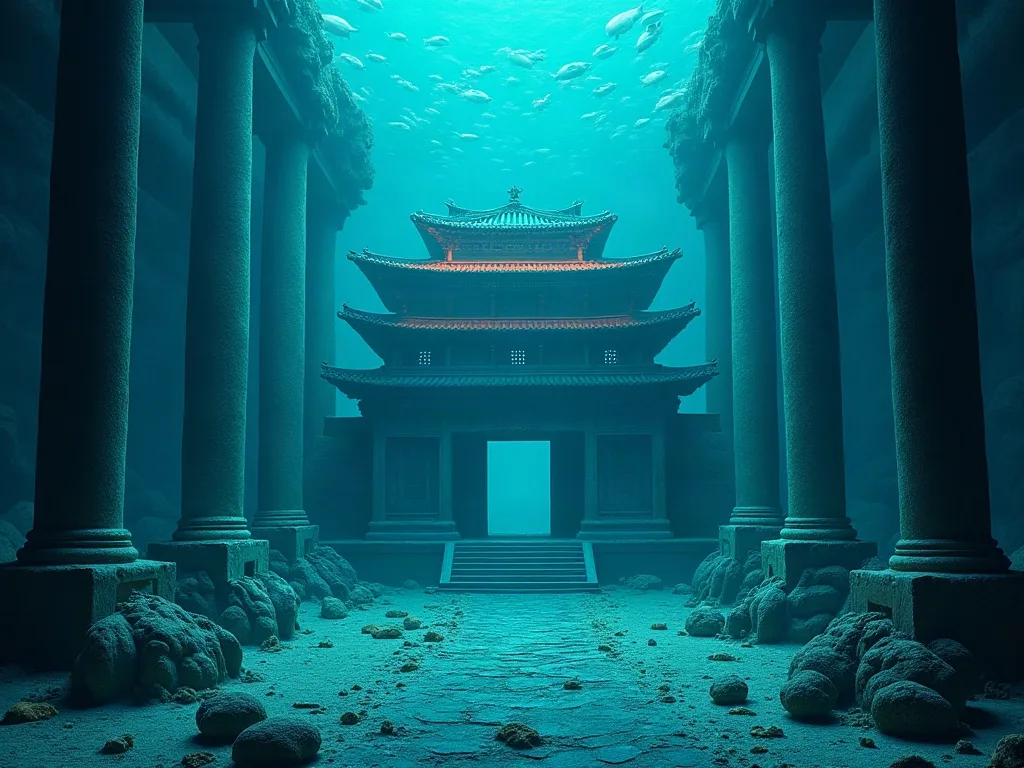
Inside his palace, called Yonggung (용궁, the Dragon Palace), the world mirrors the royal courts of Joseon-era Korea (1392-1897) but built from materials impossible on land: walls of pearl, columns of coral, floors of polished sea-glass, and fish that serve as courtiers. Scribes record births and deaths. Generals command armies of sea creatures. The whole structure operates with the logic of a functioning bureaucracy, which made it immediately comprehensible to audiences who lived under an elaborate Confucian administrative system.
A useful comparison sharpens the picture. Japan's sea dragon Ryujin (龍神) and China's Longwang (龍王) share the same Sanskrit naga raja ancestry and similarly preside over underwater palaces. Yet where Ryujin's Ryugu-jo tends to be a passive treasure-house visited by lucky mortals, and Longwang operates chiefly as an administrative functionary of the celestial bureaucracy, Yongwang occupies a more dynamic position: he is petitioned in live shamanic ceremony, outwitted in folk comedy, and honored as a moral judge who can overturn death itself. The Korean tradition grants him a warmer, more unpredictable personality than his regional cousins, rooted in the mudang's direct, embodied relationship with divine beings.
Yongwang (Korea), Shamanic, petitioned in live ritual by mudang, capable of moral judgment, subject to being outwitted; court mirrors Joseon bureaucracy.
Longwang (China) / Ryujin (Japan), More firmly embedded in celestial bureaucracy (Longwang) or passive treasure-realm mythology (Ryujin); less prominent in active living ritual.
The Myth of the Rabbit's Liver: Yongwang's Most Famous Story
The tale that gave Yongwang his sharpest narrative edges is the Byeoljubujeon (별주부전), or "The Tale of the Turtle Official," sometimes also called "The Story of the Rabbit's Liver." It circulates in multiple forms, from oral performance to pansori (a Korean musical storytelling tradition) to written prose, and it has been retold steadily for at least five hundred years.
The story opens with crisis. Yongwang falls gravely ill. His court physicians diagnose the cure: the liver of a land rabbit, consumed while still fresh. The problem is obvious. Rabbits do not live underwater. Someone must go to the surface world, find a rabbit, and persuade it to return voluntarily. A turtle, loyal and eloquent, volunteers.
The turtle reaches land and finds a rabbit. Rather than force or trick the rabbit crudely, the turtle uses flattery: he describes Yonggung in dazzling terms, a paradise of abundance where the rabbit would be honored as a guest of the great king. The rabbit, curious and a little vain, agrees to come. He dives into the sea on the turtle's back.
When they arrive at the Dragon Palace, the rabbit understands what is actually wanted. His liver. His actual liver. At this point the story pivots entirely on the rabbit's wit. He tells Yongwang that he left his liver on shore to air it out, as rabbits apparently do. He promises to return and fetch it. Yongwang, believing this, sends the turtle back with the rabbit to retrieve it. Once on land, the rabbit hops away, laughing.
The lesson cuts in two directions. Yongwang is powerful, feared, the master of fate, but he is also capable of being outwitted by the weakest animal in the story. His power operates within limits. Cleverness, whether the rabbit's quick thinking or the human fisherman's shrewdness, can navigate around divine authority. This was not accidental theology. It gave ordinary people a foothold in their relationship with an otherwise terrifying cosmic force.
The tale also appears in a Buddhist context, where its roots trace partly to the Jataka Tales, a Sanskrit collection of stories about the Buddha's previous lives. The rabbit-and-monkey-and-crocodile motif travels through multiple Asian traditions, and Korean storytellers absorbed and reshaped it, giving it distinctly Korean settings, a Korean court, Korean social dynamics, and a Korean Dragon King at its center.

Rain, Rivers, and the Politics of Weather
Across Korean history, Yongwang served a very practical religious function: he was petitioned for rain. Drought was not an abstract disaster in agrarian Korea. A failed rice harvest meant starvation, and the connection between rain and the Dragon King was so widely understood that formal rain-petition rituals, called giudo (기우도) or giuje (기우제, "rain prayer ceremony"), were performed at various levels of society, from village shamans to the royal court itself.
The logic was hydraulic and hierarchical. Rain falls from clouds. Clouds form over water. Water is governed by the Dragon King. Therefore, rain is the Dragon King's to give or withhold. Petitioners would gather at a water source, a river, a lake, or the sea itself, and perform ceremonies involving offerings of food, music, and prayer, asking him to release the moisture held above the fields.
In Joseon records, kings personally participated in giuje ceremonies during prolonged droughts. A royal protocol edict dated to 1782 and recorded in the Joseon Wangjo Sillok (the Annals of the Joseon Dynasty, compiled from 1413 onward across the dynasty's 500-year reign, referenced in the Jeongjo Sillok volume for that year) describes the proper ritual sequence when appealing to water deities. Yongwang stood as the most prominent of those beings petitioned.
Shamans, called mudang (무당), held an even more direct relationship with Yongwang. In the coastal ceremonies called byeolsin gut (별신굿, a shamanic ritual performed for the community's wellbeing), mudang would enter trance states and speak as the Dragon King, delivering his will directly to the gathered community. These ceremonies persist on the eastern coast of Korea. The Hahoe Byeolsin Exorcism Gut, listed by UNESCO, preserves theatrical elements that include dragon and sea-deity figures.
Korean shamanism and the mudang tradition preserved much of what we know about Yongwang's active worship, long after Buddhism and Confucianism became the dominant state ideologies.
The Underwater Palace and Its Cosmological Architecture
Yonggung is not simply a setting for adventure stories. It functions as a cosmological mirror: a reflection of the human world organized according to the same principles, but built from the materials of the deep.
The palace has a throne room, a treasury, a hall of records, and gardens of sea-plants that bloom in perpetual luminescent color. Time moves differently there. Heroes who visit Yongwang and spend what feels like a few days find, upon returning to land, that decades have passed. This is a near-universal feature of mythological otherworlds, present in Celtic tradition (the Irish Tír na nÓg), in Japanese legend (Ryugu-jo, the palace of Ryujin), and in Buddhist cosmology's lower realms. But in Korean telling, the time-slip tends to carry less tragedy and more wonder.
The treasure hall contains objects of immense power. The most frequently mentioned is the yeouiju (여의주, the "wish-fulfilling jewel"), a luminous pearl that grants the desires of whoever holds it. Yongwang possesses this pearl. In some stories he gifts it to heroes who serve him faithfully. In others it is the very source of his power over water, and losing it would diminish him catastrophically. The yeouiju connects Korean dragon mythology to the broader Indic and Chinese traditions: the Sanskrit cintamani, the Chinese mani, the jewel of fulfillment appears across Buddhist iconography from India to Japan.
His court includes sea creatures serving as administrators, each assigned specific duties. Carp serve as messengers. Sea turtles, as we saw in the rabbit-liver tale, serve as loyal envoys. Shrimp act as soldiers. The octopus, in several folk tales, appears as a treacherous courtier. This zoo-bureaucracy reflects a world in which the natural order of the sea was understood to have governance, not chaos.

Yongwang and the Heroes Who Visited Him
Several of Korea's most celebrated legendary heroes descend into Yonggung at a critical moment in their stories. These descents follow a recognizable pattern: the hero arrives in crisis, Yongwang tests or aids them, and they emerge transformed, carrying objects or knowledge unavailable on the surface world.
Sim Cheong, the blind man's devoted daughter in the Simcheongga (심청가, one of the five great pansori works), sacrifices herself to the sea to buy her father's sight. She sinks into the water and arrives in Yonggung, where Yongwang receives her with honor, recognizing her filial piety as a virtue so rare it must be rewarded rather than consumed. He sends her back to the surface inside a giant lotus flower. She rises to become queen, and her father's sight is restored. The Dragon King, here, functions less as antagonist and more as a divine judge who weighs human virtue and renders a verdict.
The founding mythology of the Goryeo dynasty (918-1392 AD) includes a story in which Wang Geon, the dynasty's founder, traces partial ancestry to a dragon lineage. His grandmother, in one version, is a water-dragon woman who married a human man after emerging from a river. This divine genealogy served a political purpose, anchoring the dynasty's legitimacy in cosmic authority rather than merely military conquest.
The heroic tradition in Korean mythology runs consistently through these encounters with Yongwang: the Dragon King is never merely a background deity. He is an active agent who changes the story's direction.
Buddhism, Confucianism, and the Layers of Yongwang's Identity
Yongwang did not arrive in Korea fully formed. He accumulated layers over roughly two thousand years as different ideological systems moved through the peninsula.
The oldest stratum is shamanistic and animistic. Water, as a domain of power and danger, required a presiding spirit. Long before any palace architecture or bureaucratic court appeared in the mythology, there was simply the spirit of the sea, capable of giving or taking life.
The second layer arrived with Buddhism, which entered Korea formally around 372 AD via the northern Goguryeo kingdom. Buddhist cosmology includes the naga, Sanskrit for a class of serpentine divine beings who inhabit water, guard treasures, and can bring rain or flood. The naga raja (naga king) became, in the Chinese and Korean translations of Buddhist texts, the yong wang, the dragon king. The institutional vocabulary of Yongwang's court, his scribes, his bureaucracy, his gem, all owe something to Buddhist cosmic geography as translated through Chinese canonical texts.
The third layer is Confucian and Chinese. China's dragon kings, the Longwang (龍王), appear in Chinese literature from the Tang dynasty (618-907 AD) onward as fully developed characters governing the four seas. Korean storytellers drew on this tradition heavily, particularly after the cultural exchange accelerated during the Goryeo and Joseon periods. The administrative structure of Yonggung mirrors Chinese imperial court organization.
What Korean tradition did was not passive borrowing. It took these incoming frameworks and bent them around a distinctly Korean sensibility: the importance of filial piety (as in the Sim Cheong story), the respect for the mudang's direct relationship with divine beings, the earthy humor of the rabbit-liver tale that punctures divine pretension, and the coastal, agrarian anxiety about weather that never let the Dragon King become merely a literary figure. He remained a being you could actually address, through the right ritual, in the right place, at the right time.
Regional Variations: The Four Sea Kings and Local Dragon Lords
One of the structural features of Yongwang mythology that distinguishes it from simpler divine figures is its capacity for multiplication. Korea's geography, with coastlines on three sides and a dense network of rivers and lakes inland, naturally produced regional variants.
The most structured version, influenced heavily by Chinese cosmology, posits four Dragon Kings ruling the four seas: East, West, South, and North. Each holds dominion over his quadrant. Petitions for rain or safe passage at sea were directed to the appropriate king depending on the location of the petitioner. A fisherman on the eastern coast addressed the East Sea's Dragon King. A boat passing through the Yellow Sea sought the West Sea's ruler.
Inland, rivers had their own dragon lords, lesser in rank than the great sea kings but locally significant. River dragons appear in Korean folk tales as protective spirits who can be offended by pollution or disrespect and who exact terrible costs: flooding, drowning, the death of livestock. These river dragons functioned less as benevolent rulers and more as territorial spirits requiring constant, careful acknowledgment.
Mountain springs and deep wells also had their presiding spirits in the broader animistic framework, sometimes identified as smaller dragon beings, sometimes as independent water-spirits called suryong (수룡). Yongwang thus exists at the top of a hierarchical water-deity system, not as a lone figure but as the apex of a complete cosmological bureaucracy, presiding over a chain of authority that reaches from the deepest ocean trench to the humblest village well.
Yongwang in Modern Korea: From Ritual to Screen
The twentieth century removed much of Yongwang's active ritual context. Industrialization, the Korean War, rapid urbanization, and the growth of Protestant Christianity in South Korea all eroded the network of folk belief that had kept the Dragon King practically relevant for fishermen and farmers alike.
But erasure is not the whole story. Yongwang made the transition into popular culture with surprising smoothness. He appears in Korean animated films, in webtoons, in fantasy novels, and most prominently in Korean dramas. The 2003 fantasy drama Forbidden Love (In魚人, literally "Fish Person") used the Dragon Palace as a central setting. The Dragon King figure appears as a character type across the fantasy literature boom of the 2010s, usually retaining his core attributes: the palatial undersea domain, the bureaucratic court, the gift of transformation, and the ambiguous authority over fate.
He also persists in idiom. Korean phrases invoking the Dragon Palace continue in everyday speech, much as Western languages carry Greek mythological idioms without conscious awareness. To say something belongs "in the Dragon Palace" (Yonggung) is to mark it as impossibly magnificent or impossibly distant.
The coastal shamanic traditions have not disappeared either. Practitioners of musok (무속, Korean shamanism) continue to perform sea-goddess and Dragon King rituals in communities along the eastern and southern coasts, preserving a living ceremonial relationship with Yongwang that has no clean break point between ancient practice and the present day.
The living shamanic tradition in Korea represents one of the most continuous strands of mythology practice in East Asia, and the Dragon King sits near its center.
Frequently Asked Questions about Yongwang, the Korean Dragon King
Frequently asked questions
Is Yongwang the same as the Chinese Dragon King Longwang?
They share a common ancestry in Buddhist naga cosmology and were transmitted to both Korea and China through the same Sanskrit-to-Chinese canonical translations. But Yongwang developed distinct characteristics in Korea: he is more directly connected to shamanic ritual practice, more embedded in specifically Korean folk narrative (like the rabbit-liver tale and the Sim Cheong story), and his court reflects Joseon administrative culture rather than Chinese imperial structure. Think of them as closely related but culturally distinct expressions of the same archetype. Japan's Ryujin forms a third branch of the same family tree, similarly palace-dwelling and sea-ruling, yet integrated into a Shinto cosmological register that Korean and Chinese traditions do not share.
Did Korean people actually worship Yongwang in historical times?
Yes, with documented evidence. The Joseon Wangjo Sillok, the official annals of the Joseon Dynasty compiled from 1413 onward, records royal rain-petition ceremonies that addressed water deities including the Dragon King. The Jeongjo Sillok volume preserves a 1782 edict detailing the precise ritual protocol for petitioning Yongwang during drought. Coastal communities performed shamanic rituals called byeolsin gut that invoked him directly. These were not metaphorical observances: they involved specific offerings, ritual music, and formal petitions for rain, safe fishing, and protection from storms.
What is the yeouiju, and why does Yongwang possess it?
The yeouiju (여의주) is a luminous wish-fulfilling jewel, conceptually related to the Sanskrit cintamani gem that appears across Buddhist cosmology from India to Japan. In Korean dragon imagery, the jewel is typically depicted as a flaming pearl held in the dragon's claw or beneath its chin. Yongwang possesses it because it is the source of his power over water and weather. Heroes in folk tales sometimes receive the yeouiju as a reward for exceptional service, which grants them extraordinary abilities. Its presence in Yongwang's treasure hall directly connects Korean mythology to the vast pan-Asian network of Buddhist sacred symbolism.
How does Yongwang relate to the story of Sim Cheong?
Sim Cheong is one of the five great pansori narratives, a traditional Korean musical-storytelling form. In the story, Sim Cheong sacrifices herself by leaping into the sea so that merchants can satisfy the Dragon King's demand and her blind father can afford a Buddhist offering that might restore his sight. Rather than consuming her, Yongwang honors her filial devotion and sends her back to the surface world inside a lotus blossom, where she eventually becomes queen. Yongwang functions here as a moral arbiter who rewards virtue rather than a simple antagonist, making the story one of the clearest illustrations of his capacity for grace alongside his authority over destruction.
Are there still active rituals dedicated to Yongwang today?
Yes. Shamanic practitioners of musok along Korea's eastern and southern coasts continue to perform rituals that include the Dragon King as a recipient of offerings. The Hahoe Byeolsin Exorcism Gut, which UNESCO recognized as Intangible Cultural Heritage, preserves theatrical and ritual elements that include sea-deity figures. Fishing communities in particular maintain traditions of petitioning Yongwang before major voyages or at the start of the fishing season, though the scale and formality of these rituals has diminished since the mid-twentieth century.
Why can Yongwang be outwitted, as in the rabbit-liver story?
The rabbit-liver tale reflects a theological nuance common to Korean folk belief: divine power is real but not absolute. Yongwang commands the seas and holds the Book of Life, but he is also embedded in a relational world where human (or animal) cleverness has value. His susceptibility to the rabbit's deception humanizes him and, crucially, gives ordinary people a conceptual space in which they are not wholly at the mercy of supernatural forces. This balance between awe and agency is a recurring feature of Korean folk mythology, and it is what keeps Yongwang a living story rather than a closed theological statement.
Yongwang Beyond the Shore: Scholarly Questions and Living Resonance
One of the genuine open questions in Korean religious studies is where exactly to draw the line between Yongwang as a shamanic autochthonous figure and Yongwang as a Buddhist import. The historian Laurel Kendall, whose fieldwork with Korean mudang spans several decades and produced the influential Shamans, Housewives, and Other Restless Spirits (1985), argues that Korean shamanism absorbed Buddhist figures without becoming Buddhist, producing a layered belief system in which the Dragon King could simultaneously mean different things to a Buddhist monk, a village mudang, and a Confucian court official.
That layering is arguably what kept Yongwang alive. A god with a single doctrinal owner can be suppressed when that doctrine falls out of favor. A god who belongs to the sea itself, to the rain that everyone needs, to the stories mothers tell children about turtles and rabbits, is much harder to dislodge. He persisted through the forced religious reforms of the Japanese colonial period (1910-1945), through the Protestant evangelical expansion of the late twentieth century, and through the homogenizing pressure of global media culture.
He also resonates outward. The Korean Wave, hallyu, has carried images of the Dragon Palace and the Dragon King into global popular culture through dramas and animated films. Audiences who have never encountered the Byeoljubujeon or the Simcheongga respond intuitively to a figure who combines regal authority with proximity to the natural world. The underwater palace as a space of transformation, of danger that can become grace, is not uniquely Korean. It touches something older and wider.
The broader tradition of water deities across Asian mythologies reveals just how persistent this human impulse is: to name the intelligence behind the wave, to address it, to negotiate with it rather than simply endure it.
What Yongwang ultimately represents is the ancient recognition that water is not passive. Rivers and seas have will. They give and they take on terms that humans do not set. Framing that recognition as a king, complete with a court, a book of fates, and an appetite for respect, gave Korean communities a way to enter into negotiation with forces they could not control. The negotiation continues, in rituals, in stories, and in the simple human habit of watching the sea change color before a storm.
Read the full book
Want the whole story?
The complete edition is an instant PDF download here, with a paperback on Amazon for selected titles.
Korean
The Korean Mythology Book: Dangun, Bari, the Dokkaebi Tricksters, and the Shamanic Stories of the Peninsula
From Hwanin's Heaven to the Underworld and Back
The shamanic mythology of Korea: Dangun the founder, Bari the death-walker, the Yongwang Dragon Kings, the dokkaebi goblins, and the gumiho fox spirits.
More from Korean
All articles
Korean
Hwanung: The Heavenly Prince Who Descended to Earth
Hwanung, the celestial prince of Korean myth, descended from heaven to establish human civilization. His union with a bear-woman bore Tangun, founder of Gojoseon, Korea's first kingdom. Discover how this cosmic descent shaped Korean identity and continues to echo through the nation's cultural memory.

Korean
Mago Halmi: The Primordial Creatrix Goddess
Mago Halmi shaped existence itself before time began. The Korean primordial goddess stands at the root of all creation, a force older than the heavens, wiser than fate itself.

Korean
Jumong: The Archer Hero and Founder of Goguryeo
Jumong, a legendary archer and divine prince, fled a deadly throne and established Goguryeo, one of Korea's greatest kingdoms. His story of exile, resurrection, and martial mastery shaped a nation.
Korean
The Seven Star Maidens: Chilseong and Celestial Worship in Korean Tradition
The Seven Star Maidens weave Korean spirituality with the night sky itself. Chilseong worship shaped household rituals, artistic tradition, and how ordinary people imagined fortune for centuries.