
Vertet: The Blind Seers and Prophets of Albanian Mythology
The Vertet were Albania's blind prophets, women who saw the future by surrendering their sight. Learn who they were, how they spoke, and why their visions still echo in Balkan folklore.
Contents
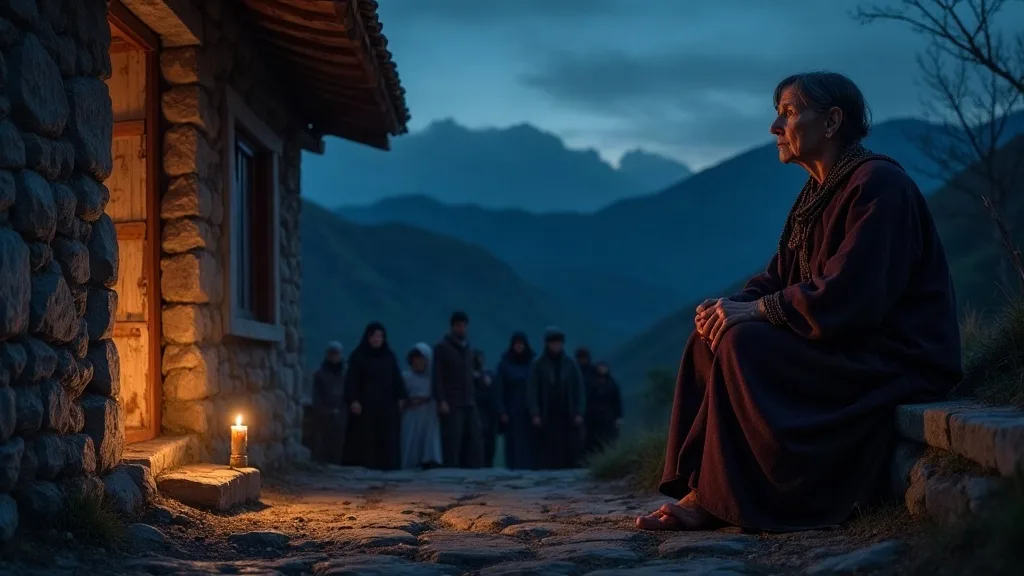
She does not look at you. Her eyes, filmed white as winter sky, turn slightly away while she speaks. Her words come slow, deliberate, as though she is reading something written on the inside of the dark. The people gathered around her listen without breathing. This is a Verta (singular of Vertet, the Albanian term for blind prophetic women), and her blindness is not her affliction. It is her credential.
Vertet: the Blind Seers and Prophets of Albanian tradition occupy one of the strangest and most compelling corners of Balkan folk belief. They are not quite oracles in the Greek mold, not quite wise women in the Celtic sense, not quite shamans as Central Asian traditions define the role. They are something more specific: women who traded physical sight for inner sight, whose very disability became proof of access to a layer of reality ordinary eyes cannot reach.
The corpus of evidence for the Vertet comes primarily from 19th and early 20th-century field collectors, above all Johann Georg von Hahn's Albanesische Studien (1854) and the later ethnographic work of Maximilian Lambertz and Stavro Skendi, supplemented by oral tradition gathered in the Albanian highlands. What emerges is a picture rich in symbolic logic, ritual precision, and narrative weight.
Who the Vertet Were and Where They Came From
The word Verta connects etymologically to roots meaning "truth" or "truthful one" in Albanian, related to the adjective vërtetë ("true, real, genuine"). A Verta was, by name, simply a teller of true things. The plural, Vertet, sometimes appears in highland speech as a collective noun for the class of prophetic women rather than a strict headcount of individuals.
They appeared most consistently in the mountain communities of northern and central Albania, regions where the oral law known as the Kanun (a vast customary code governing everything from blood feuds to hospitality) governed daily life. In that world of strict social order, the Vertet occupied a protected position. Harming a Verta, even in the heat of a blood feud, was widely considered a grave transgression comparable to violating the sacred laws of besa (sworn oath). Their neutrality echoed the neutrality of the church or the sworn oath: to touch them was to invite misfortune.
The Kanun's protection of the Vertet was not incidental. The code treated certain categories of person, including priests, guests, and women in specific circumstances, as inviolable. The Vertet fit into this framework because their prophetic function was considered a community resource rather than a private gift. To harm one was not merely to wrong an individual; it was to deprive the entire highland community of access to truths it could not otherwise reach. In this sense, the Kanun and the Vertet reinforced each other: the code gave the seer physical safety, and the seer gave the code a cosmological dimension, connecting its human laws to the fated structures that governed even those laws.
Most Vertet were women, though rare accounts mention blind male figures who performed similar functions. The female predominance likely reflects the broader pattern seen across many Indo-European traditions, where women held privileged access to prophetic or liminal roles. In Albanian highland life, where men carried arms and bore the weight of public honor codes, women moved more freely between the social and the sacred.
A Verta rarely chose her role. Birth blindness, or blindness arriving in childhood through illness, was read by the community as a sign. Families did not always welcome this interpretation, given the practical hardships involved. But the community's recognition often outweighed family reluctance. Once acknowledged as a Verta, the woman received food, shelter, and social protection from neighbors in exchange for counsel, blessing, and warning.
The Mechanics of Seeing Without Sight
How did a Verta actually prophesy? The accounts are consistent enough to suggest real practice rather than pure legend. She spoke in what highland tradition called fjalë të vërteta ("true words"), a register of speech distinct from ordinary conversation. These were not elaborate riddles in the Delphic mode. They tended to be plain, sometimes brutally direct, delivered in a low even voice.
Before speaking, a Verta would often enter a state described in reports as gjumë i hapur ("open sleep"), a kind of alert trance. She might rock slightly, control her breathing, or press both hands flat on the earth. Some accounts from the Mat and Dibër regions describe her touching the person who came to her, running her fingers across palms or foreheads, before speaking. Touch, rather than sight, was her instrument of reading.
The subjects of her prophecy fell into recognizable categories. Questions of fate dominated: would a child survive illness, would a journey end safely, would a marriage hold. War was a frequent subject in a region where raiding and feud were endemic. And the dead spoke through some Vertet, or so tradition insisted. A family who had lost someone without knowing the full circumstances of the death might visit a Verta to hear what could not be confirmed by living witnesses.
She did not claim to summon these truths herself. Albanian folk tradition placed the source of prophetic knowledge in the Zana (mountain spirits, singular Zanë), in the Ora (or Fatit, the three destiny-weaving women called the fate-women depending on dialect), or simply in the unnamed forces that dwelled in high places, old springs, and threshold spaces. A Verta was a conduit, not a creator. The distinction mattered: it kept her humble, and it kept her safe from accusations of practicing black magic.
The Zana, Albania's fierce mountain spirits, were believed to sometimes speak directly into the ears of blind women at night, filling the darkness with knowledge the sighted world could not access.
Blindness as Sacred Vocabulary
Across world mythologies, blindness and prophecy share a peculiar grammar. Tiresias, the blind seer of Greek myth, lost his sight after encountering Athena and received the gift of prophecy as partial recompense. Odin, the Norse all-father, sacrificed one eye at Mimir's well to gain cosmic wisdom. The Finnish Väinämöinen, though not blind, achieves his deepest knowledge in darkness and extremity. The pattern recurs often enough to be something more than coincidence.
Albanian tradition arrives at the same symbolic equation from a different direction. Rather than trading sight for wisdom in a single dramatic moment, the Verta carries her blindness as a permanent condition of receptivity. She is not someone who once paid a price. She is someone who lives permanently at that price's other side, always receiving.
The theological logic, if we can call it that, runs something like this: visible things compete for attention. The world of light is the world of the changeable, the distracting, the surface. The world behind closed eyes, the world that blindness makes permanent, is the world of the fixed, the real, the fated. A Verta does not see what is. She sees what must be.
| Figure | Tradition | Blindness / Darkness | Source of Knowledge |
|---|---|---|---|
| Verta | Albanian | Permanent physical blindness | Zana, Ora, threshold spirits |
| Tiresias | Greek | Blindness as divine exchange | Apollo, direct divine speech |
| Pythia | Greek | Sensory darkness (underground vapors) | Apollo at Delphi |
| Volva | Norse | Ritual trance, eyes turned inward | Seidr, ancestral memory |
| Odin | Norse | One-eyed (partial, voluntary) | Mimir's well, cosmic wisdom |
The Greek Pythia at Delphi offers the closest parallel in method: seated over a chasm, breathing vapors, cut off from ordinary sensory input, she became a vessel for Apollo's words. The Norse völva (seeress, plural völur) sat on a high platform, entered a state of seiðr (ritual trance magic), and spoke fates across time. Each tradition engineered its own form of perceptual removal. The Vertet achieved the same state through the permanent architecture of their own bodies, a lifelong rather than ceremonial threshold.
Explore the Norse völva and the seiðr tradition that shaped Odin's own quest for knowledge
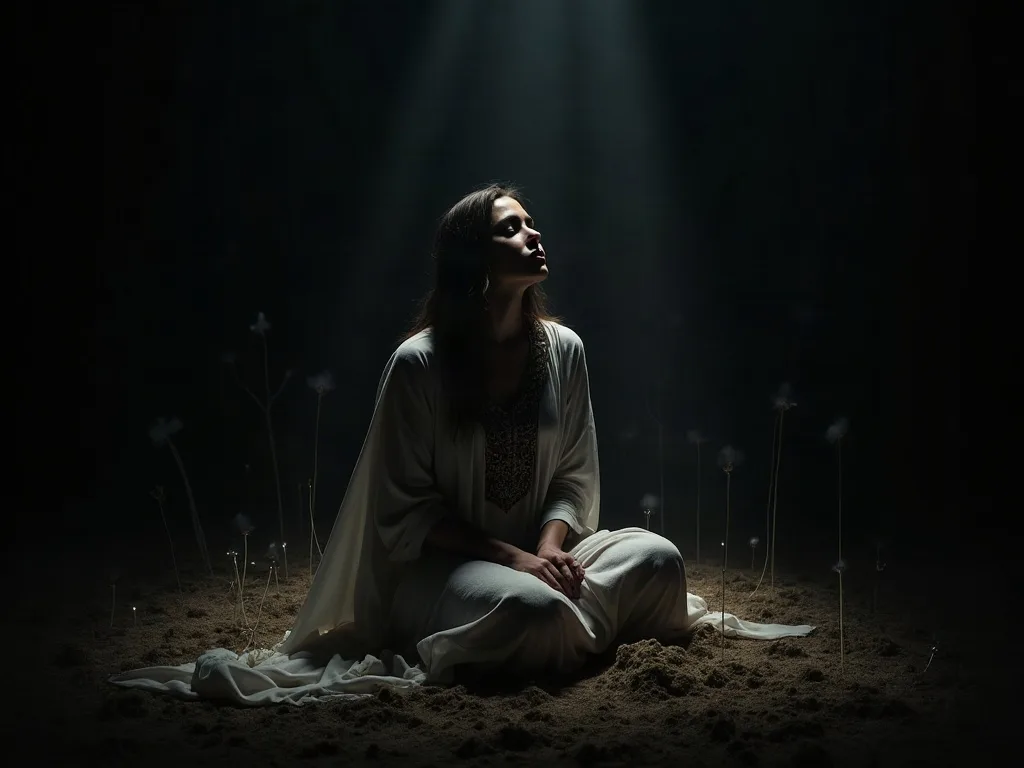
This inversion of ordinary hierarchy, where disability becomes capacity, was not unique to the Vertet but was particularly crystallized in their case. The community's willingness to feed and protect a blind woman who could not work in fields or tend livestock was a practical expression of this belief. She was doing something more valuable than plowing. She was reading the invisible ground beneath the visible one.
The Vertet and the Fate-Women: Two Sides of One System
Albanian traditional cosmology included several overlapping categories of supernatural women. The Zana were wild mountain spirits, beautiful and dangerous, associated with peaks, forests, and springs. The Ora (or Fatit) were individual destiny-women, one assigned to each person at birth, who determined the arc of a life. The Shtriga were witches who could harm and sometimes heal.
The Vertet sat in an interesting relationship with all three. They were not Zana, being human. They were not Ora, being mortal and collective. They were not Shtriga, lacking malevolent intent. But they shared something with each category: access to the non-visible structure of the world.
Some oral accounts describe the Zana whispering to blind women while they slept in open air on hillsides. In this version, the Verta is almost a spokeswoman for the Zana, a human translator of messages from wild spirits to domestic communities. Other accounts credit the Ora, the personal destiny-woman, with opening the Verta's inner sight in exchange for the physical sight she was denied. These explanations are not contradictory. They are different community understandings of the same recognized phenomenon.
Scholars including Robert Elsie, whose A Dictionary of Albanian Religion, Mythology, and Folk Culture (2001) remains the most comprehensive English-language reference, note that these categories were always permeable in lived practice. A village might use the terms interchangeably or apply them to the same individual depending on the context of need.
Discover how the Ora shaped individual destiny in Albanian cosmology
Ritual Visits and the Protocol of Asking
Consulting a Verta was not casual. Ethnographic records from the 19th and early 20th centuries describe a clear protocol, though details varied by region.
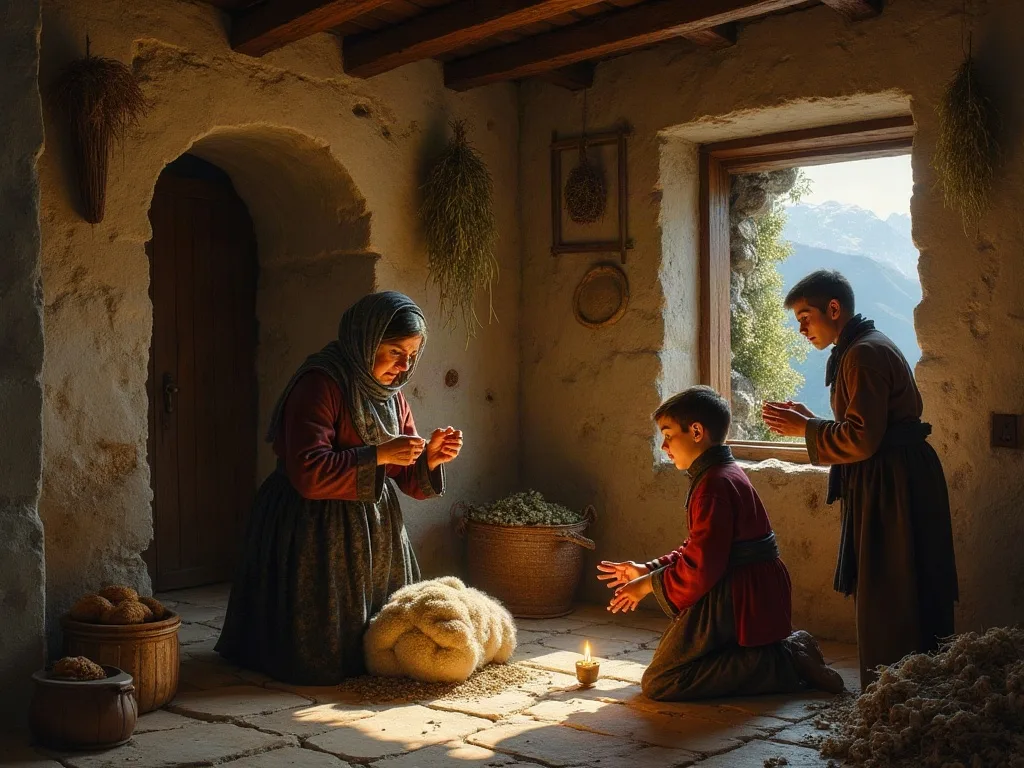
You did not arrive alone if you could help it. A witness was customary, partly for social confirmation of the Verta's words, partly because some Vertet refused to speak without a witness present, as protection for their own reputation. You brought a gift: bread, oil, wool, sometimes a coin. Not payment in the mercantile sense, but acknowledgment. The gift said: I recognize what you carry.
You stated your question plainly. Vertet reportedly had little patience for elaborate preambles. The question had to be real. Community lore held that a false or testing question (asked by someone who already knew the answer and wanted to trick the seer) would bring silence, or worse, an answer aimed at the questioner's actual hidden worry rather than the false surface one.
The Verta would then enter her trance state, speak her true words, and that was the consultation. There was no argument, no asking for clarification in most accounts. You received what was given. If it made no sense now, it would make sense later. That was understood.
After leaving, the visitor was expected not to repeat the exact words of the prophecy verbatim to others for a set period, sometimes three days, sometimes until a new moon. The words were considered still active, still forming, and to speak them too soon was to interfere with their unfolding.
The Voice That Knows the Dead
One of the most persistent and striking functions attributed to the Vertet was their ability to communicate with the dead. In Albanian highland culture, where sudden violent death was common and feuds sometimes meant bodies could not be recovered or truth about a killing could not be established, this function had genuine social utility.
A widow who needed to know whether her husband's killer was from a rival clan or a different family before the Kanun's feud obligations could be properly directed might consult a Verta. A family whose member had disappeared in the mountains might seek confirmation of death before remarrying a spouse or dividing an inheritance. In each case, the Verta's access to the dead served a function that no other community institution could fill.
The descriptions of how this worked are fragmentary but consistent. The Verta would grow very still. Her voice might change register, becoming either higher or lower than her usual tone. She spoke as though relaying speech rather than generating it. Sometimes she gave names, places, descriptions of events. Sometimes she gave only symbols or images that the family had to interpret.
Robert Elsie notes that this function parallels the role of similar figures across the Balkans, from Serbian vilas to the Greek Pythia, suggesting either a shared ancient stratum of belief or a pattern of mutual influence across centuries of cultural contact.
The Vertet After the Ottoman Period
Albania spent nearly five centuries under Ottoman rule, from the mid-15th century until 1912. During that period, and especially under the long enforced silence of communist Albania from 1944 to 1991, traditional religious and folk practices were systematically suppressed. The Vertet, like the Zana and the Ora, survived in the way that oral traditions survive: in private memory, in the stories grandmothers told quietly, in highland communities where the reach of official ideology was thinnest.
When Albanian folk culture began to be studied seriously by outside scholars in the late 19th century, and again when Albanian scholars themselves could publish freely after 1991, the Vertet appeared in the record as a recognized category, not a curiosity. They had been known. They had been remembered. The survival of the concept across Ottoman administration, Christian and then Muslim conversion pressures, and communist atheism says something important about how deeply rooted the role was.
Contemporary Albanians vary widely in their relationship to these traditions. Some dismiss them as superstition, a standard response in any post-communist, partially secularized society. Others carry them as living heritage, part of a cultural identity that was almost erased and is now deliberately preserved. A smaller number report that blind women with prophetic reputations still appear occasionally in highland communities, consulted quietly and without public advertisement.
The Vertet also live in Albanian literature. The novelist Ismail Kadare draws on the full architecture of Albanian folk belief in works like Broken April and The File on H, where the landscape itself seems to carry ancestral memory, and where women at the margins of sight and speech often know the most.
Frequently Asked Questions About the Vertet of Albanian Mythology
Frequently asked questions
Were the Vertet worshipped as goddesses or treated as ordinary people?
Neither exactly. The Vertet were recognized as humans with an exceptional gift, not as divine beings. They received respect, protection, and practical support from their communities, but were not the objects of cult worship in the way that the Zana or the Ora were. The distinction was important to Albanian folk tradition: a Verta was a channel, not a source. Revering her too highly would have confused the message with the messenger.
Why were the Vertet almost always women?
Several overlapping explanations exist. In Albanian highland society, women occupied liminal social positions, neither fully inside the male-coded honor system of the Kanun nor fully outside it. This social liminality may have made women the natural candidates for spiritual liminality. Additionally, the broader Indo-European pattern, from Greek sibyls to Norse völur (seeresses), associates women with prophetic access, suggesting a very old cultural stratum that Albanian tradition preserves with particular clarity.
What primary sources document the Vertet?
The most important early sources are Johann Georg von Hahn's Albanesische Studien (1854) and the ethnographic work of Maximilian Lambertz in the early 20th century. In English, Robert Elsie's A Dictionary of Albanian Religion, Mythology, and Folk Culture (2001) and his broader corpus of Albanian studies remain essential. Oral tradition, gathered mainly in the northern and central highland regions, fills in detail that written records leave vague.
How does the Albanian tradition of blind seers compare to similar figures in other Balkan mythologies?
The parallel is strong with Serbian and Greek traditions. Serbian vilas (supernatural women of the mountains) and Greek oracular traditions both feature female figures with privileged access to fate and the dead. The Greek Pythia at Delphi, though not blind, operated in sensory darkness (underground, inhaling vapors) in a way that functionally mirrors the Verta's trance state. The Norse völva provides a further parallel: seated apart, in ritual darkness, she too accessed fate for the community's benefit. Robert Elsie and other Balkan folklorists suggest a shared ancient substrate across these traditions, likely predating the distinct national identities of the modern Balkan states.
Did the Vertet have any connection to the Albanian sky god Zojz or other major deities?
Direct documented connections are thin, but the structural logic suggests indirect links. Albanian cosmology placed fate and prophecy under the influence of the three Ora or Fatit (destiny-women), who themselves operated within a layered supernatural world that included the sky god Zojz (related to Zeus via proto-Indo-European roots) at its apex. A Verta's knowledge, believed to come from the Zana or the Ora, placed her inside that cosmological system even if no direct theological doctrine spelled out the connection.
Are there modern Albanians who still believe in or practice traditions connected to the Vertet?
Yes, though with significant variation. In some northern highland communities, the general concept of a blind or elderly woman with prophetic gifts persists quietly alongside mainstream religious practice. Albanian diaspora communities have also carried these traditions to Italy, Greece, and North America. More broadly, the revival of interest in pre-Ottoman Albanian folk culture since 1991 has brought renewed scholarly and popular attention to figures like the Vertet, the Zana, and the Ora as key elements of a distinct Balkan cultural identity.
The Vertet and the Modern Question of What Prophecy Is For
Strip away the supernatural framework and look at what the Vertet actually did in their communities. They absorbed questions that had no other forum. They gave voice to knowledge that could not be socially acknowledged any other way. They allowed communities to process grief, decide on action, and organize meaning in the face of events that official structures, legal or religious, could not address.
A widow who needed to know the truth about her husband's death could not take testimony from a ghost in any court. But she could visit a Verta, receive a statement, and act on it in a way her community would recognize as legitimate. The Verta's role was, in a real sense, epistemological: she provided a recognized category of knowledge for things that exceeded the reach of ordinary knowing.
Anthropologists studying similar figures in other cultures, from the Siberian shaman to the Haitian manbo (a Vodou priestess who communicates with spirits), have noted this function consistently. The seer does not replace reason. She supplements it at its edges, in the zones where reason runs out of evidence and communities still need to act.
The Vertet, seen this way, were not relics of pre-rational belief waiting to be superseded by enlightenment. They were a sophisticated community technology, adapted precisely to the conditions of highland Albanian life: violent, uncertain, honor-bound, and rich with events that could never be fully witnessed or verified. Their blindness was not metaphor. But it carried the metaphor perfectly. What the eye cannot see, the true-word speaker sees for us.
That is why the image persists. That is why, in highland memory and in the literature of a nation that almost lost its entire folk inheritance, the woman who does not look at you, whose filmed eyes turn slightly away, keeps appearing. She is still reading. The darkness she lives in is still full of things we need to know.
Read the full book
Want the whole story?
The complete edition is an instant PDF download here, with a paperback on Amazon for selected titles.
Albanian
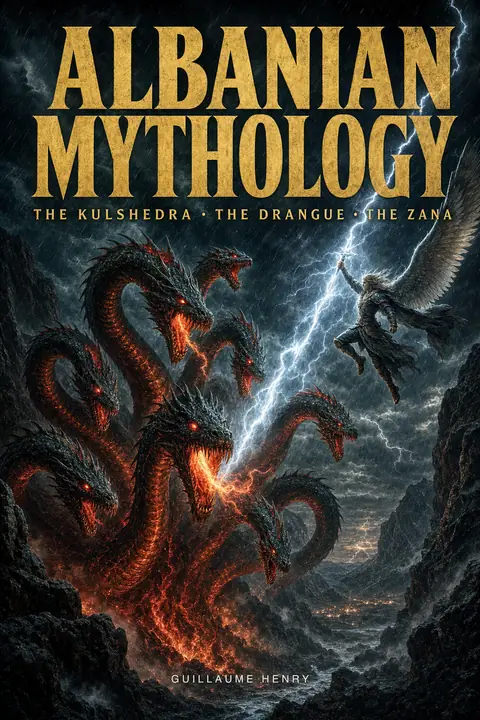
The Albanian Mythology Book: The Kulshedra, the Drangue, and the Spirits of the Mountains
The Kulshedra, the Drangue, and the Zana
The mythology of the Albanian highlands: the Kulshedra, a fire-belching dragon-hag who hoards the rains, the Drangue, winged heroes born to fight her, and the Zana, mountain nymphs who bless and curse. A pagan world that survived in the songs of the highland warriors.
More from Albanian
All articles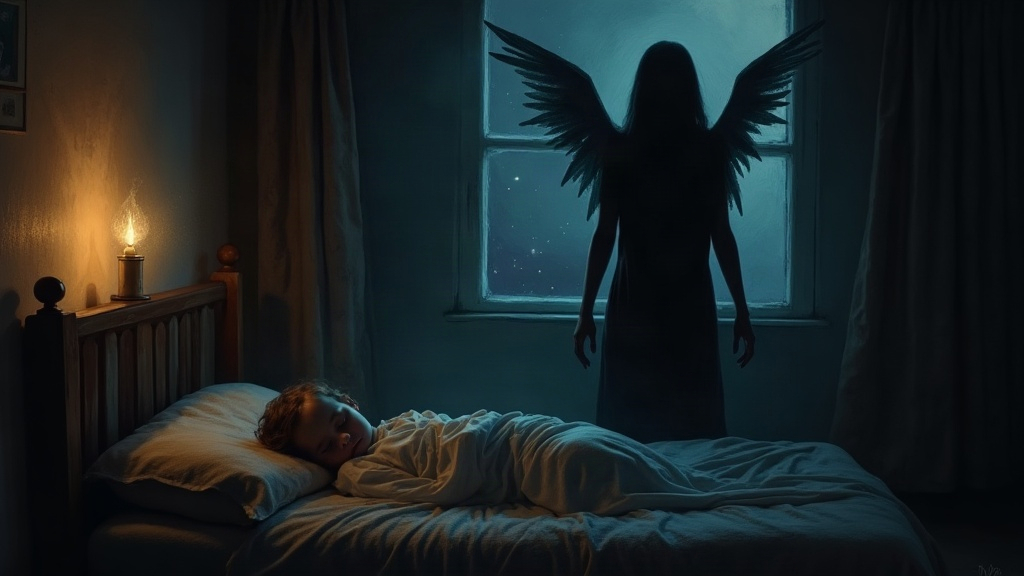
Albanian
The Shtriga: Witch-Vampire of Albanian Folklore
The Shtriga is a witch-vampire hybrid from Albanian folklore who feeds on the life force of sleeping children. Part demon, part woman, entirely dangerous, she embodies the fears of a culture caught between Christianity, Islam, and older Balkan beliefs.

Albanian
Muji and Halili: The Epic Heroes of Albanian Legend
Muji and Halili are the legendary twin heroes of Albanian epic poetry, warriors bound by blood and honor who defend their land against mythical monsters and foreign invasion. Discover how their deeds shaped Albanian cultural identity for centuries.
Albanian
The Besa: Sacred Code of Honor in Albanian Culture
The Besa is Albania's oldest unwritten law: a sacred pledge of honor, protection, and hospitality that has shaped Albanian identity for centuries. Discover how this ancient code binds community, defies conquest, and survives in modern Albania.

Albanian
E Bukura e Dheut: The Earthly Beauty and Goddess of Nature in Albanian Mythology
E Bukura e Dheut embodies the earthly beauty and goddess of nature in Albanian mythology, representing fertility, growth, and the sacred landscape. Discover how this ancient figure shaped Albanian spiritual life and persists in folk tradition today.