
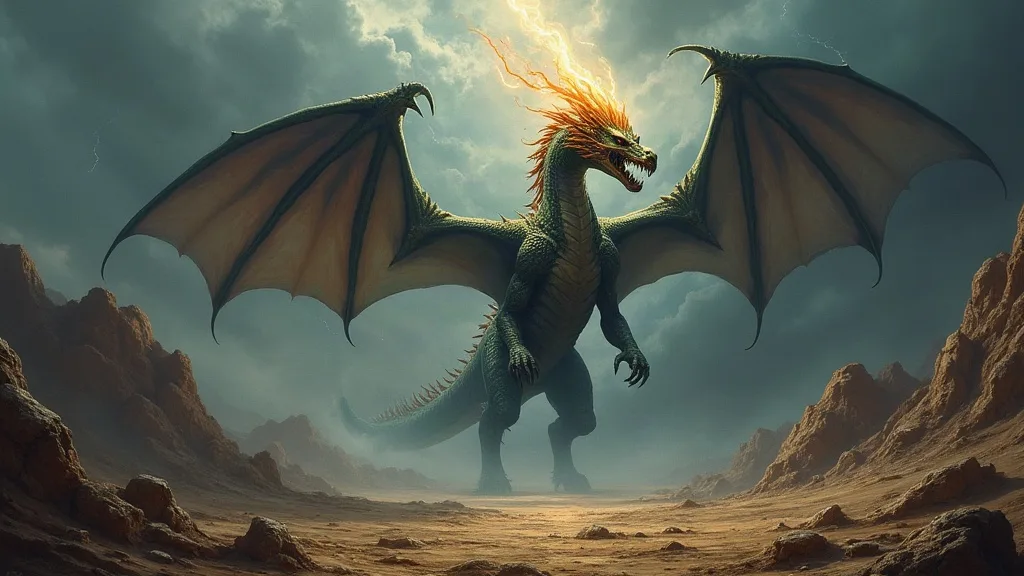
The Kulshedra: Dragon Demon of Storms and Drought
The Kulshedra is a serpentine monster from Albanian myth that brings drought, storms, and catastrophe to the land. Discover the creature's origins, its battles with heroes, and why it endures as a symbol of natural chaos in Balkans folklore.
Contents
A creature coils in the depths of the Balkan highlands, waiting between worlds. Its scales catch the first rumble of thunder. Its breath steals rain from the sky and withers crops below. For centuries, Albanian villagers named their worst fears after one monster: the Kulshedra, a dragon-demon so powerful that heroes and saints must band together to face it.
The Kulshedra is not a simple serpent. It is a force of ecological disaster wrapped in flesh and malice. When it stirs, drought follows. When it breathes, storms ravage. It is hunger given form, and the oldest stories say it can never truly die, only defeated and driven back until the next age brings it forth again.
Origin and Nature of the Dragon
The origins of the Kulshedra lie deep in the mythology of the Balkans, where pre-Islamic Albanian faith held fast to ancient gods and spirits. The creature's name itself carries weight: Kulshedra (also spelled Kulshendra or Kulshedre) likely derives from older Indo-European roots meaning a multi-headed serpent or dragon, though some scholars connect it to Slavic and Greek draconic traditions that overlap in the region.
Unlike the dragon-hoards of Norse sagas or the benevolent serpents of Hindu lore, the Kulshedra embodies pure chaos. It is neither entirely animal nor entirely demon, but something between: a creature that exists partially in the physical world and partially in the spirit realm. In its physical form, it appears as a gigantic serpent with a human-like upper body, multiple heads crowned with flame or horns, and wings that can eclipse the sun when spread. Its eyes are described as burning coals, and its breath carries the stench of sulphur and decay.
The creature's dual nature makes it a bridge between two worlds. It feeds on both material sustenance (livestock, crops, water) and spiritual energy (the terror and suffering of humans below). Some tales say the Kulshedra grows more powerful with each head it gains, and ancient versions describe it with anywhere from three to nine heads, each one granting new abilities of destruction.
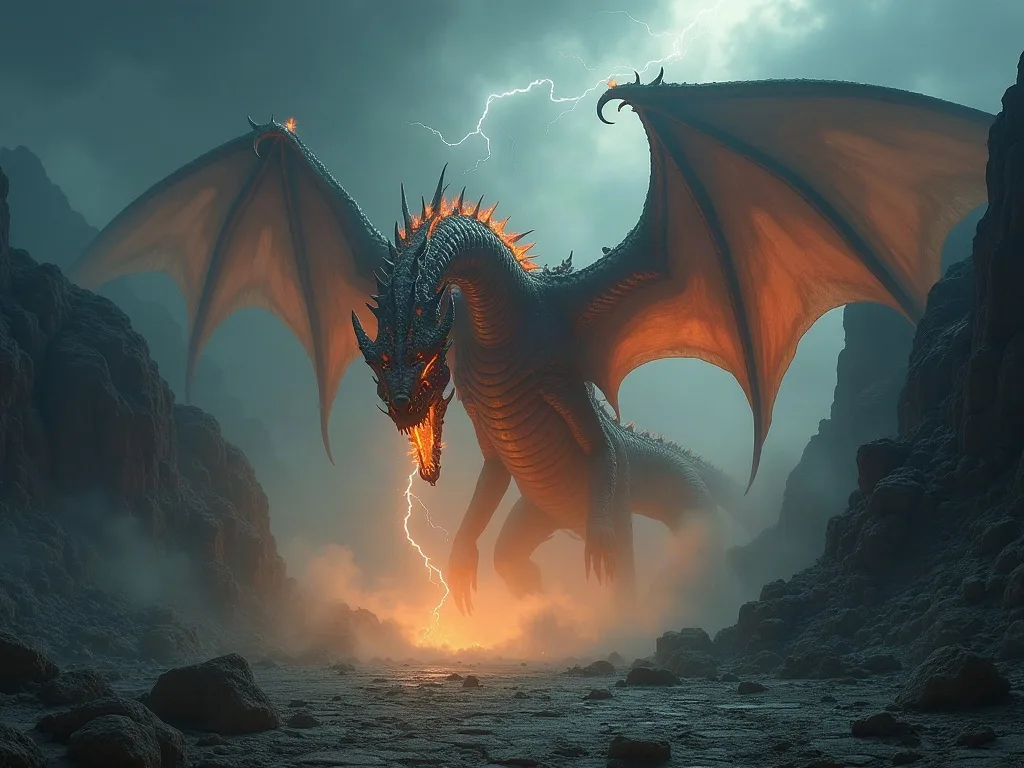
The Curse of Eternal Return
One of the defining features of Kulshedra mythology is the cycle of return. Unlike a hero who vanquishes a dragon once and for all, the Kulshedra cannot be permanently killed. Instead, heroes may wound it, drive it into hibernation, or trick it into sleep. But the curse follows: after seven years, or seven generations, or at some unspecified future hour, it will wake again.
This cyclical nature mirrors the agricultural anxieties of Mediterranean and Balkan societies. Drought is not a one-time catastrophe; it returns. Storms do not cease forever. Famine may retreat, but hunger always waits at the edge of survival. The Kulshedra gives mythic form to these recurring natural terrors.
In some versions, the creature is bound by old magic or by a saint's intervention. A famous tale tells of the Kulshedra being chained beneath a monastery or trapped under a mountain, held by divine will. But the magic weakens. The chains rust. And the monster tests them, year by year, preparing for the moment of escape.
One myth claims that a hero managed to trick the Kulshedra into a copper cauldron, then sealed it with a lid so heavy that only a hundred men could lift it. The cauldron was buried deep, and every hundred years a man is born strong enough to almost raise the lid. When someone finally succeeds, the Kulshedra will return to the world.
The Drought Bringer and Storm Master
The Kulshedra is above all else a creature of environmental chaos. Its primary power is the ability to arrest rain, bringing terrible drought to the lands below. When the monster is awake and active, the sky cracks like dry earth. Rivers fail. Lakes shrink to muddy pools. Livestock perish. Families watch their children go hungry.
Yet paradoxically, the Kulshedra is also a bringer of storms. Some versions hold that the creature must drink water to sustain itself, and when its thirst becomes unbearable, it draws moisture from the entire region into its body, creating violent tempests and torrential rains that are no less destructive than drought. Flash floods tear through valleys. Lightning sets forests ablaze. The creature's passage leaves scorched earth in either case.
This dual control over water reflects a sophisticated understanding of environmental disaster. In the Balkans, communities faced both extremes: dry seasons where irrigation failed, and sudden storms that destroyed crops through excess. The Kulshedra became the story a culture told itself about how nature could swing from one extreme to the other with terrible speed.
Heroes and Saints Against the Monster
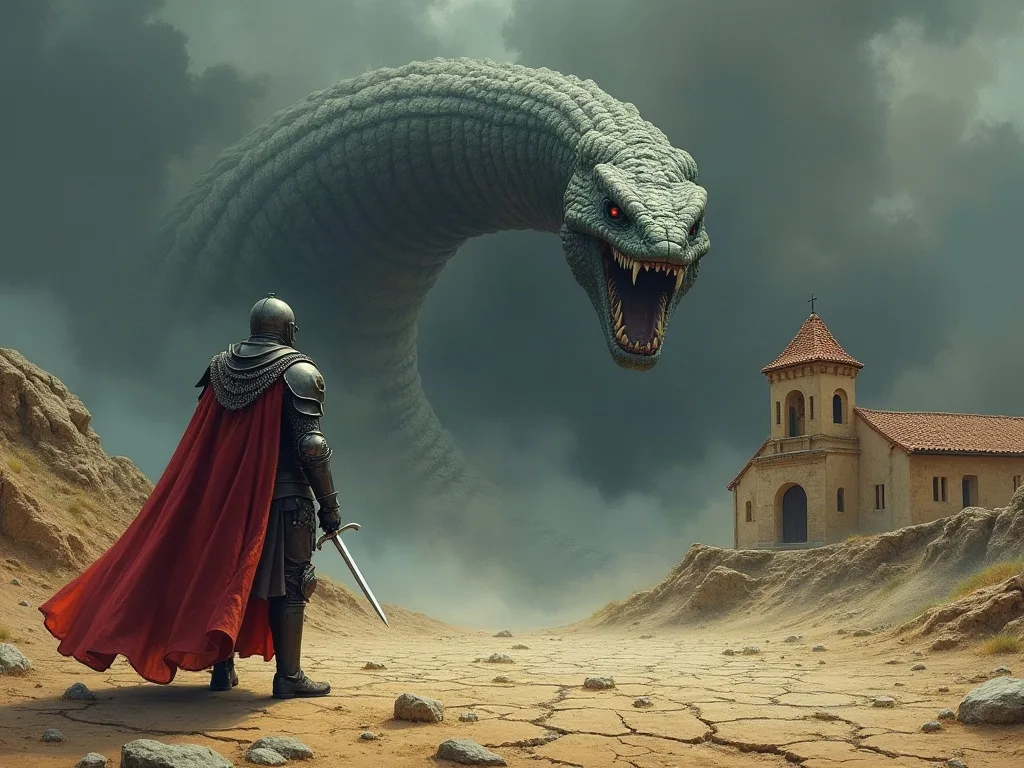
No single hero can face the Kulshedra alone. The creature is too large, too powerful, too ancient. Instead, the myths preserve stories of collective action: two brothers, a warrior and a saint, an entire village united in ritual and prayer.
One prominent cycle involves a hero (sometimes named as a version of Gjerg, a widespread name in Albanian tradition) who confronts the Kulshedra. The battle itself is described in vivid terms: the creature rises from its lair, heads writhing and snapping. Thunder shakes the mountains. The hero draws a sword forged by a smith blessed by divine will. The combat rages for days and nights. In some versions, the hero wins through cunning rather than strength: he discovers that the Kulshedra can be harmed only by weapons touched by a saint, or that it fears a certain herb, or that it cannot abide the sound of church bells.
The role of saints in these stories reflects the Christianization of Albanian lands. Over time, older pagan heroes were recast as Christian saints, and the Kulshedra became a symbol of pagan evil to be conquered by faith. Saint George, familiar across Christian traditions as a dragon-slayer, merged in places with local hero-saints to create new versions of the myth. Yet beneath the Christian overlay, the deeper story remains: humans must join together, must call on the greatest powers at their disposal, must sacrifice, to drive back the chaos the Kulshedra represents.
Comparison with Other Dragon Traditions
The Kulshedra shares DNA with dragon myths across the Indo-European world, yet it maintains a distinctive character. Unlike Fafnir, the greedy Norse dragon who guards gold, the Kulshedra has no interest in treasure. Unlike the serpents of Hindu mythology such as the Nagas, which can be benevolent or neutral, the Kulshedra is never kind. Unlike the Chinese dragons that bring prosperity and rain, the Kulshedra brings only disaster.
Fafnir (Norse)
A dragon of greed and individual power. Killed by a hero in a singular combat that echoes across ages. Associated with gold, with material wealth, with the hoarding of resources. Death is permanent; the victory conclusive.
Kulshedra (Albanian)
A demon-serpent of ecological chaos. Cannot be killed permanently; only driven back until the next awakening. Associated with water and weather, with the withholding of resources. The battle is cyclical; the victory always temporary.
The Kulshedra is closer in spirit to Mesopotamian monsters like Tiamat, the primordial chaos-dragon of Babylonian myth, or to the Python of Greek tradition, which embodied the wild forces that civilization must repeatedly push back. Yet even these comparisons are imperfect. The Kulshedra is not quite a primordial force (the world does not depend on defeating it to exist), nor is it merely a guardian of a sacred site. It is a localized, recurring apocalypse; a threat that is never fully lifted.
Water, Weather, and Cultural Meaning
To understand the Kulshedra fully, one must understand the Balkans themselves. The region is prone to both severe droughts and flash flooding. Agricultural societies in mountains and valleys lived in close negotiation with water: too much would destroy the harvest; too little would starve the community. Priests and wise people watched the skies. Rituals were performed to encourage rain, to ward off excess, to ensure a balance.
The Kulshedra is the expression of this anxiety as myth. It is what happens when that balance fails catastrophically. It is drought given teeth. It is the storm that drowns rather than nourishes. The monster is not truly alive in the biological sense; it is a phenomenon, a force, dressed in narrative language so that communities could speak about it, teach children to fear it, and organize collective responses to genuine environmental crises.
Sacred Rites and Protective Magic
In regions where the Kulshedra myth remained strong, communities developed rituals to protect themselves. These were not mere superstition; they were structured responses to environmental threat, encoded in sacred practice.
On certain calendar dates, or when drought signs appeared, villagers would gather at a crossroads or on a high place. A priest or elder would lead prayers, sometimes invoking older gods alongside Christian saints. In some versions, a sacrifice was offered: an animal, or (in darker tales) a human virgin was given to the Kulshedra to appease its hunger, buying the community another season of relative peace. The practice recalls similar mythological exchanges in other cultures: humans and monsters negotiating the terms of coexistence.
Protective charms were also widespread. A branch of certain trees, blessed and hung above a door, was believed to ward off the creature's attention. Salt was scattered around a house. Fire was kept burning through the night, on the theory that the Kulshedra feared flame. Bells were rung at intervals to remind the monster of human presence and faith.
These practices reveal something important: the Kulshedra was not abstract evil, but a neighbor. People lived in the same landscape as the monster. They could not flee. They could only prepare, protect themselves, and wait for the hero or saint who might, for a time, drive it back.
The Kulshedra in Modern Albanian Culture
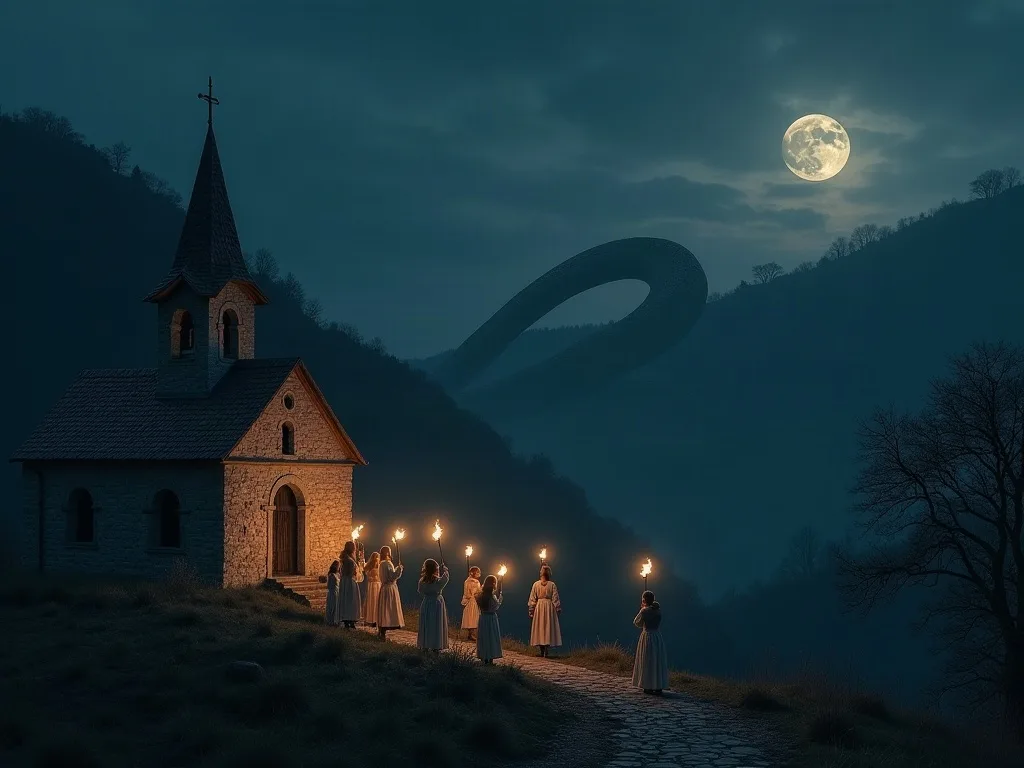
Though Albania modernized rapidly in the 20th century, the Kulshedra did not vanish from cultural memory. The creature appears in 19th-century Albanian folk collections, in nationalist literature that sought to recover pre-Ottoman traditions, and in place names across the country. Mount Kulshedra in northern Albania is named for the myth. Several villages claim to be the site of a famous battle between a local hero and the dragon.
In the late 20th and early 21st centuries, the Kulshedra has reentered Albanian popular culture through fantasy literature, visual art, and historical fiction. Writers such as Ismail Kadare referenced the creature in works that blended myth with political allegory. The monster became a symbol of any force that destroys without mercy: occupation, tyranny, environmental collapse. Its nature as a recurring threat, impossible to kill permanently, made it an apt metaphor for struggles that repeat across generations.
The creature also appears in regional Balkan popular culture more broadly. Variations of the Kulshedra myth exist in Serbian, Montenegrin, and Macedonian folklore, each adapted to local geography and history. This suggests that the core story is not unique to Albania, but rather a shared heritage of the mountain Balkans, with each people taking the basic mytheme and weaving it into their own cultural fabric.
Why the Kulshedra Endures
The Kulshedra remains powerful not because it is a specific, bounded deity like Persephone or Teshub, but because it expresses a truth about the natural world: that humans are not masters of their environment, but negotiators with forces far greater than themselves. The myth says, plainly, that you cannot win against drought or flood. You can only endure, prepare, and hope that those with courage and blessing will help you survive.
This is not the message of civilizations confident in their technological mastery. It is the message of cultures that have watched seasons fail, seen children starve, and experienced the sudden fury of storms. It is the message of the Balkans, a region that has known both great empires and terrible occupations, where stability is never guaranteed and catastrophe returns in cycles.
The Kulshedra teaches a kind of humility. It says: your world is not as ordered as you believe. The chaos you fear is real, and it lives nearby. The only response is community, courage, and the willingness to call on powers greater than yourself. Whether those powers are saints, old gods, or simply the collective will of a people united in survival, the principle remains the same.
Frequently Asked Questions About the Kulshedra
Frequently asked questions
Is the Kulshedra connected to the Dragons of other European mythologies?
The Kulshedra shares Indo-European roots with dragons across the continent, but it is distinctly Balkan in its focus on environmental chaos and its inability to be permanently slain. Unlike Norse dragons of greed or Greek dragons guarding sacred sites, the Kulshedra is primarily a force of drought and storm that embodies ecological disaster and must be defeated anew each cycle.
Why can't heroes permanently defeat the Kulshedra?
The creature's cyclical return reflects the reality of Balkan agricultural life: drought and flooding are not one-time disasters, but recurring threats that return with the seasons or across generations. The myth encodes this ecological truth into narrative form, teaching that some dangers must be managed and resisted repeatedly, never finally conquered.
What role do saints play in Kulshedra myths?
Christian saints largely replaced pagan heroes in the myth as Albanian lands Christianized. Saints brought divine power that could wound or temporarily bind the creature, turning the conflict into one between Christian faith and pagan (or demonic) chaos. The saint's role reflects how cultures often absorb older myths into new religious frameworks while preserving the core story.
Are there any historical events that might have inspired the Kulshedra myth?
While no single historical event created the myth, the Kulshedra likely crystallized during periods of severe environmental crisis: years of sustained drought, catastrophic floods, or both in sequence. Such events would have left deep marks on cultural memory and been explained through the framework of a terrible monster awakening. The myth may also reflect memories of earlier occupying powers or invading armies that came like environmental catastrophes.
Does the Kulshedra appear in written sources or only in oral tradition?
The creature appears primarily in oral folklore, collected and recorded by folklorists from the 19th century onward. It features in Albanian folk narratives, place names, and regional variations across the Balkans. Some modern Albanian and regional scholars have studied the myth systematically, but there is no ancient written text comparable to the Greek Theogony or Norse Eddas that preserves the Kulshedra's origins.
The Monster as Mirror
The Kulshedra endures because it is not truly separate from the world it devastates. It is not an invading evil from outside, but a force that emerges from the land itself. In this way, the creature differs fundamentally from demons or devils in religious traditions, which are external corruptors. The Kulshedra is internal to nature; it is what nature becomes when pushed to extremity.
This makes the creature a profoundly ecological figure, long before modern environmentalism existed. The myth says: the land has power that is not human. The land can turn hostile. When humans fail to live in balance with the water cycle, when they exhaust the soil, when they ignore the warnings of drought and flood, the Kulshedra awakens as a consequence, not a punishment from beyond, but the earth itself pushing back.
In a time when climate change is reshaping what humans thought were stable weather patterns, when drought and flooding intensify across entire regions, the Kulshedra speaks across centuries with unexpected clarity. It says: you are not in control. You never were. The best you can do is prepare, unite, and when catastrophe comes, endure it together and hope to survive to the next cycle.
This is the reason the Kulshedra remains alive in Albanian memory and imagination. It is not a relic of a superstitious past, but a profound narrative about how humans and the natural world coexist, how civilizations must negotiate with forces beyond their mastery, and how the same conflicts return again and again, demanding renewed courage from each generation.
Read the full book
Want the whole story?
The complete edition is an instant PDF download here, with a paperback on Amazon for selected titles.
Albanian
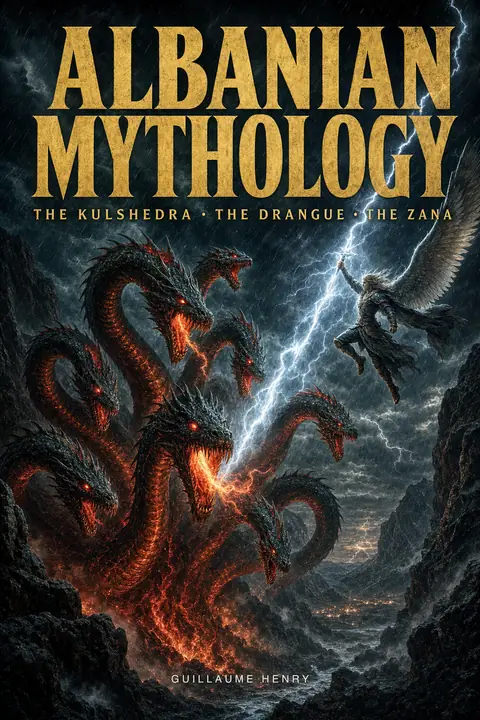
The Albanian Mythology Book: The Kulshedra, the Drangue, and the Spirits of the Mountains
The Kulshedra, the Drangue, and the Zana
The mythology of the Albanian highlands: the Kulshedra, a fire-belching dragon-hag who hoards the rains, the Drangue, winged heroes born to fight her, and the Zana, mountain nymphs who bless and curse. A pagan world that survived in the songs of the highland warriors.
More from Albanian
All articles
Albanian
The Shtriga: Witch-Vampire of Albanian Folklore
The Shtriga is a witch-vampire hybrid from Albanian folklore who feeds on the life force of sleeping children. Part demon, part woman, entirely dangerous, she embodies the fears of a culture caught between Christianity, Islam, and older Balkan beliefs.

Albanian
Muji and Halili: The Epic Heroes of Albanian Legend
Muji and Halili are the legendary twin heroes of Albanian epic poetry, warriors bound by blood and honor who defend their land against mythical monsters and foreign invasion. Discover how their deeds shaped Albanian cultural identity for centuries.
Albanian
The Besa: Sacred Code of Honor in Albanian Culture
The Besa is Albania's oldest unwritten law: a sacred pledge of honor, protection, and hospitality that has shaped Albanian identity for centuries. Discover how this ancient code binds community, defies conquest, and survives in modern Albania.
Albanian
E Bukura e Dheut: The Earthly Beauty and Goddess of Nature in Albanian Mythology
E Bukura e Dheut embodies the earthly beauty and goddess of nature in Albanian mythology, representing fertility, growth, and the sacred landscape. Discover how this ancient figure shaped Albanian spiritual life and persists in folk tradition today.