
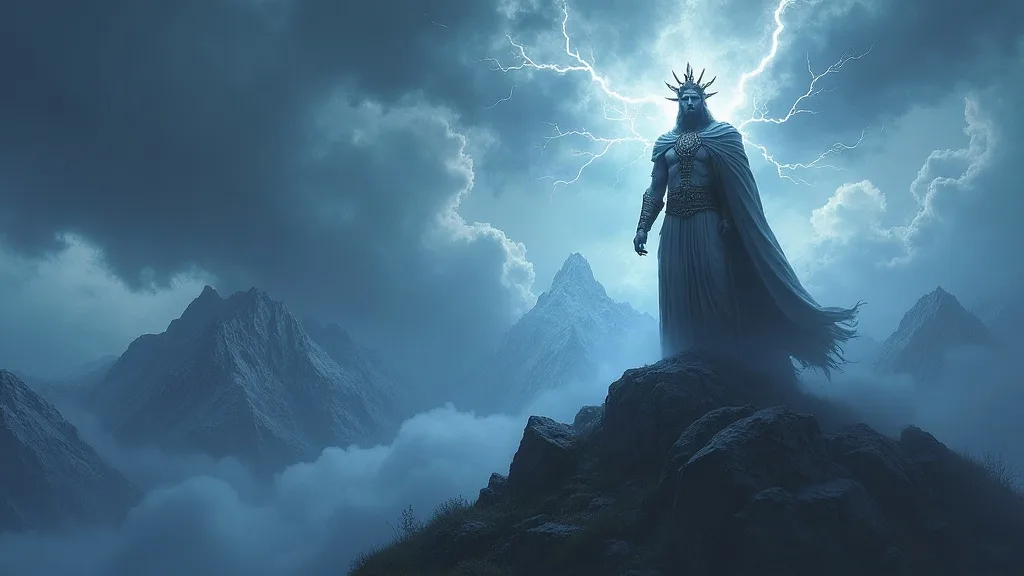
Zojz: The Supreme Sky God of Albanian Mythology
Zojz towers over Albanian belief as the sovereign of sky and thunder, a deity whose rule shaped the moral order itself. Discover how this ancient father-god commanded respect, commanded storms, and held the Dinaric highlands in awe for millennia.
Contents
From the high passes of the Dinaric Alps came a thunder that was never just weather. The Albanians looked upward, into the storm, and saw Zojz, the father of gods and the architect of cosmic order. He did not speak softly. He did not ask permission. He ruled the sky as an absolute monarch rules his realm, and in doing so, he held together the moral and natural world that sustained human life.
Zojz: The Supreme Sky God of Albanian Mythology was not a distant abstraction. The Dinaric shepherds and farmers invoked him at the threshold of each season, each journey, each oath. His thunder was justice made audible. His lightning was the sword that carved right from wrong. And his presence, felt in every tempest and every clear dawn, reminded mortals that the cosmos had a king, and that king expected obedience and virtue.
Yet for all his power, Zojz remains one of Europe's least known divine figures. While Zeus and Thor dominate the shelves of mythology bookstores, the Albanian sky father has slipped into obscurity, overshadowed by centuries of foreign rule and cultural suppression. This article restores him to light.
The Origins of Zojz in Indo-European Sky-Father Tradition
The name Zojz descends directly from the Proto-Indo-European root dyeu-, meaning "sky" or "shining." This same root spawned Zeus among the Greeks, Jupiter among the Romans, Dyaus in the Vedic tradition, and Dievas among the Lithuanians. Zojz is not a copy of these gods; rather, he is a cousin, shaped by Albanian geography, language, and history into a figure distinctly his own. The Albanians preserved in his name and function an ancient inheritance that traces back to the pastoral peoples who first worshipped the sky itself as the dwelling of the divine.
The Indo-European sky father archetype centers on several core attributes: rulership of the heavens, command over weather (especially thunder and lightning), association with oaths and justice, and the role of father to other gods. Zojz embodies each of these. He was not born from chaos or struggle; rather, he was understood as the eternal sovereign, the one who had always been and would always be. Albanian mythology, like its cousins in Greece and Scandinavia, preserved no birth myth for Zojz himself. He existed before time had a name.
This conservatism in the myth-making tradition suggests the antiquity of the figure. The older the deity, the less embellished the origin story; later gods accumulate narratives like sediment. The fact that Zojz remains starkly present, uncomplicated by elaborate genealogies, points to a belief system that valued him not as a character in a story but as an unchanging fact of the cosmos.
Divine Authority and the Pantheon
Zojz stood at the apex of the Albanian divine order. Below him ranged a family of spirits and lesser deities, each with domain and duty. The exact structure of this pantheon remains fragmentary, preserved only in folk memory and the scattered notes of anthropologists who collected them from remote villages in the 20th century. Unlike Greek mythology, which Hesiod fixed in the Theogony (a written poem from around 700 BC that systematized the gods' genealogy), or Norse mythology, which the Prose Edda (a 13th-century Icelandic text) preserved in verse and narrative, Albanian mythology survived almost exclusively in the mouths of grandmothers, shepherds, and priests.
What emerges from these oral traditions is a cosmos organized by hierarchy and function. Zojz delegated authority but retained supreme power. His will was law. When he thundered, the earth trembled not from accident but from the execution of his judgment. Oaths sworn before Zojz were sacred beyond all others; to break such an oath invited not merely social shame but cosmic retribution. The perpetrator might expect storms, barrenness, sickness. The god's memory was eternal, his arm long.
Thunder, Lightning, and the Seat of Justice
The manifestation of Zojz was storm. When clouds massed over the highlands, when thunder rolled across the granite peaks, when lightning split the darkness, Zojz was not merely present; he was speaking. This was not poetic metaphor in the minds of believers. It was literal theology.
Albanian folklore records that Zojz kept his seat in the highest heaven, in a palace of crystal and light. From that seat, he watched the deeds of mortals. He saw every lie, every theft, every act of betrayal and cruelty. He saw also courage, faithfulness, hospitality, and truth. And when the weight of human wickedness grew too heavy, he descended into the storm to purify the earth. Lightning was his instrument of judgment. A man struck dead by lightning was understood not as a victim of random chance but as one whom Zojz had found unworthy. The bolt was a verdict, swift and final.
This understanding of divine justice through weather was not unique to the Albanians. The Vedic god Indra wielded the thunderbolt vajra as an instrument of both creation and destruction. The Old Norse Thor rode across the sky in a chariot pulled by goats, his hammer Mjolnir crashing against giants and demons. But Zojz differed in one crucial respect: he was less a warrior god fighting external enemies than a judge enforcing the moral law. His thunder was punishment for breach of oath, violation of hospitality, or crime against the family. He was the guarantor of social order itself.
The Albanian code of honor, known as the Kanun (a set of customary laws handed down through centuries), placed immense emphasis on oath-keeping and hospitality. These were not mere courtesies; they were sacred obligations that Zojz himself enforced. To welcome a stranger into your home and feed him was an act of piety. To shelter a blood enemy who crossed your threshold in supplication was a duty that transcended personal vengeance. The Kanun codified what Zojz demanded, and the god's thunder made clear the cost of disobedience.
Sacred Mountains and Ritual Spaces
The geography of Albanian belief placed Zojz firmly in the landscape. The Dinaric Alps, the spine of the Balkans, were not merely physical terrain; they were sacred space. The highest peaks were understood as the thresholds where mortal and divine worlds touched. Rituals honoring Zojz took place not in temples (which were built by later, foreign religions) but at mountain shrines, at the edges of storms, in places where the sky seemed closest.
Shepherds tending flocks in high pastures would pause at twilight to acknowledge Zojz, speaking brief prayers of gratitude and supplication. A man about to swear an oath would sometimes climb to an elevated place to invoke the god, as if raising his voice closer to heaven. When disputes between clans threatened to erupt into blood feuds, the community might gather at a sacred peak to settle matters under Zojz's witness. The god's presence in the mountain air, the crackling of wind through stunted pine, the sudden clarity of light after storm clouds broke: these were all understood as signs of Zojz attending to mortal affairs.
Archaeological and anthropological evidence for these practices is limited, because the Albanian highlands remained largely outside the reach of classical scholarship and systematic religious studies until the 19th century. By that time, Islam and Christianity had already transformed the religious landscape. Oral memory, however, preserved fragments. Old women in remote villages still spoke of "going to the mountain" in times of crisis. Shepherds still murmured prayers to the sky when thunder approached. The Christianity that nominally replaced Zojz never quite erased him; he lingered in the form of Christian saints associated with storms and high places, or in the residual fear that provoked prayers whenever lightning cracked the dark.
Zojz and the Moral Order
What made Zojz different from a mere weather god was his function as guardian of morality and cosmic justice. The Albanian concept of besa, or sacred oath, depended fundamentally on Zojz's vigilance. A man who broke besa had betrayed not only his community but the divine order itself. Such betrayal invited automatic retribution, understood as inevitable rather than hoped-for. The cosmos was self-correcting, and Zojz was the mechanism of correction.
This reflects the Indo-European understanding of sovereignty. The sky father was not a tyrant who ruled through arbitrary whim but a cosmic administrator who upheld natural and moral law through absolute authority. Injustice disturbed the balance. When the balance was disturbed, the god acted to restore it. This is markedly different from a God of mercy or forgiveness; Zojz was implacable justice. He did not forgive; he corrected.
The relationship between Zojz and the concept of sovereignty itself was profound. Kings and chieftains derived their authority from him. A ruler who claimed to govern legitimately did so because Zojz permitted it, because he had proven capable of maintaining order under the god's gaze. The most serious challenge to a leader was not merely military defeat but the accusation that he had broken oath or failed to uphold justice. Such a man would lose the favor of Zojz, and his realm would descend into chaos: crops would fail, storms would ravage, disease would spread. The god's displeasure made itself felt in the material world.
Zojz in Comparative Context: The Indo-European Sky-Father Family
Placing Zojz among his Indo-European cousins illuminates both his distinctiveness and his deep continuity with ancient patterns. The sky-father template appears across nearly every Indo-European-speaking culture, from Ireland to India, from the Baltic to the Mediterranean.
Zojz (Albanian)
Supreme sky god of the Dinaric highlands; guardian of oaths, justice, and moral order; manifested primarily through thunder and lightning; less warrior than judge; preserved in oral tradition, never systematized in written epic or theology; associated with the Kanun and communal bond.
Zeus (Greek)
Supreme Olympian god; king of gods with volatile passions and numerous affairs; warrior and lover as much as judge; elaborate genealogy and narrative (birth from Kronos, overthrow of Titans); systematized by Hesiod in written poetry; associated with civilization, law, and hospitality but also with seduction and vengeance.
Both gods rule from the sky. Both command thunder and lightning. Both enforce oaths. But Zeus emerged through struggle and transgression; his mythology is full of conflict and transformation. Zojz simply was, eternal and unchanging. This difference may reflect the historical circumstances of the societies that worshipped them. Greek mythology, recorded in written form, accumulated layer upon layer of narrative elaboration. Albanian mythology, preserved orally in conservative mountain communities, kept the ancient pattern intact.
The Vedic Indra, god of the thunderbolt, is perhaps Zojz's closest structural parallel. Like Zojz, Indra is a warrior-judge whose power is absolute, whose weapon is lightning, whose function includes upholding cosmic order (rita). Yet Indra is also a god of soma (an intoxicating ritual drink) and is described with a sensuality and complexity that Zojz never acquired in the sources we have. The difference may again lie in literary tradition: the Vedas, composed over centuries and preserved in Sanskrit, allowed for elaborate characterization. Zojz lived on in the memories of unlettered shepherds.
The Baltic god Dievas presents another interesting parallel. In Lithuanian tradition, Dievas ruled the sky, associated with justice and oaths, yet was gradually displaced by the thunder god Perkunas. In Albanian tradition, by contrast, Zojz never suffered such displacement; he remained central, undissolved by the arrival of new religions.
The Question of Sources: What We Know and What We've Lost
A critical challenge in studying Zojz is the scarcity of primary sources. Unlike Greek mythology, preserved in Homer and Hesiod, or Norse mythology, recorded in the Eddas and Snorri Sturluson's prose accounts, Albanian mythology was never committed to writing by believers themselves. Instead, what we know of Zojz comes from a handful of sources:
- Scattered references in classical Greek and Roman texts, which mention "Illyrian" deities but rarely by name or with much detail.
- Later folklore collected by anthropologists and folklorists, primarily in the 19th and 20th centuries, from people who had been Christian or Muslim for centuries, yet still remembered older prayers, invocations, and stories whispered among women and elders.
- Linguistic analysis of the name Zojz and related terms, which confirms its Indo-European origin and its relationship to other sky-father names.
- Archaeological evidence from the Balkans, including inscriptions and votive objects, though much of this material is fragmentary and difficult to interpret with certainty.
This fragmentary record means that our picture of Zojz is necessarily incomplete. We do not have extended narratives like the Iliad or the Kalevala. We do not have theological commentaries. We must reconstruct Zojz from hints, echoes, and the structural logic of Indo-European mythology itself.
Some scholars argue that this very incompleteness has a virtue: it preserves Zojz in something closer to his original form, before literary elaboration and theological sophistication obscured the archaic pattern. Others maintain that we can never know Zojz truly, because too much has been lost. The truth likely lies between: we have enough to understand his role and significance, but not enough to map the full landscape of his mythology.
Religious Suppression and Syncretism: How Zojz Survived
For nearly 500 years, the Albanian lands were ruled by the Ottoman Empire, which was Muslim. Christianity, particularly Catholicism and Orthodoxy, had claimed the region earlier, but Islam became the dominant religion of much of Albania, enforced through administrative power and cultural prestige. In such circumstances, the worship of Zojz as a sky god could not openly persist. Yet it did not simply vanish.
Instead, Zojz was absorbed into the new religious systems. In Christian contexts, he was sometimes identified with St. Elias (the Prophet Elijah), who in Christian tradition was caught up to heaven in a chariot of fire and was associated with thunder and divine justice. In Muslim contexts, echoes of Zojz lingered in folk piety, invocations at sacred places, or in the residual reverence for oaths and honor that Christianity and Islam both shared with the older religion.
The Kanun, the customary law of the Albanian highlands, preserves much of what Zojz enforced. Honor, hospitality, oath-keeping, the sanctity of refuge, the obligation of blood vengeance for murder, the rules of conduct between families and clans: all of these were understood as sacred duties that could not be transgressed without cosmic consequence. The Kanun was never explicitly linked to Zojz in later written codes (because by the time it was recorded, the god had officially been replaced), yet its moral logic, its absolute demands, its connection to the landscape and community, all bear the imprint of the sky father's justice.
This is a common pattern in religious history. When a new religion arrives with the force of empire, the old gods do not simply die. They transform, merge, hide, or linger in folk practice long after the priesthood declares them gone. Zojz never became a saint or angel in the new religions that replaced him. But he never entirely left either.
Modern Scholarship and the Revival of Interest
Since the mid-20th century, scholars of Albanian culture and comparative mythology have begun to recover and study the fragments of pre-Christian Albanian religion. Scholars like Bujar Duraj and others have collected and analyzed folklore from the highlands, tracing patterns and identifying remnants of ancient belief. This work remains ongoing and incomplete, because many of the communities that preserved these traditions orally are now urbanized, and the knowledge is dying with each generation of grandmothers who once knew the old stories.
Modern Albanian nationalism has also taken an interest in recovering Zojz and the pre-Islamic religious heritage. This has sometimes resulted in romantic or politicized versions of the mythology, used to assert cultural continuity and independence. Scholars must be careful to distinguish between genuine historical reconstruction and contemporary invention. Yet even when accounting for this bias, the evidence for Zojz as a central figure in the ancient religion remains solid.
Comparative mythology has proven invaluable. By studying the parallels between Zojz and Zeus, Dievas, Indra, and other sky-father gods, scholars can fill in gaps in the Albanian record. If we know that Zeus governed oaths among the Greeks, and that Dievas governed them among the Balts, and that Indra governed cosmic order among the Indo-Aryans, then it is reasonable to infer that Zojz held similar functions among the Albanians. This method is not foolproof, but it is disciplined and has proven reliable when checked against other evidence.
Why Zojz Matters Today
In an age when the mythologies of Greece, Rome, and Scandinavia dominate popular culture and the academic canon, Zojz reminds us that Europe's religious heritage is far richer and more diverse than a handful of famous traditions. The Balkans, often treated as peripheral or exotic by Western scholarship, had a complex and sophisticated spiritual culture. The Dinaric highlands bred philosophers, warriors, poets, and priests as surely as any other region of the ancient world.
Studying Zojz also illuminates the deep patterns of Indo-European thought. Again and again, across thousands of miles and many centuries, different peoples who shared a common linguistic and cultural ancestry independently arrived at remarkably similar religious ideas. The sky father, the thunder god, the guardian of oaths and justice: these are not accidental coincidences but expressions of fundamental human concerns crystallized in myth. The fact that Albania preserved this archetype in nearly unchanged form offers scholars a window into what the ancient Indo-European sky religion might have looked like before it was elaborated, institutionalized, and transformed by contact with other cultures.
For Albanians themselves, Zojz is a symbol of cultural continuity and independence. To remember him is to assert that Albanian civilization did not begin with Roman conquest, Ottoman rule, or Christian conversion, but existed in its own right for millennia before. The god who ruled the Dinaric heights before any empire claimed them embodies a kind of resistance and rootedness that remains meaningful.
Frequently asked questions about Zojz and Albanian sky mythology?
Frequently asked questions
Is Zojz the same as Zeus?
No. While Zojz and Zeus descend from the same Proto-Indo-European root dyeu- (sky), they are distinct gods shaped by different cultures and histories. Zeus appears in elaborate narratives recorded by Homer and Hesiod; Zojz survives mainly in oral tradition and folk memory. Both command thunder and enforce oaths, but Zeus is also a lover, a warrior in battles against giants, and a god of civilization; Zojz is primarily a judge and guardian of moral order. Think of them as cousins in a family tree, not as the same figure in different languages.
What do we know about Zojz's family or relationships with other gods?
The exact pantheon and divine genealogy under Zojz remain unclear because Albanian mythology was never systematized in writing. Oral traditions suggest he had subordinate spirits and lesser deities, but modern sources do not name them consistently or describe their relationships in detail. Unlike the Greek pantheon, which Hesiod organized in the Theogony (a poem written around 700 BC), or the Norse gods, which the Prose Edda (a 13th-century Icelandic text) catalogued, Zojz's divine family survives only in fragments.
Did ordinary Albanians have rituals or prayers dedicated to Zojz?
Yes. Shepherds in the highlands invoked Zojz at key moments: before a dangerous journey, when swearing an oath, during storms, at harvest and planting. The evidence is scattered but consistent: elderly villagers remembered prayers and practices from their parents and grandparents' generation, even after conversion to Christianity or Islam. The sacred oath besa was understood as binding under Zojz's gaze. High mountain passes and peaks were considered thresholds where the god was especially present.
How did Islam and Christianity affect the worship of Zojz?
The shift from Zojz worship to Christianity and Islam was gradual and incomplete. In Christian regions, Zojz was sometimes merged with Saint Elias (the Prophet Elijah), who is associated with thunder and divine judgment. In Muslim regions, the god was formally replaced but lingered in folk custom and oath-making traditions. The Kanun, the customary law of the highlands, preserves much of Zojz's moral code (oath-keeping, hospitality, justice) even though it was never explicitly attributed to him after conversion. Over centuries, Zojz faded from active worship but never entirely disappeared from cultural memory.
What sources do scholars use to study Zojz?
Scholars rely on several kinds of evidence: linguistic analysis of the name Zojz and related terms; folklore and folk practices recorded by anthropologists in the 19th and 20th centuries from highland communities; comparative study of parallel Indo-European sky gods (Zeus, Dievas, Indra, etc.); scattered references in classical texts about Illyrian peoples; and archaeological finds from the Balkans. No ancient Albanian texts survive that describe Zojz directly, so knowledge must be pieced together from these diverse sources.
The Persistence of the Sky God in Albanian Memory
Zojz did not vanish from Europe when empires rose and religions changed. He transformed. He hid. He lingered in a grandmother's prayer, in the sudden awe that strikes when lightning tears open the night sky, in the gravitas with which an oath is sworn in the highlands. The Kanun, the customary law, kept his moral logic alive even as his name faded from formal religion.
In recent decades, as Albanian scholars have begun to recover and study the fragments of pre-Islamic culture, Zojz has re-entered the conversation. Not as a living god to whom Albanians pray, but as a symbol of cultural continuity and as a crucial piece of Europe's religious heritage. He belongs on the shelf beside Zeus, Dievas, and Indra, recognized as a full member of the Indo-European family of sky fathers.
The storm still breaks over the Dinaric Alps. The lightning still splits the darkness. In those moments, if you listen closely to the thunder rolling across the granite peaks, you might hear an echo of a very old command, a voice that once held kingdoms in its gaze and demanded absolute obedience to the laws of heaven and earth. That voice is Zojz, and it has not entirely left.
Read the full book
Want the whole story?
The complete edition is an instant PDF download here, with a paperback on Amazon for selected titles.
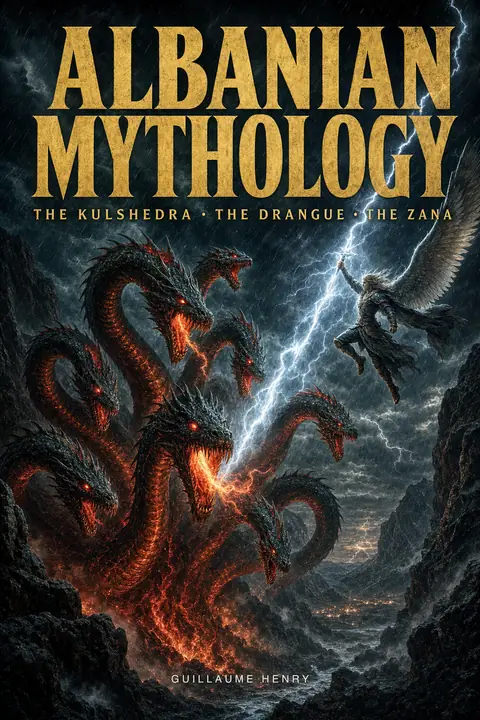
Albanian
The Albanian Mythology Book: The Kulshedra, the Drangue, and the Spirits of the Mountains
The Kulshedra, the Drangue, and the Zana
The mythology of the Albanian highlands: the Kulshedra, a fire-belching dragon-hag who hoards the rains, the Drangue, winged heroes born to fight her, and the Zana, mountain nymphs who bless and curse. A pagan world that survived in the songs of the highland warriors.
More from Albanian
All articles
Albanian
The Shtriga: Witch-Vampire of Albanian Folklore
The Shtriga is a witch-vampire hybrid from Albanian folklore who feeds on the life force of sleeping children. Part demon, part woman, entirely dangerous, she embodies the fears of a culture caught between Christianity, Islam, and older Balkan beliefs.

Albanian
Muji and Halili: The Epic Heroes of Albanian Legend
Muji and Halili are the legendary twin heroes of Albanian epic poetry, warriors bound by blood and honor who defend their land against mythical monsters and foreign invasion. Discover how their deeds shaped Albanian cultural identity for centuries.
Albanian
The Besa: Sacred Code of Honor in Albanian Culture
The Besa is Albania's oldest unwritten law: a sacred pledge of honor, protection, and hospitality that has shaped Albanian identity for centuries. Discover how this ancient code binds community, defies conquest, and survives in modern Albania.

Albanian
E Bukura e Dheut: The Earthly Beauty and Goddess of Nature in Albanian Mythology
E Bukura e Dheut embodies the earthly beauty and goddess of nature in Albanian mythology, representing fertility, growth, and the sacred landscape. Discover how this ancient figure shaped Albanian spiritual life and persists in folk tradition today.