
Tomor Mountain: Sacred Peak and Dwelling of the Gods
Tomor Mountain rises above southern Albania as one of the oldest sacred peaks in the Balkans, home to gods, spirits, and a living pilgrimage tradition that predates Islam by millennia.
Contents
The summit breaks through cloud at 2,416 meters, and on clear mornings the shadow of Tomor Mountain stretches across the Myzeqe plain like the arm of something enormous reaching toward the sea. Shepherds have read that shadow for thousands of years. So have pilgrims, poets, and warriors about to fight a battle they did not expect to survive.
No mountain in the Albanian world carries more religious weight. Tomor Mountain: Sacred Peak and Dwelling of the Gods is not a metaphor or a tourist slogan. It is, in the most literal sense available to Albanian oral tradition, the place where divine power lives, where the dead linger close to the surface, and where human beings have always gone to make requests they could not make anywhere else.
The Mountain Before the Gods Had Names
The oldest layer of Tomor's sacred history belongs to the Albanian mythological tradition, a body of oral lore that survived Ottoman rule, communist suppression, and two world wars largely because it lived inside songs, proverbs, and the memories of mountain communities rather than in manuscripts.
Albanian belongs to its own branch of the Indo-European language family. Its speakers have occupied the western Balkans for long enough that linguists place the ancestors of the Albanians, the ancient Illyrians, in this landscape before the Roman conquest. The word Tomor itself is old. Several scholars have linked it to the Proto-Albanian root connected to "dark" or "shadow," though others connect it to a pre-Illyrian substrate. The mountain was already sacred when the Romans arrived and found local communities offering animals on its slopes.
In the Kanun, the customary law code of northern Albania compiled in its most famous form by Lekë Dukagjini in the fifteenth century, mountains are not merely terrain. They are witnesses. Oaths sworn on a mountain carry more weight than oaths sworn anywhere else because the mountain itself hears, and the mountain does not forget. Tomor concentrates this principle to its sharpest point: it is the mountain that holds memory for the whole southern Albanian world.
The shpirt (the word means both "soul" and "breath" in Albanian) of a person who dies violently near Tomor does not travel immediately to the realm of the dead. It lingers on the slopes, becoming part of the mountain's layered spiritual population: warriors, ancestors, the half-divine beings the tradition calls zana.
Baba Tomor: The God Who Became the Mountain
At some point before written Albanian history begins, the mountain stopped being just a place where gods were worshipped and became a god itself.
Baba Tomor (literally "Father Tomor") is a deity unique to Albanian mythology. He is old, immense, and mostly still. He does not move through the world the way the zana do, hunting and dancing on ridge-lines. He sits. His sitting is itself a kind of power. The oral tradition describes him as the father of southern Albanian nature, the guarantor of rain, the punisher of those who cut sacred forests, and the protector of cattle herds in winter. Albanian ethnographer Faik Konica, writing in the early twentieth century, recorded that in some village traditions Baba Tomor was addressed directly in prayer, in the same grammatical form used for a living elder seated across the room.
The relationship between Baba Tomor and the zana of Albanian mythology is worth pausing on. The zana (singular zanë) are female supernatural beings, often described as mountain fairies or warrior spirits, who inhabit high peaks and clear streams. They are fierce, unpredictable, and sometimes helpful to heroes. On Tomor they appear as his daughters or his court, the active principle to his vast stillness. Where Baba Tomor watches, the zana move.
The tenth-century Byzantine geographer Constantine VII mentioned a mountain called "Tomoron" in the region of what is now central Albania, described as a place avoided by travelers at night. Whether this is the same peak is debated, but the name's continuity across a millennium speaks to the mountain's stubborn hold on regional imagination.
The Zana of Tomor: Daughters of the Peak
The zana of Tomor are not identical to the fairy beings found in other European traditions. They are closer to the Valkyries of Norse myth in their association with battle, glory, and the selection of heroic fates, though they have no direct genealogical connection to Norse tradition. The comparison is structural, not genetic: both traditions needed a figure who lived at the threshold between the human world and the divine, and who appeared to warriors at the decisive moment.
Albanian epic poetry, the këngë kreshnikësh ("songs of the frontier warriors"), preserved in the work of collectors like Gjergj Fishta and later analyzed by scholars at the University of Pristina, places the zana of Tomor in direct contact with the hero Muji (sometimes spelled Mujo), the great champion of the Albanian cycles. Muji does not receive his powers from a god handing down gifts. He earns his bond with the zana through suffering. In one widespread variant, he collapses of exhaustion on Tomor's slope, and the zana tend to his wounds, giving him strength that is also a kind of obligation: he must now fight in ways worthy of the mountain.
This exchange is not unique to Muji. Across the Albanian epic tradition, the hero who has contact with Tomor's zana carries a mark afterward. He is faster, luckier, more dangerous. He is also more doomed. The mountain gives, and the mountain eventually calls the gift back.
The Bektashi Synthesis: Islam Meets the Ancient Peak
The single most remarkable thing about Tomor's sacred life is that it did not end when Islam arrived in the Balkans after the Ottoman conquest of the fifteenth century. It adapted.
The Bektashi order, a Sufi brotherhood with roots in twelfth-century Anatolia, spread through the Albanian lands from the sixteenth century onward. Unlike Ottoman Sunni orthodoxy, the Bektashi tradition was syncretic: it absorbed pre-existing local practices rather than erasing them. On Tomor, this produced one of the most unusual religious sites in Europe.
The shrine of Abbas Ali near the summit identifies Abbas as a cousin of the Prophet Muhammad and a martyr whose tekke (Sufi lodge) on the mountain has been a place of pilgrimage since at least the seventeenth century. But the ritual surrounding the shrine, the animal sacrifice, the communal feast, the overnight camp on the slopes, the specific role of women in certain prayers, all carry structural parallels with pre-Islamic Albanian mountain cult that ethnographers like Eqrem Çabej identified decades before it was politically safe to say so in communist Albania.
The pilgrimage happens every August, centered on the feast of Abbas Ali. Families climb with animals designated for sacrifice. The meat is shared. The smoke rises. The mountain, in both the old sense and the new, receives its offering.
This is not a museum exhibit. As recently as 2024, tens of thousands of pilgrims made the climb. The Albanian government has recognized the site's cultural significance, and UNESCO has had the Bektashi tradition on its intangible heritage lists since 2015.
Tomor in the Albanian Epic Cycle: The Mountain as Witness
The këngë kreshnikësh are oral epics composed in a performance tradition that may be as old as the fourth or fifth century AD, though the texts collected in the nineteenth and twentieth centuries reflect centuries of layering. The American scholars Albert Lord and Milman Parry, who spent time in the Yugoslav and Albanian lands in the 1930s, documented singers who could perform epics of ten thousand lines from memory, without a written text. Tomor appears in these songs not as a backdrop but as an actor.
In one cycle, the hero Muji calls on Tomor before a battle. He does not pray to Baba Tomor in the way a Christian might pray to a saint. He speaks to the mountain the way you might speak to a grandfather whose opinion genuinely matters. He reports. He explains his situation. He waits for a sign: a shift in wind, the cry of a particular bird, the appearance of a zanë on the ridge above him.
The mountain's responses are always indirect. It does not speak in words. This indirection is theologically significant. Baba Tomor is not a god who intervenes crisply. He is a god whose presence is the intervention. The hero who knows the mountain is present fights differently from the hero who does not.
In another cycle, a young warrior disrespects a shrine on Tomor's slope, cutting down a sacred tree for firewood. The punishment is not immediate. It comes months later, in a battle far from the mountain, where he finds his arm will not move at the decisive moment. The mountain reaches across distance. This is an important point in Albanian theology as it appears in the oral tradition: the sacred is not localized. Tomor's authority is mobile.
The Landscape Around Tomor: Osum Canyon and the World Below
The sacred geography of Tomor does not end at the summit. The mountain is the center of a larger sacred zone that includes the Osum River canyon to the east (one of the deepest river canyons in Europe, carved through white limestone that glows at dusk) and the town of Berat below, a UNESCO World Heritage city whose Ottoman and Byzantine layers sit on top of Illyrian foundations.
Berat is called Qyteti i Njëmijë Dritareve, "the city of a thousand windows," and its history is inseparable from Tomor. The castle above Berat was built partly to control access to the sacred mountain. Medieval Albanian nobles made their oaths of alliance on Tomor's lower slopes because an oath witnessed by the mountain carried legal weight in local custom that no document could replicate.
The shpirt tradition noted earlier means that Tomor's slopes are understood to be inhabited by the dead in a specific sense: not threatening ghosts, but ancestors available for consultation. Certain springs on the western face were known, until well into the twentieth century, as places where women in mourning would come to speak to recently dead family members. The practice was discouraged by both the communist state (which banned religion entirely from 1967 to 1990) and by stricter Islamic practice. It has not disappeared entirely.
Tomor and the Broader Balkan Sacred Mountain Tradition
Tomor does not stand alone in a regional landscape of sacred peaks. Mount Olympus across the border in Greece famously houses the Greek pantheon in the imagination of classical antiquity, and the structural parallel is hard to ignore: in both traditions, a specific high mountain is the permanent address of divine power rather than a temporary visit site.
But the parallel goes only so far. The gods of Mount Olympus in the Greek tradition are individuated, named, quarreling personalities with complex genealogies recorded in texts like Hesiod's Theogony (a Greek poem from around 700 BC that lists where each god came from). Baba Tomor is more unified, more geological. He is not one personality among many. He is the mountain thinking. This is a different theology: less dramatic, less exportable, but arguably more ancient in its structure.
The Bulgarian sacred mountain Vitosha, the Serbian Mount Rtanj (called the "pyramid mountain" in local folklore), and the Macedonian Mount Korab all have their own sacred histories. What distinguishes Tomor is the continuity: the same mountain, the same name, a recognizably similar ritual structure from pre-Roman times through to last August.
Frequently asked questions about Tomor Mountain and Albanian sacred geography
Frequently asked questions
Who is Baba Tomor, and is he still worshipped today?
Baba Tomor is the personification of Mount Tomor in Albanian mythology, treated as a divine elder or father-god of the southern Albanian landscape. He governs rain, forests, cattle, and the moral order of mountain communities. Formal worship of Baba Tomor as a named deity has largely merged into the Bektashi pilgrimage tradition at the summit, but ethnographic fieldwork from the 1990s onward documents continued informal veneration, particularly among older rural communities in the Berat and Skrapar regions.
What is the Kurbani i Tomorrit, and when does it take place?
The Kurbani i Tomorrit ("sacrifice of Tomor") is an annual Bektashi pilgrimage held every August, centered on the shrine of Abbas Ali near the summit of Mount Tomor. Pilgrims climb the mountain, sacrifice animals, share communal meals, and spend the night on the slopes. The ritual blends pre-Islamic Albanian mountain cult with Sufi practice in a form scholars date to at least the seventeenth century. It remains one of the largest religious gatherings in Albania, drawing tens of thousands of participants each year.
Who are the zana, and what is their connection to Tomor?
The zana (singular zanë) are female supernatural beings in Albanian oral tradition, often described as mountain spirits, warrior guides, or nature fairies. On Tomor specifically, they appear as companions and daughters of Baba Tomor, and they interact directly with human heroes in the Albanian epic cycles. The hero Muji's bond with the zana of Tomor is one of the most developed supernatural relationships in Balkan epic poetry, analyzed in detail by folklorists at the Institute of Folk Culture in Tirana.
What is the primary source material for Tomor's mythology?
The mythology of Tomor survives primarily in oral epic poetry (këngë kreshnikësh), collected in the nineteenth and twentieth centuries by figures including Gjergj Fishta, Stiefën Gjeçovi, and later Albanian state ethnographers. The American scholars Milman Parry and Albert Lord also recorded singers in this tradition in the 1930s. No ancient manuscript directly describes Tomor's cult, though Byzantine geographical references and Roman-era archaeological finds at Berat (ancient Antipatrea) provide indirect evidence of pre-Christian sacred activity on and around the mountain.
Is Mount Tomor related to Mount Olympus in terms of mythology?
The structural parallel is real but the connection is not genealogical. Both mountains function as the permanent residence of divine power in their respective traditions, rather than as temporary visitation sites. The key difference is theological: the gods of Olympus are individuated personalities documented in texts like Hesiod's Theogony, while Baba Tomor is a unified, geological divinity with no surviving mythological narrative comparable in length or complexity. Scholars like Mathieu Aref have argued for shared Indo-European roots in Balkan sacred mountain traditions, but this remains a matter of active academic debate.
Was Tomor's sacred tradition affected by Albania's communist period?
Severely. Albania under Enver Hoxha declared itself the world's first atheist state in 1967 and banned all religious practice until 1990. Shrines on Tomor were closed or destroyed, pilgrimage was forbidden, and ethnographers who documented folk religion risked professional ruin. The tradition survived in private memory, family practice, and the physical landscape of the mountain itself. When restrictions lifted in 1990-1991, the Kurbani i Tomorrit resumed almost immediately, demonstrating the depth of its roots in Albanian community life.
What Tomor Tells Us About Sacred Landscape in the Ancient Balkans
The survival of Tomor Mountain as a living religious site through Roman occupation, Byzantine Christianity, Ottoman Islam, and forty-three years of enforced state atheism is not an accident. It points toward something specific about how Albanian culture encoded its most important beliefs: not in texts that could be burned, not in institutions that could be closed, but in landscape.
The mountain cannot be confiscated. It cannot be rewritten. Every Albanian who grew up within sight of its silhouette received the tradition without anyone having to explain it. The mountain was the explanation.
This is the oldest kind of theology, older than writing, older perhaps than the organized priesthoods that came with the first cities. The sacred peak, the divine elder, the warrior spirits dancing on the ridge-line: these are not primitive superstitions that more sophisticated religions replaced. They are a different kind of sophistication, one tuned not to the permanence of text but to the permanence of stone.
Scholars working at the intersection of Indo-European studies and Balkan archaeology, including researchers at the University of Vienna's Institute for Cultural and Intellectual History, have begun reading Tomor as a case study in what they call "vertical sacred geography," the mapping of divine hierarchy onto altitude. The summit belongs to the most powerful beings. The mid-slopes belong to spirits. The valley floor belongs to humans. Below that, the dead. This vertical map appears, in different forms, in traditions from the Himalayas to the Andes, suggesting it may answer something very old in human cognition about power, distance, and height.
Tomor is one of the places where that map is still in use. The pilgrims who climbed last August were not performing nostalgia. They were maintaining a real relationship with a real place that has been sacred for a very long time. The mountain received them the way it has always received visitors: with silence, with altitude, and with the particular quality of attention that only a very old, very large thing can give.
Read the full book
Want the whole story?
The complete edition is an instant PDF download here, with a paperback on Amazon for selected titles.
Albanian
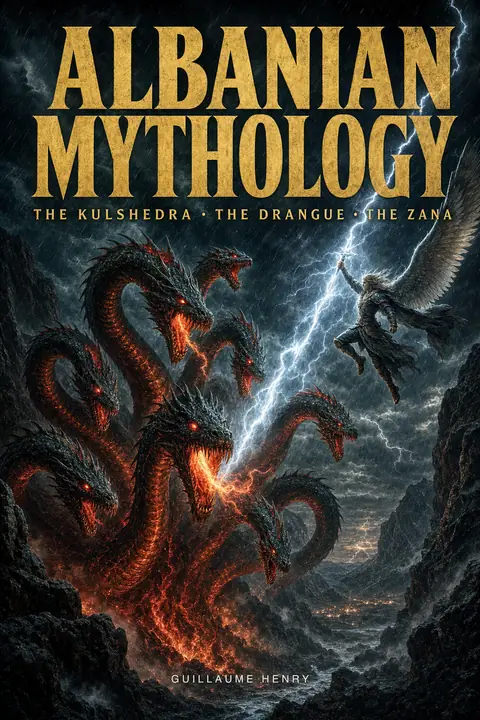
The Albanian Mythology Book: The Kulshedra, the Drangue, and the Spirits of the Mountains
The Kulshedra, the Drangue, and the Zana
The mythology of the Albanian highlands: the Kulshedra, a fire-belching dragon-hag who hoards the rains, the Drangue, winged heroes born to fight her, and the Zana, mountain nymphs who bless and curse. A pagan world that survived in the songs of the highland warriors.
More from Albanian
All articles
Albanian
The Shtriga: Witch-Vampire of Albanian Folklore
The Shtriga is a witch-vampire hybrid from Albanian folklore who feeds on the life force of sleeping children. Part demon, part woman, entirely dangerous, she embodies the fears of a culture caught between Christianity, Islam, and older Balkan beliefs.
Albanian
Muji and Halili: The Epic Heroes of Albanian Legend
Muji and Halili are the legendary twin heroes of Albanian epic poetry, warriors bound by blood and honor who defend their land against mythical monsters and foreign invasion. Discover how their deeds shaped Albanian cultural identity for centuries.
Albanian
The Besa: Sacred Code of Honor in Albanian Culture
The Besa is Albania's oldest unwritten law: a sacred pledge of honor, protection, and hospitality that has shaped Albanian identity for centuries. Discover how this ancient code binds community, defies conquest, and survives in modern Albania.
Albanian
E Bukura e Dheut: The Earthly Beauty and Goddess of Nature in Albanian Mythology
E Bukura e Dheut embodies the earthly beauty and goddess of nature in Albanian mythology, representing fertility, growth, and the sacred landscape. Discover how this ancient figure shaped Albanian spiritual life and persists in folk tradition today.