
The Nine Herbs Charm: Anglo-Saxon Magical Medicine
The Nine Herbs Charm is one of the oldest surviving magical texts in Old English, blending pagan herb-lore with Christian prayer into a vivid ritual against poison and infection. Here is what it truly means.
Contents
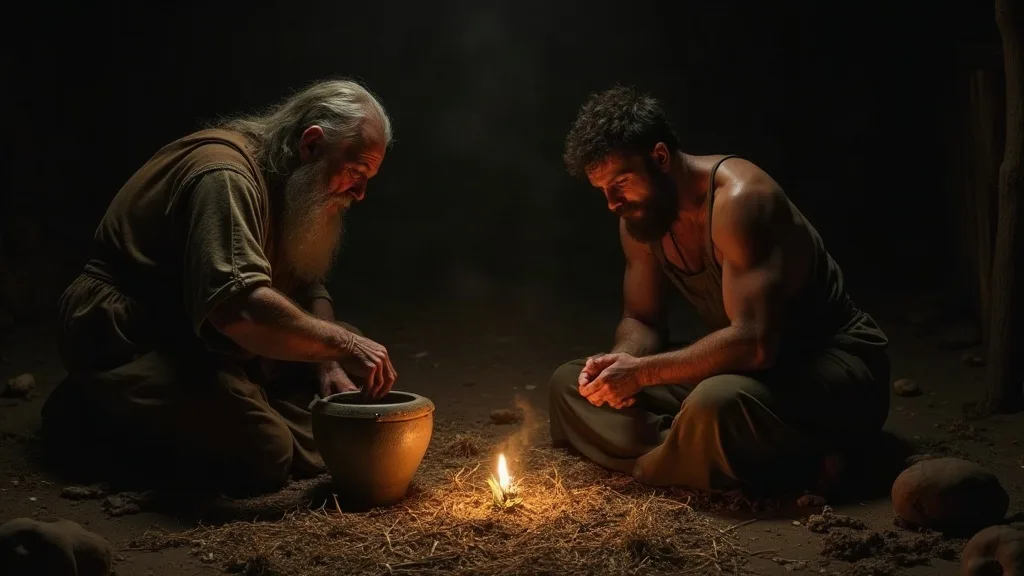
A man lies sweating on a straw pallet. His wound has turned dark at the edges. The healer kneels beside him, grinds nine plants into a paste, and begins to speak - not a prayer exactly, not a spell exactly, but something older than either word. She invokes the god Woden by name. She addresses the herbs directly, as though they can hear her. She tells a story about a serpent sliced to pieces in the sky.
This is the Nine Herbs Charm, one of the strangest and most compelling texts to survive from early medieval England. It sits inside the Lacnunga, a collection of Old English medical recipes and remedies copied around 1000 AD but preserving material much older than the manuscript itself. Part incantation, part herbal prescription, part mythological narrative, it refuses every modern category we might press it into.
What follows is that charm, opened up from the inside: its herbs, its story, its gods, and what it tells us about a world where healing, poetry, and cosmic order were the same thing.
The Manuscript That Holds It: The Lacnunga
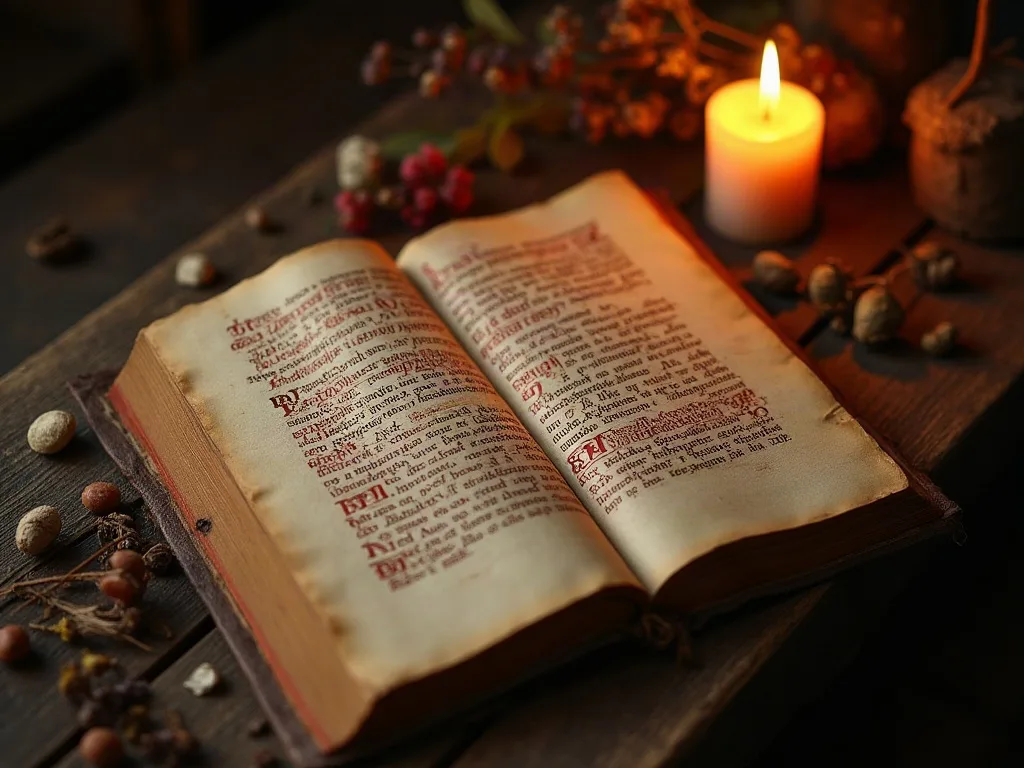
The Lacnunga, whose Old English name means simply "remedies," is preserved in British Library MS Harley 585, a manuscript produced in the late tenth or early eleventh century. It sits alongside the better-known Bald's Leechbook, another Anglo-Saxon medical text, but the Lacnunga is far wilder in character. It mixes Latin prayers, Old English verse, garbled Greek, and what scholars call "liturgical charms" - texts that use the rhythm and authority of Christian liturgy while drawing on pre-Christian lore.
The Nine Herbs Charm (sometimes abbreviated NHC in scholarly literature) is written mostly in Old English verse, though it is not strict alliterative poetry in the Old English formal sense. Scholars such as Karen Louise Jolly, whose 1996 study Popular Religion in Late Saxon England remains the standard reference for this material, argue that the Lacnunga represents a stratum of "popular" Anglo-Saxon religion that coexisted, sometimes uneasily, with the formal Christianity of the monasteries.
The charm was likely not composed at a writing desk. It carries the marks of oral transmission: repeated refrains, direct address to the herbs, a dramatic narrative embedded inside practical instructions. Someone sang or chanted this text while preparing medicine. The written version is a snapshot of something that lived first in the mouth.
The Nine Plants and Their Powers
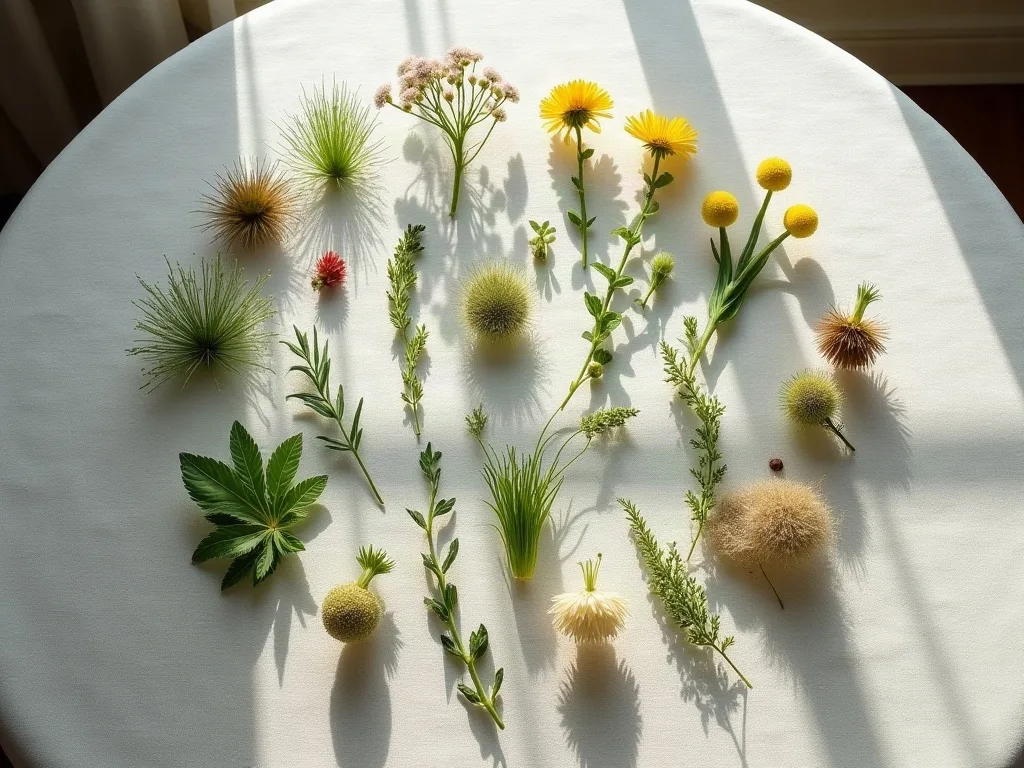
The charm names nine herbs, though matching each Old English plant name to a modern botanical species is harder than it sounds. Early medieval healers used regional names that shifted across dialects, and some names appear nowhere else. The most widely accepted correspondences are:
- Mugwort (Artemisia vulgaris) - called mucgwyrt in Old English, hailed first as "oldest of herbs, mighty against three and against thirty."
- Plantain (Plantago major or Plantago lanceolata) - called wegbrade, "waybroad," praised for spreading from the east.
- Watercress (Nasturtium officinale) - stune in the charm; some scholars prefer lamb's cress.
- Betony (Betonica officinalis or Stachys betonica) - called attorlathe, meaning "venom-loather." One of the most frequently prescribed herbs in Anglo-Saxon medicine.
- Chamomile (Chamaemelum nobile or Matricaria chamomilla) - mægthe, praised as the herb Woden taught and worked with in the sky narrative.
- Nettle (Urtica dioica) - stiðe, "stiff one," a plant still used in folk medicine across Europe.
- Crab apple (Malus sylvestris) - wergulu, whose Old English name remains partially uncertain; some prefer "wild apple" broadly.
- Thyme (Thymus vulgaris or wild thyme) - fille, though a minority of scholars read this as fennel.
- Fennel (Foeniculum vulgare) - finule, the ninth, named alongside thyme and sometimes confused with it.
The charm does not simply list these plants. It speaks to each one, reminding it of its power. "You, mugwort, what did you reveal, what did you arrange, what did you achieve in your great proclamations?" That direct address - a rhetorical form scholars call apostrophe - treats the herb as a being with memory and agency, not merely a physical substance.
Herbal as Medicine
In a straightforward medical tradition, the herb works because of its chemical properties. The healer measures, grinds, and applies it. The patient's body responds or does not. What matters is the dose and the plant.
Herbal as Ritual
In the Nine Herbs Charm, the herb works partly because it is reminded of its power. The spoken word activates something dormant in the plant. The healer's voice, the narrative of Woden, and the physical preparation form a single act. Remove any part and the remedy is incomplete.
Woden Strikes the Serpent: The Myth at the Heart of the Charm
The most arresting section of the Nine Herbs Charm is a brief myth embedded within the practical instructions. Here is a fairly literal rendering of the key lines:
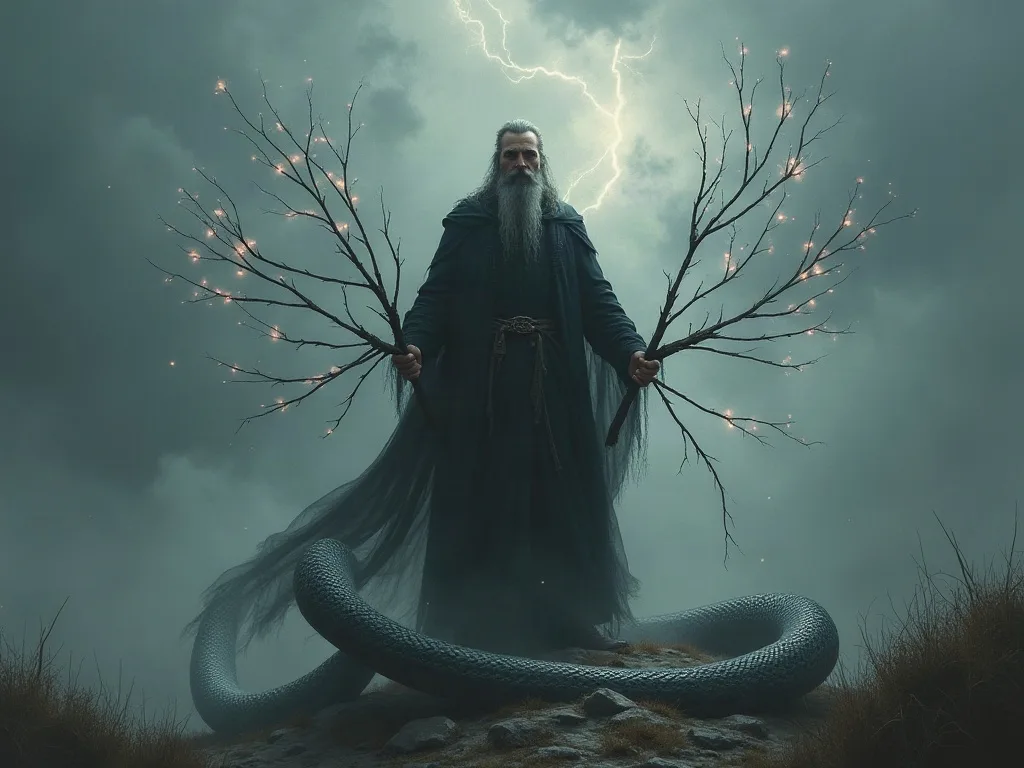
A serpent came crawling, it bit a man. Then Woden took nine glory-twigs, he smote then that adder so that it flew into nine parts. There apple and poison brought it about that the worm never would go into the house again.
This is, as far as surviving evidence goes, unique. Nowhere else in Old English literature does Woden appear in this role: a healer, a striker of serpents, wielding branches (the "glory-twigs," wuldortanas) as weapons against venom. Scholars have compared it to the Norse tradition of Odin, the cognate deity, who in the Eddas acquires wisdom and magical knowledge through sacrifice and ordeal. But the Norse Odin is rarely described as a healer in this direct sense.
Woden's action here structures the whole ritual. By invoking the original cosmic moment when venom was defeated, the healer re-enacts that moment in the present. The patient's poisoning is not a new disaster; it is a repetition of a pattern already overcome. This idea - that ritual re-enacts a founding mythological event to harness its power - appears across many ancient healing traditions. Mircea Eliade called it the "myth of the eternal return," the sense that the first time something was conquered, it was conquered forever, and the ritual re-opens that first victory every time it is performed.
The serpent in the charm is almost certainly not a literal snake (though Anglo-Saxon England had adders, and bites were a real medical concern). The nine poisons the charm names - attor, wyrm, and several others in manuscript variants - map onto a cosmological scheme. Nine is a number of wholeness in Germanic tradition: nine worlds in Norse cosmology, nine nights Odin hangs on Yggdrasil in the Hávamál (a collection of Old Norse wisdom poetry from the Poetic Edda). The charm's nine herbs counter nine poisons because the structure of nine is itself the structure of totality.
"Against Three and Against Thirty": The Poison Taxonomy
The charm opens with a declaration that mugwort has power "against three and against thirty, against the hand of a foe and against great deception." This formula appears several times in the Lacnunga and in related Anglo-Saxon texts. Scholars read it as a rhetorical intensification: if a remedy works against three threats, it works against all threats; "thirty" is not a literal count but a way of saying "every possible version of the same harm."
The charm then names the nine poisons it targets. The Old English manuscript lists them as venoms that "fly over the land" and strike humans, animals, and property alike. This is not merely physical toxicology. The poisons are described as arriving from outside, sometimes from the east, sometimes from the sky. They have a directional, almost demonic quality.
The Nine Herbs Charm specifically lists these categories of flying venom:
- Venom that flies from the north
- Venom that flies from the south
- Venom that flies from the west
- Venom that flies from the east
- Venom from snake (wyrm)
- Venom from water creature (waeter)
- Venom from thorn
- Venom from thistle
- Venom from "the hated thing" (a somewhat obscure Old English term)
The four directions are significant. Naming all four is another way of claiming totality - the remedy works against everything that can possibly attack. The directional venom is also connected to Anglo-Saxon beliefs about ylfsogotha ("elf disease") and waeterelfadl ("water-elf disease"), conditions caused by invisible supernatural beings who shot invisible projectiles into the body - a belief closely parallel to the Norse concept of alfr sickness and the Scottish Gaelic tradition of "elf-shot," where fairies caused illness by firing tiny flint arrows.
How the Ritual Was Performed
The charm is not just a text to read. It comes with instructions, interwoven with the verse, for a physical procedure. The healer:
- Grinds the nine herbs into a powder or paste, likely using a stone quern or mortar.
- Mixes them with soap (the Lacnunga specifies ald sapan, "old soap") and with apple juice, which connects the preparation back to the serpent narrative where apple plays a role.
- Prepares a liquid bath or a poultice, depending on the wound type.
- Sings or chants the charm three times over each herb before applying the remedy.
- Breathes on the wound and blows the preparation onto it in some variant readings.
The repetition of three is consistent with charm practice across medieval Europe. Three repetitions create a pattern; a pattern has force. The physical preparation and the spoken word are performed simultaneously, not sequentially. This is the crux of what makes the Nine Herbs Charm a ritual rather than simply a recipe.
The Lacnunga then instructs that the healer should carve runes on the wood of certain trees while singing. The runic element is consistent with a broader Anglo-Saxon belief that runes held intrinsic power, not merely as letters but as marks that shaped reality. The charm thus operates on at least three simultaneous channels: the chemical (the herbs), the verbal (the chanted verse), and the visual/material (the carved signs and the physical application).
Christian Layers Over a Pagan Frame
The manuscript version of the Nine Herbs Charm does not end with Woden. After the mythological narrative, the text shifts register and introduces a Latin phrase: Gif ðu wille, ic wylle, ic wille hælan eal mancyn, roughly "if you will, I will heal all mankind." Most editors read this as an echo of Christ's words to the leper in the Gospels ("If you will, you can make me clean," Mark 1:40-41). Some versions of the charm in related manuscripts append a Christian prayer or the names of saints.
This layering is not hypocrisy or confusion. It reflects the genuine religious texture of tenth-century Anglo-Saxon England. The conversion of the English kingdoms to Christianity was a process lasting from the late sixth century into the eighth, and even after that, the older frameworks of cosmic power, the old gods, the old names for forces in nature, did not simply disappear. They persisted in the margins: in healing charms, in the names of the days of the week (Wednesday is still Woden's day), in kennings embedded in poetry.
Scholars like John D. Niles and Michael D. C. Drout describe this phenomenon as "Christian accommodation," the way Anglo-Saxon monks and clergy were often willing to preserve, adapt, or Christianize older material rather than destroy it outright. The Woden of the Nine Herbs Charm is not exactly the Woden of pagan worship; he functions here more as a mythological precedent, the first healer, the way medieval Christian homilists would cite a classical philosopher as a precedent. But his name is still there, unsanitized.
Parallels in Other Traditions: The Charm Is Not Alone
The structure of the Nine Herbs Charm - a narrative myth explaining how a cosmic being first defeated a harm, followed by a ritual re-enactment of that defeat - appears in traditions far beyond Anglo-Saxon England.
The Atharva Veda, one of the four ancient Hindu sacred texts compiled roughly between 1200 and 1000 BC, contains dozens of healing charms (bheshaja) that invoke specific deities against specific poisons and diseases. The pattern is strikingly similar: name the harm, invoke the deity who first conquered it, perform the physical remedy while speaking the narrative.
In ancient Mesopotamia, healers recited incantations that recalled the primordial moment when the god Asalluhi (later merged with Marduk) first diagnosed and cured a cosmic illness, with the patient's condition reframed as a repetition of that original sickness.
The Norse tradition preserved in the Eddas includes the Second Merseburg Charm (found in a ninth-century German manuscript and written in Old High German, a close relative of Old English), where the god Phol, Woden, and a group of female figures heal a horse's broken leg. The formula: the story of the original injury is told, then the healer mirrors the divine cure. The Nine Herbs Charm belongs to the same family.
What differs is the specificity of the Anglo-Saxon text. The nine herbs are real. The dosage instructions are practical. The Lacnunga operates in the pragmatic world of actual illness, and the charm is embedded inside that practical world rather than being a purely ceremonial text. That combination - serious medicine and serious myth, inseparable - is what makes it one of the most remarkable documents in the entire medieval corpus.
The Herbs as Characters: Agency and Voice in the Charm
One of the most underappreciated aspects of the Nine Herbs Charm is its grammar of address. The healer does not simply say "I apply mugwort." The healer says, in effect: "Remember who you are. You were the first. You stood against thirty. Now do it again."
This rhetorical structure grants the herbs something close to subjectivity. Each plant has a history, a track record, a reputation. The charm is not commanding the herb; it is reminding the herb of its own power, which exists independently of the healer's action. The healer is a facilitator, a voice that activates what the plant already contains.
This is consistent with a broader Anglo-Saxon understanding of the natural world as animate and responsive. The Exeter Book, a collection of Old English poetry from around 975 AD, contains riddles in which objects speak in the first person: the bow, the key, the storm. Things have voices. Things have histories. A plant that has "stood against the power of the serpent since the world was created" - as the charm almost implies - is not merely a chemical compound. It is a veteran.
The Nine Herbs Charm asks the healer to speak that history aloud. The spoken word does not describe the herbs' power; it reconstitutes it for this specific patient, in this specific moment, against this specific harm.
Frequently Asked Questions About the Nine Herbs Charm
Frequently asked questions
Where can I read the original text of the Nine Herbs Charm?
The charm survives in British Library MS Harley 585, a manuscript dated to around 1000 AD. A critical edition with Old English text and facing translation appears in Edward Pettit's Anglo-Saxon Remedies, Charms, and Prayers from British Library MS Harley 585: The Lacnunga (2001), which is the most thorough scholarly edition currently available. Godfrid Storms' older collection Anglo-Saxon Magic (1948) also contains the text with commentary.
Is the Nine Herbs Charm genuinely pagan, or is it a Christian text with old-fashioned vocabulary?
It is genuinely both, which is what makes it valuable. Woden is named as an active mythological agent, which goes beyond mere vocabulary. At the same time, the manuscript version includes Christian phrases and structural parallels to Gospel narratives. Scholars like Karen Louise Jolly argue that this blend was not a contradiction but a coherent religious position held by many Anglo-Saxons: the old powers were real, and Christ was the greatest of those powers. The charm inhabits both frameworks simultaneously.
Did Anglo-Saxon healers actually use these nine herbs medicinally?
Yes. Several of the herbs named - plantain, betony, mugwort, chamomile - appear repeatedly across Anglo-Saxon medical texts, including Bald's Leechbook and the Old English Herbarium, a translation of a late antique Latin text. Modern pharmacological analysis confirms anti-inflammatory and antimicrobial properties in several of these plants. The charm was not pure superstition; it was embedded in a genuine tradition of empirical plant knowledge.
What is the connection between the Nine Herbs Charm and the Norse tradition?
The connection runs through the shared Germanic linguistic and cultural heritage. Woden and Odin are the same deity in different linguistic registers - Old English and Old Norse respectively. The nine glory-twigs Woden uses in the charm may be related to the nine worlds of Norse cosmology and to Odin's nine-night ordeal on Yggdrasil described in the Hávamál. The Second Merseburg Charm, written in Old High German, shows the same mythological healing structure and names Woden directly. These texts form a cluster of related Germanic healing traditions, not isolated curiosities.
Why nine herbs specifically? Does the number have symbolic meaning?
Nine is a number of completeness in Germanic tradition. Nine worlds exist in Norse cosmology. Odin hangs for nine nights. Nine is three multiplied by three, and three is itself the smallest number of repetitions that creates a pattern, a concept deeply embedded in Indo-European ritual thinking. Choosing nine herbs is not arbitrary: it claims that the remedy is total, that it covers every possible venom within a cosmically complete structure. The number performs the claim before the herbs even touch the wound.
The Nine Herbs Charm in Modern Scholarship and Living Practice
Academic interest in the Nine Herbs Charm has grown substantially since the late twentieth century, partly because it sits at the intersection of several disciplines: Old English philology, history of medicine, religious studies, and what scholars now call "vernacular theology." The charm refuses to stay inside any one of those boxes.
Historians of medicine like Linda Voigts and M. R. McVaugh have shown that Anglo-Saxon medical texts were more sophisticated than the Victorian dismissal of "superstitious leechcraft" suggested. The Lacnunga contains real pharmacological knowledge alongside its charms. The Nine Herbs Charm is not an embarrassing primitive outlier; it is a concentrated example of a coherent worldview in which material efficacy and ritual efficacy were inseparable because the world itself was understood to be both physical and animated by speech and story.
Outside the academy, the charm has attracted practitioners of modern Germanic paganism and Heathenry, who use it in reconstructed rituals. This reception is not without its complications: the manuscript context, the Christian layers, and the enormous gap between tenth-century Anglo-Saxon England and the twenty-first century all require careful navigation. But the charm's continued vitality in living practice is its own evidence that the text carries something that does not reduce entirely to its historical context.
Poets have been drawn to it too. Seamus Heaney's engagement with Old English (most famously in his Beowulf translation) opened many readers to the sonic world in which the Nine Herbs Charm was composed. The charm's language is dense with sound-patterning, with the plosive push of Old English consonants, with the rhythm of a voice that is commanding and pleading at the same time. Reading it aloud, even in translation, you hear something that was made to be spoken over a body in pain, in the dark, with real urgency.
That urgency is what keeps the Nine Herbs Charm alive after a thousand years. It was not written for posterity. It was written because someone was sick, and the healer reached for every tool available: the plant, the word, the story, the name of the god who had already won this fight once, in the sky, before memory began.
Read the full book
Want the whole story?
The complete edition is an instant PDF download here, with a paperback on Amazon for selected titles.
Anglo-Saxon
The Anglo-Saxon Mythology Book: Woden, Thunor, Beowulf, and the Lost Gods of Pre-Christian England
The Sacred Stories Before Christianity Buried Them
The mythology of pre-Christian England: Woden's ravens, Thunor's thunder, Beowulf's monsters, and the Wyrd sisters who wove fate. Recovered from Beowulf, royal genealogies, and the grave goods.
More from Anglo-Saxon
All articles
Anglo-Saxon
Hengist and Horsa: Legendary Founders of Anglo-Saxon England
Two brothers from Germanic lands, Hengist and Horsa led the first English settlers across the North Sea. Their arrival around 449 CE marks the beginning of Anglo-Saxon England, though history and legend now blur beyond recognition.
Anglo-Saxon
The Wild Hunt in Anglo-Saxon Belief: Spectral Riders and the Hunt for Souls
The Wild Hunt in Anglo-Saxon belief was a ghostly procession across the night sky, led by divine or demonic riders who hunted both the living and the dead. Discover how this ancient vision shaped English folklore for over a thousand years.

Anglo-Saxon
The Sutton Hoo Ship Burial: Archaeology and Myth
In 1939, archaeologists uncovered a 27-meter ship buried in Suffolk, England, holding treasures and weapons from the 6th century. The Sutton Hoo ship burial bridges Anglo-Saxon reality and the epic worlds of Beowulf, revealing how real kings were sent to their gods.

Anglo-Saxon
Eostre: Goddess of Spring and Dawn
Eostre is the Anglo-Saxon goddess of spring, dawn, and fertility, known through a single historical mention by the Venerable Bede. Discover how this shadowy deity shaped the season of renewal and inspired the modern holiday of Easter.