
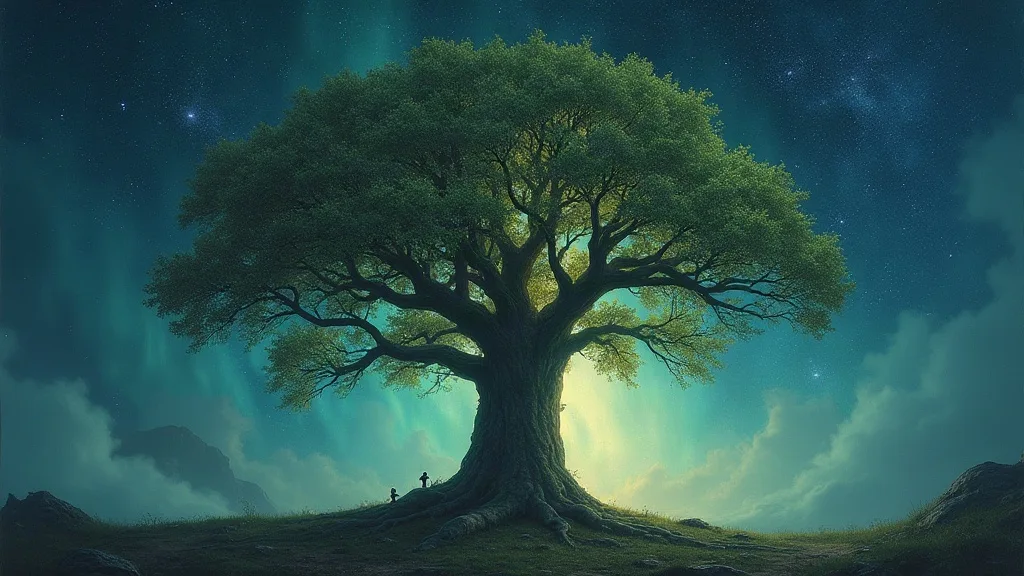
Yggdrasil: The World Tree in Heathen Cosmology
Yggdrasil, the vast ash tree that holds all nine Norse worlds on its branches, is the literal skeleton of existence itself. Discover how the Heathen cosmos hangs from a single tree, and what its daily destruction and renewal tell us about survival, fate, and renewal.
Contents
The cosmos does not sit in a void. In Norse thought, it hangs from a tree. Not a metaphor. An actual tree, ancient beyond counting, whose roots drink from three wells and whose branches hold nine worlds where gods, humans, giants, and the dead all exist at once. That tree is Yggdrasil, and understanding how it works is the key to grasping why the Heathen universe feels so different from most other mythologies.
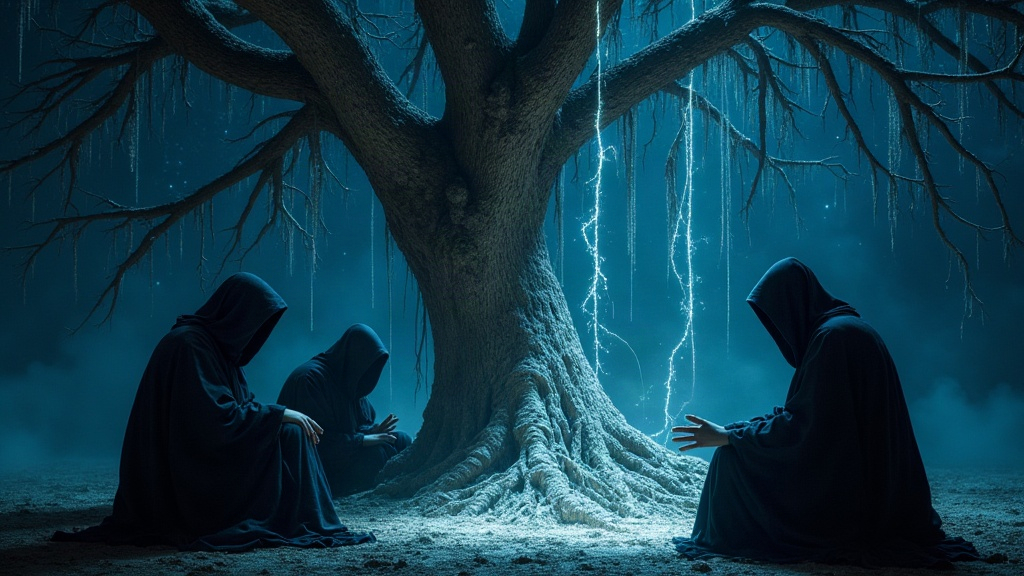
Every morning, Yggdrasil the World Tree trembles. A squirrel named Ratatosk scurries along its trunk carrying insults between the eagle perched in its highest branches and the serpent Nidhogg gnawing at its roots. Frost drips from the branches of the Aesir's realm. Dew falls to nourish the humans below. The tree is wounded, burning, eaten away at every moment. Yet it does not fall. This cycle repeats every day until the end of time itself.
The Poetic Edda, a collection of Old Norse poems composed around the 10th century, and the Prose Edda, written by the medieval scholar Snorri Sturluson in the 13th century, preserve these images in vivid detail. They were written down long after Christianity had arrived in Scandinavia, yet they captured something older, something that clung to the land and the people's sense of how the world actually worked.
The Nine Worlds Suspended in the Branches
Yggdrasil does not hold one world. It holds nine, and they are stacked not vertically like a tower but nested within the tree's root system and crown. This is not a bug in Norse thought; it is deliberate. The worlds are real, simultaneous, and connected.
The nine worlds divide into three groups of three, and a traveler who knows the paths can move among them. Asgard, home of the Aesir (the chief gods), sits in the highest branches. Vanaheim, realm of the Vanir (the earth gods), is nearby. Muspelheim, the world of fire where the giant Surtr waits for Ragnarok, burns beyond the southern horizon. Niflheim, primordial ice and mist, lies at the tree's deepest roots. Jotunheim, the land of the giants, occupies its own branch entirely.
Then there are the human-adjacent worlds. Midgard, the realm of humans, sits at the center of the tree, defended by Bifrost, the rainbow bridge that connects to Asgard. Svartalfheim (Dark Elf Home) exists in the shadows beneath the roots. Alfheim, the world of light elves, glimmers in the upper branches. And Muspelheim's counterpart, Niflheim, answers to it across the cosmic gulf.
The ninth world is Hel, the land of the dead, itself a place neither underworld nor afterlife but a genuine location where souls arrive after death, tended by the goddess Hel herself, daughter of the trickster Loki. To reach Hel, the dead must travel along Helveg, the road of the dead, deep beneath the roots.
Each world has its own logic, its own inhabitants, its own purpose. Yet they are not separate. They are all strung together on the same tree.
The Three Wells and the Root System
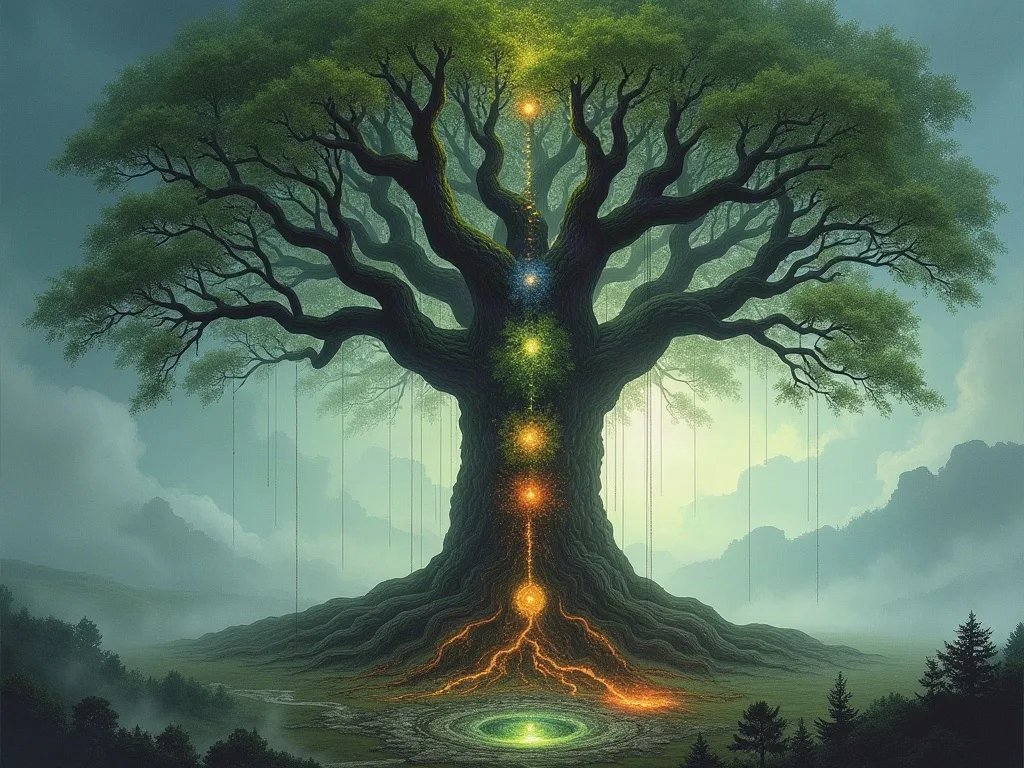
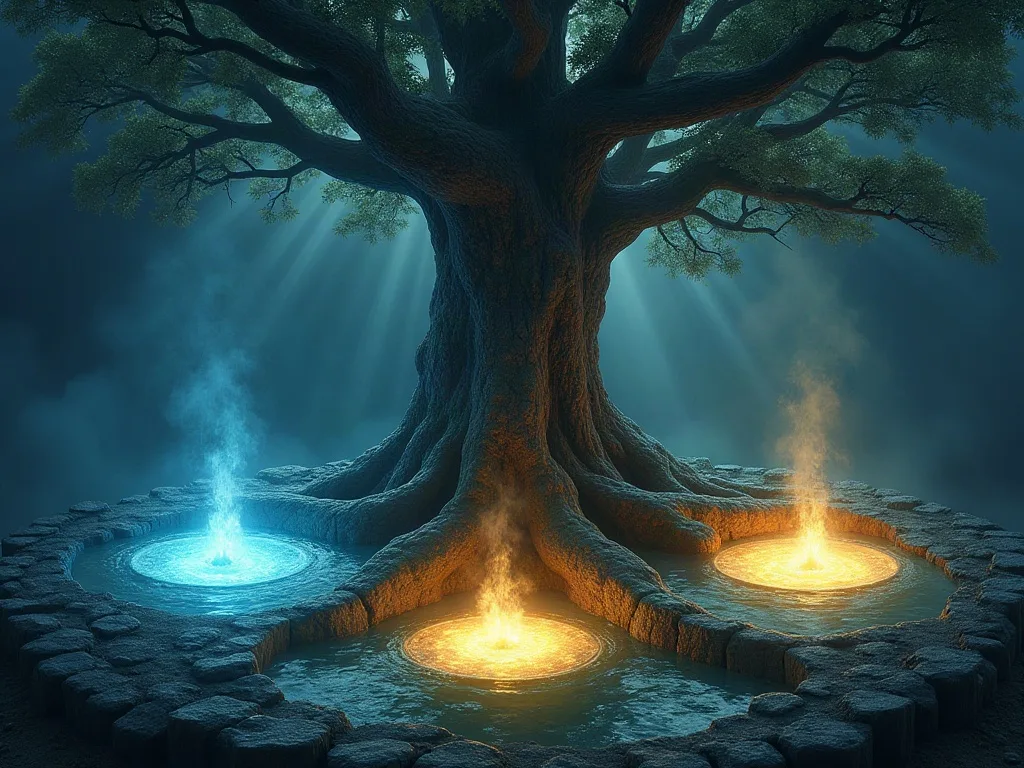
Yggdrasil does not feed like an ordinary tree. Its three massive roots drink from three sacred wells, each one a center of power in its own right.
The first root plunges into Urdarbrunnr, the Well of Urd, which lies in Asgard itself. Urd is one of the three Norns, beings of fate: Urd represents the past. Here the Aesir gather daily to hold their councils and judge disputes. The waters of Urd are so sacred that they are used to temper and preserve the world itself.
The second root reaches Mimir's Well, hidden in Jotunheim among the lands of the giants. Mimir was once a god of wisdom, and he guards this well with fierce protection. The waters of Mimir's Well grant knowledge of everything in all nine worlds, but the price is steep: Odin, the All-Father, sacrificed his right eye to drink from it, and he gained access to visions that extend beyond normal time. To drink from Mimir's Well is to taste prophecy and see what cannot normally be seen.
The third root reaches Hvergelmir, the cauldron of boiling springs in Niflheim. This well is the source of all water in all nine worlds. From it flow the rivers that feed the others. Hvergelmir is where Nidhogg, the great serpent, gnaws ceaselessly at the roots of the tree. The dragon does not gnaw out of hunger but out of spite, as though time itself were a poison to be consumed from within.
These three wells are not poetic devices. They are geographic locations in the Heathen cosmos, and the roots of the tree are the literal cables connecting them.
The Creatures of the Tree
Yggdrasil is not a still thing. It is alive, wounded, and inhabited by beings whose actions move the cosmos forward.
Nidhogg is perhaps the most famous. His name means "malice striker," and he is a serpent (some sources say dragon) vast enough that his body fills the caverns beneath the tree. Every moment, he gnaws at the roots, trying to weaken the tree, trying to hasten the day when all worlds will fall. He never succeeds, but he never stops. The Heathen universe does not imagine evil as defeated; it imagines evil as perpetual, and the gods' job is perpetual resistance.
High in the topmost branches perches an eagle. The Prose Edda does not name him, but his significance is absolute: he is the watcher at the height of the cosmos. Between the eagle and Nidhogg runs the squirrel Ratatosk, a messenger of insults and rivalry. The eagle and the serpent never cease their feud, and Ratatosk carries their words back and forth, stoking the tension. In one sense, Ratatosk is a nuisance. In another, he is the mechanism by which opposing forces remain in dialogue rather than colliding into silence.
Many smaller creatures live in the tree as well. The Poetic Edda mentions stags that browse the branches and graze the bark of Yggdrasil itself, feeding on its leaves while the tree feeds the worlds. This image is strange and dark: the tree that sustains all things is also consumed by all things. There is no clean cycle here, no separation of food chain from cosmic framework.
The Roots of Fate and the Norns
At the base of Yggdrasil, where the Well of Urd collects, three figures move in eternal work. They are the Norns: Urd (past), Verdandi (present), and Skuld (future). They do not merely observe fate. They weave it.
Every day, the Norns draw water from Urdarbrunnr and water the roots of Yggdrasil. They also carve runes into the trunk and branches, writing the destinies of every being that lives in the nine worlds. The tree itself is a record of all that has happened and all that will happen. To read Yggdrasil is to know everything.
In Heathen cosmology, fate is not random, but it is also not imposed by a single all-knowing god. Fate is woven by three beings whose knowledge is themselves in time. Even Odin, despite his wisdom, cannot fully escape the Norns' judgment. He knows he will die at Ragnarok, killed by the wolf Fenrir, and he cannot prevent it. Knowledge of fate does not free you from it; it teaches you to meet it with dignity.
This is one reason Yggdrasil matters so much to Heathen thought: the tree is the physical embodiment of this idea. It is wounded, it is gnawed, it trembles, it will eventually burn. But it persists. After Ragnarok, the cycle begins again. A new world grows from its ashes.
Ragnarok: The Tree Burns and Survives
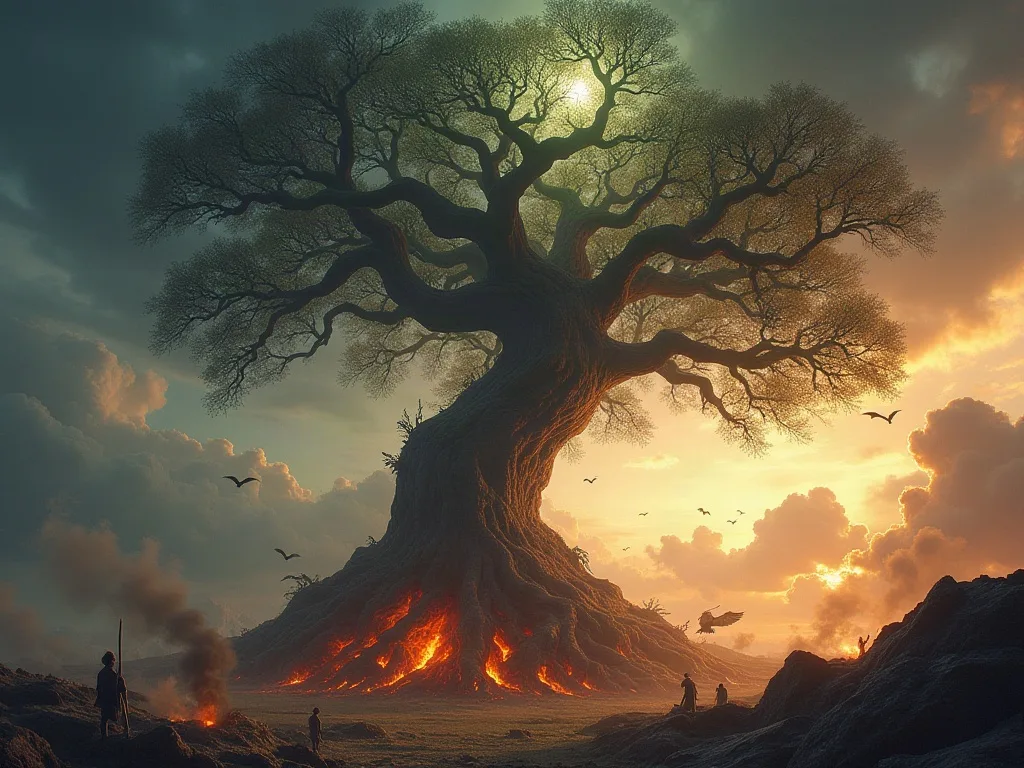
Yggdrasil is not immune to the end. The Norse mythology of Ragnarok, the Twilight of the Gods, describes a moment when all bonds break and all enemies meet in final battle. The sun darkens. The stars vanish from the sky. The earth sinks into the sea. The mountains crumble. And Yggdrasil trembles in a way it never has before.
The bonds that hold all things together snap. Fenrir, the monstrous wolf bound by magic chains, breaks free and devours the sun. His jaws stretch from earth to sky. Jormungandr, the serpent-child of Loki who lies coiled around Midgard (the human world), thrashes and rises from the ocean, causing tidal waves that flood the earth and make the ship Naglfar break loose from its moorings. Naglfar, built entirely from the fingernails of the dead, sails now as a vessel of the forces arrayed against the gods, captained by the giant Hrym.
Heimdall, the watchman of the gods, sounds the Gjallarhorn, a blast heard in all nine worlds. Odin prepares for his final battle, knowing it will be his last. The Aesir and Einherjar (the dead warriors gathered in Asgard's hall Valhalla) march to face the giants and the forces of destruction.
In the midst of this, Yggdrasil trembles violently. The tree sways so hard that every branch shivers and every world lurches. But the tree does not fall. Yggdrasil bends and weathers the storm.
After the great battle, after Odin falls and Thor slays Jormungandr (though he himself is poisoned by the serpent's venom and takes only nine steps before collapsing), after most of the world is consumed by fire and water, something new rises. The earth emerges again from the sea. A new sun begins its course. And from the ashes of the old world, a new Yggdrasil spreads its roots.
Two humans, Lif and Lifthrasir, emerge alive within the branches of this new tree, carrying seed and life forward. The tree that was nearly destroyed becomes the cradle of rebirth. This is not resurrection in the Christian sense. It is renewal. The cosmos learns nothing and forgets nothing; it simply cycles.
Yggdrasil in Modern Heathenry and Beyond
For more than a thousand years after the Christianization of Scandinavia, Yggdrasil lived mainly in old texts and the folk memory of people who still left offerings at holy groves. The 19th-century Romantic movement rediscovered Norse mythology as a source of deep European identity, and Yggdrasil became a symbol of nature, fate, and the interconnectedness of all things.
In the 20th century, Asatru (literally "faith in the Aesir"), a modern religious movement that reconstructs pre-Christian Norse practice, placed Yggdrasil at the center of its cosmology and ritual. Modern Heathens meditate on the tree, visualize traveling its roots and branches, and invoke the Norns through its image. The tree becomes a gateway to understanding how the nine worlds relate to one another, and how human action in Midgard reverberates through the cosmos.
Contemporary Heathenry also uses Yggdrasil as a template for understanding the self. In some schools of thought, each person contains a smaller version of the tree: the roots reach into the unconscious (Niflheim), the trunk grows through conscious awareness (Midgard), and the branches touch divine inspiration (Asgard). The tree becomes a map of human consciousness as well as cosmic structure.
Outside of Heathenry proper, Yggdrasil has become a symbol in popular culture, from fantasy literature (J.R.R. Tolkien drew heavily on Norse images) to video games that use the tree's structure as a level design template. Each translation changes the meaning slightly; the original Yggdrasil is more alien and harder than most pop-culture versions allow.
The Ash and the Abyss: Why This Tree Matters
Yggdrasil is an ash tree. The Prose Edda is explicit about this. An ash is not traditionally a tree of great size in human experience, but in Norse imagination it is the greatest of all trees, vast beyond comprehension, old beyond age. The Heathen cosmos does not rest on a foundation of stone or sit in emptiness; it depends on a living, growing, wounded, and resilient organism.
This matters because it means the Heathen universe is not static. It is not perfect. It is not even stable in the way that some religions imagine perfection and stability. The tree is being eaten. The tree is burning. And this is normal. This is how things are meant to be.
The Norns do not stand apart from this process, mourning the damage. They maintain it. They tend it. They understand that a cosmos without struggle, without gnawing, without fire, would be a cosmos without time, without change, without life. The tree persists not because it is unbreakable but because breaking and healing are the same process repeated infinitely.
In modern Heathen practice, this becomes a profound teaching. Life is not about winning some final victory or reaching a state of permanent peace. Life is about standing firm while everything tests you. Life is about knowing you will fall and falling with dignity anyway. Yggdrasil teaches this by its example: every day it is hurt; every day it endures.
Frequently asked questions about Yggdrasil and the World Tree
Frequently asked questions
Is Yggdrasil described in the Poetic Edda and Prose Edda differently?
Yes, subtly. The Poetic Edda, older and more fragmented, gives vivid images (the eagle, the squirrel, Nidhogg gnawing) without always explaining the full geography. The Prose Edda, written by Snorri Sturluson around 1220 CE as a guide to understanding older poems, is more systematic: it names all nine worlds, explains the three wells, and places the Norns at the tree's base. Both are authoritative, but the Prose Edda is more complete as a cosmological map.
What happens to Yggdrasil after Ragnarok?
The tree endures. After the fire and flood consume the old world, the earth rises again from the sea, and from the branches and roots of Yggdrasil new life emerges. Two humans, Lif and Lifthrasir, survive within the tree itself, and from them a new humanity grows. The tree is the one thing guaranteed to survive destruction; it is the promise that renewal will follow any ending.
Is the World Tree unique to Norse mythology, or do other cultures have similar cosmic trees?
Other traditions have cosmic or world trees: the Hindu Ashvattha, the Mesoamerican Ceiba, the Jewish Kabbalah's Sephirotic Tree, and many others. What makes Yggdrasil distinctive is its combination of three elements: it holds multiple worlds, it is actively being destroyed by forces that never stop, and it will renew itself after apocalypse. Most other world trees emphasize harmony or hierarchy; Yggdrasil emphasizes struggle and endurance.
How do modern Heathens use Yggdrasil in practice?
Modern Asatru practitioners use the tree in meditation, visualization, and ritual. Some imagine traveling along its roots to visit different worlds and gain wisdom. Others use the nine-world structure as a template for understanding how different aspects of life (physical, mental, spiritual) relate to one another. The tree is also a symbol of interconnection: every action in Midgard (the human world) reverberates through all nine worlds, so responsibility and care matter cosmically, not just personally.
What is Nidhogg, and is it the same as the serpent Jormungandr?
No. Nidhogg is the dragon or serpent that gnaws the roots of Yggdrasil in the depths of Niflheim. Jormungandr is Loki's serpent-child, so vast that he encircles Midgard and bites his own tail. They are distinct beings with different roles. Nidhogg attacks the tree's infrastructure; Jormungandr attacks the worlds directly during Ragnarok.
Yggdrasil as a Living Symbol Today
The World Tree persists not because the Heathen peoples who first imagined it prevailed politically or militarily. It persists because the image works. A cosmos held in the branches of a wounded tree, burning yet enduring, tended by three weavers of fate, attacked by forces that will never fully succeed and will never cease trying: this is not a comfortable image. But it is true to how many people actually experience existence.
In a time of ecological collapse, of social change, of uncertainty about the future, Yggdrasil offers something other mythologies sometimes cannot: a vision of the world as fundamentally resilient, not because it is protected or perfect, but because breaking and healing are built into its nature. The tree will burn. The tree will be reborn. This is not tragedy. This is how things work.
To stand under Yggdrasil, in Heathen thought, is to understand your place: you are part of a tree that is far older than you, that was wounded before you arrived, that will continue long after you fall. And your job is not to save it or to fix it. Your job is to tend it, like the Norns tend the Well of Urd, and to live with courage while accepting that you cannot control the cycle.
Read the full book
Want the whole story?
The complete edition is an instant PDF download here, with a paperback on Amazon for selected titles.
Asatru
The Asatru Book: Norse Paganism, Heathenry, and the Worship of the Old Gods
Norse Paganism, Heathenry, and the Old Gods
The living revival of Norse paganism: who the heathens worship, how the blót and the sumbel work, what the Nine Noble Virtues are, and how a faith that ended a thousand years ago came back to life in the modern world. Rooted in the Eddas, practiced today.
More from Asatru
All articles
Asatru
Mjolnir: Thor's Hammer as Symbol and Talisman
Mjolnir, Thor's legendary hammer, embodies divine power, protection, and order in Norse mythology. Discover how this symbol shaped Viking belief, ritual, and endures in modern culture.
Asatru
Winter Nights and Yule: Heathen Seasonal Festivals and Their Sacred Roots
Winter Nights and Yule are the two cornerstone heathen seasonal festivals that mark the darkest months of the year. Rooted in pre-Christian Norse and Germanic traditions, these observances honor the cycle of death and rebirth, ancestor veneration, and the sacred interplay between human and divine realms.
Asatru
Folkish versus Universalist Asatru: The Inclusion Debate
Asatru splits between two visions: one rooted in ancestry and ethnicity, one open to anyone who honors the Norse gods. We trace the ideological divide, its history, and how it shapes modern practice.
Asatru
Wyrd and Orlog: Fate and Personal Destiny in Norse Mythology
In Norse tradition, **Wyrd and Orlog** are the twin forces that shape destiny. Wyrd flows from the present moment, personal and mutable; Orlog is the ancient law laid down at creation. Together they answer the oldest question: how much of our fate is written, and how much is ours to choose?