
Winter Nights and Yule: Heathen Seasonal Festivals and Their Sacred Roots
Winter Nights and Yule are the two cornerstone heathen seasonal festivals that mark the darkest months of the year. Rooted in pre-Christian Norse and Germanic traditions, these observances honor the cycle of death and rebirth, ancestor veneration, and the sacred interplay between human and divine realms.
Contents
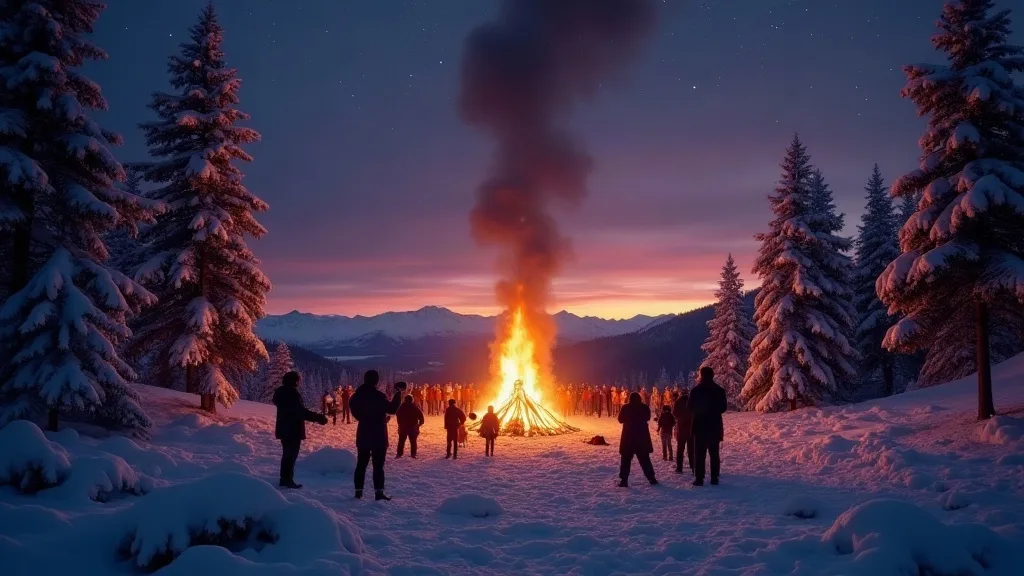
The fire dies down to embers. Snow piles thick outside the great hall. For the ancient Norse, autumn's final weeks brought a threshold moment: the veil between worlds grew thin, the harvest was done, and the season of ice demanded both practical preparation and spiritual reckoning. That sacred time was called Vetrnætr, or Winter Nights. It was harvest festival, ancestor feast, and community renewal rolled into one.
Then came Yule, stretching across the winter solstice and into the new year. The Yule log burned for twelve nights. Animals roamed free. The dead walked. Odin himself rode the winter sky on his eight-legged horse. These two festivals, separated by weeks but bound together by their winter context, defined the spiritual calendar of the heathen North and formed the heartbeat of a culture that never forgave nature for being harsh.
Today's Asatru practitioners honor these festivals much as they were honored a thousand years ago. The bones of tradition run deep, even if some flesh must be rebuilt by modern hands.
Winter Nights: The Autumn Blood-Sacrifice and Remembrance
Winter Nights (Vetrnætr in Old Norse) fell around mid-October, marking the transition from autumn to winter and the end of the pastoral year. For farming societies, this was the pivotal moment when herds had to be culled; not every animal could survive a Scandinavian winter on stored fodder. The blót, or blood sacrifice, was not an abstract ritual. It was practical and sacred at once.
The Norse would select animals for slaughter: sheep, goats, cattle, sometimes horses. But this was no casual butchering. The meat was consecrated to the gods and the land spirits. Part was burned on an altar as an offering; part was distributed among the community as a feast. The ritual acknowledgement transformed a necessary killing into a covenant: the people gave blood to the divine powers, and in return sought fertility, protection, and prosperity through the dark months ahead.
What made Winter Nights distinct from spring sacrifices (the Sumar Blót) was its intimate connection to the boundary between seasons and between the living and the dead. Medieval Norse texts, particularly the Landnámabók (Book of Settlements) and references in the Prose Edda, suggest that Winter Nights was a time when the dead drew near. Families would name children after deceased ancestors. Spirits of those who had died in the past year were believed to journey into the household, welcomed and fed through the rituals.
The historian and Old Norse scholar Hilda Ellis Davidson notes in her work on Norse festival cycles that Winter Nights served as a moment of spiritual accounting: debts (both material and spiritual) were settled, old grievances aired, and the community was metaphorically reborn for the winter. No major undertaking was begun during this liminal time; instead, the focus was inward.
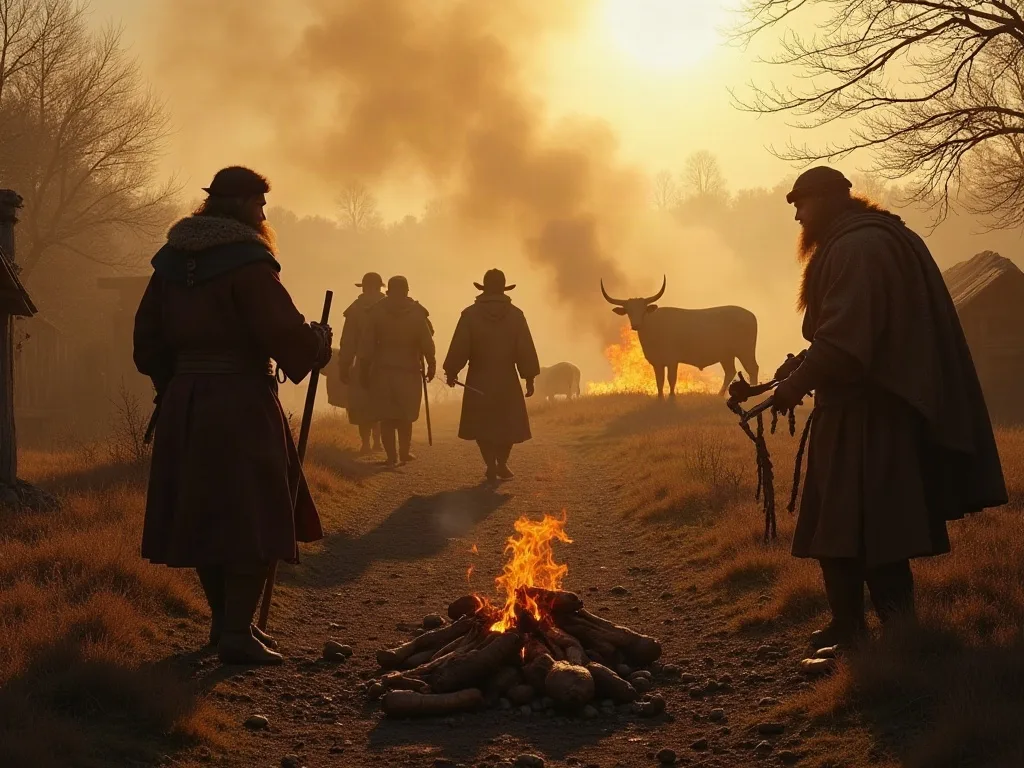
Modern Asatru groups honor Winter Nights by preparing a simple blót (most today use drink offerings, plant offerings, or symbolic gestures rather than animal sacrifice, though some lineages in rural settings maintain the traditional practice). The ritual typically involves a household or kindred gathering, sharing food and drink, speaking names of honored dead, and renewing bonds of kinship and loyalty. Some kindle a bonfire. Others process around the homestead with torches, honoring the boundary between summer and winter lands.
The festival lasted roughly three days, though some sources suggest a longer observance. It was a time of abundance (the last fresh meat and mead of the season) and a time of hard work (storing food, preparing the hall, mending tools). The sacred and the mundane were never divided in heathen thinking.
Yule: The Twelve Nights of Return and Transformation
Yule (Jól in Old Norse) arrived with the winter solstice, around December 21, and stretched into the new year. It was the longest festival in the Norse calendar, and in some texts is described as lasting the entire twelve-night period from the solstice to January first. The Prose Edda and Heimskringla (a medieval history of Norwegian kings) both confirm that Yule was the supreme winter festival, a time when the entire cosmic order seemed to hang in balance.
The solstice brought the year's longest night and shortest day. To the Norse mind, the sun had been captured or diminished by dark forces; Yule was the ceremony of its return. A massive log, the Jólablóki or Yule log, would be chosen (often an oak or pine). It would be carried into the hall with ceremony and set alight. The log was tended continuously for the twelve nights; it must not go out. If it died, so the belief went, the sun itself might not return.
The Yule log was more than a heat source. It was a cosmic anchor. In Hyndluljóð, a poem embedded in the Prose Edda, the Völva (seeress) speaks of the nine worlds hanging from the branches of Yggdrasil, the world-tree. The Yule log's flames were a sympathetic magic: as the fire burned bright and endured, so would the sun endure and return. The ashes were scattered on fields in spring as a blessing for fertility.
The twelve nights of Yule had specific associations. Each night was believed to predict the weather for the corresponding month of the year ahead. If night one was clear, January would be clear; if night two brought snow, February would be snowy. This tradition persisted into the Christian calendar as "Twelfth Night" and the folk custom of reading the future in winter weather patterns.
During Yule, boundaries between worlds dissolved. The dead roamed openly. Animals could speak. Food and drink were left out for spirits. Locks were left open so wandering souls could find warmth. Most significantly, Odin, the All-Father, was believed to ride the winter sky with his wild hunt, the Wildes Heer. Known variously as the Ásynjur ride or the Wild Hunt, this supernatural procession moved across the dark sky, and mortals who saw it risked being swept up into Odin's train forever. Doors were locked and bolted at night partly for practical warmth, but also for spiritual protection.
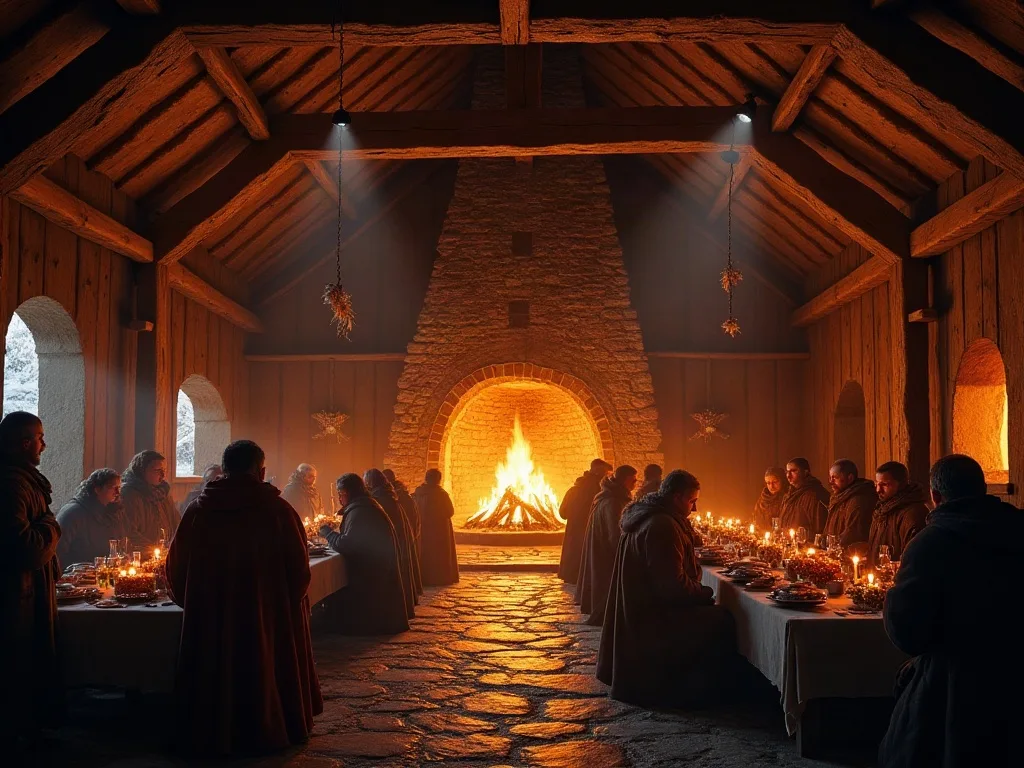
The Yule board was laid with vast quantities of food: ale, mead, bread, meat, dried fruit, nuts, and preserved vegetables. This was not purely festive indulgence; it was an investment in the community's morale and strength before the worst of winter set in. The ritual of síðr (custom or law) demanded that the household be hospitable. Any traveler, wanderer, or beggar who arrived at a hall during Yule had to be fed and sheltered. To turn someone away was to invite spiritual misfortune.
Gifts were exchanged, especially among kin. The Langabarðorum (tribe history) mentions that generosity at Yule confirmed one's standing in the community and one's honor. Stinginess at the winter festival was a sign of spiritual poverty, far worse than material poverty.
The Deep Roots: Samhain, Saturnalia, and the Sacred Turning
Winter Nights and Yule sit within a broader Indo-European pattern of winter threshold festivals. The Celtic Samhain, celebrated on October 31st and November 1st, echoes Winter Nights: a boundary time, ancestor veneration, thinning of the veil, ritual cleansing. The Roman Saturnalia (December 17-25) mirrors Yule's themes: a temporary suspension of normal social order, role reversal, gift-giving, and the symbolic death and rebirth of the solar deity Saturn.
The parallels are not coincidence but cultural echo. All agricultural societies in the temperate zones faced the same crisis: the sun's apparent death each winter. The cosmic anxiety was real. Stars moved. The sun shrank. Trees died. Snow came. Without a ritual framework to contain and work with these terrors, a people would fracture. Festivals provided the structure: a collective acknowledgement of the danger, a ceremonial way to influence the gods and cosmic forces, and a renewal of communal bonds.
Archaeological evidence from Denmark and Sweden shows that midwinter sacrifices date back at least to the Bronze Age. Animal remains, pottery vessels, and worked stone at excavation sites suggest that ritual fires, offerings, and feasting occurred at the solstice for over three thousand years. The Norse festivals were the echo of that deep antiquity.
In medieval Christian Norse territories, the Church attempted to absorb these festivals. Yule became "Christmastide." Winter Nights fell near Allhallows (All Saints' Day). The pagan rites didn't disappear; they were repackaged. Ancestor veneration became veneration of the saints. The Yule log became the Christmas log. The gift-giving of Yule transferred to gifts for Saint Nicholas (later Santa Claus). Many villages continued to honor the old observances in folk form, disguised enough that the priest might not interfere.
The Yule Feast and the Ritual of Abundance
One cannot overstate the material and social weight of the Yule board. For a people surviving on stored food, dried meat, and fermented or preserved vegetables, the Yule feast was an almost shocking abundance. Fresh ale and mead, brewed weeks before, would have been aged to potency. Bread baked with honey. Meats hanging from the rafters would be cut and roasted. Dried berries stewed with spices (if spices could be afforded; for most folk, it was salt and herbs).
The ritual was not consumption for its own sake. The Norse concept of gipt (gift) was central. When you feasted well and gave generously, you were distributing gipt, a spiritual power that created obligation and honor. The host who set the finest table was the most honored. The goði or chieftain who gave the most lavish Yule gifts secured loyalty not through coercion but through generosity. This was economics and magic woven together.
For thralls (unfree laborers) and poor folk, Yule was the one time of year when social boundaries softened. Everyone was fed from the same board (though perhaps not at the same table). The community was renewed as a whole. This temporary equality was not subversive; it was part of the sacred order. The gods themselves, in myth, drank and feasted as equals during certain festivals. Social order could safely flex during a threshold festival.
Sacred Animals and the Winter Herds
The heathen calendar revolved around animals. Spring was calving time; summer was pastoral expansion; autumn was culling and harvest; winter was survival. Winter Nights specifically marked the moment when the herd was reduced to what could be fed through the dark months. This was brutal arithmetic.
The animals chosen for the solstice and Winter Nights blots were typically the finest specimens, not the weakest. The best ram, the finest cow, a good horse: these were given to the gods as the most precious gift the community possessed. The hide was used for leather; the bones were tools; the meat was food; but the moment of offering, when the blade fell and the blood ran, was sacred. The priest (the goði or völva) would catch the blood in a wooden bowl and sprinkle it on the altar stone, the walls of the hall, and the gathered people. This was not squeamish; it was profound. The blood was the life-force, the connection between human and divine.
In modern Asatru practice, most kindreds do not perform animal sacrifice. The ethics are complex; modern animal welfare law in most countries forbids it; and Asatru is a minority religion without the communal, state-sanctioned framework that once supported such rites. Instead, modern heathens use sumbr (ritual toasting) with mead or beer, pours of libation, or symbolic offerings (bread, coins, crafted objects). The underlying covenant remains: humans give to the divine, and the divine sustains human life.
The Völva and the Oracular Winter
The Völva, the seeress or prophetess, held particular power during winter festivals. The Poetic Edda describes a völva speaking prophecy, and medieval Norwegian sagas detail völvas traveling from farmstead to farmstead during Yule and Winter Nights, performing seiðr (divination).
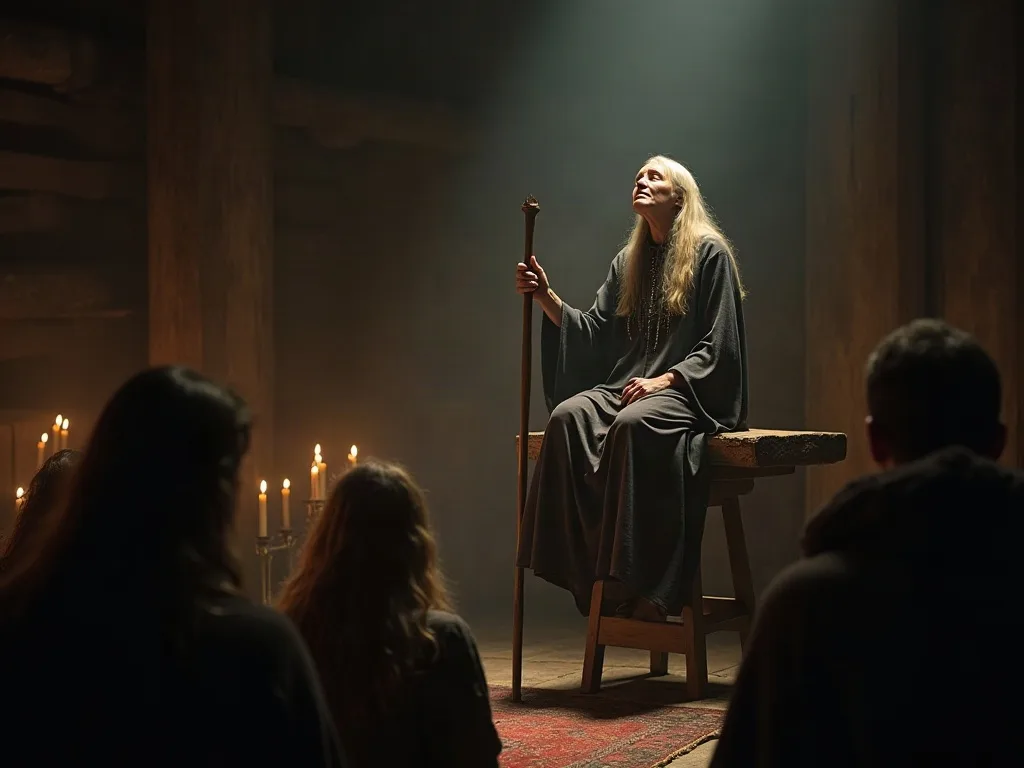
The seiðr was often a shamanic ritual. The völva would sit on a high seat (the seiðhjallr), perhaps drum or chant, and enter a trance state. In that state, she was believed to perceive events hidden from ordinary sight: the fates of individuals, the fortune of the harvest to come, the will of the gods. People would queue to ask her questions. Her answers shaped behavior: if she said a marriage would be unhappy, negotiations might end; if she said a child would be a great warrior, he was raised differently.
Winter, with its darkness and liminal quality, was the ideal season for such workings. The boundary between worlds was thinnest. Perception shifted. The völva's trance visions were taken as absolute truth. Her authority rivaled (and sometimes exceeded) that of the chieftain or priest.
Modern Asatru has experienced a resurgence of interest in reconstructing seiðr practice. Some groups train practitioners in modern versions of the ritual. This remains controversial: the practice is poorly documented, and reconstructionists sometimes disagree on methodology. But the impulse to reconnect with the völva's ancient role speaks to the power of winter oracular tradition.
The Juletide Suspension of Law
One striking feature of Yule across Norse and Germanic cultures was the temporary cessation of normal legal and social order. Feuds were suspended. Debts could not be collected. Criminals were sometimes released from confinement. The rule of law paused, as if the community had collectively agreed that normal time had stopped; different rules applied.
This was not anarchic. The heathen concept of law was cyclical and magical. Law existed within time; when time shifted (as it did at the solstice), law shifted too. The Yule truce was not a gap in law but a different law: the law of the gods, the law of the threshold, the law of abundance and forgiveness.
This concept influenced later European Christmas traditions. The "Christmas truce" in medieval wars, the idea that violence was suspended during the holy season, echoed the old Yule truce. Some scholars argue that the Christian Church deliberately positioned Christmas to coincide with winter solstice and Yule specifically to absorb and Christianize these pre-existing traditions of peace and renewal.
Winter's Dark Work: Preparation and Endurance
Beneath the festival's sacred layer lay the grimmer reality of survival. Winter in the North is a predator. Starvation was real. Cold meant death. Frostbite. Scurvy. Despair. The Norse did not romanticize winter; they feared it and they honored it.
Winter Nights and Yule were partly morale operations: community gathering, shared food, the assurance that the gods cared and that one's neighbors cared. The ritual reinforced the message that endurance was possible, that the sun would return, that the dark would not last forever. This was not empty optimism. The ceremony was an agreement between community members: we will help each other through. The gods are with us. We have done what we must do (the sacrifice, the offering). Now we can survive.
The practical work of winter began in earnest after Yule. Animal herds were brought into byres (barns). Tools were repaired. Walls were checked for leaks. Stores were inventoried. The festival passed; the long, cold, quiet months followed. Some folk barely left the hall from January to April, emerging only when the ice began to crack and green shoots pushed through the thaw.
The Yule Lads and Folk Variants
By the medieval period, Yule had accumulated numerous folk layers. In Iceland specifically, the Jólasveinar (Yule Lads) became a fixture of the season. These were mischievous trolls or elves (depending on the telling) who visited farmsteads on the thirteen nights before Christmas, one each night. Each had a name and a quirk: one stole candles, one slammed doors, one scraped pans.
The Yule Lads likely reflect a Christianization of older winter spirit traditions. Pre-Christian heathen belief held that trolls and elves were more active during winter, more likely to venture into human settlements. The Yule Lads preserved that belief in folk form. Children would leave shoes on windowsills, and the Yule Lads would leave small gifts or coal. This tradition influenced the modern Christmas stocking.
Modern Asatru practitioners differ on how to treat these folk layers. Some see the Yule Lads as delightful cultural echoes and incorporate them into their winter observance. Others prefer to focus on the reconstructed ancient practices and see the Lads as medieval Christian overlay. Both approaches exist within modern heathenry, reflecting healthy internal debate.
The Winter Sun and Cosmic Renewal
Ultimately, Winter Nights and Yule were expressions of a fundamental heathen insight: the cosmos is cyclical, not linear. The sun dies and is reborn. The year turns. Worlds end and are reborn (a theme central to Ragnarök, the Norse apocalypse-and-renewal). Life moves through seasons, and each season has its own spiritual quality and demand.
The solstice is an astronomical fact: the sun reaches its lowest point and begins to climb again. But for the Norse, this astronomical event was inseparable from spiritual reality. The ritual of Yule was not separate from the sun's return; it was the sun's return, made manifest in human act. When the community kept the Yule log burning, they were doing what the gods did: maintaining the fire of life, ensuring continuity.
This cosmology had moral weight. If the cosmos cycles through death and rebirth, then human death was not final. The ancestors' shades would return. Those who had died well (in battle, with honor, remembered by name) would continue in some form. Yule honored that continuity.
In the mythic tradition, the giants of cold and dark (like Ymir in the creation myth) were not evil, merely other. Winter was not evil. Death was not evil. They were necessary parts of the cycle. The heathen winter festivals embodied this acceptance: neither naive optimism nor despair, but clear-eyed engagement with the world as it was.
Modern Asatru and the Winter Observance
Today's Asatru heathens are scattered across the world, from cold climates where winter still bites to warm regions where December is mild. The festival practice varies accordingly.
In Scandinavia, Iceland, and northern Europe, Winter Nights and Yule are observed much as they might have been five centuries ago, albeit with modern amendments. A kindred gathers. A blót is performed (usually with libations rather than animal sacrifice). Mead or ale is brewed weeks in advance. The Yule log burns for the full twelve nights (or as many as practicality allows). Stories are told. Names of the dead are spoken. Gifts are exchanged.
In the United States, Australia, and other regions, Asatru groups have adapted. Some observe Winter Nights in October regardless of latitude. Some compress the twelve-night Yule into a weekend gathering. Many blend the festival with modern winter holiday structures: Yule becomes the secular winter celebration, and Christian or secular colleagues are invited without offending the sacred core.
The underlying consistency is this: a gathering of kin (by blood or choice), a ritual honoring the gods and the dead, a feast, and a renewal of bonds. The form adapts; the substance endures.
Frequently asked questions about Winter Nights and Yule: Heathen Seasonal Festivals
Frequently asked questions
What is the difference between Winter Nights and Yule?
Winter Nights (Vetrnætr) falls in mid-October and marks the end of the pastoral year, the culling of herds, and a threshold between seasons. It is intimate, ancestor-focused, and brief (roughly three days). Yule arrives at the winter solstice and lasts twelve nights; it is cosmic in scale, focused on the sun's return and the renewal of all life. Both are winter festivals but serve different functions and cover different spiritual ground.
Did the ancient Norse really keep the Yule log burning for twelve nights?
Medieval texts describe the Yule log (Jólablóki) as a central feature of the festival, and the twelve-night duration appears in several sources. Whether every farmstead maintained it continuously or the practice was more symbolic in some cases is debated by scholars. The practice certainly existed; modern reconstructionists honor it where feasible, though few can maintain a live fire for the entire period.
Can modern heathens perform Yule and Winter Nights without animal sacrifice?
Yes. Most modern Asatru groups use libations (pours of mead or ale), symbolic offerings (bread, coins, crafted items), or simply speak the words of offering without a physical sacrifice. The underlying covenant remains intact: humans give something of value to the divine, and the divine sustains human life. Animal sacrifice is practiced by some lineages in rural areas where it is legal and culturally sustainable, but it is not required for a meaningful observance.
What role did the Völva play in winter festivals?
The Völva (seeress) performed seiðr (divination) during winter, often traveling between farms during Yule and Winter Nights. She entered a trance state and offered prophecy about individual fates, harvests, and the will of the gods. Her authority was profound; her answers shaped major decisions. Modern Asatru groups have attempted to reconstruct seiðr practice, though documentation is sparse and reconstructions vary.
How do the winter festivals connect to Ragnarök, the Norse apocalypse?
Both embody the cyclical nature of Norse cosmology. Ragnarök is the end and rebirth of all worlds. Yule celebrates the death and rebirth of the sun each year. Winter Nights marks the boundary between seasons. The underlying principle is the same: endings are beginnings; nothing is permanent; the cosmos renews itself. By honoring the seasonal cycle, heathen practitioners align themselves with the larger cosmic pattern.
Are Winter Nights and Yule still observed in modern Scandinavia?
Folk traditions persist, especially in Iceland and rural areas of Norway and Sweden, though often in secular or Christian form. Modern Asatru communities in Scandinavia have worked to revive explicitly heathen observances. Some families blend the old and new: Yule and Christmas coexist, with the heathen elements (the log, the toasts, ancestor honor) occurring within or alongside Christian celebrations.
Cosmic Continuity: Why Winter Festivals Matter Today
The winter festivals of the Norse have survived fourteen centuries of Christianization, displacement, and cultural rupture because they address something enduring in human experience: the fear and wonder of winter, the need for community in dark times, and the awareness that life moves in cycles rather than straight lines.
Climate change and modern heating mean many people no longer fear winter as genuinely dangerous. Yet the solstice remains an astronomical turning point. The darkness still settles. The need for gathering, for ritual, for renewal persists.
Modern Asatru practitioners find in Winter Nights and Yule a way to stay connected to something ancient and true. These festivals are not escape fantasies; they are rooted in the material realities of a harsh landscape and in the psychological truth that human beings need rhythm, structure, and gathering to survive and thrive. The Norse knew this. They built their spiritual calendar around it.
When a modern kindred gathers to kindle the Yule log, speak the names of the dead, and share mead, they are participating in a practice that may stretch back three thousand years or more. The specific words may be reconstructed, the form adapted to modern life, but the substance is ancient: humans acknowledging the gods, honoring the ancestors, and renewing the bonds that hold a community together as the year turns and the ice comes deep.
Read the full book
Want the whole story?
The complete edition is an instant PDF download here, with a paperback on Amazon for selected titles.
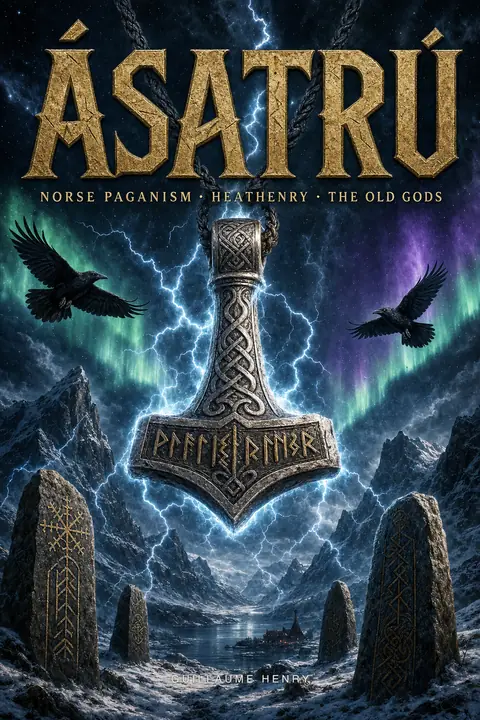
Asatru
The Asatru Book: Norse Paganism, Heathenry, and the Worship of the Old Gods
Norse Paganism, Heathenry, and the Old Gods
The living revival of Norse paganism: who the heathens worship, how the blót and the sumbel work, what the Nine Noble Virtues are, and how a faith that ended a thousand years ago came back to life in the modern world. Rooted in the Eddas, practiced today.
More from Asatru
All articles
Asatru
Mjolnir: Thor's Hammer as Symbol and Talisman
Mjolnir, Thor's legendary hammer, embodies divine power, protection, and order in Norse mythology. Discover how this symbol shaped Viking belief, ritual, and endures in modern culture.
Asatru
Folkish versus Universalist Asatru: The Inclusion Debate
Asatru splits between two visions: one rooted in ancestry and ethnicity, one open to anyone who honors the Norse gods. We trace the ideological divide, its history, and how it shapes modern practice.
Asatru
Wyrd and Orlog: Fate and Personal Destiny in Norse Mythology
In Norse tradition, **Wyrd and Orlog** are the twin forces that shape destiny. Wyrd flows from the present moment, personal and mutable; Orlog is the ancient law laid down at creation. Together they answer the oldest question: how much of our fate is written, and how much is ours to choose?

Asatru
Ragnarök: Apocalypse and Renewal in Norse Mythology
Ragnarök is the Norse end of the world: a cataclysm where gods fall, giants rise, and creation begins anew. Discover what the Eddas reveal about this apocalypse and why it shaped how Vikings saw death, duty, and destiny.