Asatru
How modern Asatru reconstructs Norse religion from the Eddas and sagas. History, practice, community splits, and what the sources actually say.
Most guides to modern Norse paganism treat it as a unified tradition with a clear lineage back to the Viking Age. The reality is messier and more honest. Asatru and Heathenry are twentieth-century reconstructions, not unbroken survivals. They draw on the Eddas, the sagas, and fragmentary accounts of pre-Christian ritual, but they are shaped just as much by the choices, debates, and ideological splits of the people who revived them.
This article distinguishes what we know about historical Norse religion from what modern practitioners have built in its name. It maps the divisions within contemporary Heathenry, identifies the primary sources that anchor the tradition, and explains why two Heathens standing at the same altar may hold profoundly different ideas about who belongs there.
What Asatru and Heathenry Are
The Names and What They Signal
Asatru is an Icelandic term meaning "faith in the Æsir," the family of gods that includes Odin, Thor, and Frigg. Heathenry is an English umbrella term covering the same general movement but often preferred by practitioners who want to avoid the specifically Icelandic branding or who honour the Vanir, the second family of Norse deities, with equal weight. Some groups use Forn Siðr (Old Custom) in Scandinavia or Fyrnsidu in Anglo-Saxon contexts.
The choice of name often signals ideological alignment. Asatru tends to be used by more formalised organisations. Heathenry is broader and includes solitary practitioners, reconstructionists, and those who blend Norse elements with other northern European traditions.
Reconstruction, Not Survival
There is no unbroken chain of Norse pagan practice stretching from the Viking Age to the present. Christianity arrived in Scandinavia between the tenth and twelfth centuries, and the old religion was suppressed, absorbed, or forgotten. What survives are texts written by Christians, archaeological remains, place names, and folklore that may or may not preserve genuine pre-Christian elements.
Modern Asatru does not claim to be a survival. It is a reconstruction, an attempt to build a living religious practice from fragmentary sources. That honesty is one of its strengths.
The Historical Norse Religion They Draw From
The Gods in the Eddas and Sagas
The primary window into Norse cosmology is the Poetic Edda, a collection of Old Norse poems preserved in thirteenth-century Icelandic manuscripts. The Völuspá recounts the creation of the world, the deeds of the gods, and the coming of Ragnarök. The Hávamál presents itself as the wisdom of Odin, covering everything from practical advice to the mystery of the runes.
Snorri Sturluson's Prose Edda, written around 1220, is the other major source. Its Gylfaginning section provides a narrative framework for the myths, while Skáldskaparmál preserves poetic kennings and additional stories. Snorri was a Christian writing for a Christian audience, and his theological framing colours the material. He describes the gods as powerful beings, not as metaphors, but he also distances himself from them.
The sagas, particularly Eyrbyggja saga and the kings' sagas in Heimskringla, offer glimpses of ritual practice. These are not sacred texts. They are literature, history, and propaganda, written generations after conversion.
Ritual Practice Before Christianisation
We know that blót, a sacrificial rite, was central to Norse religion. Animals were slaughtered, their blood sprinkled on altars and participants, and their meat consumed in a communal feast. Heimskringla describes King Hákon the Good's reluctant participation in a blót at Hlaðir, where he was pressured by pagan chieftains to honour the old gods despite his Christian faith.
Eyrbyggja saga mentions a temple at Helgafell with a high seat pillar sacred to Thor, where oaths were sworn and disputes settled. The Landnámabók records settlers dedicating land to gods and spirits, marking boundaries with ritual acts.
The most detailed account of a Norse funeral rite comes from an outsider: Ibn Fadlan, an Arab diplomat who witnessed a Rus ship burial on the Volga in 922 CE. His Risala describes human sacrifice, ritual intercourse, and the burning of a chieftain's body alongside a slave woman. The account is vivid, troubling, and impossible to verify independently.
What We Do Not Know
We do not know the exact words of prayers or invocations. We do not know how often rituals were performed, who led them, or whether practice varied significantly by region. We do not know if there was a professional priesthood or if religious authority rested with chieftains and heads of households.
The gaps are vast. Modern Heathenry fills them with educated guesses, comparative mythology, and personal inspiration.
The Twentieth-Century Revival
Iceland and the Ásatrúarfélagið
The modern Asatru movement began in Iceland. In 1972, a farmer and poet named Sveinbjörn Beinteinsson petitioned the Icelandic government to recognise Ásatrúarfélagið, the Asatru Fellowship, as a legal religious organisation. Recognition was granted in 1973. Sveinbjörn became the first allsherjargoði, or chief priest, and the group held its first public blót that summer.
The Icelandic revival was cultural as much as religious. It was a reassertion of national identity, a way to honour the sagas and the landscape without the overlay of imported Christian theology. It was not, at its inception, politically extremist. It was literary, romantic, and rooted in a specific place.
The American and European Branches
Asatru spread to the United States in the 1970s, where it took on a different character. Stephen McNallen founded the Asatru Free Assembly in 1974, later reorganised as the Asatru Folk Assembly. Other groups followed: The Troth, founded in 1987, emphasised inclusivity and scholarship. Regional kindreds formed, some reconstructionist, others eclectic.
In Germany, the United Kingdom, and Scandinavia, parallel movements emerged. Some were neopagan in flavour, blending Norse elements with Wiccan ritual structures. Others were fiercely reconstructionist, rejecting any practice not attested in the sources. The movement fractured early and has remained fragmented.
Core Beliefs and Practices in Modern Heathenry
The Nine Noble Virtues and Their Contested Origins
Many Asatru groups teach the Nine Noble Virtues: courage, truth, honour, fidelity, discipline, hospitality, self-reliance, industriousness, and perseverance. These are often presented as ancient Norse values. They are not. The list was codified by the Odinic Rite in the 1970s and later adopted by other organisations.
The virtues draw loosely on themes in the Hávamál, but they are a modern construction, shaped by twentieth-century ideas about what Viking ethics should have been. Some Heathens reject them entirely. Others use them as a starting point for ethical reflection.
Blót, Sumbel, and Seasonal Rites
Blót remains the central ritual form. In modern practice, it usually involves an offering to the gods, often mead or beer poured onto the ground or into a fire, sometimes accompanied by bread, meat, or other food. Animal sacrifice is rare but not unheard of in rural communities where participants have the means and legal permission.
Sumbel is a ritual toasting ceremony. Participants sit in a circle and pass a drinking horn. Each person makes a toast to a god, an ancestor, or a personal oath. The structure is simple, but the emotional weight can be significant. Oaths spoken in sumbel are considered binding.
Seasonal rites are common: Yule at midwinter, Ostara at the spring equinox, Midsummer, and a harvest blót in autumn. The names and dates vary by group. Some follow the solar calendar, others the agricultural cycle, others the attested festival dates from saga sources.
Ancestor Veneration and the Landvættir
Ancestor veneration is central to many Heathen practices. Altars often include photographs, heirlooms, or symbols representing deceased family members. The dead are not distant. They are part of the extended household, honoured at seasonal rites and invoked for guidance.
The landvættir, or land spirits, are also honoured. These are not gods but localised beings tied to specific places: hills, rivers, groves. Offerings are left at natural sites, and practitioners speak of building relationships with the spirits of the land they inhabit. This practice has parallels in other animistic traditions but is grounded in references from the sagas and Eddic poetry.
"Cattle die, kinsmen die, the self must also die; but glory never dies, for the man who is able to achieve it." Hávamál, stanza 76
The Ideological Splits Within the Community
Folkish Versus Universalist Heathenry
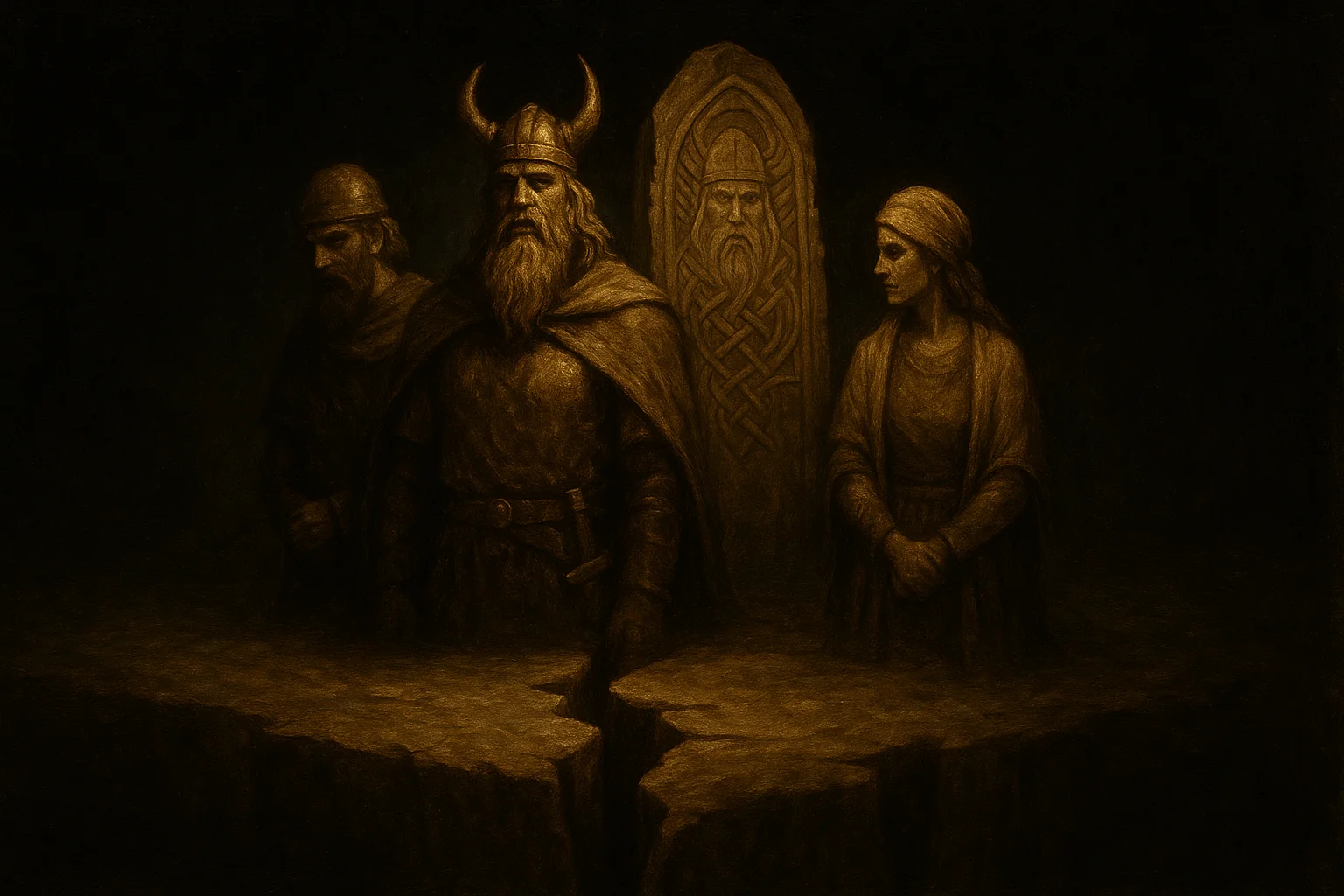
The sharpest division within modern Heathenry is between folkish and universalist factions. Folkish Heathens believe that Norse religion is tied to ancestry, that it is the native tradition of northern European peoples and should be practised primarily or exclusively by their descendants. Universalist Heathens reject that claim, arguing that religion is a matter of belief and practice, not blood.
The debate is not abstract. Folkish groups have been accused of providing cover for white supremacist ideology. Some folkish organisations explicitly disavow racism; others do not. The Southern Poverty Law Center and other watchdog groups have flagged certain Asatru organisations as hate groups. The Troth and other universalist bodies have issued public statements condemning racism and affirming that Heathenry is open to all.
The historical sources do not resolve the question. The sagas describe a world where ethnicity, kinship, and religion were intertwined, but they also describe conversion, adoption, and the integration of outsiders. The gods themselves, in the myths, cross boundaries. Odin wanders in disguise. Thor visits giants. The Vanir marry into the Æsir.
Reconstructionist Versus Eclectic Approaches
Reconstructionists aim to recreate historical Norse practice as closely as the sources allow. They study Old Norse, read the sagas in the original, and avoid elements not attested in pre-Christian sources. Eclectics are more flexible, blending Norse elements with other pagan traditions, modern ritual structures, or personal inspiration.
Reconstructionists criticise eclectics for diluting the tradition. Eclectics argue that reconstructionism is impossible given the gaps in the record and that living religions must adapt. Both positions have merit. The tension is unlikely to resolve.
Folkish Heathenry
Emphasises ancestry and ethnic continuity; views Norse religion as the heritage of northern European peoples; often includes genealogical research and kinship ties as part of religious identity.
Universalist Heathenry
Open to practitioners of any background; focuses on belief, practice, and relationship with the gods; explicitly rejects racial or ethnic requirements for membership or participation.
Asatru Around the World Today
Asatru is legally recognised in Iceland, Denmark, Norway, and Sweden. Membership numbers are small but growing. In Iceland, the Ásatrúarfélagið has over 5,000 registered members, roughly 1.5 per cent of the population. In the United States, the 2014 Pew Religious Landscape Study estimated fewer than 20,000 self-identified Heathens, though the number is likely higher if unaffiliated practitioners are included.
Communities exist across Europe, North America, Australia, and New Zealand. Online forums, podcasts, and social media have allowed geographically isolated practitioners to connect. The movement remains decentralised. There is no single authority, no unified creed, and no consensus on who speaks for Heathenry.
Some groups build physical temples. Others meet in homes, parks, or rented halls. Some practitioners are solitary, maintaining personal altars and performing rites alone. The diversity is both a strength and a source of confusion for outsiders trying to understand what Asatru is.
Primary Sources and How They Are Used
The Poetic Edda and Prose Edda are the foundation. Practitioners read them not as mythology in the academic sense but as sacred literature, texts that convey the character of the gods and the structure of the cosmos. The Hávamál is quoted in ritual, carved into runestones, and used as a guide for ethical decision-making.
The sagas are read for cultural context and glimpses of ritual. Eyrbyggja saga and Heimskringla provide details about temple layout, seasonal festivals, and the social role of religion. The Landnámabók is consulted for information about land-taking rites and the honouring of local spirits.
Some practitioners also study the Anglo-Saxon Nine Herbs Charm, the Old English Lacnunga, and other fragments of Germanic paganism outside Scandinavia. Others look to comparative sources: Roman accounts of Germanic tribes, archaeological finds, and runestone inscriptions.
The challenge is always the same: how much weight to give a source written by a Christian, centuries after the fact, with motives we can only guess at. Heathens read critically, but they also read devotionally. The texts are not just evidence. They are scripture.
Frequently asked questions
Is Asatru the same as Norse mythology?
Norse mythology is the body of myths, stories, and cosmological ideas preserved in the Eddas and sagas. Asatru is a modern religious movement that draws on those myths but also includes ritual practice, community structures, and ethical frameworks not found in the ancient texts. One is literature and tradition; the other is lived religion.
Do Asatru practitioners believe in Ragnarök?
Beliefs vary. Some Heathens interpret Ragnarök as a mythic narrative about cyclical destruction and renewal, not a literal future event. Others see it as a metaphor for personal or societal transformation. A minority take it as prophecy. The Völuspá describes Ragnarök in vivid detail, but it does not prescribe how modern practitioners should relate to it.
Can you practice Asatru alone, or do you need a group?
Both solitary and group practice are common. Many Heathens maintain personal altars, perform daily offerings, and celebrate seasonal rites alone. Others join kindreds, local groups that meet for blót, sumbel, and study. Some practitioners move between solitary and communal practice depending on geography and personal preference.
What is the difference between Asatru and Odinism?
Odinism typically emphasises Odin above other gods and is more often associated with folkish or racialist ideology, though not universally. Asatru honours the full Norse pantheon and includes both folkish and universalist groups. The terms overlap, and some practitioners use them interchangeably, but Odinism carries more ideological baggage in contemporary usage.
Are there Asatru clergy or priests?
Some organisations have formal clergy, often called goði (masculine) or gyðja (feminine), terms borrowed from Old Norse. These individuals lead rituals, perform weddings and funerals, and provide pastoral care. Other groups operate without clergy, rotating ritual leadership among members or allowing anyone to lead who feels called to do so.