
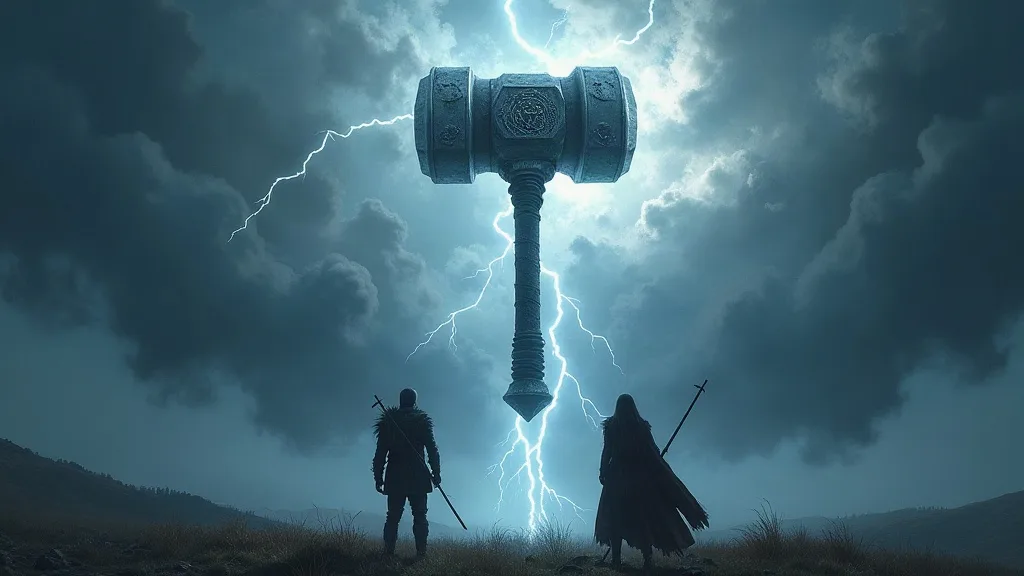
Mjolnir: Thor's Hammer as Symbol and Talisman
Mjolnir, Thor's legendary hammer, embodies divine power, protection, and order in Norse mythology. Discover how this symbol shaped Viking belief, ritual, and endures in modern culture.
Contents
In the forge of Svartalfheim, the black elves hammered the most fearsome weapon the Nine Worlds have ever known. The dwarven smith Sindri pulled forth Mjolnir, a hammer so heavy that only the strongest god in Asgard could lift it, so short in handle that it could be hidden in a shirt, so perfectly balanced that it would always return to the hand that threw it. No stone wall could stand. No skull could withstand its blow. Yet this weapon of terrible destruction became something far greater: a symbol of cosmic order, divine protection, and the renewal of the world itself.
The story of Mjolnir opens a window into how the Vikings understood power, faith, and the nature of reality. It was not merely a tool of war. It was a talisman worn around necks, invoked in sacred oaths, and carved into stone at burial sites. It represented the boundary between chaos and civilization, between the giants who threatened existence and the gods who stood against them. Even today, more than a thousand years after the Viking Age ended, the image of Mjolnir carries weight, worn by practitioners of Asatru, invoked in popular culture, and studied by scholars seeking to understand what ancient peoples believed about the sacred.
The Forging of Mjolnir: Craft and Competition
The Poetic Edda, a collection of Old Norse poems composed around 1200 AD but preserving much older material, tells how Mjolnir came to be. The god Loki, famous for his mischief and shape-shifting, made a wager with the dwarves Sindri and Brokkr. He wagered his own head that they could not create treasures more magnificent than those already possessed by the Aesir, the high gods. The stakes were absolute. The smith who crafted the greatest object would win the right to claim Loki's head.
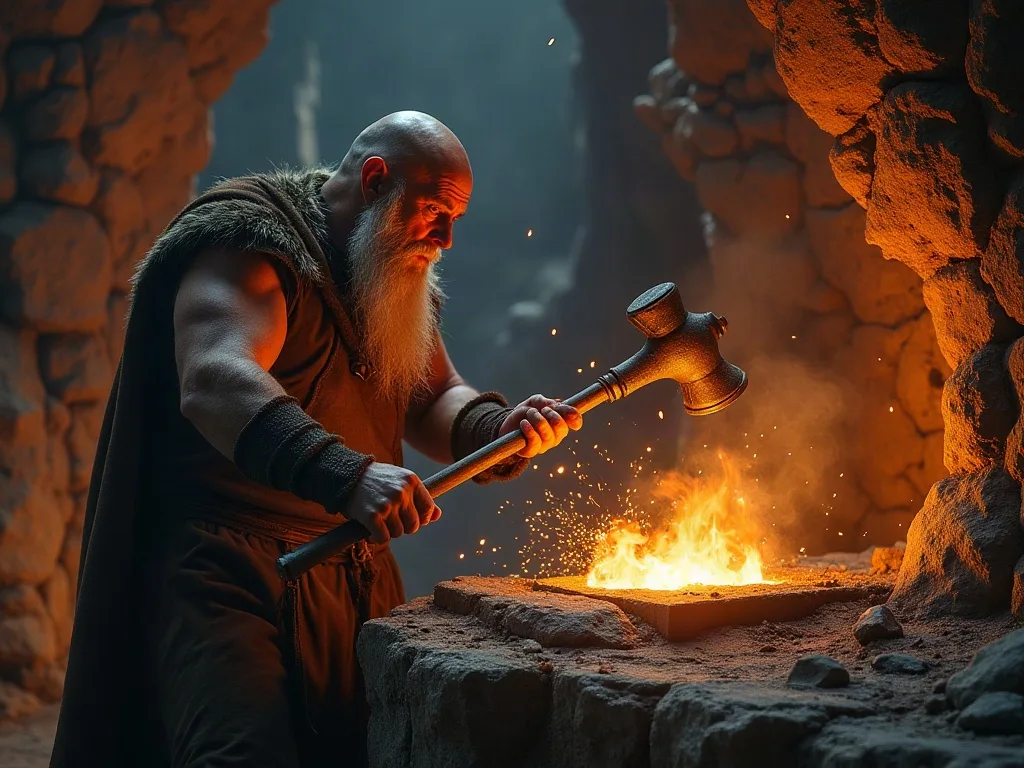
Sindri, the more skilled of the two dwarves, set to work at his forge. He took gold and worked it into the form of Brisingamen, a necklace of such beauty that it would outshine the sun itself. He crafted Gullinbursti, a golden boar whose bristles shone like daylight across dark landscapes. Then he began his masterwork: Mjolnir. As he worked the iron and shaped it at white heat, Loki interrupted him in the form of a fly, biting at his brow. Blood streamed down Sindri's face, but he did not pause. The hammer took shape. Its head grew massive and heavy. Its handle remained short. When Sindri pulled it from the forge, all present knew something unprecedented had been born.
The hammer had a flaw, though. The handle was slightly short, so short that Thor, the thunder god, could grip it only with both hands. Yet this imperfection became its greatest virtue. Thor could hide the hammer inside his shirt. He could wield it in battle as easily as a human warrior might swing a war axe. And when thrown, it would obey its master's will, always returning like a falcon returning to its master's arm.
The Myth of Mjolnir's Power and Purpose
Mjolnir was no ordinary weapon. The Prose Edda, a 13th-century prose account of Norse mythology written by the Icelandic scholar Snorri Sturluson, records that the hammer had a special property: it always returned to Thor's hand after being thrown, no matter how far it traveled. This was not magic in the sense of deception or illusion. It was the natural law of the cosmos asserting itself through craft, the dwarves had woven the very structure of reality into the weapon's forging.
Thor used Mjolnir to protect the Nine Worlds against the giants of Jotunheim, the hostile realm beyond Asgard. When giants threatened to breach the boundaries between worlds, when they sought to steal from the gods or capture the goddesses, Thor raised his hammer. The boom of its impact echoed across the mountains. The earth shook. The giants fell. Mjolnir was not a symbol of tyranny or cruelty. It was the enforcer of boundaries, the tool by which order prevailed over chaos.
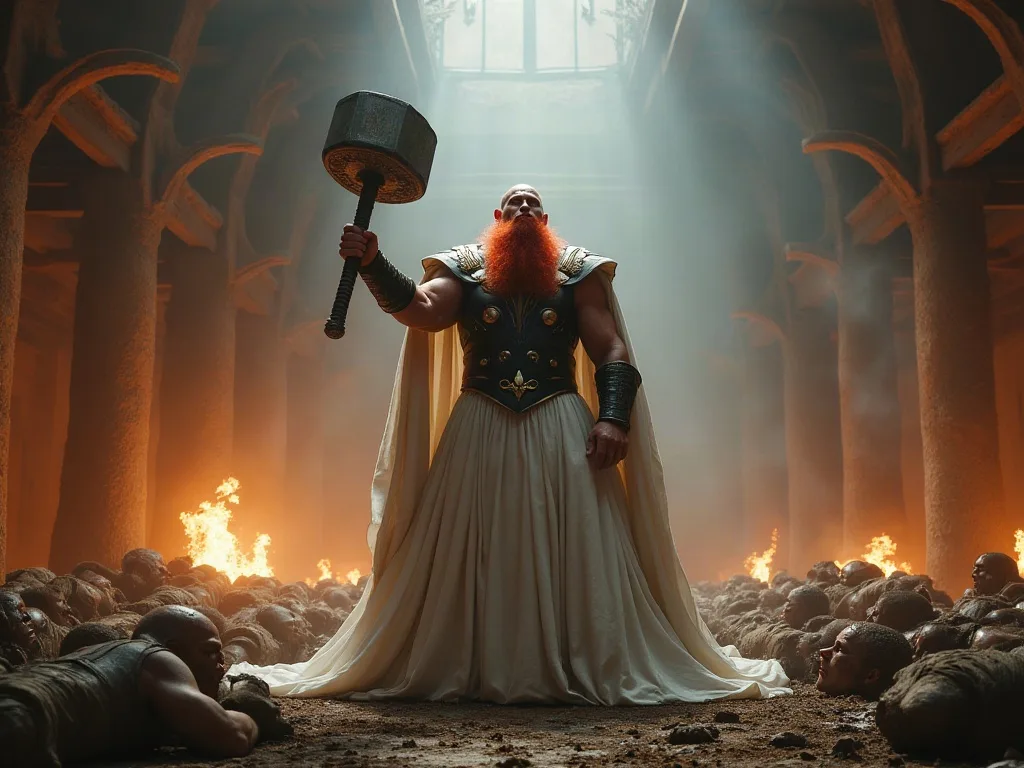
One famous story illustrates this perfectly. The giant Thrym stole Mjolnir and hid it in the earth, buried nine fathoms deep. He demanded the goddess Freyja as ransom. The gods grew desperate. Without Mjolnir, they could not defend themselves. It was Loki, the same troublemaker who had wagered his head, who devised the plan to recover it. He convinced Thor to dress as the bride, Freyja, and travel to Thrym's hall with Loki disguised as a bridesmaid. When Thrym brought out Mjolnir to lay on the bride's lap in blessing, Thor seized it, threw off the wedding dress, and slew every giant in the hall.
The story is told with humor, Thor in a bridal gown, yet it carries profound meaning. Mjolnir, in the hands of the right god for the right purpose, restored order instantly. The chaos that Thrym represented could not stand against it.
Mjolnir and the Cosmic Structure
To understand why Mjolnir became far more than a weapon, one must understand what the Vikings believed about the structure of existence itself. The cosmos was not a stable, permanent thing. It was fragile, held together by the will of the gods and the laws they upheld. At the edges of the worlds lived enemies, giants, demons, and forces of entropy that perpetually threatened to tear reality apart.
Thor, the red-haired, thunder-voiced god of strength and protection, was the chief defender of the established order. His role was not to expand the realm of the gods but to maintain it, to hold the line against those who would destroy it. Mjolnir, in his hands, became the instrument of this defense. Every time he swung it, he was not simply winning a battle; he was reaffirming the cosmos itself.
The Norse cosmos contained nine worlds hanging from the branches and roots of Yggdrasil, the World Tree. Mjolnir was the hammer that upheld the law across all nine. It was present in the minds and hearts of all who sought to live in right relationship with the gods. When a Viking warrior wore the symbol of Mjolnir around his neck, he was not claiming divine power for himself. He was placing himself under the protection of the god who wielded it, and pledging himself to the order that the hammer defended.
Mjolnir as Sacred Talisman and Ritual Object
The Vikings did not treat Mjolnir as a distant myth, something to be enjoyed as a story and forgotten. They made it real in their lives through ritual and devotion. Archaeological evidence and historical accounts reveal that Mjolnir pendants were among the most common religious talismans in the Viking Age, particularly in Scandinavia between the 8th and 11th centuries.
Excavations in Sweden, Norway, and Denmark have uncovered hundreds of small silver and bronze Mjolnir amulets, often worn on chains or leather cords around the neck or wrist. Some were simple, cast in a single mold. Others were intricately carved, with runes inscribed or decorated with intricate knotwork. These were not luxury items reserved for the wealthy; they appear in graves across all social classes. A thrall and a jarl (nobleman) might both wear the hammer. This tells us that Mjolnir represented something universal within Norse society: a promise of protection, a marker of faith, an affirmation that one belonged to a world ordered and defended by the gods.
Historical sources describe how Mjolnir was incorporated into Christian conversion as well. When missionaries arrived in Scandinavia, beginning in earnest in the 10th century, they encountered fierce resistance from those devoted to the old gods. Some Vikings resisted conversion entirely. Others found ways to blend the old faith with the new. In a few documented cases, Vikings wore both a cross and a Mjolnir hammer, hoping perhaps that the new God and the old gods would both offer protection. Over time, the hammer faded from daily wear in Scandinavia as Christianity took root, but it never entirely disappeared from the cultural memory.
Mjolnir in Sacred Oaths and Rituals
The hammer held a special role in Norse law and religious practice. Historical texts, particularly the Icelandic sagas, record that Mjolnir was invoked at sacred gatherings and in the swearing of binding oaths. The historian and lawspeaker would hold up a symbol of the hammer, or even invoke it in speech, when formalizing agreements that required the protection of the gods.
Weddings in Norse society were blessed with Mjolnir. When a couple married, the groom would lay the hammer on the bride's lap in a ritual gesture, calling upon Thor to bless the union and protect the household that would arise from it. This ritual survived into Christian times in modified form, with priests using crosses instead, but the essence remained: invoking divine power to sanctify human bonds.
The hammer also appears in the rituals of sacrifice. When the Vikings made offerings to the gods, grain, animals, or precious objects, they would sometimes inscribe or shape the offering to honor Mjolnir. These were not blood sacrifices in the sense of crude butchery. They were structured acts of devotion. A farmer might offer a portion of his harvest at a stone marked with Mjolnir, asking the god for protection of his livestock and fields. A warrior might lay a weapon at such a stone before a great battle, pledging his courage to Thor's service.
The Symbol in Stone: Mjolnir in Runes and Carved Art
The Vikings left their beliefs carved into stone. Across Scandinavia, thousands of runestones stand as monuments to the dead and declarations of faith. Many of these stones carry an image of Mjolnir, either carved in outline or invoked through runes, the angular script the Norse peoples used for writing and divination.
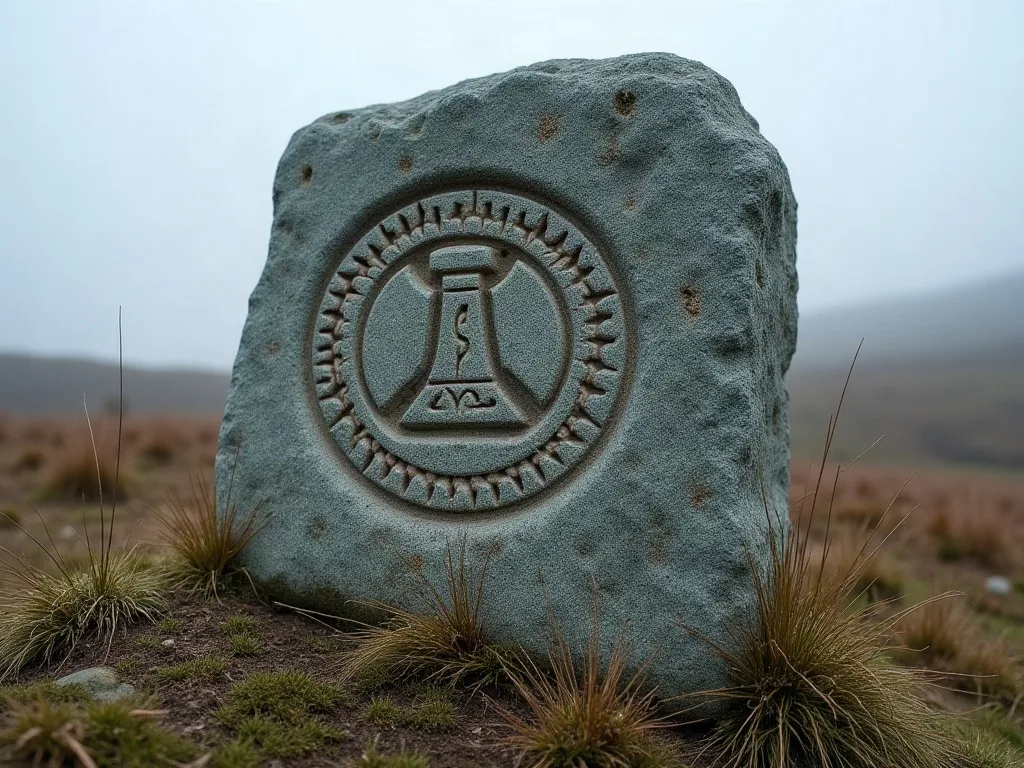
The simplest representation is a T-shape or hammer outline, immediately recognizable. More elaborate versions show the hammer with its handle curved or decorated, sometimes surrounded by serpents or geometric patterns that echo the knotwork of Norse art. These carved images were not purely decorative. They were protective sigils. A stone marking a grave with Mjolnir carved upon it was a declaration that the dead person lay under the protection of Thor, that their spirit would be defended in the worlds beyond death.
Rune workers, those who carved runes and understood their power, would sometimes include Mjolnir symbols alongside letter-forms. The hammer could be carved as a kind of blessed boundary marker, defining sacred space from ordinary space. It could protect a farmstead from evil spirits or harm. This practice was so prevalent that later Christian authorities sometimes tried to suppress it, viewing the hammer as a competing sacred symbol.
The Twilight of the Gods and Mjolnir's Final Hour
If Mjolnir was the tool of cosmic order, then the Norse apocalypse, the Ragnarok, the "Doom of the Powers", would be the moment when order finally failed. The Poetic Edda describes this end-time in vivid, terrifying language. The sky would split. The stars would vanish. The earth would sink into the sea. The World Tree Yggdrasil would shudder. The giants would break free from their bonds. And Thor would face his ancient enemy, the Midgard Serpent, Jormungandr, in a final battle.
In that battle, Thor would raise Mjolnir one final time. He would strike the serpent dead. But the venom that poured from the creature's jaws would strike Thor down as well. The thunder god would fall. His hammer would fall silent.
Yet this was not the end of the story. The Edda promises that after the destruction comes rebirth. A new sun would appear. New earth would rise from the sea. And Mjolnir, so the texts suggest, would endure. The hammer, as an symbol of order and cosmic law, could not be truly destroyed. It would remain as a promise of renewal, that order would be restored, that the cycle would turn again.
This vision of death followed by rebirth was central to Norse thought. It was not pessimism. It was realism about the nature of existence, combined with faith that renewal was possible. Mjolnir embodied this truth: the hammer that protected the world now would protect the world to come.
Mjolnir in the Modern World
The symbol of Mjolnir did not die with the Viking Age. It persisted in the folklore of Scandinavia, buried but not erased. In the 19th century, as scholars began to rediscover Norse mythology through texts like the Prose Edda and the Poetic Edda, the hammer reemerged as a symbol of cultural identity. Scandinavian nationalists, and later German extremists in the 1930s, appropriated Mjolnir as a symbol of racial or ethnic purity. This dark chapter in the symbol's history, its use by Nazi ideology, must be acknowledged and rejected. The hammer's authentic meaning in Viking culture was protective and cosmic, not ethnic or supremacist.
Today, practitioners of modern Asatru and Heathenry, spiritual movements that seek to revive or reimagine Norse religious practice, wear Mjolnir pendants as a central expression of faith. For them, the hammer represents connection to ancestral traditions, commitment to values of strength and honor, and protection under the gaze of Thor. Modern craftspeople create Mjolnir pendants in silver, bronze, wood, and other materials, often returning to historical designs while adding contemporary flair.
The hammer has also become a fixture of popular culture. It appears in comic books (most notably Marvel's Thor), in fantasy literature, in video games, and in films. These modern interpretations, while often straying far from historical accuracy, have kept the symbol alive in public consciousness. They have invited millions of people to ask the question: what did this symbol mean? Why did Vikings care about it? What does it represent?
Mjolnir Beyond the Myth: Symbol of Cosmic Balance
Mjolnir endures because it represents something universal. It is a symbol of power, yes, but power deployed in service of order and protection rather than domination. It is a promise that cosmic chaos can be held at bay, that there are forces in the universe that stand against entropy and destruction. For the Vikings, it was a physical reminder of these truths, something to be worn or invoked when facing danger or uncertainty.
The hammer also represents a kind of balance. It is a tool of terrible destruction in the hands of a god, yet it was created by craftspeople, the dwarves, whose skill and intention shaped its power. It cannot be wielded by just anyone; only those with the strength to lift it and the right to claim it can truly use it. This idea resonates across cultures and eras. Power has its limits. Strength carries responsibility. The cosmos is not ruled by might alone, but by law and right relationship.
In the modern world, where many feel untethered from tradition and meaning, the symbol of Mjolnir speaks to a deep human need: the need to believe that there are forces, whether divine, natural, or cultural, that protect us, that uphold order, that defend us against chaos. The Vikings expressed this through their gods and their symbols. We express it through different languages, but the longing remains the same.
Frequently asked questions about Mjolnir
Frequently asked questions
Why could only Thor lift Mjolnir?
The Prose Edda records that Mjolnir had a special enchantment. Its weight could only be supported by those with the divine strength of the Aesir, and even among them, only Thor possessed sufficient power. The dwarven smith Sindri crafted this into the hammer deliberately, ensuring it could not fall into the hands of giants or other threats. Some interpretations suggest the hammer was bound to Thor personally, recognizing him as its rightful wielder.
Did Vikings actually wear Mjolnir pendants, or is that just mythology?
Archaeological evidence confirms that Vikings wore Mjolnir pendants extensively. Hundreds of small silver and bronze hammer amulets have been excavated from Viking Age graves and settlements in Scandinavia, particularly from the 8th to 11th centuries. These talismans ranged from simple to intricately carved, and they appear across all social classes, suggesting Mjolnir was a widespread symbol of faith and protection, not a luxury for the elite.
What does Mjolnir mean as a symbol in modern Asatru?
For modern practitioners of Asatru and Heathenry, Mjolnir represents connection to ancestral Norse traditions, divine protection from Thor, and commitment to values like strength, honor, and cosmic order. It is worn as a talisman and invoked in ritual to affirm one's faith. The symbol carries the weight of history, though modern wearers must be careful to distinguish authentic historical meaning from modern ideological appropriation, particularly by extremist groups.
How is Mjolnir different from other mythological weapons?
Mjolnir is unique because it combines several properties: it always returns to its thrower, it cannot be lifted by the weak, its handle is unusually short, and it represents cosmic law, not merely personal power or conquest. While other mythological weapons (like Excalibur or the swords of Hindu epics) are tools of heroism or kingship, Mjolnir is fundamentally a tool of protection and order. It defends the boundary between chaos and civilization itself.
Did Christianity replace worship of Mjolnir and Thor in Scandinavia?
Yes, over the course of the 10th and 11th centuries, Christianity gradually displaced the worship of Thor and other Norse gods in Scandinavia. Some Vikings resisted this transition and wore both cross and hammer for a time, hoping for dual protection. However, the symbol of Mjolnir never entirely vanished from cultural memory. It persisted in folklore and was rediscovered and revived by modern scholars and spiritual practitioners beginning in the 19th century.
The Enduring Echo of the Hammer
The story of Mjolnir is the story of how humans make the sacred tangible. The Vikings could not visit Asgard or speak directly with Thor, so they carved his symbol into stone, wore it at their necks, and invoked it when their lives depended on protection and order. The hammer became real through belief and practice. It shaped how they saw the world, how they understood power and responsibility, how they faced uncertainty and death.
Today, Mjolnir remains in circulation. It appears in museums, in scholarly texts, in the hands of people who wear it as talisman or cultural marker. Each generation reads the symbol anew, finding in it what their time demands. For some, it is a connection to ancestral heritage. For others, it is a character in an epic tale. For still others, it is a symbol of resilience, the idea that the forces of order can hold back chaos, at least for a time, and that renewal is always possible.
The dwarves forged it in their black-elf smithy. Thor carried it across the Nine Worlds. The Vikings wore it into battle and laid it on the tombs of their dead. And still the hammer echoes. Not because the gods themselves walk among us, but because the truths the hammer represents, protection, order, the possibility of renewal, remain as relevant to humans now as they were a thousand years ago.
Read the full book
Want the whole story?
The complete edition is an instant PDF download here, with a paperback on Amazon for selected titles.
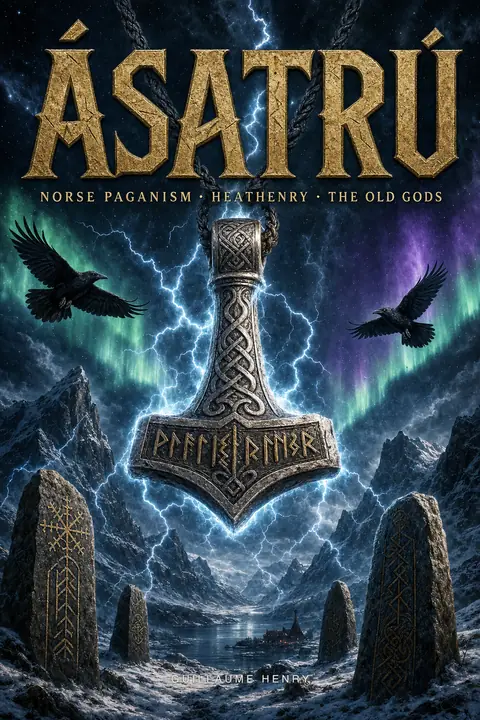
Asatru
The Asatru Book: Norse Paganism, Heathenry, and the Worship of the Old Gods
Norse Paganism, Heathenry, and the Old Gods
The living revival of Norse paganism: who the heathens worship, how the blót and the sumbel work, what the Nine Noble Virtues are, and how a faith that ended a thousand years ago came back to life in the modern world. Rooted in the Eddas, practiced today.
More from Asatru
All articles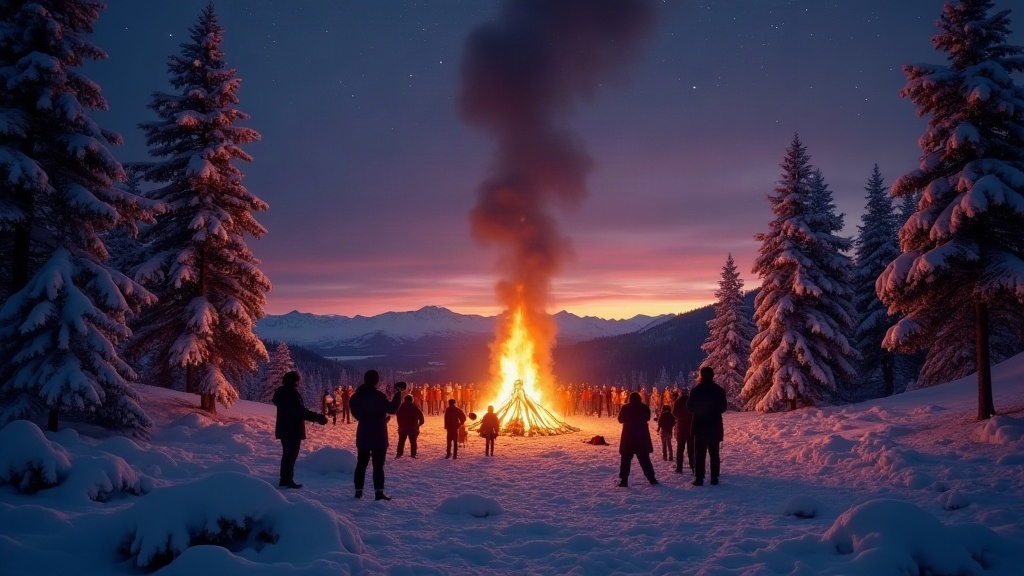
Asatru
Winter Nights and Yule: Heathen Seasonal Festivals and Their Sacred Roots
Winter Nights and Yule are the two cornerstone heathen seasonal festivals that mark the darkest months of the year. Rooted in pre-Christian Norse and Germanic traditions, these observances honor the cycle of death and rebirth, ancestor veneration, and the sacred interplay between human and divine realms.
Asatru
Folkish versus Universalist Asatru: The Inclusion Debate
Asatru splits between two visions: one rooted in ancestry and ethnicity, one open to anyone who honors the Norse gods. We trace the ideological divide, its history, and how it shapes modern practice.
Asatru
Wyrd and Orlog: Fate and Personal Destiny in Norse Mythology
In Norse tradition, **Wyrd and Orlog** are the twin forces that shape destiny. Wyrd flows from the present moment, personal and mutable; Orlog is the ancient law laid down at creation. Together they answer the oldest question: how much of our fate is written, and how much is ours to choose?

Asatru
Ragnarök: Apocalypse and Renewal in Norse Mythology
Ragnarök is the Norse end of the world: a cataclysm where gods fall, giants rise, and creation begins anew. Discover what the Eddas reveal about this apocalypse and why it shaped how Vikings saw death, duty, and destiny.