
The Poetic Edda and Prose Edda: Source Texts of Heathenry
The Poetic Edda and Prose Edda are the bedrock of Norse mythology. Composed centuries apart, these two works preserve the gods, cosmology, and ritual knowledge of the Viking world. Learn how they shaped Heathenry and why scholars still debate what they reveal.
Contents
A woman sits by a fire, her voice steady in the darkness. She begins to sing of Yggdrasil, the world tree whose roots hold all things. She names the giants, the gods, the nine worlds. Around her, people lean in. This scene never appears in any surviving text, yet it captures something real: the Eddas were once living songs and stories, passed from mouth to mouth across centuries before anyone carved them into manuscript.
Today, we know the Nordic gods through two books that saved these words from oblivion. The Poetic Edda and the Prose Edda are not the original poems sung in Viking halls. They are echoes, written down by Christian scribes who lived centuries after the pagan age. Yet they remain the closest thing we have to the voice of the old North.
Understanding these texts is essential. Not just for historians. Modern Heathenry, the living spiritual tradition that honors the Norse gods today, rests entirely on what the Eddas preserved. Every ritual, every name, every story that modern practitioners know about Odin, Thor, and Freyja flows back to these manuscripts. The better we understand the Eddas, the better we understand both ancient Norse culture and the spiritual movements that claim its inheritance.
The Poetic Edda: Fragments of Pagan Song
The Poetic Edda, also called the Elder Edda, is the older of the two texts, though it was written down later. This collection of anonymous poems was composed across centuries, some pieces perhaps as early as the 9th century, others much later. The poems were likely preserved by oral tradition, sung and recited in households across Iceland and Scandinavia, until a single unknown scribe collected them in a parchment manuscript sometime in the 13th century.
The manuscript that survived is a single copy, kept in Iceland. It was lost for a time, nearly destroyed, rediscovered in the 17th century, and is now housed in the Árni Magnússon Institute in Reykjavík. Without this one parchment, everything we know about Odin, the creation of the cosmos, and the fate of the gods at Ragnarok would be gone.
The Poetic Edda contains 29 poems, divided into two groups. The first group, the mythological poems, tells the story of the gods and the creation of the world. The second group, the heroic poems, recounts the deeds of legendary humans like Sigurd and Brynhildr. The mythological poems are what modern readers typically encounter first.
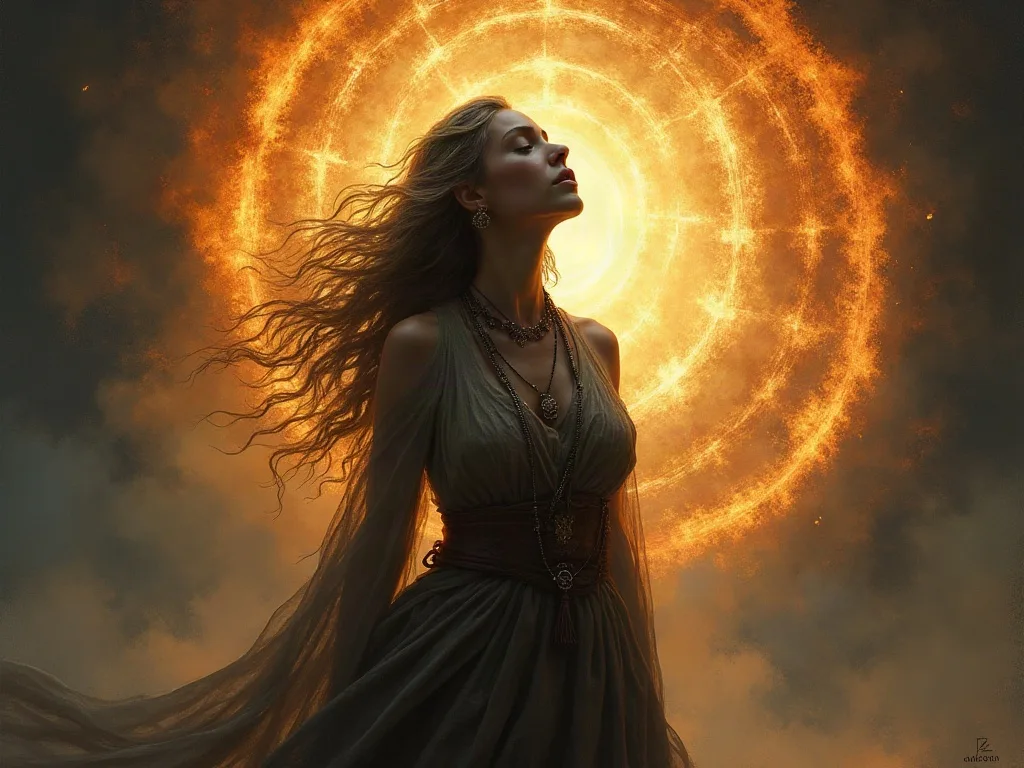
The most famous is the Völva's Prophecy, or Völuspá, which opens the entire collection. A völva was a seeress, a woman who could see the future. The poem begins before time itself, when nothing existed but mist and void. It names every stage of creation: how the first giants were born in the void, how the god Odin and his brothers shaped the human world from the body of the giant Ymir, how the gods built Asgard, their golden realm. Then it turns to prophecy. The poem describes, in vivid and often terrible images, the end of all things at Ragnarok. The sun will darken. The stars will vanish from the sky. The earth will sink into the sea. Heimdall will blow the Gjallarhorn to wake all beings. The giants will break free and march against the gods. Odin will be swallowed by Fenrir the wolf. Thor will kill the Midgard serpent but fall dead from its venom. Yet the poem does not end in despair. A new earth will rise from the sea. Green fields will grow. The sun will have a daughter who will light the sky. Two humans will repopulate the world.
This single poem, preserved by unknown voices across centuries, gave Western culture its first detailed account of Norse cosmology. Without it, we would barely know that the Norse imagined the world tree, the nine worlds, or the ultimate doom and renewal of creation.
Other major mythological poems include Havamal, the words of Odin, which records wisdom teachings, magical knowledge, and warnings about the dangers of pride and hunger. Lokasenna captures a scene of dark comedy: Loki, the trickster, crashes a feast of the gods and insults each one in turn, revealing secrets and shames. Thrym's Theft tells how the giant Thrym stole Thor's hammer and demanded a price; the poem shows Thor in drag to trick the giant, a story that reveals a pagan world far less concerned with strict gender roles than later Christian Scandinavia.
The Poetic Edda's language is Old Norse, written in a style called alliterative verse. Instead of end rhyme, lines are linked by the repetition of initial sounds. The result is a rhythm that was easy to memorize and beautiful to hear when spoken aloud. This form was the natural container for oral poetry, which suggests these poems were composed to be sung, not read in silence.
Dating and Composition
The poems were not all written at the same time. Scholars analyze vocabulary, imagery, and mythological references to estimate when each was composed. Some poems use very old Norse language and reference details unknown to Christianity; these are thought to date from before the 10th century, when Iceland officially converted to Christianity in the year 1000. Others show Christian influence or reference later historical events.
The genius of the unknown scribe who collected them was recognizing that these fragments, scattered across generations, held a complete mythological system. Perhaps he was a scholar. Perhaps he was a priest, preserving the old stories to understand Iceland's pagan past. We will never know his name.
The Prose Edda: Snorri's Handbook
Snorri Sturluson was born in Iceland around 1179. He was a farmer, a politician, a historian, and one of the greatest writers of medieval Scandinavia. Snorri lived two centuries after Iceland's conversion to Christianity. He grew up Christian. Yet he was fascinated by the old stories.
In his house in Iceland, Snorri had access to copies of the Poetic Edda. He was also a student of the skalds, the court poets of the Norwegian kings. These poets still composed in the old Norse style, using the same alliterative verse and mythological metaphors that pagan poets had used. Snorri recognized something important: if he did not write down how the old poems worked, their meaning would soon be lost. Future poets would not understand the metaphors. The mythology would fade from memory.
Around 1220, Snorri wrote the Prose Edda, a work he called the Prose Treatise on Old Poetry. It was a handbook for poets. It explained how to compose in the old style. It summarized the myths so that readers would understand the metaphors embedded in ancient verse.
The Prose Edda is structured in four parts. The first, the Prologue, was Snorri's attempt to reconcile pagan mythology with Christian belief. He suggested that the ancient Norse gods were actually human leaders, perhaps from Asia, who had been deified because of their power and wisdom. This interpretation was typical of medieval Christian scholars trying to make sense of pagan cultures. It is not accurate, but it preserved the stories.
The second part, called the Gylfaginning (the Deluding of Gylfi), is the heart of the Prose Edda. It frames the mythology as the revelation given to a legendary Swedish king named Gylfi. He travels to Asgard and meets three figures who reveal the secrets of creation, the names and deeds of the gods, and the fate of the cosmos. The Prose Edda summarizes nearly everything we know about Norse cosmology in this section: Yggdrasil, the nine worlds, Odin's sacrifice and his acquisition of magical knowledge, Thor's deeds against giants and monsters, Freyja's control of love and death, and much more.
The third part, the Skáldskaparmál (the Language of Poetry), is a detailed handbook of poetic metaphors. It explains that poets did not simply say "the sea." Instead, they called it "Ran's realm" or "the whale's home," because the sea was the domain of Ran, a goddess who lived beneath the waves. Each god had a list of poetic names. Thor could be called "the thunderer," "the enemy of giants," or "the charioteer." Understanding these metaphors was the key to comprehending ancient verse. Snorri gives examples and explanations for hundreds of them.
The fourth part, the Háttatal, is a poem Snorri wrote about his patron, King Haakon of Norway. It was a technical demonstration of his mastery of the old poetic forms.
Snorri's Prose Edda is a work of genius, but it is also a problem. Snorri was reinterpreting the myths for a Christian medieval audience. He may have changed details. He may have emphasized some stories and downplayed others. When the Prose Edda and the Poetic Edda contradict each other, which is the more authentic? Scholars still debate this question.
Snorri's Manuscript Tradition
Snorri's original manuscript no longer survives. What we have are copies made by later scribes. The earliest known copy dates to about 50 years after Snorri wrote the original. This copy is now in Copenhagen. Other copies exist in Sweden, Iceland, and elsewhere. Each copy shows variations, signs that later scribes changed words, expanded passages, or added notes.
Snorri's text also survived in a summary called the Skjöldunga saga, written sometime after Snorri's death but before 1400. This summary compressed the Prose Edda into narrative form, making it more readable but less detailed.
How These Texts Relate to Each Other
The Poetic Edda and Prose Edda are often treated as a single source, but they are very different works. The Poetic Edda is a collection of ancient poems, many of which preserve pre-Christian pagan ideas. The Prose Edda is a 13th-century handbook written by a Christian man, intended for poets, not for religious instruction.
When you read a story in both texts, you are seeing the myth filtered through two very different lenses. Consider the story of Odin's sacrifice of his eye. In the Poetic Edda's Havamal, Odin says he hung himself on Yggdrasil for nine nights, pierced by a spear, to gain knowledge of the runes. In the Prose Edda, Snorri tells a different version: Odin traded his eye to drink from Mimir's well of wisdom. Both stories involve Odin gaining knowledge through a painful sacrifice, but the details are not identical. Did the ancient poets know both versions? Did Snorri change the story? Did later scribes confuse two separate myths? We cannot be certain.
The Lost Knowledge: What the Eddas Don't Tell Us
The Eddas are silent on many things. They tell little about actual religious practice: how people prayed, what sacrifices looked like, how temples were arranged. They mention rituals like blótar, blood sacrifices, but do not describe them in detail. They are silent on the names and stories of many local deities that surely existed in Scandinavia. They focus on the major gods of the larger Norse pantheon while ignoring countless figures who were important to specific communities.
The Eddas were written down by Christian scribes, and some stories may have been deemed too pagan or too morally offensive to preserve. Other stories were simply lost, kept only in distant communities or in texts that were not copied and did not survive. Balder the Beautiful, who dies and whose death triggers the final destruction, is one of the most important Norse gods in the Eddas. Yet he appears in very few of the poems. Was he a later invention? Was he forgotten? Was his full story never written down?
Archaeological evidence suggests that Norse paganism was more diverse and regional than the Eddas indicate. Amulets and figurines discovered in graves suggest cults of goddesses who barely appear in these texts. Runestones and inscriptions invoke gods not mentioned in either Edda. The Eddas are a window, not a mirror. They show us something real, but they also hide much.
Scholarship and Debate
For centuries after they were rediscovered in the 17th century, the Eddas were accepted as straightforward historical documents. Scholars mined them for facts about Viking Age Scandinavia.
In the 19th and 20th centuries, this attitude began to shift. Scholars asked harder questions. Where did each poem come from? How much had the oral tradition changed the original stories? How much did Snorri alter what he transcribed? How much of what survived was chance, and how much was the result of deliberate choices by scribes?
The German scholar Andreas Heusler, writing in the early 20th century, proposed that many of the Poetic Edda's poems were not ancient pagan compositions but rather medieval Christian poets' reconstructions of what they imagined pagan poems sounded like. This theory challenged the idea that the Eddas were windows into the pagan past. If true, they would be more like medieval fantasies about paganism than authentic records of it.
Most modern scholars reject Heusler's extreme position. They believe the Poetic Edda does contain very old material, preserved through centuries of oral tradition. But they acknowledge that the texts we have are not pristine records. Every poem has passed through many mouths and many hands.
Scholars also debate the historical context of the myths themselves. Were Odin, Thor, and Freyja worshipped by all Norse peoples in the same way? Or did different regions have different beliefs? The Eddas seem to describe a unified mythological system, but did that system exist in the minds of Viking Age pagans, or did it exist only in the poems themselves?
The Eddas in the Viking Age and After
The Eddas were not the primary way that Norse mythology was transmitted during the Viking Age itself. Instead, the knowledge was alive in society. People learned myths through poetry performed at feasts, through the stories told by skalds to kings and nobles, through ritual observance of the gods' feasts, and through folklore passed down in families. The Eddas recorded this living tradition, but they were not the tradition itself.
After the conversion to Christianity around 1000, the situation changed. The living tradition faded. Churches replaced temples. Christian priests replaced pagan priests. The myths were no longer sung in daily life. They became the property of scholars and poets, preserved in texts rather than in practice.
Snorri's decision to write down the Prose Edda in 1220 was a crucial moment. By that time, even in Iceland, knowledge of the old myths was fading. Younger poets no longer understood the allusions in the ancient verse. Without Snorri's handbook, the literary tradition would have died. The myths would be forgotten or known only as vague folk memories.
In the centuries that followed, the Eddas remained important in Scandinavian culture, but mainly as historical curiosities, odd relics of paganism. The Reformation in the 16th century renewed interest in texts about Scandinavian history. Scholars collected, copied, and studied the manuscripts. By the 18th century, a few educated Europeans were reading the Eddas in translation and being struck by their power and complexity.
The 19th century saw a romantic revival of interest in Norse mythology, particularly in Germany. Figures like Richard Wagner drew on the Eddas to write his operas. German nationalist movements adopted Norse mythology as a symbol of racial purity and ancient Germanic power. This appropriation was dangerous and ultimately led to the perversion of the Eddas during the Nazi era, when the myths were twisted to justify racist ideology.
This dark chapter is important to acknowledge. The Eddas themselves contain no racist content. But they were used to support racism by those who claimed to honor them. Modern Heathenry has had to reckon with this history, explicitly rejecting the racist interpretations while reclaiming the myths for spiritual practice.
The Eddas and Modern Heathenry
Heathenry emerged in the 1970s and 1980s as a modern spiritual movement dedicated to honoring the Norse gods. Modern Heathens do not have priests with an unbroken lineage to Viking Age shamans. They do not have liturgies or sacred texts handed down through centuries. Instead, they have the Eddas and archaeology, along with scholarship on reconstructing what they believe Viking Age practice might have been like.
Different Heathen groups interpret the Eddas in different ways. Some take the texts almost literally, trying to reconstruct ancient practice as closely as possible. Others see the Eddas as inspiration and mythology rather than as historical documents, using them to develop modern spiritual practices that honor the spirit of Norse tradition without claiming historical authenticity.
All Heathen communities agree on one thing: the Eddas are central. When a Heathen calls upon Thor in a ritual, the image of Thor they invoke comes from the Eddas. When they speak of the nine worlds or Odin's quest for wisdom, they are drawing on stories found in these medieval texts. The Eddas shape how modern practitioners understand the gods, how they structure their communities, and what they believe their religion teaches about honor, courage, and human duty.
This reliance on the Eddas gives modern Heathenry a unique character among contemporary spiritual movements. Unlike many modern religions, Heathenry is explicitly tethered to texts. This brings both advantages and challenges. The advantage is authority. When a Heathen argues that a particular practice is correct, they can point to the Eddas as support. The challenge is that the Eddas are incomplete and sometimes contradictory, requiring interpretation and debate.
The Problem of Authenticity
One of the deepest questions facing modern Heathenry is whether it is possible to revive a religion that died a thousand years ago. Can a living faith be reconstructed from texts written by Christians centuries after the faith had vanished?
Some scholars and critics argue that modern Heathenry cannot claim to be the same religion as Viking Age Norse paganism. Too much has been lost. Too much has been changed. The best Heathenry can do is create something new, inspired by the Eddas but not continuous with the past.
Other Heathens argue that the Eddas preserve something essential about how the Norse people understood the gods and the world. If we honor the gods as the Eddas describe them, if we live by the values the Eddas teach, we are honoring the ancestors who created these texts. Whether or not every detail is historically accurate matters less than whether we are faithful to the spirit of the tradition.
This is not a debate that has a simple answer. What matters is that it is asked honestly. The Eddas demand respect, but they do not demand blind acceptance. They are a gift from the medieval past, preserving something precious from the pagan age. But they are also texts, written by humans, filtered through Christian understanding, copied and recopied over centuries. Understanding both what they preserve and what they cannot tell us is the beginning of real knowledge.
Frequently asked questions about the Poetic Edda and Prose Edda
Frequently asked questions
When were the Poetic Edda and Prose Edda actually written?
The Poetic Edda's poems were composed over centuries, likely from the 9th to 13th centuries, but were collected and written into a manuscript sometime in the 13th century. That manuscript survived as a single copy kept in Iceland. The Prose Edda was written by Snorri Sturluson around 1220. We do not have Snorri's original manuscript; we have copies made by later scribes, the earliest from about 50 years after Snorri wrote it.
Are the Poetic Edda and Prose Edda eyewitness accounts of Viking Age religion?
No. They were written down centuries after the Viking Age ended and after Iceland converted to Christianity around 1000. The poems preserve older material, some very ancient, but the texts we have are products of medieval manuscript culture, not contemporary records. They are the closest thing we have to a written record of Norse mythology, but they are not historical documents in the modern sense.
Why do the Poetic Edda and Prose Edda sometimes contradict each other?
The poems in the Poetic Edda come from many sources and periods. Snorri, writing 200 years later, summarized and interpreted the myths for a Christian audience. When he rewrote the poems in prose, he may have changed details or emphasized different versions. Scholars still debate which version is more historically authentic when contradictions appear, but often we simply cannot know what the original pagan beliefs were.
Could the Norse gods have looked very different from how the Eddas describe them?
Absolutely. The Eddas focus on a limited set of major gods and may not reflect local or regional variations in worship across Scandinavia. Archaeological evidence, place names, and scattered written sources suggest that many other deities were important to different communities. The Eddas give us a window into one strand of Norse mythology, perhaps the strand that mattered most to poets and the educated elite, but not the complete picture of what Norse people believed.
Why do modern Heathen communities rely so heavily on the Eddas if they are unreliable sources?
Because the Eddas are what survived. They are imperfect, but they are the only substantial written record of Norse mythology we possess. Modern Heathens use the Eddas as a foundation while acknowledging their limitations. They also draw on archaeology, comparative mythology, and scholarly analysis to develop their practices. The Eddas do not dictate modern Heathenry, but they anchor it.
Are there other sources that can help fill in what the Eddas don't tell us?
Yes. Archaeological excavations reveal how people actually lived and what they valued. Place names across Scandinavia preserve the names of gods worshipped in those regions. Accounts by foreign writers like Tacitus and Ahmad ibn Fadlan describe Norse practices they observed. Runestones and inscriptions invoke gods and spirits. None of these sources is as detailed as the Eddas, but together they provide context and sometimes contradict or expand what the Eddas say.
The Eddas as Living Literature
What makes the Eddas remarkable is not that they are perfect historical documents. They are not. What makes them remarkable is that they survived at all, and that they continue to move readers more than a thousand years after they were first composed.
When you read the Völuspá and encounter the vision of Ragnarok, the end of the world, you are experiencing something that made audiences shiver in Viking Age halls and makes readers shiver today. When you read Odin's words in Havamal, warning against drinking too much or trusting too easily, you are listening to voices across centuries. The myths in the Eddas speak to something deep in human experience: the desire for knowledge, the fear of fate, the hope that even in the face of inevitable doom, something beautiful can endure.
This is why the Eddas matter, not just to scholars and Heathens but to anyone interested in how humans make meaning. The Eddas show us a people trying to understand their world, their gods, and their place in the cosmos. They show us what they valued: courage, honor, loyalty, wisdom earned through suffering. And they show us how stories, once told, can survive almost anything. Even the Christianization of Scandinavia could not entirely erase the voices of the old gods from human memory. They echo still in these texts, waiting for readers willing to listen.
Read the full book
Want the whole story?
The complete edition is an instant PDF download here, with a paperback on Amazon for selected titles.
Asatru
The Asatru Book: Norse Paganism, Heathenry, and the Worship of the Old Gods
Norse Paganism, Heathenry, and the Old Gods
The living revival of Norse paganism: who the heathens worship, how the blót and the sumbel work, what the Nine Noble Virtues are, and how a faith that ended a thousand years ago came back to life in the modern world. Rooted in the Eddas, practiced today.
More from Asatru
All articles
Asatru
Mjolnir: Thor's Hammer as Symbol and Talisman
Mjolnir, Thor's legendary hammer, embodies divine power, protection, and order in Norse mythology. Discover how this symbol shaped Viking belief, ritual, and endures in modern culture.
Asatru
Winter Nights and Yule: Heathen Seasonal Festivals and Their Sacred Roots
Winter Nights and Yule are the two cornerstone heathen seasonal festivals that mark the darkest months of the year. Rooted in pre-Christian Norse and Germanic traditions, these observances honor the cycle of death and rebirth, ancestor veneration, and the sacred interplay between human and divine realms.
Asatru
Folkish versus Universalist Asatru: The Inclusion Debate
Asatru splits between two visions: one rooted in ancestry and ethnicity, one open to anyone who honors the Norse gods. We trace the ideological divide, its history, and how it shapes modern practice.
Asatru
Wyrd and Orlog: Fate and Personal Destiny in Norse Mythology
In Norse tradition, **Wyrd and Orlog** are the twin forces that shape destiny. Wyrd flows from the present moment, personal and mutable; Orlog is the ancient law laid down at creation. Together they answer the oldest question: how much of our fate is written, and how much is ours to choose?