
The Capitoline Triad: Jupiter, Juno, and Minerva
The Capitoline Triad bound Rome's three supreme gods to a single temple atop the city's sacred hill. Learn who they were, why they ruled together, and what their union meant for Roman religion.
Contents
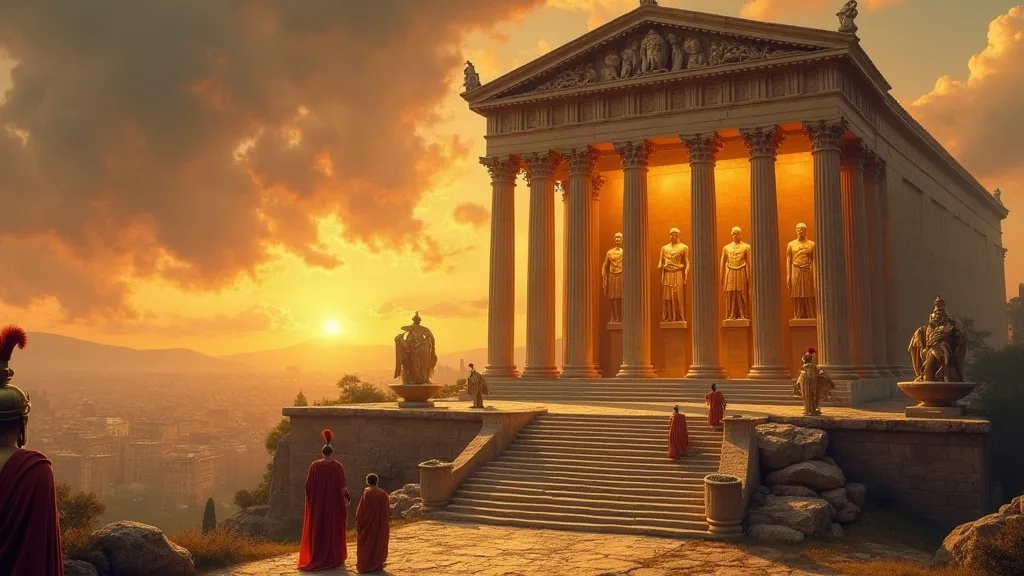
The hill rose above the city like a clenched fist. At its crown stood a temple so massive its terracotta roof tiles weighed tons, and its columns could be seen from the Tiber on a clear day. Inside, three gilded cult statues shared a single podium: a king of thunder on a throne of ivory, a queen of heaven on his left, a warrior goddess of wisdom on his right. Rome did not simply worship three separate gods. Rome worshipped a unit.
The Capitoline Triad: Jupiter, Juno, and Minerva formed the spiritual backbone of Roman state religion for roughly nine centuries. Every Roman general who won a triumph climbed the steps of their shared temple on the Capitoline Hill to offer thanks. Every treaty was sealed in their name. Every new colony founded in Roman territory built a smaller version of their sanctuary, stamping Rome's authority into foreign soil. To understand this triad is to understand why Roman religion was, above all else, a technology of power.
Who Built the Capitoline Temple and Why
The temple had a name Romans said with reverence: the Templum Iovis Optimi Maximi, the Temple of Jupiter Best and Greatest. Ancient tradition, recorded by the historian Livy in his Ab Urbe Condita (written around 27 BC, though drawing on far older records), placed its founding vow with the Etruscan king Tarquinius Priscus in the early sixth century BC. His successor Tarquinius Superbus reportedly began construction, but it was the early Roman Republic that consecrated it in 509 BC, the very year Rome expelled its last king.
That date was not accidental. The Romans used the temple's dedication to mark the birth of republican government. The gods and the state launched together.
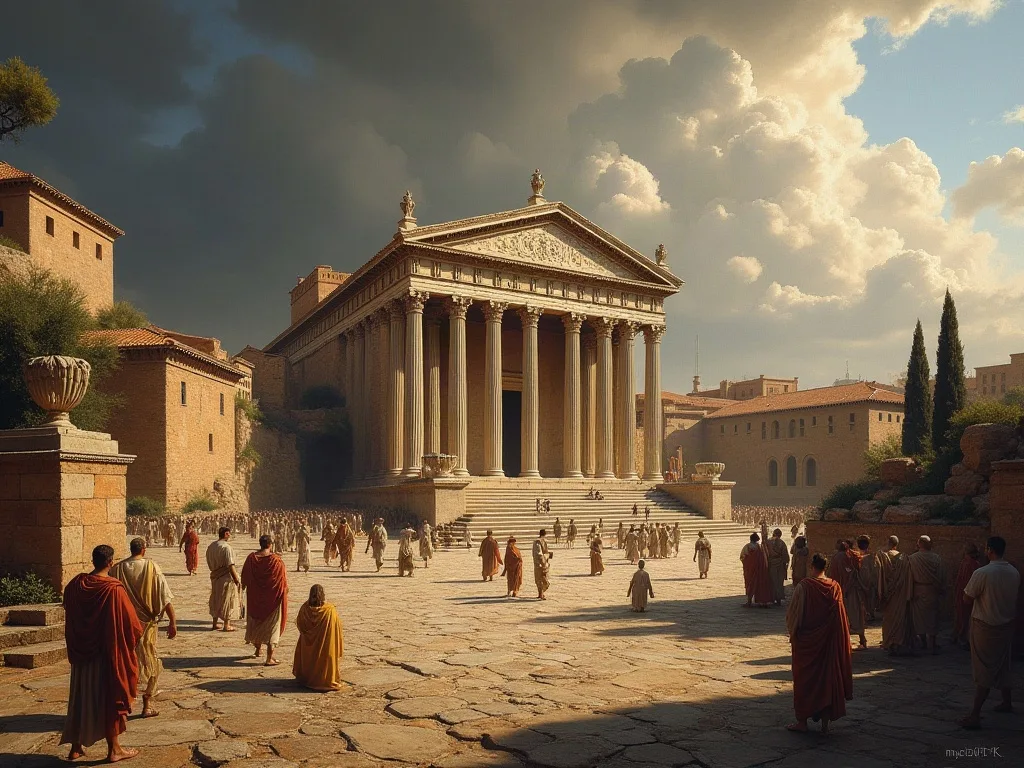
The structure that rose on the Capitoline was Etruscan in style, not Greek: a wide, low podium with three parallel cellas, or inner rooms, one for each deity. Jupiter occupied the central cella, the largest and most prominent. Juno Regina (Juno the Queen) held the left cella. Minerva stood to the right. This arrangement was not incidental. Position in Roman ritual space was loaded with meaning. Jupiter's centrality announced the hierarchy: he led, the others flanked him, and together they enclosed Roman power in a single architectural body.
Archaeologists excavating the Capitoline since the nineteenth century have confirmed the temple's extraordinary scale. The podium measured roughly 53 by 63 metres, making it one of the largest temple platforms in the ancient world at that date. The historian Dionysius of Halicarnassus, a Greek writing in Rome around 7 BC, called it "the most beautiful and the largest of all temples in Rome."
Jupiter: The Sky King Who Made Promises Binding
Jupiter carried more weight than any other Roman god. His name derives from the Proto-Indo-European root Dyeus Phter, meaning "sky father," a linguistic connection he shares with the Greek Zeus Pater and the Vedic Dyaus Pita. That shared ancestry matters: it shows Jupiter was not a Roman invention but the local expression of an ancient Indo-European divine king, one who commanded thunder, lightning, and the canopy of heaven.
In Roman practice, Jupiter's authority extended beyond weather. He was the guardian of oaths (Iuppiter Fidius), the protector of boundaries (Iuppiter Terminus in combination with the boundary god Terminus), and the divine patron of the Roman state itself. When a consul swore an oath of office, he swore it to Jupiter. When Rome made a treaty, an official called the fetialis would call on Jupiter as witness, striking a sacred pig with a flint stone while declaring that Rome would be struck in the same way if it broke its word.
The Romans had a word for this sworn relationship: fides, meaning trust, good faith, reliability. Jupiter was its divine anchor. He did not merely punish oath-breakers; his presence made the oath real in the first place.
On the Capitoline, Jupiter's cult statue showed him seated on an ivory throne, holding a thunderbolt in one hand and a scepter in the other. On the day of a triumph, the victorious general was dressed in Jupiter's own ceremonial garments, borrowed from the cult statue for the occasion. His face was painted red to resemble the god's. For a few hours, the general became Jupiter, walking through Rome as the city's divine protector made flesh. That ritual detail tells you everything about how Romans understood the relationship between divine and political authority.
Juno: Queen, Protector, and the Feminine Power of Rome
If Jupiter held the sky, Juno held the time. She governed the calendar's pulse. Her name attached to the month of June (Iunius), and the Kalends, or first day of every month, was sacred to her. Roman women prayed to Juno at every significant threshold: marriage (Iuno Pronuba), childbirth (Iuno Lucina), and the full span of a woman's life (Iuno as each woman's personal divine double, called her Iuno the way each man had his Genius).
She was also a war goddess. Juno Regina, the aspect housed in the Capitoline temple, was specifically the Queen who protected Rome's military sovereignty. Romans believed that Juno could shift her allegiance if offended, and the story of the Gallic sack of Rome in 390 BC was told partly as a consequence of neglected Junonian rites.
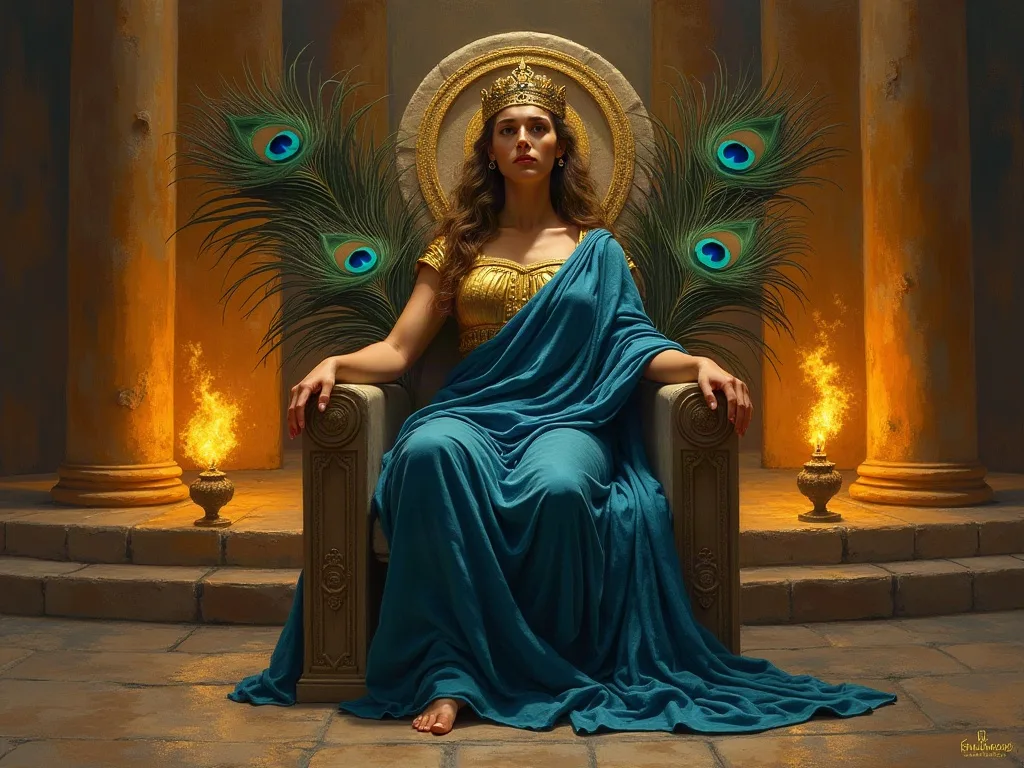
Juno's relationship with Jupiter was complicated. The ancient sources, including Ovid's Fasti (a poetic calendar of Roman religious festivals written around 8 AD) and the Homeric tradition that influenced Roman literature, portrayed their marriage as stormy, competitive, and sometimes bitter. But this domestic drama, borrowed heavily from the Greek portrait of Zeus and Hera, sat uneasily with the Roman Juno's real character. The Roman Juno was less a jealous wife than a sovereign in her own right. She was worshipped independently at shrines across Latium long before the Capitoline temple formalised her pairing with Jupiter.
Her most politically charged myth in Roman tradition was the evocatio of Juno Regina from the Etruscan city of Veii. Around 396 BC, the Roman general Camillus besieged Veii after a ten-year war. Before the city fell, Roman priests performed an evocatio, a ritual inviting Juno to leave Veii and come to Rome, promising her a great temple in the new city. Livy reports that a soldier asked Juno's statue, with some boldness, whether she wanted to move to Rome, and the statue nodded its head. Juno came. A temple on the Aventine Hill was built for her. The act was a kind of divine kidnapping with consent, and it was the supreme statement of Roman confidence: even another city's gods would choose Rome.
You can read more about how Roman gods absorbed and transformed their predecessors in the broader mythology tradition from which the Capitoline Triad emerged.
Minerva: The Goddess Who Brought Rome Its Sharpest Tool
Minerva is the most intellectually precise of the three. Her domain covered craft, skill, strategic intelligence, and all forms of knowledge that could be turned to practical use. Artisans, poets, schoolteachers, physicians, and military strategists all claimed her patronage. Her festival, the Quinquatria, ran for five days in March and was celebrated with particular intensity by craftsmen and students, who paid their teachers on those days.
She was not originally a Greek import. Scholars including William Warde Fowler (in his 1911 The Religious Experience of the Roman People) and more recent classicists have argued that Minerva descended from an Etruscan goddess named Menrva, herself possibly connected to a broader Italic tradition. The Etruscans had their own triad: Tinia (sky god), Uni (queen goddess), and Menrva, which maps almost exactly onto the Capitoline grouping. This parallel is the strongest evidence that the Capitoline Triad drew on Etruscan religious architecture, not simply on Roman political invention.
Minerva's helmet and spear placed her in the same visual register as the Greek Athena, and Roman poets such as Ovid freely blended the two. But Minerva's Roman character was earthier, more practical. She did not fight wars for abstract justice; she gave soldiers better tactics and smiths better tools. When Ovid listed her powers in the Fasti, he named weaving, music, medicine, and the making of weapons in the same breath, all facets of the same godly competence: the ability to make things work.
Inside the Capitoline temple, her cella stood to Jupiter's right, the position of the trusted advisor. That spatial arrangement was quietly eloquent. Jupiter commanded. Minerva refined the command into strategy.
How the Triad Functioned as a State Religion
Roman religion was not primarily a matter of personal belief. It was a system of do ut des, "I give so that you may give," a reciprocal contract between the Roman people and their gods. The Capitoline Triad sat at the top of that contract hierarchy.
Specific rituals tied the state to the triad throughout the year:
- The ludi Romani (Roman Games, held in September) were dedicated to Jupiter, but the triad's temple was the focal point of the procession that opened them.
- The Ides of March (the fifteenth) carried double significance as the date of the Equirria horse races dedicated to Mars, but also as a day tied to the Capitoline complex.
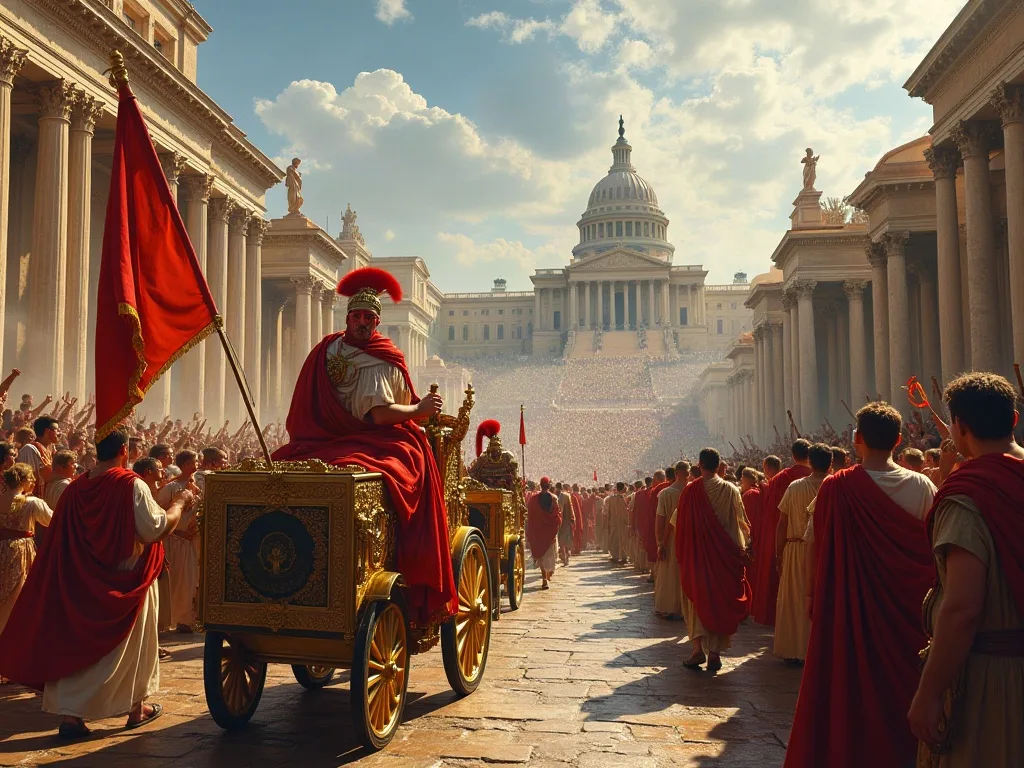
- Every Roman triumph ended at the Capitoline. The general climbed the hill on foot, wearing Jupiter's garments, and deposited his laurel wreath at the feet of the cult statue. No triumph was complete without that final gesture of submission to divine authority.
The triad also functioned as a constitutional symbol. When Rome established a colony, one of the first structures built was a Capitolium, a miniature copy of the Capitoline temple housing the same three gods. This architectural franchise spread Roman religious authority across the empire in a way that was immediately legible to every Roman soldier or administrator who arrived in a new city. The gods were already there, ready for business.
Dozens of these colonial Capitolia have been excavated, from Cosa in Etruria (founded 273 BC) to Volubilis in modern Morocco to Timgad in modern Algeria. The triad's reach was physically encoded in stone across three continents.
The Triad Against the Background of Greek Influence
The Greek Capitoline Triad parallel is unavoidable, and scholars have debated it since at least the Renaissance. The Greek pantheon did not organise itself into official triads the same way. Zeus, Hera, and Athena were closely related, but no single Greek city consecrated a triple-cella temple to all three as a constitutional act.
The Roman arrangement was more purposeful. It was a political theology: three divine powers covering sky-sovereignty, civic fertility, and skilled intelligence, assembled not by mythological accident but by deliberate institutional design. The Roman scholar Marcus Terentius Varro, writing in the first century BC (his work Antiquitates Rerum Divinarum survives only in fragments quoted by the Christian author Augustine of Hippo), categorised Roman religion into three types: mythological, natural, and civic. The Capitoline Triad was the supreme example of civic religion, gods in service to the res publica, the public thing.
This is also why the triad had almost no mythology of its own. The stories, the romances, the conflicts that fill Ovid's Metamorphoses or Virgil's Aeneid belonged to Jupiter, Juno, and Minerva as literary figures, heavily coloured by their Greek counterparts. The Capitoline cult statues, by contrast, received no bedtime stories. They received offerings, incense, sacrificial animals, and treaties. Their purpose was governmental, not narrative.
The contrast becomes sharp when you compare the Capitoline Triad with the Olympian gods of the Greek tradition: where the Olympians generated myths that explained the cosmos, the Capitoline three legitimised the city.
The Temple's Destruction, Rebuilding, and Long Memory
The original temple burned in 83 BC during the civil wars that tore the late Roman Republic apart. Romans treated the fire as a catastrophe on the same level as a major military defeat. The sacred objects inside, including the Sibylline Books (prophetic texts consulted during national emergencies), were either saved or lost depending on which source you read.
The temple was rebuilt by the dictator Sulla, then rebuilt again by Augustus, then again by the Flavian emperor Vespasian after another fire in 69 AD, and once more by Domitian after yet another blaze in 80 AD. Domitian's version, completed around 82 AD, was coated in gilded bronze roof tiles and reportedly cost 12,000 talents of gold, a figure the historian Plutarch found almost unbelievable. Each reconstruction followed the same footprint and the same tripartite plan. The Romans were not rebuilding a building; they were reinstating a constitutional fact.
By the fourth century AD, as Christianity spread through the empire, the Capitoline complex faced a different kind of threat. The emperor Theodosius I in 391 AD banned pagan sacrifice throughout the empire, which effectively ended the temple's religious function. The last recorded restoration attempt came under the usurper Eugenius in 392-394 AD, who briefly revived traditional pagan rites before his defeat by Theodosius.
The temple itself fell into disuse and gradual ruin through the fifth and sixth centuries. By the medieval period, the Capitoline Hill had become a grazing ground for cattle, called the Monte Caprino, or Goat Hill. The cult statues were gone. The gold tiles were stripped. But the hill's name, and the memory of what had stood there, never left Rome's geography or its imagination.
The Capitoline Triad in the Modern Imagination
The triad's afterlife in Western culture is longer than its active religious life. Renaissance humanists rediscovered Varro's theological categories and used the Capitoline model to argue that the papacy had inherited Rome's sacred geography: the Vatican, like the old Capitoline, sat on high ground overlooking the city's political centre. Whether that parallel was polemical or flattering depended entirely on who was making it.
The word "Capitol" in English comes directly from the Capitoline Hill. The United States Capitol building in Washington D.C., the many state capitol buildings across America, and the word "capital" as used for a nation's governing city all carry this etymology. Every time a senator walks into a Capitol rotunda, they walk through a name the Romans gave to the hill where Jupiter, Juno, and Minerva once received a triumphant general's laurels.
The triad also left marks on art. Giovanni da Bologna's 1576 bronze group of the three deities for the Boboli Gardens in Florence, Annibale Carracci's ceiling frescoes in the Farnese Palace in Rome, and dozens of early modern allegories of Justice, Wisdom, and Power drew on the Capitoline iconography without always naming it. The shorthand was legible to any educated European for centuries: a thunderbolt, an owl, a peacock feather, and you knew exactly which three divine figures were being invoked.
The Roman mythological tradition continued shaping European imagination long after the last pagan priest left the Capitoline, carrying the triad's symbolic grammar into philosophy, heraldry, and eventually the architectural vocabulary of modern democracy.
Frequently Asked Questions About the Capitoline Triad
Frequently asked questions
Why were Jupiter, Juno, and Minerva chosen for the Capitoline Triad instead of other Roman gods?
The grouping likely reflected the Etruscan religious model the early Romans inherited, where the triad of Tinia, Uni, and Menrva already held supreme status. Jupiter covered cosmic authority and oaths, Juno covered civic fertility and queenly protection, and Minerva covered skilled craft and strategic intelligence. Together they represented the three qualities Rome most needed to institutionalise: power, legitimacy, and competence. Mars, the god of war, was extremely important to Rome but was not a guarantor of civil order in the same way.
Was the Capitoline Triad the same as the Greek divine triad of Zeus, Hera, and Athena?
They share obvious parallels and Roman poets freely identified the pairs, but the Capitoline Triad served a distinct civic function. Greek religion had no equivalent of the triple-cella state temple consecrated as a constitutional act at the founding of a republic. The Roman triad was a governmental institution first and a mythological family second. Varro distinguished this carefully in his first-century BC theological writings, preserved in fragments by Augustine of Hippo.
What happened to the Capitoline Temple after Rome became Christian?
The emperor Theodosius I banned pagan sacrifice in 391 AD, ending the temple's active religious life. The building decayed through the fifth and sixth centuries as its materials were stripped for reuse elsewhere. By the medieval period the Capitoline Hill had become agricultural land. No physical trace of the temple superstructure survives above ground today, though the massive podium foundations have been confirmed by archaeological work since the nineteenth century beneath the Palazzo dei Senatori.
What was the ritual of the Roman triumph, and how did the Capitoline Triad fit into it?
A Roman triumph was the state's highest military honour. The victorious general entered Rome through the Porta Triumphalis, processed through the city in a chariot, and climbed the Capitoline Hill on foot to the temple of Jupiter Optimus Maximus. There he deposited his laurel wreath at the cult statue's feet. During the procession, the general wore Jupiter's own ceremonial costume and had his face painted red, temporarily embodying the god. The climb and the wreath-offering completed the ritual by returning that divine authority to its proper owner.
How did the Capitoline Triad spread across the Roman Empire?
Every Roman colony was expected to build a Capitolium, a scaled-down version of the Capitoline temple, to house the same three deities. This architectural requirement, confirmed by inscriptions and by the physical remains of dozens of colonial Capitolia, made the triad a universal marker of Roman civic identity. Capitolia have been excavated as far west as Spain and as far east as the Levant, with notable examples at Cosa (Etruria), Thugga (Tunisia), and Timgad (Algeria).
What is the connection between the Capitoline Hill and the word 'Capitol' today?
The Latin Capitolium referred specifically to Rome's sacred hill and the temple complex atop it. The word entered medieval Latin as a general term for a chief city or governing seat, eventually producing the French capitale and the English "capital." When the founders of the United States named their legislative building the "Capitol," they were consciously invoking the Roman precedent: a hilltop seat of civic authority sanctioned by something greater than any individual ruler.
What the Triad Tells Us About Roman Power and Sacred Space
The most honest way to read the Capitoline Triad is as a mirror. It reflected back to Romans exactly what they wanted to believe about themselves: that their city had divine permission to rule, that its authority rested on cosmic order rather than mere force, and that its leaders operated under divine scrutiny.
This is why the temple had to be rebuilt after every fire, at whatever cost. A destroyed Capitolium was not just an architectural loss; it was a crack in the state's theological self-image. Vespasian, clearing the rubble after the civil war of 69 AD, reportedly joined in the work himself, carrying the first basketful of debris away by hand. That gesture was political theatre, but it was also a genuine statement about what the temple meant. The triad's house was the Republic and Empire made solid in limestone and gold leaf.
Scholars including Mary Beard (in her 2015 book SPQR) and Jörg Rüpke (in his 2007 Religion of the Romans) have emphasised that Roman religion was fundamentally about correct practice rather than correct belief. The Capitoline Triad embodied that principle completely. Romans did not need to agree about Jupiter's precise nature or Minerva's biography. They needed to show up, offer the right sacrifice at the right time, and trust that the gods were holding up their end of the contract. The triad asked nothing more theological than that, and it held Rome's sacred centre for five hundred years of republic and another five centuries of empire, a record of institutional endurance that few religious structures in human history can match.
Free 25-page sample
Want the whole story?
Take the first 25 pages free. If it pulls you in, the full edition is yours as an instant PDF download, with a paperback on Amazon for selected titles.
Roman
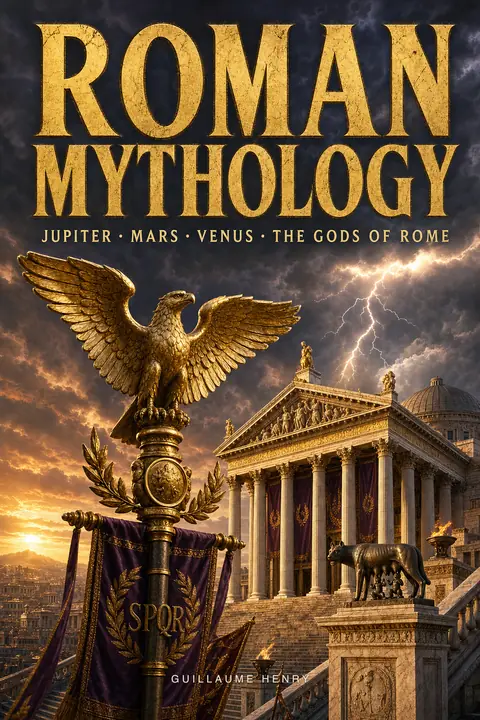
The Roman Mythology Book: Jupiter, Mars, Venus, the Aeneid, and the Sacred Stories That Built an Empire
Jupiter, Mars, Venus, the Aeneid, and the Sacred Stories That Built an Empire
The complete guide to Roman mythology from Virgil's Aeneid to Ovid's Fasti. Every god, every founding myth, every Vestal rite.
More from Roman
All articles
Roman
Romulus and Remus: The Myth of Rome's Foundation
The twin sons of Mars raised by a she-wolf; a fratricide, a city, and an empire. How Rome's founding myth shaped the identity of Western civilization's greatest power.
Roman
Aeneas and the Founding of Rome: The Aeneid's Sacred Narrative
Virgil's Aeneas carries Troy's fate to Italy, writing Rome's origin in blood and duty. Discover how the Aeneid transformed a hero's journey into a nation's sacred story.

Roman
Venus: Goddess of Love and Ancestor of the Roman People
Venus was Rome's goddess of love, fertility, and military victory. But she was also the divine ancestor of the Roman people through her son Aeneas. Discover how this single goddess embodied Rome's most powerful myths about its own origins.
Roman
Mars: Roman God of War, Agriculture, and the Father of Rome
Mars was no mere god of bloodlust. The Roman war god fathered Romulus, blessed the harvest, and embodied the discipline that built an empire. Discover how Rome's greatest god shaped both sword and soil.