
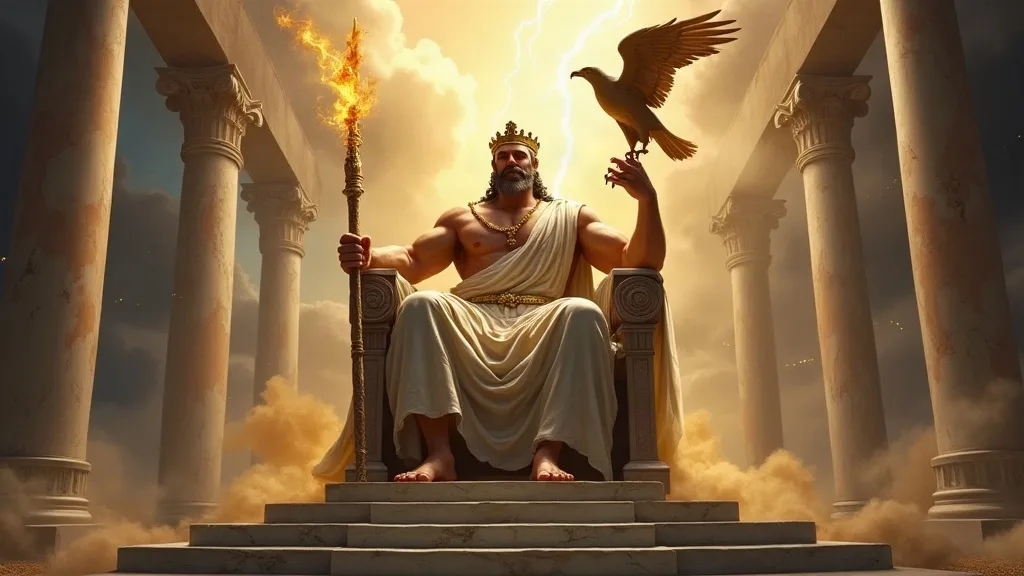
Jupiter: King of the Roman Gods and God of Sky and Thunder
Jupiter ruled the Roman pantheon as king of gods, master of the sky and thunder. Discover how Rome's greatest deity evolved from an ancient weather god into the cosmic sovereign whose word shaped empires, wars, and fates.
Contents
High above Rome, in a bronze-roofed temple on the Capitoline Hill, an image of Jupiter sat in eternal judgment. His right hand gripped a thunderbolt. His left held a staff crowned with an eagle. For over a thousand years, this god did not merely receive prayers; he validated Roman power itself. When generals won battles, they credited Jupiter. When the state faced crisis, priests consulted his signs in bird flight and thunder. He was not a god who whispered secrets or demanded introspection. He was the sovereign of weather, fate, law, and empire, and every Roman knew it.
Jupiter: King of the Roman Gods and God of Sky and Thunder was not born fully formed in Roman religion. He evolved from a much older sky deity, merged with Greek Zeus, absorbed influences from Etruscan religion, and became something uniquely Roman: a god whose authority rested not on myth alone but on state ritual, military success, and legal order. To understand Jupiter is to understand how Rome translated divine power into earthly governance.
The Ancient Root: From Sky God to King
Jupiter's name comes from the Latin Iuppiter, which scholars trace back to the Indo-European root dyeu, meaning "sky" or "bright sky." The same root appears in Greek Zeus, in Sanskrit Dyaus, and in Old Norse Tyr. Before Rome had an empire or even a republic, before the city existed, the people who would become Romans spoke of a bright sky god who controlled weather, crops, and the seasons.
In the earliest Italian tradition, Jupiter was a storm deity. Farmers prayed to him for rain during drought. Warriors called on him before battle. He was not yet the elaborate, anthropomorphic god of later literature. He was the sound of thunder, the flash of lightning, the unpredictable force of the sky. Priests read his will in how birds flew, in the pattern of lightning strikes, and in the entrails of sacrificed animals. These signs were called auspices, and Jupiter's signs were the most powerful.
What made Jupiter different from other weather gods was the Roman way of binding him to political order. Around the 6th century BCE, as Rome moved toward its monarchy and later republic, the Etruscans (a civilization north of Rome with their own strong religious traditions) influenced Roman cult. They worshipped a triad of gods on high ground: Tinia, Uni, and Menrva. When Rome rebuilt the temple on the Capitoline Hill (the Capitolium), it too housed a triad: Jupiter, his wife Juno, and Minerva. Jupiter occupied the central, highest position. The placement was deliberate. A king sat on a high seat. A god of gods should sit higher still.
The Merger with Zeus: From Italian Sky God to Cosmic King
When Romans encountered Greek civilization, they did not abandon Jupiter. Instead, they grafted onto him the elaborate mythology of the Greek Zeus. The process happened gradually over centuries. Greek merchants brought their stories. Roman writers studied Greek texts. Soldiers returned from the Hellenistic East with new ideas.
Zeus, in Greek myth, was not merely a sky god. He was the king of Olympus, the father of gods and men. He had overthrown the Titans. He had won the cosmos in a lottery of dice throws. He seduced mortal women and produced heroes. He was passionate, jealous, and bound by fate itself. The Romans took this entire mythology and made it Jupiter's.
The result was a hybrid. Jupiter inherited Zeus's supremacy and his love affairs (Roman writers told of Jupiter's conquest of women with the same breezy irreverence as the Greeks). But Jupiter was also distinctly Roman. Where Zeus was bound by fate and lived in mythological time, Jupiter was bound by law and ritual, and he lived in the continuous present of Roman state religion. When a Roman general won a victory, he did not tell a story about Jupiter the lover. He offered a sacrifice and read Jupiter's signs to confirm the gods approved his action.
This is the fundamental difference. Greek religion was mythological. Romans inherited Greek myths but built their religion on ritual and political legitimacy. Zeus was a character in stories. Jupiter was a partner in governance.
The Attributes: Thunder, Justice, and the Eagle
Over centuries, Jupiter accumulated symbols and domains. He was god of the sky and thunder, yes. But he was also god of justice, law, and the state. He was god of oaths (broken oaths brought his lightning). He was god of hospitality and guests. He was god of the military victory. An eagle was his sacred animal. In art, he always carried the thunderbolt (fulmen), a weapon of absolute authority.
The thunderbolt itself became central to Jupiter's identity in a way it never quite was for Zeus. Roman writers and sculptors emphasized it. When a thunderbolt struck the city, it was not random weather; it was Jupiter's judgment. If it hit a house, the house was considered accursed. If it hit during a religious ceremony, the ceremony had to be restarted (the gods had rejected it the first time). Every thunderstorm was a conversation with Jupiter, and the Romans were extremely attentive listeners.
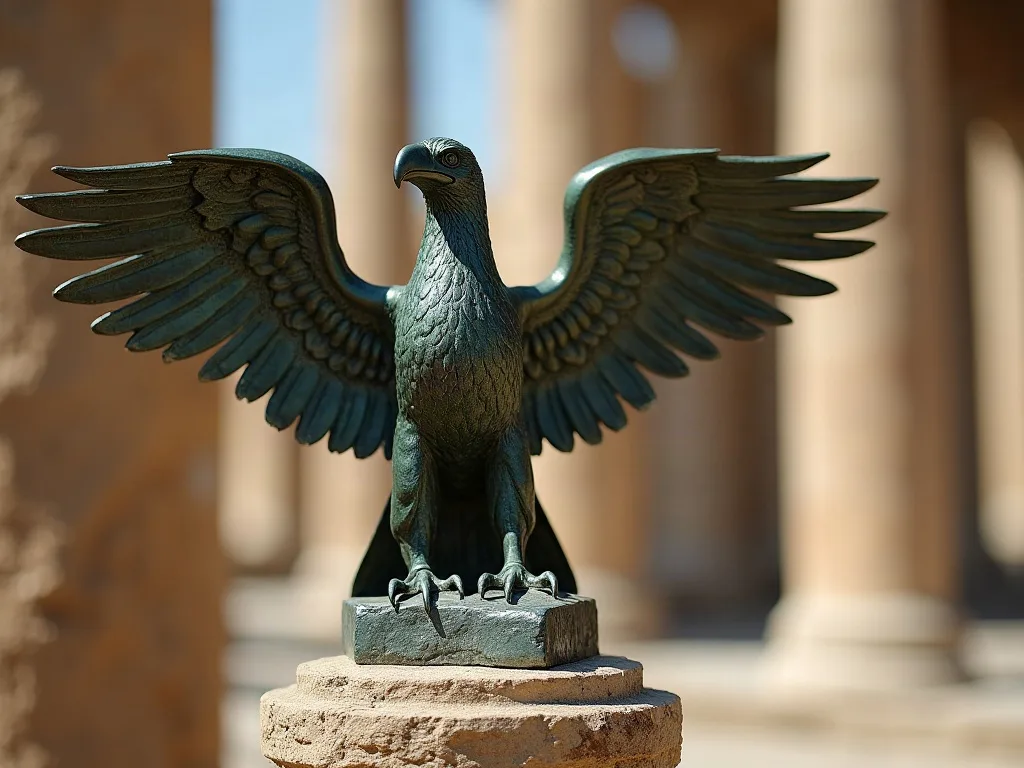
The eagle (aquila) was equally laden with meaning. Eagles hunted from the sky. They moved with purpose and certainty. The Roman army's standard, the aquila, was an eagle made of gold or silver on a pole. Soldiers treated it with reverence approaching religious awe. To lose your army's eagle in battle was unspeakable shame. To recover it was honor. The eagle connected Jupiter directly to military power, to Roman dominion, to the idea that Rome's victories came because Jupiter willed them.
The Romans also associated Jupiter with the thunderstone. When lightning struck, it sometimes fused sand into a glass-like formation. These stones were called fulgurites and were treated as sacred objects. A priest called the rex sacrorum (king of sacred things) was responsible for proper handling of anything related to Jupiter's lightning. The role existed to keep the boundary between divine and human strictly maintained.
The Capitoline Temple: Where Jupiter Ruled Rome
The most important temple of Jupiter stood on the Capitoline Hill, one of Rome's seven hills. The Capitolium (from which the word "Capitol" derives) was not just a religious building. It was the political and spiritual center of the Roman state. This is where generals brought their victories for ratification. This is where the Senate met at times of crisis. This is where Jupiter's priests (the pontiffs) determined whether the gods approved a proposed action.
The temple was massive, with a bronze roof visible from the city streets. Inside, a seated statue of Jupiter looked down on visitors. In his right hand was the thunderbolt. In his left was a staff or orb representing sovereignty over the world. The statue was made of ivory and gold and was believed to be the most accurate representation of the god that existed.
Once a year, on the Ides of September (September 13), Rome celebrated Jupiter's festival, the Ludi Romani (Roman Games). Originally a single day, it expanded over time into a week or more of ceremonies, sacrifices, processions, and theatrical performances. The festival was not merely religious ceremony; it was a statement of the city's continuity and order. So long as Jupiter received his proper honors, so the Romans believed, the city would endure.
Jupiter's Many Forms and Domains
Because Jupiter represented so many aspects of Roman authority, he accumulated epithets and specialized forms. Jupiter Optimus Maximus meant "Jupiter Best and Greatest." This was his supreme title, used when calling on him in his role as guardian of the state. Jupiter Capitolinus was Jupiter of the Capitol. Jupiter Stator was the form invoked to halt an army in retreat. Jupiter Victor was called upon for military victory. Jupiter Libertas protected freedom. The list could extend to dozens.
Each form had a different shrine, a different priest, different ritual practices. Yet they were all manifestations of a single god. This flexibility was distinctly Roman. Where a Greek might treat Helios and Apollo as separate entities with separate mythologies, Romans could invoke Jupiter in multiple modes without contradiction. He was one god expressing many aspects of cosmic and civic authority.
Jupiter was also the god of oaths. A Roman who swore an oath called on Jupiter as witness. Breaking an oath brought Jupiter's wrath, often in the form of lightning. This made Jupiter intimately involved in daily Roman life. Every contract, every treaty, every legal proceeding invoked his presence. The oath-taking ceremony was not theater; it was Jupiter entering the transaction as a party to it.
Jupiter and the Republic: Sign-Reading and Political Will
In the Republic (roughly 509 BCE to 27 BCE), Jupiter's priests played crucial political roles. Before any major decision, declaring war, passing a law, holding an election, priests called augurs would consult Jupiter's signs. They would watch the sky for birds and their flight patterns, listen for thunder, and interpret the results.
This was not superstition in the Roman mind. It was a rational political mechanism. An augur who wanted to block a proposal could claim bad auspices; an augur who wanted to support it could declare good auspices. The system allowed veto power without requiring open political disagreement. It was also, from a practical standpoint, a brake on hasty action. If you wanted to declare war immediately, you had to first obtain favorable auspices, which might take days or weeks. This delay could be enough to change minds or for diplomacy to succeed.
The most famous instance came in 63 BCE. The orator Cicero wanted to expel the conspiracy of Catiline from Rome, but his opponent, a tribune named Metellus, used his own auspices to block the vote. Cicero had to wait for Metellus's term to end before proceeding. Jupiter's signs had effectively created a pause in the political process.
By the late Republic, everyone understood that the auspices were a tool. Yet Romans were unwilling to abandon the fiction that Jupiter actually communicated through them. The system worked because it was believed to work. As long as the ritual was observed correctly, Jupiter's approval was considered genuine. In politics, sometimes the map is the territory.
Jupiter and the Empire: Validator of Imperial Authority
When Caesar Augustus became the first emperor of Rome around 27 BCE, he could not simply declare himself king. Romans despised kings; they had driven out their last king 400 years earlier. Instead, Augustus claimed to have accepted an extraordinary grant of power from the Senate and people of Rome. He ruled not as king but as princeps (first citizen) and as pater patriae (father of the nation).
The legitimacy of this claim rested heavily on Jupiter. Coins minted in Augustus's reign showed Jupiter on one side and Augustus on the other, visually linking the two. When Augustus won battles, priests sacrificed to Jupiter in thanksgiving. When an heir was born to Augustus's family, it was celebrated as Jupiter's blessing on the dynasty. The message was clear: Jupiter approved the new order.
Later emperors reinforced this connection. Domitian, an emperor often remembered for cruelty, particularly emphasized his relationship with Jupiter. He referred to himself as the earthly representative of Jupiter's will. This was not unique to Rome; many ancient societies used such language. But Romans took it further. They created a theological justification for absolute rule: the emperor rules because Jupiter wills it, and Jupiter's will is revealed through the emperor's success.
This created a problem when an emperor lost battles or the city faced plague or famine. If Jupiter wills the emperor's success, what does it mean when the emperor fails? The Romans had an answer: the emperor must have displeased Jupiter. Perhaps through error in ritual, perhaps through moral failing. The solution was either reform or assassination. Remarkably, this theological framework often functioned as a check on power. An emperor whose failures suggested he had lost Jupiter's favor might face conspiracy and death.
Jupiter in Love: The Myths Romans Inherited
Because Romans adopted Greek mythology wholesale, they inherited Zeus's elaborate love life and applied it to Jupiter. These stories were told with gusto in Roman literature, especially in Ovid's Metamorphoses, a long poem written in the early 1st century CE that catalogs Jupiter's many conquests.
Jupiter seduced the mortal woman Leda by transforming into a swan. He became a golden shower to seduce Danae. He took the form of a white bull to seduce the princess Europa. These stories served purposes beyond entertainment. They explained the origin of heroes. Hercules (Latin name for Heracles) was the half-mortal son of Jupiter, a hero of extraordinary strength. Minos, the legendary king of Crete, was also Jupiter's son. By claiming descent from Jupiter, royal families and hero-cults traced their authority back to the god himself.
But here is the interesting part: Romans told these myths, but they did not build their religious practice around them. The state religion of Jupiter was almost entirely separate from his mythological love affairs. A Roman general did not invoke Jupiter's affair with Danae when preparing for battle. He did not make an offering to Jupiter as god of seduction. The myths were part of culture, part of literature, part of how educated Romans understood the divine world. But they were not part of formal state religion.
This separation is crucial to understanding Roman religion overall. Mythology was entertainment and education. Ritual was governance. The two existed in the same tradition but served different functions.
Jupiter, Fate, and Cosmic Order
One more layer complicate Jupiter's identity. The Greeks taught that even Zeus was subject to moira (fate). The Fates, three women who spun, measured, and cut the thread of life, controlled even the king of gods. Fate was older and stronger than any individual god.
Romans adopted this idea but struggled with it. How could Jupiter be supreme if he was subject to fate? Some philosophical schools resolved this by arguing that Jupiter was fate, or that he administered fate on behalf of the universe. Others accepted the paradox: Jupiter was king but bound by cosmic law, just as a Roman magistrate was powerful but bound by law.
This paradox appears in Roman literature. Virgil, in the Aeneid (an epic poem about Rome's legendary founder), shows Jupiter and Juno in conflict. Juno opposes the founding of Rome. Jupiter supports it. But even Jupiter cannot simply overrule fate. He must allow events to unfold according to destiny, while working through providence to ensure the outcome favors Rome. The tension between Jupiter's will and fate becomes the engine of the narrative.
This view made Jupiter less of an arbitrary tyrant and more of a administrator of cosmic law. A Roman could accept Jupiter's authority not because he was all-powerful but because he represented the order of the universe itself.
Jupiter's Afterlife: From Ancient Rome to Modernity
When Christianity became the official religion of the Roman Empire in the late 4th century, pagan temples were closed and pagan worship was suppressed. Jupiter's Capitoline temple fell into disrepair. The great statue was destroyed or removed. The rituals that had sustained Jupiter's worship for a thousand years ceased.
Yet Jupiter did not vanish entirely. His mythology lived on in literature, in art, in the classical education of medieval and Renaissance scholars. When Renaissance thinkers rediscovered Roman texts, they encountered Jupiter anew. Artists painted him. Poets invoked his name metaphorically. Astronomers named the largest planet in the solar system after him (a naming convention that honored the god as king, since Jupiter is the brightest and most massive of the visible planets).
In modern culture, Jupiter appears primarily through mythology and art. His name is invoked for authority and power (the "Jupiter grant" in science, the character Jupiter in fantasy novels). His image adorns government buildings and law courts, where his association with justice remains symbolically relevant. He has become what he was not in ancient Rome: a figure of culture and imagination rather than active worship.
Yet in the imagination he remains what he was: a king, a lawgiver, a wielder of thunderbolts, a god whose authority spans heaven and earth.
Frequently asked questions about Jupiter and Roman religion?
Frequently asked questions
How did Jupiter differ from the Greek god Zeus?
Jupiter was Zeus, but adapted to Roman culture. Romans inherited Greek mythology about Zeus and applied it to Jupiter, but they separated myth from political religion. While Greeks told stories about Zeus, Romans built a whole system of state governance around Jupiter's supposed approval (through auspices). Jupiter was also more legalistic and tied to Roman civic order, where Zeus was more mythological and tied to Olympian drama. Both were sky kings, but Jupiter was also a constitutional principle.
What were the auspices and how did they work?
Auspices were signs from Jupiter that priests called augurs interpreted to determine if the gods approved an action. Before declaring war or holding an election, officials would consult augurs. The augurs would watch for birds, listen for thunder, or examine animal entrails, then claim either favorable or unfavorable auspices. This was partly genuine belief and partly political mechanism: it allowed people to delay decisions, block proposals, or legitimize actions through appeal to divine will. The system worked because everyone treated it as real.
Did the Romans believe Jupiter was a real being who answered prayers?
Yes, though with nuance. Educated Romans like philosophers understood Jupiter as a principle or cosmic force. Ordinary people prayed to Jupiter for rain, success in business, protection in war. Most Romans held both views at once: Jupiter was both a literal being who could intervene and a divine principle governing the universe. The key was that Jupiter was never distant or abstract. His presence was felt in weather, in political outcomes, in military success or failure. Romans expected him to communicate through signs and to respond to proper ritual and sacrifice.
Why did Romans have so many versions of Jupiter (Capitolinus, Victor, Optimus Maximus, etc.)?
Each version of Jupiter represented a specialized function or location. Jupiter Capitolinus was Jupiter of the Capitol temple. Jupiter Victor was called upon for military victory. Jupiter Optimus Maximus was his supreme, universal form. This was not inconsistency; it was sophistication. Romans understood Jupiter as one god expressing many aspects of authority. It allowed flexible invocation: you could call on the specific form of Jupiter most relevant to your need while honoring the god as a whole. Modern parallels might be different titles or roles a person holds in different contexts, but all expressing one underlying identity.
How did Jupiter's importance change from the Republic to the Empire?
In the Republic, Jupiter's priests (augurs) held significant political power through their control of auspices. They could block decisions by claiming bad signs. In the Empire, emperors took control of Jupiter's religious authority. Emperors themselves became the chief interpreter of Jupiter's will. Coins and art linked emperors directly to Jupiter, suggesting divine approval of imperial rule. Jupiter remained Rome's supreme god, but the real power over his interpretation shifted from an independent priestly class to the emperor and his appointed priests.
Jupiter Beneath the Surface: Continuity, Adaptation, and Modern Authority
What makes Jupiter's story remarkable is not its uniqueness but its durability. A sky god worshipped by Indo-European peoples thousands of years before Rome existed was transformed through Etruscan influence, then through Greek influence, then adapted to republican governance, then to absolute empire. Each time, Jupiter remained Jupiter. Each time, the core function remained: Jupiter is supreme authority, lawgiver, orderer of the cosmos.
This pattern teaches something about how religions adapt. They do not usually disappear when conquered or transformed. They persist by absorbing new meanings, new myths, new functions. Jupiter survived the rise of Rome, the spread of Greek culture, the establishment of autocratic rule, and the triumph of Christianity. In each case, he was remade without being destroyed.
Today, Jupiter is no longer worshipped in temples. No augur reads his signs. No general offers him a sacrifice before battle. Yet his image endures. The word "jovial," meaning cheerful and generous, comes from Jupiter (Jove in Latin). Laws are still described as just. Authority is still expected to follow the rule of law, not arbitrary power. In these abstract ways, Jupiter's ideals persist. A god of sky and thunder has become a god of human aspiration: that authority should be orderly, that power should be bound by law, that the universe is governed by principle, not chaos.
This is perhaps Jupiter's greatest victory: not dominion over the actual sky, but residence in the imaginations of cultures that never sacrificed to him, never read auguries in his name, but still recognize in him a symbol of what they value in governance and order.
Free 25-page sample
Want the whole story?
Take the first 25 pages free. If it pulls you in, the full edition is yours as an instant PDF download, with a paperback on Amazon for selected titles.
Roman
The Roman Mythology Book: Jupiter, Mars, Venus, the Aeneid, and the Sacred Stories That Built an Empire
Jupiter, Mars, Venus, the Aeneid, and the Sacred Stories That Built an Empire
The complete guide to Roman mythology from Virgil's Aeneid to Ovid's Fasti. Every god, every founding myth, every Vestal rite.
More from Roman
All articles
Roman
Romulus and Remus: The Myth of Rome's Foundation
The twin sons of Mars raised by a she-wolf; a fratricide, a city, and an empire. How Rome's founding myth shaped the identity of Western civilization's greatest power.
Roman
Aeneas and the Founding of Rome: The Aeneid's Sacred Narrative
Virgil's Aeneas carries Troy's fate to Italy, writing Rome's origin in blood and duty. Discover how the Aeneid transformed a hero's journey into a nation's sacred story.

Roman
Venus: Goddess of Love and Ancestor of the Roman People
Venus was Rome's goddess of love, fertility, and military victory. But she was also the divine ancestor of the Roman people through her son Aeneas. Discover how this single goddess embodied Rome's most powerful myths about its own origins.

Roman
Mars: Roman God of War, Agriculture, and the Father of Rome
Mars was no mere god of bloodlust. The Roman war god fathered Romulus, blessed the harvest, and embodied the discipline that built an empire. Discover how Rome's greatest god shaped both sword and soil.