
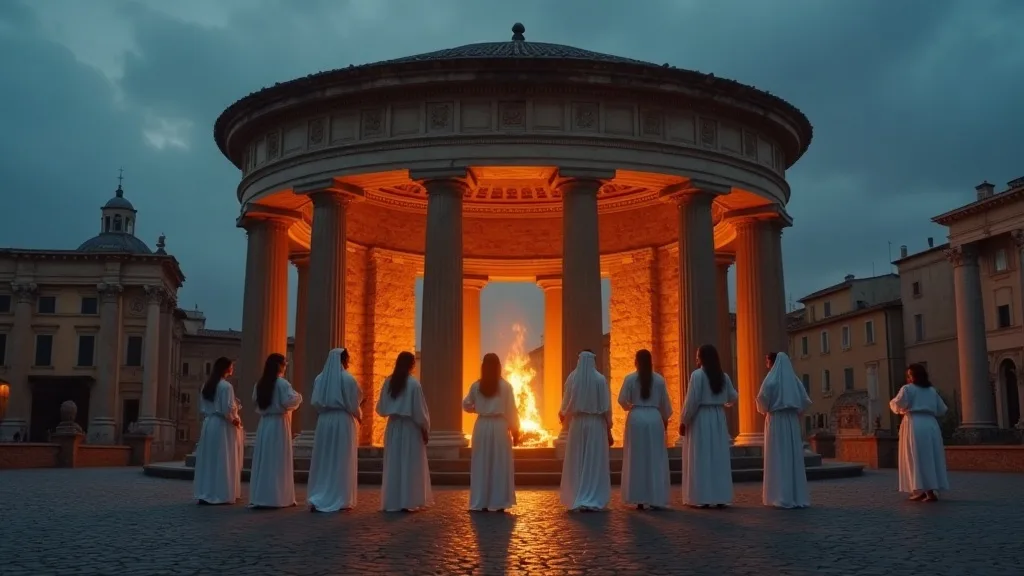
Vesta and the Vestal Virgins: Sacred Fire and Roman Purity
Vesta, Rome's goddess of the hearth, held the empire's fate inside a single flame. Meet the Vestal Virgins who guarded it, and why their purity was Rome's survival.
Contents
The flame had no statue. No face, no arms, no myth of a love affair or a battle won. Just fire, burning in a round temple at the center of the Roman Forum, tended night and day by six women who had given their childhood to the goddess and their lives to the city. If that fire went out, Romans believed, Rome itself would fall.
Vesta and the Vestal Virgins sat at the absolute core of Roman religion, not at the edges, not as a colorful decoration, but as the structural pillar on which every other ritual leaned. Generals consulted them before campaigns. Emperors courted their blessing. And the women themselves walked streets where senators stepped aside, where condemned men begged for a touch of their robe.
This is the story of that flame, the goddess behind it, and the extraordinary women who carried the weight of a civilization on their shoulders for over a thousand years.
Vesta: The Goddess Who Refused a Shape
Most Roman gods wore a human face. Vesta did not. She was the hearth itself, not a deity who lived beside it. Ancient Roman writers struggled to explain her nature precisely because she defied the usual grammar of divine portraits.
The poet Ovid, writing in his Fasti (a verse calendar of Roman festivals completed around 8 AD), put it plainly: "Vesta is the same as the Earth; beneath both is perpetual fire." He wasn't speaking loosely. In Roman religious thought, Vesta embodied the living heat inside the earth, the same warmth that made grain grow and bread rise and families gather at the hearth after dark. She was not a goddess who gave fire. She was fire.
Her Greek counterpart was Hestia, the first-born and last-poured child of Kronos, who quietly held the center of Olympus. The parallels are deep. Both goddesses refused marriage (when Poseidon and Apollo competed for Hestia, she swore perpetual virginity to Zeus). Both presided over domestic fire as a civic and religious concept. But where Hestia remained a relatively peripheral figure in Greek myth, Vesta became one of the most politically powerful forces in Roman public life.
The Romans categorized Vesta among the Di Indigetes, their oldest native gods, predating even the Olympian imports. Cicero, the statesman and philosopher writing in the 1st century BC, called her the guardian of pietas, the Roman value of duty toward gods, family, and state at once. These three duties were never separate. They collapsed into one flame.
The Myth Rome Didn't Really Tell
Vesta has almost no mythology in the conventional sense. She appears at the edge of the Homeric Hymns (the short Greek devotional poems collected around the 7th-6th centuries BC), where she is promised a place of honor in every human home. She surfaces in Hesiod's Theogony (around 700 BC) as the eldest child of Kronos and Rhea. She has no monsters slain, no rivers crossed in disguise, no mortal lovers. Roman poets sometimes found this awkward.
Ovid, always inventive, tried to fill the silence. In the Fasti, he records a story in which the god Priapus (a rustic fertility deity) crept toward the sleeping Vesta during a feast of the gods. A donkey brayed, Vesta woke, the assault was foiled. It's a comic scene in a serious book, and Ovid uses it to explain why donkeys were garlanded on Vesta's festival day. Scholars debate whether Ovid invented the story or recovered a genuine folk tradition. Either way, it's the exception. The rule was silence, because Vesta required no story. She was the condition that made all other stories possible.
What Rome told instead of myths were rituals. The entire body of Vestal practice, the daily acts of tending, the annual purifications, the precise handling of sacred objects, that practice was the narrative. Vesta's story was told in action, not in words.
The Six Women: Selection, Service, and Status
The Vestals were chosen young, between the ages of six and ten, from patrician families of good standing (though later, plebeian families became eligible too). The pontifex maximus, Rome's chief priest, selected them through a ceremony called the captio, literally "the taking." The chosen girl left her family on the spot. Legally, she ceased to belong to her father. She entered a thirty-year term of service.
Those thirty years were divided into three decades of roughly equal purpose:
- The first ten years were spent learning: memorizing the rituals, mastering the preparation of the sacred mola salsa (the salted grain cake used in public sacrifices), watching and absorbing.
- The second ten years were spent performing: leading the rites, tending the flame, participating in the great festivals.
- The final ten years were spent teaching: passing what they knew to the newest initiates.
After thirty years, a Vestal was released. She could marry. Most did not. Roman sources suggest they found the return to ordinary domestic life strange, even lonely, after three decades at the center of everything.
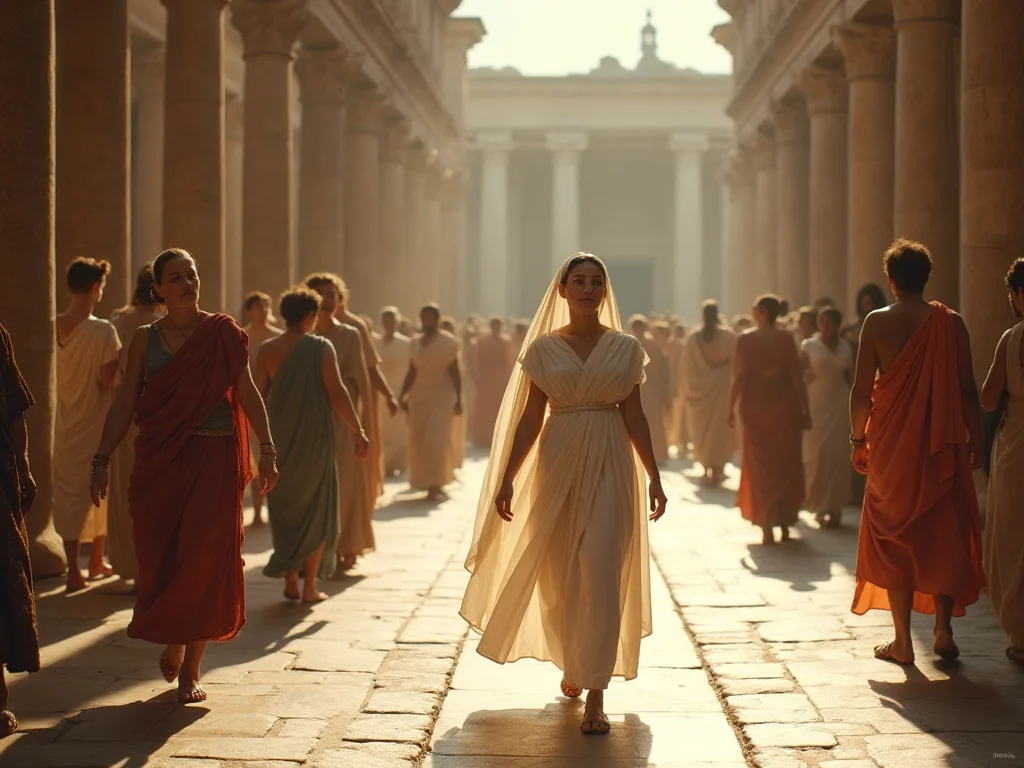
Inside that service, their legal status was extraordinary. A Vestal held sui iuris, the legal independence normally reserved for adult men: she could own property, make a will, give evidence in court without an oath (because her word was already sacred). When she walked through Rome, a lictor, the bodyguard normally reserved for senior magistrates, preceded her. If a condemned prisoner happened to meet a Vestal on the road to execution, he was pardoned on the spot.
Keeping the Flame: Daily Ritual in the Temple of Vesta
The round temple of Vesta (aedes Vestae) stood in the Forum Romanum, between the Palatine and Capitoline hills. Its circular form was deliberate. Ancient sources connect it to the tholos, the early round hut of the prehistoric Latin settlements, making the temple a memory of Rome's very first hearth.
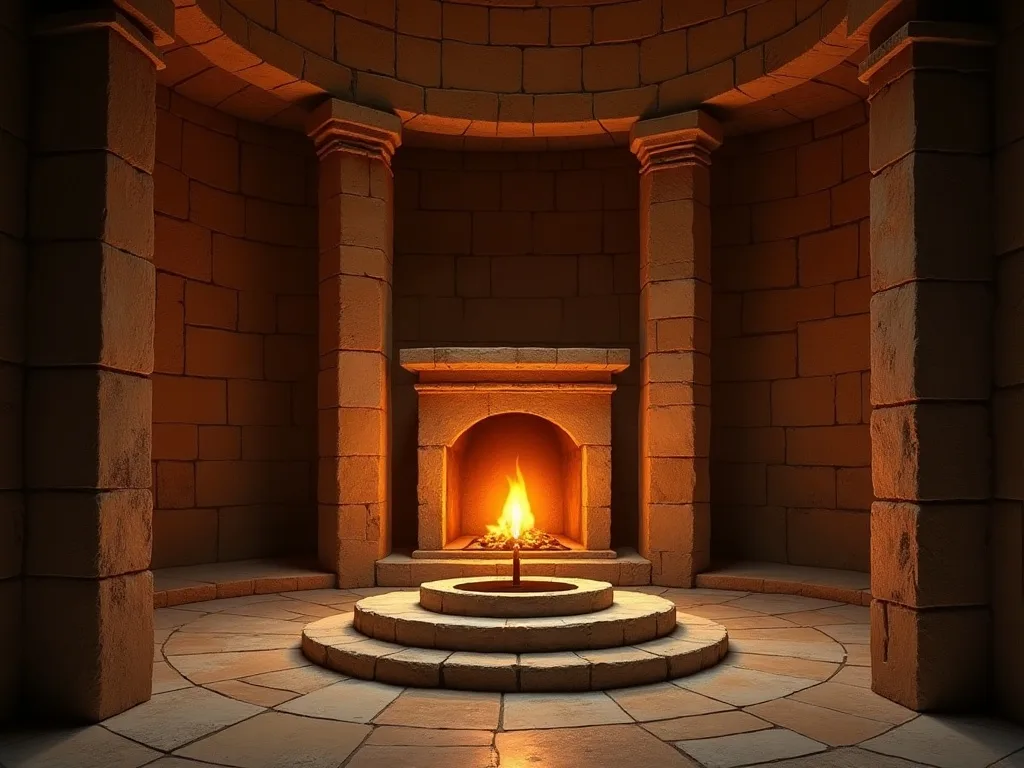
Inside, the flame burned on a sunken hearth. The Vestals fed it daily, carrying water from the sacred spring of the Fons Camenarum (near the Caelian Hill) in vessels that could not touch the ground once filled, because contact with the ordinary earth would break the vessel's purity. They swept the inner shrine with ritual care. They performed the mola salsa rites at key points in the Roman calendar.
The flame was renewed every year on March 1, the original Roman new year, when the Vestals lit a fresh fire using the friction of two sticks of wood (the arbor felix, an auspicious tree species). Electric lighters would have horrified them. The point was the effort, the ritual act of coaxing life from friction, mirroring how Rome itself had been built.
If the flame went out accidentally, the Vestals were flogged by the pontifex maximus - not as punishment for carelessness alone, but because an extinguished flame was read as a sign of divine displeasure, a fracture in Rome's relationship with the sacred. The flame was re-lit only by focusing sunlight through a bronze mirror, or by friction, never from any common fire.
The Palladium and Other Objects That Could Not Be Seen
The inner sanctum of Vesta's temple, the penus Vestae, was forbidden to all men and to most women. Only the Vestals entered, and even they approached certain areas with specific protocols. Roman writers hint at sacred objects kept inside, foremost among them the Palladium.
The Palladium was said to be a small wooden statue of Pallas Athena, supposedly brought from Troy by the hero Aeneas after the city fell. Roman legend held that as long as the Palladium remained in Rome, the city could not be destroyed. Ovid mentions it in the Fasti, and the Roman historian Livy implies its continued presence. The object was never publicly displayed, never confirmed, almost never described. Its power lay precisely in its hiddenness.
This combination of fire and hidden object, visible warmth and concealed talisman, captures something important about Roman religion. The sacred operated both in public spectacle and in a protected interior that the public could not reach. The Vestals were the hinge between those two zones.
The Price of Failure: Punishment and the Living Burial
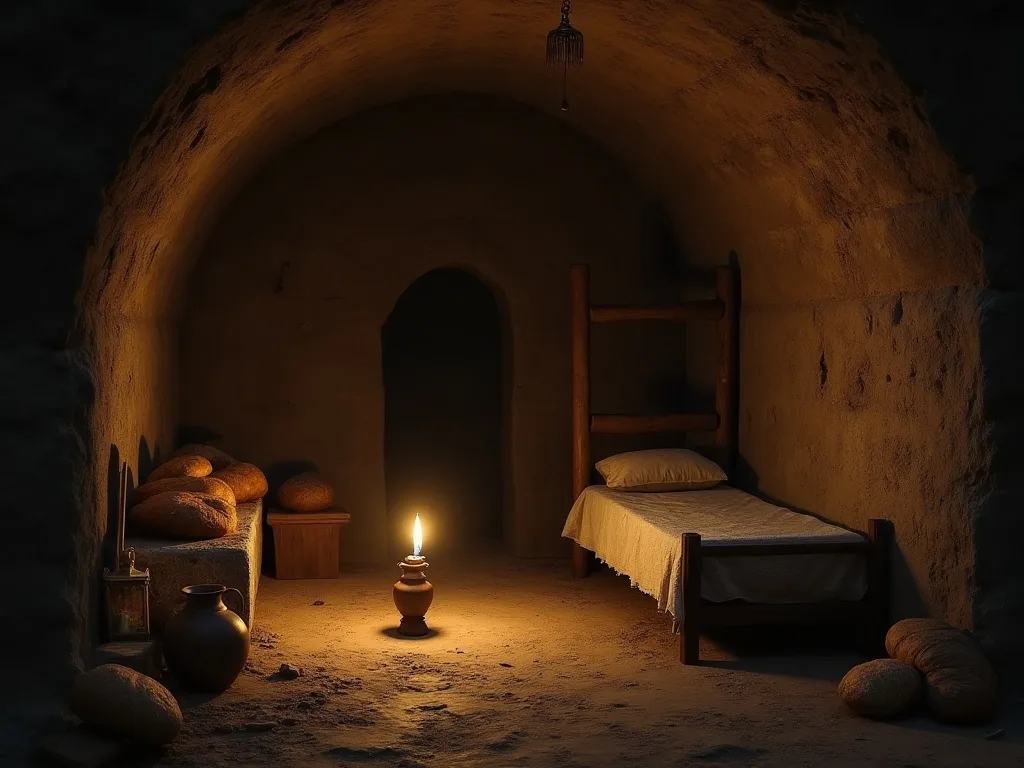
Roman law held that a Vestal who broke her vow of chastity had committed an act of impiety so grave it threatened the state. The punishment was defossio, being buried alive in a small underground chamber near the Colline Gate of the city, with a lamp, a little bread, a little water, and a bed. The chamber was sealed. The Romans technically did not "execute" the Vestal; they entombed her with supplies, so the gods could decide her fate.
The accused Vestal's lover, real or alleged, was flogged to death in the Forum.
This happened rarely, but it happened. Livy records cases from the early Republic. The emperors Domitian (reigning 81-96 AD) and Caracalla both prosecuted Vestals on chastity charges, and historians have debated whether those prosecutions were sincere or politically convenient. Under Domitian, three Vestals were condemned and one, the chief Vestal Cornelia, was buried alive. Pliny the Younger, writing to a friend shortly after, called the scene at the Colline Gate one of the most disturbing things he had ever witnessed.
The vow of chastity was not simply a personal moral standard. It was a cosmic condition. The Vestals' purity was Rome's purity. A broken vow meant the city had lost its sacred contract, which explained why every military defeat, every plague, every flood prompted anxious Romans to check whether the Vestals were blameless.
Vesta's Festival: The Vestalia of June
Once a year, between June 7 and 15, the Romans celebrated the Vestalia, one of the oldest festivals in the Roman calendar. For nine days, the inner sanctuary of Vesta's temple was opened to women, who brought offerings of food and prayer on behalf of their households. Millers and bakers also came: donkeys wore garlands of bread and violets (the same donkeys who, per Ovid's story, had saved the goddess). Mills stood idle for the duration. Grain was sacred; its preparation was sacred; the fire that cooked it was sacred.
On June 15, the sanctuary was ritually swept and purified. The swept-out material, dust and ash and ritual debris, was carried in a specific route to the Tiber and tipped into the river. Only after this cleaning was the Vestalia closed and the sanctuary sealed for another year. The day of the sweeping was called the Quando stercus delatum fas est, which translates roughly as "when the sweeping of the filth is a sacred act." Even the dirt was handled with precision.
Ovid, ever interested in origins, suggests the word Vesta itself shares a root with the Greek Hestia, both possibly connected to a verbal root meaning "to burn" or "to shine." Modern linguists link the name to the Proto-Indo-European root h₂wes-, "to shine, to be bright," connecting Vesta to a vast family of fire deities across the ancient world.
Sacred fire in Roman religion: Political Power and Imperial Manipulation
The Vestals' power was real and measurable. Wills were deposited in their keeping: Julius Caesar, Sulla, and Mark Antony all lodged official documents with the Vestals. Embassies from foreign states used the temple as neutral ground. Their intercession could stop a legal execution.
Augustus, the first emperor, understood this power acutely. He reorganized the Vestal college as part of his broader religious revival, granting the Vestals enhanced privileges while simultaneously tying their public role more tightly to the imperial family. He placed his own will and that of his wife Livia with the Vestals for safekeeping. His successors did the same. The Vestals became, in a quiet way, custodians of dynastic legitimacy as much as of the sacred flame.
This entanglement cut both ways. Emperors who wanted to project piety promoted the Vestals. Emperors who wanted to assert dominance prosecuted them. The historian Tacitus, writing in the early 2nd century AD, notes cases where Vestal trials became tools of factional politics, using the language of sacred purity to destroy political enemies. The flame burned. The politics burned too.
The End of the Fire: Theodosius and 394 AD
The Christian emperors of the 4th century progressively dismantled Roman polytheism. Constantine had ended state support for traditional cult sites in 312 AD. Julian (reigning 361-363 AD) briefly reversed course, even reportedly visiting the Vestals and asking to be received by them as a traditional Roman leader. They refused, because Julian was not the recognized emperor's son, and the refusal itself is a measure of their continued institutional seriousness.
Theodosius I struck the final blow. His edict of 391 AD banned all pagan sacrifice. In 394 AD, he ordered the sacred fire extinguished and the Vestal college dissolved. The women who were serving at that moment were released from their vows. Rome did not fall immediately, but it fell: the Visigoth king Alaric sacked the city in 410 AD. Many Romans who still remembered the old religion said exactly what they expected to happen when the fire died.
Augustine of Hippo, writing the City of God partly in response to that sack, argued at length that the pagan gods had never actually protected Rome. The old Vestals, had any still been alive to read it, might have said that was precisely the point.
Vesta's Afterlife in Western Culture
The image of the Vestal Virgins never fully left Western imagination. Renaissance painters depicted them in white robes holding lamps. Jacques-Louis David painted his famous neoclassical scene in the 1780s. The 19th century was saturated with Vestal imagery: purity, sacrifice, female devotion, civil religion, all made the archetype useful to artists, politicians, and reformers alike.
The French painter Jean-Léon Gérôme painted "Pollice Verso" in 1872, featuring a Vestal in the Colosseum deciding a gladiator's fate (a popular but historically inaccurate scene; the thumbs gesture is attested but Vestals attended the games only in specific seats, not as routine arbiters). What the painting captured, even inaccurately, was the cultural intuition that Vestal power was real and visual.
In the 20th century, the Vestals became a recurring point of reference for scholars studying women in ancient religions. Mary Beard, the British classicist, published an influential 1980 paper questioning the easy categories applied to Vestal sexuality and ambiguity. She argued that the Vestals occupied a gender category Roman law simply hadn't built vocabulary for: neither fully male nor fully female by Roman legal standards, powerful in ways that women nominally couldn't be, restricted in ways that free men weren't. The debate continues in classical studies programs today.
The flame itself resurfaces in Italian civic memory. The Olympic torch relay, introduced at the 1936 Berlin Games, was modeled partly on ancient Greek practice but draws visual and symbolic vocabulary from the Vestal tradition: a sacred fire, lit by concentrated sunlight, carried by women in white, never allowed to die. The borrowing is not accidental. Every civilization that inherits Western culture inherits a little of Vesta's flame.
Frequently asked questions about Vesta and the Vestal Virgins
Frequently asked questions
How were the Vestal Virgins chosen, and could a family refuse?
The pontifex maximus selected candidates between ages six and ten from freeborn Roman families of good standing. The selection ceremony, called the captio ("the taking"), transferred legal guardianship from the father to the state. Roman law technically allowed refusal in specific circumstances (if a candidate had a sibling already in Vestal service, or if her father held a priesthood), but social pressure made refusal extremely rare. Being chosen was considered a profound honor.
What happened to a Vestal Virgin after her thirty years of service ended?
After completing thirty years, a Vestal was legally free to marry and return to private life. She kept her legal independence and any property accumulated during service. Roman sources, including Plutarch writing in the late 1st and early 2nd century AD, note that most chose not to remarry, finding the transition to ordinary domesticity difficult after decades of public prestige and sacred purpose.
What sacred objects were kept in Vesta's temple besides the flame?
Roman sources mention several objects in the inner sanctuary, the penus Vestae, though few were ever publicly described. The Palladium, a small wooden statue of Athena said to have been brought from Troy by Aeneas, was the most famous. Other references mention objects called the sacra whose nature was deliberately left vague. The concealment was intentional: part of the objects' power came from their inaccessibility.
Is there a difference between Vesta and the Greek goddess Hestia?
Both share deep roots, likely in a common Proto-Indo-European fire cult. But their cultural roles diverged sharply. Hestia remained important in Greek domestic religion but held a minor place in public myth. Vesta, by contrast, was embedded in Rome's political and legal structures through the Vestal college, making her one of the most institutionally powerful deities in the ancient world. Their characters also differ: Hestia appears occasionally in the Homeric Hymns and Hesiod, while Vesta was so abstract she generated almost no independent mythology.
Why was the Vestal flame extinguished in 394 AD, and what were the consequences?
The emperor Theodosius I ordered the flame extinguished as part of his prohibition on all pagan worship. The Vestal college was dissolved and the surviving Vestals were released from their vows. Sixteen years later, in 410 AD, the Visigoth king Alaric sacked Rome, an event many surviving pagans linked directly to the end of Vesta's protection. Modern historians point to decades of political fragmentation, but the symbolic resonance of the timing was not lost on contemporaries.
Did Vesta have temples outside Rome?
The main cult center was always the round temple in the Roman Forum, but smaller shrines to Vesta existed in Roman colonies and private homes. Every Roman hearth was considered sacred to Vesta in a domestic sense, and her name was invoked at private meals as well as public sacrifices. Pompeii's excavations have revealed household shrines, the lararia, that honored Vesta alongside the Lares (household guardian spirits) and the family's Genius (its protective spirit).
What the Flame Still Tells Us About Rome
A civilization's deepest fears show up in its most persistent rituals. Rome was terrified of disorder, of the fragile web of obligations between gods, state, family, and citizen snapping without warning. Vesta's flame was the answer to that fear. Not a doctrine, not a theology, not a creed. A fire. Warm, visible, tended by human hands, never allowed to die.
The Vestals were not passive symbols. They were trained specialists, legal persons, political actors. They held the city's documents. They pardoned its condemned. They managed their own property and trained their own successors. The purity demanded of them was extreme, but it came bundled with a power that no other Roman women held. That paradox sits at the heart of the Vestal Virgins' sacred role: the more they surrendered, the more authority Rome placed in their hands.
Scholars like Mary Beard and Ariadne Staples (whose 1998 book From Good Goddess to Vestal Virgins remains a foundational text) have argued that the Vestals were not simply Rome's version of chaste priestesses. They were a structural solution to a problem Roman religion couldn't otherwise solve: how to make the domestic sacred public, how to give the hearth a civic address, how to ensure that the warmth at the center of every Roman home connected upward to the warmth at the center of the Roman state.
The flame is long gone. The temple is a ruin. But the question the Vestals answered, how a society keeps faith with its own continuity, remains very much alive.
Free 25-page sample
Want the whole story?
Take the first 25 pages free. If it pulls you in, the full edition is yours as an instant PDF download, with a paperback on Amazon for selected titles.
Roman
The Roman Mythology Book: Jupiter, Mars, Venus, the Aeneid, and the Sacred Stories That Built an Empire
Jupiter, Mars, Venus, the Aeneid, and the Sacred Stories That Built an Empire
The complete guide to Roman mythology from Virgil's Aeneid to Ovid's Fasti. Every god, every founding myth, every Vestal rite.
More from Roman
All articles
Roman
Romulus and Remus: The Myth of Rome's Foundation
The twin sons of Mars raised by a she-wolf; a fratricide, a city, and an empire. How Rome's founding myth shaped the identity of Western civilization's greatest power.
Roman
Aeneas and the Founding of Rome: The Aeneid's Sacred Narrative
Virgil's Aeneas carries Troy's fate to Italy, writing Rome's origin in blood and duty. Discover how the Aeneid transformed a hero's journey into a nation's sacred story.

Roman
Venus: Goddess of Love and Ancestor of the Roman People
Venus was Rome's goddess of love, fertility, and military victory. But she was also the divine ancestor of the Roman people through her son Aeneas. Discover how this single goddess embodied Rome's most powerful myths about its own origins.

Roman
Mars: Roman God of War, Agriculture, and the Father of Rome
Mars was no mere god of bloodlust. The Roman war god fathered Romulus, blessed the harvest, and embodied the discipline that built an empire. Discover how Rome's greatest god shaped both sword and soil.