
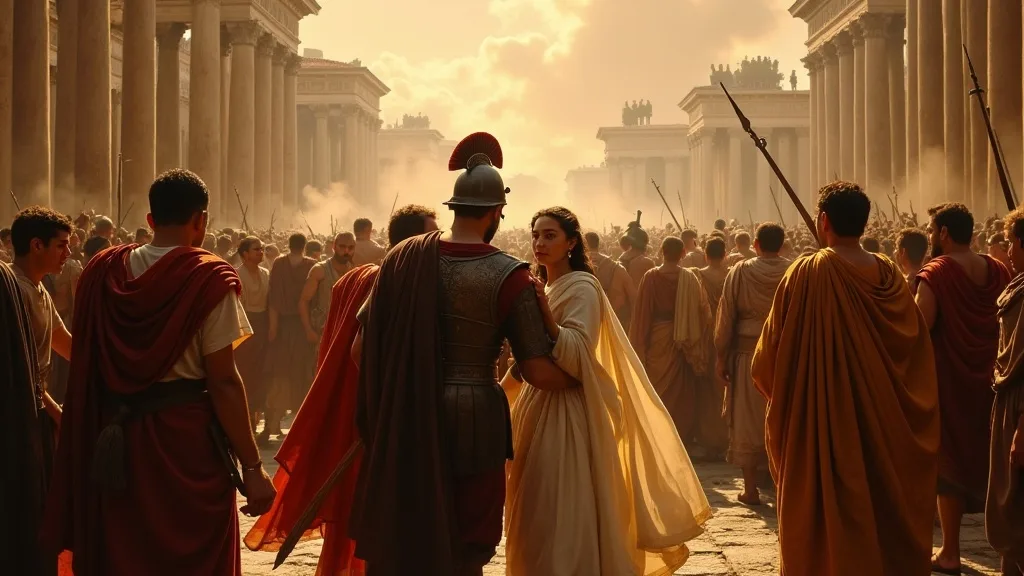
The Rape of the Sabine Women: Rome's Founding Crisis
Rome had walls and soldiers but no women, no future. The abduction of the Sabine women was not merely a scandal: it was the city's first existential gamble, and the myth that encoded Rome's ambivalence about its own violent origins.
Contents
The Rape of the Sabine Women: Rome's Founding Crisis begins with a city that should not have survived. Romulus had drawn his pomerium, the sacred boundary furrow, and men had come: exiles, runaways, landless farmers, fugitives from a dozen Latin towns. They had swords and ambition. What they did not have was women. Without women there would be no second generation, no marriages, no hereditary clans. The city built on fratricide would die in a single lifetime.
What followed was an act the Romans called the raptus, a word meaning seizure or carrying off, not necessarily rape in the modern legal sense, though modern readers are right to feel its violence. Romulus sent envoys to the neighboring peoples: the Caeninenses, the Crustumini, the Antemnates, and above all the Sabines, a mountain people of central Italy whose towns clustered in the hills northeast of the Tiber. Each embassy came back empty-handed. No father would send his daughter to a city of thieves. Romulus filed that refusal away. He had a plan.
The plan was a festival. Games in honor of the god Consus, announced with enough ceremony to draw curious crowds from across Latium. The Sabines came in families: fathers, mothers, daughters, sons. They spread out across the new forum, admired the young city, watched the athletic displays. Then, at a signal from Romulus, the Roman men seized the unmarried women and carried them off into the houses of the new city. The fathers fled in horror. The festival had been a trap.
Why Rome Needed the Sabine Women: The Population Problem of 753 BCE

The political logic behind the raptus is older than Rome. Livy, writing under Augustus around 27 BCE, opens his account of the event in Book I of Ab Urbe Condita by establishing the demographic crisis clearly: Romulus had created an asylum, a sanctuary on the Capitoline for runaway slaves, debtors, and dispossessed men from neighboring towns. The city filled with men of "obscure" origins. The surrounding peoples refused intermarriage precisely because of this. The word Livy uses is dignitas: they would not mix their blood with a rabble.
The Sabines were the logical target for three reasons. First, they were numerous enough to supply a real population base. Second, their territory shared a natural boundary with Rome along the Tiber valley. Third, they were, in the Roman tradition, famously stern and virtuous, the very qualities that Rome would later claim as its own national character. Stealing their women was not random: it was aspirational, a claim that Rome deserved what it was taking.
Romulus spoke to the captured women directly, according to Livy. He told them the act had been forced on him by the pride of their fathers. He promised them legitimate marriage, citizenship, and children who would be Roman citizens. He told them they would hold the honored title of matres familias. This speech matters: the myth goes out of its way to distinguish the raptus from a slave raid. The women were not to be concubines but wives, and specifically wives of Roman citizens, which made them among the most legally protected women in the ancient Mediterranean.
Plutarch, writing his Life of Romulus around 100 CE, adds a detail Livy passes over: Romulus himself took one woman, Hersilia, as his own wife, or at least so one tradition held. This was a signal to his men that the seizure carried honorable intention, not mere appetite.
The Abductors and the Abducted: What the Ancient Sources Actually Say
The number of women seized varies between sources. Livy gives a low count of around 30, which would explain why each woman became the eponym of a Roman gens, a clan. Plutarch's sources push the number to 683. The discrepancy reflects the dual function of the myth: the 30-woman version emphasizes foundational genealogy, each clan tracing its origin to a specific Sabine bride; the larger figure emphasizes the scale of what Romulus was building, a real city, not a symbolic one.
The names that survived are worth knowing. Hersilia appears in multiple sources as the most prominent of the Sabine women, later deified as Hora, a goddess of beauty and the seasons. She reportedly interceded between Rome and her father's people during the subsequent war. The women were assigned to Roman men not by lottery but by a process that Livy describes cautiously: men who had seized specific women were given those women as wives, provided they could keep them. This detail is uncomfortable and the ancient writers know it; Livy's syntax in this passage is notably clipped, as if he does not want to linger.
What the sources do not report is any mass resistance from the women once the marriages were established. This silence has drawn centuries of scrutiny. Some ancient commentators took it as evidence of Romulus's persuasive speech and the genuine dignity of Roman marriage. Modern scholars, including Phyllis Culham and Judith Hallett, have pointed out that the sources were written exclusively by Roman men, centuries after the events, and that the myth's narrative of female acquiescence is ideological rather than historical. The women speak twice in the tradition: once when they plead with their fathers and husbands not to fight, and once when Hersilia's prayer places her among the gods. Both moments serve Roman interests.

The Sabine War and the Miracle on the Forum
The Sabine king Titus Tatius assembled an army. He marched on Rome. The war that followed was the first real test of the new city, and it almost ended Rome before Rome had properly begun. Tatius bribed a Roman girl named Tarpeia to open the gates of the Capitoline citadel. She asked for what the Sabine soldiers wore on their left arms, expecting their gold bracelets. They crushed her with their shields instead, since their shields were also worn on the left arm, as punishment for treason. The rock from which traitors were later thrown in Rome bore her name: the Tarpeian Rock, still identifiable on the Capitoline Hill today.
The armies met on the low ground between the Capitoline and Palatine hills, in the space that would become the Roman Forum. The Sabines pressed the Romans hard. Rome's finest soldier, Hostus Hostilius, fell. The Roman line broke. Then a peculiar scene: the Sabine women ran onto the battlefield between the two armies. They held their children. They wept. They called out to their fathers by name and to their Roman husbands by name. Livy records their speech as a single collective cry, because to individualize it would have required inventing dialogue the tradition did not preserve. But the structure of the argument is clear: if you fight, you kill either our fathers or our husbands; either way you destroy us. We are the bond between you. Make peace.
The armies stopped. The two kings, Romulus and Titus Tatius, agreed to a treaty. More than a treaty: a merger. The Sabines joined the Roman state. Titus Tatius co-ruled with Romulus for several years. The Roman people were divided into three tribes, one of which, the Tities, took its name from Titus Tatius. Several prominent Sabine families enrolled in the Roman senate. Rome doubled in population in a single afternoon.
Roman Account (Livy, c. 27 BCE)
Focuses on the legal and political logic: Romulus frames the seizure as necessary for the city's survival, emphasizes the dignity of Roman marriage law, and treats the women's intervention as a civic founding act. The number of women is low (around 30), reinforcing the genealogical reading.
Greek Account (Plutarch, c. 100 CE)
Adds psychological and biographical depth: Romulus takes Hersilia as his own wife, the number rises to hundreds, and the individual anguish of the women receives more space. Plutarch also records dissenting ancient voices who found the story morally troubling.
The Myth's Political Architecture: What Rome Was Saying About Itself
The raptus story is not primarily a historical account. It is a foundation myth doing very specific ideological work, and understanding that work requires seeing what anxieties it was designed to manage.
Rome's founders were migrants and outlaws. The asylum on the Capitoline was a real institution or at least a real memory: men without land, without ancestors, without legitimate civic standing. The myth of the Sabine abduction addresses this by claiming that Rome's second generation, its real social bedrock, came from the oldest and most respected of the neighboring peoples. The Sabines in Roman tradition were the ancestors of rustic Roman virtue: frugal, warlike, pious. By absorbing Sabine women as mothers and Sabine men as citizens, Rome retroactively dignified its own mixed origins.
The treaty was more than diplomacy. The Sabine merger gave Rome the cultural authority of an ancient people. Roman aristocrats of the Republic and Empire frequently claimed Sabine descent. The family of the future emperor Vespasian traced roots to the Sabine country around Reate. Claiming Sabine blood was claiming a kind of moral seniority over the chaotic, opportunistic founding generation.
The women's intervention scripts female virtue for the Republic. The scene on the battlefield is carefully constructed: the women act not out of love for Rome, and not out of hatred for their fathers, but out of loyalty to their children and to peace. They are matres, mothers first, and their maternal function gives them political authority precisely because it is selfless. This is the ideological payoff. The Roman matron who later refused to mourn her son killed fighting for Rome (a historical anecdote Livy admires) traces her steel back to these Sabine women who chose peace over grief.
Cross-Cultural Parallels: Abduction as Origin Myth
The pattern of foundational abduction runs through many ancient traditions, and placing Rome's version beside them sharpens what is specific to the Roman telling.
The Homeric tradition gives Helen of Troy as its central abduction figure: a woman whose seizure unmakes a city rather than founds one. Troy burns; Rome grows. The inversion is not accidental. Roman writers knew the Homeric cycle well, and the Sabine episode can be read as an anti-Troy: an abduction that generates order rather than destroying it, precisely because the Romans marry their captives as citizens instead of keeping them as prizes.
In the Hebrew tradition, the Book of Judges (chapter 21) records the men of Benjamin seizing wives from the dancing girls of Shiloh during a festival, a structural parallel so close that some scholars, including William Smith in the 19th century, suggested direct influence. The parallels are probably independent: the "festival trap" is a recurring narrative solution to the same demographic problem across many founding traditions.
The Celtic mythological cycle of Ireland preserves abduction tales, particularly around women taken into the sídhe, the otherworld mounds, from which they sometimes return to mediate between two hostile groups. The mediating function of the abducted woman, her role as the hinge between two kinship systems, appears in Irish myth, Roman myth, and Sabine-Roman historiography alike.
What distinguishes the Roman version is its insistence on legal consequence. The women become matres familias, Roman citizens with inheritance rights and the protection of Roman law. The myth cannot allow the abduction to remain merely an act of force; it must be laundered through marriage law. This is Rome performing its identity: violent origins redeemed by institutional framework.
The Raptus in Roman Religion and Ritual
The myth left traces in Roman religious practice that outlasted the Republic. The god Consus, in whose honor the festival that triggered the abduction was supposedly held, was an ancient deity associated with stored grain and the hidden powers of the earth. His altar on the Circus Maximus was buried underground and only uncovered on festival days. The Consualia festival continued to be celebrated in Rome into the imperial period, with horse races and the ritual rest of work animals.
More intriguingly, some elements of Roman marriage ritual may echo the founding abduction. The Roman bride was carried over the threshold of her husband's house, not simply led in. She was accompanied by a procession that included a ritual cry, the Talasio or Talassio, whose origin even ancient Romans could not agree on. Several ancient etymologists connected it to the abduction: it was supposedly the name of a Roman soldier who had seized a particularly beautiful Sabine woman and called out her destination to protect her from rivals. Whether true or not, the persistence of this story shows that Romans felt the raptus was encoded in their most intimate domestic ceremonies.
The name of Romulus himself was bound to this event in Roman memory. The city was named for the man who organized a mass abduction to save it. Romans did not find this contradiction unbearable. They found it generative. The tension between force and law, between the necessity of the founder's violence and the justice of the state he created, was the tension that produced Roman jurisprudence itself.
Tarpeia, Hersilia, and the Women Who Named Rome's Landscape
Two women from the raptus tradition left permanent marks on Roman topography and theology.
Tarpeia is the darker figure. A Vestal's daughter, or in some accounts a common Roman girl, she opened the Capitoline gate for Titus Tatius and was crushed by his soldiers as a traitor. The Tarpeian Rock became the place of execution for traitors through the entire Republican period. Some ancient scholars, uncomfortable with making the founding generation purely villainous, suggested that Tarpeia had been tricked, that she really wanted the gold bracelets and had not expected shields. Others called her a deliberate agent of betrayal. Both versions agree on the end: crushed, her body marking the rock, her name embedded in Roman law as the symbol of treachery's reward.
Hersilia follows the opposite arc. Taken as a wife (by Romulus himself in one tradition, by a leading Roman citizen in another), she interceded on the battlefield, advocated for the treaty, and in the end was deified. Ovid in the Metamorphoses (Book XIV) describes her apotheosis: the goddess Iris descends, Hersilia's hair catches fire, and she rises to Olympus as Hora, companion to the deified Romulus. Ovid's treatment is notably tender; Hersilia and Romulus are reunited in divinity, their mortal marriage transformed rather than ended.
These two women bracket the myth's moral range. Tarpeia represents the danger of women as intermediaries: the gate-opener, the betrayer, the one whose mixed loyalties destroy rather than build. Hersilia represents the ideal: the woman whose position between two peoples becomes the foundation of civic unity rather than its undoing.
How Rome Retold the Myth Across Eight Centuries
The raptus was never a stable story. Each generation of Roman writers refracted it through contemporary preoccupations.
In the mid-Republic, when Rome was absorbing Italian peoples through warfare and gradual citizenship grants, the myth of Sabine incorporation functioned as a template: military conquest followed by legitimate assimilation. The Sabine treaty had set the precedent.
Under Augustus, the story took on new urgency. Augustus's social legislation: the lex Iulia de adulteriis, the lex Iulia de maritandis ordinibus, and the lex Papia Poppaea, attempted to force the Roman citizen class to marry and produce children. The demographic crisis of 753 BCE was, to Augustan propagandists, happening again. The Sabine women had once saved Rome from childlessness by force of circumstance. Augustus tried to save it by law. The parallel was not subtle.
Ovid treated the raptus with characteristic irony in the Ars Amatoria (Book I, lines 101-134), describing the scene as Rome's first seduction manual: Romulus was a clever lover who created the occasion for desire. Augustus exiled Ovid in 8 CE, partly for the Ars Amatoria. Whether the irreverent treatment of the founding myth played a role in that exile is a matter of scholarly debate, but the proximity of Ovid's flippant retelling and his banishment is difficult to ignore.
The sculptors of the Renaissance and Baroque found the story irresistible: Giambologna's Rape of the Sabine Women (1583, Piazza della Signoria, Florence) and Nicolas Poussin's two painted versions (c. 1634-35, now in the Metropolitan Museum and the Louvre) established the visual language of the event for centuries. Both artists emphasized the formal beauty of intertwined bodies, the geometry of struggle, which is itself an aesthetic ideology: violence made classical, crisis made art.
Jacques-Louis David's painting of 1799, now in the Louvre, reverses the focus entirely. It shows not the abduction but the battlefield intervention, Hersilia at the center, arms spread, stopping the war. David painted it during the chaos of the French Revolution's aftermath, when he was personally involved in attempted reconciliation between factions. The myth absorbed his present completely.
Frequently Asked Questions About the Rape of the Sabine Women
Frequently asked questions
Did the rape of the Sabine women actually happen?
No ancient source treats it as a recoverable historical event in the modern sense. The narrative appears first in the annalistic tradition of the 3rd and 2nd centuries BCE, several centuries after the supposed date of 753 BCE. Most classical scholars today treat it as a foundation myth that may encode a real period of conflict and integration between early Latin and Sabine communities around the Tiber valley, but the specific episode of a planned festival abduction is a narrative construct, not a chronicle entry. Livy himself signals uncertainty at several points in Book I.
What does 'raptus' actually mean in Latin?
The Latin raptus derives from the verb rapere, meaning to seize, snatch, or carry off by force. It covers a range from theft of property to the abduction of persons. It does not map directly onto the modern legal definition of rape, though it certainly includes forced sexual violence in many ancient uses. In the Roman legal tradition, raptus of a woman was a serious offense when committed against a citizen woman by a non-husband, but the Romulus story was framed as the founding of legitimate marriages, not criminal assault. This legal framing was ideologically important to Roman self-presentation, even if it does not resolve the moral question for modern readers.
Who were the Sabines historically?
The Sabines were an Oscan-speaking Italic people who inhabited the central Apennine highlands and the Tiber valley northeast of Rome. They appear in historical records as a distinct political and cultural group through the 3rd century BCE, when Rome formally incorporated their territory. Several prominent Roman families claimed Sabine descent, including the family of the emperor Vespasian (reigned 69-79 CE). The Sabine language is poorly attested; only a few dozen words survive. Their reputation in Roman literature for rustic austerity and old-fashioned piety made them a useful cultural touchstone for Roman moralists.
Why did the Sabine women intervene to stop the war?
Livy and Plutarch both present their intervention as stemming from divided loyalties: they loved their Roman husbands (or at least their children by those husbands) and still loved their Sabine fathers. But the intervention also carries a structural logic in the myth: the women are the only figures who belong to both sides simultaneously. Their children are both Roman and Sabine by blood. This dual belonging gives them the authority, in the myth's symbolic grammar, to stand between armies. The scene also validates the marriages retroactively: women who fight to save both their fathers and their husbands cannot be presented as mere captives. The myth needs them to have chosen Rome, even if the choice came after coercion.
How did later Roman writers treat the Sabine women story differently?
The tradition shows real variation. Livy (writing around 27 BCE) is relatively restrained and legalistic, emphasizing political outcome over individual drama. Plutarch (writing around 100 CE) introduces more biographical detail and records ancient debates about the ethics of the act. Ovid (writing around 1 BCE to 8 CE) uses the event ironically in the Ars Amatoria as an example of erotic opportunism, a reading that scandalized Augustan moral reformers. Dionysius of Halicarnassus (contemporary with Livy) attempts the most detailed political analysis, treating the raptus as a calculated act of state policy rather than an impulsive response to diplomatic failure.
What happened to Hersilia after the myth?
In the tradition preserved by Ovid's Metamorphoses (Book XIV), Hersilia was deified after the death and apotheosis of Romulus. The goddess Iris descended from Olympus and led her soul to the heavens, where she was transformed into the goddess Hora, a figure associated with beauty, youth, and the rhythms of time. She was sometimes depicted as the companion and celestial wife of the deified Romulus, who was worshipped as the god Quirinus. A small cult of Hora Quirini is attested in Roman religious calendars. This apotheosis gave the Sabine abduction a mythological resolution: the founder and his Sabine bride were reunited in divinity, their violent beginning transcended.
The Myth's Unresolved Tension in Modern Scholarship
The raptus tradition refuses to resolve cleanly, and modern scholarship has not let it. The debate runs on two tracks that rarely meet.
The first track is historical. Archaeologists working at the sites of early Rome and the Sabine hills (Cures, Amiternum, Reate) have documented genuine cultural interchange between proto-Latin and Sabine communities in the 8th and 7th centuries BCE: shared ceramic forms, overlapping votive deposits, evidence of intermarriage through burial assemblages that mix ornamental traditions. This does not prove the abduction story, but it confirms that the two peoples were in real, sustained, sometimes coercive contact during the period the myth describes.
The second track is ethical and historiographical. Feminist scholars since the 1970s have read the myth as Rome's founding statement on the status of women: that women are a resource to be allocated between male kin groups, that their consent is a secondary concern subordinated to the political needs of the state, and that the ideology of the mater familias was partly constructed to make this subordination look like honor. Amy Richlin's work on Roman sexuality and violence in myth, Judith Hallett's studies of Roman fathers and daughters, and more recently Emma Southon's popular history A Fatal Thing Happened on the Way to the Forum (2021) have all pressed this reading in different ways.
Neither track cancels the other. The myth is simultaneously evidence of real population dynamics in archaic Latium, a sophisticated piece of state ideology, and a story whose central violence is performed on women's bodies while their voices are filtered entirely through male authors. Holding all three of those truths at once, without collapsing them into a single verdict, is perhaps the most honest thing a modern reader can do with it.
Rome was always, at its core, a city that insisted its worst acts had been necessary. The raptus was the first and most durable expression of that insistence. It set the template: seize what you need, legalize it after the fact, and call the result civilization. Whether that is an indictment or a description depends on which side of the Tiber you are standing on.
Free 25-page sample
Want the whole story?
Take the first 25 pages free. If it pulls you in, the full edition is yours as an instant PDF download, with a paperback on Amazon for selected titles.
Roman
The Roman Mythology Book: Jupiter, Mars, Venus, the Aeneid, and the Sacred Stories That Built an Empire
Jupiter, Mars, Venus, the Aeneid, and the Sacred Stories That Built an Empire
The complete guide to Roman mythology from Virgil's Aeneid to Ovid's Fasti. Every god, every founding myth, every Vestal rite.
More from Roman
All articles
Roman
Romulus and Remus: The Myth of Rome's Foundation
The twin sons of Mars raised by a she-wolf; a fratricide, a city, and an empire. How Rome's founding myth shaped the identity of Western civilization's greatest power.
Roman
Aeneas and the Founding of Rome: The Aeneid's Sacred Narrative
Virgil's Aeneas carries Troy's fate to Italy, writing Rome's origin in blood and duty. Discover how the Aeneid transformed a hero's journey into a nation's sacred story.

Roman
Venus: Goddess of Love and Ancestor of the Roman People
Venus was Rome's goddess of love, fertility, and military victory. But she was also the divine ancestor of the Roman people through her son Aeneas. Discover how this single goddess embodied Rome's most powerful myths about its own origins.

Roman
Mars: Roman God of War, Agriculture, and the Father of Rome
Mars was no mere god of bloodlust. The Roman war god fathered Romulus, blessed the harvest, and embodied the discipline that built an empire. Discover how Rome's greatest god shaped both sword and soil.