
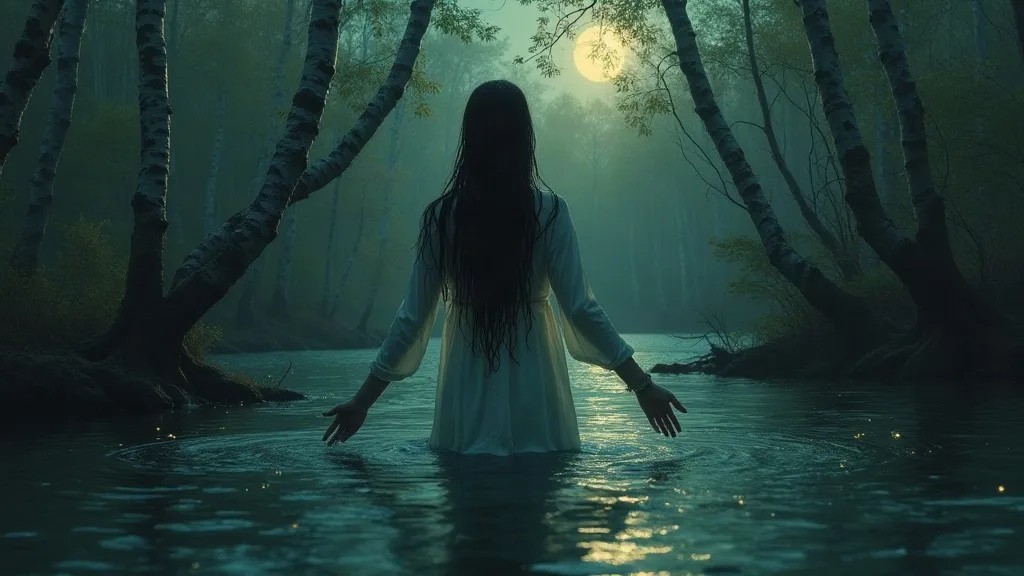
Rusalka the Water Spirit: Slavic Myth, Ritual, and the Undead Bride
Rusalka the water spirit haunts rivers, lakes, and forest edges across Slavic tradition: part ghost, part nature force, wholly dangerous. Learn where she came from and why she endures.
Contents
A young woman walks into the river. She does not come back. But she is not gone.
In Slavic villages from the Carpathians to the Russian steppe, people knew exactly where the drowned went. They became rusalki (singular: rusalka), creatures that hovered between the living world and whatever lay beneath the dark water. Not monsters from a distance, not angels of mercy, but something in between: restless, beautiful, and quietly lethal. Fishermen saw long hair floating on the surface before a net went wrong. Farmers kept their children away from the riverbank in early summer. Young men who lingered near the water at dusk sometimes did not come home.
Rusalka the water spirit is one of the most deeply rooted figures in Slavic folklore, recorded across centuries of ethnographic field work, folk songs, ritual calendars, and literary sources. She carries the grief of an unfinished life. She also carries the power to flood a field or dry it out, to curse a harvest or bless a village with rain. Understanding her means sitting at the edge of two worlds: the human world of longing and mourning, and the older Slavic world where the dead stayed close to the living long after burial.
Where Rusalki Come From: Death, Water, and the Unquiet Dead
The question of origin matters here, because rusalka is not simply a mermaid with Slavic dress. She is, at her core, a category of the dead.
Slavic folk belief drew a sharp line between the properly dead and the improperly dead. The properly dead were those who had lived a full life, received the right funeral rites, and passed over at the right time. They could become benevolent ancestor spirits, dedyi, who protected the family hearth. The improperly dead, called zalozhnye pokoiniki (a term roughly meaning "the staked-away corpses"), were those who died before their time: murdered, drowned, stillborn, or unbaptised. They were considered unclean and dangerous, because their allotted span of life had not been used up. That unused life-force had to go somewhere.
Rusalki were overwhelmingly drawn from this second group. The ethnographer D.K. Zelenin, writing in his 1916 study of the zalozhnye pokoiniki, argued that the rusalka was not originally a water being at all. She was first a spirit of the unquiet dead who happened to cluster near water because that was where young women most often drowned, whether by accident, suicide, or murder. Over centuries, the water association solidified until the two things became one creature.
This origin shapes everything about her. She does not haunt because she is evil. She haunts because she is incomplete. The Russian folk songs collected by Alexander Afanasyev in the nineteenth century, the same scholar who compiled the foundational Narodnye russkie skazki ("Russian Folk Tales"), describe rusalki weeping in willow trees, calling out the names of the living they once knew. Their grief is real. Their danger is real. Both are part of the same condition.
The Rusalka Week: Ritual Time and Living Danger
Rusalka mythology did not exist only in stories. It was embedded in the agricultural year, especially in the period after the Orthodox Christian feast of Pentecost, known in Slavic villages as Rusalka Week or Rusal'naya nedelya (roughly "the Rusalka fortnight").
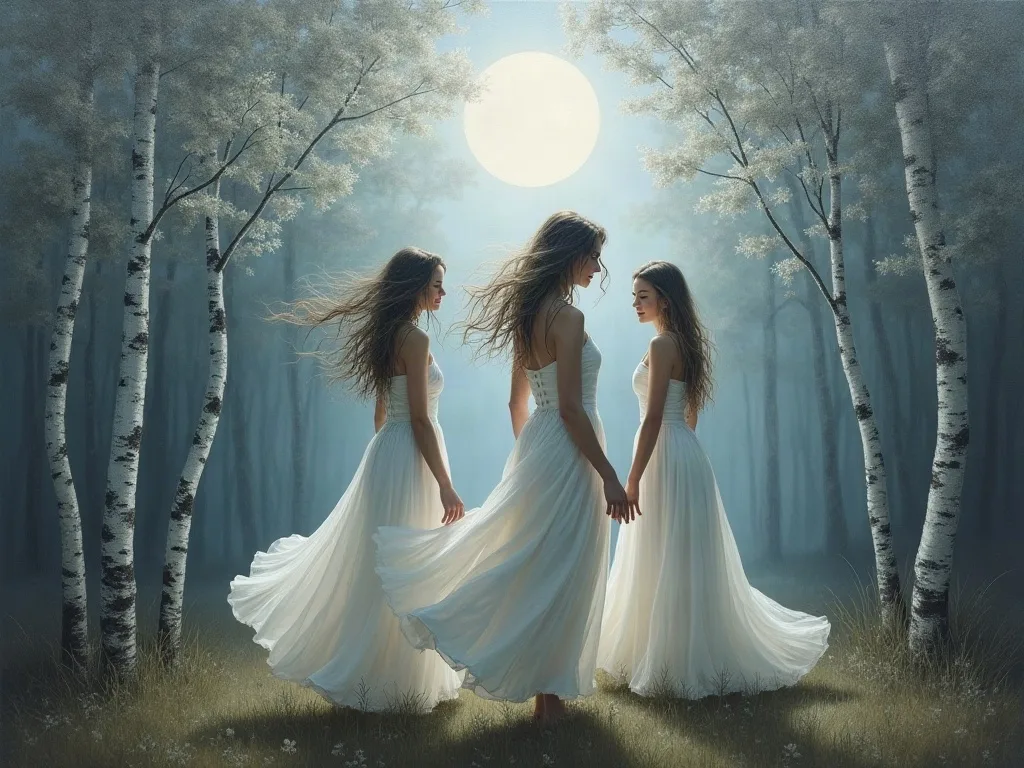
During this period, usually falling in late May or early June, the rusalki were believed to leave the water and roam freely through forests, fields, and village edges. They gathered in clearings, danced in circles under the moon, and swung from tree branches, especially birch trees, which were sacred to them. The ethnographic record collected by scholars like Lyubov Nikolaevna Vinogradova in the late Soviet period shows that these beliefs were not ancient survivals by the nineteenth century; they were living, functional community knowledge.
What did people do during Rusalka Week?
- Women did not wash clothes in rivers or leave laundry out at night.
- Men avoided swimming alone, especially at midday and dusk.
- Children were kept inside after sunset.
- Farmers did not work in the fields on certain days, to avoid disturbing the rusalki as they moved through the rye.
- Mugwort (chernobylnik) was worn tucked into belts or around the neck as a plant repellent against rusalka touch.
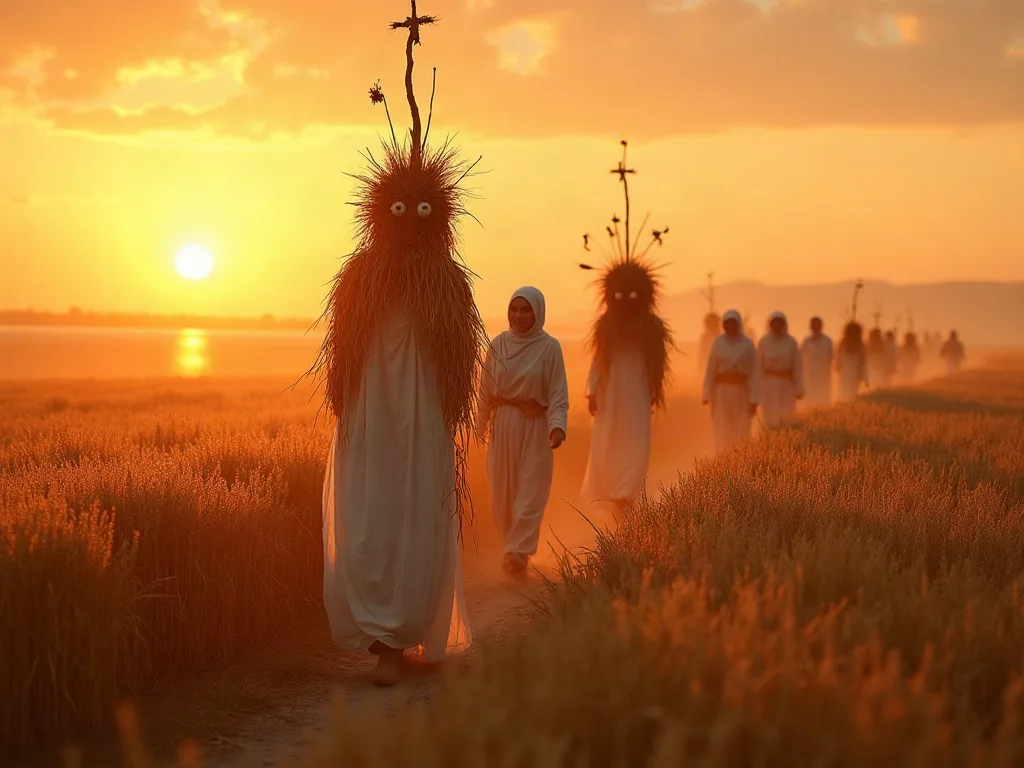
The village collectively performed the provody rusalki, the "sending off of the rusalka", at the end of the week. A straw effigy representing the rusalka was made, sometimes dressed in white, paraded through the village, and burned or thrown into the river. The ritual was not hostile. It was closer to a respectful farewell: you were welcome here for your season, now go back.
This calendar logic reveals something scholars like Marjorie Reeves and, more recently, Andreas Johns in his work on Slavic supernatural beings have noted: the rusalka functioned as a regulator of the boundary between seasons and between the worlds of the living and the dead. She was not simply a threat. She was part of the cosmic order.
What She Looks Like: A Portrait of Many Forms
No single image captures rusalka the water spirit completely, because her appearance varied enormously by region and by period.
In Russian and Ukrainian traditions collected before the twentieth century, the rusalka was often described as an ordinary-looking woman, pale, unsmiling, with her hair unbound and loose. Unbound hair was a marker of liminal status in Slavic culture: brides wore their hair loose before the wedding, and the dead were sometimes buried that way. The rusalka's hair was always wet, or, in forest variants, wild and tangled with leaves.
In some northern Russian accounts, she was ugly and old, more hag than maiden. In Ukrainian and southern traditions she was more often young and beautiful, which made her more dangerous precisely because men wanted to approach her.
The fish-tail variant, so familiar from Western popular culture, arrived later and came largely from urban, literary Slavic culture of the Romantic period. Writers like Pushkin absorbed Western fairy-tale conventions, and the image of the half-fish creature filtered into educated Russian imagination. Folk tradition almost never described rusalki this way.
What the folk traditions consistently agreed on:
- She was wet, or associated with moisture.
- She had exceptional hair, often green-tinged in river variants (from algae, people said).
- She could be heard singing or laughing near water.
- She could tickle a person to death, literally tickling until the victim's heart stopped. This detail appears across dozens of ethnographic collections.
- She could call a person by name, and if they answered, they were at risk of drowning or being led into the water.
How Rusalki Killed: The Mechanics of Enchantment
The danger of the rusalka was not brute force. It was seduction, enchantment, and a specific kind of disorientation that older Slavic communities called leshachestvo, being "led astray", the same thing forest spirits called leshiye could do.
A rusalka might approach a man on a forest path and ask him a riddle. If he answered wrong, she pulled him into the water. She might dance in a ring, and if a traveller stumbled into the ring, he would dance until he died of exhaustion. She might simply call out his name in a voice that sounded like his mother or his wife, and he would follow the sound off a cliff or into the river.
The tickling motif, shchekotanie, appears across Russian, Ukrainian, Belarusian, and Polish accounts and is specific enough to be a genuine folk-belief marker rather than a literary borrowing. The image is precise and strange: the rusalka holds a man and tickles him, laughing, until he stops laughing too. Scholars like the Polish folklorist Kazimierz Moszynski, writing in the 1930s, catalogued dozens of local variants of this death-by-laughter motif.
What protected a person? The protective plants were crucial: mugwort, wormwood, garlic, and certain grasses whose sharp smell was believed to repel the rusalka. Making the sign of the cross was also reported as effective in post-Christian accounts. Some village sources said that the rusalka could not cross iron, which she shared with many Slavic supernatural entities. And she could not enter a space that had been ritually closed: a home with a threshold charm, a field that had been blessed.
Rusalki and the Agricultural World: Fertility Behind the Danger
Here is the part of the rusalka story that popular retellings almost always miss: she was also a fertility figure.
The rusalki, precisely because they were spirits of the improperly dead concentrated around water, were believed to control rain, dew, and the moisture that made crops grow. When they danced in the rye fields during Rusalka Week, this was not simply a threat to farmers. It was also a blessing. The dew they left behind was considered sacred, good for the skin, good for the cattle, good for the grain. The wetness of the rusalka, the thing that made her uncanny, was the same force that kept the village alive through summer.
This double nature, dangerous and necessary, frightening and fertile, is characteristic of many Slavic supernatural beings. The domovoi, the household spirit, could protect a family or bring disaster depending on how it was treated. The rusalka operated on the same logic. You needed her dew on your rye. You just needed to survive the encounter.
The anthropologist Linda J. Ivanits, in her study "Russian Folk Belief" (1989), documents the specific ritual behaviors farmers used to simultaneously placate rusalki and benefit from their presence. Offerings of cloth, thread, and bread were left at the edges of fields. In some Ukrainian communities, young women performed ritual dances in the rye on the last day of Rusalka Week, acting out the rusalki themselves, essentially embodying the spirits to mediate between them and the living.
This ritual substitution, where humans perform the role of the dangerous spirit to defuse it, is one of the more striking features of rusalka tradition. It suggests that communities did not simply fear the rusalki. They understood them well enough to speak their language.
The Slavic Rusalka vs. the Greek Water Nymph
Scholars comparing Slavic tradition with Greek mythology sometimes reach for the naiad (a freshwater nymph of Greek myth) as a parallel to the rusalka. The comparison is understandable but imprecise.
Rusalka (Slavic)
Originates in the unquiet dead; a drowned or murdered woman transformed into a spirit. Her danger comes from incompletion and grief. She belongs to a ritual calendar with specific dates. She can bless fields and bring rain. Her power is communal and agricultural, rooted in village life. She is appeased through ceremony and eventually "sent away" at season's end.
Naiad (Greek)
Originates as a minor goddess or divine being, born of a Titan or Oceanus. Her nature is intrinsically divine, not transformed from a human death. She has no ritual calendar governing when she may move through the world. Her domain is beauty and the aesthetics of water, not agricultural fertility. She is not "sent away"; she is propitiated through sacrifice at her sacred spring.
The difference in origin is the key difference in everything else. The naiad is a god diminished. The rusalka is a human transformed. One carries divine essence. The other carries the weight of an unfinished life. That difference in emotional texture is exactly what makes the rusalka so persistent in Slavic imagination: she is recognizably human. She was someone's daughter.
Rusalka in Literature, Opera, and Modern Culture
The nineteenth century was decisive for the literary rusalka. Rusalka the water spirit moved from village ritual into high culture, and in doing so changed shape again.
Alexander Pushkin wrote his unfinished play Rusalka (begun around 1829), in which a miller's daughter, seduced and abandoned by a prince, drowns herself and becomes the queen of the rusalki. Her daughter, born underwater, becomes a creature of revenge. Pushkin kept the folk architecture intact: the drowned woman, the undead transformation, the grudge against the man who caused her death. But he added psychological depth that the folk tradition gestured at without spelling out.
Nikolai Dargomyzhsky set Pushkin's text to music in his opera Rusalka (1856), one of the first major Russian operas to use genuinely folk-inflected melody rather than Italian conventions.
The most famous musical rusalka, however, is Czech. Antonin Dvorak's opera Rusalka (1901), with a libretto by Jaroslav Kvapil, draws heavily on the Czech folk variant and on Hans Christian Andersen's "The Little Mermaid". Dvorak's rusalka gives up her voice to become human for the man she loves, is rejected, and returns to the water as a deadly spirit. His aria "Song to the Moon" (Mesicku na nebi hlubokem, "Moon, high and deep in the sky") is one of the most performed soprano arias in the operatic canon.
The rusalka also appears in:
- Ukrainian Romantic poetry of the nineteenth century, particularly in Taras Shevchenko's Lileya ("The Lily", 1846), which reimagines a rusalka as a grieving mother.
- Serbian and Bulgarian folk songs (narodne pesme) describing rusalki guarding wells.
- Contemporary Slavic fantasy literature, where the figure has become a staple of the slavic fantasy genre alongside the firebird and Baba Yaga.
- The 2023 Ukrainian animated short Mavka: The Forest Song, which draws directly on the rusalka-adjacent figure of the mavka (a Ukrainian variant of the rusalka).
Regional Variants: From Belarusian Forests to Polish Rivers
"Rusalka" is the Russian and Ukrainian name. The same creature type carries different names across the Slavic world, each with local flavor.
In Belarus, she is sometimes called rusalka but also kupalka, linking her to the midsummer festival of Kupala (a Slavic fire-and-water festival roughly corresponding to the solstice). The Belarusian variant tends to appear near grain fields as often as near water.
In Poland, the rusałka (same word, different orthography) is often interchangeable with the topielica, literally "the drowned woman", a female drowning ghost. Polish regional variants recorded in the Mazovia and Lesser Poland areas describe the topielica as a woman who drowned on her wedding day, making her grief specific and her grudge directed at happy couples.
In the Czech and Slovak traditions, the relevant figure is sometimes the víla or wila (a nature spirit with both benevolent and dangerous aspects), though the rusalka variant is also present. The víla is more ambiguously good, closer to a fairy than a ghost.
In Bulgaria and the former Yugoslavia, the samodiva (or samovila) holds the rusalka's ecological role: a female spirit of wild places who dances in circles, can lead men to their deaths, and must be appeased during specific ritual periods. The structural similarities are strong enough that most Slavic folklorists treat these as regional variants of one underlying type rather than entirely separate creatures.
What holds all these variants together: a female spirit connected to water or wild nature, generated by a violent or premature death, dangerous to men, active during specific seasonal windows, and appeasable through correct ritual behavior. The specific name changes. The underlying category does not.
Frequently Asked Questions About Rusalka the Water Spirit
Frequently asked questions
Is the rusalka the same as a mermaid?
Not exactly. The mermaid of Western tradition (part woman, part fish) is a distinct figure with different origins, largely in ancient Mediterranean seafaring cultures and Norman coastal folklore. The rusalka in older Slavic folk belief was fully human in shape, just pale, wet, and dead. The fish-tail image entered Slavic urban culture during the Romantic era through literary borrowing from Western sources. The folk rusalka was a ghost, not a hybrid creature.
Where does the word 'rusalka' come from?
The etymology is debated. The dominant scholarly view, advanced by Zelenin and later supported by Boris Rybakov in his work on Slavic paganism, connects rusalka to Rusalia, a spring festival for the dead that Slavic communities adopted and adapted from the Roman Rosalia rose-offering ceremonies. A minority view connects the root to Old Slavic rusa (referring to the color of water or flowing things). The festival connection is stronger because the rusalka and the ritual calendar are so tightly intertwined.
Could a rusalka ever be helpful or benevolent?
Yes, consistently so. Rusalki were believed to bring rain and dew to fields, making them guardians of agricultural fertility alongside their more dangerous aspects. Ritual offerings left at field edges during Rusalka Week were meant to cultivate their goodwill, not simply to ward them off. Some village accounts describe rusalki warning children away from dangerous water, inverting their usual association with drowning. The creature was ambivalent, not purely evil.
What is the difference between a rusalka and a mavka?
The mavka (also spelled navka) is a Ukrainian and Carpathian variant of the rusalka, drawn specifically from the souls of unbaptised children rather than drowned women. Mavky were considered even more dangerous than rusalki because they had never lived at all, making them more alien to human feeling. The mavka is central to Ukrainian Romantic literature, most notably in Lesya Ukrainka's dramatic poem Lisova Pisnya ("The Forest Song", 1911), where she appears as a forest spirit capable of love but unable to remain in the human world.
How did Orthodox Christianity change the rusalka tradition?
The Christianisation of Slavic lands (roughly ninth to thirteenth centuries for different regions) layered new explanations onto old beliefs without replacing them entirely. Unbaptised children, previously just zalozhnye pokoiniki (improperly dead), became specifically associated with rusalki under Christian thinking, because lack of baptism placed them outside the community of the saved. The ritual "sending off" of the rusalka was often performed near the feast of Pentecost, integrating the pagan calendar into the Christian one. The scholar Andreas Johns notes this process of "double faith" (dvoeverie in Russian), where Christian and pre-Christian beliefs coexisted in Slavic rural life well into the nineteenth century.
The Rusalka in 2026: Why She Keeps Coming Back
Folklore never simply dies. It migrates.
The rusalka has found new life in the last two decades through a specific route: the global appetite for Slavic mythology as an alternative to the Greek and Norse traditions that dominate Western fantasy. Writers like Katherine Arden, whose Winternight Trilogy (2017-2019) brought domovye and forest spirits to mainstream readers, have opened a door. The rusalka has walked through it.
She appears in video games (The Witcher series uses a variant called bruxa and water-hag topielec, and the 2019 game draws heavily on Slavic supernatural logic even where it reinvents names). She appears in Slavic dark fantasy art from Ukraine and Russia. She appears in diaspora poetry by writers processing generational grief through the image of the woman who went into the water and did not come back.
That last use is the most honest one. The rusalka was always a vessel for a particular kind of grief: the grief of a life cut short before it could be fully lived, the grief of the people left behind who did not know what to do with their feeling of guilt or loss. Giving that grief a form, a name, a week in the calendar when she was real and present and had to be dealt with through ritual, was a way of making the unbearable manageable.
Scholarship continues to refine the picture. Marjorie Reeves, Lyubov Vinogradova, and Andreas Johns have established strong regional databases of rusalka accounts. Ukrainian ethnographers documenting traditions disrupted by the war that began in 2022 are working to preserve rusalka-related ritual knowledge that might otherwise be lost with the communities that held it. The creature who came from loss is now being recorded against the threat of further loss.
She will outlast that threat too. She always has.
Read the full book
Want the whole story?
The complete edition is an instant PDF download here, with a paperback on Amazon for selected titles.
Slavic
The Slavic Mythology Book: Perun, Veles, Mokosh, and the Sacred Stories of Pre-Christian Russia and the Balkans
Thunder Gods, Serpent Lords, and the Witch in the Chicken-Leg Hut
The mythology of the Slavs before Cyril and Methodius: Perun's thunder against Veles' serpent coils, Mokosh's weaving, Baba Yaga's mortar flight, and the four-faced idols that stood in sacred groves.
More from Slavic
All articles
Slavic
Veles: Slavic God of the Underworld and Cattle
Veles rules wealth, the underworld, and herds in Slavic tradition. A shapeshifter and keeper of secrets, he stands at the boundary between the living world and the realm below. Discover the god who defied easy categories.
Slavic
Rod and the Rozhanitsy: Slavic Deities of Fate and Fertility
Rod weaves the threads of destiny while the Rozhanitsy nurture life itself. Discover how these ancient Slavic deities embodied the hidden forces that shaped families, harvests, and the very fabric of fate.

Slavic
The Cosmic Battle of Perun and Veles: Thunder, Chaos, and the Slavic Cosmos
In the Slavic cosmos, thunder god Perun and serpent deity Veles clash eternally: a primal battle between order and chaos, sky and underworld, that sustains the world itself. Discover the myths, the gods, and what scholars have found in the ruins of this ancient tradition.

Slavic
Domovoi: The Slavic Household Spirit
Meet the Domovoi, the ancient Slavic guardian spirit who dwells behind the stove and watches over a family's fortune. Learn how peasants and nobles alike honored this invisible master of the home, and why his blessing or curse could mean survival or ruin.