
Kupala Night: The Slavic Summer Festival of Fire, Water, and Hidden Fern Flowers
Kupala Night, the ancient Slavic midsummer festival, burns with fire-jumping rituals, river offerings, and the mythical fern flower that blooms only once a year. Here is what actually happens when the solstice arrives.
Contents
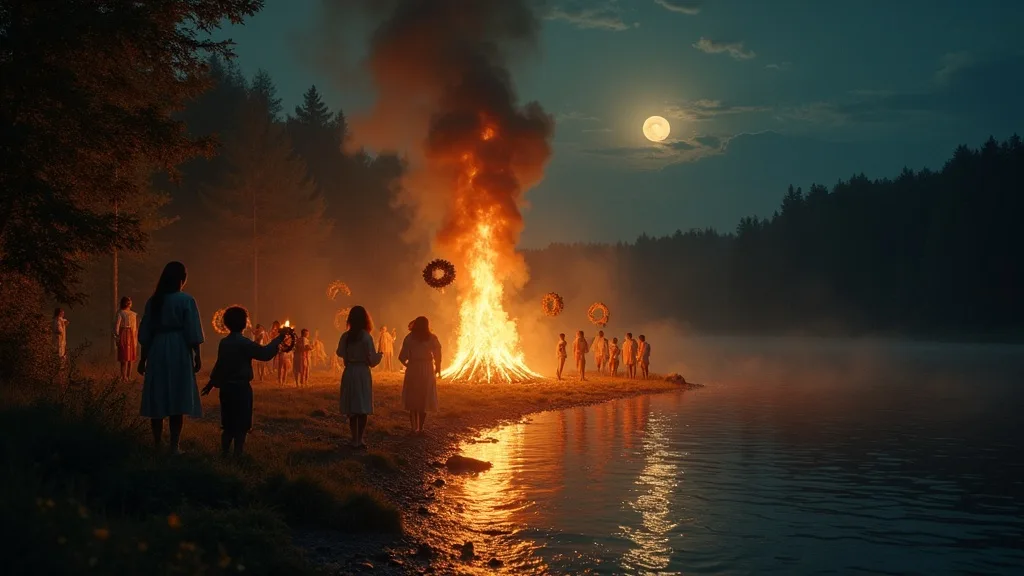
The fires go up at dusk. Across the riverbanks of Ukraine, Poland, Belarus, and Russia, young men stack wood as high as their shoulders, and the first sparks catch before the sky has fully darkened. Wreaths of wildflowers float downstream, their candle flames marking where the current takes them. Someone screams with delight, vaults the fire, and the night begins in earnest.
Kupala Night is the oldest surviving Slavic festival still practiced at scale, a midsummer gathering rooted in pre-Christian ritual that the Orthodox calendar eventually repositioned around the feast of John the Baptist (Ivan Kupala in East Slavic traditions). The calendar date shifted; the bonfires did not. The rites of fire-jumping, wreath-floating, and searching the forest for the mythical fern flower have persisted across a thousand years of Christianisation, Sovietisation, and cultural upheaval. That persistence alone tells you something about the depth of the instinct the festival satisfies.
This is a night when water cleanses, fire purifies, and the boundary between the human world and the spirit world grows thin enough to slip through.
The Name Itself: Who or What Is "Kupala"?
The etymology of Kupala is older and stranger than the later association with the Baptist. Scholars trace it to the Proto-Slavic root kup-, related to bathing, gathering, and heaping together. The Russian kupat'sya (to bathe), the Polish kąpać się, and the Old Church Slavonic kupati all share this root. The festival name means, at its most literal, "the bathing one" or "the great bath."
Pre-Christian Slavic tradition personified Kupala as a spirit or minor deity presiding over midsummer waters and vegetation. The figure appears in folklore manuscripts and ethnographic records from the 16th century onward, often described as young, crowned with flowers, and associated with the moment when standing water gains its maximum healing and purifying power. Whether Kupala was ever a fully anthropomorphised deity in the way that Perun or Veles were worshipped is a genuine scholarly debate. The 12th-century Primary Chronicle and later Gustynska Chronicle both condemn the festival's excesses without naming a presiding deity, suggesting that "Kupala" designated the ritual occasion itself more than a cult figure.
What the historical record makes clear is that the night's two central forces, fire and water, were treated as sacred opposites held in seasonal balance. The solstice was the pivot point where summer heat peaked and water held curative properties it would lose as the year aged. That cosmological moment, not any single god, was the true object of veneration.
Fire-Jumping and the Logic of Purification
The bonfire is not decorative. In Slavic folk belief, fire at midsummer carries a particular potency borrowed from the sun at its highest arc. The flames of Kupala Night were lit, traditionally, by friction: a wooden drill spun against dry tinder, producing what was called "living fire" (zhivoi ogon') as opposed to the mundane fire kept burning in a hearth. Living fire purified. Ordinary fire merely burned.
Participants leapt the bonfire singly, in pairs, and in groups. The quality of the jump carried meaning:
- A clean, high leap meant health and good fortune for the coming year.
- Stumbling or clipping the flames was read as a warning of illness or misfortune.
- Couples who successfully jumped holding hands were understood to be destined for marriage.
The flames were also used to burn effigies, old clothing, and bundles of herbs gathered specifically for the occasion. Burning nettles, wormwood, and mugwort during Kupala Night was believed to drive off malicious spirits called rusalki and lisovyki (forest spirits), who were thought particularly active around the solstice when the boundary between worlds was at its most permeable.
Cattle were driven through the dying embers at the end of the night. This was not theatrical; it was practical ritual technology aimed at protecting livestock from disease throughout the summer. The logic was consistent: fire that purified humans could protect animals too.
Wreaths, Rivers, and the Rusalki
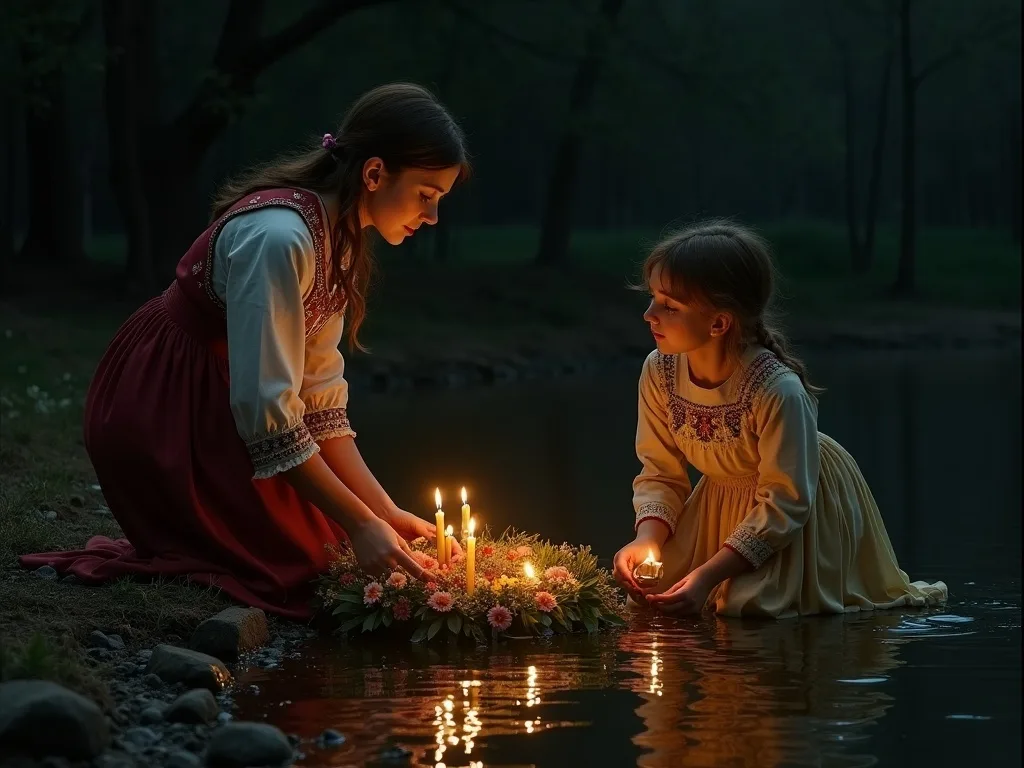
The water rites of Kupala Night mirror the fire rites in structure. Where fire purifies by consuming, water purifies by carrying away. Young women wove wreaths from wildflowers gathered before sunset: St. John's wort, cornflowers, chamomile, and fern fronds. Each wreath held a lit candle at its centre.
At the river's edge, a woman would set her wreath on the current and read its movement:
- A wreath that floated straight and far predicted a good marriage.
- One that circled back to shore suggested the year would pass without a husband.
- A wreath that sank immediately was an omen of death or serious illness.
Young men stationed themselves downstream to catch the wreaths, and a man who caught a wreath claimed a kind of symbolic claim on the woman who had sent it. This was one of the festival's licensed forms of courtship, one of several moments in the Kupala Night calendar where ordinary social rules around contact between unmarried men and women were relaxed under ritual sanction.
The rusalki, the water spirits of Slavic tradition, demanded respect on this night above all others. These figures occupied an ambiguous position in folk belief: they were the spirits of women who had died young, often by drowning, and they inhabited rivers and lakes. During the period around Kupala Night, known in some regions as Rusal'naia nedelia (Rusalka Week), they were believed to leave the water and walk among the living. Encountering one was dangerous. Offerings of bread, eggs, and ribbons left at riverbanks before the festival were intended to appease them.
The Fern Flower: A Myth Within a Festival
No element of the Kupala Night summer festival has captured the literary imagination quite like the fern flower. According to widespread Slavic folk belief, the fern (paporot') blooms exactly once a year, at midnight on Kupala Night. The bloom lasts only an instant. Anyone who witnesses it and seizes the flower gains the ability to understand the speech of animals, locate buried treasure, and see through all enchantments.
The fern, of course, is a non-flowering plant. Botanically, it reproduces by spore. The tradition almost certainly arose from the fact that fern spores, which ripen in late June and early July, were once believed to possess magical properties precisely because no one could see them clearly. In older folk accounts, fern "seeds" (the spores) were gathered on Kupala Night and carried in shoes or pouches to confer invisibility. The blooming fern is a later, more dramatic elaboration of this older spore-gathering practice.
The forest on Kupala Night is explicitly dangerous in folklore. To find the fern flower, a seeker must go alone into the woods, draw a protective circle around themselves with a knife or a piece of iron, and wait without speaking or looking at anything that appears at the circle's edge. The spirits trying to prevent the flower from being taken will shout, weep, call out in the voices of loved ones, and show terrible visions. The person who breaks the circle or answers a spirit's call loses the chance forever.
Kupala Night Across the Slavic World: Regional Variations
The festival is not a monolith. Its shape shifts significantly across geography, and the regional variations reveal how local communities adapted a shared ritual skeleton to their own conditions.
Ukraine holds the most elaborate surviving folk observances. The holiday is called Ivana Kupala and is treated as a major cultural celebration. Since 2023, as a direct consequence of Russia's full-scale invasion, many Ukrainian communities have moved their observance from July 7 back to June 23-24, explicitly reclaiming the pre-Julian calendar date and symbolically distancing the holiday from Russian Orthodox practice. This is a live cultural-political negotiation playing out in real time.
Poland calls the holiday Noc Kupały or, more widely, Noc Świętojańska (St. John's Night). Wreath-floating (puszczanie wianków) on the Vistula in Kraków is one of the largest public observances, drawing tens of thousands of participants. The Polish folk tradition emphasises the courtship elements: the night is as much about young love and pairing as it is about purification.
Belarus preserves perhaps the most archaic-feeling rituals. Ethnographers working in Belarusian villages in the late 19th and early 20th centuries documented elaborate multi-day preparations, including the construction of a straw effigy called Kupala or Marena (a figure also connected to winter and death), which was either burned or drowned at the festival's climax. This dual fate of the effigy, fire or water, reflects the festival's cosmological core.
Russia absorbed the holiday as Ivan Kupala with less institutional support after Soviet anti-religious campaigns; still, urban revivals in Moscow and St. Petersburg have grown significantly since the 1990s, often blending folk reconstruction with neo-pagan aesthetics.
Eastern Slavic (Ivan Kupala)
Observed July 6-7, Julian calendar. Strong association with the feast of John the Baptist. Effigy burning or drowning prominent. Cattle driven through embers. Fern flower search central to men's tradition.
Western Slavic (Noc Kupały)
Observed June 23-24, Gregorian calendar. Wreath-floating (puszczanie wianków) the dominant public ritual. Courtship and pairing foregrounded. St. John's wort (dziurawiec) gathered for medicinal use. Large urban observances in Warsaw and Kraków.
Herbs, Healing, and the Sacred Botany of Midsummer
The plant-gathering dimension of Kupala Night is one of its least-discussed aspects outside specialist ethnobotany, yet it was historically central. The belief was consistent across regions: herbs gathered before dawn on Kupala Night held their maximum potency for the entire year. The dew on the grass at sunrise was curative. Bathing in a river before the sun came fully up transferred the water's midsummer power to the bather's body.
Specific plants were assigned specific functions:
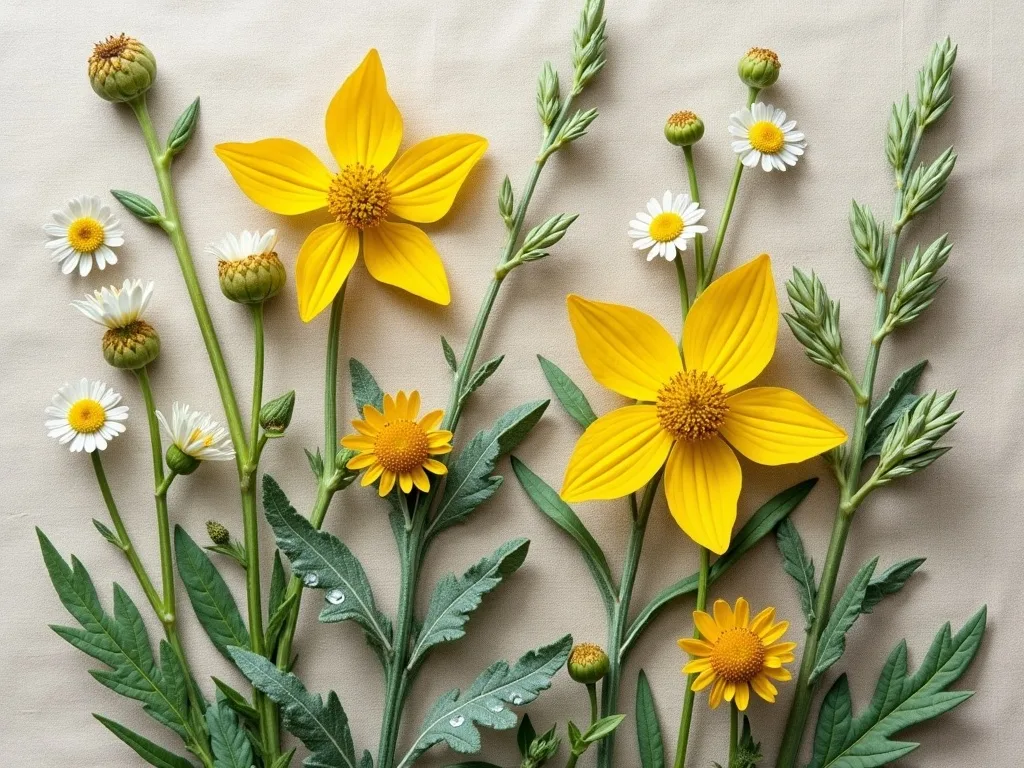
- St. John's wort (Hypericum perforatum): gathered to protect against evil spirits and cure melancholy. Its yellow flowers, opening around the solstice, visually echo the sun.
- Mugwort (Artemisia vulgaris): burned in fires to drive off harmful spirits, worn in garlands around the head to prevent tiredness during the long night's festivities.
- Water mint and chamomile: woven into wreaths and later dried as household protective herbs.
- Fern fronds: carried for luck and, in older practice, gathered for their "seeds."
The ethnobotanical record collected by Polish researcher Józef Rostafiński in the 1890s and expanded by Ukrainian folklorists of the Kharkiv Romantic School shows that Kupala herb-gathering was not casual. Specific collectors (often older women with established reputations) led gathering expeditions and maintained knowledge of which plants to take, from which kinds of ground, at which hour. This was specialist knowledge, transmitted within communities over generations.
Christianity, Soviet Policy, and the Festival's Survival
The Orthodox Church attempted to redirect Kupala Night at least twice. The first redirection placed the festivities on the eve of John the Baptist's nativity (June 24 Old Style), absorbing the pagan bonfire night into the Christian calendar under a new patron. This strategy worked partially: the name "Ivan Kupala" in East Slavic traditions fused the pre-Christian Kupala with the baptising saint, creating a genuinely syncretic celebration where neither strand fully consumed the other.
The second pressure came from Soviet anti-religious campaigns, particularly intense from the late 1920s through the 1950s. Kupala Night was classified variously as "religious superstition" and "bourgeois nationalism" depending on the decade. Observances were suppressed in some regions and tolerated or even repackaged as "folk culture" (stripped of ritual intent) in others. The Soviet regime's ambivalence is visible in the ethnographic record: collectors sent to document dying practices in the 1930s found them still very much alive in rural areas, precisely because fire, water, flowers, and dancing do not look like religion to a bureaucrat who associates religion with churches.
After 1991, the festival's recovery was rapid. In Ukraine especially, Kupala Night became a focal point for broader cultural reclamation. The holiday appears regularly in popular music, visual art, and literature as a symbol of continuity: proof that something survived.
Kupala Night in Slavic Literature and Art
The fern flower's grip on the literary imagination produced some of the tradition's most distinctive works. Nikolai Gogol's short story Vecher nakanune Ivana Kupaly (Evening on the Eve of Ivan Kupala, 1831-1832) is the best-known literary treatment: a young man gains treasure by committing a terrible act on Kupala Night, only to lose his memory and his identity. Gogol drew directly from Ukrainian folk narratives he collected during his childhood in Poltava, and the story's atmosphere, all flame-light and unease, captures the festival's double quality. The night is magical; it is also genuinely dangerous.
The Ukrainian Romantic painter Mykola Pymonenko produced the canvas Ivan Kupala in 1895, now in the National Art Museum of Ukraine in Kyiv. The painting shows young women launching wreaths on a river at dusk, the candlelight catching the water's surface. It became a defining visual shorthand for the holiday and remains widely reproduced.
In contemporary music, Kupala Night has inspired a substantial body of folk revival and neo-folk work. The Belarusian band Kupała (named for the poet and the festival both) and Ukrainian groups like DakhaBrakha incorporate Kupala Night imagery into performances that deliberately blur the line between concert and ritual.
What Kupala Night Reveals About Slavic Sacred Time
At the deepest structural level, Kupala Night belongs to a pattern of seasonal rituals visible across the Slavic year: the midwinter Koliada (connected to the winter solstice), the spring Maslenitsa (burning of winter), the spring flood Rusal'naia nedelia, and the harvest Dozhinki. Each pivot point in the agricultural year was marked by a moment when the boundary between the ordinary and the extraordinary became permeable. Fire, water, plants, and the spirits of the dead all moved closer to the living world.
This is not primitive superstition dressed up in flowers. It is a coherent calendar system in which human communities oriented themselves in time, managed anxiety about the future (Will the harvest hold? Will the livestock survive?), and reinforced the social bonds that made survival possible. The couple that jumped the fire together was making a public declaration. The woman whose wreath floated far had the community's attention and good wishes. The elder who led the herb-gathering held genuine authority rooted in genuine botanical knowledge.
The festival survived because it did real work. It still does.
Frequently Asked Questions About Kupala Night
Frequently asked questions
What is the difference between Kupala Night and Ivan Kupala?
They are the same festival viewed through different cultural lenses. "Kupala Night" (Noc Kupały in Polish, Kupala in Belarusian and Ukrainian) is the pre-Christian designation, emphasising the figure or spirit of Kupala and the midsummer rites themselves. "Ivan Kupala" is the East Slavic syncretic name that fused the celebration with the feast of John the Baptist after Christianisation. The rituals in both cases are largely identical; the naming reflects how much or how little a given community absorbed the Christian overlay.
Does the fern really flower on Kupala Night?
No. Ferns are non-flowering vascular plants that reproduce via spores. The "fern flower" is a mythological construct. Scholars believe the tradition derives from earlier beliefs about fern spores, which ripen in early July and were associated with magical properties because of their near-invisibility. The elaborated story of a flower blooming at midnight appears in 16th and 17th century sources and likely developed as the underlying spore-magic was forgotten and replaced with a more vivid narrative.
Who were the rusalki and why were they dangerous on this night?
The rusalki were spirits of women who had died young, often by drowning or suicide, and who inhabited bodies of water. In the period around the summer solstice, known as Rusal'naia nedelia (Rusalka Week), they were believed to emerge from the water and walk among the living. They were dangerous because they could lure young men to their deaths and cause illness in children. Protective measures included carrying wormwood (which rusalki supposedly feared), avoiding rivers after dark, and leaving offerings at the water's edge before the festival.
How is Kupala Night observed today?
Large-scale public observances take place across Poland, Ukraine, Belarus, and diaspora communities worldwide. In Kraków, the wreath-floating on the Vistula draws tens of thousands of spectators. In Kyiv, the festival has been revived with deliberate emphasis on pre-Christian Slavic heritage. Many communities hold bonfires, music festivals, and craft markets. Since 2023, numerous Ukrainian communities have returned to the June 23-24 date on the Gregorian calendar, reclaiming the holiday from its Julian-calendar association with Russian Orthodox tradition.
Is Kupala Night connected to other European midsummer festivals?
Yes, structurally. The bonfire tradition, the gathering of protective herbs, and the divination rituals of Kupala Night share broad parallels with Scandinavian Midsommar, Celtic midsummer fires, and the Germanic St. John's fires (Johannisfeuer). Scholars debate whether these parallels reflect shared Indo-European ancestry, independent parallel development, or later medieval exchange. The Latvian Jāņi and Lithuanian Rasos festivals are the most closely related, belonging to the same Baltic-Slavic cultural zone and preserving comparable fire, water, and herb-gathering rites.
What primary sources document the pre-Christian origins of Kupala Night?
The 12th-century Primary Chronicle (Povest' vremennykh let) condemns midsummer festivities among the Slavs, describing dancing, singing, and what the Christian author calls "devilish games" near water. The 17th-century Gustynska Chronicle is more specific, naming Kupala among other condemned spirits or celebrations. The richest documentation comes from 19th-century ethnographic collection, particularly the work of Pavel Chubynsky in Ukraine and Bronisław Gustawicz in Poland, who recorded rituals still practiced in living memory.
Kupala Night in 2026: A Living Ritual in Motion
The summer of 2026 will bring Kupala Night to communities that did not observe it a generation ago. Diaspora Ukrainians in Warsaw, Berlin, Toronto, and Chicago have built new observances over the past decade, adapting the festival to urban parks and community halls while preserving the core rites. Polish heritage organisations run wreath-making workshops in the weeks before June 23. Neo-pagan and reconstructionist Slavic communities across North America and Western Europe hold open-air gatherings that combine archaeological reconstruction with genuine communal celebration.
What is striking about this expansion is that it is not driven by tourism boards or heritage-preservation anxiety. The people building new Kupala Night fires are young, and they are doing it because the ritual makes sense to them. Fire and water, the solstice, the question of what comes next: these are not archaic concerns. They are structurally permanent.
The Slavic mythological tradition from which Kupala Night springs was never a tidy system with a fixed canon. It was a living body of practice, continuously adapted, never fully written down, always subject to local variation and creative reinterpretation. The festival itself models that flexibility. You can observe it on June 23 or July 7. You can float a wreath or jump a fire or simply stand at a riverbank and watch the candles go downstream. What remains constant is the gesture toward the night itself: the longest day just passed, summer at full burn, the river running dark, and the year beginning its long turn toward autumn.
That gesture has been made on these dates for longer than any written record captures. In 2026, it will be made again.
Read the full book
Want the whole story?
The complete edition is an instant PDF download here, with a paperback on Amazon for selected titles.
Slavic
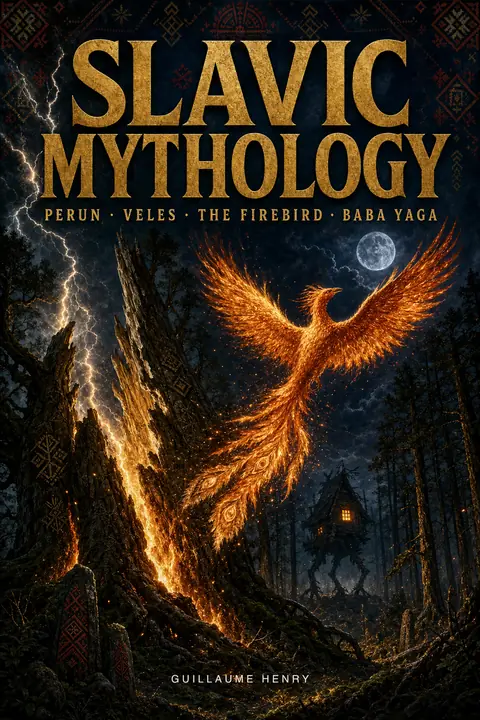
The Slavic Mythology Book: Perun, Veles, Mokosh, and the Sacred Stories of Pre-Christian Russia and the Balkans
Thunder Gods, Serpent Lords, and the Witch in the Chicken-Leg Hut
The mythology of the Slavs before Cyril and Methodius: Perun's thunder against Veles' serpent coils, Mokosh's weaving, Baba Yaga's mortar flight, and the four-faced idols that stood in sacred groves.
More from Slavic
All articles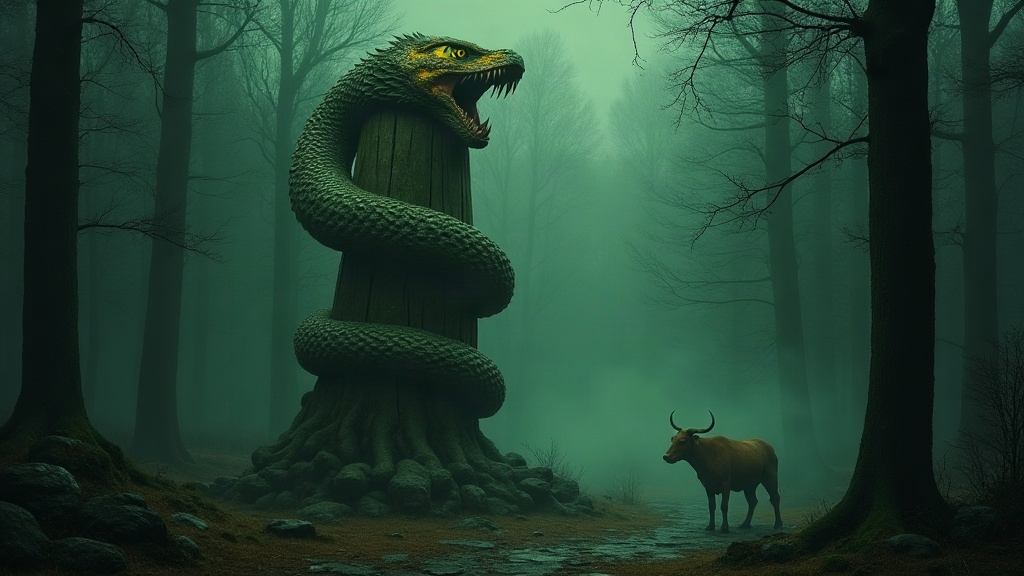
Slavic
Veles: Slavic God of the Underworld and Cattle
Veles rules wealth, the underworld, and herds in Slavic tradition. A shapeshifter and keeper of secrets, he stands at the boundary between the living world and the realm below. Discover the god who defied easy categories.
Slavic
Rod and the Rozhanitsy: Slavic Deities of Fate and Fertility
Rod weaves the threads of destiny while the Rozhanitsy nurture life itself. Discover how these ancient Slavic deities embodied the hidden forces that shaped families, harvests, and the very fabric of fate.

Slavic
The Cosmic Battle of Perun and Veles: Thunder, Chaos, and the Slavic Cosmos
In the Slavic cosmos, thunder god Perun and serpent deity Veles clash eternally: a primal battle between order and chaos, sky and underworld, that sustains the world itself. Discover the myths, the gods, and what scholars have found in the ruins of this ancient tradition.

Slavic
Domovoi: The Slavic Household Spirit
Meet the Domovoi, the ancient Slavic guardian spirit who dwells behind the stove and watches over a family's fortune. Learn how peasants and nobles alike honored this invisible master of the home, and why his blessing or curse could mean survival or ruin.