
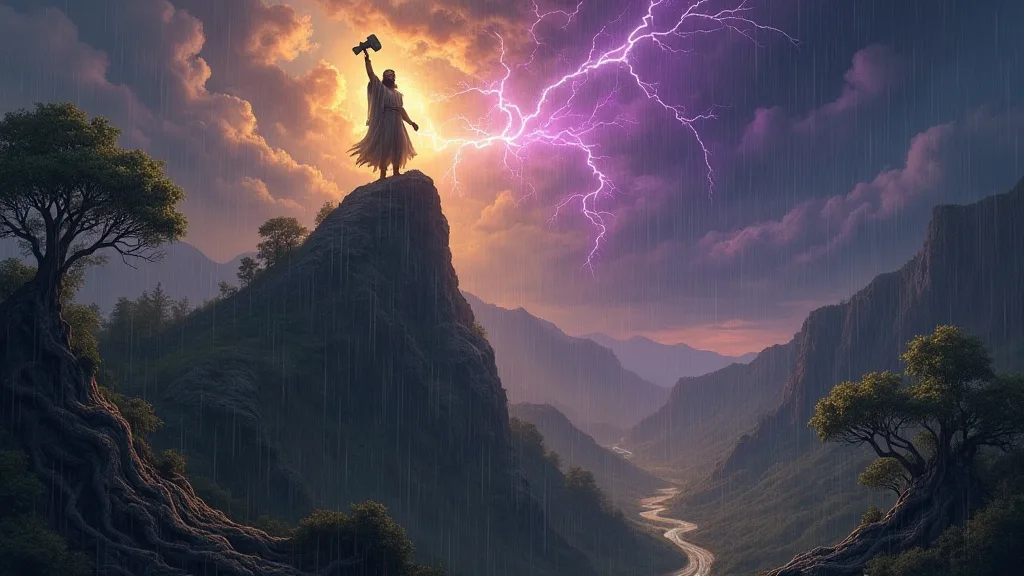
Perun the Slavic Thunder God: Storm, Oak, and the Eternal Serpent War
Perun ruled the storm-lit sky of the ancient Slavic world, hurling thunderbolts at a shape-shifting serpent below. His myth is one of the oldest battles in human memory.
Contents
The sky splits open. Rain hammers the earth. Somewhere above the clouds, a god with an axe is hunting.
Perun the Slavic thunder god stood at the very top of the ancient Slavic pantheon, the mightiest figure in a tradition that stretched from the forests of Poland to the steppes of Ukraine and deep into the Balkans. He was the lord of storms, the wielder of lightning, the guardian of the oath and the protector of the warrior. When thunder rolled across the sky, people did not ask what caused it. They knew: Perun was on the move, chasing his old enemy through the clouds.
His myth is not a polished literary text like the Greek Iliad or the Norse Edda. It survived in fragments: in folklore, in ritual, in the names of weekdays and plants, in the terrified prayers recorded by Christian missionaries who found, to their frustration, that Slavic peasants kept leaving offerings at ancient oak trees long after baptism. What those fragments reveal, when scholars piece them together, is a cosmic story of extraordinary age and power.
The Name Behind the Thunder
The word perun itself is ancient. Linguists trace it to the Proto-Indo-European root *per-, meaning "to strike". The same root surfaces in the Lithuanian thunder god Perkūnas, the Latvian Pērkons, and in the Vedic Sanskrit Parjanya, the rain deity. That family tree puts Perun in the company of Thor and the Vedic storm god Indra, all sharing a common ancestor from the Bronze Age steppe cultures that spread across Eurasia thousands of years before the first Slavic kingdom.
Scholars call this the "thunder god" archetype, but the shared root is more specific than just weather control. The Proto-Indo-European deity associated with this root was a sky warrior who fought a chthonic (underworld) serpent. That battle, reconstructed by comparative mythologists Marija Gimbutas and later Roman Jakobson, is the structural core of Perun's myth. You find it from the Vedic Vritra myth to the Norse Jormungandr to the Greek tale of Zeus and Typhon. Perun's version is among the best preserved of all.

The Eternal Enemy: Veles and the Serpent Below
No account of Perun the Slavic thunder god is complete without his opponent: Veles (also spelled Volos), the god of the underworld, cattle, wealth, and magic. Where Perun ruled the sky, Veles ruled everything below: the damp roots of the world tree, the realm of the dead, the wealth hidden under the earth.
The two gods were not merely rivals. They enacted a cycle. Veles, taking the form of a great serpent, would climb from the underworld into Perun's domain. He would steal cattle, or gold, or water, or sometimes even Perun's wife or children. Perun would give chase across the sky and down to earth, hurling his thunderbolts. Veles would shapeshift, hiding inside trees, stones, animals, even humans. Perun's lightning would split the oak, shatter the rock, send the serpent fleeing back underground. Rain would fall. The land would receive water. The cycle of the year would turn.
This is not a moral story where good defeats evil once and the matter is settled. It is a description of how the world works, repeated season after season. The storm chases the dry spell. Rain breaks the drought. Life returns to the fields. The theologian and folklorist Radoslav Katičić, working from South Slavic oral poetry collected in the 19th and 20th centuries, reconstructed whole scenes of this myth from scattered verses that farmers and herders had preserved without knowing the original cosmic context.
The two gods also defined a vertical cosmology. Perun lived at the top of the World Tree (a great oak or mountain peak), looking down. Veles lived at the roots, looking up. Between them stretched the human world. People needed both: Perun's rain to grow the grain, Veles's wealth to fill the storehouse. Angering either god was dangerous. But Perun was the one invoked in oaths. To swear by Perun meant the oath was bound by lightning.
Perun's Sacred Symbols: Oak, Axe, and the Iris
Every detail of Perun's worship points toward the same cluster of imagery: height, fire, and impact.
The oak was his tree above all others. Oaks are the trees most frequently struck by lightning (their deep root systems and height make them lightning conductors), and ancient Slavic communities throughout Central and Eastern Europe maintained sacred oak groves where Perun's fire was kept burning. The 10th-century Byzantine historian Leo the Deacon recorded that Rus warriors swore oaths to Perun and to their swords. The Primary Chronicle, the Povest' Vremennykh Let compiled by the monk Nestor around 1113 AD, records that treaties between the Rus princes and the Byzantine Empire in 907 and 945 AD were sworn in Perun's name, confirmed by laying weapons before his idol.
His weapon was the thunderbolt, represented in ritual objects as a stone axe or a stone arrowhead. Interestingly, Slavic peasants well into the 19th century called prehistoric stone tools "thunder stones" (gromovye strely in Russian, meaning "thunderbolts"), believing them to be the literal bolts Perun had thrown. People kept them in their homes as protection against lightning and fire. That is a remarkable example of mythological continuity across more than a thousand years of Christianity.
The iris flower (kosatets in some Slavic languages) was associated with Perun in ritual contexts, its sword-shaped leaves read as miniature lightning bolts. The number seven also appears repeatedly in Slavic thunder lore: seven oak trees, seven-day storms, rituals repeated on the seventh day.
The Idol on the Hill: Perun in Documented History
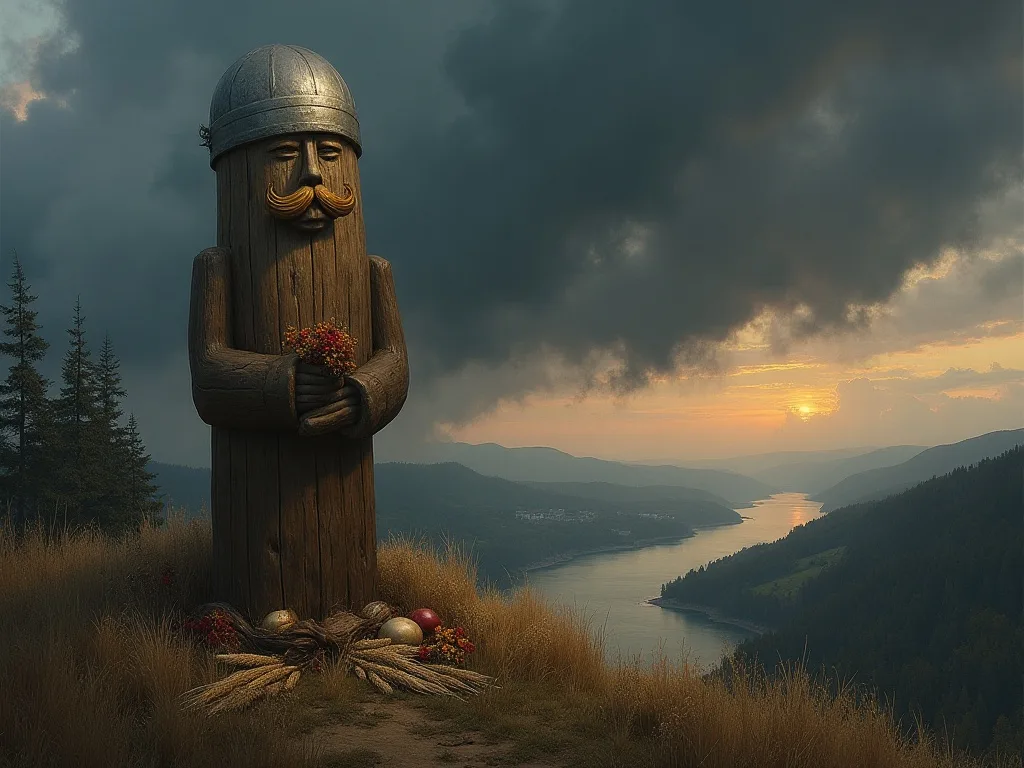
The single most vivid historical record of Perun worship comes from Kyiv in 980 AD. The Povest' Vremennykh Let describes how Prince Vladimir I of Kyiv, before his Christian conversion, erected a row of idols on the hill above the city. Perun's idol headed the list. It had a wooden body, a silver head, and a gold moustache. Alongside him stood Khors (a solar deity), Dazbog (a sky-sun god), Stribog (the wind), Simargl (a fire-bird figure), and Mokosh (the only goddess in the group, associated with fate and weaving).
Eight years later, in 988 AD, Vladimir converted to Orthodox Christianity and ordered all the idols thrown into the Dnieper River. Perun's idol was specifically floated downstream on a raft, and the chronicle records that mourning Kievans ran along the riverbank begging their god not to be taken away. That detail, even if partly invented by the Christian chronicler, tells us something real: Perun was not an abstract theological concept. He was a present, beloved, terrifying protector. His loss was felt like a death in the family.
The Christianization of Perun's attributes followed the pattern seen across Europe. The Church could not simply erase a thunder god with such deep roots, so it layered a new figure over the old one. Saint Elijah the Prophet (known as Sveti Ilija in South Slavic traditions, Il'ya Muromets in Russian heroic epic) absorbed almost all of Perun's storm attributes. Elijah rides a fiery chariot across the sky, causing thunder. He controls rain. He is celebrated on July 20, right in the thick of summer storms. In the Balkans, the folk rituals performed on Elijah's Day are often direct continuations of pre-Christian Perun rites. The thunder god did not die. He changed his name.
Perun Across the Slavic World: Regional Variations
Perun the Slavic thunder god did not look identical everywhere the Slavic languages spread. Regional differences are genuine, and they matter.
In South Slavic traditions (what is now Serbia, Croatia, Bosnia, Bulgaria, and North Macedonia), the conflict between the thunder god and the serpent figure is preserved in dozens of folk songs and oral epics collected by ethnographers like Vuk Stefanović Karadžić in the 19th century. The storm god often appears under the name Grom (thunder) or folded into the figure of Saint Elijah, but the structure of the myth, the aerial chase, the shapeshifting serpent, the liberating rain, is intact.
In Russian tradition, Perun's clearest folkloric echo is in the figure of the folk hero Il'ya Muromets, the great warrior of the Kievan byliny (oral heroic poems). Il'ya fights a series of monstrous opponents, including the serpentine Tugarin Zmeevich, in battles that structurally replay the Perun-Veles conflict. He is also associated with oak trees, oaths, and lightning-like power.
In Polish and Czech sources, the name Perun appears in medieval glosses and place names (mountains, hills, and springs across the Carpathians carry names derived from Perun), even though extended mythological narratives from these areas are thin. The place names alone confirm that Perun worship was geographically broad.
Perun (Slavic)
- God of thunder, storm, and sky
- Weapon: stone axe or thunderbolt
- Sacred tree: oak
- Eternal enemy: a serpent (Veles)
- Invoked in oaths and war
- Absorbed into Saint Elijah after Christianization
- Reconstructed largely from folklore and chronicles
Thor (Norse)
- God of thunder, storm, and strength
- Weapon: iron hammer (Mjolnir)
- Sacred tree: oak
- Eternal enemy: a serpent (Jormungandr)
- Invoked by warriors and farmers alike
- Persisted in Norse literature through the Eddas
- Documented in detailed 13th-century texts
The parallel between Perun and Thor is not a coincidence. Both descend from that same Proto-Indo-European thunder deity. But Perun's tradition is arguably closer in structure to the Vedic Indra vs. Vritra myth, where the cosmic serpent hoards the world's waters and the thunder god must free them through combat. The rain that follows Perun's victory is not incidental. It is the whole point.
The Cosmic World Tree and Perun's Place in Slavic Cosmology
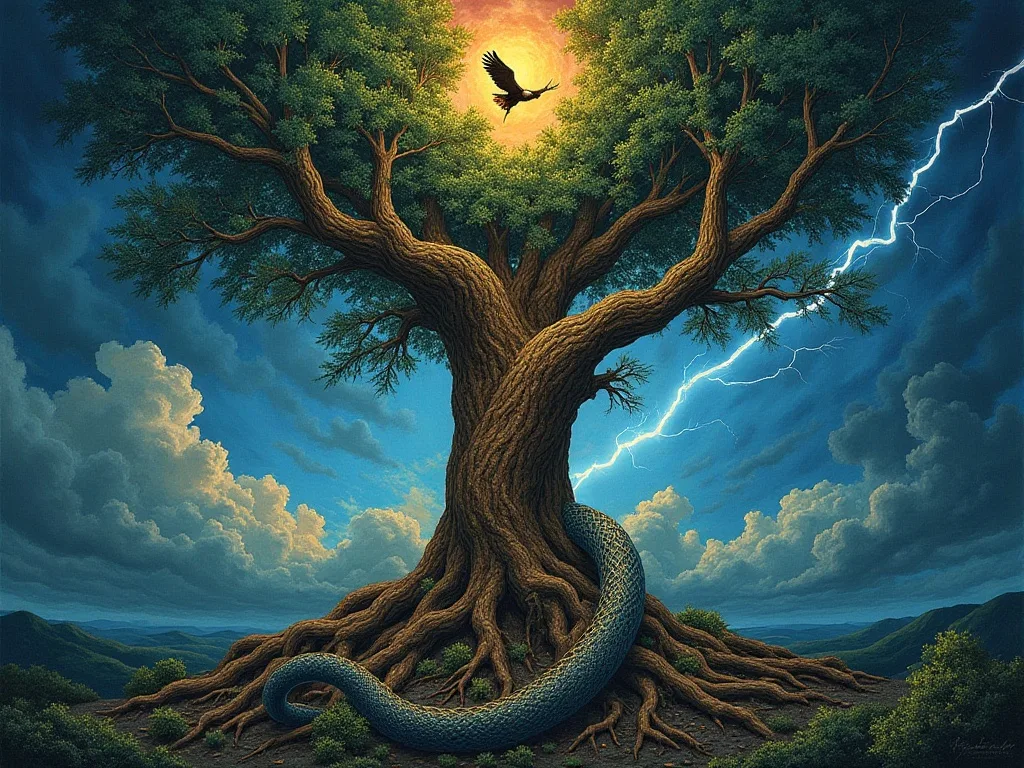
Slavic cosmology placed the universe in the structure of a great tree, a concept that scholars call the World Tree or Cosmic Tree (mirovoe derevo in Russian scholarship). Its crown touched the sky where Perun lived. Its roots reached the underworld where Veles waited. Its trunk was the living world of humans, animals, and plants.
This tree was most often imagined as an oak, and Perun sat at its peak, sometimes as a bird of prey (an eagle or a falcon), looking down. Veles coiled at the roots in serpent form, looking up. The two never truly stopped their contest. Every storm was a chapter of it.
The World Tree concept connects Slavic mythology to a much wider family of traditions. The Norse have Yggdrasil, the great ash tree with a dragon gnawing at its roots and an eagle in its crown. The Vedic tradition has the Ashvattha, the cosmic fig tree. The structural match is close enough that scholars like Georges Dumézil and Mircea Eliade treated it as a genuine shared archetype of Indo-European religious thought.
For Perun, the tree was not just a cosmological symbol. It was a map of power. His position at the summit explained why lightning hit high places first: mountains, hilltops, the crowns of old oaks. Lightning was not random destruction. It was a targeted strike by a god who knew exactly where his enemy was hiding.
Perun's Legacy in Language and Landscape
One of the strongest proofs of Perun's ancient importance is how deeply his name sank into the physical landscape of Slavic lands. Mountains, hills, springs, rivers, and forests carry Perun's name from Poland to the Balkans.
In Serbian, the word perunika (the iris flower) carries his name directly. In Russian, the archaic word prun meant "to jump" or "to strike", rooted in the same verbal energy as the god's name. The days of the week in some Slavic languages preserved his memory: Thursday (chetverg in Russian) was associated with thunder gods across the Indo-European world, Thursday being Thor's day in Germanic, Jove's day (Giovedi) in Italian, all pointing to the same sky-father cluster.
The lightning rod Slavic farmers used against storms was sometimes called the "Perun herb", a plant believed to repel lightning. This botanical folk magic persisted in rural areas of Ukraine and Belarus into the 20th century, documented by ethnographers like Vladimir Propp and Boris Rybakov. Rybakov's 1981 study Yazychestvo drevnikh slavyan ("The Paganism of the Ancient Slavs") remains the most comprehensive archaeological and textual argument for Perun's central place in pre-Christian Slavic religion, though later scholars have challenged some of his more speculative reconstructions.
The honest picture is one of a god who never quite disappeared. He was too useful, too embedded in the landscape, too present in the sound of every summer storm. Christian authorities found they could rename him but could not silence the thunder.
Frequently asked questions about Perun the Slavic thunder god
Frequently asked questions
What is the primary historical source for Perun worship?
The most direct source is the Povest' Vremennykh Let (Primary Chronicle), compiled around 1113 AD by the Kievan monk Nestor. It records that Prince Vladimir erected Perun's idol on a hill above Kyiv in 980 AD, describes the idol's silver head and gold moustache, and details its destruction in 988 AD during Vladimir's forced Christianization. Byzantine chronicles and the texts of Rus-Byzantine treaties from 907 and 945 AD, which invoke Perun as the Rus oath-god, provide independent corroboration.
How does Perun compare to Thor and Indra?
All three descend from a reconstructed Proto-Indo-European thunder deity associated with sky battle, storm, and a serpentine underworld enemy. Perun's combat with Veles mirrors Thor's conflict with Jormungandr and Indra's killing of the water-hoarding serpent Vritra. The weapons differ (axe vs. hammer vs. thunderbolt), but the cosmic function is identical: the thunder god breaks the serpent's hold, rain falls, and life continues. Perun is considered structurally closer to the Vedic tradition than Thor is, based on the "stolen waters" motif.
Which Christian saint absorbed Perun's attributes after Christianization?
Saint Elijah the Prophet, called Sveti Ilija in South Slavic languages and Il'ya Prorok in Russian, took on most of Perun's storm identity. According to Orthodox tradition, Elijah rides a fiery chariot across the sky, which folk belief interpreted as the direct cause of thunder. His feast day on July 20 falls in the peak of summer storm season, and in rural Balkan communities, the rituals performed on that day, including outdoor feasts near oak trees and animal sacrifices, trace directly back to pre-Christian Perun worship documented by ethnographers like Veselin Čajkanović.
Is the Perun-Veles myth a real reconstructed myth or a modern invention?
It is a genuine scholarly reconstruction, not a modern invention, though it requires careful handling. The framework was built primarily by Roman Jakobson in his 1985 essay "The Slavic God Veles" and expanded by Radoslav Katičić and Vitomir Belaj through detailed analysis of South Slavic oral poetry. The reconstruction draws on comparative Indo-European linguistics, folklore motifs, and medieval chronicle evidence. It is accepted by most specialists in Slavic religion, though scholars like Leszek Słupecki caution that some gaps in the evidence are filled by analogy rather than direct attestation.
Where can Perun's name still be found in Slavic languages today?
His name survives in several places. The Serbian and Croatian word perunika means the iris flower, named for its lightning-bolt-shaped leaves. Dozens of place names across Poland, Serbia, Croatia, Ukraine, and Slovakia preserve Perun's name in hills, mountains, and springs. In some archaic Slavic dialects, perun was also a common noun meaning "thunder". The continuity is striking: a god officially abolished in 988 AD left traces in everyday language and geography that are still visible more than a thousand years later.
What Modern Scholarship and Slavic Revival Say About Perun
Academic interest in Perun the Slavic thunder god has grown sharply since the late 20th century, partly driven by the broader revival of Indo-European comparative mythology after the work of Georges Dumézil and Marija Gimbutas. The Slavic materials, long considered too fragmentary to be meaningful, have been reappraised as a crucial dataset precisely because they preserve the oldest structural features of the Indo-European storm-god myth with the least literary distortion.
Katičić's collaboration with Belaj, published in Croatian as Gazdarica na Vrelima (2010), offered the most ambitious attempt to reconstruct a Slavic mythological calendar in which Perun and Veles enact their conflict at specific points in the agricultural year. The spring storm, the summer drought, the autumn rain, the winter silence: each was a chapter of the ongoing battle. Critics point out that the reconstruction sometimes moves faster than the evidence, but the underlying methodology, reading folk ritual backward to reconstruct the myth, is now standard in the field.
At the same time, Perun has become a central figure in the modern Slavic Native Faith movement (Rodnovery), a contemporary religious revival with practitioners across Russia, Ukraine, Poland, and the Czech Republic. For Rodnovers, Perun is not an academic reconstruction but a living deity, worshipped at outdoor shrines near oak trees, invoked before battles (including, controversially, by some combatants in recent Eastern European conflicts). The modern reception of ancient mythology is rarely tidy, and Perun's case is no exception.
What stays constant, across the 10th-century chronicle, the 19th-century folk song, the 20th-century linguistic analysis, and the 21st-century religious revival, is the image: a god at the top of the world, axe raised, scanning the roots of the great oak for the shape of his oldest enemy. The storm builds. The lightning falls. Rain soaks the earth. The wheat will grow.
The thunder has not stopped.
Read the full book
Want the whole story?
The complete edition is an instant PDF download here, with a paperback on Amazon for selected titles.
Slavic
The Slavic Mythology Book: Perun, Veles, Mokosh, and the Sacred Stories of Pre-Christian Russia and the Balkans
Thunder Gods, Serpent Lords, and the Witch in the Chicken-Leg Hut
The mythology of the Slavs before Cyril and Methodius: Perun's thunder against Veles' serpent coils, Mokosh's weaving, Baba Yaga's mortar flight, and the four-faced idols that stood in sacred groves.
More from Slavic
All articles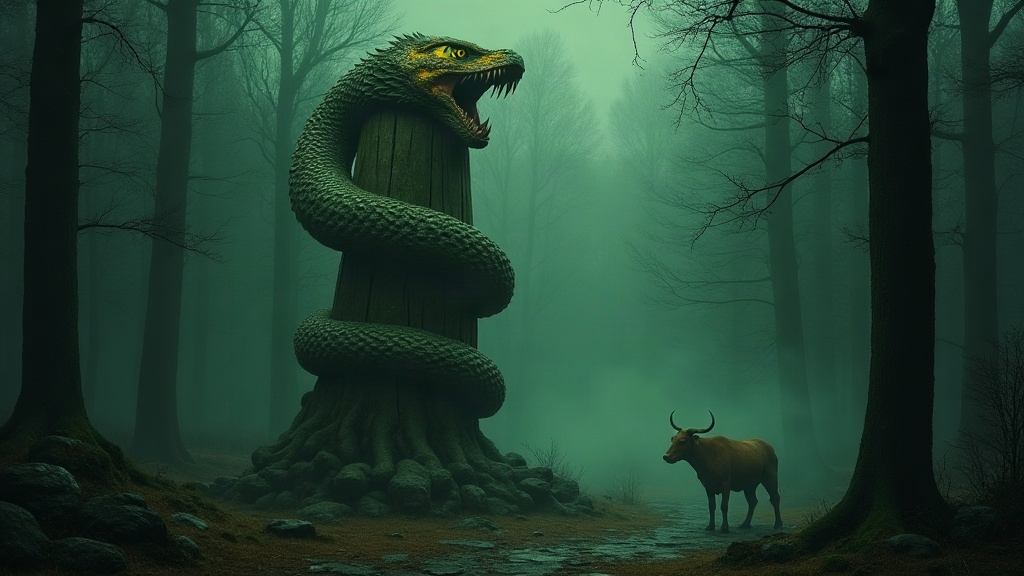
Slavic
Veles: Slavic God of the Underworld and Cattle
Veles rules wealth, the underworld, and herds in Slavic tradition. A shapeshifter and keeper of secrets, he stands at the boundary between the living world and the realm below. Discover the god who defied easy categories.

Slavic
Rod and the Rozhanitsy: Slavic Deities of Fate and Fertility
Rod weaves the threads of destiny while the Rozhanitsy nurture life itself. Discover how these ancient Slavic deities embodied the hidden forces that shaped families, harvests, and the very fabric of fate.

Slavic
The Cosmic Battle of Perun and Veles: Thunder, Chaos, and the Slavic Cosmos
In the Slavic cosmos, thunder god Perun and serpent deity Veles clash eternally: a primal battle between order and chaos, sky and underworld, that sustains the world itself. Discover the myths, the gods, and what scholars have found in the ruins of this ancient tradition.

Slavic
Domovoi: The Slavic Household Spirit
Meet the Domovoi, the ancient Slavic guardian spirit who dwells behind the stove and watches over a family's fortune. Learn how peasants and nobles alike honored this invisible master of the home, and why his blessing or curse could mean survival or ruin.