
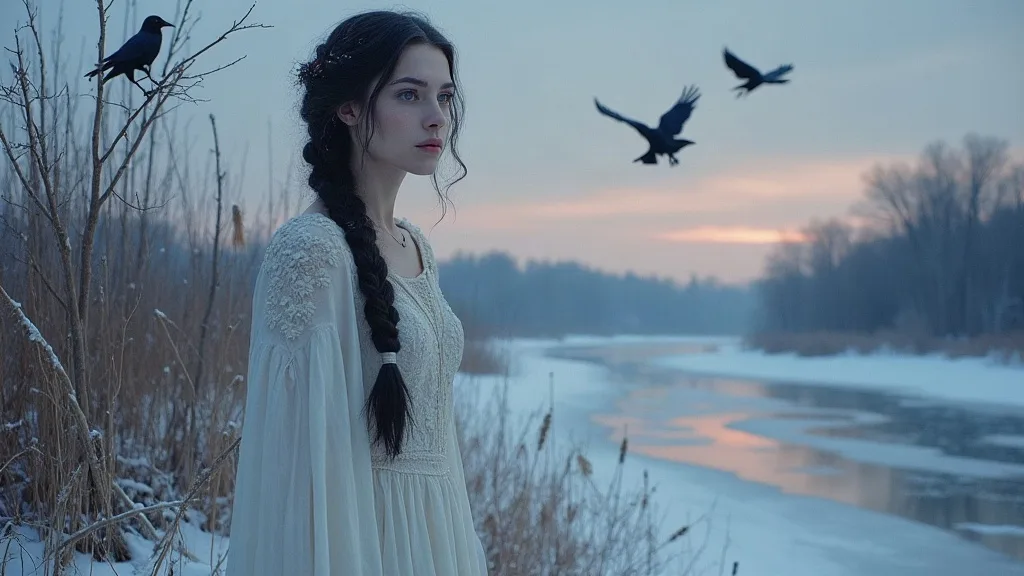
Morana: Slavic Goddess of Winter and Death
Morana rules the cold months in Slavic myth: a goddess of winter, death, and the dark season. Learn her stories, her symbols, and why villages still drown her effigy every spring.
Contents
The river is cold. The straw figure balanced above it wears a white dress, a garland of bare twigs, and a face painted in ash. Children circle her. Then they throw her in.
Every spring, from Poland to the Czech lands to Slovakia and beyond, villages have staged this ritual for centuries. The effigy sinks. Winter dies. The crowd cheers. The figure they drowned had a name: Morana, the Slavic goddess of winter and death. She was not a villain. She was a necessity. Without her, the world could not turn.
She is one of the oldest figures in Slavic religious imagination, traced through folk practice, folk song, place names, and scattered medieval chronicles that tried, often unsuccessfully, to capture beliefs older than the churches that were replacing them. She governed the half of the year that mattered most to anyone whose survival depended on harvest: the dark half, the hungry months, the season when the earth stopped giving and death came knocking.
The Name and Its Echoes Across Languages
Morana carries her meaning inside the syllable mor, a root shared across Indo-European languages for death, darkness, and pestilence. In Sanskrit, mara means death. Latin gives us mors (death) and morbus (disease). Old Irish has marb (dead). The goddess herself seems to hold all of these in her name at once.
She appears under several regional spellings. In Polish tradition she is Marzanna or Morena. Czech sources call her Morana or Mořena. Slovak folk practice knows her as Morena or Marena. In some South Slavic traditions she surfaces as Mara, a figure of nightmare and plague who rides sleeping people in the night, a memory of the same root deity refracted through centuries of regional variation.
The Russian word mor still means pestilence or mass death. When Slavic-speaking communities said her name aloud, they were already saying what she was.
This is not unusual in Slavic polytheism. Divine names frequently hold their portfolio inside them: Perun, the thunder deity, may connect to roots meaning to strike or to beat. The name was the function, compressed into two syllables.
What Morana Actually Ruled
Death and winter are her two pillars, but neither is quite as simple as it sounds in her mythology.
Winter, in the Slavic agricultural year, ran from roughly the autumn equinox through the spring equinox. It was not merely cold: it was the season of maximum vulnerability, when stored grain determined whether a family lived or starved, when disease spread fastest through villages crowded indoors, when ice made rivers impassable and travel lethal. Morana's dominion was, quite literally, the dominion of everything that could kill you between October and March.
Death, in her specific portfolio, covered natural death and the deaths that came from sickness and cold rather than war. This distinguished her from deities associated with battle-death, which in Slavic tradition carried entirely different connotations. Morana's deaths were the quiet ones: the old woman who stopped breathing in her sleep, the infant who couldn't survive a fever, the farmer who walked into a blizzard and didn't walk back out.
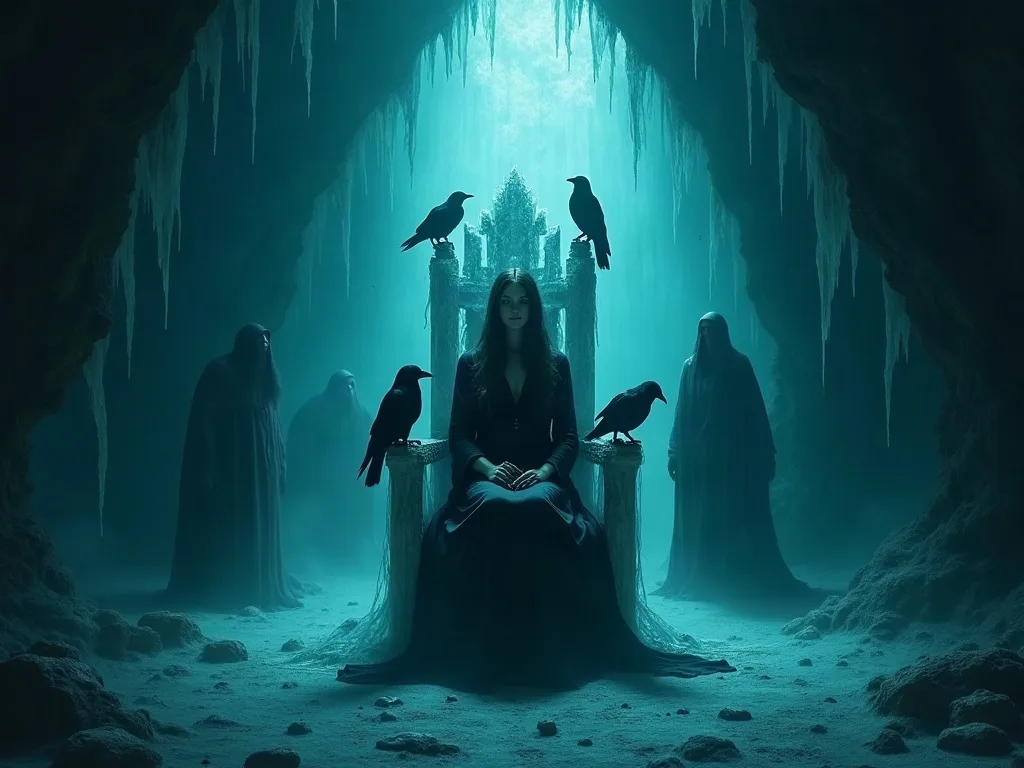
She also held authority over the Nav (sometimes written Nav'), one of three realms in Slavic cosmological thought. The Slavic cosmos divided existence into Prav, the realm of divine order and celestial gods; Yav, the living world of humans and nature; and Nav, the realm of the dead, ruled by darkness and spirits of ancestors. Morana presided over this Nav, the underworld that was less a place of punishment than a shadowed mirror of the living world.
The Spring Ritual: Drowning Marzanna
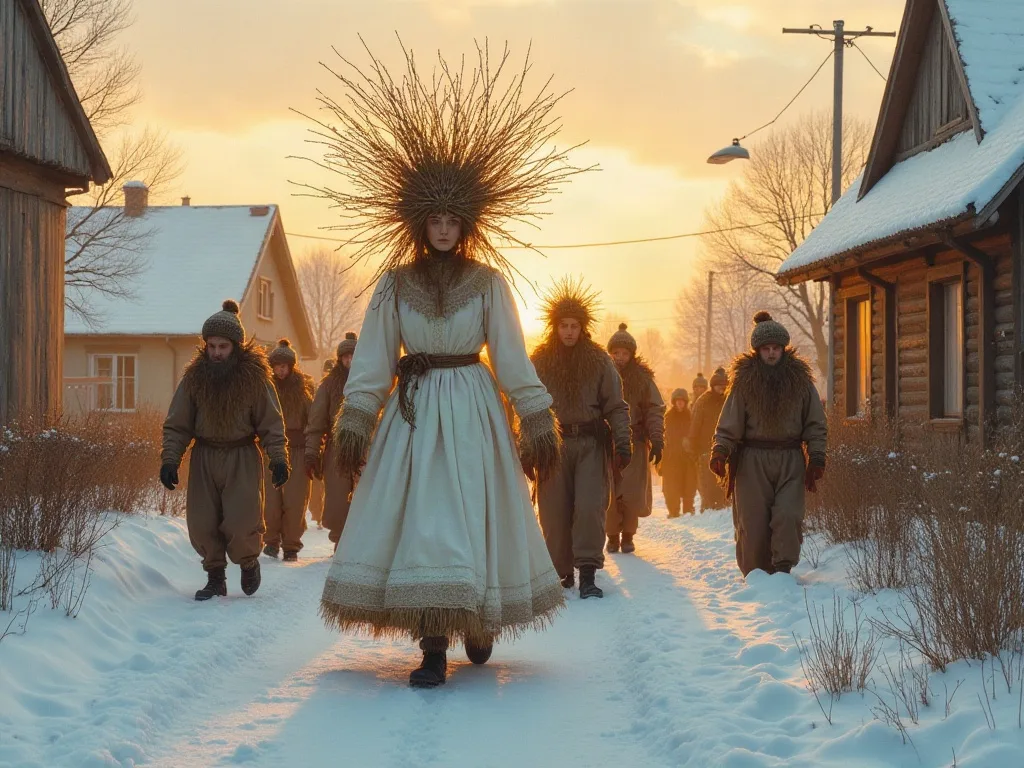
The ritual known across Central Europe as the drowning of Marzanna (or Morena, depending on the region) is the most tangible survival of Slavic goddess worship anywhere on the continent. It still happens. Villages in Poland, the Czech Republic, Slovakia, and parts of Ukraine carry out some version of it each year as spring arrives, though the religious dimension has long since blended into cultural tradition and local celebration.
The structure is remarkably consistent across hundreds of kilometers and multiple languages.
Communities, typically led by young women or children, construct an effigy of straw or rags. They dress it in white, or sometimes in colorful clothing meant to mock or honor her depending on the local tradition. They carry it in procession out of the village. They throw it into a river, a lake, or a pond. Sometimes they burn it first. Sometimes they drown it after burning. The key element is destruction followed by disposal: Morana must leave the village completely.
After disposing of the effigy, participants traditionally carried a green bough, a symbol of the returning life, back into the village. The sequence matters: death goes out, life comes back. The two cannot coexist; one must yield to the other.
Medieval Christian chroniclers who recorded these practices were uncertain what to make of them. A 15th-century Polish chronicle described young women carrying an effigy they called Marzanna to a river and submerging it, then returning with a green branch. The chronicle notes the practice with a mixture of disapproval and anthropological curiosity that runs through much of what we have.
Ethnographer Zofia Kossak-Szczucka documented 19th-century versions of the ritual in Polish villages where participants sang specific songs directly addressed to Marzanna, telling her to leave and not return until the following autumn. The songs were not hostile: they acknowledged her right to return. They just wanted her gone for now.
Morana and the Balance of the Year
Slavic religious thought, as reconstructed from folk practice, folk song, and the comparative work of scholars like Alexander Afanasyev (whose 19th-century collection Poetic Views of the Slavs on Nature remains a foundational source) and more recently Marija Gimbutas, operated on a strong principle of seasonal alternation. No deity simply won or lost. They took turns.
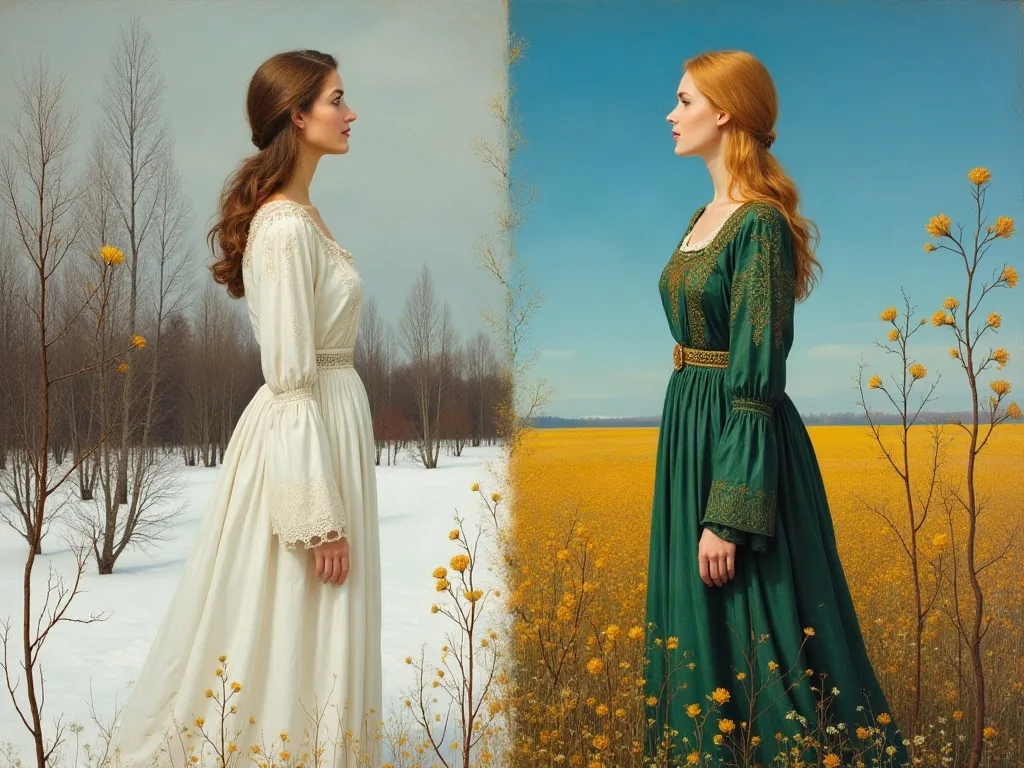
Morana's counterpart, in many traditions, is Vesna (sometimes called Zhiva in other regional variants), the goddess of spring, youth, and living nature. Where Morana brings cold and death, Vesna brings warmth, growth, and fertility. The year is their negotiation.
Morana
Domain: Winter, death, darkness, the realm of Nav, disease, cold months
Symbols: Straw effigy, white garments, bare branches, ice, snow
Season: Autumn equinox through spring equinox
Ritual action: Drowning or burning of her effigy at the start of spring
Mood: Austere, powerful, necessary, feared but not despised
Vesna
Domain: Spring, life, warmth, fertility, growth, youth
Symbols: Green boughs, flowers, nesting birds, running water
Season: Spring equinox through autumn equinox
Ritual action: Welcoming processions, flower garlands, songs addressed to her return
Mood: Joyful, gentle, desired, celebrated openly
The two are not enemies in any simple sense. They are the two faces of a single cycle. Morana's death is what makes Vesna's rebirth possible. Without the ground freezing, it cannot thaw. Without the old growth dying, new growth has no room. The ritual drowning of Marzanna is, read this way, not an act of hostility toward the goddess but a ritual permission slip: winter, your time is up, the cycle requires you to go.
This cosmological symmetry has led several scholars, including the Polish religious historian Aleksander Bruckner, to argue that Morana belongs to a genuinely archaic stratum of Slavic belief predating any significant contact with classical Mediterranean religion. Her structure is too embedded in agricultural necessity to be a later cultural borrowing.
Morana in Myth: Fragments and Reconstructions
Here the historian must be honest. The Slavic world did not produce a written mythology comparable to the Norse Eddas (the two Icelandic manuscripts, written around the 13th century, that preserved Norse myth in extraordinary detail) or the Greek Theogony (the poem by Hesiod, written around 700 BC, cataloguing Greek divine genealogy). Slavic polytheism was largely oral. When Christianity moved through Slavic-speaking lands from roughly the 9th century onward, the systematic recording of the old stories was not a priority for the missionaries doing the recording.
What survives comes from three main sources: medieval chronicles written by Christian clerics who mention pagan practices they wanted to suppress; the vast archive of folk songs, fairy tales, and ritual texts collected by folklorists in the 18th and 19th centuries; and comparative Indo-European mythology, which allows scholars to reconstruct probable shared features by triangulating related traditions.
From these fragments, a few narrative threads around Morana emerge.
In some South Slavic traditions she appears as Mara, a figure who visits the living at night, sits on sleeping people's chests, and brings nightmares and illness. This connects directly to the English word "nightmare" (from Old Norse mara, the same root, the same night-riding spirit) and to similar figures across German, French, and Scandinavian folklore. The root seems genuinely ancient.
In East Slavic fairy tales, a figure called Morena or Death (sometimes personified as a woman of extraordinary beauty) bargains with heroes, strikes deals, and is occasionally tricked, though never permanently defeated. The tales collected by Alexander Afanasyev in his monumental 19th-century anthology feature death-women who take the recently dead down into their underground realm, who punish the greedy and spare the humble, and who possess an absolute authority that no mortal cleverness can permanently circumvent.
In some Russian bylinas (oral epic poems, the long narrative songs that preserved pre-Christian memory alongside Christian imagery), a female figure associated with winter and death stands at the boundary between the living world and the underworld, sometimes represented as a crone, sometimes as a beautiful young woman, sometimes as both at different moments of the same encounter.
The shape-shifting between crone and beauty is significant. It appears in Celtic goddess traditions, in Hindu goddess traditions, and in Morana's orbit alike. The beautiful young woman is the promise of spring; the ancient crone is the weight of winter. They are the same person because winter always returns.
Symbols, Iconography, and Sacred Animals
Because no temple statues or classical-era artwork of Morana survives (Slavic polytheism was not a temple-building tradition in the classical sense; worship centered on outdoor sacred groves called roshcha, river crossings, and household shrines), her iconography comes primarily from folk art and the symbolic language of the ritual traditions.
White is her color. Not the white of purity in a Christian sense, but the white of snow, of bleached bone, of frost on a windowpane. The straw effigy is dressed in white because straw is what remains after the harvest is stripped away: the empty husk of what was once alive.
Bare branches appear consistently in her symbolism. Trees in winter, stripped of leaves, show their skeleton. The branch that accompanies her effigy in ritual is always leafless. The green bough that replaces her when she is drowned is deliberately, pointedly alive.
Birds associated with her lean toward corvids: crows and ravens, birds that stay through winter when others migrate, birds whose black plumage and intelligence made them natural messengers between the living and the dead in Slavic folk thought. The cuckoo, curiously, also connects to her: in Slavic folk belief, the cuckoo counted the years of life remaining to a person. Hearing it at the wrong moment was an omen of death.
The river matters. In Slavic cosmology, rivers are thresholds. They separate the living world from the dead world. Drowning Marzanna in a river returns her to Nav, the underworld she governs, through the boundary that rivers represent. The choice of water is not random and not merely practical. It is cosmologically precise.
Where Morana Connects to Other Traditions
The figure of a winter-death goddess drowned or expelled at spring is not unique to Slavic Europe, and this is exactly what makes Morana interesting to comparative mythologists.
Hel, in Norse mythology, governs the realm of the ordinary dead, those who did not die in battle. Her name gives English its word "hell," and her hall, named Hel like herself, sits in the frozen far north. She is half living woman, half corpse. Morana and Hel share: dominion over natural death, an underworld location, association with cold, a liminal physical form between life and death.
In Greek myth, Persephone is carried into the underworld each year, and her absence causes winter. Her return causes spring. The structural parallel to the Morana-Vesna alternation is exact: one female figure must descend or be expelled for the warm season to begin. Whether this reflects shared Indo-European ancestry or parallel cultural development from similar agricultural realities is a genuine scholarly debate.
The Hindu goddess Kali, black-skinned, garlanded with skulls, dancing on a corpse, governs destruction and time. Like Morana, she is feared, propitiated, and recognized as absolutely necessary. Without destruction, there is no renewal. Both traditions landed at the same insight through very different routes.
These parallels do not dissolve Morana into a generic "death goddess" type. She is specific: her white dress, her straw body, her Czech and Polish and Slovak village rituals, her crows, her frozen rivers. The parallels illuminate the depth of her archetype without erasing what is particular to her.
Morana in the Modern Imagination
The 20th century was not kind to Slavic pre-Christian mythology as a field of serious study. The Soviet Union actively discouraged research into folk religion that it categorized as superstition. Nationalist movements in various countries appropriated Slavic paganism selectively, distorting and romanticizing it for political purposes. Western scholarship, focused heavily on the better-documented Greek, Roman, and Norse traditions, left Slavic myth comparatively underserved.
Since the 1990s, that has shifted considerably. The growth of academic Slavic studies, new translations of Afanasyev and other primary collectors, and a broader cultural curiosity about pre-Christian European traditions have brought Morana back into serious discussion.
She appears in Polish fantasy literature, where she has become something of a canonical figure in the dark Slavic fairy tale genre that writers like Andrzej Sapkowski helped popularize internationally through the Witcher series. The series never names her directly but borrows heavily from the winter-death goddess archetype she represents, including the striga (a reanimated corpse connected to mara traditions) and the forest-hag figures drawn from the same mythological soil.
In Czech and Slovak folk-revival movements, the spring drowning of Morena has experienced something of a renaissance, with municipalities organizing public ceremonies that blend genuine folk tradition with consciously preserved cultural heritage. Participants are often fully aware they are enacting a pagan ritual while identifying as Christian: the two coexist in a way that would not have surprised medieval Slavic villagers, who managed similar coexistences for centuries.
Contemporary Slavic neopagan movements, particularly those grouped under the umbrella term Rodnovery (from rodna vera, "native faith"), have formally re-incorporated Morana into active religious practice. Rodnovery has grown substantially across Russia, Poland, Ukraine, and the Czech Republic since the 1990s, though scholars are careful to note that modern Rodnovery practices are reconstructions, often well-researched ones, rather than unbroken survivals.
Frequently Asked Questions About Morana, Slavic Goddess of Winter
Frequently asked questions
Is Morana the same as the Slavic goddess of death, or are they separate figures?
Morana holds both winter and death in her portfolio simultaneously. In Slavic cosmological thought, the two were inseparable: winter was the season of death, and death was winter's most reliable companion. Some regional traditions differentiate figures more sharply (a specific Smert, or Death, appears in East Slavic fairy tales as a distinct personification), but in the broadest shared tradition, Morana is the primary female divine figure governing both cold and mortality. She should be understood as a goddess of the dark half of the year in its fullest sense, not merely as a personification of one season or the other.
Where does the evidence for Morana come from, given that Slavic mythology was mostly oral?
The evidence comes from three overlapping sources. Medieval Christian chronicles from the 10th to 15th centuries occasionally mention pagan practices by name, including the Marzanna/Morena ritual. 19th-century ethnographers, particularly in Poland, Russia, and the Czech lands, recorded folk songs, ritual descriptions, and oral traditions in extraordinary detail before industrialization erased them. Comparative Indo-European linguistics and mythology allow scholars to cross-reference Slavic figures against better-documented related traditions, identifying probable shared archaic features. No single source is definitive, but the convergence of all three is strong.
Why is the spring drowning of Marzanna still practiced today?
The ritual survived partly because it was adaptable. By the time Christian missionaries reached most Slavic regions (between the 9th and 12th centuries), the Marzanna ritual was already too deeply embedded in agricultural community life to extinguish cleanly. Church authorities attempted to ban it repeatedly and largely failed. Over the centuries it shed its explicitly religious framing and became a folk custom, a cultural celebration of seasonal change, without losing its basic structure. Today it persists as both genuine folk tradition and consciously preserved heritage, depending on the community.
How is Morana different from Baba Yaga?
They share territory but are distinct figures. Baba Yaga, the ambiguous crone of East Slavic fairy tales, lives in a hut on chicken legs at the edge of the forest and tests heroes who come to her door. She can help or destroy depending on her mood and the hero's conduct. Morana is a divine figure governing a cosmic domain, not a fairy-tale character testing individual travelers. That said, the crone aspect of Morana and the figure of Baba Yaga draw from the same mythological soil: both represent the dangerous, death-adjacent power that lies at the boundary of the known world. Some scholars, including Marija Gimbutas, treat Baba Yaga as a later folk crystallization of the older goddess type that Morana represents.
Does Morana appear under other names in related traditions?
Yes. The root mor (death, darkness) generates cognate figures across related cultures. Old Norse Mara (the nightmare spirit) shares both the root and the night-riding function seen in South Slavic Mara traditions. The Sanskrit Mara is the Buddhist death figure who tempts the Buddha. Germanic Mare and French Cauchemar (nightmare, literally "treading Mara") all descend from the same ancestral figure. Whether these all ultimately derive from a single Proto-Indo-European goddess-type is debated, but the family resemblance is too consistent across too many traditions to be coincidence.
Morana's Unresolved Question: Goddess or Personification?
Scholars still argue about the exact status Morana held in Slavic religious practice before Christianity arrived. The question matters more than it might seem.
A goddess is a distinct divine person with a mythology, a cult, priests or priestesses, a relationship with other deities, and an active role in cosmological narrative. A personification is a more abstract figure: winter given a name and a dress, but not necessarily worshipped or narrated as a person in her own right.
The evidence sits uncomfortably between the two. The spring ritual is consistent with genuine cult practice: it is structured, repeated annually, accompanied by specific songs, and requires the effigy to be constructed according to specific rules. That looks like religion, not metaphor. But no Slavic temple to Morana has ever been found. No chronicle names priests or priestesses who served her specifically. The written record of her as a figure with a personal mythology is thin.
Alexander Bruckner, whose 1918 study Mythologia Slowianska remains influential despite its age, argued that many figures identified as Slavic gods by later scholars are actually personifications elevated by Romantic-era folklorists who wanted Slavic mythology to look more like Greek mythology. He applied this skepticism to Morana specifically.
More recent scholars, particularly those working with the ritual evidence rather than the literary evidence, push back. Luba Michajlova and other ethnoreligious historians argue that the consistency and geographic spread of the Marzanna ritual across hundreds of kilometers and multiple distinct Slavic language branches is more consistent with genuine shared religious heritage than with a spontaneous parallel invention of the same ritual by unconnected communities.
The honest answer is that the question is open. What is not open is the reality of the ritual, the depth of her cultural presence, and the genuine antiquity of the root she carries in her name. Whether she was worshipped as a person or invoked as a principle, Slavic communities across Central and Eastern Europe built a ceremony around her that they repeated every spring for at least a thousand years. That is a kind of proof that does not require a temple to be valid.
Read the full book
Want the whole story?
The complete edition is an instant PDF download here, with a paperback on Amazon for selected titles.
Slavic
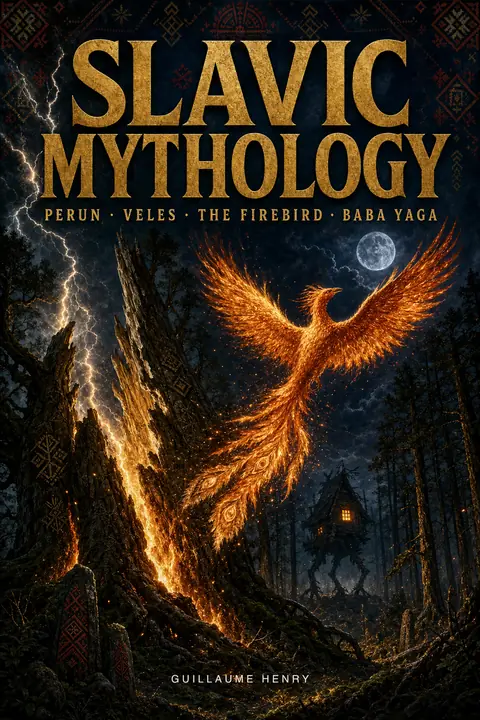
The Slavic Mythology Book: Perun, Veles, Mokosh, and the Sacred Stories of Pre-Christian Russia and the Balkans
Thunder Gods, Serpent Lords, and the Witch in the Chicken-Leg Hut
The mythology of the Slavs before Cyril and Methodius: Perun's thunder against Veles' serpent coils, Mokosh's weaving, Baba Yaga's mortar flight, and the four-faced idols that stood in sacred groves.
More from Slavic
All articles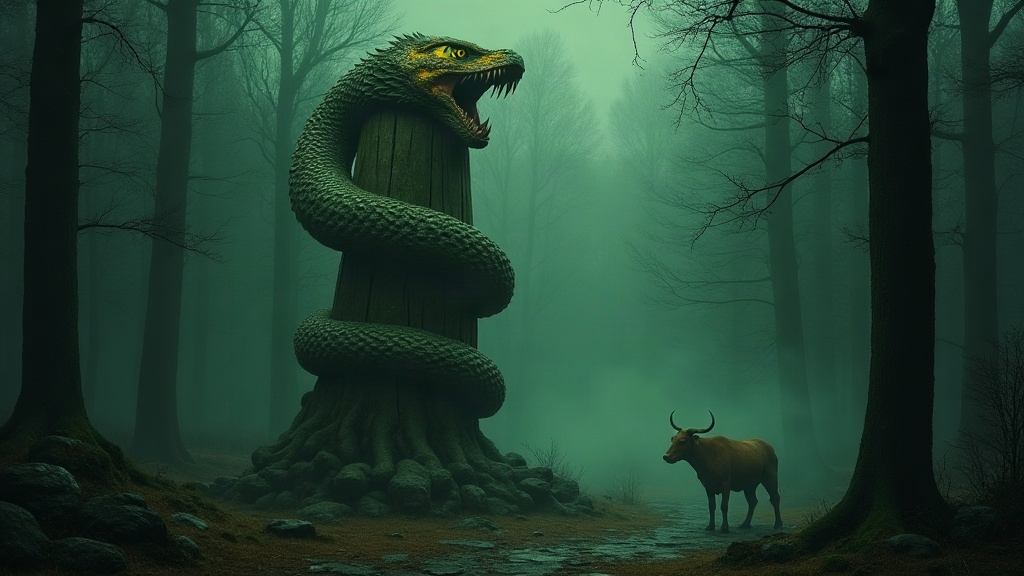
Slavic
Veles: Slavic God of the Underworld and Cattle
Veles rules wealth, the underworld, and herds in Slavic tradition. A shapeshifter and keeper of secrets, he stands at the boundary between the living world and the realm below. Discover the god who defied easy categories.
Slavic
Rod and the Rozhanitsy: Slavic Deities of Fate and Fertility
Rod weaves the threads of destiny while the Rozhanitsy nurture life itself. Discover how these ancient Slavic deities embodied the hidden forces that shaped families, harvests, and the very fabric of fate.
Slavic
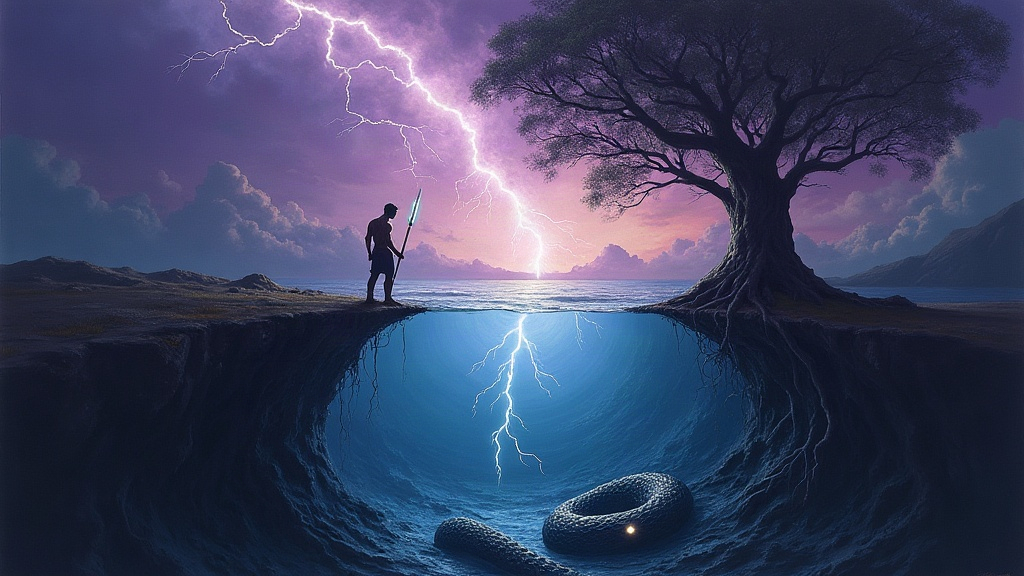
The Cosmic Battle of Perun and Veles: Thunder, Chaos, and the Slavic Cosmos
In the Slavic cosmos, thunder god Perun and serpent deity Veles clash eternally: a primal battle between order and chaos, sky and underworld, that sustains the world itself. Discover the myths, the gods, and what scholars have found in the ruins of this ancient tradition.

Slavic
Domovoi: The Slavic Household Spirit
Meet the Domovoi, the ancient Slavic guardian spirit who dwells behind the stove and watches over a family's fortune. Learn how peasants and nobles alike honored this invisible master of the home, and why his blessing or curse could mean survival or ruin.