
Tangaroa: God of the Sea and Fish in Maori Mythology
Tangaroa rules the ocean depths in Maori mythology, commanding every fish and sea creature. Trace his origins, his cosmic rivalry with Tane, and his enduring power across Polynesia.
Contents
The ocean off Aotearoa has no visible bottom. Stand at the coast and you see the surface shift and breathe, endless grey-green water pushing toward the horizon. To the Maori people who sailed to these islands across thousands of kilometres of open Pacific, that water was not empty. It was alive with a presence, a personality, a will. His name was Tangaroa, and he did not merely live in the sea. He was the sea, from the surface spray to the lightless floor.
Ancient whakapapa, the genealogical chants that Maori tradition uses as both history and cosmology, place Tangaroa among the most senior children of Ranginui (the Sky Father) and Papatuanuku (the Earth Mother). He is older than most human reckoning. Long before the first canoe touched Pacific water, he was already there, breathing beneath it.
What makes Tangaroa unusual, even among powerful gods, is that his domain defines human survival. For people who crossed the Pacific in double-hulled waka (canoes), who fished the open water for centuries, who read the sea to navigate between island groups, this god was not a figure of idle worship. He was the power you bargained with every time you left shore.
The Birth of Tangaroa: Sky Father, Earth Mother, and the Children of Light
Before Tangaroa existed, there was only Te Kore, the void, and Te Po, the long darkness. The Maori creation tradition, preserved in oral chants sung by trained tohunga (priestly experts), describes a cosmos that begins in absolute nothingness and gradually fills with being.
Ranginui and Papatuanuku lay locked together, their bodies pressed so tightly that no light could enter. Their children, cramped in the darkness between them, grew restless. The Maori oral tradition names these children differently across iwi (tribal groups), but Tangaroa consistently appears as one of the most powerful: a primary deity born before the separation of sky and earth.
When Tane, the god of forests and birds, finally pushed his parents apart with his legs, light flooded the world for the first time. It was a violent, necessary act, and each child staked out a domain in the new light. Tane claimed the forests. Tumatauenga claimed war and humanity. Rongo claimed cultivated food. Tangaroa, moving swiftly toward the horizon, claimed everything the light touched on water.
Some traditions, particularly those recorded by ethnographer Elsdon Best in the early twentieth century, describe Tangaroa as initially fleeing into the ocean when his parents separated. Not from cowardice, but because the sea was always his place. He slipped into it the way a sea creature returns to its element: instinctively, completely.
The separation of sky and earth was also a wound. Papatuanuku weeps still: her tears are the morning dew. Ranginui's grief falls as rain. Tangaroa receives both, absorbing the sorrow of creation into his body. In this sense he is not only a domain-holder but a container for cosmic loss, the place where the sky's longing finally settles.
Tangaroa and Tane: A Rivalry Written into Nature
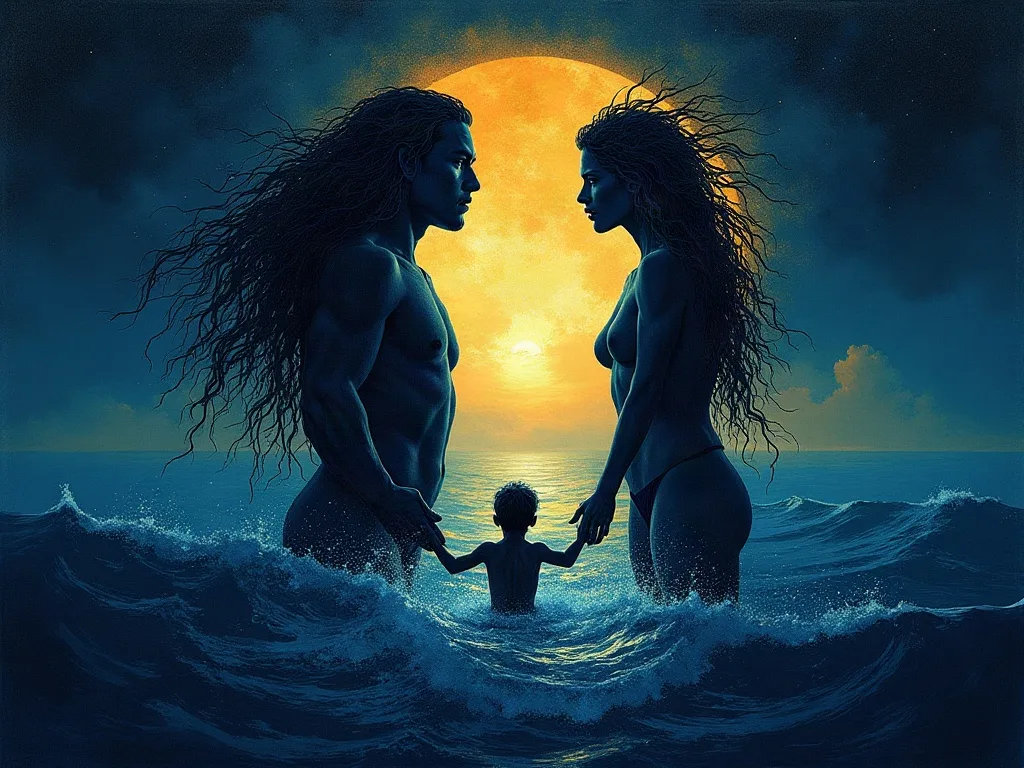
The tension between Tangaroa: God of the Sea and Fish and Tane, lord of the forest, is one of Maori mythology's most generative conflicts. It explains the world as Maori people actually experience it: the constant tension between sea and forest, fish and bird, the ocean that swallows trees and the trees whose roots resist floods.
The conflict sharpened around a specific betrayal. Some creatures originally belonged to Tangaroa but chose to live on land instead, sheltering among Tane's trees. Reptiles made this choice. The tuatara, the gecko, the skink, all reptiles that can live near water but move on land, were understood as deserters who abandoned Tangaroa for his brother's domain. Tangaroa never forgave it.
Tane responded by providing wood for the canoes and fishing nets that humans used to catch Tangaroa's fish. Every time a fisherman cast a net woven from Tane's flax or paddled a canoe carved from Tane's trees, the rivalry was being played out in real time. The sea gave fish; the forest gave the tools to catch them. Neither god could function without the other, and neither could accept the fact.
This is not a story about evil and good. Both brothers are powerful, legitimate, and justified in their grievances. The Maori mythological imagination is comfortable with that kind of moral complexity: gods in genuine conflict over genuine principles, with no resolution that satisfies everyone.
Tane Mahuta, god of the forest, stands as Tangaroa's direct counterpoint in the Maori pantheon, and the friction between their domains runs through dozens of ritual practices. Where Tane's trees reach upward into Ranginui's sky, Tangaroa's depths pull downward into an underworld of cold and pressure. The axis of the cosmos runs between them.
The Body of the God: What Tangaroa Holds
Tangaroa is not simply a metaphor for the sea. In Maori theology, he is the sea's substance. Every fish, every crab, every shark, every whale moves through his body. The whales carry a specific weight in this cosmology: they are sometimes described as Tangaroa's children, vast and sovereign, deserving of particular caution from fishermen. To harm a whale carelessly was to strike the god's own kin.
His realm is called moana (the deep ocean), and Maori oral tradition distinguishes it carefully from the shallower tai (coastal waters). The moana is where Tangaroa is most fully himself, an unbounded presence with no edges. When fishermen in traditional Maori society pulled a catch from deep water, they performed specific karakia (prayers) acknowledging the gift. The fish did not belong to the fisherman. They were loaned from a god who could reclaim them at any moment in the form of a storm.
The sea's moods, its sudden swells, its calm stretches, its green-black depth in winter, were all read as Tangaroa's temperament. A storm was not a meteorological event. It was an argument. A long calm before departure was a sign of his approval, or at least his neutrality.
Tangaroa also governs rain in some regional traditions, particularly those where the connection between ocean evaporation and weather remained visible to careful observers. The water cycle, understood intuitively by people who lived close to it, kept bringing the sea back through the sky. Even Tane's forests drank Tangaroa's water in the end. That mutual dependence was never lost on the people who lived between the two brothers' domains.
Tangaroa Across Polynesia: One God, Many Oceans
The reach of this deity extends far beyond Aotearoa. Across the Pacific, related cultures carry recognisable versions of the same god under slightly different names. In Hawaii, he is Kanaloa, associated with the deep ocean and often paired with Kane (the Hawaiian cognate of Tane) in a pairing that mirrors the Maori rivalry precisely: forest and sea, growth and depth, the green world against the blue one. In Samoa and Tonga, he appears as Tagaloa, a creator god of enormous scope who in some versions pulls islands up from the sea or shapes the first humans.
The Tahitian and Cook Islands traditions carry him as Ta'aroa or Tangaroa, and in some of these accounts he becomes a primary creator figure, the god who existed before all others and whose broken shell became the dome of the sky. This is a significant difference from the Maori version, where he is one senior child among several rather than a supreme creator. The variation tells us something real about how Pacific communities adapted shared ancestral beliefs to fit their own landscapes and relationships with the sea.
Maori Tangaroa
One of the senior children of Ranginui and Papatuanuku. Governs the sea, fish, and sea creatures. Stands in ongoing rivalry with Tane. His power is vast but lateral: he is a great atua among peers, not a supreme creator.
Polynesian Tagaloa / Ta'aroa
In Samoan and Tahitian traditions, Tagaloa and Ta'aroa take on a creator-god role closer to monotheism. In some accounts, Tagaloa existed alone in the void and made the world from his own body. He is less a sibling of other gods and more a source of all divinity.
The Hawaiian Kanaloa variant occupies a middle position worth noting: paired permanently with Kane rather than set in outright rivalry, Kanaloa represents the complementary darkness to Kane's light, the ocean depth to the fresh-water spring. Where the Maori Tangaroa and Tane fight, Kane and Kanaloa cooperate, a difference that may reflect Hawaii's more centralised chiefly political culture, where cooperation between great powers was modelled as an ideal.
This pan-Polynesian presence tells us that the worship of a supreme oceanic deity predates the settlement of any individual island group. When Polynesian ancestors set out across the Pacific roughly 3,000 years ago, they carried this god with them on every canoe. The name changed by degrees. The ocean did not.
Ritual, Offering, and the Ethics of Fishing
Tangaroa demanded acknowledgment, not simply fear. Traditional Maori fishing was a ritualised activity, not a casual one. Before a fishing expedition, tohunga performed karakia to Tangaroa, asking permission to take from his realm. First catches were often returned to the sea as a sign of respect, a practice that researchers in marine anthropology have noted aligns with sustainable harvest patterns.
The carving of fish hooks (matau) was itself a sacred act. Certain hooks were tapu (ritually restricted), meaning only certain people could handle them, and they were never left casually on shore. A lost hook was not just inconvenience; it was a breach of relationship with the sea itself. Some matau were made from bone, which carried significant spiritual weight in Maori belief, connecting the hook directly to ancestral power.
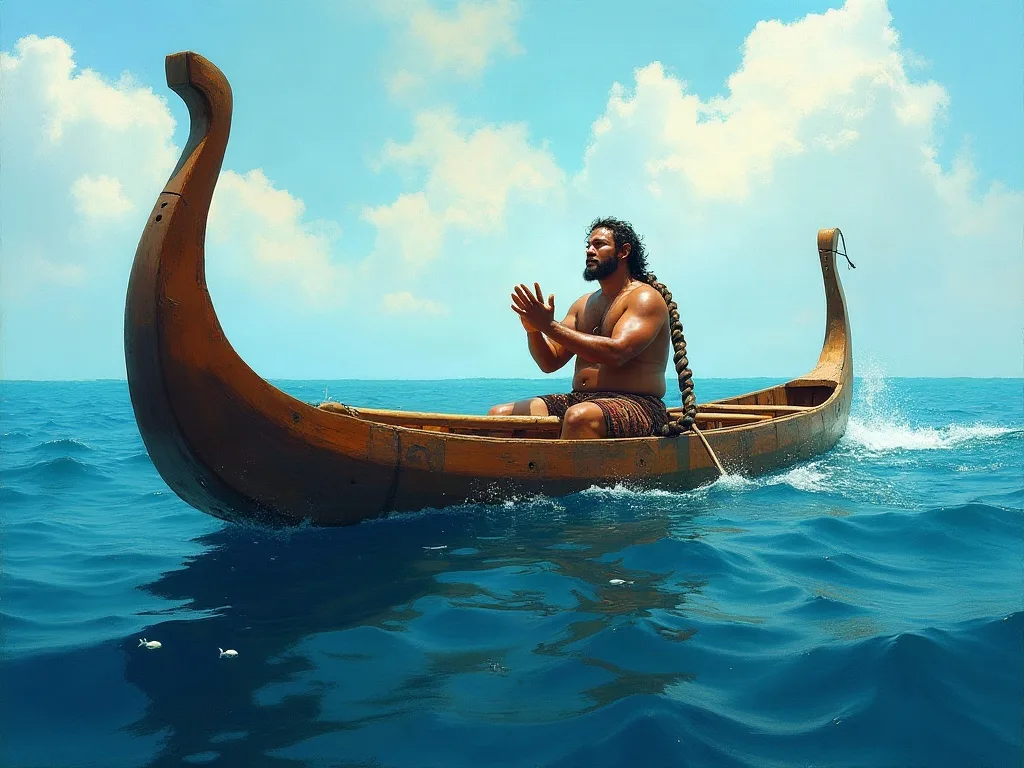
Tangaroa's presence on fishing canoes was marked by specific carvings. The prow of a waka often bore carved figures referencing atua associated with the sea, and the act of launching a canoe required its own karakia. Even the direction of the launch, facing the sunrise or facing open water, carried meaning tied to Tangaroa's domain.
The ritual use of karakia across Maori spiritual practice extended to every domain where an atua held authority, binding daily human activity to the divine order that Tangaroa and his siblings maintained.
Tangaroa in Carving and Visual Culture
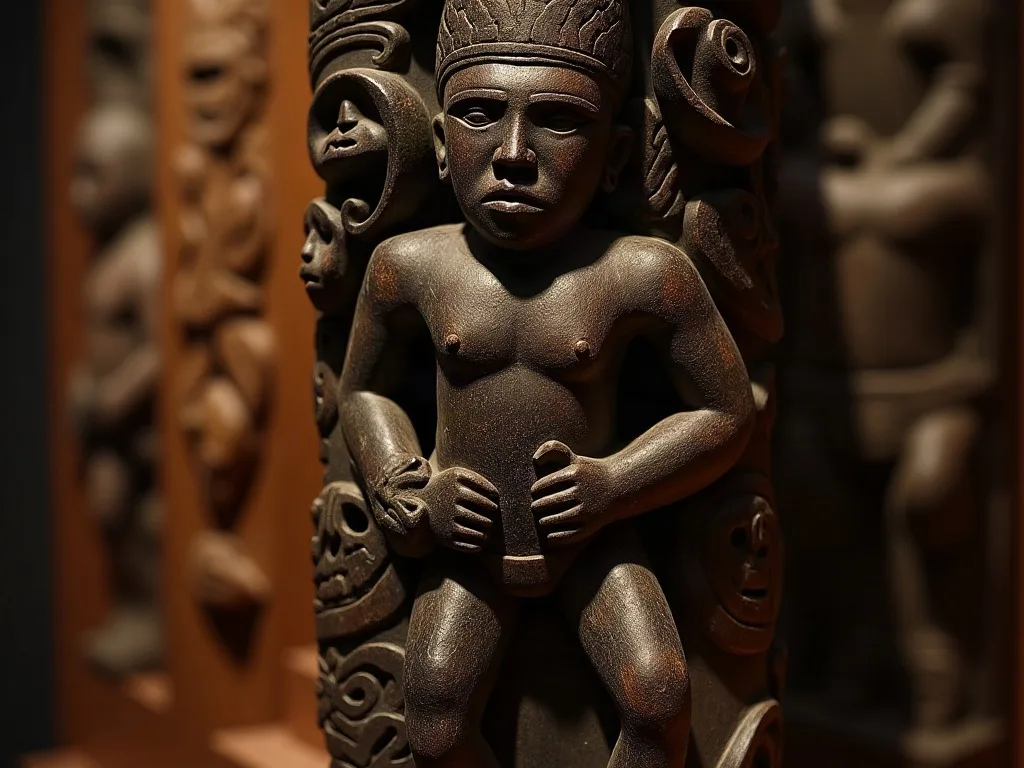
Maori art treats Tangaroa with a visual vocabulary that emphasises scale, depth, and fertility. His carved representations tend toward the abundant: figures surrounded by smaller figures, a visual expression of the god whose body contains all sea life.
The most celebrated single image in this tradition is a standing carved figure held by the British Museum, acquired in the nineteenth century and attributed to the Cook Islands (Rarotonga), representing Tangaroa with smaller figures emerging from his body. Each small figure represents a creature or a being born from his substance. The carving is not decorative. It is a theological statement about how life comes from the god's own body. The figure stands roughly 70 centimetres tall, yet the density of smaller forms pressing outward from its torso creates the impression of something vast trying to contain itself.
In Maori meeting houses (wharenui), carved panels sometimes depict the cosmic sea, and Tangaroa's presence is implied in any image involving water, fish, or the ocean horizon. The tiki-like figures with large heads and powerful limbs represent an ancestral energy that, when associated with sea contexts, carries his resonance.
Traditional Maori tattoo (ta moko) also incorporated maritime symbolism, with certain patterns associated with lineages that traced their whakapapa back through the sea, back toward Tangaroa himself. To bear those marks was to carry the god's identity on your own skin. The tattoo was not ornament. It was genealogy made visible, Tangaroa's lineage pressed into the living body of his descendants.
Tangaroa and the Living Ocean: An Unresolved Tension in Maori Law
The old question of who owns the sea has never fully been resolved in New Zealand law. Maori communities in Aotearoa have argued for decades that their relationship with the moana, rooted in Tangaroa's authority and in centuries of careful stewardship, gives them rights that secular law has been slow to acknowledge.
The 2004 Foreshore and Seabed Act, which removed Maori ability to claim customary title to coastal areas, sparked one of the largest political protests in modern New Zealand history. The Hikoi, a march from the Far North to Wellington, drew tens of thousands of people. Tangaroa's name was in the speeches. The argument was not abstract: it was that the god and his people have been managing this coastline since before the state existed, and that severing that relationship through legislation is a form of sacrilege as much as a legal wrong.
The act was eventually repealed and replaced by the Marine and Coastal Area Act of 2011, which restored some mechanisms for Maori customary recognition. The legal battle reflects something deeper than property law. It reflects the continuing reality that for Maori communities, Tangaroa: God of the Sea and Fish is not a historical curiosity but an active framework for understanding human responsibility toward the ocean.
In recent years, several New Zealand rivers were granted legal personhood following Maori advocacy, most notably the Whanganui River. The logic is directly related to Maori cosmological understanding: a waterway is not property, it is an ancestor, a living being with rights of its own. The same argument, extended to the sea, places Tangaroa at the centre of contemporary environmental law.
Papatuanuku, the Earth Mother, shares this contemporary relevance: both she and Tangaroa are increasingly cited in Maori climate advocacy as the original law-givers for how humans must treat the natural world.
Frequently Asked Questions about Tangaroa, God of the Sea
Frequently asked questions
Is Tangaroa the most powerful god in Maori mythology?
Tangaroa ranks among the most senior atua (gods) in Maori whakapapa, but Maori theology does not operate with a single supreme deity the way Abrahamic traditions do. He shares senior status with Tane (forests), Tumatauenga (war and humanity), Rongo (cultivated food), and others. His power is absolute within his domain, the sea and all its creatures, but that domain exists alongside rather than above his siblings'.
What is the relationship between Tangaroa and Tane?
The two gods are brothers, both children of Ranginui and Papatuanuku. Their rivalry stems from creatures, particularly reptiles, that abandoned Tangaroa's ocean realm to live in Tane's forests. Tane also provides the wood and flax that humans use to build canoes and weave nets, tools that intrude on Tangaroa's sea. The conflict is ongoing, reciprocal, and without clean resolution, which is central to how Maori cosmology understands the natural world.
How is Tangaroa worshipped or honoured in traditional Maori practice?
Traditional acknowledgment of Tangaroa centred on karakia (ritual prayers) performed before and after fishing, the careful handling of tapu fishing hooks (matau), the return of first catches to the sea, and specific carvings on the prows of waka (canoes). Tohunga (priestly experts) managed these rituals and maintained the relationship between fishing communities and the god. Some iwi maintained specific sacred sites along coastlines connected to Tangaroa's authority.
How does the Maori Tangaroa differ from the Polynesian Tagaloa or Ta'aroa?
In Maori tradition, Tangaroa is one of several powerful children of the sky and earth, with a lateral relationship to his siblings. In Samoan tradition, Tagaloa is closer to a supreme creator who existed alone before the world and made it from his own substance. In Tahiti, Ta'aroa similarly holds a more cosmologically central role. The Hawaiian Kanaloa, by contrast, is paired with Kane as a complementary force rather than a rival, suggesting a different cultural model of divine power. The name and the oceanic domain remain consistent across all traditions.
Are there primary sources that describe Tangaroa in detail?
The main sources are oral rather than written. The whakapapa and karakia recorded by nineteenth and early twentieth century ethnographers, particularly Elsdon Best (in Maori Religion and Mythology, 1924) and Edward Shortland (in Traditions and Superstitions of the New Zealanders, 1856), preserve substantial accounts of Tangaroa's mythology. The Maori scholar Sir Apirana Ngata also contributed significantly to recording chant traditions. These sources draw on oral material that predates European contact by centuries.
Is Tangaroa still relevant in contemporary Maori culture?
Tangaroa remains a living figure in Maori thought, not a historical relic. His name appears in contemporary karakia at sea, in the political arguments about Maori rights to coastal waters, in environmental advocacy for ocean health, and in contemporary Maori art and carving. Many Maori environmental organisations explicitly frame ocean conservation through the lens of their obligation to Tangaroa's realm.
Tangaroa in the Age of Dying Oceans
The Pacific is changing. Ocean temperatures are rising. Fish stocks that sustained Polynesian communities for three thousand years are moving, shrinking, disappearing. Coral bleaches across atolls that have never known anything but colour. And in this crisis, the figure of Tangaroa has acquired a new kind of urgency.
Maori environmental advocates argue that the traditional relationship with Tangaroa, built on the idea that the sea is a god whose gifts can be withdrawn, provides a better framework for ocean stewardship than market-based fisheries management. The god who punished overreach, who sent storms when fishermen took too much, who demanded that first catches be returned, was encoding a sustainable harvest ethic in religious language long before modern ecology named the concept.
Some iwi have formally invoked Tangaroa in their submissions to the New Zealand government on ocean management, naming him not as metaphor but as the authority under which their stewardship obligations arise. It is an unusual argument in a secular legal system. It is also a profoundly serious one.
The scholar Anne Salmond, in her work on Maori relationships with the sea, argues that Maori cosmological thinking treats the ocean as a kinship network rather than a resource base. Writing in Tears of Rangi: Experiments Across Worlds (2017), she observes that in Maori thought "the sea and its creatures are not things to be owned, managed, or extracted from, but relatives to be respected, and sometimes feared." Tangaroa is the senior ancestor of that network, which means fishing is not extraction. It is a family negotiation with a very powerful elder who can end the conversation whenever he chooses. That framing, applied to a Pacific Ocean under industrial pressure, is not romantic. It is practical. It insists on limits. It insists on reciprocity. It insists that the sea is not infinite.
The wider Polynesian tradition of ocean navigation and cosmology shows how deeply the identity of Pacific peoples is bound to the sea and to the atua who animate it. Tangaroa is not a symbol layered onto that relationship. He is the relationship itself, the living grammar through which Maori people have always spoken to the water.
Tangaroa was always teaching that lesson. The question is whether enough people are finally ready to learn it.
Read the full book
Want the whole story?
The complete edition is an instant PDF download here, with a paperback on Amazon for selected titles.
Maori
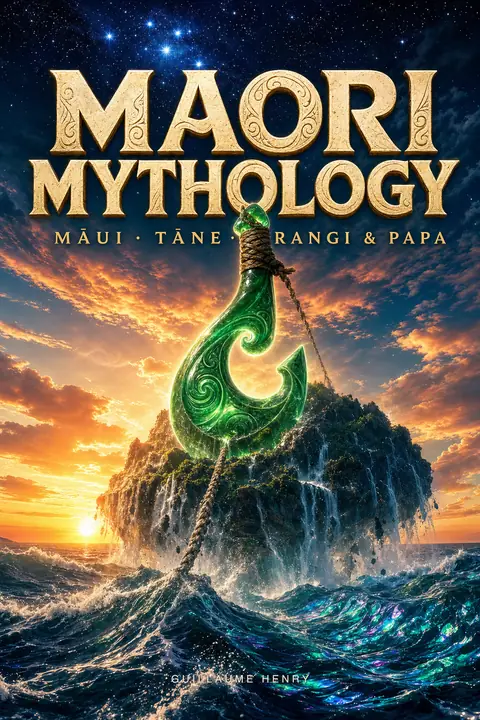
The Maori Mythology Book: Māui, Tāne, and the Gods of Aotearoa
Māui, Tāne, and Rangi and Papa
The mythology of New Zealand’s first people: the sky-father and earth-mother locked in an embrace, the children who forced them apart to let in the light, and Māui the trickster who fished up islands, snared the sun, and died trying to defeat death itself.
More from Maori
All articles
Maori
The Marae: Sacred Meeting Ground in Maori Culture
The marae stands at the heart of Maori identity: a sacred communal space where land, genealogy, and spiritual power converge. Discover how this open courtyard became the foundation of Maori society, ceremony, and connection to place.
Maori
Tiki: The First Man and Ancestral Symbol in Maori Mythology
In Maori creation myth, Tiki was the first human, carved from earth by Tane Mahuta, the god of forests. This symbol represents the bridge between the divine and human worlds, still vital in Maori art and culture today.

Maori
The Taniwha: Supernatural Guardians of Waterways in Maori Mythology
The taniwha are powerful supernatural beings in Maori mythology that guard rivers, lakes, and caves. These shape-shifting creatures demand respect and have shaped Maori settlement patterns for centuries.
Maori
Tapu and Noa: Sacred Restriction and Freedom in Māori Worldview
Tapu and Noa are the twin forces that shaped Māori life: one sacred, restricted, potent; the other free, ordinary, unrestricted. Learn how these concepts governed everything from food and ritual to social order and spiritual safety.