
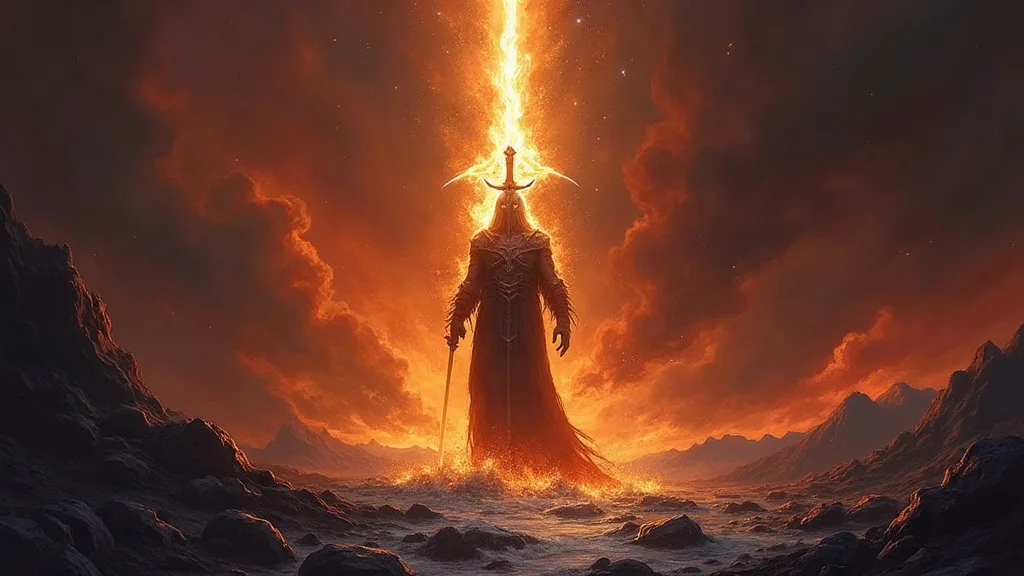
Surtr the Fire Giant: The Norse Colossus Who Burns the World
Surtr the fire giant waits at the edge of Norse creation, sword blazing, destined to end everything at Ragnarok. Discover his origins, his role in the Eddas, and why he matters beyond the last battle.
Contents
The sword he carries has no equal in the nine worlds. It burns brighter than the sun, and when Surtr the fire giant finally swings it at Ragnarok, the flames will swallow every tree, every ocean, every god still standing. Then the world goes dark before it can be born again.
That is the end of the story. But Surtr is older than the end. He was already standing guard at the border of Muspelheim, the realm of primordial fire, before Odin hung on Yggdrasil, before the first humans breathed, before time had a name. His patience is cosmic, and his purpose is absolute.
Few figures in world mythology carry the weight of an entire eschatology on their shoulders the way Surtr does. He is not a villain in the ordinary sense. He does not scheme or lie or steal. He simply waits, sword in hand, doing exactly what the universe assigned him to do. That combination of ancient stillness and apocalyptic violence makes him one of the most unsettling characters in the Norse canon.
The Oldest Fire: What the Eddas Say About Surtr's Origins
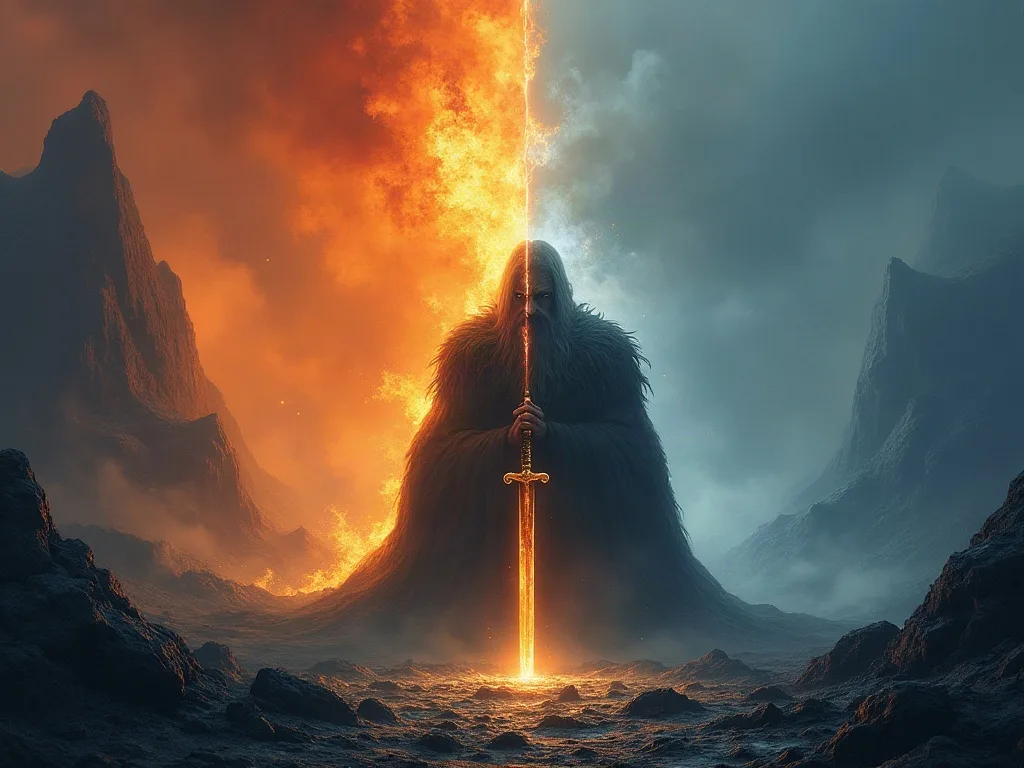
The two primary sources for Norse mythology, the Prose Edda compiled by the Icelandic scholar Snorri Sturluson around 1220 AD and the Poetic Edda collected in the Codex Regius, both treat Surtr as a being of extreme antiquity. Snorri's Gylfaginning, the first section of the Prose Edda, describes the Norse cosmogony with careful geometry: to the north lies Niflheim, the realm of primordial ice and mist; to the south lies Muspelheim, the realm of fire and heat. Between them stretches Ginnungagap, the void. Where the cold and heat met, drops of liquid formed, and from those drops emerged the first being, the frost giant Ymir.
Muspelheim itself belongs to Surtr. Snorri writes that Surtr sits at the border of that realm, guarding it with a flaming sword. The text in Gylfaginning is direct: "At the world's southern end sits one called Surtr; he guards the frontier with a flaming sword. At the end of the world he shall go forth and harry and conquer all the gods and burn the whole world with fire." That is essentially Surtr's entire biography, condensed to two sentences. He exists at the edge, he guards, he waits, he ends.
What the Eddas do not provide is a birth story, parents, or childhood for Surtr. He appears fully formed, sword already blazing. This absence of origin is itself significant. Surtr belongs to the same generation of primordial forces as Ymir, perhaps even earlier in the implied cosmological order. The fires of Muspelheim predate the gods entirely. If Surtr is the guardian of those fires, then in some readings he predates the Aesir, the family of gods led by Odin, by an indeterminate age.
His name in Old Norse, Surtr, carries a meaning that scholars broadly agree on: "the black one" or "the swarthy one." The Old Norse adjective svartr (black) is the root. The name is ironic to modern ears because Surtr is associated with fire, not darkness. But in the Norse imaginative world, char and soot follow flame. After the burning comes the blackness. Surtr's name describes what comes after his work is done.
Surtr and the Structure of Muspelheim
The Prose Edda places Muspelheim as one of the two elemental realms that precede the ordered world. Snorri writes in Gylfaginning that "Muspell is bright and hot, that region flames and burns, and it is impassable to those who are foreigners there and have no roots there." The fire giants, sometimes called Múspellsmegir (the sons of Muspell) in Old Norse texts, are its inhabitants. Surtr rules over them as their lord.
The sons of Muspell are not frost giants. The Norse tradition distinguishes clearly between the jotnar (giants broadly) and the beings of Muspelheim. Frost giants like Ymir belong to the ice-world of Niflheim. The Muspelheim beings are creatures of fire. They have no major mythology of their own beyond their role at Ragnarok, no stories of feuding with the Aesir over generations, no marriages or border disputes or divine trickery. They are held in reserve.
This is one of the structural peculiarities that makes Surtr so different from other antagonists in Norse myth. Loki, whose cleverness poisons the world over many generations, has a personal history with nearly every major Norse deity. Surtr has none. He simply guards his fire until the appointed moment. The Norse poets built tension through his silence more than through any action they assigned him.
The Sword That Burns Brighter Than the Sun
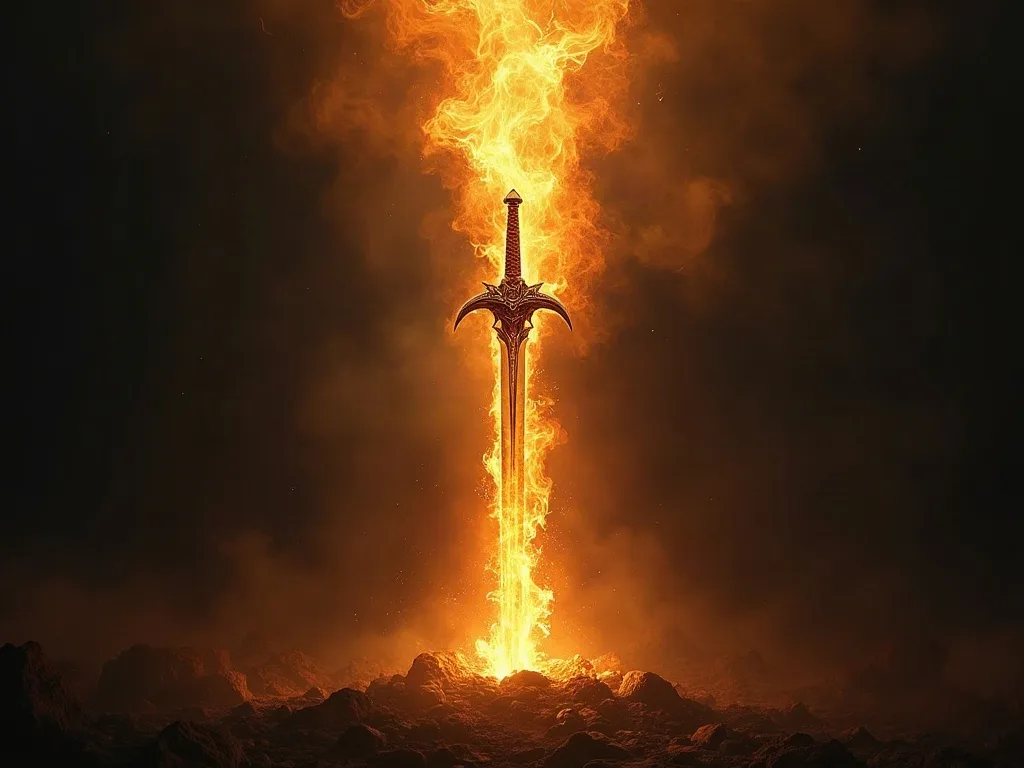
The Völuspá, which translates roughly as "the prophecy of the seeress," opens with a völva (a prophetic woman, a seeress) recounting the history of the cosmos from creation to the end. In stanza 52, the poem announces Surtr's arrival at Ragnarok with stark economy: "Surtr fares from the south with the scourge of branches, the sun of the battle-gods shines from his sword." The phrase "sun of the battle-gods" is a kenning, the Old Norse poetic device of layering images to create a new name. The sword's light equals the sun. That image alone communicates Surtr's destructive scale.
Surtr's sword has attracted considerable scholarly attention because it may be the same weapon listed elsewhere as Lævateinn or connected to Hævateinn, a mysterious weapon mentioned in Fjölsvinnsmál, another poem in the Poetic Edda. The identification is contested and cannot be confirmed from the surviving texts. What every source agrees on is that the sword is fire itself made solid, a weapon of absolute finality.
The Prose Edda's Skáldskaparmál, Snorri's guide to poetic kennings, lists "Surtr's fire" as a standard kenning for general fire or for the sea in certain compound formulas. This tells us that medieval Icelandic poets considered Surtr's fire so archetypal that it became a reference point for fire itself. His name was a unit of measurement for heat and destruction.
There is also a quiet parallel with other world-ending fires across mythologies. The Zoroastrian tradition of ancient Iran describes a final purification by molten metal that flows over the earth, burning away evil while the righteous pass through unharmed. The Hindu tradition imagines cycles of creation ending in fire before new cycles begin. Norse tradition is more unsparing: Surtr's fire is not a filter. It burns everything. The regeneration comes after, not because the fire was selective.
Ragnarok: Surtr's Hour, Freyr's Last Stand
Ragnarok, the doom of the gods, is the event the entire Norse mythological cycle bends toward. Every action Loki takes, every war the Aesir fight, every prophecy Odin extracts at terrible personal cost, all of it leads to a single field called Vígríðr (the field of battle), where the final confrontation happens.
When Ragnarok arrives, Surtr leads the sons of Muspell across the bridge Bifrost, the rainbow bridge connecting Asgard to the other realms. The Prose Edda specifies that their crossing breaks Bifrost under their weight, a detail that underlines how alien these fire beings are to the constructed order of the Norse cosmos. The Aesir built Bifrost for communication and travel. Muspelheim's children are not visitors. They are an ending.
Freyr, the Vanir god of fertility, sunlight, and abundance, fights Surtr at Ragnarok. This pairing is one of the most poetically loaded matchups in the entire battle. Freyr once gave away his magical sword, a weapon that fought by itself, to win the hand of the giantess Gerd. The sword he sacrificed was precisely the kind of weapon he would need against Surtr. In Gylfaginning, Snorri notes this explicitly: Freyr will "fall before Surtr, because he lacks the good sword that he gave to Skírnir." Without his self-moving sword, Freyr faces the fire lord armed with only an antler. He loses.
The tragedy of Freyr is not that he made the wrong choice. He chose love, fertility, the continuation of life, over weaponry. But the universe, as Norse mythology constructs it, does not reward good values in the final battle. It rewards preparation and force. Surtr is fully prepared. Freyr is not.
After defeating Freyr, Surtr does what he was always going to do. The Völuspá describes it in stanza 57: "Surtr flings fire over the earth, and scorches it above and below. The sun turns dark, earth sinks in the sea, the bright stars fall from the sky, smoke rages and fire, leaping flame licks heaven itself." The world ends. Not gradually. All at once.
After the Fire: The World That Grows Back

This is where Norse mythology diverges sharply from pure nihilism. The Völuspá does not end with Surtr's fire. After the burning, the earth rises again from the sea. The poem describes green fields, self-sowing grain, waterfalls. Two humans, Líf and Lífthrasir, survived by sheltering in a forest called Hoddmímis holt, the grove of Hoddmir. Several gods survive too, including Thor's sons Magni and Modi, and Baldr, who returns from the realm of the dead.
Surtr is not present in this new world. His role is complete. He burned everything that needed to burn, and the universe moved past him. This temporal architecture, where a destructive figure fulfills a necessary cosmic function and then disappears from the story, has deep roots in comparative mythology. Shiva in the Hindu tradition holds the function of destruction as part of a continuous cycle. Tezcatlipoca among the Aztecs presides over the end of each cosmic age. The difference is that Surtr acts once, definitively, with no role in the rebirth phase.
Some scholars, including John Lindow in his 2001 Norse Mythology: A Guide to the Gods, Heroes, Rituals, and Beliefs, read the post-Ragnarok world as evidence that the Norse cosmos operates cyclically at the grandest level, the way seasons cycle, the way the sun rises again. Surtr is the winter that makes the spring possible. That reading softens him somewhat without dishonoring his destructive power.
The fire giant's absence from the reborn world also reinforces something the Eddas hint at throughout: Muspelheim's forces are not part of the ordered cosmos. They are outside it, older than it, and when the ordered cosmos ends, so does their purpose. They were never meant to stay.
Cross-Cultural Parallels: Other World-Ending Fire Beings
Surtr the fire giant stands in a long line of mythological fire-wielders whose function is less about warmth and more about terminus. Comparing him to figures from other traditions clarifies what makes his Norse version distinctive.
In Zoroastrian eschatology, the figure of Ahriman, the principle of evil and darkness, leads forces of chaos against the forces of goodness at the end of time. But Ahriman is a moral adversary, the enemy of righteousness. Surtr carries no such moral charge in the Norse sources. He is not evil. He is elemental. The Eddas present him with a certain neutral grandeur.
The Hindu god Shiva holds the Mahakala aspect, the great destroyer, who dances the cosmos to its end before Brahma begins a new creation cycle. Shiva's destruction is philosophically integrated into a rhythm of birth, maintenance, and dissolution. Surtr's destruction is more abrupt, though the post-Ragnarok renewal suggests a similar underlying structure.
The Vedic fire god Agni offers a closer textural parallel. Agni acts as a mediator between humans and gods, but in his most primordial aspect he is the fire that predates creation and will outlast it. Surtr's positioning at the edge of Muspelheim before the universe was organized parallels Agni's primordial form: fire that exists before meaning, before gods, before story.
In Mesoamerican tradition, the Fifth Sun mythology of the Aztecs describes previous cosmic ages each ending in catastrophe: wind, rain, flood, and a rain of fire. The age destroyed by fire maps closely onto the Surtr episode structurally, a catastrophic burning that clears the field for a new cosmic order. But in Aztec cosmology, the gods themselves orchestrate the destruction as a sacrifice. In Norse cosmology, the destruction runs on its own logic, and Surtr is simply the instrument.
Surtr in Old Norse Kennings, Skalds, and Place Names
The mark of a truly central mythological figure is their absorption into everyday language. Surtr passed that test early. Old Norse skaldic poetry, composed by professional court poets (skalds) often for living kings, used Surtr's name in kennings that audiences were expected to recognize instantly.
"Surtr's sea" was a kenning for fire or lava. "Surtr's sister" appeared in some kenning chains referencing fire in its threatening aspect. The name functioned as a shorthand for ultimate heat and destruction, the way "Achilles" functions in modern English as shorthand for a fatal weakness.
Geographically, the name Surtr attaches to the volcanic island Surtsey, which erupted from the Atlantic Ocean floor off Iceland's southern coast in 1963. Icelandic scientists named it directly after the fire giant, a recognition that Surtr's imagery mapped perfectly onto a volcanic island bursting from the sea in flames. Surtsey is now a UNESCO World Heritage Site, studied for how life colonizes new land. The island's existence is its own mythological irony: named for a destroyer, it became a laboratory for creation.
Iceland's volcanic landscape almost certainly shaped the Norse conception of Surtr and Muspelheim. The early Norse settlers of Iceland, arriving from Scandinavia in the late 9th century, found a land of active volcanoes, lava fields, geysers, and hot springs sitting alongside glaciers. The meeting of fire and ice was not an abstract metaphor to them. It was the view from their front door. Surtr was not merely a myth; he was a geological reality given a name and a sword.
Frequently Asked Questions About Surtr the Fire Giant
Frequently asked questions
Is Surtr actually a giant in the Norse sources?
The Old Norse texts classify Surtr among the beings of Muspelheim rather than among the frost giants (hrimthursar) or the earth giants (bergrisar). Snorri Sturluson groups the Muspelheim beings separately from the jotnar in the Prose Edda. Surtr is not assigned the word jotun (giant) directly in surviving texts, though later tradition and modern usage routinely call him a fire giant because of his enormous destructive scale and his opposition to the Aesir.
Which god kills Surtr at Ragnarok?
No god kills Surtr. He survives Ragnarok, at least long enough to burn the world after the battle ends. The Prose Edda in Gylfaginning says he "will harry and conquer all the gods and burn the whole world with fire." Freyr fights him but loses. No other deity is paired against Surtr in combat. His fire consumes everything, and the texts do not describe his death, only his disappearance from the new world that rises afterward.
What is the connection between Surtr's sword and Freyr's magical sword?
Freyr possessed a sword that could fight on its own "if wise he who wields it," according to the Prose Edda. He gave that sword to his servant Skírnir as payment for courting Gerd on his behalf. Snorri explicitly states that Freyr falls to Surtr at Ragnarok because he lacks his self-moving sword. The sword Surtr carries is described as blazing and sun-bright but is not identified as Freyr's lost weapon in the surviving texts. The connection is tragic and structural rather than literally the same blade.
Does Surtr appear anywhere in the Poetic Edda besides the Völuspá?
Yes. Surtr is also named in Vafthrudnismal, a wisdom contest poem in the Poetic Edda where Odin tests his wits against the giant Vafthrudnir. Vafthrudnir mentions that "from the south Surtr comes with blazing fire" as part of describing Ragnarok's sequence. Surtr also appears briefly in Lokasenna, the flyting poem where Loki insults the gods at a feast, and in Fafnismal through related kenning usage. His appearances are consistently eschatological: wherever Surtr is named, destruction is the subject.
How does Surtr compare to Loki as a Ragnarok antagonist?
Loki and Surtr are both forces on the side that opposes the Aesir at Ragnarok, but their roles are structurally very different. Loki is a former member of the Aesir household, a shapeshifter with centuries of personal history with the gods, whose betrayal is rooted in grievance and divine politics. Surtr has no personal history with the Aesir. He is not a traitor but an outside force. Loki steers the ship Naglfar carrying the dead, a narrative role. Surtr leads the Muspelheim forces and commits the final act of world-burning. Loki's role is relational; Surtr's is elemental.
Why did Icelandic scientists name Surtsey after Surtr?
When the volcanic island emerged from the Atlantic in November 1963 after an underwater eruption southwest of Iceland, the spectacle of fire, steam, and new land rising from the sea mapped directly onto the Norse image of Muspelheim forces breaching the boundaries of the ordered world. Icelandic naming tradition has long drawn on Norse mythology for volcanic features. Surtsey, meaning "Surtr's island," carried the giant's name as both a geological reference and a cultural recognition that Icelanders still held Surtr's imagery as a living vocabulary for volcanic creation and destruction.
Surtr's Long Shadow: From Viking Age Verse to Modern Imagination
The Viking Age ended roughly in the 11th century, but Surtr the fire giant never stopped working. His image carried forward into the Christian medieval period partly through the Prose Edda itself, which Snorri Sturluson wrote partly to preserve the old kenning tradition for Christian-era poets who still composed in the old forms. Snorri was a Christian writing about pagan gods, and he treated Surtr with the same careful neutrality he extended to the rest of the Norse pantheon: not as devils, not as God's enemies, but as figures from a coherent mythological system worth understanding.
The Romantic era rediscovered Norse mythology in the 18th and 19th centuries with considerable enthusiasm. Richard Wagner's Der Ring des Nibelungen, completed in 1876, builds its climax around a world-consuming fire that owes a structural debt to Surtr's Ragnarok fire, even though Wagner replaced Surtr with the Valkyrie Brunnhilde as the catalyst. The fire that ends Valhalla in Götterdämmerung burns with distinctly Surtian heat.
In modern fantasy literature and gaming, Surtr appears often as a fire giant king or a volcanic deity. Marvel Comics gave him a version that fought Thor, adapting the Freyr-Surtr matchup to a Thor-Surtr conflict that eventually reached cinematic form. These adaptations keep the essential shape: a massive, ancient, flame-bearing being whose purpose is destruction at a cosmic scale. The details shift, but the silhouette holds.
What makes Surtr more than a convenient antagonist for modern storytellers is precisely what makes him interesting in the original Norse sources: he is not reducible to evil. He carries out the world's end because that is the function Muspelheim was always going to perform. The Norse cosmos was built knowing Surtr waited at its edge. That knowledge is woven into every Eddic poem, every kenning, every skaldic verse that names his fire as the measure of heat. He is the deadline written into the universe at the moment of creation, patient, blazing, and absolute.
Yggdrasil, the world tree that connects all nine realms, will burn in Surtr's fire along with everything else. That is not a failure of Yggdrasil. It is the completion of a cycle the tree was always part of. Surtr does not destroy what was never meant to last. He destroys everything, which is precisely the point.
Free 25-page sample
Want the whole story?
Take the first 25 pages free. If it pulls you in, the full edition is yours as an instant PDF download, with a paperback on Amazon for selected titles.

Mythology
The World Mythology Book: The Gods, Heroes and Myths of Every Culture
The Gods, Heroes and Myths of Every Culture, in One Volume
The whole of world mythology in a single volume: Greek, Norse, Egyptian, Japanese, Hindu, Celtic, Slavic, Mesoamerican and African myths gathered side by side, each drawn from the primary sources.